April 30, 2011
Sasha Terebenin: abstraction
One current strand of contemporary photography is abstraction. Sasha Terebenin (Alexander Georgievich Terebenin) was a theatre designer, decorator, and artist and he is currently doing fine art research, photography and installations. A striking feature of his oeuvre is his minimalism and abstraction.
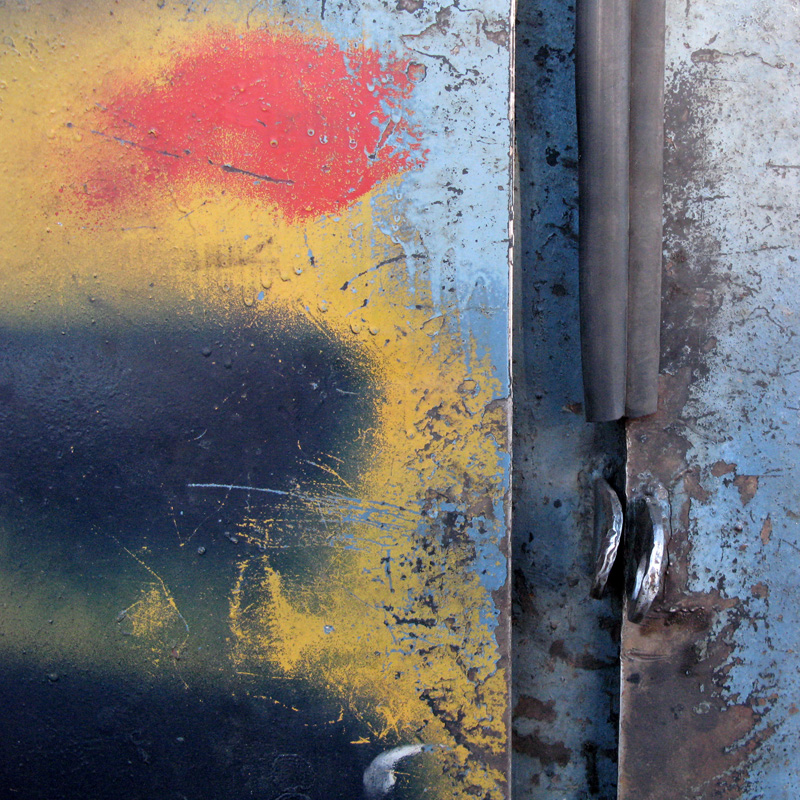 Sasha Terebenin, Distraction, 2011
The emergence of digital photography means that a majority of people in the West own a camera and have take pictures. From family portraits to snapshots, many consider photography as a means of direct literal representation of people and things. Yet from its beginnings abstraction has been intrinsic to photography, and its persistent popularity reveals much about the medium.
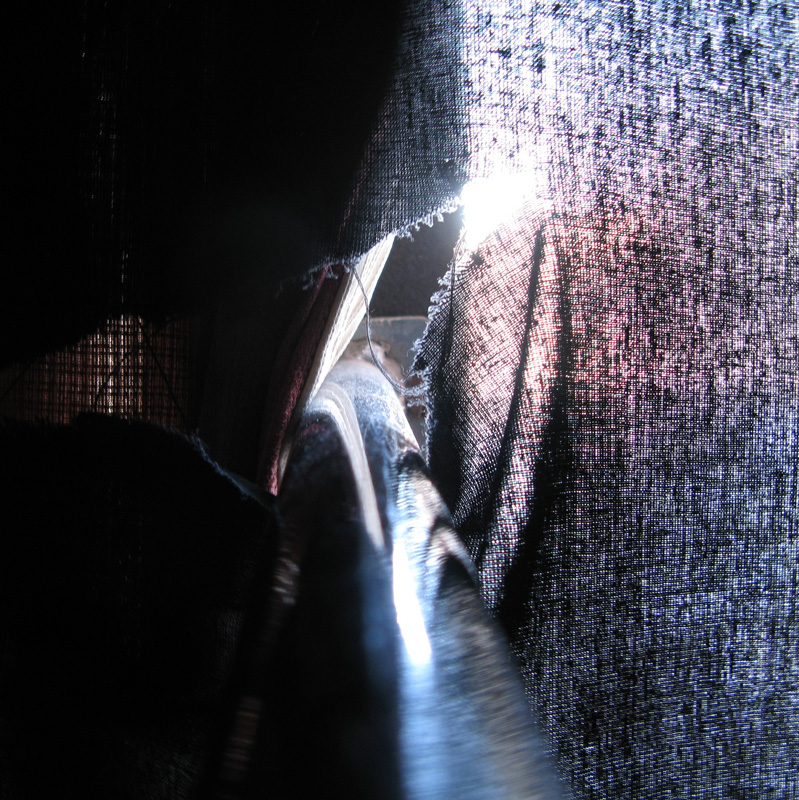 Sasha Terebenin, The Gate, 2011
Photography has always participated in such abstraction, whether its internal image-language is representational or abstract, documentary or pictorialist. On the other hand, abstraction in photography is often considered to be inconceivable and to be antithetical to its very essence, which is built upon the imprint of the trace of a real object on the photosensitive surface and the creation of a strong bond between photography and reality.
April 29, 2011
Frederick H. Evans: architectural photography
I was deeply impressed by the representation of the architectural space of Westminster Abbey by the BBC, as they were recording the media spectacle of Prince William and Kate Middleton's wedding that I saw last night on TV.
It recalled the architectural work of Frederick H. Evans. He photographed English and French cathedrals around 1890 --1910, and who was regarded as perhaps the finest architectural photographer of his era:
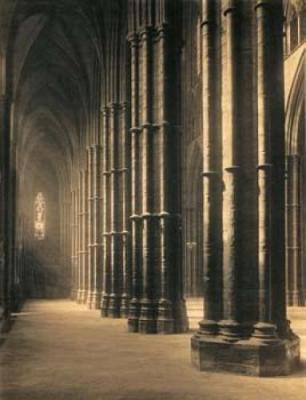 Frederick Henry Evans, Westminster-Abbey-No-1, 1912
Evans' work is not concerned with factual imaging. He is fascinated with texture and with his concern is to show the effects of weight and balance, space, light and shade. He is more concerned to create artistic compositions than more straightforward documentary images.
April 28, 2011
black humour
This is my state of mind after yesterday.
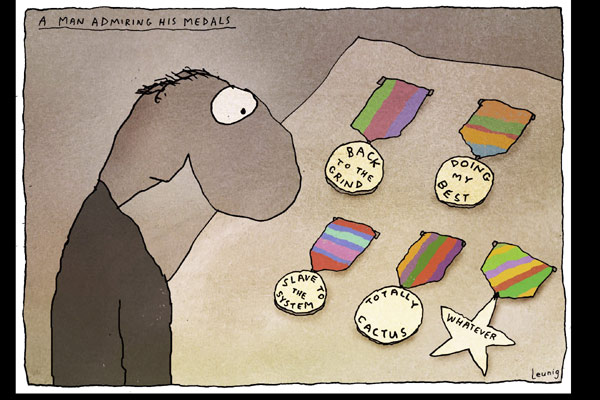
All the IT problems that we experienced were due to the Telstra exchange in Victor Harbor going on the blink and causing an outage. This knocked the household's modem out of action.
I then suddenly realized how much of our everyday household life is premised, and dependent on, the technology of the internet; and how much photography has gone digital. It is now a digital art. The darkroom has become a digital suite: scanners, computer, screens,external storage, back ups, printers.
April 25, 2011
Wim Wenders: photography
Wim Wenders was the European maestro of the road movie, his postwar generation’s consciousness colonized, as he would often remind us, by American culture. Wenders, in documenting his global wanderings since the early 80s,has built up a large body of photographic work.
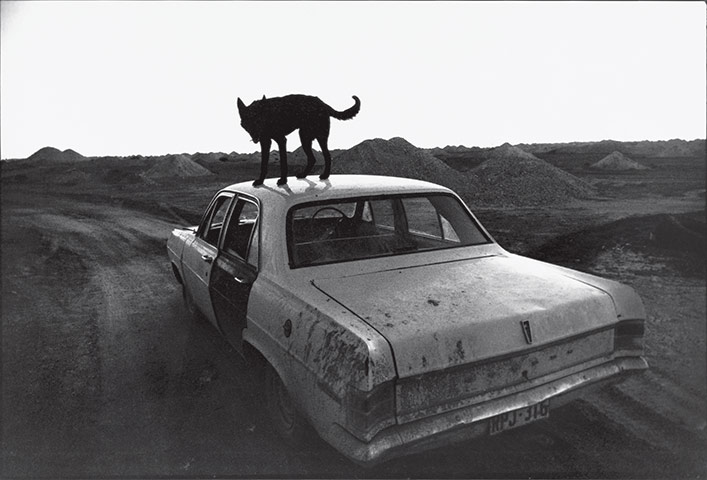 Wim Wenders, Dusk in Coober Pedy, South Australia, 1978
His Places, strange and quiet exhibition includes some early black-and-white prints that predate Written in the West, a book of American street scenes shot while scouting locations for Paris, Texas.
April 24, 2011
Les Walkling: Pilbara
Foam in WA has organized The Pilbara Project Exhibition featuring images from the work of four photographers Tony Hewitt, Peter Eastway, Christian Fletcher and Les Walkling.
The body of work is entitled 52 Weeks On and it was produced from several journeys into the Pilbara. On this year long collaboration they travelled with a group of students throughout the altered landscapes of northern Pilbara, including Port Hedland, Dampier Archipelago, Pardoo Station, and Marble Bar. This is mining country and they had been bought together to photograph it by Christian Fletcher.
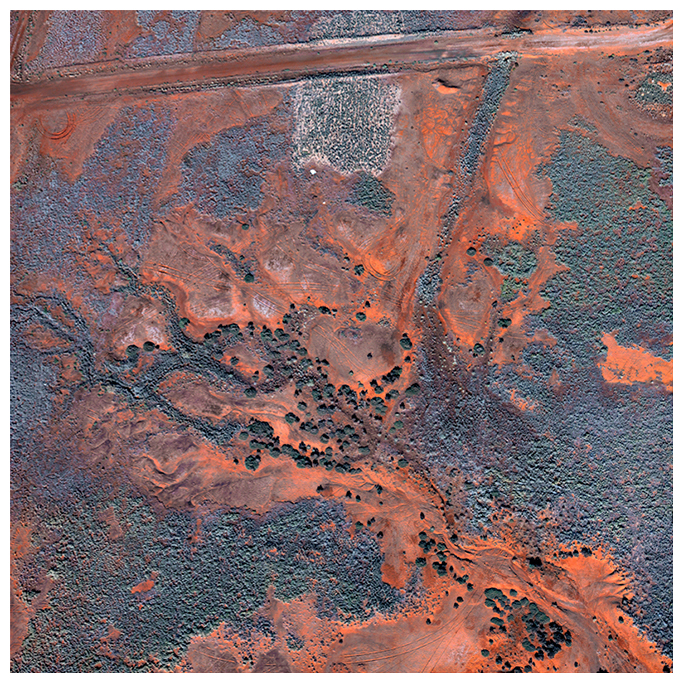 Les Walkling untitled, 2011
Walkling has moved from making photographic images via 8×10 silver gelatin contact prints in the 1970s to their enlargements in the 1980s, a transition to digital processing in the 1990s, and then digital capture in the 2000s. His PIlbara series was done with a Hasselblad H4D -200MS camera that is connected to a computer on site.
I've only got to the stage of digital processing my negatives and relearning how to use large format cameras. Walkling, in, working in the post-film-era medium format world, is definitely someone ‘of his time’. Digital medium format is the technological future of photography:
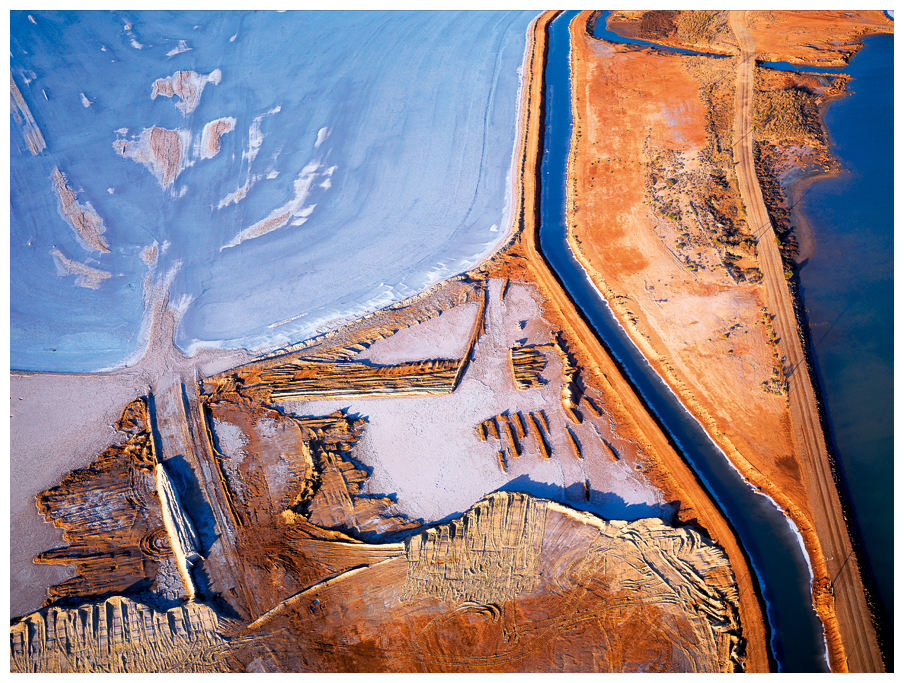 Les Walkling untitled, 2011
Walkling's reflections about his relation to the Pilbara landscape are very interesting. He says that:
The Pilbara is not my home so I am an incurser (to incuse), who stamps my way on what I find. At worst this is imperialist, at best it is colonialist. My response to date is culturally naive and artistically suspect. I can't hide behind notions of objectivity or professional privilege. I need a thesis. I need a belief.....I am a stranger in the Pilbara. I have engaged with it as a professional tourist, at best. Or at least that is how I have responded. I have not done enough research, so I started with no greater motivation than to be with friends, photographing together while exploring a new environment. Though that was more than sufficient to get me involved.
He highlights how relatively 'unknown' the Pilbara is to curators and other friends on the east coast of Australia. There is a blind-spot on the east side of the country, to most of the rest of Australia in fact, even though the land pervades our consciousness through literature, music, film, poetry and other cultural mythologies.
But in photography, the most visual of all media (but not necessarily the most intelligent), we have a mighty gap or absence. Where in our photographic histories is the treatise on the history of Australian landscape photography? It doesn't exist.
Well, we do have the 19th century colonial photographers who represented the landscape. This is being recovered by the photographic art historians--eg., Helen Ennis Photography and Australia. I'm just beginning to dig into the landscape work of the 19th centiuy photographers in South Australia.
April 21, 2011
Mark Kimber: The Cloud Chamber
Mark Kimber's exhibition at Greenway Gallery in Adelaide were taken with a plastic pinhole camera. This is tiny hole in a piece of metal that projects an image onto film, a camera obscura.
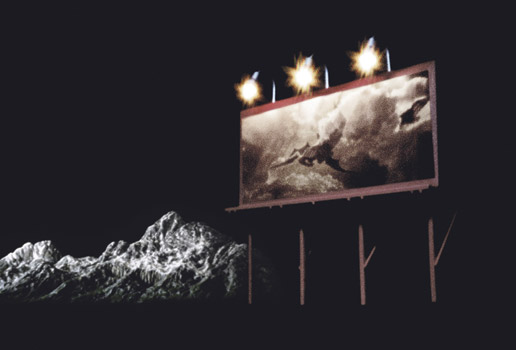
Kimber says that he has:
found it quite mesmerizing the way a small hole in the wall could create an image of the outside world, stripped of its finer details, and reduced to its elemental form and that has stayed with me. I am not interested in the pixel perfect replication of “reality” that is possible with CGI photography rather my enthralment lies in the theatrical abstraction that comes about when photography’s protean talents enchantingly distorts it.
The cut out clouds in a theatre set don’t say this is exactly what a cloud looks like, it suggests that this is a representation of a cloud, - how we might remember clouds to be, or even how clouds “feel”.
April 20, 2011
Phil Underdown: nature + ideology
Phil Underdown explores the relationship between environmentalism and photography around the collision and interconnection between the land, industry and culture.
I was attracted to the image below after having returned from Tasmania where the clearfelling of old growth native forests for woodchips is still in full swing. This depicts one form of the interaction of humans and the natural world.
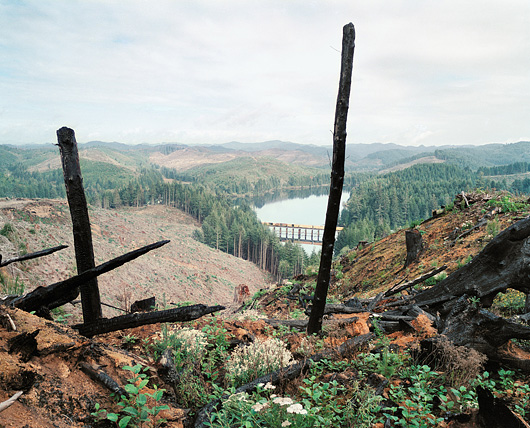 Phil Underdown, Oregon Clearcut, from Proud New Future series, 1993
In this interview with Antone Dolezal for finitefoto---a new media collective that investigates and promotes the intersection of photography and culture in the state of New Mexico---Underwood says that:
with the changes being brought about in our environment as the result of climate change and our ever-expanding footprint, there is such a huge roll photography, and visual art in general, can play in helping to interpret and make visible these changes. Not just documenting what is disappearing, but also helping us to see where we are now and where we are headed.
It's an excellent point.
Underdown says that his work has been informed by the:
work of the New Topographics and Dusseldorf School photographers has always been very influential. Some more specific examples—John Gossage’s, The Pond. Jem Southam’s Upton Pyne series, Frank Gohlke and his Sudbury River work, Gilbert Fastenaekens’ Noces, all interest me for their sustained, intense attention to a small personal landscape. Some other photographers and books—Simone Nieweg’s Landschaften und Gartenstuke, Mark Power’s 26 Different Endings, Gerhard Richter’s Wald, anything by Olaf Otto Becker…
April 19, 2011
Foam + photography's future
Amsterdam's Foam museum is debating/exploring the future of photography with a panel of experts. Foam is for photographers, picture editors, designers and all those who have a passion for photography. The debate is online at Foam.
One of the questions is will chemical photography survive? Film and paper manufacture require factories, expensive technology and experienced technicians as well as sufficient volume production to enable it to be sold at a price enough people can afford. One commentator says:
It's a matter of economics. Chemical-based photography requires an industry to provide the raw assets for capture (film) and development (processing chemicals). This industry requires a particular scale to support the fixed costs of its infrastructure. When the available customer base no longer can support that infrastructure, the manufacturers will have some decisions to make, decisions that will be made wholly independent of its practitioners' desires.
So it looks as if analogue photography will become a niche-- a highly niche photographic process since it is no longer cheap, and it is becoming increasingly hard to find decent services for it in Australia. So we may well be are left with film fetishists & aficionados.
April 18, 2011
Henry Dixon
Henry Dixon stands out not because of his discoveries, or because he introduced a new technique in photography, but simply because he made what must be the very first systematic photographic record of London. He did this for the "Society for the Photographing of Relics of Old London".
Prompted by the imminent demolition of an old London inn near St Paul's, the Society for the Photographing of Relics of Old London set about using photography as a means of documenting buildings that represented old London threatened with destruction.
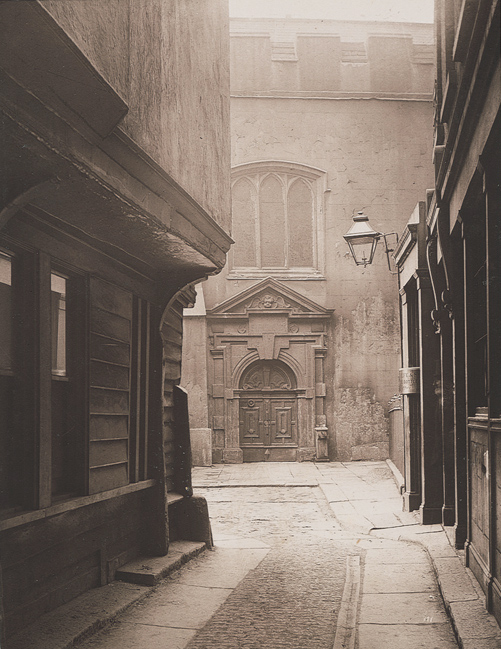 Henry Dixon, St Helens, London, 1886
Dixon recorded the Holborn Valley Improvements, one of the largest building projects undertaken in mid-Victorian London which altered the face of that section of the City. Most famously he photographed London's threatened buildings in the 1870s and 80s.
His photographs for the Society for Photographing Relics of Old London record a heritage on the verge of destruction as Victorian London re-invented itself. Amongst the subjects recorded were the galleried coaching inns which had existed in some form since the time of Chaucer and which were swept away by the coming of the railways. Most ended their days as slum dwellings before being demolished. Only one, the George, now survives.
Dixon also captured the atmosphere of humbler streets for the City Sewers Commission with a series of photographs which now only survive as glass-plate negatives in the Guildhall Library.
April 16, 2011
Charles Marville
The real name of the renowned 19th-century French photographer, Charles Marville was Charles-François Bossu. The young Bossu adopted the pseudonym Marville just as he was embarking on a career as an illustrator and painter in the early 1830s, but he is most well known for his photographs of Paris in the 1860s.
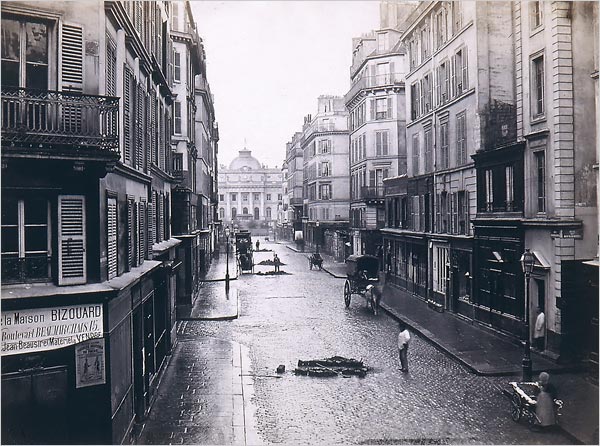 Charles Marville, Rue de Constantine, Paris; Charles Marville c1865 (Metropolitan Museum of Art )
In the late 1850s the city of Paris( the Commission for Monumental Historical Monuments) commissioned Marville to document the ancient quarters of the city before encroaching urban modernization changed them forever. He photographed renovations and new construction, including the new Paris Opéra.
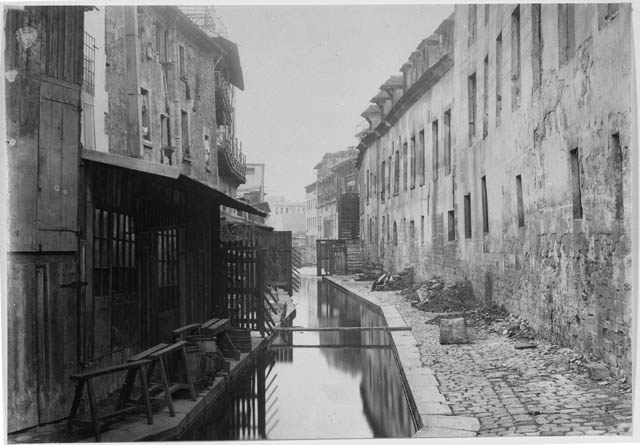 Charles Marville, 13e Arrondisment, Paris, 1865
Marville purposely took the photographs of Paris's architecture and streets scenes when it was raining, so that the soft diffused light mixed with the rain on the cobblestone produced a picturesque image that elicited a feeling of urban beauty.
His views, taken in the late 1850s, were intended to record the many buildings and neighborhoods ultimately destroyed by Baron Georges-Eugène Haussmann's urban planning project that would create the boulevards and open spaces of modern Paris. While Marville's survey of the city, extensive and thorough in scope, prefigured other important efforts of its kind, it is distinguished by its emotional accessibility. His work beautifully reveals a Paris that has long disappeared.
April 15, 2011
interpreting Eugene Atget
In Canon Fodder: Authoring Eugène Atget Abigail Solomon-Godeau focuses her attention on how Atget is both currently and historically represented in our photographic culture. This is a fit between the requirements of late modernist photographic theory (requirements that are institutional, canonical, and discursive in nature) and Atget's work.
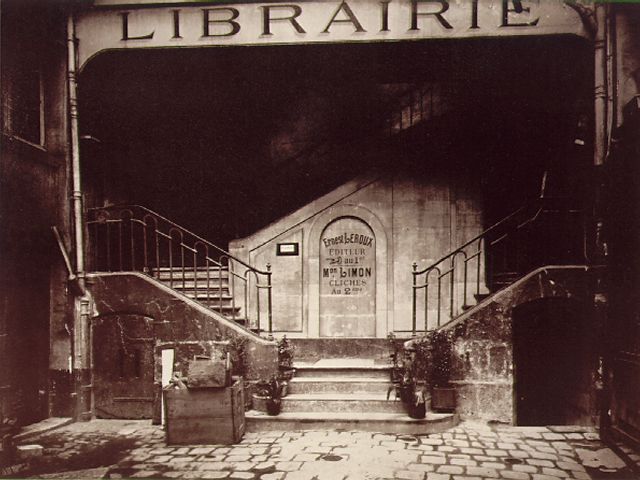 Eugene Atget, Cour, 28 rue Bonaparte, 1910
MOMA's interpretation of Atget is someone who reconciled the medium's documentary obligations with the more eccentric goals of art, all the while standing outside that airless room politely called the "art world," notwithstanding the resemblance of Atget's archive to nineteenth century photographers such as Charles Marville or to his contemporaries producing topographical, documentary and architectural photography (eg., Karl Abt and Henry Dixon).
In Szarkowski's hands Atget is the forebear to the generation of documentary art photographers the curator spent his influential career promoting--photographers like Robert Adams, Diane Arbus, William Eggleston, Robert Frank, Lee Friedlander and Garry Winogrand (not to mention Abbott's contemporary, Walker Evans, who first translated Atget for American audiences).
April 14, 2011
Florentine tree sit
As we know the old growth forests, such as the Florentine and Styx Valleys in Tasmania's south-west, have been the key battleground in a war between environmentalists and loggers for 30 years or more. Both the state-owned Forestry Tasmania and Gunns have been in the forefront of the war to log Tasmania's old growth forests.
However, I was under the impression that there was a kind of ceasefire and a deal in the making in the forestry wars in Tasmania to end large scale native forest logging in Tasmania. The deal was quite recent.
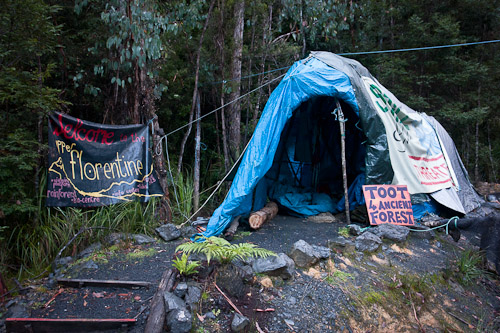 Gary Sauer-Thompson blockade, Still Wild Still Threatened, 2011
That was my impression until I saw the direct action Still Wild Still Threatened camp on the road from Maydena to the Gordon Dam in the Southwest National Park via Strathgordon. Forestry Tasmania was still logging.
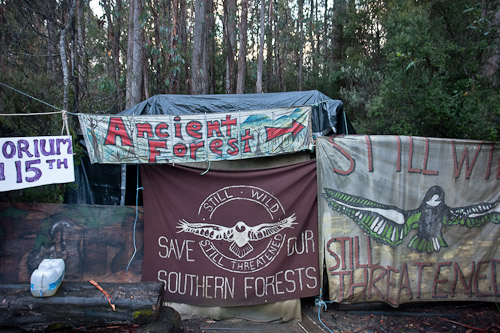 Gary Sauer-Thompson blockade, Still Wild Still Threatened, 2011
The tree sit/blockade was being undertaken by the “ratbags” within Still Wild Still Threatened (SWST) group. Instead of coming across as the mass media's stereotypes of either stinky hippies, or anarchist dilettantes, they spoke and acted as intelligent, committed and dedicated activists willing to put their bodies on the line in a campaign to save the forests.
The blockade was situated on a proposed logging road, and the group had dug huge holes on both sides of the road to protect the camp from any vehicles approaching, allowing access only by foot. Rope and pole structures also obstructed the road and were attached to tree sits high in the canopy. A central feature of the camp was the house built in the middle of the road out of recycled materials from nearby towns and the immediate area.
The activists are there to stay.
April 12, 2011
a visual rhetoric
The rise of modernity saw both the demise of rhetoric, the emergence of natural science and the dominance of logico-mathematical analysis. What was not mathematically expressible ----fantasy, passion, memory and emotion---was simply ignored by the mathematization of modernity. The question of rhetoric is dead and buried.
What was ignored was taken up by modern art, which fundamental rejection of the "style of vision," the "way of experiencing the world" characterized by the new physics of nature and the new physiology of the body of Galileo, Descartes and Newton.
The metaphor of the seeing eye as a camera that becomes literalized in the invention of linear perspective is a vision that allows for the Cartesian cogito's primacy over the social and historical dimensions of existence. Long considered "the noblest of the senses," vision has increasingly come under critical scrutiny by a wide range of thinkers who question its dominance in Western culture. The critics of vision, especially prominent in twentieth-century France, have challenged its allegedly superior capacity to provide access to the world.
In response to the the mathematization of modernity modern art centred on a subjectivism, that emerges partly out of the romantic preoccupation with the subject thrust back upon itself, and upon its emotions of personal life experience. The immediate appeal to raw feeling was exhausted with the romantic's turning inward in opposition to the dominance of instrumental reason.
Can rhetoric and metaphor "live on" in a postmodern world. Can we express our relation to the social, historical, and cultural without sacrificing personal experience? Can photography become a visual rhetoric---a form of observing and a means of persuasion? Does the postmodern" marks the return of rhetoric as a disruptive critical force?
April 11, 2011
in Queenstown
I haven't posted that many of the photos I've taken whilst I was in Queenstown on junk for code. I have been posting some on my Flickr stream, on Rhizomes1, and on poodlewalks.
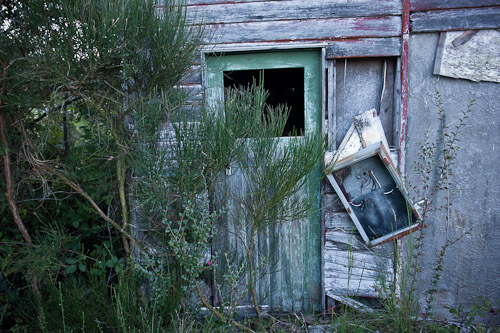 Gary Sauer-Thompson, decay, Queenstown, 2010
What intrigued me about Queenstown was the extent of the of the decay of the built environment--the ruins --and the way that nature was rapidly reclaiming the built environment.
This was one of the themes of Neo-romamticism, and it often had a barbed edge to it. Thus ruined buildings to be found where nature had reclaimed the urban territory and I'm interested in the point where psychic flak, historical relevance and urban myths collide.
April 8, 2011
Julian Cooper at LARQ
The current artist in resident at Landscape Art Research Queenstown (LARQ) is Julian Cooper, an English painter based in the Lake District, UK, who is a mountain climber and who specialises in mountain painting and rock surfaces.
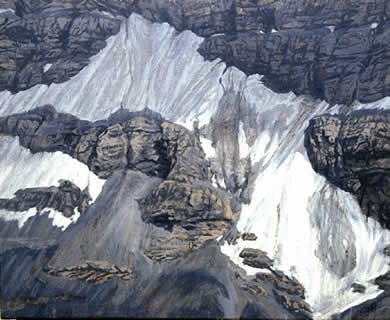 Julian Cooper, At the Base of the Eiger, 2004, oil on canvas
His focus in the autumn residency is the patterns, textures and forms of the local rocky landscape --mountains and quarries--and presumably his studio work will be based on plein air painting as a recording device (ie., studies), the camera and memory.
His latest work interests me. He has move on from pen-air painting in the high Andes, and the semi-abstract and highly-textured paintings of the Himalayas in the 1990s to paint industrially-worked rockfaces which are literally the interface between human beings and nature.
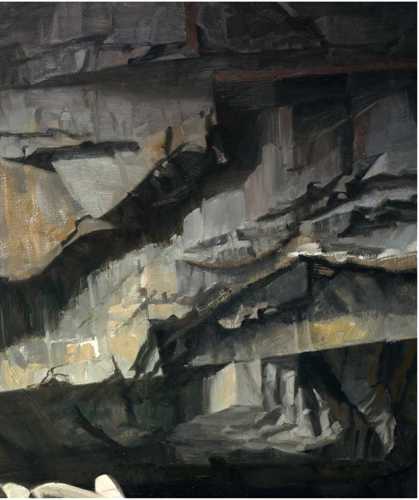 Julian Cooper, Cumbria Quarry, oil on canvas
The two sites are at the abandoned slate quarries at the Langdale and Coniston areas in the UK, and at the Carrara marble quarries – the historic quarries from which Michelangelo took his marble and which are now quarried on an industrial scale.
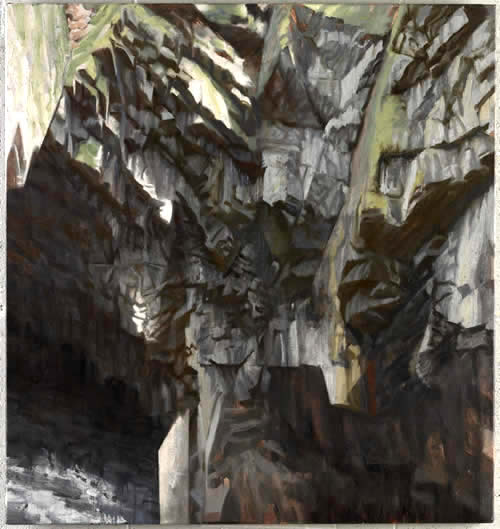 Julian Cooper,Quarry Cave, 2006,
oil on linen
Julian Cooper,Quarry Cave, 2006,
oil on linen
I presume the open cut mines in Queenstown represent the third site.
April 7, 2011
Osmosis at LARQ
Landscape Art Research Queensland (LARQ) in Queenstown hosts a program of exhibitions, residencies and print workshops that explore art and its relationship to the geomorphologies and human dwelling on the Mt Read volcanic belt.
One of the exhibitions this year was by Osmosis a group of Tasmanian female artists. One of the group is Fiona Fraser, a Hobart based photographer and printmaker who works as an arts administratior roles and currently as Visual Arts Coordinator at the Salamanca Arts Centre:
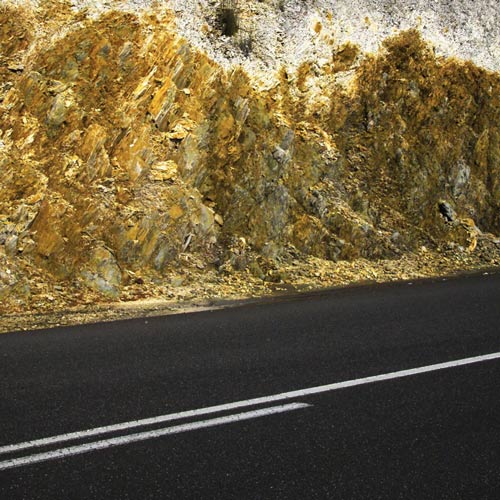 Fiona Fraser, Cutting, Queenstown, 2010
Her emphasis was on the steep, narrow and winding road into and out of Queenstown. There are only a few places to stop the car and look at either the landscape, or the relationship between the road and the cliff the road has been cut into.
If you want to take photographs you need to park the car and walk it. Basically you are working on the road ---a view camera and dark cloth is not practical---and to keep moving out of the way of the cars travelling up and down the road. Thankfully, the road is so windy that the cars go slow and so you can move body and camera and trip out of the way.
April 6, 2011
Mining heritage in Tasmania
A lot of the ruins of mining in Tasmania are hard to uncover, even though Tasmania’s west coast is at the heart of the state’s mining industry. Zinc, iron, tin, copper were mined and as a result of this, this part of western Tasmania is crisscrossed by a freight rail network that was used to transport ores to the coast, from where it was shipped to the rest of the British Empire. Little is now left of this history.

E Searle, Mt Lyell Mining Co. Smelters in Queenstown, Tasmania, circa 1911-1915
The Tasmanian Smelter Co site at Zeehan, which I have been exploring, has been dismantled. I've no idea when the smelter stopped operating. In the early 20th century is my guess, after the region's mines ran out.
I know nothing about the North East Dundas Tramway from Zeehan to Williamsford, even though I wandered around Zeehan.
April 5, 2011
French Photography: Yannick Demmerle
Yannick Demmerle is known for making large-scale photographs of forests, lakes and wild-animal cages with an 8x10:
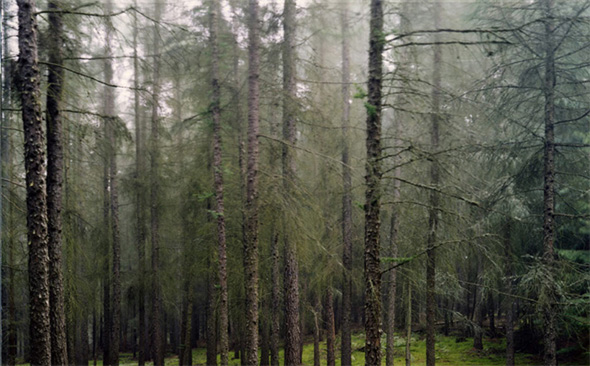 Yannick Demmerle, untitled, from the L'Ours, la mort et les arbres foudroyés exhibition
In his Tasmania work, whilst having a residency at Landscape Art Research Queenstown ( LARQ) He hiked through the wilds for weeks on end, accompanied only by his bulky camera equipment--focusing on the rain forest not the tree. He says that he endeavours to photograph the invisible between the trees, for example, fear.
The Europeans interpret the photographs he creates in the solitude of this remote wilderness as revealing nature much as German landscape painting in the Romantic era did. But while the Romantic painters always included an element of civilisation in their pictures – a ruin, a path, a human being – and depicted their motif from a distance and with a visible horizon, Demmerle closes in on his subjects. There is no horizon and no living creatures to be seen in these images.
This wilderness for the Europeans is merciless, alien and menacing in its sheer unbridled force--his photographs are an expression of the fantastic, irrational and dark.
April 2, 2011
Tasmania: Hobart
I fly out to Tasmania early this morning to begin to build on this body of work. We fly into Hobart via Melbourne, but the time we will spend in Hobart is very brief--sufficient time to get my Telstra mobile broadband sorted.
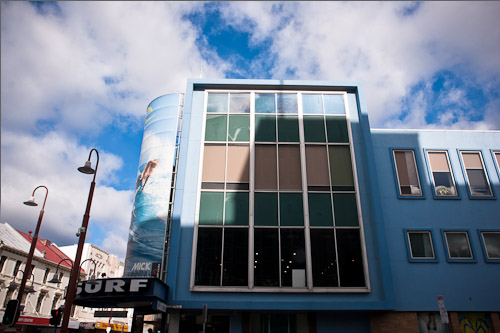 Gary Sauer-Thompson, Surf, Hobart, Tasmania
We drive up to Tunbridge via Oatlands in the Midlands to spend the evening with Barb and Mal in their Georgian store, which they are renovating over a ten year period. On Sunday afternoon we drive to Evanston and stay there the night with family. On Monday Suzanne and Barbara start their Cradle Mountain walk, Malcolm returns to Brisbane, and I go on to Queenstown.
Update
Though it is warm and pleasant during the day out of the wind, the westerly wind is very chilling. I would find it hard to live with. It was chilly around the edges of my body in Hobart but it cut through my clothes in the Midlands. Tasmania has had a sudden cold snap.
The CBD of Hobart looked depressing---there looked to be a lot of unemployed young people hanging out on the streets and the urban (working poor) poverty was very evident. What was evident was the bogan youth street culture that was in opposition to the official culture of conservative Tasmania.