March 31, 2011
Tasmania bound
I'm off to Tasmania on Saturday for a photographic trip and a holiday. A lot of the photography will be concentrated in Queenstown, exploring the effects of the Mt Lyell copper mine on the local environment.
 Gary Sauer-Thompson, rockface, Queenstown
Whilst I am photographing in Queenstown with my renovated Linhof 5x4 Technika IV Suzanne will be doing the Cradle Mountain-Lake St Clair 5 day walk on the Overland Track in the Cradle Mountain National Park with Barb, her sister.
This is my third trip and it has slowly evolved into a project, which I plan to built on the early work done with a Leica and Rolleiflex by using the venerable 5x4.
I don't have the trunk to take the 8x10 Cambo monorail. Maybe an 8x10 is the next trip--but with a field camera that can be carried in a backpack. Maybe.
March 30, 2011
Architectural photography: a note
Architectural discourse in Australia continues to o maintain a position that architecture (and design and urbanism) has an autonomy separate from music, art, video games, movies, food, infrastructure, etc. We still have buildings that stand alone as architectural forms that have very little connection to the urban life on the street around them. They appear as fortresses.
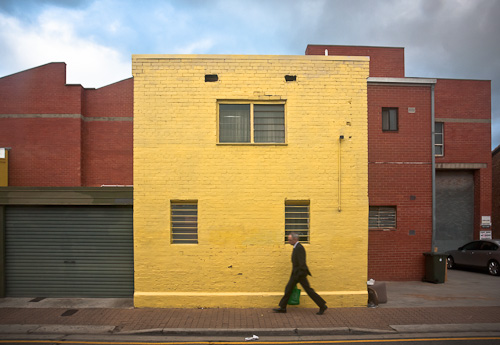 Gary Sauer-Thompson, yellow building, Adelaide, 2011
I mention this because I'm beginning to explore how to approach architectural photography, and I'm not sure how to go about doing this.
Architectural photography, from what I can gather, is more about creating glossy hardcover promotional images that critically engaging with our built culture; or they celebrate architects as master of design rather than a concern about how the built form relates to the public space.
There is not yet a whole of government approach to innovative and sustainable urban design, building and infrastructure in South Australia.
March 29, 2011
the International (Polaroid) Collection
The Impossible Project signifies the rebirth of analog photography after the digital revolution. As is well known it was founded by photo enthusiasts and entrepreneurs who saved the last Polaroid instant-film plant in the Netherlands and who are currently working to develop a successor to the instant film for the SX-70 cameras and the popular Polaroid 600 color film for Polaroid 600 cameras.
What is also known is that Edwin H. Land, gave many artists access to his cameras and film as a way to demonstrate Polaroid’s artistic potential and to get feedback from artists. The collection eventually grew to include 16,000 images with most of the photographs being kept in the United States. After Polaroid went under in 2008, a Minnesota bankruptcy court ordered the company to sell a portion of the collection; an auction of some of the works at Sotheby’s in the summer of 2010 generated $12.4 million.
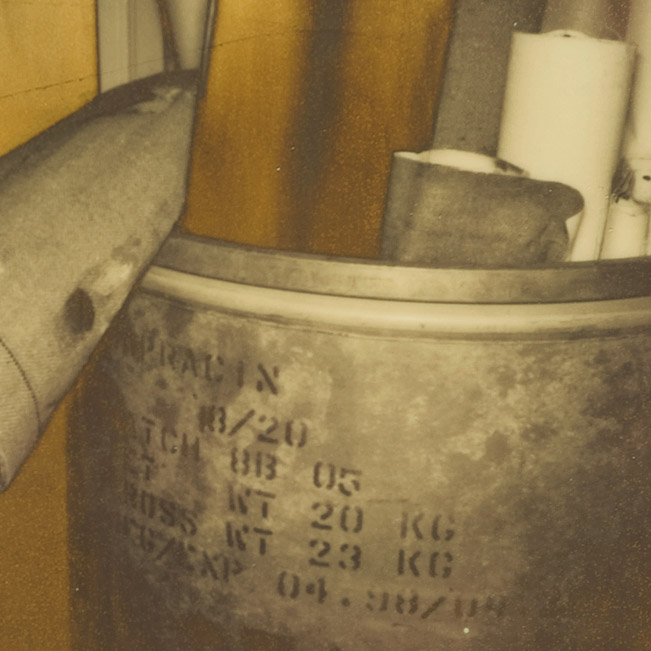 Untitled, Filippo Centenari, Italy (Detail), The Collection
Another collection of more than 4,500 prints by 850 artists had been held in trust since 1990 at the Musée de l’Elysée in Lausanne, Switzerland. That trove, known as the International Collection, has now been acquired by the WestLicht photo gallery in Vienna, a 10-year-old institution that collects photographs and antique cameras, with the help of the Impossible Project.
March 28, 2011
scanning negs
I've been trying to scan some old medium format negatives today with the Epson V700 scanner as a trial run to scanning some of the recently developed 8x10 black and white negatives.
I've had several goes at scanning and I've got nowhere fast. The digital images have been a mess--covered with dust spots despite the care I took; the colours have been way out; the images have been reversed. I cannot correct the mistakes in Lightroom. Early this afternoon I was unable to get an image in Lightroom when I import the scanned negative into Lightroom.
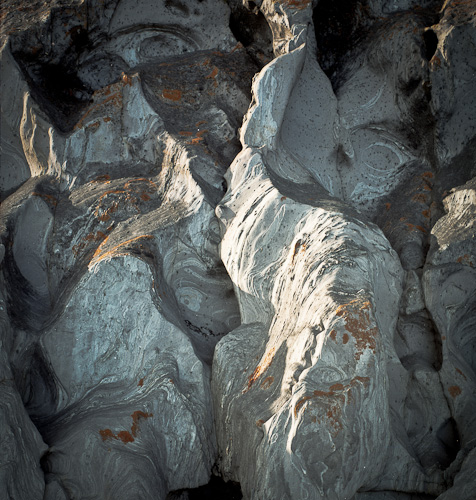 Gary Sauer-Thompson, rocks, Victor Harbor, 2007
You name the problem I've struck it, so much so that I'd given up. I was just getting nowhere.
But I cannot afford to pay a pro-lab to scan the negatives anymore, and they cannot do anything bigger than 5x4. So that leaves me sitting on 5x7 and 8x10 negatives So I have to teach myself through trail and error.
Update
I finally managed to get a coloured image into Lightroom when I import the scanned negative into Lightroom, as you can from the above image.
I then spent all afternoon tying to scan an 8x10 b+ w negative then importing it into Lightroom. I can only get a negative image: ie., there is no conversion of negative to positive image, even if I scan it as b+ w negative or as a colour negative. Yet when I scan a proper colour negative I get a conversion of the colour negative into a positive image.
There must be something I am doing at the scanning end? Who knows. I have spent hours online reading the various guides and I can find nothing. Nor can I find anything in the Epson scanning set up.
March 26, 2011
Lumen
The theme of the inaugural issue of Lumen is forests. The Preface states that this debut collection of essays, visuals and sounds is assigned to the Forest; and is explored by our contributors, without the intention of being exhaustive, in a proximate thematical relation to cinema.
I found this interesting as I have trouble with photographing forests and I only succeed occassionally. This is in contrast to the work of Daniel Gustav Cramer in his Trilogy series:
 Daniel Gustav Cramer Untitled Trilogy series
Cramer says that Trilogy started in 2003 with its first part, Woodland.The second part, Underwater, began in 2005. The last part of Trilogy was Mountain.
In the Preface Edwin Mak & Matthew Flanagan say:
The Forest has been approached as an invariant idea that continues to be deployed in variations of literary metaphor, materialist topography and the mise-en-scène of theatre or film since antiquity. It may be said that its art, at its most elemental, has been to act as a measure of existence; in the trembling of the earth, ravages of time and light that breaks into worlds that are our own. Its woods persist in attracting imaginations that entertain its condition as, at once, an environment for inexhaustible becomings, and being as an incessant becoming in itself: myriad negentropic excrescences in chaotic organic flows, or matter shimmering in the multiplicity of its decay and regeneration.
My own experience of forests and mountains in NZ is one of being in nature; but not in terms of the classical dichotomy between the domesticated self encountering the objective realm of wilderness which treats the natural world as a thing to be discovered by human beings. Rather, it is more in terms of my body being a world of things and processes (wind, rain, etc); as being within the fabric of the forest. There is a process of interaction between body and forest.
March 24, 2011
Japanese photogrpahy: Kou Igarashi
I know very little about the work of Kou Igarashi and there is very little of either text or photos on the web. It looks interesting.
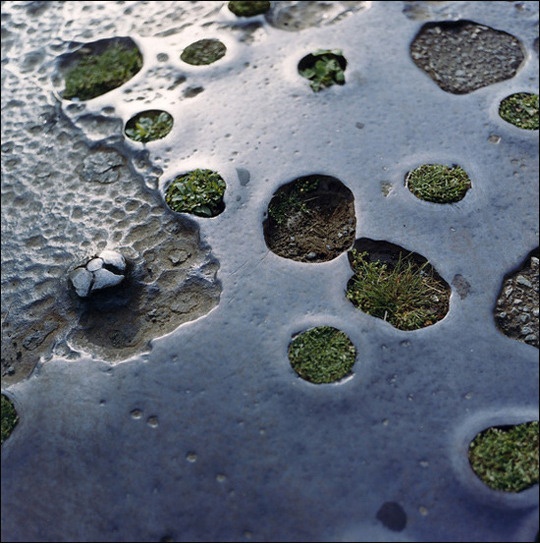 Kou Igarashi
It is frustrating when this happens as I would like to know more about the photographer and his work. There is probably material in Japanese somewhere on the web.
 Kou Igarashi
It is a pity because the work looks to be interesting. I'll keep googling though , and I I come across anything I will add it to the post.
March 23, 2011
Japanese photography: Naoki Ishikawa
Naoki Ishikawa, is an explorer and photographer, who is pretty active with his books The Void, Polar, New Dimension, and Mount Fuji.
 Naoki Ishikawa The Void #30, 2005
Many of the images in The Void are of New Zealand rain forest and the wilderness of New Zealand's northern island.
March 22, 2011

March 21, 2011
Tasmanian photographers: David Stephenson
I've started looking for some Tasmanian photographers in preparation of my trip to Tasmanian in early April. The Ten days on the Island festival will be finishing just as we arrive. In the visual arts there is an exhibition of the Olegas Truchanas' photographs of Lake Pedder
 David Stephenson, The Zinc Works and Mount Wellington, Tasmania, 2004, from Marking Time
There is Tales of Suburbia --- photographs from The Robinson Collection at the Devonport Regional Gallery
March 20, 2011
aerial photography: Yann Arthus-Bertrand
Whilst I lug my camera gear whilst walking in the Waite Conservation Reserve on a Sunday morning Yann Arthus-Bertrand photographs landscapes from helicopters and balloons:
<
Yann Arthus-Bertrand, dead tree, Sherwood Forest.
He achieves some stunning results. In the meantime I plod along on the ground exploring a site with a digital camera then going back and reshooting selected objects with a film camera.
March 19, 2011
NSW Police mug shots
The Forensic Photography Archive is held at the Justice & Police Museum in Australia and it can be accessed through Historic Houses Trust. The archives contain an estimated 130,000 images created by the New South Wales Police between 1910 and 1960, with many of the mug shots taken on 4-by-6-inch glass plate negatives:
 NSW Police, Leslie Selina Gertrude Rees, 1915
Leslie Rees was convicted of bigamy at the Moree Quarter Sessions and was sentenced to four months light labour.
These images invite interpretation, but I know very little about this archive, or even how it has been interpreted by photographic historians and academics in Australia; or how the interpretations of the archive are connected to 20th century European writing on photography and culture. The mug shot photo books/archives was associated with both “disciplining” the criminal body and more generally, in fixing the modern conception of individual identity. It is also a template for virtually all modern surveillance systems, and fixes the process by which we construct ourselves as surveilled subjects.
 NSW Police, Haunted by a Vitality that is No More - Interpreting the Photograph in the Crime Archive in the Journal of Media Arts Culture--- in Shadows of the Dead: Mediating the Archive Photograph (Dec. 2005) says:
 The meanings these crime archive mug shots of the 1920s, 30s and 40s release are partly discovered within their mass accumulation of period detail. There is an enormous inventorying of clothing, hairstyles, shoes, ties, shirt collars, hats, the outward layers and wrappings human beings adopt to present themselves to the world. This external detail is combined with a capture of a more personal kind of information that exposes the ways in which the bureaucratically possessed and processed subject reacts to the machinery that seeks to ensnare that same subject in a strategy of objectification. We see this in the waves of louche defiance, cavalier indifference, disgruntled incomprehension and sad resignation emitted from the eyes to the camera’s lens.
These crime archive photographs, like the pathologist’s charts at the foot of the hospital bed, take the pulse of a deeply traumatised civilization that produced them.The mug shots depict family breakdown, upsurges in casual and opportunistic crime, random accidents, prostitution, grog shops.
March 17, 2011
forces of nature
The events in Japan reminds us of the power of nature and the limits of human's mastering nature through science and technology to increase their utility:

Despite atomic bombings of Hiroshima and Nagasaki and the firebombing raids on other Japanese cities in 1945 and two massive natural disasters – the Great Kanto Earthquake of 1923 and the Great Hanshin (Kobe) Earthquake of 1995 – Japan is the most technologically modern nation in the world. Its building codes and engineering prowess kept its earthquake-resistant modern buildings from collapsing.
But clearly it was not enough of a buffer against the power of the natural world. The tsunami caused widespread death and destruction, whilst explosions of smoke and steam billowed and radiation leaked from the nuclear power plants that were supposed to be disaster-proof. Natural disasters of this magnitude effect the entire surrounding region – indeed, reverberate around the world.
Those who raise the issue of limits of humans mastering nature through ingenuity and science are dismissed as cultural pessimists and anti-modernist wallowing in a culture of fatalism. They are prophets of doom.
March 16, 2011
Harry Callahan: colour
Although the introduction of chromogenic color processes made color photography commercially viable by the 1930s, it was not widely employed by artists until the 1970s. The pioneers of color photography, include Harry Callahan and William Eggleston, who made exceptional work using the complicated dye transfer process.
 Harry Callahan, Alley with Green Moss, Venice, 1978
Harry Callahan (1912-1999) is widely recognized as one of the more influential photographers and teachers of the last half of the 20th Century. In the late 1970s, he began focusing on color. He had made color photographs for decades, but they only existed as Kodachrome transparencies. He began to produce dye transfer prints of his colour images and held his first color show in 1978 at the Light Gallery in New York.
There is no question that digital imaging and the internet have revolutionized the art of photography. Now everyone with a camera and a computer has the ability to take literally unlimited amounts of photographs, without any of the previous “arcane technical knowledge” required in the days of manual cameras and instantly display them to an audience of millions of people.
March 15, 2011
Japan: devastation
The image is of a lone Japanese woman surrounded by mounds of incredible rubble from the devastating earthquake and tsunami in northern Japan:
 Jeremy Traum
There are increasing fears of a meltdown at the Fukushima Daiichi nuclear power plant. It is difficult to understand what exactly is happening at the damaged nuclear plants. It appears that there is a meltdown in the core and some radiation released, but no major leak.
Japan is struggling to prevent nuclear catastrophe at its reactors in the days since a massive earthquake and tsunami knocked out power, crippling cooling systems needed to keep nuclear fuel from melting down.
March 12, 2011
public phone booths
David Trotter in The Person in the Phone Booth in the London Review of Books says that:
Anyone old enough to have made use of public phone booths on a regular basis will know that they were more often than not damp, cold, filthy and foul-smelling, and while amply supplied with the phone numbers of prostitutes, practically impossible to make any sort of call from. So folk memory insists, at any rate. So literature insists too. Urban phone booths in particular have become indelibly associated in the literary imagination with urine.
The implication of the folk memory endlessly recycled in genre fiction, is that we don’t fully recognise a phone booth as a phone booth until we’ve felt just a little bit sick at the sight and smell of it. The disgust is the recognition.
 Gary Sauer-Thompson, public phone box, Karamea, South Island, New Zealand
Evans says that in cities we used to enter phone boxes on the street in order to be private in public. That is, we once did, before we all had mobiles. Nowadays you don’t go somewhere special to make a call unless your mobile’s broken, or you’ve left it at home.
He adds that:
The new urban spectacle consists of people apparently in earnest conversation with themselves, whom we might once have crossed the road to avoid, or broadcasting the gory details of a personal fiasco to a train carriage full of strangers. It is in fact the prospect of the phone box’s complete supersession by the mobile which has most effectively laid bare its original purpose. For each of these mobile-users is engaged, as we once were when we stepped into a phone box, in constructing privacy in public.
The history of the urban phone box is the history of the construction of privacy in public.
March 10, 2011
charting the cultural turn
In her book Loft Living: Culture and Capital in Urban Change, published in 1982, the New York City-based urban sociologist Sharon Zukin writes about the role of artists in making “loft living” comprehensible, even desirable and provides a sociological analysis of the role of artists in urban settings, their customary habitat.
Listen to more Grateful Dead at Wolfgang's Vault.
Zukin focuses on the transformation, beginning in the mid-1960s, of New York’s cast-iron district into an “artist district” that was eventually dubbed Soho. In this book Zukin lays out a theory of urban change in which artists and the entire visual art sector—especially commercial galleries, artist-run spaces, and museums—are a main engine for the repurposing of the post-industrial city and the renegotiation of real estate for the benefit of elites.
By the 1970s, art suggested a new platform to politicians who were tired of dealing with urban poverty. Many cities, especially those rustbelt ones lacking significant cultural sectors, established other revitalization strategies. The search for more and better revitalization, and more and better magnets for high earners and tourists, eventually took a cultural turn, building on the success of artists’ districts in post-industrial economies.
March 9, 2011
Tasmanian trip
I am starting to prepare for my trip to Tasmania in early April (2nd --16th) where I will continue the work that I began I year ago. I want to build on that work now that I have a new bellows for the 5x4 Linhof Technika field camera.
Suzanne and I will be going for 2 weeks. The first week is structured around Suzanne doing the 4 day Cradle Mountain walk with her sister and me photographing in and around Queenstown. The second week is spent together in the south east of Tasmania.

I had started working on a book of the images taken in 2009 through Pic Press, but I gave up as the software made available in the workshop was not suitable for both images and text.
So I will shift to using Adobe InDesign and using the photos from both of the trips. My plan is to get a draft up and running this year using Pic Press' template. In all probability I will need to involve a book designer.
March 8, 2011
Alex Frayne: Adelaide Noir
Alex Frayne has had a long fascination with ‘night-scapes’ that exist in Adelaide and on the Fleurieu Peninsula.
 Alex Frayne, playground, 2010
Below are selected photos from Frayne's 2010 "Adelaide Noir Series", currently being shown at the Kerry Packer Civic Gallery
At night, even in its capital city one gets a sense of hauntedness. In playgrounds, on roadsides and in suburban streets, the feeling lingers.
March 7, 2011
On Shadow
On Shadow as a hybrid blog/magazine primarily run by Nicholas Calcott and is updated once a week or so with original projects, essays, and interviews. It was originally the blog arm of the publisher 12th Press.
In the post On Web Form and Photography it is argued that the way that websites themselves are designed really defines what we take away from them.This should be clear to anyone who reads a photo blog:
Organized chronologically, photo blogs are set up in a way that once a post disappears off the front page, it is essentially lost forever. There are some advantages to this method of consumption – for example, the reader sees a lot of different photographers’ work. But this work is usually presented only in the form of one or a handful of images. These images are frequently disconnected and have only a fragmentary relationship to a larger body of work: Strong individual images are encouraged, and concepts that are easy to understand in the relatively brief space of the blog form.
The critical failing of "photoblogs in contrast to Flickr is their inherent lack of connectedness. Secondly, the problem is that the form of the weblog encourages strong images as eye candy for the readers consumption.
Hence the different web form of On Shadow that makes great use of the archives.
March 6, 2011
regulating access to public spaces
San Rocco, which is a magazine about architecture written by architects, has an interesting post on regulating access to public spaces in Italy. They say:
On December 18, Italian Minister of the Interior Roberto Maroni officially supported a proposal by Undersecretary Alfredo Mantovano to extend the anti-hooliganism police measure known as “Daspo” (an acronym for Divieto di accedere alle manifestazioni sportive, or prohibition of access to sporting events) to regulate access to public spaces on the occasion of political rallies.
They say that the proposal was made on the heels of student demonstrations in Rome and has been enthusiastically supported by several of the Minister’s brilliant peers, such as the Mayor of Rome, Gianni Alemanno, and Senator Maurizio Gasparri.

The above is San Rocco's modest proposal to introduce efficient technological devices to regulate access to urban public space. Keep people out.
March 5, 2011
Zaha Hadid: Guangzhou Opera house
Well, Zaha Hadid's new Guangzhou Opera house is an architectural step on from Utzon's Sydney Opera House.
This is a zig-zag staircase reaching theatrically from the main foyers to the three upper tiers of the auditorium
 Dan Chung, Guangzhou Opera House, 2011
The Sydney Opera House was the 20th century--one of the great designs and iconic buildings of that century. The Guangzhou Opera House is an expression of the 21st century. Shaped to resemble two boulders on the bank of the Pearl River in Guangzhou this amorphous yet geometric structure includes a 1,800 seat theater and a 400-seat hall as well as rehearsal space and an entrance hall.
The 70,000 sqm project consists of two solid geometric forms wrapped with a structural exoskeleton. The two components, with their similar form, color and shared structural expression, create a strong artistic expression to house the cultural center. Hadid’s angular exterior intentions are carried through the interiors, shaping dynamic gathering spaces and interstitial spaces.
The opera house has two venues, one in each boulder. The larger black granite boulder contains a 1,800-seat grand theatre, while the white granite of the smaller element (set as a rainscreen above a proprietary standing seam roof) envelops a 400-seat multipurpose hall
March 4, 2011
creative industries
In Meanjin vol 69 no 3 2010 there is an article Hilary Glow and Stella Minahan entitled ‘Richard Florida and the Arts: A Rescue Fantasy’.
This is relevant to me as I live in the inner city and photography is part of the creative industries. Australia has accepted Florida's argument that the distinction between ‘arts and industry’ and ‘arts and economy’ as a false dichotomy that needs to be put to bed and that the creative industries lead to vibrant communities.
 Gary Sauer-Thompson, Slow, Adelaide, 2011
Glow and Minahan look at the contradiction between arts policies and working conditions, and Florida's argument that creativity is critical to the success of the global capitalist economy.
They say that:
Florida has dazzled politicians, businessmen and CEOs with the argument that creativity is critical to the success of the global capitalist economy. The arts, on the other hand, have been persuaded to comply with business thinking, strategic planning and management know-how—to internalise the idea that the business model is part of a progressive and modernising agenda that will rescue the arts from obscurity and poverty.
Like many others who advocate the advantages of a creative industries approach, Florida links creativity to innovation, and innovation to increased commercial profit. Commerce and culture are happy bedfellows, but ‘creative industry’; is a haven for the so-called creative classes. In Florida’s vision, the creative worker is free and reflexive, working in an environment that fosters tolerance, liberalism, diversity and non-hierarchical management.
The reality of course is otherwise. The realities of working in the arts for most, means low wages and long hours combined with managerial activities designed around compliance to policy and procedure.
March 3, 2011
photography after photography
The third in Culture Machines series of Liquid Books is Technology and Cultural Form: A Liquid Reader, which presents a series of texts that interrogate the notion of ‘technology’ as a specific cultural form.
In Part 111: Technology in the Making: Art, Craft and Poiesis there is a section on photography entitled 'Digital Futures, or Who Is Afraid of the Amateur Photographer?' Most of this is concerned with the citizen photographer as photojournalist.
However, there is a broader article by Manovich, L. entitled The Paradoxes of Digital Photography’, Photography after Photography exhibition catalogue (1995).
In it he states that he will:
refrain from taking an extreme position of either fully accepting or fully denying the ideaof a digital imaging revolution. Rather, I will present the ogic of the digital image as paradoxical; radicallybreaking with older modes of visual representation while at the same time reinforcing these modes. I will demonstrate
this paradoxical logic by examining two questions: alleged physical differences between digital and film-based representation of photographs and the notion of realism in computer generated synthetic photography.
His arguement is that the logic of the digital photograph is one of historical continuity and discontinuity. The digital image tears apart the net of semiotic codes, modes of display, and patterns of spectatorship in modern visual culture -- and, at the same time, weaves this net even stronger. The digital image annihilates photography while solidifying, glorifying and immortalizing the photographic. In short, this logic is that of photography after photography.
March 2, 2011
photography + higher education
I've just stumbled upon this career guidance or handbook from the Russell Group, which represents the UK's 20 largest universities, in which it is stated that they favour students who study traditional subjects at A-level over newer ones such as business studies or photography. The handbook also reveals an overwhelming preference for science and maths subjects – even for seemingly unrelated degrees.
 Gary Sauer-Thompson, Remarkable Rocks, Kangaroo Island,
In the guide, at the question "Do universities prefer certain advanced level subjects over others?", the top British universities answer that:
there are many rumours about subjects being regarded as 'hard' or 'soft' and different people will have differing opinions on the matter. In general, subjects referred to as being 'hard' are more traditional and theoretical subjects, for example: English, History, Physics and Chemistry. 'Soft' subjects are usually subjects with a vocational or practical bias, for example: Media Studies, Art and Design, Photography and Business Studies. However, there is no set definition of a ‘hard' and ‘soft' subject. Generally speaking, students who take one ‘soft' subject as part of a wider portfolio of subjects do not experience any problems applying to a Russell Group university.
This bias confirms what many people knew. It is also what confirms what many photographers tacitly hold, namely that photography is a vocational or practical bias and students do not need theory and art history to work in our visual culture.
The right response to this is that photography properly taught to problem solve, think creatively and to act independently. The trouble is that may photography in many courses is not properly---there is not a lot of academic as well as practical content.
That was my experience in Melbourne.
March 1, 2011
interpreting Dylan
I saw a DVD of I'm Not There, the 2007 biographical musical film directed by Todd Haynes, that uses different actors to depict the different facets of Dylan's life and public person. Blanchett's command of the mid-60s Dylan role was the highpoint followed by Marcus Carl Franklin characterization of Dylan's Woody Guthrie persona.
What the film did explore was a nostalgia for a pastoral America (without including The Band)--what we now call Americana or alt. country. What it didn't explore was Dylan's reinterpretation of his music over the three decades covered by the film, even though Dylan was the greatest songwriter of his era and there were interpretations of several of Dylan's songs in the film by different artists.
This version of 'She Belongs to Me' by the Grateful Dead wasn't included but its kinda sweet in a low key way. It refers back to The Basement Tapes period. It has more sparkle than a lot of their covers of Dylan, which more often than not were pedestrian.