February 28, 2011
Already Home
The Adelaide City Council has finally embraced digital media with its Already Home website. This is a gateway or portal for sharing stories through film, prose and photographs about daily living in the inner city of Adelaide from those who call Adelaide home. I call Adelaide home.
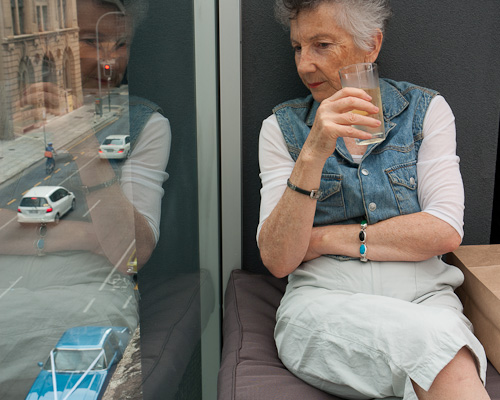 Gary Sauer-Thompson, Suzanne, rooftop bar, Gallery on Waymouth, Adelaide, 2011
It's a good idea. I'm not sure how the user generated content works, but I sent them the link to my locally based poodlewalks photoblog. I suspect that you send a completed work to them --eg., a film or a story-- and they host it on the website.
February 26, 2011
NGA: street art
The National Gallery of Australia (NGA) currently has a show of street art entitled Space Invaders that is drawn entirely from the collection of the NGA.
 Gary Sauer-Thompson, kissing skeletons, unknown artist, Melbourne, 2010
Official attitudes to street art - stencils, posters, tags, aerosol murals and paper ''paste-ups'' - in Melbourne are deeply contradictory. It is seen as art with the street art on the lane way walls seen as a tourist attraction. On the other hand, there is a tough stance on graffiti ---it is illegal and municipal teams are hard at work painting over graffiti.
The NGA say that the vanguard of Australian street art can be traced to a small number of artists experimenting during the late 1970s. They add:
It was not until the mid 1990s, however, that there was a voracious surge in the act of creating works of art on the street, which could be identified as the beginning of the contemporary Australian street art scene. It should also be acknowledged that the roots of Australian street art lie in the Australian graffiti subculture. Since graffiti’s appearance in Australia in the early 1980s, this subculture has undergone significant aesthetic transformation. In the last three decades, Australian graffiti, as we traditionally understand it, has grown from the internally coded expressions of notorious hardcore writers into a multifaceted scene that comprises a conglomeration of artists using text, symbols and signs. The graffiti subculture has multiplied its forces of collaborating practitioners and has spawned numerous street art offshoots that have, since 2000, revolutionised creativity in public spaces.
The transition of many practitioners from modern graffiti styles to street art experimentation is still strongly rooted in old‑school graffiti culture. THe NGS says:
The street-stencil images held in Australia’s national art collection were created for the street, where they have long since decayed, been painted over, buffed and destroyed. In 2004, the National Gallery of Australia intervened, asking artists to print their street stencils on paper. Once put to paper, collected, preserved and displayed in a completely different context, these works of art essentially become important documents or records of imagery originally intended for the street. The collection of street stencils at the Gallery—only a portion of which is on display in Space invaders—is now a time capsule of what was happening on Australian streets at a particular moment of collective creativity.
major strength of Australian street art is its ability to mix pop-cultural imagery with political message. From hard-hitting protest to political satire, clever combinations of sarcasm, mockery and paradox in placement, all of the artists here show their skill in utilising the street,
February 24, 2011
architecture, emptiness, photography
Filip Martens in his The Aesthetics of Space: Modern Architecture and Photography in The Journal of Aesthetics and Art Criticism, vol. 69 no.1 (a free sample copy) makes an interesting observation about architectural photography.
He says that the emergence of modern architecture coincided with the popularization of photography and that:
Given the modernists’ fascination with the metropolis, the bustle of crowded streets and busy traffic, and given the typically modernist visions of the orchestration of the crowds, it is striking to see how desolate their interior spaces are when photographed. Schools, cinemas, houses, and the like are almost always shown as deserted, devoid of people, and often even completely cleared out, with no furniture or other signs of human occupation. This characterizes a great deal of architectural photography from its origin to the present day.
He then raises a question that touches upon the relation between photography and the aesthetic status of architectural space:
what is the purpose of the ‘emptiness’ that so strongly characterizes architectural photography? Is it that (a) the emptiness of these depicted spaces merely serves the purpose of rendering a neutral photographical representation? Or is it that (b) this emptiness fulfills a specific role in that it influences—or has come to influence—our appreciation of the spatiality of architecture?
The first alternative means that when a building is emptied, it allows for an optimal photographic depiction of its interior and of the condition of its material components. The second alternative is more interesting.
It suggests that photography developed a manner of portraying architecture that has come to determine the way we look at architectural space. Martens says:
a photograph of an object is fundamentally different from a direct perceptual experience of the same object. A photograph leaves out the spatial horizon of possible views on the object's surroundings as well as the temporal horizon of previous and subsequent experiences of the perceiver. By freezing a moment and framing a perspective, photography isolates objects, events, and situations from their original spatiotemporal context. Thus, by capturing something in a frame, a photograph offers an uncommon presentation of common things. Art photography can further exploit this and make one look differently at familiar things.
Architectural photography can present familiar buildings and living spaces in a specific way and, in doing so, influence our view of them. Architectural photography is strongly characterized by:
a tendency to remove inhabitants along with any object referring to their occupations from the image it presents. However, with the removal of functional references, the support for a spontaneous understanding of the spatial organization also disappears. When functionality and its significance vanish, so too does the purposive nexus that grounds our spontaneous spatial interpretations.As significance recedes, abstract spatial compositions come to the fore. Hence, it is plausible that the initial “idea” of architectural space has been further elaborated through the way in which interior spaces have typically been depicted in photographs. As they are usually seen in pictures, architectural interiors exert a certain attraction on us because they no longer appear as part of a functional, purposeful whole.
Pictures present rooms that are cleared out, as if architecture were essentially about empty spaces. The atmosphere in these pictures—which is appealing for different reasons—seems to reflect and sustain the theoretical discourse of architectural space. In any case, since designers, students, and critics get to know buildings through photographs, the aesthetics of architectural photography helped to establish a certain image about what architecture is or should be.
February 23, 2011
American photography: An-My Lê
In contrast to Herbert Ponting seeing Antarctica as wilderness and an imperial blank slate tourists, artists and scientist now go to there each summer. As Elena Glasberg says in Blankness in the Antarctic Landscape of An-My Lê:
Working within globalizing capital and big science in Antarctica is a small but persistent history within the U.S., the NSF: the Artists and Writers Program. Beginning as early as 1957, it has sent visual, sound, literary, and other artists-observers to the ice, including both Porter and Lê. The AAWP has managed beautifully to balance the requirements of the state and the need to support science with an allowance for artistic freedom. Although the populations of the southern hemispheric states like Australia and New Zealand incorporate Antarctica much more intimately into their national cultures, the size and quality of the U.S. program has produced a U.S.-authored commentary disproportionate to U.S. cultural involvement in Antarctica.
She adds that we could even argue that the program keeps the U.S. in the game culturally, and in the important area of geopolitics and the media, or that the AAWP is the cultural wing of a neoimperial project in Antarctica, one that operates beyond the need to legally claim territory, and that surpasses the sundry claims of other nations no matter their histories and worthiness.
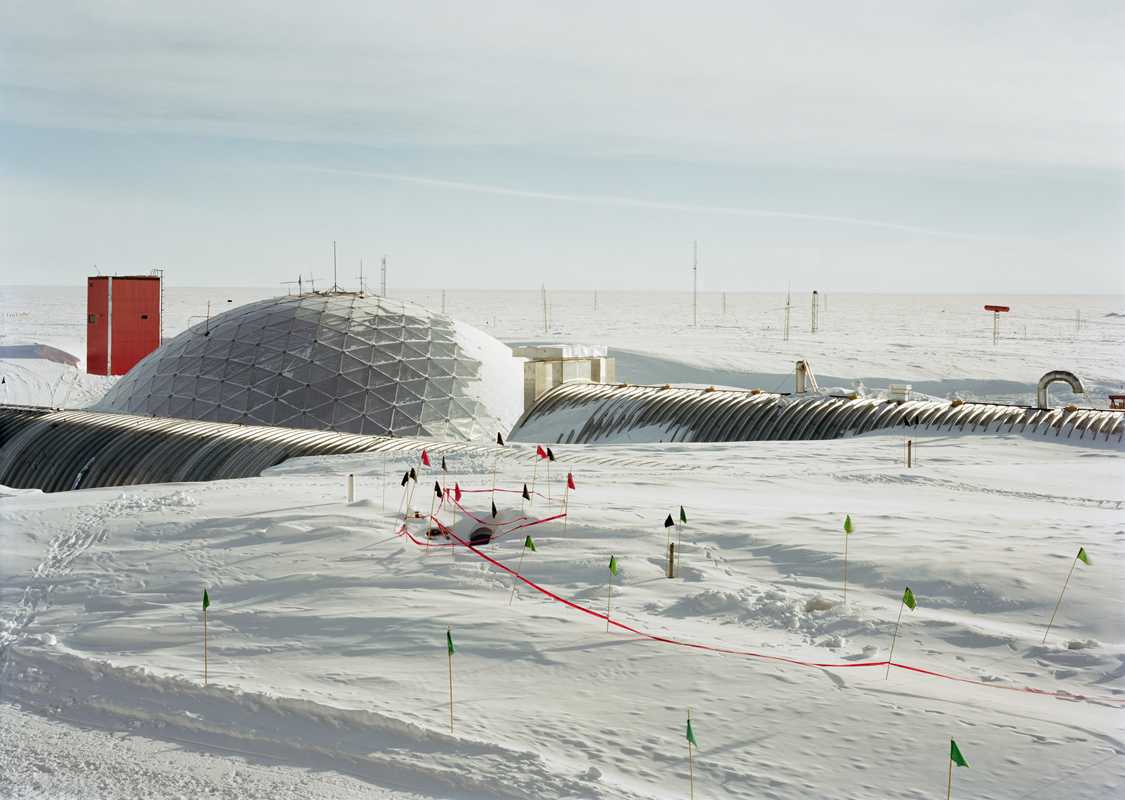 An-My Lê, Abandoned Dome, South Pole, Antarctica, 2008, Archival pigment print, from the Events Ashore series.
This is a Buckminster Fuller geodesic dome, or a "Bucky Ball," that is slowly being buried in the ice of the south pole, after having been planned in the late 1960s and completed in 1973 and shielding inhabitants and supplies until 2007?
Lê, an assistant professor of photography at Bard College in New York, in taking photos of military ships delivering supplies explored notions of empire and military might in the face of the natural world's vastness.
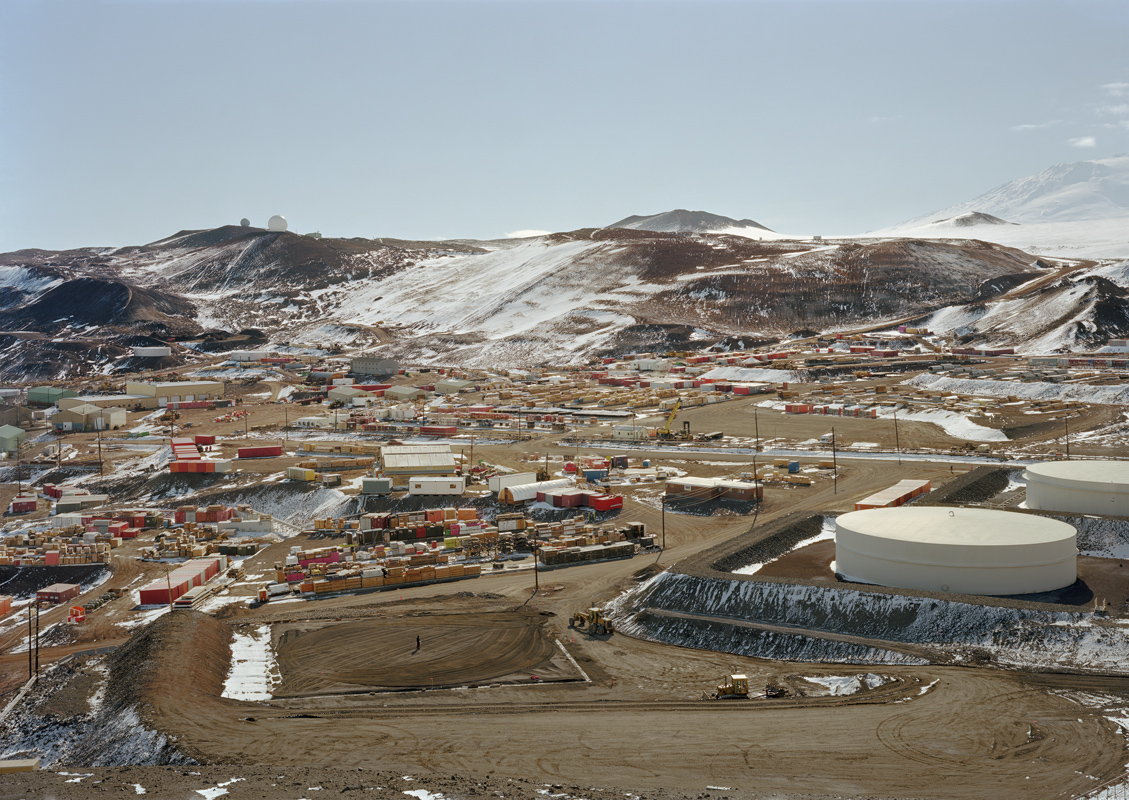 An-My Lê, Fuel Storage Tanks, McMurdo Station, Antarctica, 2008, Archival pigment print, from the Events Ashore series.
U.S. presence at the site of Scott's former base is a location that at first glance hardly seems Antarctic at all. Glasberg says that:
Lê disrupts the aestheticization of Antarctic wilderness begun with the Heroic Age and instead links Antarctica to sites of U.S. militarization around the globe. Lê inherits an iconography from Ponting and applied to a U.S. western subject through Porter, but focuses not on the "empty" deserts of untouched wilderness, or the wilderness fantasy, but rather on the traces of human presence mystified in the Porter images. For Lê, the detritus of a built environment becomes the survival of the Heroic and later environmentally conscious ages that sit strangely, disturbingly on a contemporary Antarctic of international science.
She says that Lê refuses the overexposed, official view and shifts away from what we might call an Antarctic exceptionalism. Antarctic exceptionalism, modeled on American exceptionalism, creates a separate sphere for Antarctica. Lê's high art and highly technical images negotiate between the landscape aesthetic that broke down at the Pole and the more vernacular aesthetic that visitors to, and inhabitants of, the South Pole have been attempting to reestablish. Lê focuses instead on the industrial infrastructure, the chaotic, menacing, and wasted space of an unredeemable blankness very different from both the blank of imperialism's hope and the desert of Elliot Porter's conservation aesthetic.
February 22, 2011
CH CH: another earthquake
Only five months after being hit by a 7.1 magnitude quake, Christchurch--my hometown--- was again hit by a large, 6.3 magnitude tremor. The latter earthquake was related to the 7.1 magnitude quake that struck the city last September.
The port suburb of Lyttelton, the epicentre of the earthquake, was destroyed. This time round there have been fatalities--- 75 confirmed dead-- as the earthquake happened around midday and hit the CBD hard. At least 100 people remain trapped in the ruins. 300 are still missing.
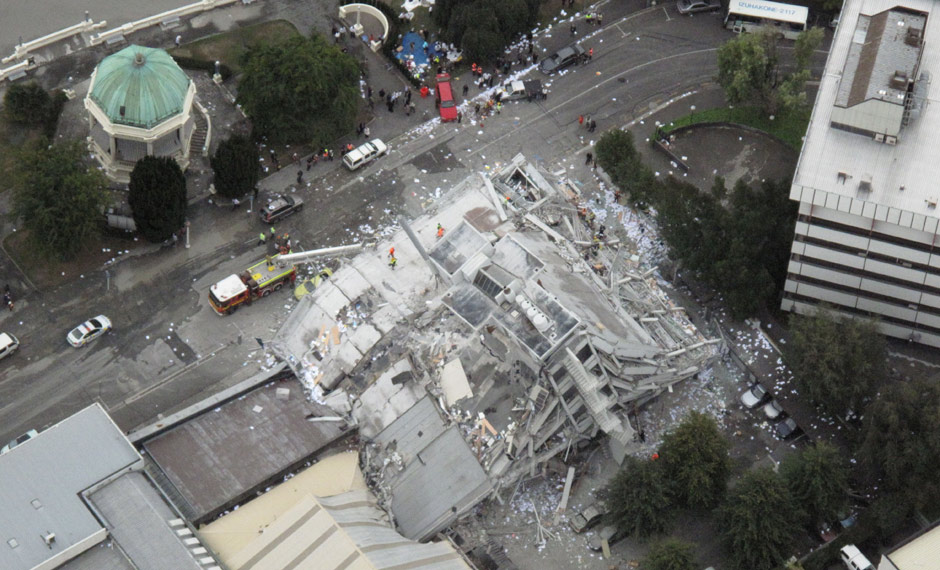 destroyed building, Christchurch, New Zealand, 2011
Many more deaths are expected. The water mains and sewer lines, still under repair after last September, have ruptured. Roads has been buckled up. \The streets are littered with dead bodies. The aftershocks keep coming. The earthquake was at shallow depth and Christchurch is built on silt and this amplifies the seismic effect and causes the process of liquefaction.
My mother is okay. She only lost the chimneys of her house. All I wanted to do growing up in Christchurch was get out. I I watched the raw footage coming through from a live feed when I was at Melbourne airport waiting to fly back to Adelaide.
The strong 6.3 magnitude shake--the main aftershock of the earlier 7.1--- dislodged the soft land around central Christchurch. This means properties around the Avon and Heathcote rivers face further damage, as the soil begins to slip towards the river, taking properties with it.
Update
New Zealand is in a region of extraordinary geological activity called the Ring of Fire, which stretches from Indonesia to the coast of Chile. For every 10 earthquakes on the planet, nine are in this region. New Zealand itself straddles the boundary between the Pacific and Australasian tectonic plates, which slowly grind into one another. In the south island the Pacific and Australasian plates slip past each other horizontally, producing the enormous Alpine fault that runs down the western flank of the island.
Christchurch sits on what is historically a tectonically active area where the Alpine fault runs right across New Zealand's South Island. Associated with this are many fault segments. What seems to have happened is that the pressure has built up on a particular fault segment with the epicentre much closer to the city itself.
February 19, 2011
British Photography: Herbert Ponting
Herbert Ponting, the official "camera artist" of the 1910-12 Scott Expedition, struggled to address the relative lack of classical perspective of horizon and scale.
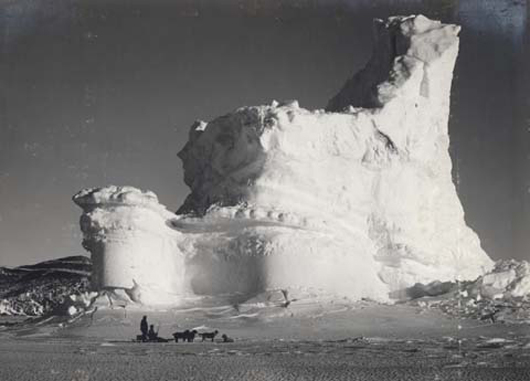 Herbert Ponting, The Castle Berg, 1911
The human-scale figures and the "sublime" icescapes only become meaningful in relation to one another. Elena Glasberg says in the Blankness in the Antarctic Landscape of An-My Lê:
Without human figures, the unfamiliar environment would escape the particularity of place. This paradox of encounter, which fueled the Heroic Age, between an indifferent ice and humans intent on colonizing the uninhabitable, recurs throughout Antarctic photographic representation. It has left deep traces of style, object choice, and perspective on Antarctic representational history, not the least of which is the powerful imperial imaginary of Antarctica as a tabula rasa, or a pristine, untouched, terrain that, as the translation "blank slate" would suggest, invited marking.
The kind of blankness produced by juxtaposing human figures on the ice or staging perspective with the lens is a "filled in" kind of blankness. It is not unlike the blankness of early European maps that designated the southern continent as terra incognita, in words written boldly across the map vellum.
Glasberg says that:
For Ponting, the inviting blankness of Antarctica seemed almost formalist, an aesthetic challenge to create a recognizable scape from such impoverished materials. That his photos were part of an imperial expedition to claim Antarctica and the South Pole underscores the role of cultural concepts in the construction of empire. Ponting's landscapes were more than attempts to fill in the blank of Antarctica with familiar gestures to romantic sublimity: they were claims on the territory created by the camera's eye as much as by the juridical intentions of the British.
Ponting's black and white juxtapositions of ice and human figures created a powerful aesthetic characterized by the trace of the body: the footprint, the track in ice, and the human figure itself. The Heroic aesthetic sees men, ice, materials, and animals all within a range of objects and relations that coordinate towards an inhabitation, a claim. Despite and against their own fragility or marginality to the ice, these marks march toward a future of increased levels of habitation: more marks and more men.
February 18, 2011
in Melbourne: Bolte Bridge
I'm in Melbourne attending a funeral and family matters, so blogging is rather light.I have planned to include some photography --after the funeral--but so far the weather has been unsuitable. It has been hot, muggy and windy.
It was unsuitable for the work I tried to do around the overpasses to the Bolte Bridge on Thursday after I arrived in Melbourne. I found the ideal spot for me--some public ground under the overpasses:
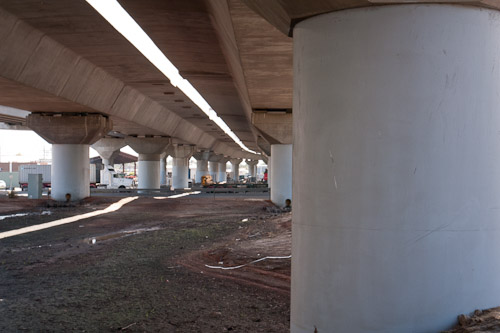 Gary Sauer-Thompson, overpass, Bolte Bridge, Melbourne, 2011
I worked between 11.30am--3.30pm but the light was ugly. I was waiting the cloud cover to come over --it looked as if it would, but it never did. I got badly burned walking through the Docklands to and from the Southern Cross Station to the overpasses.
I eventually gave up and caught the train out to Safety Beach down along the Mornington Peninsula.
February 16, 2011
German Photography: Clemens Bechmann
I am intrigued by the way Clemens Bechmann explores the impact of humans on the environment.
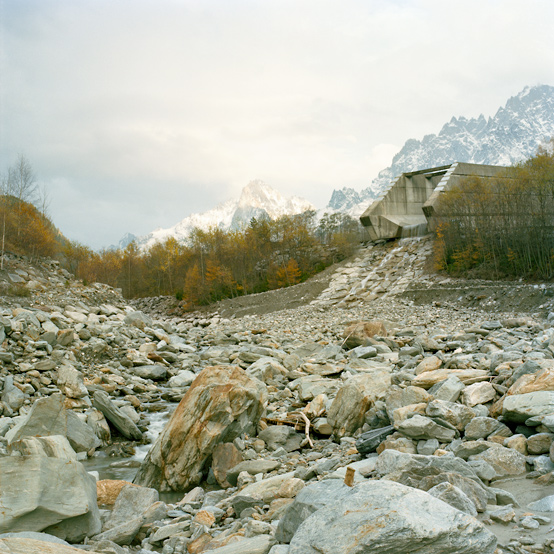 Clemens Bechmann,
This work shows signs of the measures to regulate the mountain areas for the tourist industries.
February 15, 2011
New Zealand Photography: Ben Cauchi
McNamara Gallery Photography in Whanganui exhibits New Zealand, selected Pacific Rim & International, photographically-based art; has a fundamental interest in modern & contemporary art practice; and an interesting roster of photographic artists.
One of the artists is the Auckland based photographer Ben Cauchi, the Auckland based photographer, who works with an 8 x 10 camera and renders images via a 19th century vocabulary.
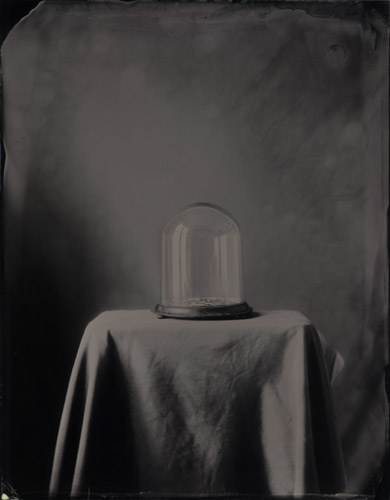 Ben Cauchi, The Hermetic Seal, 2006, ambrotype
His work deals with the psychological dimensions of memory, identity and the land, as well as, commenting on the very process of photography.
February 14, 2011
New Zealand photography: Derek Henderson
Photography is popular in New Zealand as an art form, concerned with the creation of images, the ideas communicated, and how they in turn make the viewer contemplate subjects and ideas.
Derek Henderson is a NZ fashion photographer who spent the better part of the last twenty years in New York, London and Los Angeles, and is now living in Auckland. He regularly returns to New Zealand for photographic trips. All his personal work is done in New Zealand.
The Terrible Boredom of Paradise' (2005) collects a series of photographs resulting from a 13,000 km road trip from Westport, South Island to Hikurangi, North Island over four and half months with a 4x5 camera. It is old New Zealand:
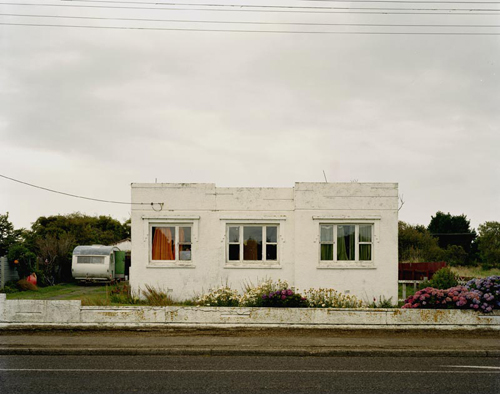 Derek Henderson, 41 Palmerston Street, Riverton, Southland, 10:30am, 23rd February, 2004, from The Terrible Boredom of Paradise' (2005)
Like Robert Adams's 'New Topography' of the 1960s and 1970s, Henderson highlights human impact on landscape. The power lines against the sea, the rusting train carriage that frames a mountain, the dilapidated shack incongruously boasting a blooming hydrangea show a country where beauty is everywhere but often ignored and invariably damaged.
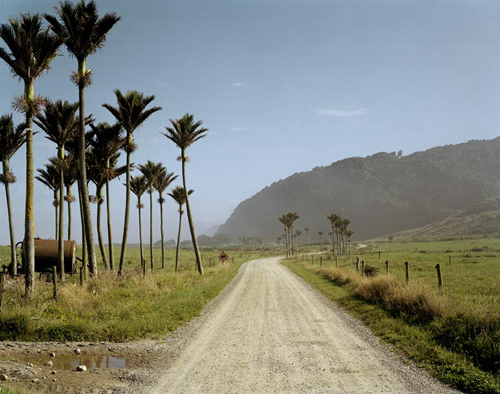 Derek Henderson, Kohaihai Road, North Beach, West Coast, 10:30am, 9th February, 2004.
He observes that it "It’s a beautiful landscape, but everyone seems to be quite bored.”
A latter rbook is "Mercer Mercer "(2008), which is is a photographic exploration of the Waikato River:
Derek Henderson talks about his exhibition at the ACP from ACP Exhibitions on Vimeo.
This body of work is as a reaction to the stereotype in the plethora of New Zealand’s scenic landscape books that present a certain skewed depiction of NZ as a wilderness paradise in the form of photographic journal of a roadtrip that refers back to Robin Morrison’s The South Island of New Zealand from the Road (1981).
February 13, 2011
German Photography: Margret Hoppe
Margret Hoppe was born in 1981 and studied philosophy, art history as well as photography. The Leipzig-trained photographer often explore the absence and disappearance of the socialist realism imagery in former communist countries in Eastern Europe. An example is the Bulgarian monuments series.
Hoppe says that in this post communist state there are still many outdated monuments that still represent the ideology of communist power:
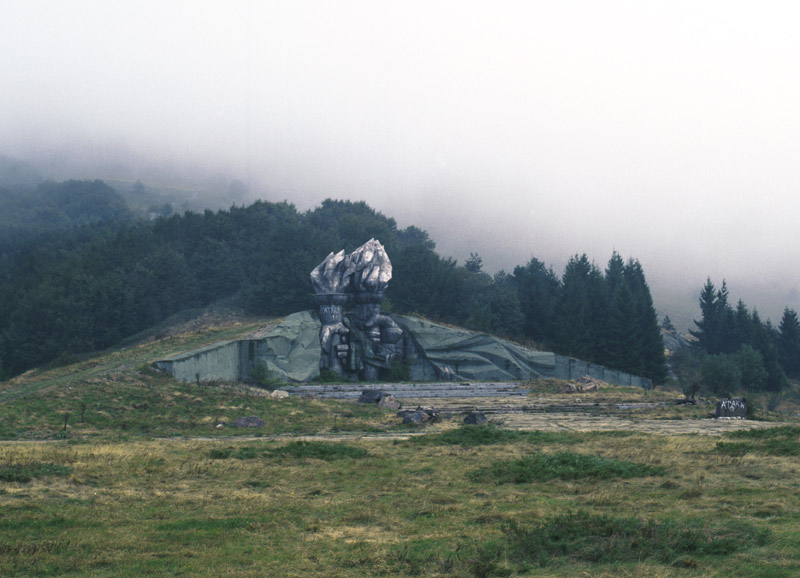 Margret Hoppe,Stoju Todorow: Unity of the fight for national and social freedom, 1975, Busludscha summit metal, concrete, 2007
These are now ruins that being re-interpreted.
Hoppe says:
After the cultural turn in 1989 the character of those monuments changed. They were destroyed or abandoned and thus altered their appearance. In my photos I show different states of their variation and by doing so put a question mark over the value of those relics.
They would also be forgotten with the painful memories of life under a dictatorship buried. They would eventually become alien:
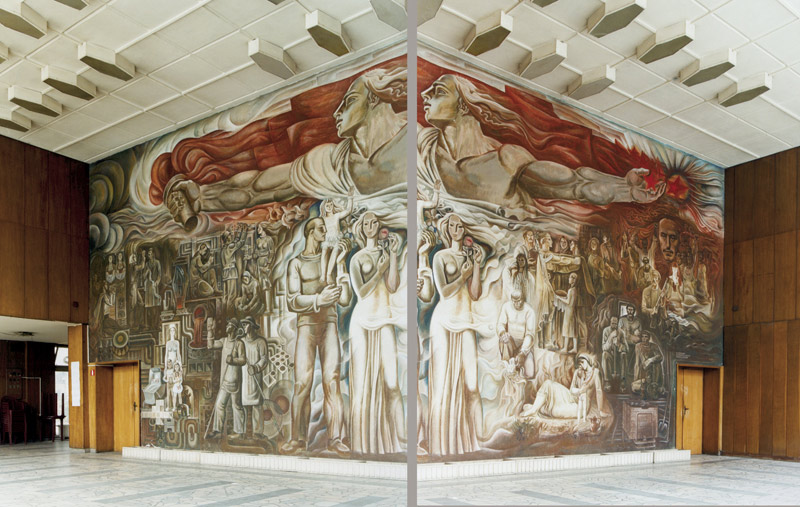 Margret Hoppe, Dimo Saimow: Die Partei (The Party), 1976, wall painting/ party building Pernik, 2007
Hoppe photographed these socialist monuments ehile on a DAAD scholarship in Bulgaria, a popular holiday destination in GDR times.
February 12, 2011
New weblog: poodlewalks
I have started a new weblog called poodlewalks.
It is a lo-fi visual diary using the WordPress publishing platform to feature snaps made on my daily afternoon walks with the standard poodles. It is a lo-fi photo blog because the photography for the blog is done with a point and shoot digital camera with minimal processing.
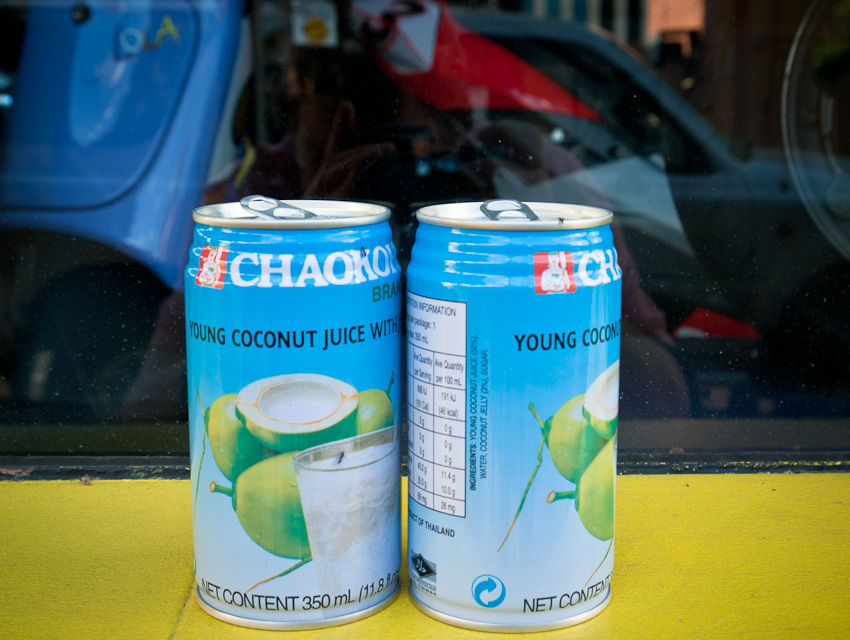 Gary Sauer-Thompson, Coconut Juice, Adelaide, 2010
I take quite a lot of photos whilst walking with the dogs and I do very little with them. They are stored on the hard disc of the computer and I select only the occasional one to publish on either Flickr or my Rhizomes1 photoblog.
The most that I do with the rest of the pictures on the hard drive is to go through and edit them occasionally when I'm looking for visual ideas to explore. Some of the pictures are okay but, for some reason I don't post them on Flickr or Rhizomes1.
Hence the idea of a lo-fi photoblog in which these kind of images can be published and so shared with others--I'll just publish them.
February 11, 2011
the photographer's darkroom
With the ongoing march of digital technology the photographer's darkroom is rapidly becoming part of photographic history.
The pro labs are quickly going. Hence the documentary project by Richard Nicholson of London's last commercial photographic darkrooms. When Nicholson began to shoot images of professional darkrooms in and around London in 2006 some 204 were still in existence, continuing the printing of image from film-stock to paper within the new digital era. When he completed the project some three years later, only 6 remained.
February 9, 2011
shit happens
In the light of these events:
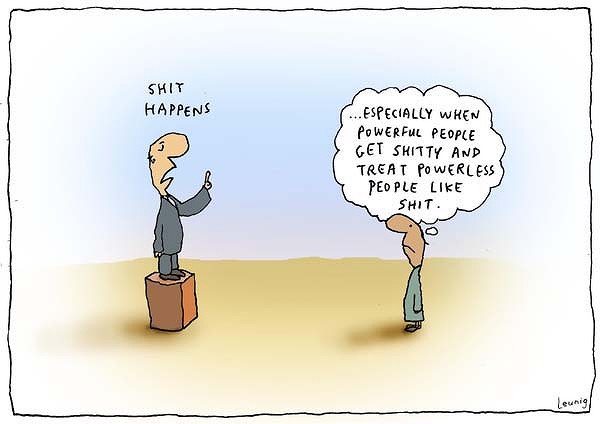
Some times people have enough of being shitted on from those in power. The Egyptian people are an example.
February 8, 2011
a small step
I sent off 7 black and white 8x10 double dark slides to Chris Reid at Blanco Negro to be processed. Nobody in Adelaide provides this service (only 8x10 colour processing but no scanning), and Blanco Negro is the only " pro-lab" in Australia that provides this service. Blanco Negro is actually a commercial fine print darkroom.
The photos have been taken over a number of months and they have mostly been landscape details at Victor Harbor--eg., rock studies--- and urbanscapes at Port Adelaide. I started out very hesitantly and modestly, feeling my way:
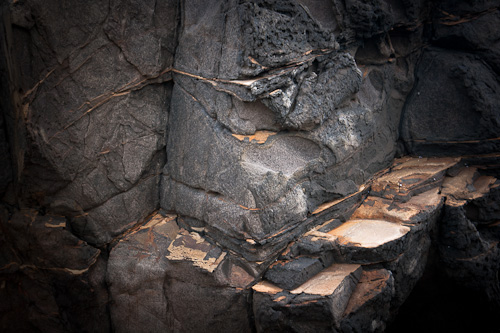 Gary Sauer-Thompson, rock ledge, Petrel Cove, 2010
I wasn't at all confident in what I was doing. Nor am I sure where I am going with this kind of 8x10 work. I want to continuing to work in black and white and I have a vague idea of exhibiting the best images in this body of work.
Flickr has provided me with a platform to get my photography off the ground and now I want to move on. That's working on projects and having exhibitions.
February 7, 2011
slow photography
Tim Wu in The Slow-Photography Movement in Slate draws our attention to the instant fast photography of people taking tourist photos:
What struck me was just how like a reflex the whole process was; the act of photography had become almost entirely unconscious.....Speed has gained ascendance over everything. Today's cameras are remarkable devices. It is easy to take hundreds or even a thousand photos in a single day..... Photography is so easy that the camera threatens to replace the eyeball. Our cameras are so advanced that looking at what you are photographing has become strictly optional.
All this has spawned a rebellion that is being called the slow-photography movement. My turn to large format photography means that I'm a part of this movement. This evokes a direct comparison to slow food, and over the last 10 years there's been a greater recognition of what fast food has done to our bodies and health.
Wu's argument is that that fast photography leads to a focus results and documentation, while not bad, can lead you to miss out on other, deeper experiences. It is the difference between an activity as a means and as an end in itself.
February 6, 2011
just too slow
This was the view I was trying to take with the 5x7 Cambo monorail early on Saturday morning. But I failed.
Just when I was ready to take the photo the sun came out behind the clouds and shone straight into the camera. The sun had shifted from directly lighting up the face of the cliffs just after dawn --which is what I'd initially seen--- to the worst possible position for me, whilst I was struggling to set up the camera.
 Gary Sauer-Thompson The Bluff, 2010
I'd taken too long to set the monorail up. I hadn't allowed for that. I should have got there before dawn instead of after dawn. The conditions were perfect too:--cloudy, no wind, soft light. Those kind of conditions don't come that often in summer. I blew it.
I decided to come back in the afternoon when the sun was behind me. But by then a really strong south west wind was blowing across the sea and the cliffs. The same windy conditions prevailed on Sunday, only the wind was stronger and there was no cloud. So that was that.
How you actually compose the image using a large format view camera in the dark beats me. You wouldn't be able to see anything through the ground glass. Nor do I fancy scrambling around on narrow ledges in the dark.
February 3, 2011
British Photographer: Tim Rudman
The conversion of mainstream photography to digital--it is the predominant technology for photography --- has actually stimulated interest in older processes to the quieter, more craft-based approach. Tim Rudman, the British photographer and master printer, is currently having a show at Gold Street Gallery. His printing and toning processes derive from the late nineteenth and early twentieth centuries,
Rudman says of his series of photographs of the The Victorian era West Pier at Brighton England that it:
was closed and inaccessible for twenty five years after being deemed unsafe. Cut off from land, it was abandoned to the elements and in the last two and a half decades its only visitors were the pigeons and sea birds that made it their home. In the winter months they were joined by some fifty thousand starlings and their flocks became a local feature. I still have memories of being taken on the pier in my childhood and I have watched its slow decline with sadness. I was granted access to photograph the very unsafe pier, until it collapsed into the sea.
He adds that the remaining structure was subsequently burned down by boat-borne arsonists, whilst it was awaiting Heritage funds for restoration.
 Tim Rudman, West Pier#2, Silver Gelatin print
The series--unfinished--was an exploration of Rudman's past and some of the feelings from there that were uncovered when he entered this sad pier in its derelict years. Rudman is a member of the Arena Photographers from the South.
February 1, 2011
Cyclone Yasi
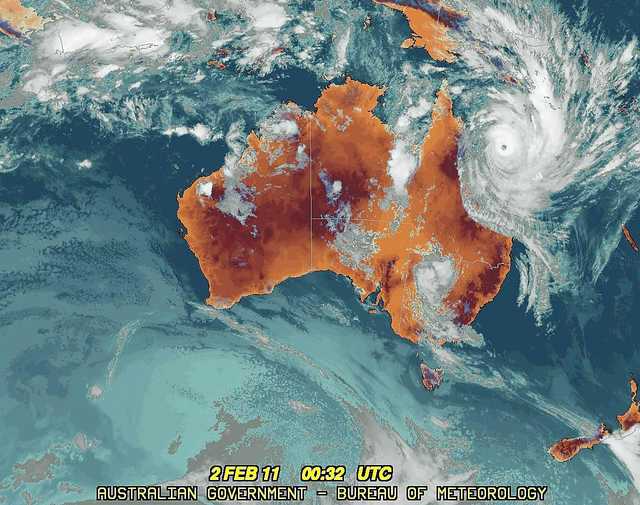
The powerful and massive Cyclone Yasin, a category 5 cyclone, is bearing down on the Queensland coast near Cairns. It is expected to hit around 10pm on the 2nd of February and to move inland as far as Mt Isa.

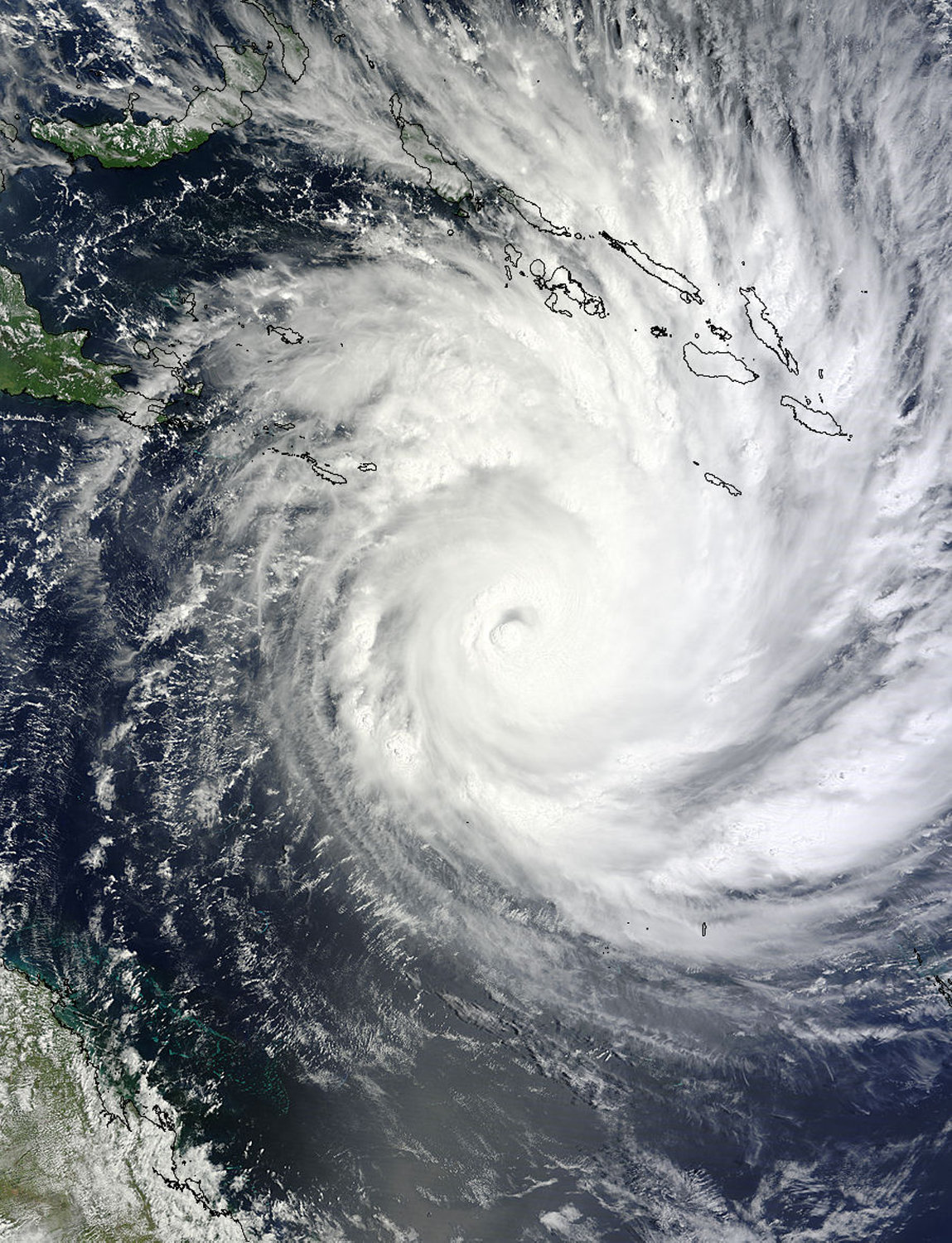
Cyclone Yasi is a powerful and dangerous storm and is generating waves up to 38 feet (11.5 meters) in the Coral Sea. The system is expected to continue to intensify. Winds are expected to be approach 300 kilometres an hour and a storm surge of 2.9 metres on top of a very high tide of about 4.1 metres is expected.
This is bigger than Cyclone Tracy, the most devastating storm in Australian history, and could cause even more widespread destruction than Tracey caused in Darwin. Cairns will be inundated.
Update 1
This is a monumental storm that poses an extremely serious threat to life and property within the warning area between Cairns and Townsville. Yasi could take at least 24 hours to weaken after it makes landfall.
There are reports that some people are going surfing. Others--storm chasing photographers-- see it as once in a lifetime experience.
Update 2
The latest tracking map from the Australian Government Bureau of Meteorology. It’s expected to hit around midnight local time tonight. It is not expected that the cyclone will diminish in intensity. 6.6. metres waves hit Townsville this afternoon; now they are around 9.6 metres.