|
February 23, 2011
In contrast to Herbert Ponting seeing Antarctica as wilderness and an imperial blank slate tourists, artists and scientist now go to there each summer. As Elena Glasberg says in Blankness in the Antarctic Landscape of An-My Lê:
Working within globalizing capital and big science in Antarctica is a small but persistent history within the U.S., the NSF: the Artists and Writers Program. Beginning as early as 1957, it has sent visual, sound, literary, and other artists-observers to the ice, including both Porter and Lê. The AAWP has managed beautifully to balance the requirements of the state and the need to support science with an allowance for artistic freedom. Although the populations of the southern hemispheric states like Australia and New Zealand incorporate Antarctica much more intimately into their national cultures, the size and quality of the U.S. program has produced a U.S.-authored commentary disproportionate to U.S. cultural involvement in Antarctica.
She adds that we could even argue that the program keeps the U.S. in the game culturally, and in the important area of geopolitics and the media, or that the AAWP is the cultural wing of a neoimperial project in Antarctica, one that operates beyond the need to legally claim territory, and that surpasses the sundry claims of other nations no matter their histories and worthiness.
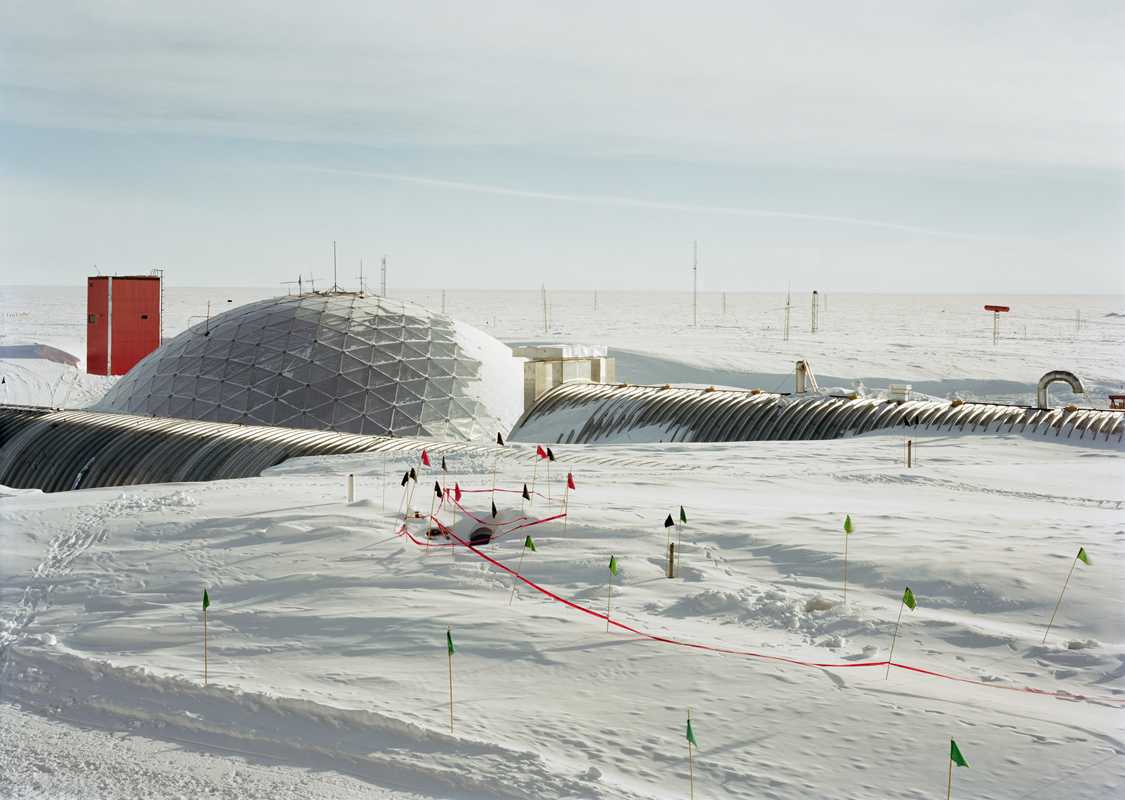 An-My Lê, Abandoned Dome, South Pole, Antarctica, 2008, Archival pigment print, from the Events Ashore series.
This is a Buckminster Fuller geodesic dome, or a "Bucky Ball," that is slowly being buried in the ice of the south pole, after having been planned in the late 1960s and completed in 1973 and shielding inhabitants and supplies until 2007?
Lê, an assistant professor of photography at Bard College in New York, in taking photos of military ships delivering supplies explored notions of empire and military might in the face of the natural world's vastness.
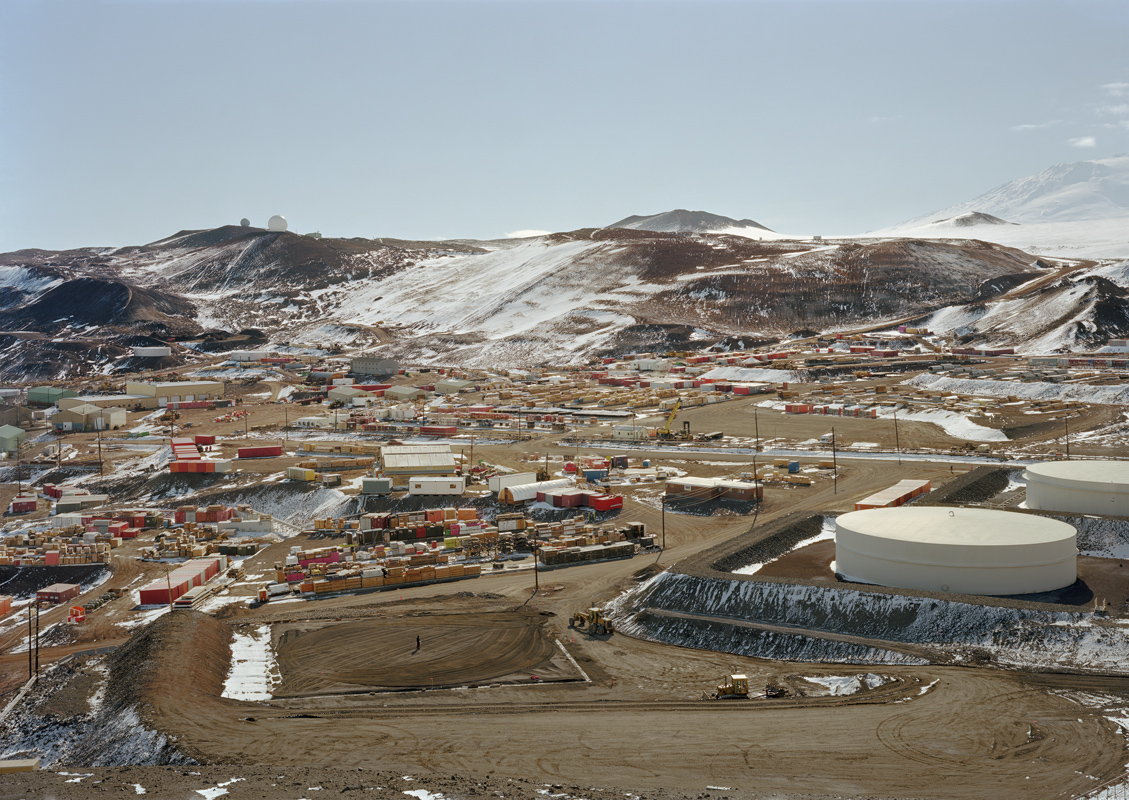 An-My Lê, Fuel Storage Tanks, McMurdo Station, Antarctica, 2008, Archival pigment print, from the Events Ashore series.
U.S. presence at the site of Scott's former base is a location that at first glance hardly seems Antarctic at all. Glasberg says that:
Lê disrupts the aestheticization of Antarctic wilderness begun with the Heroic Age and instead links Antarctica to sites of U.S. militarization around the globe. Lê inherits an iconography from Ponting and applied to a U.S. western subject through Porter, but focuses not on the "empty" deserts of untouched wilderness, or the wilderness fantasy, but rather on the traces of human presence mystified in the Porter images. For Lê, the detritus of a built environment becomes the survival of the Heroic and later environmentally conscious ages that sit strangely, disturbingly on a contemporary Antarctic of international science.
She says that Lê refuses the overexposed, official view and shifts away from what we might call an Antarctic exceptionalism. Antarctic exceptionalism, modeled on American exceptionalism, creates a separate sphere for Antarctica. Lê's high art and highly technical images negotiate between the landscape aesthetic that broke down at the Pole and the more vernacular aesthetic that visitors to, and inhabitants of, the South Pole have been attempting to reestablish. Lê focuses instead on the industrial infrastructure, the chaotic, menacing, and wasted space of an unredeemable blankness very different from both the blank of imperialism's hope and the desert of Elliot Porter's conservation aesthetic.
|
|


