March 31, 2008
photoblog-----Rhizomes1
My photoblog --RhizomesI--- is finally up and running. It needs some tweaking design wise and it needs to be bought into Thought-Factory network,. But it has the photographic quality and size that I desire. It was a quality that I never could obtain from using Movable Type here on junk for code, and it was that lack that pushed me into setting up RhizomesI
The photoblog and Flickr change the way I make my photography public. Junk for code will no longer be the main mode for my photography. This weblog has served its purpose of facilitating my return to photography after a long break when I stopped using film.
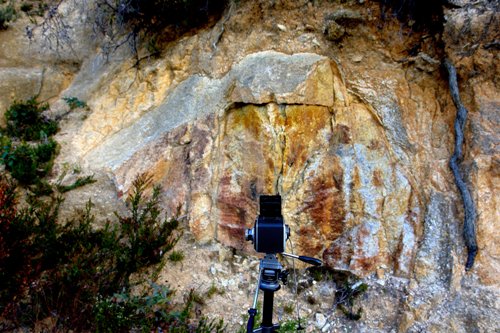 Gary Sauer-Thompson, Wilsons Promontory, Victoria, 2008
I'm not sure how many Australian photographers run photoblogs as opposed to weblogs about photography or producing e-books. Not many from what I can judge.
In this article on the future of photography Rob Haggart says:
You’ve got to make your photos available online for free. Anything that can be distributed digitally must now be distributed for free to remain competitive. Not for commercial use and not without attribution but fans should be able to distribute your photography for free and view it big on your website without watermarks and other barriers. It’s not like you don’t already do this it’s just that there’s a lot of hand wringing going on about the ability of consumers to scrape your photos off your website. It’s not necessary because they’re the fans you want to sell prints, books, lectures, clinics and personal commissions to. You should encourage them to look at and help you distribute your photography so you can bring in more fans. Don’t forget that some of those people will be Art Buyers and Photo Directors.
I am suprised by the emphasis on fans as the audience but then that is the way music works. So why would photography be any different?
Michael David Murphy response the The Future is Alor, ” on 2point8, says that Haggart’s future of photography:
will not be found in the hushed walls of the gallery, or in the download-disabled watermarked-protected sites of copyright-scared photographers. The future’s already out there, in cheaply printed print-on-demand books, in small collaborative global-web-ventures, in xerox copies taped to lightpoles, affordably editioned prints, and in sites like Mark Alor Powell’s.
I do know enough about the world of digital photography to be able to comment.
Desert Rhythms
The project I have been on is finally slowing down; essentially to a standstill. It will go live next month. This raises a few issues. Since I have been doing eighteen hour days in the last month of the project I am kind of at a loose end as to what to do with all this copious spare time. I am also in the groove of the project's clock, rising at dawn and going to bed at midnight. On saturday morning to walk off the energy of having nothing to do upon waking I went up Camelback at the crack of dawn.

It is one of the popular city walks in Phoenix that is well travelled from dawn to dusk despite being a strenuous hike. There were many people walking up it at dawn including some who had hats with lights on them having obviously hit the trail prior to the sun leaking over the horizon. It is a beautiful walk with the strong red of dawn, the rocks shining a bright orange or a deep gold.


It has been an abnormally wet spring in the desert and the environment has responded appropriately. The flowers and trees are blooming with great vigour at the moment. You don't normally attach allergies and hay-fever to a desert, but the sniffles are a common ailment in Phoenix with all the pollen in that air at the moment.

The big winner has been the grasses, they have pretty much occupied every wet niche of the desert. A native Phoenician exclaimed with surprise to me recently that she has never seen the city walks so green before.
March 30, 2008
a dead public space
It was a warm early evening around 5-6pm when I took this photo in Perth's CBD. Yet no one hung around this space on a weekday to have a drink and socialize before heading off to their homes in the dormitory suburban fringe development. If Perth is a nice place to live it isn't a vibrant place to live.
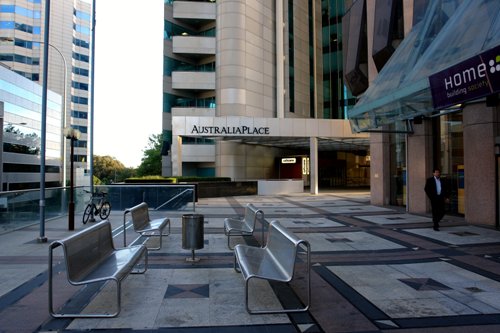 Gary Sauer-Thompson, Australia Place, Perth CBD, 2008
There was very little urban vitality and spark in Perth's CBD that Thursday evening. Mostly people were waiting at bus stops to go home. There was nothing in this public space in Australia Place to encourage people to tarry a while and meet up with friends over a drink. I was looking for a space to sit amongst people in a bar as I walked the streets, but I found nothing. The CBD was emptying out. It becomes a bit of ghost town at night.
I didn't come across any bars in my explorations. Just like Adelaide I thought--it lacked a vital and exciting urban life. The CBD was all about working in the business precinct, and then shopping in the mall. From what I could see people got drunk and partied in the expensive restaurants, where the 'easy-living, boom-town' status was expressed.
Perth lacked a bar culture despite having some laneways in the CBD. It was all pubs and restaurants. All the dreams and desires seem to be embodied in the proposed Riverside development.
I appreciate that East Perth and Subiaco offer a superior urban life than the suburbs. The smaller private space is made up for by high quality public spaces, and these neighbourhoods enbale their residents to walk to many destinations locally, whether visiting a friend, going to work, catching a train or grabbing a meal. East Perth and Subiaco do demonstrate that reurbanisation is possible in cities heavily influenced by the Garden City Movement, where the automobile and public perception has been traditionally anti urban and pro suburban.
March 29, 2008
wandering Perth's CBD
I had little time to wander and explore around the CBD of Perth due to work commitments. But I did manage to walk up and down St. Georges Terrace exploring the street and the architecture --the old and new. This strip was the finance sector, and the corporate buildings were a mixture of nineteenth century, brutalist modernism and the glassy international style with a postmodernist touch.
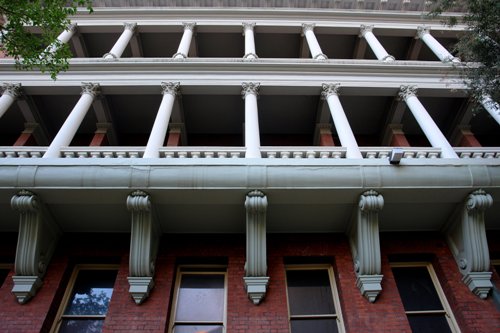 Gary Sauer-Thompson, heritage, Perth CBD, 2008
The shopping precinct still appeared to be centred in the Hay Street mall and, from what I could make out, little had changed as a result of the boom. The expansion in the CBD was in corporate finance. I did see signs of a new shopping complex being built in St Georges Terrace--an indication that a big boom needs a new up to date consumer palace with unrestricted trading hours.
Should this circa 1960s modernism be seen as heritage?:
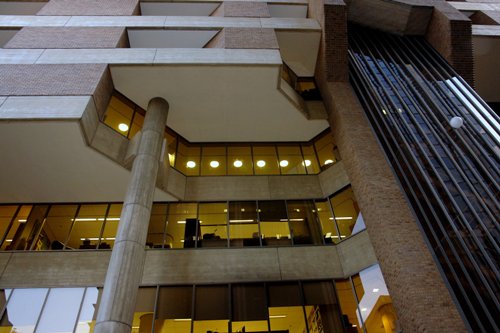 Gary Sauer-Thompson, State Insurance Office, off St Georges Terrace, 2008
Then we have the gesture to the postmodern in what is heralded as the finest modern landmark office towers in Perth and Perth's premier corporate headquarters. The building signifies that Perth is no longer stuck in a 1970s mentality like Adelaide:
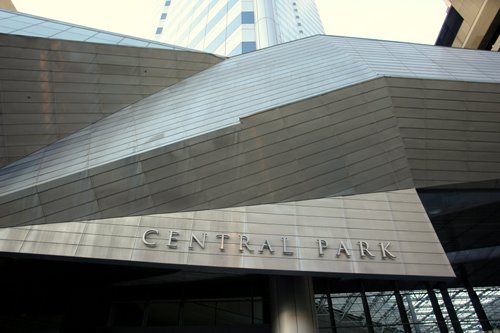 Gary Sauer-Thompson, Central Park, Perth CBD, 2008
This is 21st century Perth, whose image is that it is becoming Australia's version of California. I couldn't see it myself--the population is so white and Anglo-Saxon---but this was the self image of many living in Perth.
March 28, 2008
Wynne prize 2008
The Wynne Prize is awarded to what the judges consider to be the best landscape painting of Australian scenery in oils or watercolours, or for the best example of figure sculpture by an Australian artist. What is the connection between figure sculpture and landscape painting by the way?
The winner in 2008 is:
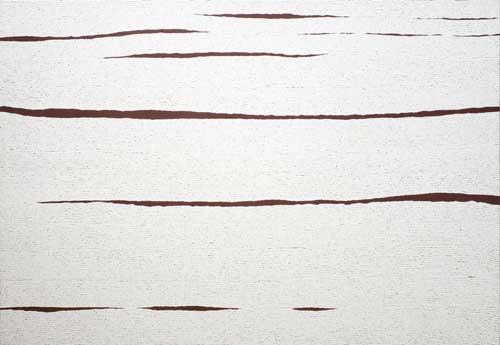 Joanne Currie Nalingu The river is calm
This is indigenous art that mediates between the traditional indigenous landscape and New York style minimalism and the abstracted landscape. I cannot evaluate it in relation to the other finalists as the NSW Gallery does not put them online for us to see. You have to be in Sydney to see them. This assumption that Sydney is Australia leaves me in the position of not knowing what kind of work Christian Lock and Julie Harris---or any of the other finalists--- have produced.
March 27, 2008
in Perth
I'm in Perth and my days are full. I'm talking to people at Murdoch University about where health care is going in the future. The evenings are taken up with working dinners. Other days are taken up with a conference.
The cartoon is a playful, whimsical joke by Moir about town planning in Sydney and the way they make a mess of things in the name of development:
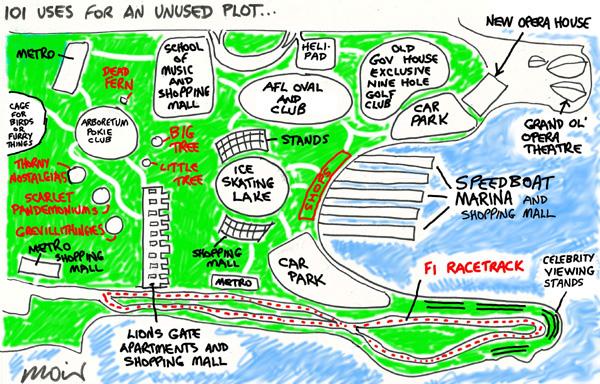 Alan Moir
I feel schzoid, dislocated in Perth. This is a boom city that has all the effervescence of the bubble economy with the old inferiority complex-----isolated, ignored, ripped off etc by the eastern states. There is little sense of the eastern Carpenter Government using the cash to plan for the future to improve urban life. From what I've seen so far Perth looks to be car dominated, whilst the CBD has little sense of urban life. It's all about business not society.
WA's booming economy, which is based on being China's quarry, is contributing to the nation's growth and prosperity. The state government runs a budget surplus around $2billion or so and yet it is unwilling to spend money to provide the digital infrastructure---cables, power, security and internet connectivity--- to put Rudd's computers into public schools. The Carpenter Government is complaining about having to spend money to link up schools and kids to the internet when they are rolling in a cash and should be using the cash to invest in the future of their state.
An op-ed in the tabloid West Australian by Paul Murray interprets Rudd's computer policy in terms of class warfare! Why? Because Rudd Labor uses the language of a digital divide and social inclusion. I couldn't even follow the reasoning of this Australian conservatism. The article was actually about computers not helping with basic skills of reading and maths and appear to have a negative impact. There was no mention of digital literacy or the internet being a part of every day life. This is not part of Murray's 1950s thinking about education.
March 25, 2008
sensing the sublime
Finally, the promise of rain other than a bit of drizzle that wets the road. It was a a touch of autumn on my walk last night at Victor Harbor before returning to Adelaide and then heading out west to Perth and the heat.
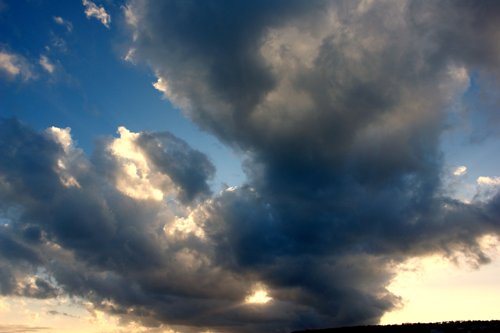 Gary Sauer-Thompson, storm clouds, Victor Harbor, 2008
The sublime talk is seen as little more than a turning towards the archaic emotive language of Romanticism. Why cannot we speak of the sublime in the contemporary context whilst refusing to reduce the sublime to the spiritual and transcendent experience?
For Burke or Kant the sublime meant the experience of human limits, notably the limits of rationality.It expresses the edge of our conceptual powers and reveals the multiplicity and instability of the postmodern world.Did not modernism reinvent the sublime in terms of the primitive? Modern art was born in the late 19th century partly out of the frisson between imperialist European powers and the cultures to which they suddenly had unrestricted, and for those cultures often catastrophic, access. Wasn't something more creative and ambiguous going on than the pejoratively labelled "primitivism"? Thus Pablo Picasso invented Cubism after seeing African masks.
Others hold that modernism was the true art of the sublime and talk in terms of the utopian sublime of modernism---meaning the idea of art seeking its own dissolution by dissolving itself into life.
March 24, 2008
modern living
The 60 year old movement to the suburbs is being counterbalanced by the movement back to urban living in the inner city. Back then the suburban dream embodied in the General Motors Pavilion was "the world of tomorrow. ride called the The Futurama-- in the New York World's fair of 1939 and 1940 is fading, even as the suburban grid continues to spread out around our capital cities.
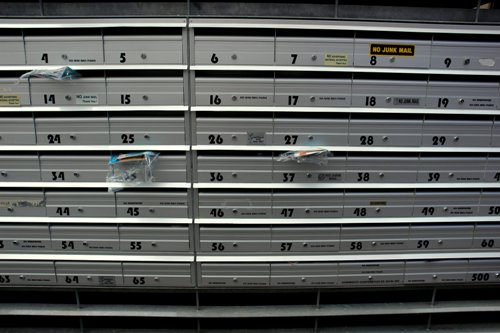 Gary Sauer-Thompson, letterboxes, Adelaide CBD, 2008
This turn away from suburban life and a return to the city as a space where Australians live and work involves suburbia being re-interpreted as a bleak world, as the outer suburbs on the city fringe are segregated from work, shopping and entertainment. Urban life in contrast, is seen as exciting, diverse and vital. So we have the regeneration of the inner city.
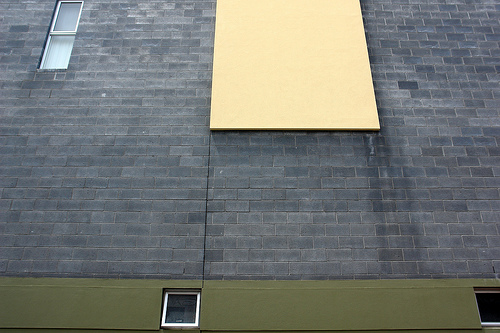 Gary Sauer-Thompson, window, Adelaide CBD, 2008
If conventional suburban lifestyles are falling out of fashion as a walkable urban lifestyle comes into favour what is going to happen to the cheaply built McMansions and the large suburban residential areas being built on the edges of our cities? Will they deteriorate in value? Will they become a region of lower -income families and rental properties? Will the car-based suburban regions decline the way the inner city did in the 1960s--becoming magnets for poverty, crime and social dysfunction?
I don't know the answer to these questions. I'm not even sure our town planners are thinking in terms of the outer suburbs declining and becoming dysfunctional. They are still thinking in terms of an ever expanding suburbia.
John Tuomisto-Bell's Bronze Pouring
I recently went to the opening night of a new display by Arizonan sculptor John Tuomisto-Bell at the G2 Gallery. The main piece was a large bomb which could be wound up until a large spring took over and the bomb made a large cracking sound. It was loud enough that the whole gallery would jump each time it was wound up.
I was fortunate enough to be invited to a bronze pouring at his studio this weekend. Unfortunately I forgot my camera and the photo below is from a previous bronze pouring event.

I thoroughly enjoyed it. John gave a bit of a speech of the intricacy that goes into a casting, from wax, to ceramic shell, to smelting the bronze to pouring. It is a time and labor intensive process. Unfortunately the mould they were pouring into this weekend cracked and broke,spilling bronze all over the sand covered pit the mould was ensconced in. It is a hazard of the process; which can be an expensive setback especially when it is a casting for another sculptor.
More of John Tuomisto-Bell's work can be seen on his website.
March 23, 2008
Conrad Martens
Edmund Burke's notion of the sublime referred to romantic notions of ‘terror’ and ‘awe’ in landscape. Burke talked about the sublime in terms of infinity, vastness and intensity of feeling, especially terror and awe, and drew a clear distinction between the sublime and the concept of beauty, which he linked to feelings of pleasure, tenderness and harmony and with things of delicacy and elegance.These emotions of terror and awe could be triggered by steep mountains, or gloomy grottoes.
In the Australian context, with Marcus Clarke, the emotions of terror and awe associated with the natural sublime could also be triggered by the 'weird and melancholic forests'. The Australian landscape was primitive and frightening, the untamed opposite of the English pastoral ideal.
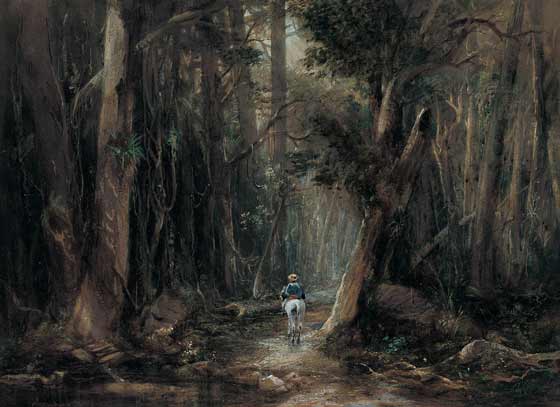 Conrad Martens, Forest, Cunningham's Gap, 1856, Watercolour on paper
The conventional art historical view is that the Australian landscape was seen in settler Australia as very boring and dull and monotonous, and that the artists complained that they couldn't really construct sublime or picturesque kind of pictures out of what Australia presents. Some traditionalists even thought that landscape painting couldn't be done in Australia. They were referring to neo-classical Georgian Claude Lorrain-type landscape.
What was created by Conrad Martens and others is the visual language of the romantic sublime.
March 22, 2008
Landscape at the NGA: Turner to Monet
The title of this post refers to the blockbuster exhibition at the Australian National Gallery, which looks at landscape painting in the nineteenth century as it transformed from the depiction of known places to explorations of mood and time passing. This intimate image is included:
 Van Gogh, Tree Trunks in the Grass, 1890, oil on canvas
The exhibition includes a large number of Australian landscapes. The key idea of the curators---Ron Radford, Lucinda Ward and Christine Dixon--- is that the Australian romantic painters----such as John Glover, Eugene von Guerard + Conrad Martens --were continuing British and northern Europe traditions of landscape; and that in responding to the Australian landscape these cliche-ridden and hack painters came into their own.
They stopped trying to imposing an inherited idiom and falsified ideal and started painting sunsets, the dramatic vistas with their mountains and seaside cliffs, and pastoral views that implied divinely ordained ownership of the land.
This view contest the traditional art historical interpretation of the Australian romantics that their fondness for the romantic sublime were simply unable to get to grips with Australian light and its anti-picturesque physicality. That only came with the noonday light of the plein-air of the Heidleberg school. What we have is an argument that is profoundly and strategically 'national'--Australia had its own culture and history--and which placed an emphasis on border protection not border crossing, essence rather than hybridity and centres rather than margins.
Radford and Co tend to downplay Australian exceptionalism and suggest that Australian art is a lot like that of other places.
March 21, 2008
Elvis: 1968 Comeback Special
We watched Elvis Presley's "1968 Comeback Special" on ABC1 last night. This was a comeback after Presley had seemingly abandoned live performing in favor of a career making awful movies, and it revitalised his musical career.
By 1968, the British Invasion had largely chased the older American rock artists off the charts and rockabilly as a commercial genre was put away for good by the arrival of the Beatles So a lot depended on this comeback. In it Presley showed that he had combined the rockingest current urban sounds with the most backwoods country to create a new sound that had more edge than either of its sources.

The '68 Comeback Special was an intimate show, with Elvis singing his old songs on a small stage, often alone, surrounded on all sides by small audience. The show's numbers fall into three general categories: the black leather stand-up shows, in which Elvis performs solo on stage; the black leather sit-down shows, in which Elvis jams with former bandmates Scotty Moore and D.J. Fontana and others; and big production numbers, often overdone and now looking as dated as any other 1960s variety show.
My preference was the black leather sit-down show where he sang some of the rawest rock and blues he had ever recorded. This was rockabilly ---section, with its uptempo fusion of country and rhythm and blues with a strong back beat.
This verison of 'That's All Right' is neither blues or country, even though it's roots is a 1946 blues song by Arthur "Big Boy" Crudup. This interpretation reaches back to Sun Recordings in 1953/4.
The rockabilly look or fashion is definitely black leather. Presley was arguably at his strongest when he was singing rockabilly, that rock and roll prototype he virtually invented along with Carl Perkins. Milk Cow Blues is a good example of this classic style:
This was recorded December 1954 at Sun Records with Scotty Moore on guitar and Bill Black on standup bass, and Elvis on guitar. It was originally recorded as Milk Cow Blues Boogie in the 1930s by Kokomo Arnold, and adapted by Robert Johnson as Milk Cow Calfs Blues.
Easter: caring, sharing gospel or bacchanalia?
It's finally autumn in Adelaide. There was coolness in the air this morning and just a touch of rain yesterday evening as we drove into Victor Harbor, and then again early this morning. But it cleared to being bright and sunny late morning with a cold southerly wind.
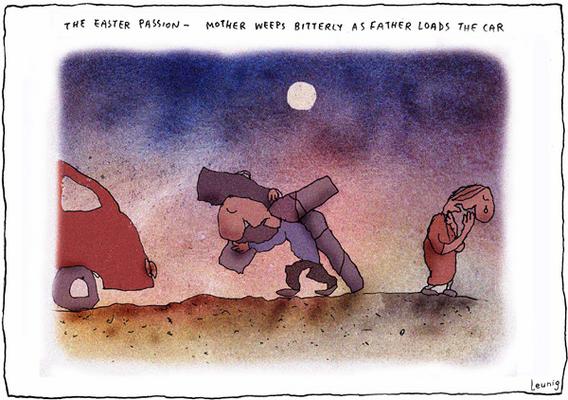 Leunig
My current cross is technology ---getting the renovated desktop computer, wireless modem, laptops and software to work smoothly at the weekender so that I can actually post. The shift in just over two years is one from just having an old second computer with dial-up to the beginnings of a photographic studio with lots of digital backup (LaCie Ethernet Big Disk) and online music.
But I have no idea what Easter rabbits and eggs have to do with Christ dying on the cross and rising again---the Last Supper on Holy Thursday to the death of Jesus on Good Friday and finally, his resurrection on Easter Sunday. However, Easter is all about the easter eggs. There are no cards, customs, songs about the latter. It's chocolate everywhere in the supermarkets. If renewal and hope are the great themes of Christian Easter, then people in the shopping malls in secular Australia translate these themes into long boozy afternoons, judging by the amount of alcohol being carried out the bottle shops in the shopping malls in Victor Harbor.
The caring, sharing gospel seems to have been replaced by a 4 day bacchanalia.
March 19, 2008
Rosemary Laing
As a satellite exhibition to the Art Gallery of SA's Australian Biennial of Australian Art Handle with Care - we have Rosemary Laing's photographic series to walk on a sea of salt, and Susan Norrie/David Matow photographs of the steel walls and razor wires of a desert detention centre at Woomera.
Some would argue that these images have little conceptual subtlety as they prefer prefer ambiguity in art.
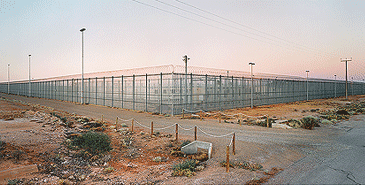 Rosemary Laing, Welcome to Australia from 2004
Butt these are a stark reminder what the detention of aslyum seekers would involve. They suggest harsh penal treatment.
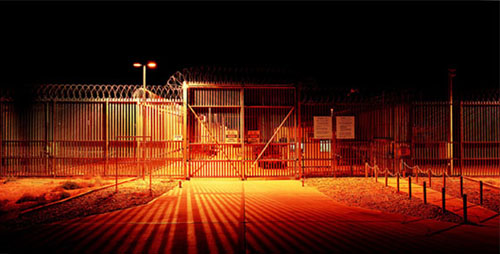 Rosemary Laing, Welcome to Australia from 2004
We do not want to forget this history, even if the cultural conservatives say critics of the camps and their harsh treatment of asylum seekers hate their country and are un-Australian. Australians, these conservatives say, ought to feel pride in their achievements in protecting the country's borders and fighting would be terrorists.
March 18, 2008
Liveable cities
This is what cities could become. It s a caricature of a modernist city for sure, but it has enough reality to make us feel uncomfortable about what is happening to our cities.
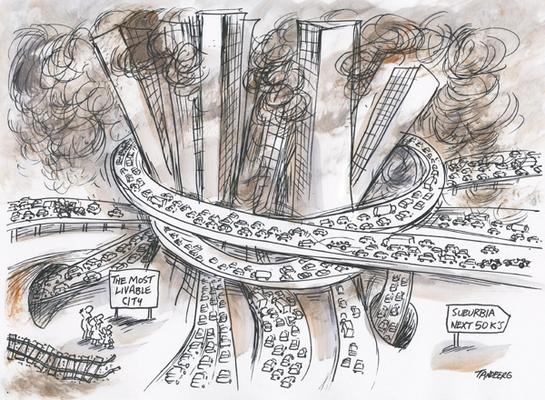 Tandberg
People often argue that the car is king. Thus Michael Warren in The Australian:
On the outer mortgage belt of urban Australia the car is king. Distance and population density make the most enthusiastic public transport systems expensive and inefficient. Working families drive to work, to sport and to the shops because they have no alternative.Fuel consumption in Australia is highly inelastic to price. In other words, no matter how expensive petrol gets, people just spend more of their disposable income on it, grumble, and get on with things.
So how did this state of affairs come about? An example from Adelaide will show why. the railway track from the outer suburban fringe of Victor Harbor to Adelaide was pulled up in the 1970s by enlightened bureaucrats captured by the car industry.
Since there is no fast rail available people commute in their cars. Nor will the state government invest heavily in public transport because of the dead hand of Treasury. That is why the car is king.
March 17, 2008
Festivaling in Adelaide: dark shadows
Despite the heat wave Saturday and Sunday afternoons were given over to having a look at the visual art exhibitions at the Adelaide Festival of Arts. There was a more expansive visual art offering at the Adelaide Festival than usual----due to Brett Sheehy, the festival's director, committing resources to visual art.
I left the Adelaide Biennial's Handle with Care curated by Felicity Fenner until a latter date. I explored the Destiny Deacon exhibition at Tandanya with its videos of historical footage, and installations about, the practice of assimilation in the 1940s and 1950s that is so dearly loved, and defended by the anti-Reconciliation Quadrant conservatives in the Australian cultural wars.
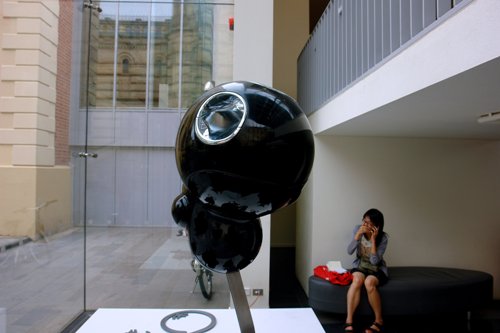 Gary Sauer-Thompson, foyer, SA State Library, 2008
Deacon's Clandestine exhibition was one of the stronger parts of the visual arts programme of the Festival of Arts --- it had more depth than the various Speed of Light shows: those of neon tube arranger New York-based Chilean Iván Navarro at Greenaway. and those of light and media artist Mischa Kuball at the Experimental Art Foundation, whose works look like wine cask innards (sculptures made from his digitized brain waves) with letters of the alphabet projected onto them.
The South Australian Museum mounted a display of the Ngurrara canvas, a huge painting measuring 10 metres by 8 metres, presented along with artefacts, crayon drawings and maps from a 1953 anthropological expedition. Ngurrara was painted by senior traditional owners of the Great Sandy Desert of north western Australia as an emotionally and politically charged expression of their links to their country, for presentation to the National Native Tribe Tribunal in 1997.The abstractions were difficult to interpret.
The slow burn was the assimilation videos in the school room--- assimilation here meant merging blacks into the whiter community so that they would forget that there were Aboriginal Australians. The images showing this, coupled with archival footage of the Black and White Ministerial Show on another television in the same room was chilling. This was an attempt to make a people disappear from history and to ensure a forgetting of their existence in Australia.
March 16, 2008
Formula 1: the spectacle returns
So the Formula 1 spectacle is back in Melbourne for close to the last time. It is becoming too expensive for the Brumby Government to subsidize, its benefits re the global branding of Melbourne are becoming less, the numbers are falling and it looks tired.
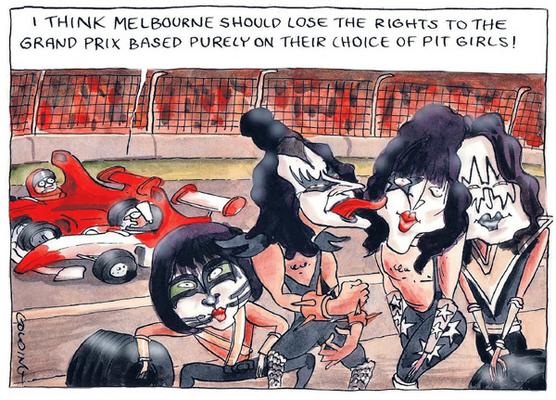 Matt Golding
Guy Debord's central argument is that direct lived experience in our society has been obliterated by its representation in a dizzying proliferation of manufactured images and objects. We are positioned as spectators for whom reality has become a disorientating object of contemplation of viewing of a welter of mediated images of sleek cars, grid girls, bare flesh rock stars, junk food, booze, boorish behaviour and corporate sexism packaged up as part of the day's entertainment.
Grid girls, pit babes and paddock chicks spread the gospel of cars, beer, fast food, mobile phones based around the old tits-and-arse formula.
March 15, 2008
Bidydanga + Sally (Liki) Nanii
The Bidydanga artists are currently being heralded as one of the most exciting art movements to emerge in the Australian and International Indigenous world of art. That gives it the flavour of avant-garde--innovators at the "cutting edge" of art and politics.
This is a questionable framing in a postcolonial culture increasingly shaped by globalization, since avant-gardism, which was founded on an historical consciousness, on its sense of difference from the past, is no longer critical or emancipatory. However, this modernist frame is an improvement on the stigma of negativity inherited by the notion of otherness from the old and never abandoned Western prejudices on primitivity, barbarity and a timeless culture.
Bidyadanga is a coastal town situated 250km south of Broome composed of 4 different Indigenous tribes plus the traditional owners plus the saltwater Karrajarri people. One of them is the extended Yulparija tribe, who came from an area around the Percival Lakes in the Great Sandy Desert (Wirnpa country), in the 1960s.
One of the artists in the Yulparija community is Sally (Liki) Nanii, whos work is grounded on an indigenous sense of place:
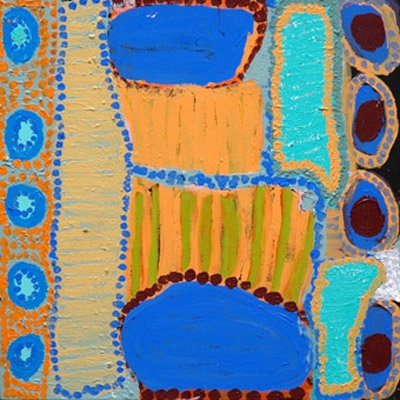 Sally (Liki) Nanii, Untitled, (?), Acrylic on Canvas
When Anglophone philosophers talk about music or film or literature or art it is usually a pretty narrow band of works that are taken as paradigmatic—inevitably these are the works that the writers know, more often than not canonical works in the western tradition. Rarely do these writers venture out of their safe harbour--- ie., of using English words drawn from Western European artistic traditions---to discuss contemporary indigenous art.
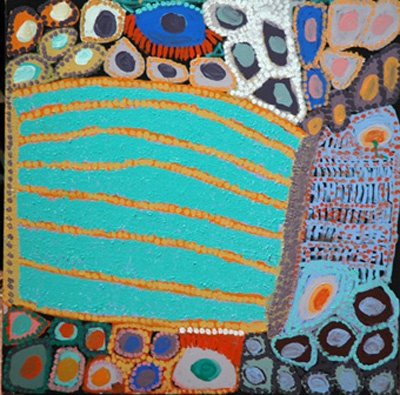 Sally (Liki) Nanii, Untitled, (?) Acrylic on Canvas
This kind of work demands that we do discuss indigenous art. Aboriginal art has been enormously important in enabling white Australia to come to an understanding of the integrity of Aboriginal culture. All those issues of the connectedness of Aboriginal people to the land and the violence of their being displaced from it, for instance, are given a new level of intelligibility through the art.
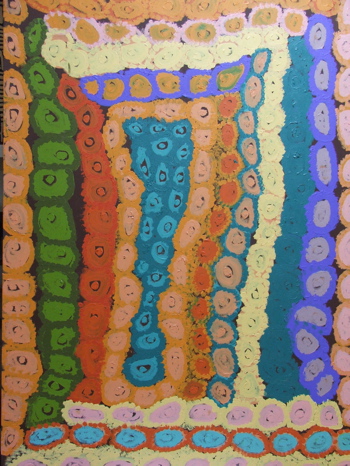 Sally (Liki) Nanii, Untitled, 2005, acrylic on canvas
The growing world market for Aboriginal art has resulted in works that are intentionally transcultural in nature: produced in one culture for use in another. As Aboriginal paintings move from Aboriginal communities to the Western art world, they assume "meanings" and significances, which are unknown or unimportant to their (Ab)original creators. Yet transcultural aesthetics has not yet been appreciated by philosophers.Will post-colonialism provide the opening?
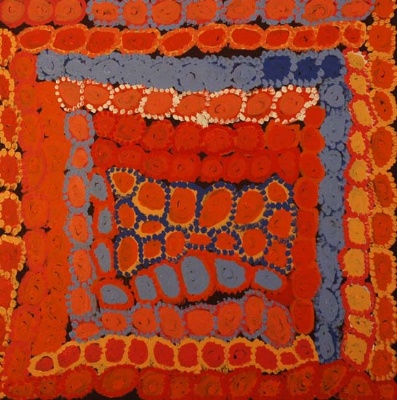 Sally (Liki) Nanii, All the Jila, (?), Acrylic on Canvas
In the meantime we swing between the idea that Aboriginal art originates in a world locked in an ideal pre-industrial past, and that Aboriginal artists offer a passport to this lost garden of Eden; or viewing Aboriginal art through the lens of western modernism; eg., interpreting the later work of Turkey Tolson, Mick Namarari and (especially) Emily Kngwarreye as gradually evolving a high abstract expressionism originating in New York.
March 14, 2008
Sydney playtime at Ivy
I spent last evening in a recently opened cocktail/wine bar/restaurant complex called Ivy at 320-330 George Street in the Sydney CBD. This is the play pen of the financial market crowd who work in the global economy. Justin Hemmes' Ivy is more a bar precinct, with eight zones over several levels, great decor It's for the young and wealthy.
Teppanyaki, whose kitchen is headed by ex-Sushi e chef Shaun Presland, is a dimly lit restaurant area with curvy, black tasselled lamp shades whilst the Ivy Lounge has velvety armchairs, marble-topped tables and ceramic elephants. The cool drinks and tasty snacks come with a good price tag in this edifice to good times.
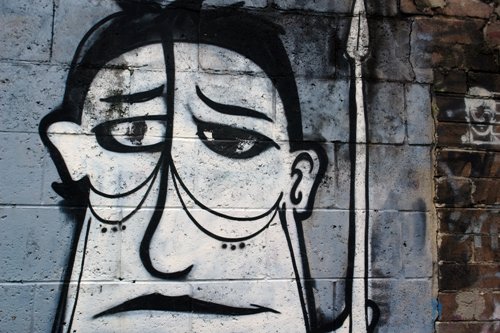 Gary Sauer-Thompson, street art, Newtown, 2008
The place oozes wealth, sex and chic designer style. Ivy, when completed, will span two city blocks comprising a boutique hotel, bars, a day spa, nine restaurants, a swimming pool with bar, European-style laneways, gardens, cafes, retail outlets, delicatessens, a ballroom and office space. The venue will hold around 3000 patrons with a 1000 person nightclub space.
So the CBD comes alive with Ivy, which is helping to change the landscape of Sydney nightlife over the last decade. But not its bar culture. Sydney still thinks in terms of barns------huge, impersonal venues designed to cater to thousands.
It's a mixture of fashion folk, party poopers, professionals and financial workers whose chic over-crowded meat market world is one where men are men full of testerone---red-blooded blokes --- and women are woman with the body.---a bevvy of young hotties as they say in the entertainment pages.
March 13, 2008
urban travel
A quirky John Spooner cartoon that highlights the importance of public transport as petrol prices and the cost of using cars in the city increases:
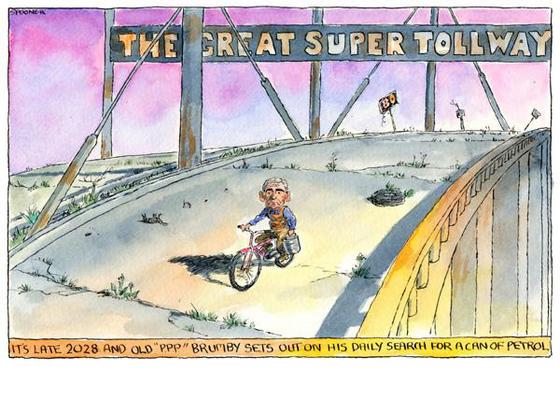
At one level Melbourne is addressing urban congestion from cars though a free train travel deal. After a five-month trial on two lines this deal will be extended to include all commuters from March 31. Under the deal Melbourne commuters can save up to $47.40 a fortnight if they arrive in the CBD by 7am. It's a creative way to address urban congestion, but it requires an investment in public transport as a public service.
Critics are pointing to what they describe as a "disconnect" between what the Brumby Government says about the environment, and what it does when faced with short and medium-term transport and planning dilemmas. The gridlocked west is confronted by the e West Gate no longer coming close to meeting the needs of the burgeoning — and public transport-starved — outer-western suburbs. So big road and rail tunnels to ease both the gridlock in the west and the traffic pressure from the eastern suburbs are being looked at.
The spectre of peak oil makes the case for roads even more difficult. While the Brumby Government is not prepared to offer a view about when oil is likely to start running out, the Queensland Government estimates it will begin by 2017. If Brumby were to decide to back the tunnel project this year, it would still have to go through years of planning, environmental impact assessments and tendering before work started. By, say, 2010 or 2011, the idea of building a major new road through the middle of Melbourne may well be looking a little dated.
March 12, 2008
binging
It's like a replay of prohibition. Teenagers denied alcohol so they binge drink illegally at parties and schoolies week. The Rudd Government talks in terms of a national strategy to deal with what they regard as a binge-drinking crisis whilst the experts call for greater sanctions. Conservatives say parents have to be more responsible, that society's standards are sliding into chaos, and kids need to be taught to teach respect is for police. The police deal with the consequences--crime. And so the cycle goes round.
 Leunig
The police say the growing issue of street crime is grounded in the economic boom, which is partially responsible for a breakdown in public standards. The theory goes that a significant minority of young people have been given so much so early that they have not learnt acceptable boundaries of behaviour. The inference is that they need to be bought back into line.
March 11, 2008
a nomadic existence
The 'Taking a photo a day' is popular style of photography on Flickr. It keeps the eye in I guess. It's an appealing idea. I could not do it, as I'm not that habitual in my photography. I would like to be in the artistic groove all the time.
However, I decided to do something to capture me being on the move: a nomadic existence with a camera, laptop, mobile phone, PDA and a mobile broadband connection.
So the last few days look like this. Friday evening--working on the photoblog--RhizOmes0
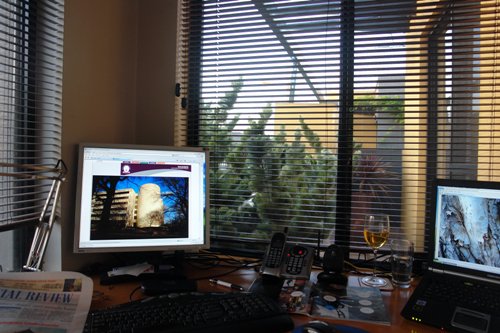 Gary Sauer-Thompson, Sturt Street, Adelaide, 2008
On Saturday, catching the bus to Victor Harbor, and spending the early evening relaxing on the beach on the Fleurieu Peninsula to escape the heatwave that has enveloped South Australia.
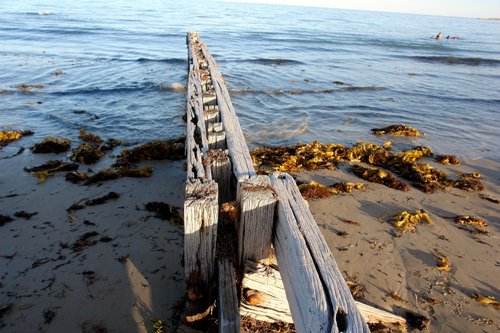 Gary Sauer-Thompson, Hayborough Beach, Victor Harbor, 2008
Then a drive back to the searing heat in Adelaide on Monday late evening. The air conditioner in the apartment goes all night so that we can sleep.
Tuesday: flying to Sydney in the late afternoon for a two day conference on Wednesday and Thursday, catching a bit of Question Time at the Qantas Club:
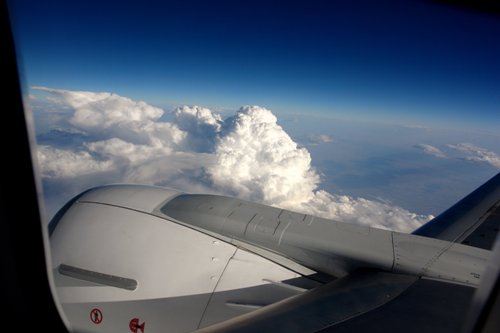 Gary Sauer-Thompson, flying to Sydney, 2008
I't was dark when I arrived at the the Novotel hotel in Brighton Le Sands on Botany Bay so I couldn't do any photography. The post is written in the hotel room.
I fly back to Adelaide on Thursday evening.
March 10, 2008
successful cities
Deyan Sudjic, director of the Design Museum, has an op-ed in The Observer on cities entitled Cities on the edge of chaos in which he explores the kind of lives we are creating in our cities and asks will citizens - and cities - cope with the fierce pressures of this new urban age.
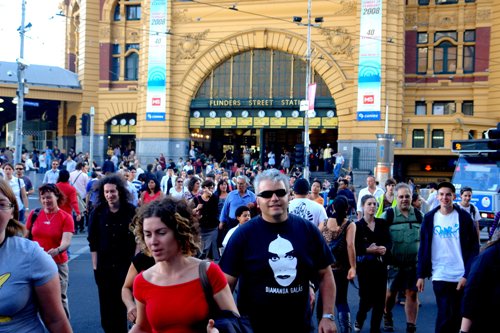 Gary Sauer-Thompson, Flinders/Swanston St, Melbourne, 2008
Sudjic says that we do not belong to a generation that has the shared faith that the pioneer architectural modernists had when they chartered a liner to cruise the Mediterranean and drew up their vision of what the modern city ought to be, the 1933 Charter of Athens written by Le Corbusier.
Its ideas are well known. It's main purpose was to erase pedestrian urban life as defined on vibrant city streets in prewar European capitals. We were offered seductive images of skyscrapers sitting in vast parks long with the strict segregation of uses.
Sudjic adds:
They divided their ideal city into functional zones, shaped by slabs arranged to maximise the sunlight falling on the ground between them.Theirs was a generation that was freed from the luxury of self-doubt. Ours is not and that is why we struggle now when we try to think what cities should be. We have seen too many soured urban utopias that were invented by the architects on that liner, and propagated by a political system that measured success in the number of new buildings that it could deliver each month.
Politicians love cranes; they need solutions within the time frames of elections and cranes deliver them. But there are only a limited number of problems that are susceptible to this kind of time scale. He says that:
The result is a constant cycle of demolition and reconstruction that is seen as the substitute for thinking about how to address the deeper issues of the city.Visions for cities tend to be the creation of the boosters rather than the theorists or the policy-makers. City builders have always had to be pathological optimists, if not out-and-out fantasists. They belong to a tradition that connects the map-makers who parcel up packages of swamp land to sell to gullible purchasers...Cities are made by an extraordinary mixture of do-gooders and bloody-minded obsessives, of cynical political operators and speculators. They are shaped by the unintended consequences of the greedy and the self-interested, the dedicated and the occasional visionary.
The cities that work best are those that keep their options open, that allow the possibility of change. The cities that work best are those that keep their options open, that allow the possibility of change. Successful cities are the ones that allow people to be what they want; unsuccessful ones try to force them to be what others want them to be.
March 9, 2008
Richard Wastell
The work produced by Richard Wastell challenges both the conventions of Tasmanian wilderness photography and the Tasmanian tourist cliches of great mountains, wild rivers and stormy seas, since it explores how humans are currently living with nature in that island state.
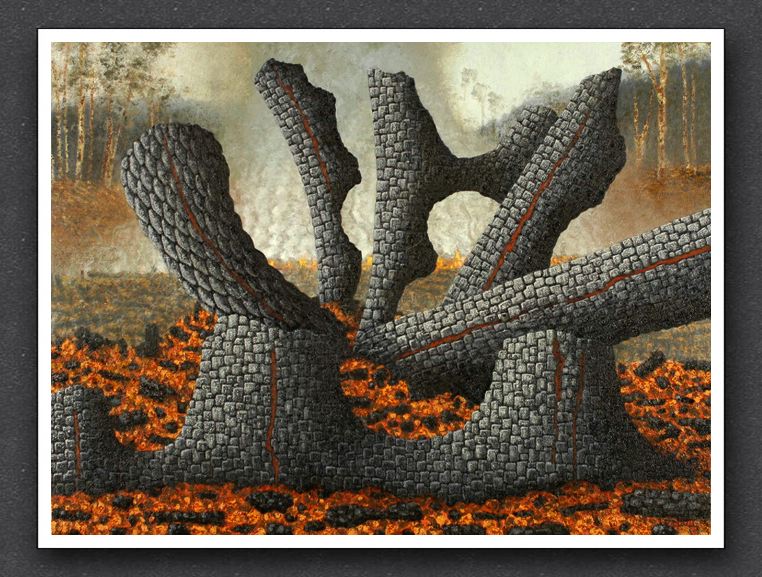 Richard Wastell, Then Tasmania can be a shining beacon, 2006
The image is from "We are making a new world" shown at the Bett Gallery, North Hobart in 2006, then at fortyfivedownstairs in Melbourne. Making a new world through the clear-felling of virgin Tasmanian forest is the Tasmanian way. Tasmania's old growth native forest continues to be levelled to the ground to produce wood-chips. After being industrially logged, what remains is napalmed from the air. What results are fires of intense ferocity.
 Richard Wastell, The wild beasts, 2006
Richard Flanagan, in opening the exhibition at the Brett Gallery,said that:
Into the plains of ash that are left are planted monocultural plantations, maintained by an intense regime of poisoning and fertilizing that has seen protected native animals killed in their hundreds of thousands, water supplies poisoned, and the spectre of a raft of illnesses draughting in the wake of these horrendous practices.To maintain such monstrosity, to evade the ever growing public anger, the woodchipping industry has had to exercise an ever stronger control over ever more aspects of Tasmanian life.
This is one example of the good work being produced by contemporary artists in Tasmania
Phoenix's First Friday
Phoenix holds an open art area on the first friday of each month. It is more like a flea market that is dominated by the works of art students. There is a lot of adhoc street stalls with paintings being hung from wirechain fences, or displayed on card tables. There are also a lot of small one room galleries up and down the road. One of the more interesting small galleries showing had work by Matthew Mayes.

There was also a series of places that had bands playing, from metal, to pop, to rap, to hip hop to buskers - and even a bass player and drummer just playing with each other. The stress looks like an old residential one from the 1950s and most of the galleries and shops are converted tract housing. The quality of the art was not high, it was student level, same with the music and the stalls - which is why it had a flea market feel.
March 8, 2008
Remembering another time
It looks so green, fresh and cool. I long for the the return of the autumn rains and winter We are in the midst of a heatwave in South Australia. It is very hot and very still, with no cooling winds in the evening. Like everyone else we have fled to the coast to escape the oppressive heat (35-40 degrees) in Adelaide. There is not a spare room, apartment or unit in Victor Harbor this long weekend.
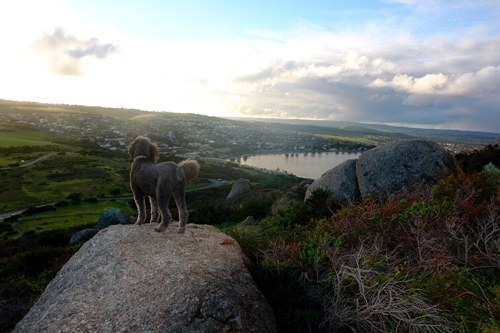 Gary Sauer-Thompson, Agtet+ Bluff, Victor Harbor, 2007
It's day after day of blue sky, bright sun, warm northerly winds during the day, fierce heat and little let up in the evenings in Adelaide's semi-desert conditions. The houses are hot, the computers close down, the airconditioners barely cope with the heat, gardens wilt, and Adelaide's water supply dwindles.
These autumn temperatures have not been recorded in Adelaide since an eight-day heat wave in 1934. It is predicted there will be no relief from the heat until Tuesday week, when temperatures are tipped to descend into the 20s.The extended hot spell is a product of north winds coming off the desert.
The upside of the heatwave is that it is warm enough to use the beach in the early morning and in the early evening. Swimming in the water cools the body down and provides comfort from the heat. The rest of the day is spent avoiding the sun and longing for a cool coastal breeze to lower the temperature.
March 7, 2008
festivals + carnivals
There is a Fringe Festival on in Adelaide but I have not explored many of its earthly delights. It's been too hot, as a heat wave as enveloped Adelaide, and the temperatures have been in the high thirties all this week and will continue all next week. It's night time work only:
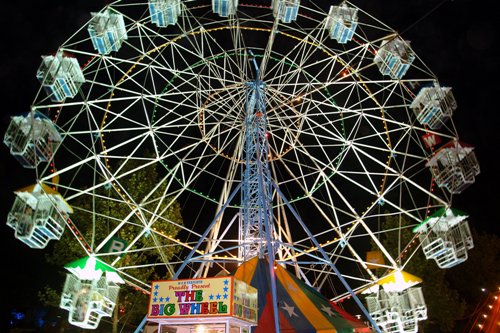 Gary Sauer-Thompson, Big Wheel, Fringe Festival, Adelaide, 2008
I did venture out to see to see the Northern Lights last night but I was ill-equiped to take photos. Others did though. I'm not really grounded in my own city.
The fringe is represented as a playful, alternative culture-- a network of diverse groups, both antagonistic and submerged, which reinvents the feast of foolsd←tournement, in which the artists often appropriate tools of the "oppressor" and then resituate these tools in a disturbing and disorienting fashion. We participants are left with the lingering image of grotesque ugliness, whichhaunts us.This festival draws upon traditional folly, but appearing in a disenchanted post-modern society, the concept of The Fool is resurrected, challenging and satirizing oppressors in order to cause reflection on their positions, attitudes, and worldviews.
When we play The Fool, we are The Other, strangers who are in this world but not entirely of it. The "freedom of the fool" reminds us that in a moment of ecstasy we can sweep away the illusion of so much of what we endure. To counter the oppressive and ubiquitous corporate monoculture that is so prevalent in late capitalist society, culture jamming through performance may well be the only solution to facilitate critical reflection on our mode of life.
March 6, 2008
May Lane, street art, grunge
My practice of dérive (academics call it psychogeography ), or drifting around Newtown, eventually led me to coming across May Lane, near St Peters railway station:
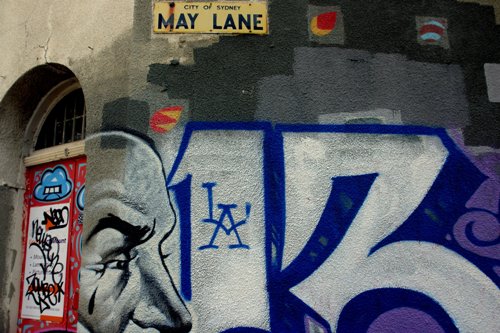 Gary Sauer-Thompson, May Lane, Newtown, 2008
Whilst wandering---and noting that Sydney lacked a laneway bar culture---I wondered whether the edgy street art I had been seeing in my explorations could be interpreted as the visual equivalent of grunge in literature, or music---- a hybrid mix of ‘60s garage rock, heavy metal, and ‘70s punk. The last two are often connected in Australian cultural criticism. Grunge is devalued because it falls outside dominant Australian literary traditions thus appearing illegitimate and unauthentic.
Was there grunge visual art in Australia? By that I mean something more than photographs of grunge musicians, or designs of album covers. Is there such a thing as grunge art as there was punk visual art? If so does it have anything to do with an abject art and the explosion of the repressed in a search for broader political affect? Has it anything to do with the ugly in visual culture?
My guess is that grunge art would start from graffiti or street art as this form was post punk, diy, and a form of resistance to the commercialization of public space:
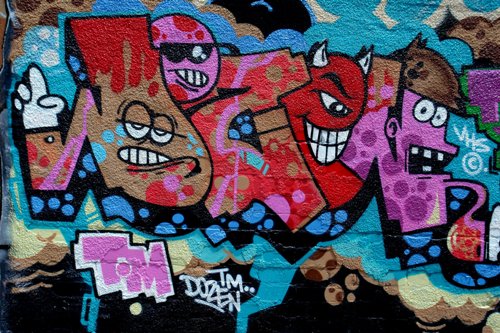 Gary Sauer-Thompson, TM, May Lane, Newtown, 2008
This is very self-conscious as it changes the conventional stylistic lettering by incorporating faces. It is part of a space that signifies itself as a transgressive space with its sense of subcultural capital and a ‘coolness’. Unlike Caledonia Lane in Melbourne there is little sign of private and commercial interests being served through the basic manipulation of a public space.
Since the street work exhibited in May Lane is very varied it is better to think in terms of grunge culture which includes visual art, just as it includes the fashion of flannel shirt, ripped jeans and Doc Marten boots. Maybe we can think in terms of a 'structure of feeling' that expresses a bleak life of kids from broken homes living on the margins of postindustrial urban Australia.
As McKenzie Wark observes Raymond William's Left Leavisite concept of a 'structure of feeling':
...gives you the sense of culture as something you learn, perhaps without really being aware of it, yet it shapes your awareness of everything around you and how you react to things.
Williams understands this as "practical consciousness of a present kind … a social experience which is still in process. If ithis interpretation is light on bodies, it does highlight mediations that link feelings to social structures and social formations, and it introduces the idea of distilled residue of the organization of the lived experience of a particular community.
If global capitalism sediments and reproduces particular pasts, whilst encouraging particular orientations to history, then we have a sedimentation of a "structure of meanings".
Adorno calls form a "sedimentation" of content, thus implying that as society changes so artistic materials, techniques, and forms must also change. The form of an artwork is multilayered, different layers deriving from different periods and their circumstances, but with the layers still interacting and forming a complex whole.
March 5, 2008
Destiny Deacon
Destiny Deacon has an exhibition at Tandanya as part of the Adelaide Festival of Arts 2008. Deacon and her friends have masked themselves in long-johns and assumed the role of Aussie fanatics, re-enacting current events with sinister humour. Crudely drawn faces, with messy lipsticked mouths, send up the anonymity (a tool of fear) sought by masked terrorists.
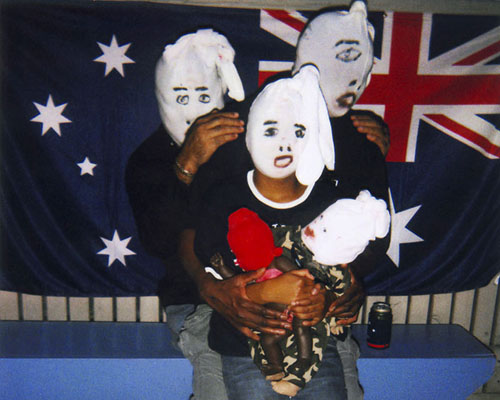 Destiny Deacon, the Goodie Hoodie Family, Whacked, 2007, Lightjet print from Polaroid original
Daily Serving interprets the work as a reflecting on recent events such as the racially motivated 2005 Cronulla riots, Deacon through her use of black humor, reflects on the increased sense of xenophobia caused by the fear of terrorism.
March 4, 2008
détournement
One of the situationist's techniques is détournement, which involves a displacement of the modernist emphasis on creating the new. It involves the reuse of preexisting artistic elements in a new ensemble through the capturing of various spectacular images and turning them around in a new presentation in order to subvert the authority of the sign and the significations it sets in order.
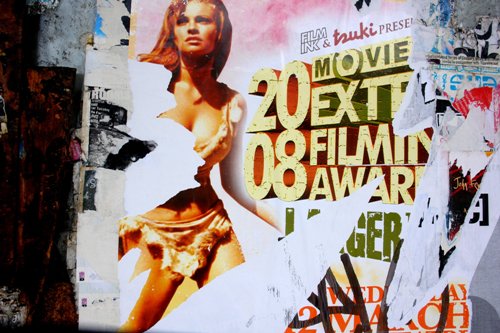 Gary Sauer-Thompson poster, Newtown, Sydney, 2008
John Moore in his The insubordination of words: Poetry, insurgency and the situationists says that Debord and Wolman understand détournement as both negation and prelude – not, it should be noted, as negation and affirmation. Negation means that existing structures of meaning are to be dismantled, and through the collision, juxtaposition and collocation of the liberated autonomous elements, a new ensemble of meanings is assembled which confers fresh significance on the new images.
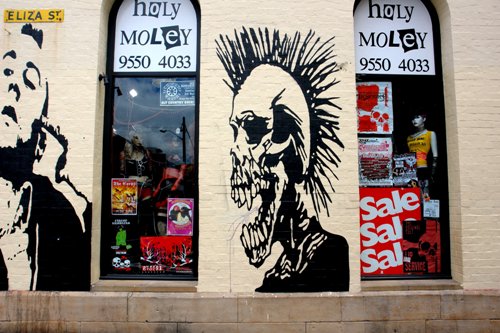 Gary Sauer-Thompson, shop front Newtown, 2008
Détournement provides a way to rethink the work of history in the present to open time that appears to stand still in the conservative hegemony that we have experienced for the last decade. It's also a way to counter the market view of historical time that renders the present in terms of unfolding laws of history. It is a also a way to tear the present out of neo-liberals conception of the continuum of history as the naturally evolving and civilizing free market.
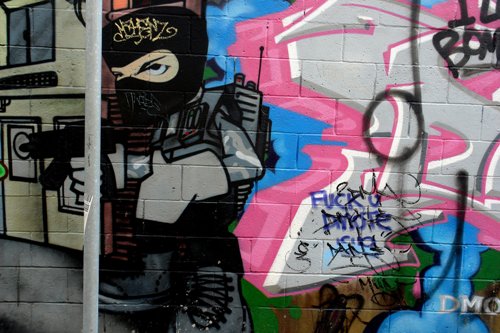 Gary Sauer-Thompson, street art, Newtown, 2008
If the aim is to fracture a seamless present and to lift that present from seamless time, then untimely critique insists on alternative possibilities and perspectives in a seemingly closed political and cultural world.
March 3, 2008
Newtown: architecture
There is another side to the glossy cosmopolitan image of Australia's global city--- Sydney, Australia's number one, and only global, city. And it's not the One Nation battler suburbs in the redneck western Sydney either.
The image of 'Global Sydney' is that from the perspective of those with jobs in the financial markets, media, advertising, movies, sport and recreation. If you are a globe trotter, returning expatriate, visiting business professional, or even a high-flying rust-belt refugee from Victoria or South Australia, who can therefore afford to live by the beach or the harbour, then Sydney offers an attractive climate, lifestyle and fun people.
The glossy image is that of a big cosmopolitan city and a resort:
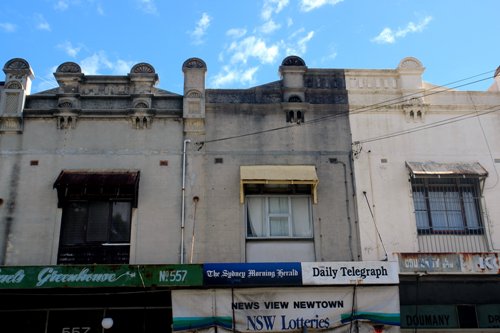 Gary Sauer-Thompson, shop facades, Newton, Sydney, 2008
Behind this grunge and decay in Australia's global city we have an inner city urban culture, which provides another reason why people think Sydney is hot, even if they cannot afford Sydney mortgages. An insurgent inner city culture that has broken away from the modernist emphasis on newness and innovation.
This transgressive Grunge culture complicates the narrative tropes of neoliberalism as a healthy, growing, flexible economy delivering prosperity with a conservative humanistic culture providing the means for civilising global capitalism. What is disclosed in the Newton part of the global city is pollution from cars and waste (rubbish); drugs and disease; figures of abjection and melancholy and pornography. It's a sleazy world full of international students using wirelessed internet cafes.
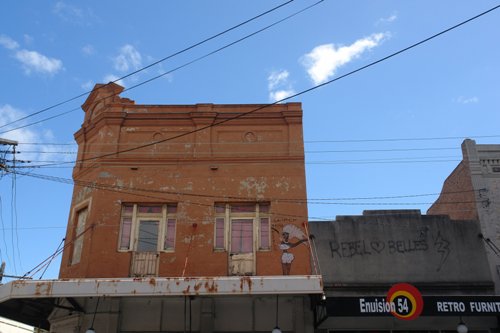 Gary Sauer-Thompson, King Street, Newtown, Sydney, 2008
One effect of a neo-liberal rationality and governance of the global political economy on this inner city culture is that the conservative civilising culture of an Arnoldian-Leavisite project based on the reading of a traditional canon and felt experience has been dumped by many as waste into the council rubbish bins lining the back streets.
 Gary Sauer-Thompson, 222 King Street, Newton, Sydney, 2008
The anglocentric, monocultural heritage, which has been embodied in academic English, the traditional humanities and literary culture, has been displaced by an embrace of cultural studies.
March 2, 2008
cruising Newton, Sydney
It was raining in Sydney this morning so I had to delay my explorations or wanderings of Newton until mid-morning when the rains had cleared. I caught the train from Mascot to central, then to Newton and walked up and down both sides of King Street---the main drag---having a look.
It initially reminded me of Brunswick Street in Melbourne---an old, grungy, inner city, white Anglo-working class suburb going funky from being peopled by students, artists and gays. It had that similar "counterculture' buzz and zing, which is what Adelaide really lacks.
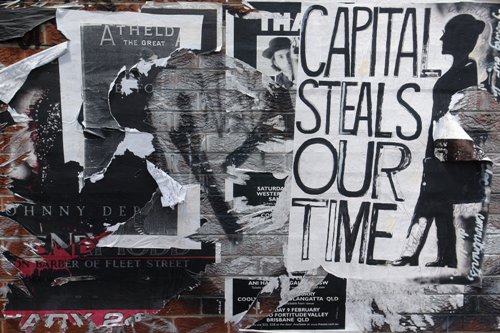
I was searching for May Lane to see the latest exhibition of street art. But I was doing so without knowing where May Lane was. I had decided to work blind as a good situationist. I would either stumble upon the lane, or be directed by the locals where to go. This is called dérive (or ‘drifting’, which is understood as, 'A mode of experimental behaviour linked to the conditions of urban society: a technique of transient passage through varied ambiences’).
Why street art and visual culture rather than exploring the literary bookshops that embody a literary culture? Paul Davies in his The Decline of the Literary Paradigm in Australian Publishing (accessed through Michael Christies' excellent Eurhythmania weblog) gives a plausible answer:
Literature once had a special role to play in advocating such [cultural] values. Since the nineteenth century, the coterie elites that literary cultures nurtured have produced leading public intellectuals, a founding duty of literature having been, after all, to ‘heal nations’ and save their citizens from the worst excesses of capital... Such figures continue to exist but in most cases they are unrepresentative and have no truly popular sway.
Davis adds that attempts to resurrect their prestige and that of the literary-intellectual culture that sustained them, in anthologies of essays and new magazines and in ritualistic attempts to talk the literary novel back into cultural prominence, are ever more unconvincing.
Quite simply, there can be no going back, because the cultural nationalist, protectionist moment is over. The problem is not merely literary– it is one of founding a genuinely popular critique of neo-liberal marketisation, even as the traditional intellectual bases from which such critiques spring, including literary culture, have been sidelined.
Can a visual culture help to develop a popular critique of neo-liberal marketisation? If so, then can photography help do this? If so in what way?
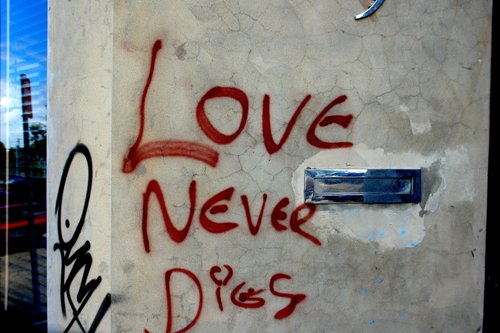 Gary Sauer-Thompson, love, Newtown, Sydney, 2008
That is what I was exploring as I stepped of the train at Newton station and started my explorations along King Street. The above images are crude but they do indicate an ethos of critique in a neo-liberal world.
in Sydney
The traffic in the streets in Sydney may be in gridlock but it is possible to get around by rail fairly easily. I was able to go from Mascot to Central to Strathfield and back again with ease and in quick time. It was moving around Strathfield in a car that was the problem. It was a traffic jam. Urban congestion in Sydney is worse on the weekends than the weekday. Hence the Saturday morning mashup.
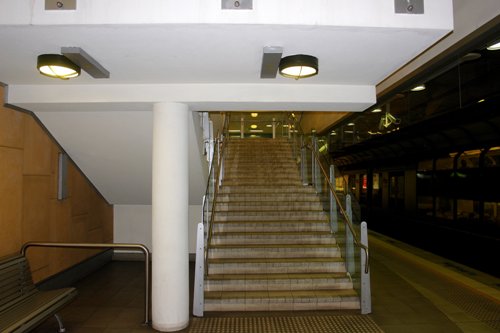 Gary Sauer-Thompson, Mascot Station, 2008
Why more money is not spent on improving the rail infrastructure so that people can move around quickly and easily around Sydney is beyond me. From what I can make out, the Lemma Government is wanting lots of money from Infrastructure Australia for motorways: the M4 and the F3-M7 connection are mentioned, along with the Moorebank freight terminals and southern Sydney freight lines.
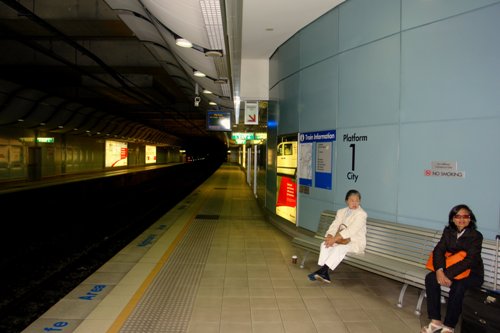 Gary Sauer-Thompson, Mascot Station Sydney, 2008
It is now very expensive to avoid the gridlock and travel around Sydney by car on all the tollways. The gridlock is on the suburban roads that are near to, or access, the various motorways. The people who catch the trains to work take their cars out on the weekend and so clog the roads. Leisure time is fighting gridlock.
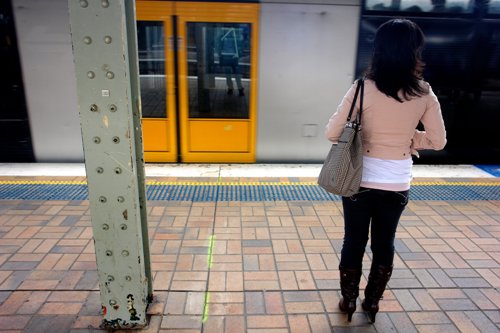 Gary Sauer-Thompson, Central Station, 2008
The car is not the solution if you want to improve the liveability of the metropolis. It is better rail transport.