|
March 6, 2008
My practice of dérive (academics call it psychogeography ), or drifting around Newtown, eventually led me to coming across May Lane, near St Peters railway station:
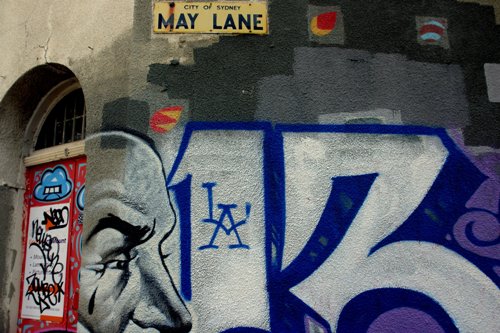 Gary Sauer-Thompson, May Lane, Newtown, 2008
Whilst wandering---and noting that Sydney lacked a laneway bar culture---I wondered whether the edgy street art I had been seeing in my explorations could be interpreted as the visual equivalent of grunge in literature, or music---- a hybrid mix of ‘60s garage rock, heavy metal, and ‘70s punk. The last two are often connected in Australian cultural criticism. Grunge is devalued because it falls outside dominant Australian literary traditions thus appearing illegitimate and unauthentic.
Was there grunge visual art in Australia? By that I mean something more than photographs of grunge musicians, or designs of album covers. Is there such a thing as grunge art as there was punk visual art? If so does it have anything to do with an abject art and the explosion of the repressed in a search for broader political affect? Has it anything to do with the ugly in visual culture?
My guess is that grunge art would start from graffiti or street art as this form was post punk, diy, and a form of resistance to the commercialization of public space:
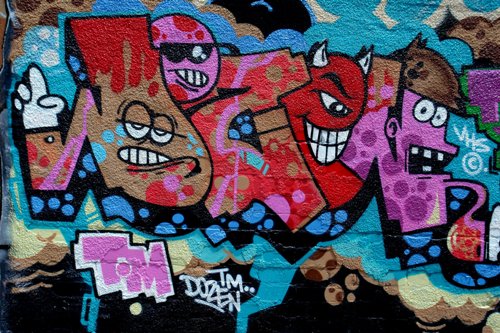 Gary Sauer-Thompson, TM, May Lane, Newtown, 2008
This is very self-conscious as it changes the conventional stylistic lettering by incorporating faces. It is part of a space that signifies itself as a transgressive space with its sense of subcultural capital and a ‘coolness’. Unlike Caledonia Lane in Melbourne there is little sign of private and commercial interests being served through the basic manipulation of a public space.
Since the street work exhibited in May Lane is very varied it is better to think in terms of grunge culture which includes visual art, just as it includes the fashion of flannel shirt, ripped jeans and Doc Marten boots. Maybe we can think in terms of a 'structure of feeling' that expresses a bleak life of kids from broken homes living on the margins of postindustrial urban Australia.
As McKenzie Wark observes Raymond William's Left Leavisite concept of a 'structure of feeling':
...gives you the sense of culture as something you learn, perhaps without really being aware of it, yet it shapes your awareness of everything around you and how you react to things.
Williams understands this as "practical consciousness of a present kind … a social experience which is still in process. If ithis interpretation is light on bodies, it does highlight mediations that link feelings to social structures and social formations, and it introduces the idea of distilled residue of the organization of the lived experience of a particular community.
If global capitalism sediments and reproduces particular pasts, whilst encouraging particular orientations to history, then we have a sedimentation of a "structure of meanings".
Adorno calls form a "sedimentation" of content, thus implying that as society changes so artistic materials, techniques, and forms must also change. The form of an artwork is multilayered, different layers deriving from different periods and their circumstances, but with the layers still interacting and forming a complex whole.
|


Gary
Abject art is a term suggested by the theoretician Julia Kristeva to designate art based on the image of the human body, but specifically the body fragmented and decayed or represented by one of its socially less presentable functions (scatological images. In depicting what most people would rather not see, the theory goes, art breaks through societal taboos, especially those surrounding sexuality. It's about the nauseating and physically revolting that challenges the limits of the art institution.
This is different to grunge--it would be outside of, and opposed to, the art institution.
Shame and vision are inextricably bound up one with the other. For some, shame about the body or some aspect of the body is experienced while looking in the mirror, akin to subjective self-awareness. For others, it is experienced most acutely as a fear or anticipatory dread of the scornful gaze of another person or persons, akin to objective self-awareness. In psychoanalytic treatment, the analyst finds himself or herself enlisted as a visual witness or spectator (often a reluctant one) to the patient’s body, of which the patient is ashamed.