December 30, 2010
Kodachrome: 1935-2010
The last lab in the world processing Kodachrome has just closed. Kodak stopped making Kodachrome film in 2009. The loss of this film is deeply mourned. There is a sense of nostalgia for a bygone aesthetic of film.
Paul Simon's Kodachrome is from the album There Goes Rhymin' Simon.
I never really used Kodachrome--and the projector and slides in a carousel---as I was into negatives and print on a rangefinder. Looking back, the pace of technological change has been phenomenal, introducing extraordinary levels of image quality for digital formats, as well as the convergence of high-definition video with stills. I often wonder today how I managed without digital.
Looking back I begin to understand that unlike the history of cinema, which developed by synchronising sound and vision, photography’s arrested development meant that it continued to view the world mute and still. What would be interesting to explore is reintroducing sound back into the photograph in a way that challenges the photograph’s muteness and the way photographic space is negotiated.
cricket tragics
Often the intertextuality is forced and unconvincing. But this works:
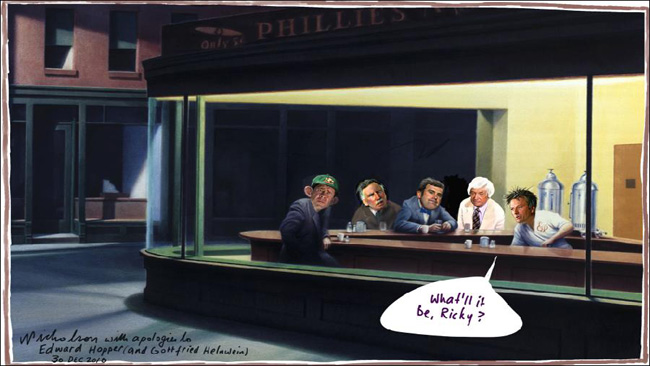
Edward Hopper's 1942 Nighthawks captures three customers seated at the counter of a brightly lit all-night diner, all seemingly lost in their own thoughts. It is a dark, evocative painting of, what once was, a New York City diner. The viewer's eye is drawn first to the bright, cold fluorescent light of the interior, but quickly refocuses on the three customers. The three counter patrons are set against the dark background of the nighttime street.
The darkness is not just from the night. There is a psychological darkness here. The customers seem frozen, lost in their own thoughts. Physically close, but emotionally detached, they are separate from one another. it suggests that the pulse of the city as desolate and dangerous with predators lurking.
What we have with the cricket tragics is the feeling of desolation and despair rather than with loneliness or alienation. Australian cricket has lost is shine and glamour. It looks tawdry.
Many artists have produced works that allude or respond to Nighthawks---eg., Tom Waits Nighthawk Postcards:
This is from his third album, Nighthawks at the Diner, in which Tom Waits set up a nightclub in the studio, invited an audience, and cut a 70-minute, two-LP set of new songs.
December 29, 2010
Joseph Cornell: multimedia
I've long had a fascination with the work of Joseph Cornell, especially the wooden boxes that incorporated his assemblages created from found objects.
The Soap Bubble Sets, the Medici Slot Machine series, the Pink Palace series, the Hotel series, the Observatory series, and the Space Object Boxes indicate that Cornell is the acknowledged master of assemblage art. The assemblages have came to be considered among the most seminal works of 20th-century art. They combine the formal austerity of Constructivism with the lively fantasy of Surrealism.
I'm discovering that Cornell was much more versatile as an artist than being a sculptor. This "sculpture" is almost a still life:
 Joseph Cornell, 7 Tears of Lucia (for Anna Moffo), 1964, wood, glass and paper
I didn't know that Cornell was a film maker. While his earlier films were often collages of found short films, his later ones montaged together footage he expressly commissioned from the professional filmmakers with whom he collaborated.
Yet I still come back to the assemblages--eg., the Aviary series:
 Joseph Cornell, Untitled, (Aviary with Parrot and Drawers), 1949
In the late 1930s, inspired by the bird cages hanging in the window display of a local pet store, Cornell began his aviary series, one he would work on until his death. The boxes, which at first featured only parakeets (cutouts from natural history books and children's shooting gallery sets, mounted on conforming pieces of jigsawed wood), would soon include owls, cockatoos, canaries, and finally, about a decade later, an absent bird: an empty perch in a barren cage. Cornell's birds were often world travellers who pasted collage remnants of their exploits on the walls of their cages: hotel paraphernalia, foreign newspaper clippings, European advertisements, theatre and dance programmes.
Many of Cornell's boxes were not intended for the museums in which they now reside. They were gifts, tokens of affection.
December 26, 2010
photography + the archive
I'm down at Victor Harbor cleaning and painting the weekender with Suzanne over the Xmas break so that friends can use it for a couple of weeks for their summer holiday. We had Xmas day off from the spring clean.
Since the weather has been too windy for large format photography on the coast, I have been going through my archives and wondering about the archive in relation to memory; or rather the loss of memory.
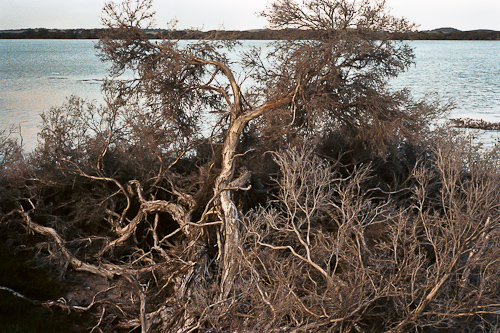 Gary Sauer-Thompson, Xmas in the Coorong, 1997
I realize that one aspect of photography is concerned with using the archive in a struggle against the loss of memory, an attempt to archive and preserve what is about to disappear for good. This dimension of photography is associated with mourning of what has been and what may be forgotten.
Gary Sauer-Thompson, Xmas in the Coorong, 1997
I realize that one aspect of photography is concerned with using the archive in a struggle against the loss of memory, an attempt to archive and preserve what is about to disappear for good. This dimension of photography is associated with mourning of what has been and what may be forgotten.
In this case it is the Xmas Suzanne and spent camping in the Coorong in the year her mother died. The house, once so full of family life, was now so empty. It made Suzanne lonely and she wanted to get away from it. Hence Xmas in the Coorong. It was a way to mourn---the death of her mother, a way to guard against that mourning, and a living on.
Update
We arrived back in Adelaide late Wednesday morning (29th) utterly sick of cleaning and painting the weekender. There was no time for photography or for going through the photographic archive.
December 25, 2010
Xmas
Merry Xmas everyone.
 Gary Sauer-Thompson, Christmas Lily, 2010
Hope you all have a good break. Cheers
December 22, 2010
Zappa and Beefheart
An evening with Frank Zappa & Captain Beefheart in a radio broadcast in 1975.
Track 1. Cucumonga 2. Orange Claw Hammer, live in studio (Don van Vliet) 3. I Was A Teenage Maltshop, demo 1965 4. Studio Rehearsal, 1965. I was attracted by the version of Orange Claw Hammer, which I found quite appealing.
December 21, 2010
poor Flickr
Thomas Hawke in his An Open Letter to Carol Bartz, CEO Yahoo Inc. says about Flickr that:
It’s the largest well organized library of images in the world. Not only that, it has a very strong social networking component. In fact, Flickr may represent (if managed correctly) your single biggest opportunity to launch a much larger and more lucrative social network (and stock photography agency as well). Have you spent any time in any Flickr groups? They are addicting. People live in them. They play games in them. All kinds of activity goes on in them every day. And if you took the time to really explore the social side of Flickr, you’d learn this, and figure out a way to grow it.
Yahoo isn't doing much with Flickr. They are not properly growing it. They are more pre-occupied with cost cutting (laying off staff) than with Flickr's social networking potential. Yahoo is an aggregator. Their business model is to aggregate and slap ads on stuff and they see Flickr as a non-core, underperforming asset”.
Flickr is seen by the public as an image hosting website without much innovation. Hawke's argument is that social networking component of Flickr is by far the most valuable aspect of the site.
He suggests that Flickr could become the largest stock photography agency in the world; Yahoo could seriously get into the self publishing business for business cards, holiday cards, photobooks, albums, etc. Flickr could open physical galleries and automate more of the “community management” at the site; host an online photography/videography school for users to brush up on their photographic skills; give users the ability to sell their photos – not just as stock imagery, but as art; software that runs through your entire stream and flags images being used elsewhere on the web commercially without payment.
December 20, 2010
aesthetics: a note
A 2007 issue of Filozofski Vestnik, an online open access journal of philosophy with an interdisciplinary character, was concerned with aesthetics. For many aesthetics is generally considered to be a discipline that is outdated, conservative, too formalist, and devoid of contact with real life. If the task of aesthetics is to reflect art, then aesthetics currently lives under the sign of uselessness.
Ernest Ženko in Mode-2 Aesthetics points out that:
When art lost its connection with the beautiful during the first decades of the twentieth century, there were considerable efforts among aestheticians to replace the beautiful as a key concept in grasping the essence of art and aesthetics with some other comparable notion. Unfortunately the results were not satisfactory; sublime, form, expression, creativity, and other concepts have never achieved the importance of the beautiful. nonetheless, a Kantian logic that related the beautiful to “an entirely disinterested satisfaction,” survived in the autonomy of art, which was the essential condition of modernism in the arts, as well as of cultural modernity in general.
This type of aesthetics was seen as an autonomous discipline within the context of autonomous art (the closed world of art), and it is related to modernist art production and cultural modernity, to the autonomy of art and culture, to concepts such as aesthetic judgment, aesthetic value, creativity, the artist, the artwork, form, and so on.
Both art and culture have gradually lost their autonomy, due to commodification, and aesthetics looks decidedly traditional and outmoded. Outmoded in the sense that art is not essentially about beauty nor was the production of beauty the core purpose of art. We can, however, talk about artistic excellence which is not the same thing as aesthetic beauty.
So we need to disjoin art and beauty and allow beauty to be the idol of the marketplace---in fashion, advertising, everyday life and in the media. Why should celebrate an idol of the marketplace? Isn't art a realm of alterity? Shouldn't we link the arts and the experience of the arts to the rest of human experience? If so, then we would have an aesthetics based on the role of the arts in culture and history.
December 19, 2010
Captain Beefheart: goodbye
The late period of the recently deceased Captain Beefheart refers to the albums Doc at the Radar Station and Ice Cream for Crow that were made with a new Magic Band lineup. The latter is the final album.
The 'Dirty Blue Gene ' track from the Doc At The Radar Station (1980) album is a fitting way to say goodbye:
The album contains quality material recycled in part from "the lost album" sessions. Instead of seeking ideas from sidemen, Beefheart claims to dictatorially control his Magic Band members. In description, the music reads like jazz, though.
Rhythms are carried by the singer and by all instruments - most often by electric guitars. Drums and percussion usually create subordinate, overlapping patterns. Conventional melody and harmony aren't prime features, but what exists is played by all the musicians.
Don Van Vliet switched from music to painting in the 1980s:
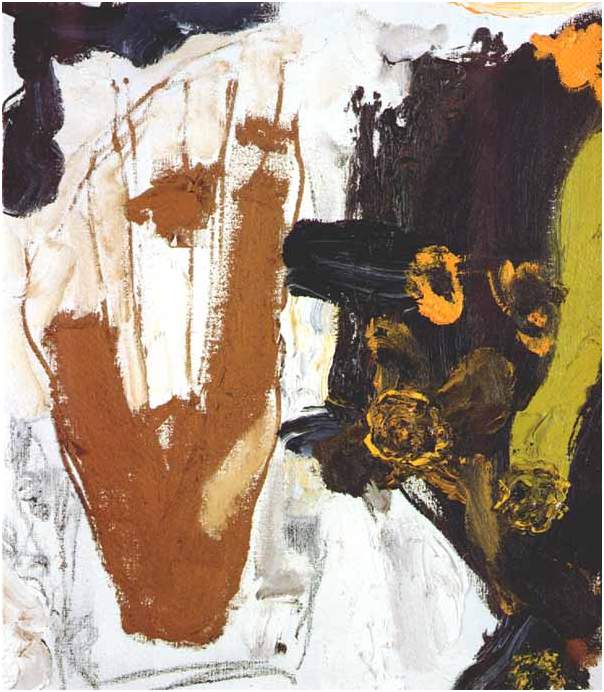 Don Van Vliet, Middle Flower, 1991
Captain Beefheart's music can be seen as musical counterpoints to the American abstract expressionist tradition of the previous generation (eg., Arshile Gorky, De Kooning or Jackson Pollock) and Beefheart has the ability to unite discordant musical, literary and visionary elements to create a unsettling whole.
Beefheart's stated painting reference point is Franz Kline.
December 18, 2010
American photography: Jo Ann Walters
In this interview with Amy Stein on the latter's blog Jo Ann Walters says that it began:
by driving around in the bad neighborhoods, photographing vacant lots, railroad lines, burned-out buildings. These are the parts of my hometown that show the deep scars of industrialism. I was looking for something that nobody else wanted anymore, something anonymous, something forgotten.
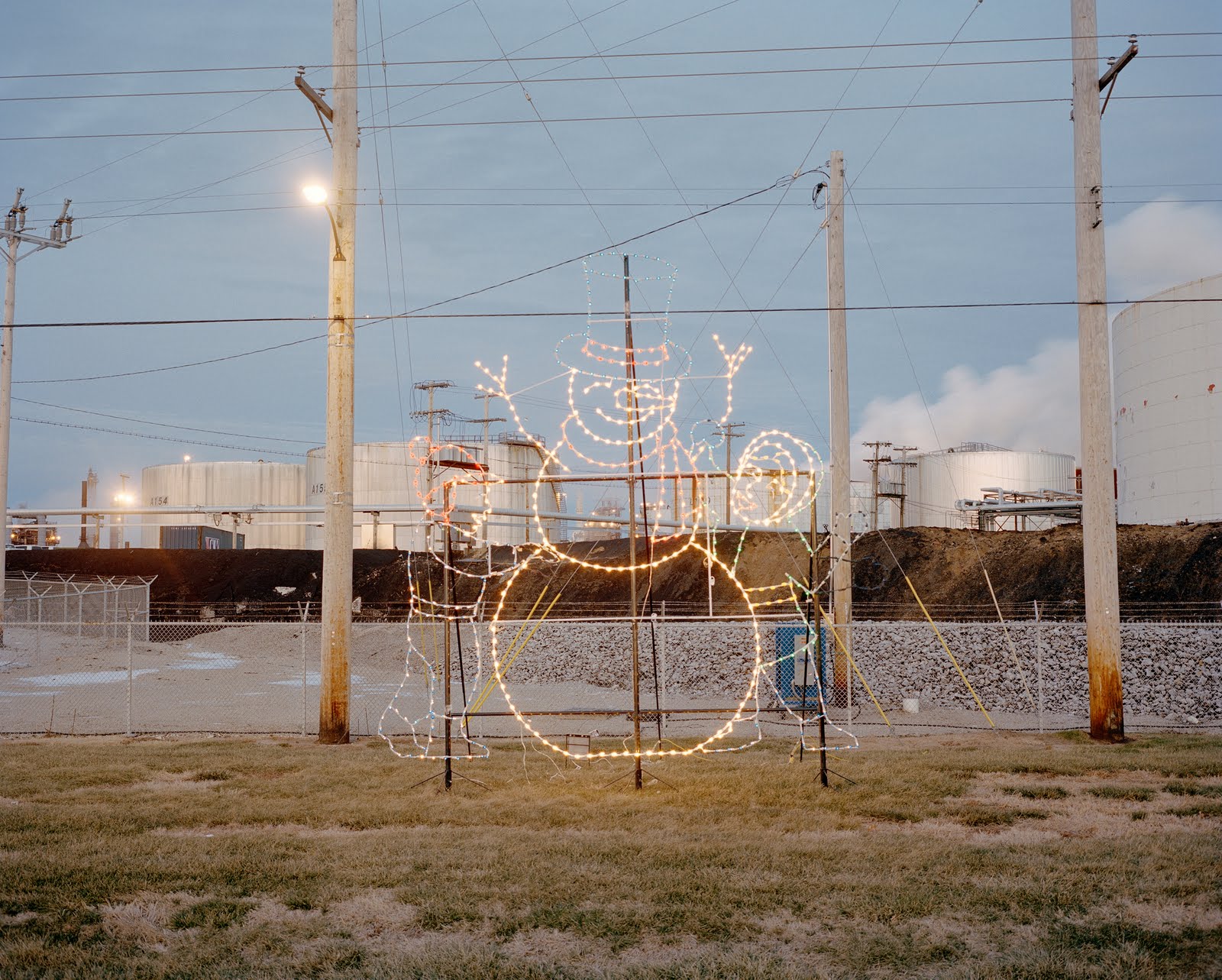 Jo Ann Walters, Christmas Lights at the Refinery, from the series Dog Town, Illinois, 2010
Latter in the interview she mentions that her work is informed by a combination of Eggleston and Atget centred on a concern for beauty that is differentiated from sentimentality.
December 17, 2010
British photography: Sarah Amy Smith
Sarah Amy Smith was born and brought up in Cornwall and her photography of the area is expressed in in her 'Of Land and Sea' project that is shot using a Mamiya 7 Rangefinder camera.
 Sarah Amy Smith, Caravan, from Of Land and Sea
This series is Smith or rather Falugo's sympathetic portrait of people and place is done in a documentary style in which people and the architecture are situated within their landscape.
December 16, 2010
Frank Gehry: Dr Chau Chak Wing Building
Frank Gehry has designed the proposed UTS business school building in Sydney to be known as the Dr Chau Chak Wing Building. His brief was to transform a former industrial site at Ultimo---wedged between the ABC Ultimo Centre and the Powerhouse Museum--- into a building of international repute.
This will probably be Gehry's only building in Australia. This is the view of the building as it faces the street:

This is in the deconstructive style---deconstructing modernism. It makes a welcome change from most of the banal built environment ----the uninspiring office buildings, tract houses in suburbia, the McMansions, the strip malls, the shopping malls. Rarely do we see great architecture. So UTS needs to be applauded for being so adventurous and for breaking away from the brutalist UTS high rise tower.
 Frank Gehry, Dancing House, Prague
Gehry's work is in the tradition of art and architecture transform the identity of a city and its people---- the Parthenon effect, the Chartres Cathedral effect, the Notre Dame effect.
December 15, 2010
interpreting images
My interpretation of Susan Sontag's work on photography is that she is endeavouring to come to terms with digitization as a chaotic deluge in which a sheer volume of information bombards us--the consumer and citizen--- every day. The various images with varying degrees of frequency come into close proximity in brutally contradictory settings and with no necessary rational thread.
We are kinda left naked in our visual culture. We are left to narrativize such a messy surfeit of images in our culture by using the images in a pragmatic way, inserting and situating them in a patchwork of connections of our own making.
 Gary Sauer-Thompson, Memorial to German Jews in WW2, Melbourne Cemetery, 2010
Does this indicate an emergent style of thinking that is not necessarily bound by the interpretative narrative reason of a humanist literary culture?
December 14, 2010
photography and the end
A lot of critical commentary on photography is about its ending, end or its inscription by death. Photography is typically construed to be about likeness, to produce a likeness; our habitual reliance on its capacity to document is one example of this presumption.
Despite its well known capacity for distortion, the photograph's power to describe lets it be taken for a mirror. This understanding of photography, which used to be hegemonic, is coming to an end, even though some have faith in photography as an objective record of the world out there.
In Toward a Photography of Love: The Tain of the Photograph in Anne Carson's Autobiography of Red in Postmodern Culture E.L. McCallum addresses on version of what this end might be:
Because film photography is, as Derek Attridge has pointed out, "analogically bound to the referent," it faces a challenge in the digital age when the photograph "can always /not/ be the direct effect of the referent on sensitized paper" ....The change from emulsion to pixels impels us to rethink fundamentally what photography might be. Can we compare image pixels to those that comprise words? The change in medium raises the question of whether there is a change in the photographic relation as well: would photography no longer work through analogy, or for that matter through the contiguity of the negative and the printing paper? These questions push us headlong into the theory of digital images.
I've never been persuaded by the direct referent argument that we need to rethink the ontology of photography because photography is dead. Photography was always an interpretation of an event or scene not a reflecting mirror, and the referent though important, was not the source of photography's capacity to represent. Secondly, the technology of photography has changed since it was invented in the 19th century. Digital is the most recent technological shift; one that replaces the film negative with pixels and the darkroom with computer software.
Susan Sontag who disputes photography as interpretation, had a different version in On Photography (1977) of the end. She claimed, in criticizing our photophilia that turns everything eventually into an image, that "all photographs are memento mori". Presumably, she meant a genre of artistic creations that share the same purpose of reminding people of their own mortality. Not all contemporary photography is about skulls and bones suggesting our death.
McCallum goes on to say that some of the most widely read photography theory today focuses on death as the way of figuring ending in a photograph:
remarking on a photograph of himself in Camera Lucida (the book he wrote after the death of his mother), Roland Barthes tells us that "death is the eidos of that photograph"... Even critics who do not explicitly link photography with death tie it to implicitly deathly things: Andre Bazin, for instance, after suggesting that "the practice of embalming the dead might turn out to be a fundamental factor" in all of the plastic arts....goes on to claim later that photography in particular "embalms time".... Eduardo Cadava's more recent reading of photography in the oeuvre of Walter Benjamin leads him to attest that "photography is a mode of bereavement. It speaks to us of mortification". Geoffrey Batchen reveals that the link might reach back to portrait photography's earliest days, when subjects' "heads were inevitably supported by a standing metal device to keep them steady for the necessary seconds. Photography insisted that if one wanted to look lifelike in the eventual photograph, one first had to pose as if dead" ...; even so, "photography was a visual inscription of the passing of time and therefore also an intimation of every viewer's own inevitable passing"...
The assumption here is that time as key to photography's inscription or linkage with death---eg., the stopping of time in the still frame when compared to motion in film.
The photograph both perpetuates a moment or event beyond its time and indicates the absence or displaced trace of the depicted. So we have the interplay of presence and absence.
December 13, 2010
British photography: Andy Sewell
Andy Sewell is more an English photographer than a British one from judging from his body of work entitled The Heath. This is about a world that is simultaneously urban and wild
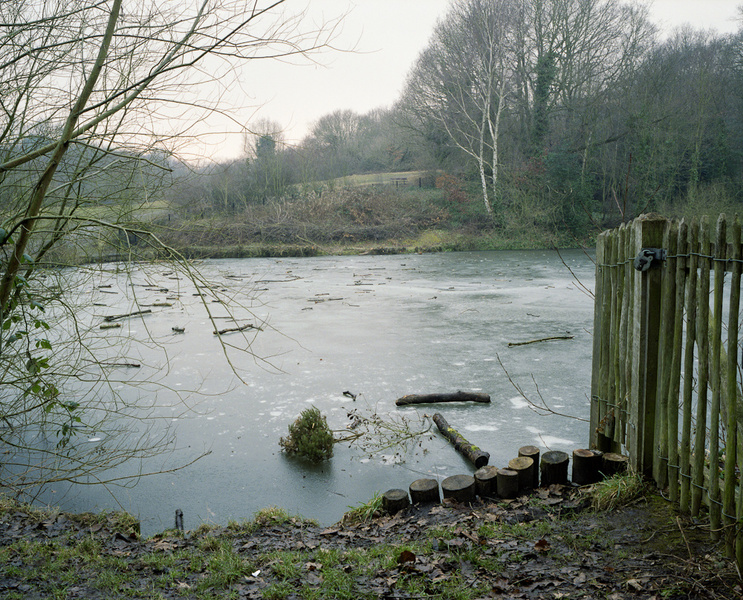 Andy Sewell sticks, The Heath
The Heath refers to Hampstead Heath; a managed green space in London that feels wild. It is a place of trees, tall grass and thickets. A third type of 'landscape' I guess. An urban forest.
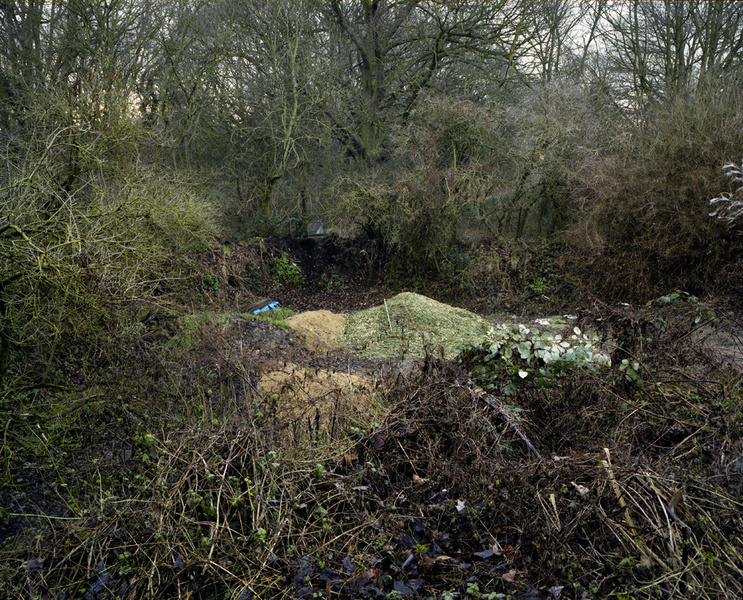 Andy Sewell bush, The Heath
Hampstead Heath is rambling and hilly, embracing ponds, recent and ancient woodlands, a lido, playgrounds, and a training track.
December 12, 2010
The urban renaissance
Regenerated cities produce property developers. That is what appears to be happening with Labor's urban renewal, both in the CBD and in the dockside redevelopment at Port Adelaide along with the huge expansion of suburbia and, to a much lesser extent, increasing the density of the inner suburbs. Adelaide's skyline is developing as the CBD is being rebuilt, and it is different to the dull concrete modernism of the 1960s. But its enclosed space.
 Gary Sauer-Thompson, Adelaide CBD, 2010
The basic premise is right. Cities are very important things. We do need to be building them and conserving them, building up their power and influence and independence. But how this is being done—via private finance initiatives, luxury flats, speculation etc—is fairly disastrous; and the architectural results--mostly modernist--- with few exceptions, look to be very, very poor.
The architects have spent the 80s and 90s agitating for tightly packed housing, the use of urban brownfield sites, compact cities, piazzas and public transport – all attempts to manage and make urban density comfortable. The results entailed four- to 12-storey flats built around with mooted shops and facilities in the ground floor. An inner-city housing boom started to match its suburban precursor.
In reality, the shops and nurseries became empty units or estate agents, the squares are inept and windswept, and speculative developers cram as many tiny flats into their plots as possible.
December 11, 2010
Tom Waits: Bone Machine
Tom Waits moves from gravel-raw hobo-rock to tender jazz-crooner torch songs, has one foot in blues-roots traditionalism and one ear to modern sounds, and inhabits various fictional personae and pours out his heart like a bottle. If his earlier career was built on engaging with the living repository of 20th century American music and culture, then his latter career engaged with German cabaret tradition of Brecht and Weill.
Bone Machine (1992) is a stripped-down approach to music comes a tightly-arranged, percussion-heavy style with no frills. The album is noted for its dark lyrical themes of death and murder and the junkyard/industrial percussion-driven sound at the core of this album.
'Who are You' is from Bone Machine and it was co-written by Waits and his wife, Kathleen Brennen:
The sleeve-artwork can be seen as evoking an aura of white-heat, sheet metal and crackling electricity: a machine. Yet, as the title suggests, it is an animalistic machine, a bone machine, that has an apocalyptic tone that disrupts and destabilizes conventions. The shambling percussive backbone of the songs is pushed up in the mix, turning the songs inside-out and making rhythm the raw focal point.
December 10, 2010
borderlands
Erik Johnson's Borderlands also explores the edges where the forces of nature encounter the urban environment.
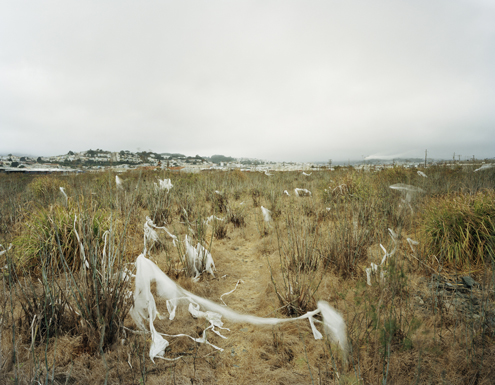 Erik Johnson, Untitled (tarp) from the series Borderlands, 2004
This is a series of lush, almost surreal large-format images of urban and near urban areas that have largely been abandoned to nature--greenbelts of undeveloped patches of weeds and forest. Untitled (Tarp) shows the remains of a white tarp against an empty field, the plastic ripped to wispy shreds by the wind and rain, their shapes echoing those of the fennel plants in the background.
Johnson is an assistant professor of photography at Massachusetts College of Art and Borderlands was published by Twin Palms Publishers in 2005.
December 9, 2010
a fraying edge: Alexander Gronsky
One of my photographic interests is the borderland between nature and the urban environment; that space with its fraying edge on the borders of cities that is often considered banal because it is a wasteland. It is often a wasteland because it has yet to be developed through urban expansion. Or we have the wastelands within a city.
One photographer who explores this kind of space is the Moscow-based Estonian Alexander Gronsky. His series of large format photographs made on the outskirts of Moscow, "The Edge," spring from an interest in the idea of boundaries both literal and abstract.
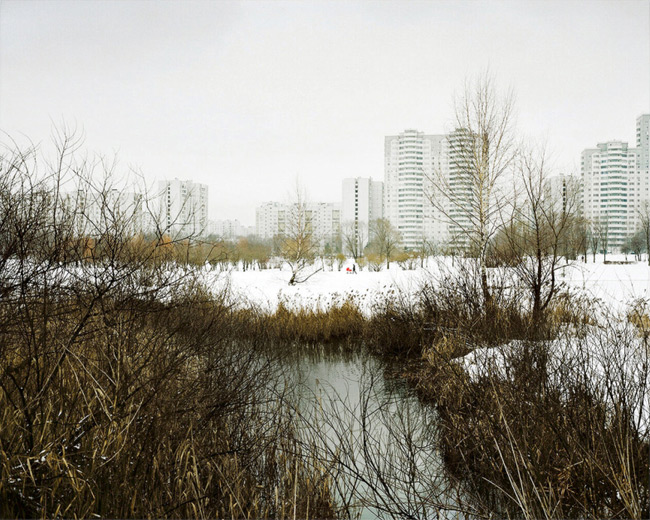 Alexander Gronsky, Untitled, from the pastoral series
These wastelands within the city are neither entirely urban nor rural and often they are where city dwellers find solace in nature interact with, but do not seem connected to, nature. The edge of the city looms in the" background with its faint skyline and construction cranes, leaving the viewer ever aware that these "natural settings exist within a vaster urban context.
To create the images, Gronsky studies Google Maps to find swamps, woodlands and unbuilt areas and is interested in the interaction of human and natural environments, by the intersection of chaos and order. He enjoys the irony that development intended to impose order often does just the opposite. "The human habitat is a form of chaos interacting with the very strict order of nature.
December 8, 2010
British Photography: Ian Teh
The earlier post on Deep Sleep magazine looked at Issue One. The issue of this new online project that I found most interesting was Issue 4 entitled Memory. It was the work of Ian Teh that caught my eye.
 Ian Teh, A mural in a polluted village depicts a famous Chinese waterfall, Linfen, China, Tainted Landscapes 2, China: Undercurrents
He is a member of the VU Agency and a central strand of his work is photographing the social, political and environmental issues and has made China a key focus of his current documentary work. This is explored in the series China Undercurrents.
Linfen, which lies in the heart of 12 mile industrial belt, is fueled by dirty, inefficient coal-fired plants and is one of the most polluted cites in China. It is enveloped by thick smog and is one of the worlds most contaminated spaces.
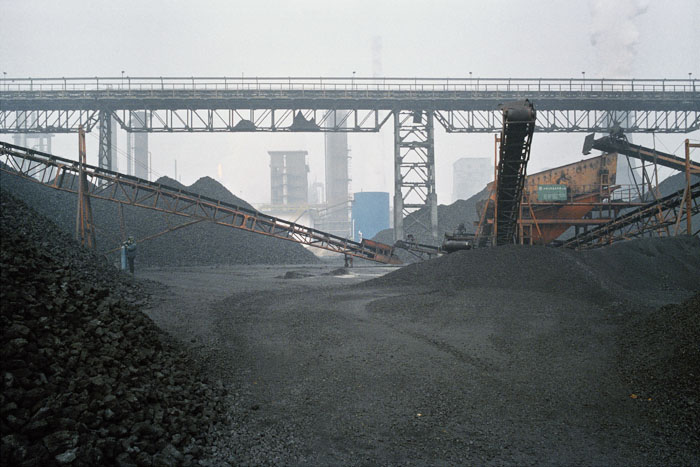 Ian Teh, Tar refinery plant, Linfen, China.
It is the high cost of China's breakneck economic growth that comes to the fore in this work; breakneck growth to lift the population from poverty. The unsustainable nature of red-hot economic growth has led to new policies to bring pollution (air and river contamination) under control, protect the environment and to switch to new, low-carbon, energy sources.
China Undercurrents” has been published in a photo-book by Timezone 8.
December 6, 2010
photography related blogs
Here is a list of 10 Photography Related Blogs that you should read sooner rather than latter to sample the diversity of writing about the contemporary photographic culture.
The work of these author bloggers (as opposed to the content aggregators) indicate just how quickly the internet is developing in terms of its free content and web platforms, and the significance of the photographic book in contemporary photography.
I know some of these blogs from stumbling across, and dipping into, them. The ones I don't know are Andrew Hetherington's What's the Jackanory?, Miguel Garcia-Guzman's EV +/-] Exposure Compensation, and Douglas Stockdale's The Photographic Book.
There were no Australian-based photography related blogs. As one would expect, since this list of blogs reflects the dominance of American photographic culture. There is just a fact of the globalized digital world. On the other hand there is probably not much online and free writing about photography in Australian photographic culture.
As far as I know, despite the commitment to an open culture amongst photographers, there is no web based photographic magazine being produced in Australia. What we have for the moment is Flickr as the photographic archive of image production in postmodernity with its collapse of the old distinctions between professional and amateur and private and public.
This archive of everyday Australian photography on Flickr is so chaotic that any kind of unity --ie 'Australian photography'--is nigh on impossible. It stands in contrast to the Art institution's curated and archive in the form of a photographic canon. The latter form of the archive is a restricted order
December 5, 2010
finally, some movement
The weather was suitable enough for me to finally able to get the 5x7 Cambo view camera down to the rocks near Kings Beach, Victor Harbor, yesterday morning:
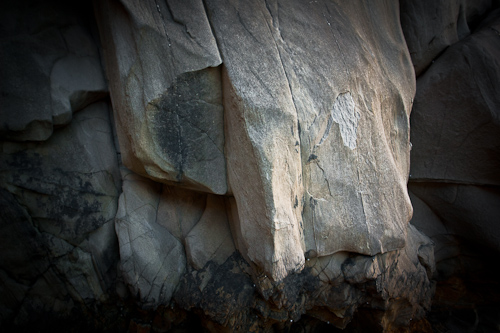 Gary Sauer-Thompson, rockface, Kings Beach, early morning, digital
Some of the images I'd planned were too difficult to do, given the limitations of the equipment: some required a telephoto lens on the large format to reproduce and I don't have one for the 5x7-- only have a normal and an old wide lens.
Other images were too low to the ground to attempt in the limited time that I had. Basically I ran out of time--the early morning cloud cover along the coast broke up and the open shade that I was working in was gone. I was lucky to get a couple of hours of cloud cover and still conditions.
I went back to King's Beach in the afternoon to do a broader landscape with Suzanne in it. We had to wait for an hour or so for a group of people--a family--- to pack up and leave the area.
December 4, 2010
Tom Waits: Swordfishtrombones
I watched a documentary on Tom Waits early music the other night. The music was the albums he made for Asylum Records between 1973 and 1980s. The album that I know the best from this period of the dark world of bars and all-night diners is Small Change.
The documentary referred to Waits shift to Island Records and Swordfishtrombones (1983), which found him experimenting with horns and percussion and using unusual recording techniques:
Waits sounds more like Captain Beefheart and closer to Kurt Weill and German cabaret here than on his earlier barfly albums. I find the album very accessible and musically interesting.
December 3, 2010
British photography: Sam Baguley
Sam Baguley is a founding member of Deep Sleep and he designed and developed the website. He has worked as a freelance designer and developer for many leading design and advertising agencies in London.
He had a portfolio of photographs in the first issue of Deep Sleep entitled London Beach:
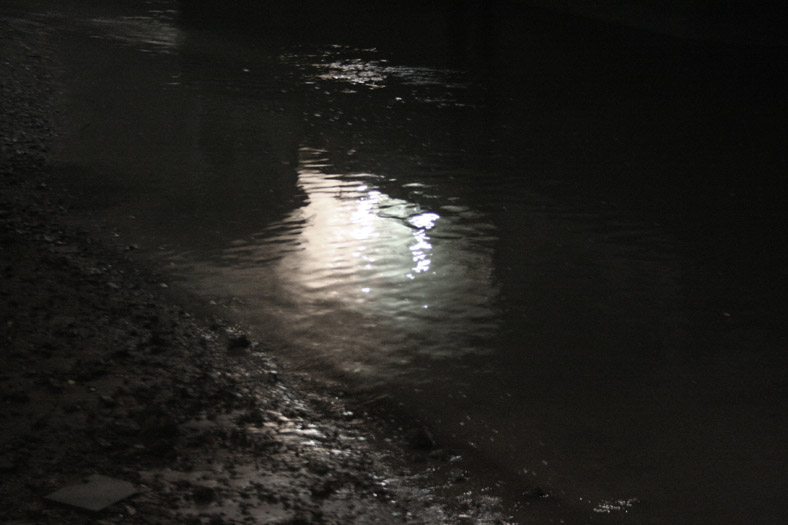 Sam Baguley untitled, from London Beach series
Many of the people involved in Deep Sleep appear to be part of the design/advertising world as well as the photography one. I'm not sure what 'invisible' means or refers to in both Baguley's London Beach---there are no people?---or the issue as a whole.
December 2, 2010
NZ Photography: Fiona Pardington
Another photographer in the Unnerved: The New Zealand Project exhibition at the Ian Potter Gallery in Melbourne was Fiona Pardington, who lives in Waiheke Island and works in analogue photography that is handprinted and toned.
 Fiona Pardington,The Bellbird's Nest with 4 Eggs (Korimako) 200, Toned silver bromide fibre based print
Fiona Pardington has been photographing taonga (treasures in Māori) for over a decade. She searches for forgotten museum objects that were once cherished — such as hei tiki (neck ornaments) or taxidermied extinct animals — and deliberately re-presents them as portraits imbued with a sense of their past value.
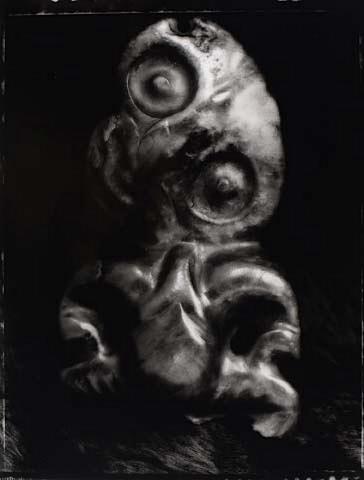 Fiona Pardington, Greenstone heitiki 30187, Whareakeake - Murdering Beach, 2001
Work from this series was also shown in the exhibition:
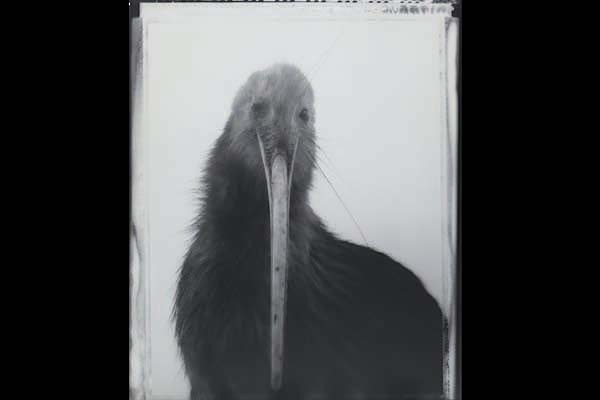 Fiona Pardington, Kai Tahu, Kati Mamoe, Kati Waewae, Sweet Kiwi, 2008, from the collection `Whanganui Museum'
December 1, 2010
New Zealand Photography: Ava Seymour
One of the photographers in the Unnerved: The New Zealand Project exhibition at the Ian Potter Gallery in Melbourne was Ava Seymour, the Auckland based photo-media artist.
The work shown was from Seymour's 'Health Happiness and Housing' series:
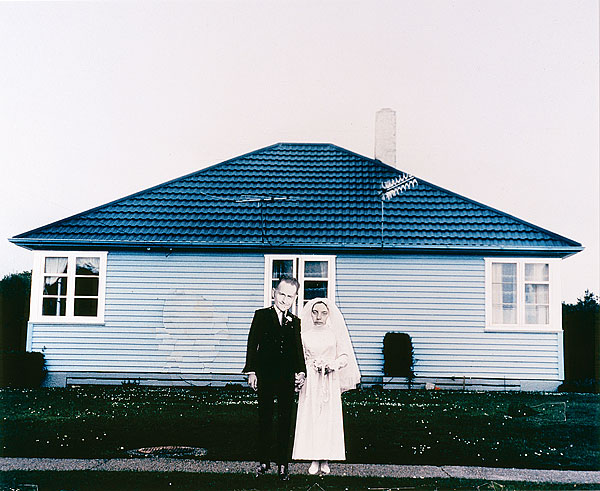 Ava Seymour, White wedding, Invercargill, New Zealand, 1997, Type C photograph
Seymour travelled the country from Auckland to Invercargill, photographing concentrations of state housing in places like Otara, Glen Innes, Porirua, the Hutt Valley and Brockville to find bleak suburban backgrounds into which Seymour superimposed found, black and white images of retards, cripples and amputees. These characters show the frailty and disability of their lives--- human deformity, suburban claustrophobia and shattered dreams.
The titles include Welfare Mom, Minne Dean, State Highway 1 and Enema Nurse and in some of the images Seymour, in which she has superimposed images of children on to photographs of council houses, and replaced the children's faces with those of people with Down syndrome or other disabilities.
 Ava Seymour, Bandy candy, 2001
Seymour began making photomontages while based in Berlin in 1992. By cutting and reassembling found images from photographs, magazines and medical textbooks, she has produced work that is provocative, contentious and absorbing. The most obvious lineages in her work include Hannah Hoch and John Heartfield. But whereas these classic exponents of Dada juxtaposition made art for specifically polemic ends, Seymour has disavowed political agency. Her work is predicated towards moods rather than messages, as she creates scenes that are simultaneously inviting and repellent.
The work does question the utopian vision which originally included reasonable housing for the economically disadvantaged who have relied on State houses.