|
November 29, 2010
Unnerved: The New Zealand Project, which was curated by Maud Page, is on tour in Australia. It claims to be neither “representative nor comprehensive of contemporary New Zealand art. There has been no major exhibition of contemporary New Zealand art in Australia since Headlands: Thinking through New Zealand art at Sydney’s Museum of Contemporary Art in 1992.
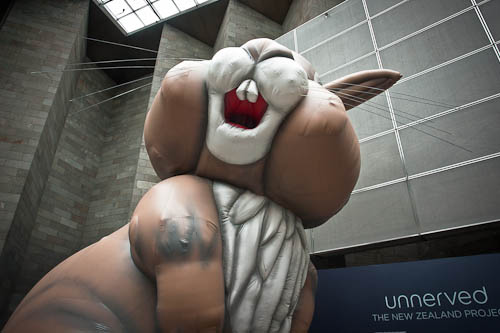 Gary Sauer-Thompson Michael Parekowhai's inflatable McMurty rabbit, NGV, 2010
Unnerved features more than 120 contemporary New Zealand works by more than 30 artists, dating from the late 1960s to the present, including paintings, drawings, photographs, sculptures, installations, film and video art. It shows some of the Queensland art Gallery’s diverse trans-Tasman holdings acquired through the acquisition of works from the Asia Pacific Triennales. What we are presented with is the plurality of contemporary cultural production in which photography has a central place.
In his review entitled in The Australian Christopher Allen found the show 'dreary' with little 'light relief' and lamented the blurring of disciplines. He contextualizes the show by emphasizing the differences between Australia and NZ, to infer that:
The result is a sensibility [in NZ] that has been regularly described as gothic, as in a gothic novel or the popular youth culture that fetishises gloom and death; and that is what is suggested by the exhibition's title, Unnerved. The term usually conveys a sense of sudden anxiety and uncertainty.
This kind of approach position New Zealand as somehow “exotic” in relation to Australia, largely because of the biculturalism and Māori/Pakeha polemics.
David Broker in stirred not shaken in Contemporary Art Centre of South Australia's (CACSA) Broadsheet rejects Allen's approach and argues that:
Much more interesting and productive is a focus on some of the factors that have driven the production of art in the dynamic and turbulent bicultural environment of Aotearoa.
Broker fails to analyze what this might be other than to mention the presence of religion. What was obvious to me was the ongoing influence of post-Duchampian conceptualism, in which the relative weight of any one discipline, style and genre, has for the most part been flattened.
Most advanced art practices now requires an knowledge of both art history and the specific idea being articulated. Art theory enables us to comprehend the philosophical transformation that occurs in which anything can potentially become art if it occupies the structural place of art. Since conceptualism, art has become increasingly accustomed to playing host to its own critique. Following the impact of a critique of canonical art history that has been underway for half a century the social function of art is that of identifying aesthetic conventions and artifice that are inherently political and then opening them up. The nostalgic lament for the loss of traditional skills does not acknowledge the contemporary realities of a pluralist cultural landscape.
|


