October 31, 2007
Rock Relics+Facebook
I've been establishing another kind of online presence at Facebook and, in searching for some musical material, I stumbled across this musical moment from the past ----'White Horses' by the Rolling Stones, stripped, from around 1995.
It's an acoustic version and, suprisingly, the song is performed quite well. I've added it to the 'my videos' section on Facebook, even, though I'm not sure what to make of Facebook. There's a lot of buzz and the Australian bloggers are all busy constructing their own Facebooks --but for what purpose? What's it all about? How come the buzz?
I can see that it's an application platform for personal information that construct a pop culture picture of who one is. But it's more than identity, since whenever I do something of significance inside any of my Facebook applications the platform itself will inform automatically my contacts about it. So my personal Facebook experience depends on the number and level of activity of my Facebook contacts.
If there is no one on Facebook, then you know that the value of Facebook will be little or zero for me. But the more of your Contacts are using Facebook applications actively the more value in terms of “getting to know about what they do”----eg., books my friends are reading. Is this personal information important? I can see that what I get out of Facebook is the “network effect”: the more people using a network the higher is the value for the individual user. We stay automatically in contact with our Facebook contacts.
I can see that Facebook's social networking application platform enables a group of people--those interested in street art or art photography or political art or music--- to stay as a working group together in touch and on target.
Lake Mead, Arizona
This post builds on Cam's earlier post here on the declining lakes levels in south-western America in a warming world.
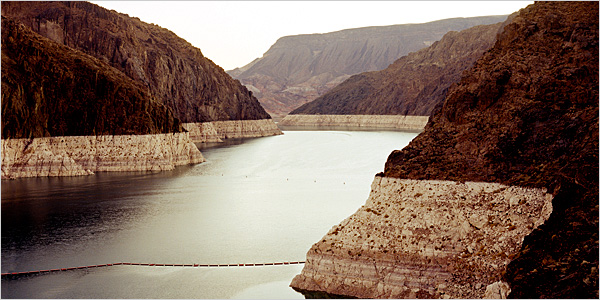
Lake Mead, in Arizona and Nevada, half-empty
This lake sits behind the Hoover Dam on the Colorado River, which currently provides water for some 30 million people in seven states--Colorado, Utah, Wyoming, New Mexico, Arizona, Nevada and California---and supplies nearly all the water for Las Vegas. The situation is one of limited Colorado River water supplies, increasing demands, warmer temperatures and the prospect of recurrent droughts.
It sounds familiar does it not?
Like the Murray-Darling Basin in Australia, the American West's huge economy and political power has derived from , and depends on, the 20th-century water infrastructure that conquered rivers like the Colorado, established a reliable water supply, and make deserts bloom. If you read the history of the south west of in terms of water development, then this account in the New York Times Magazine describes the current situation:
In the 20th century... all of our great dams and reservoirs were built — “heroic man-over-nature” achievements, in Binney’s words, that control floods, store water for droughts, generate vast amounts of hydroelectric power and enable agriculture to flourish in a region where the low annual rainfall otherwise makes it difficult. And in constructing projects like the Glen Canyon Dam — which backs up water to create Lake Powell, the vast reservoir in Arizona and Utah that feeds Lake Mead — the builders went beyond the needs of the moment. “They gave us about 40 to 50 years of excess capacity,” Binney says. “Now we’ve gotten to the end of that era.” At this point, every available gallon of the Colorado River has been appropriated by farmers, industries and municipalities. And yet, he pointed out, the region’s population is expected to keep booming.
Because the supply of water in the West can’t really change, and there's no no magical locked box of water, so the water is going to have to come from an existing use.
The situation is that of the Murray-Darling Basin. You can’t call it a drought anymore because it’s going over to a drier climate.
October 30, 2007
Adelaide calling
When I wandered home from the Luminaries exhibition on Friday I noticed this representation of Adelaide in the window of SA Tourism. Clowns are usually seen as fun creatures but I interpret them as strange if not fearful ones

Gary Sauer-Thompson, clowns, 2007
It's Adelaide ugly--the poisonous comment world of Adelaide Now (the online site for News Limited's Adelaide Advertiser and Sunday Mail)--not Adelaide enlightened.
October 29, 2007
Australian photographers: Carol Jerrems
I caught Kathy Drayton 's Girl in a Mirror: A portrait of Carol Jerrems (2005) by chance on ABC last night. The 55-minute documentary, which is available as a DVD, is constructed from seventy-three of Jerrems' original prints; 166 new prints made from the extensive collection of negatives stored in the gas rooms of the NGA; together with thirty portraits of Jerrems sourced from the archives of contemporaries, Rennie Ellis, Robert Ashton and her teacher and mentor, filmmaker Paul Cox.

Carol Jerrems, Vale Street, 1975
Vale St, St Kilda, has become the iconic image of Australia in the seventies. It is a portrait of Melbourne model Catriona Brown flanked by two sharpie teenagers, the boys standing just behind in the shadows.
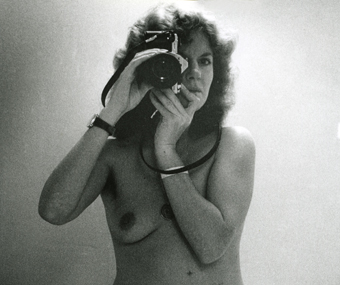 Jerrems aimed to capture the raw edges of the world she saw around her: sharpie subculture, street life and urban indigenous people.
She was part of the counterculture of the 1970s - and photographed the music, the cars, the fashions, the social tensions and the sexual experimentation.
Jerrems was diagnosed with polycythemia, a rare blood-related cancer when in Hobart. She underwent months of invasive and painful procedures, but came to a realisation she was dying.
Jerrems photographed and wrote about her physical decline. She photographed doctors hovering, the scars on her stomach, and her mother, with whom she had a difficult relationship, visiting. Jerrems had moved from observer and recorder of the historical moment, to a very personal open style: collaborating with her subjects in their representation, and often including herself in reflections in the frame.
Balthus revisited
The French painter Balthus (Balthasar Klossowski, 1908-2001) was an outsider during the modernist period. The pointed eroticism in his paintings young girls on the threshold of adulthood caused shock and consternation, just as Balthus had intended.
He worked in a self-consciously pre-modern style that rejected the twentieth century trend toward abstraction, though his work had definite elements of surrealism.He is one of the first anti-modernists as he painted the figure at a time when figurative art was largely ignored.

Balthus, The Mountain, 1937
The Mountain, a quirky representation of young hikers in the Bernese Oberland, with is referenes to Courbet, Caspar David Friedrich and Poussin that it approaches pastiche. Poussin and Courbet in France and Piero della Francesca among the Italians were his reference points. Although his works were formally somewhat conservative, they raised controversy for their subject matter: the scenes often have an erotic, disturbing atmosphere and are often peopled with pensive adolescent girls.

Balthusa, Patience, 1943
Balthus works in the space defined by the essential difference between eroticism or sexuality and pornography and he finds a particular poignancy in the notion of very young people set apart in a world of their own.
October 28, 2007
Canyon Lake, Arizona
Canyon Lake is an artificial water body created by damning in the 1920s. It is close to Phoenix, being about twenty-five miles away, and is a popular recreational boating spot. When I went past there the boat ramps were closed as they did not touch water. The only boats on the lake were on the pontoons which were sunk way below the normal waterline of the lake.

You can see the roofs of the pontoons are below the bleach line. Pretty significant pressures on water in the US south-west.
Canyon Lake from maps.google:
View Larger Map
Phoenix is to the west on the map.
Adelaide Architecture
This craft workshop is half a block from the Central Market in Adelaide. The shop itself is a heritage building:
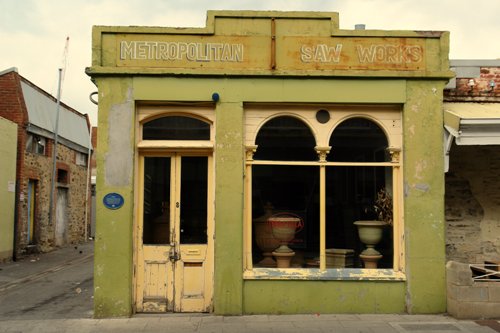
Gary Sauer-Thompson, Metropolitan Saw Works, Adelaide, 2006
The little lane that runs beside the shop and the back of the shops on Gouger Street, is remarkably free of graffiti. Suprisingly so. Just down the street from the Metropolitan Saw Works is a old building with a Housewives Association sign on it. The building looks decrepit and as if it is not used. Presumably, the Housewives Association is defunct. Many women are now in part-time work and some men are house-husbands.
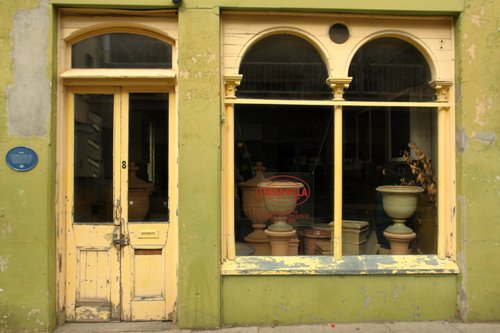
Gary Sauer-Thompson, Saw Works Shop Adelaide, 2006
October 27, 2007
Luminaries: contemporary jewellery
Last night I went to the opening of a contemporary jewellery exhibition entitled Luminaries at Flinders University Art Gallery in Adelaide. I wandered out into the foyer between speeches and took this:
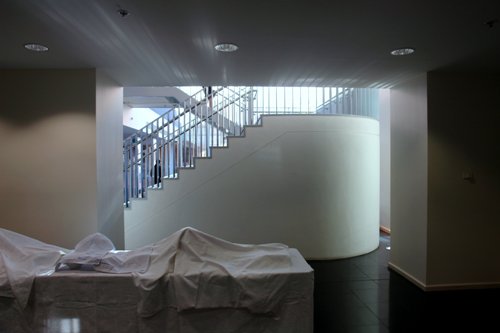
Gary Sauer-Thompson, Foyer, Flinders University Gallery, 2007
and uploaded it to my uban gallery.
Luminaries is a traveling exhibition that shows new work by six Australasian jewellers: Warwick Freeman, Barbara Heath, Marian Hosking, Carlier Makigawa, Catherine Truman and Margaret West.
Barbara Heath, who is staying with us at the weekender in Victor Harbor, gave a talk in which she said that:
my work is earthed, by the functional imperitive of daily wearability. Sensuality and the pleasure of wearing objects that conform to the body is part of the work too.The kinesthetic body... the one that feels, and knows by feeling. The weight and density of metal encircling a finger, the rolling fluidity of a knotted strand of beads draped around a neck - these kind of presences and restrictions draw our inner attention to our body’s own sites of meaning, to our posture and our collective memory and our rituals.
She linked her work in the exhibition to the Cheapside Hoard archives. The group of 400 items includes delicate gem rings each having their gold bands partially concealed beneath white enamel. In Barb's work the gold is partly covered with white enamel.
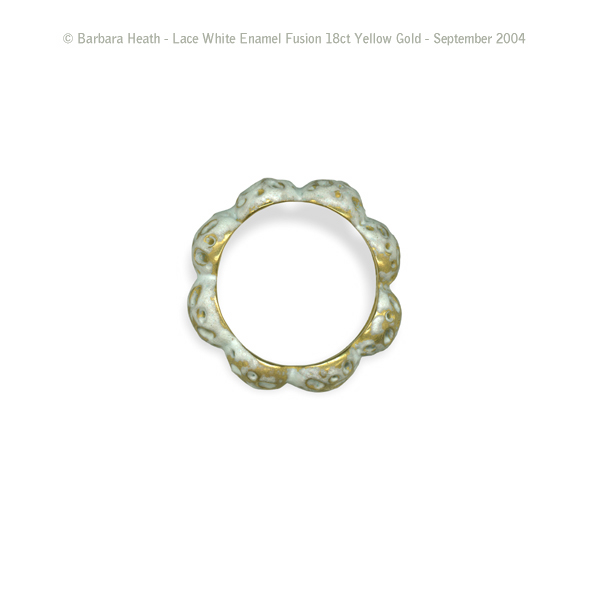
Barbara Heath, Lace White Enamel Fusion, 18ct Yellow Gold, 2004
October 26, 2007
The End is Nigh
The federal election campaign after 2 weeks:
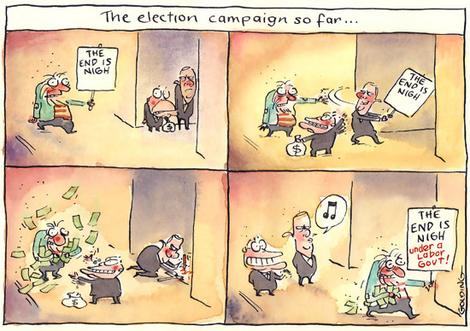
Matt Golding
We are all going to suffer terribly is the message. Who from? The Coalition's account up to now says the trade union bogey man (eg., Jo McDonald, the West Australian CFMEU union official) who wears blue shirts and red braces. That negative image appeals to and reinforces our entrenched prejudices.
However, Peter Costello, the federal treasurer, has started doing a fine line in doomsday rhetoric in that a market apocalypse was on the horizon.The image of the wreckage caused by unregulated financial markets is no longer the wrecking ball--it is the tsunami.
October 25, 2007
graffiti as a decayed form
If graffiti is seen as street art, as Marcus Westbury argues, then some of its forms are very stereotyped. It's the same throwup form repeated over and over again with different colours, but little attempt is made to transgress the form.

Gary Sauer-Thompson, wall, Adelaide, 2007
If street art is alive and happening now, in contrast to the collected art displayed in the grand art institution, then this expressive form does not say very much about our everyday life in Australia. In contrast to the underground, experimental and DIY culture this kind of throwup graffiti becomes boring and tedious. There is nothing to engage with.
Nor does the graffiti form refer to other visual creative forms, or to help establish or reinvent a rustbelt Adelaide as a creative and interesting urban cultural centre where art and music is made in disused industrial buildings or run-down bowling clubs. Nor does it seem to be a part of the street culture of DYI fashion, music, art that is happening in the spaces of derelict warehouses that have become studios.
Marcus Westbury works with the familiar notions of high and low culture to argue that these spaces are crucial for low art. The kind of work generated by The Empty Show movement can develop if artists have studios in the art spaces in the derelict buildings, which would otherwise stand empty if not being used by artists to make things. These spaces/studios become the incubators that grow into this:
A better quality of Broken Yellow's excellent video of The Herd's reinterpretation of Redgum's classic 'I was only 19' can be found here.
The Who: The Kids are Alright
I watched this DVD (Special Edition) last night. It is an enhancement or re mastering of Jeff Stein's 1979 film of the same name, and it achieves a higher quality of the sound, the restoration work has made the picture quality much richer and sharper, whilst footage cut from the film (eg., the clip from The Rolling Stones' Rock 'n' Roll Circus) has been returned. What it shows is the way the band expanded the boundaries and vocabulary of pop music in the late 60s and early 70s.

It is is not a chronological telling of the Who's career told in terms of TV performances or video clips of hits. There’s no narrator. There appears to be no clear order to the music. Stein’s film is a salvage project, a patchwork of rare television appearances, 8mm footage, early promos, seamlessly integrated and re-cut Woodstock images, and live performances the director captured in 1978.
It is conceptual in that you see The Who in their different styles: R&B ravers, Mod poppers, blues aficionados, rock opera stars, and hard driving anthem blasters. What we are offered is a band with their roots in pop visual culture and mod London, who were in great danger of becoming a vaudeville stage act smashing guitars and drums.
Townshend's music saved them, until the musical decline after the classic Who's Next, when they abandoned their exploratory music in the mid-'70s, settled into their role as arena rockers in pursuit of the dollar, became a money-making machine and slowly disintegrated as a musical group.
This loosely assembled archival footage is more a scrapbook than a history, as the Lifehouse Project is not explored, nor is any mention made of Quadrophenia even the DVD finishes with a studio performance of the Who Are You in 1978. It's a pity since Townshend 's anchoring the band with his furious windmills, propulsive rhythms, and a songs, formed the complex, contradictory heart of the Who. The Lifehouse project eventually developed into The Lifehouse Chronicles.
The DVD (Special Edition) is close to the Jeff Stein original film, which has become one of the most celebrated documentaries in the history of rock. The restored version doesn't offer many extended excerpts or unused performances. Most of the two-disc set's supplementary material is dedicated to detailing what went into the restoration— it's interesting material---and it almost context-free for history or insight into the band's development. This is less a film about rock 'n roll, than of film of rock’s dynamic performers.
October 24, 2007
Not quite Art
I watched the second part Marcus Westbury's Not quite Art---The New Folk Art --- on ABC TV last night. This series explores how the art world looks from the other side of the art institution. Westbury began The New Folk Art -by exploring the street art of Hosier Lane, Melbourne. His argument was that this kind of art is a messy, dirty thing that comes from the bottom up, refuses to behave, is borderline illegal, and is very transitory. Stencil graffiti is art.
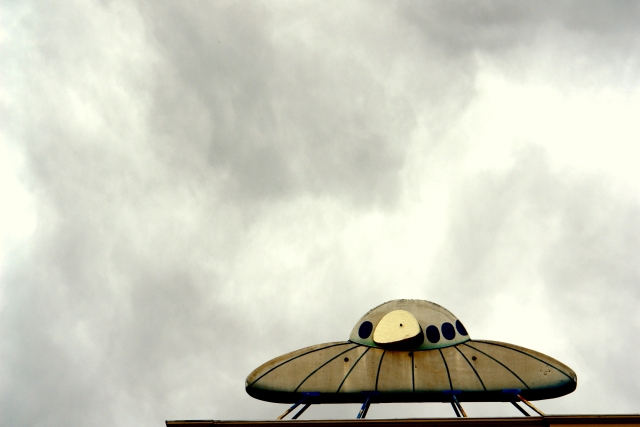
Gary Sauer-Thompson, spacecraft, Adelaide, 2007
Westbury, the founder and manager of This Is Not Art Australia’s premier independent, emerging and experimental arts festival in Newcastle, NSW, reckons that art should reflect, reject, dissect and infect the way the world does business. It's unpopular culture created by vandals, deadbeats and trespassers, because they are creating the kind of art he was most interested in.
This is placed in opposition to the echoes of the past---cover bands such the symphony orchestras and opera companies and the state theatre companies--- that produce comparatively little in the way of original, innovative or even Australian work. The innovative street art is also juxtaposed to the high art in the white walled art institution.
Update
I've been playing around with the video file as I wanted to hear the video again. My attempt to play the downloaded MP4 in Apple's Quicktime didn't work. I've finally got Windows Media Player working so that I can watch the video on the ABC site. I've also downloaded the video file as WMV so that could listen to the segment on painting the walls of soon to be demolished derelict building and factories.
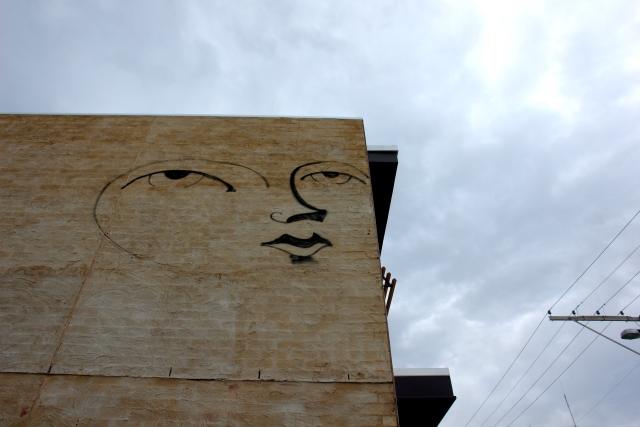
Gary Sauer-Thompson, face, Adelaide, 2007
I was hoping that this kind of work--The Empty Show --- would be digitally archived in some form--- I saw a shot of images on a portable Apple computer. I wanted to have a closer look at the site-specific works, as The Empty Show movement was born in Melbourne when a group of street artists did up the interior of an abandoned hotel.
October 23, 2007
Quarry Australia
It's election time and people are caught up in the details of electoral politics. This Simon Letch image is the reason why I'll be turning my back on the Coalition and bidding them adieu:
 It's Quarry Australia. Australia's future lies in becoming an information society along these lines ---- Robert Reich's The Work of Nations: Preparing Ourselves for 21st Century Capitalism.
Another review.
Some comments can be found on this post at public opinion
Reich argues in "The Work of Nations "that growing involvement with the world economy is one of the great changes of our time. He says that we are witnessing the end of "national economies, at least as we have come to understand that concept."
Reich argues that in a world without economic borders all people will rise or fall to their market values; the skilled and talented will prosper, while the uneducated and unskilled will not. In his view, then, the "work" of a nation is to improve the skills of its people so that they will flourish in this new world order.
The better educated we are, the better off we will be as a nation. Who can dispute that?
October 22, 2007
Where is Water Wisdom?
I went to visit Canberra's second largest dam last week. The Corin Dam is located in the Namadgi National Park in the Australian Capital Territory. Corin Dam was built in 1968 to add to the national capital’s water supply. Nine years ago the dam wall was raised in height by two meters, increasing capacity to 75,400 M/L (according to a sign at the dam), presumably to accommodate a healthy supply. However, in past six years, Corin's supply of water for Canberra’s population of 330,00 people has dropped to less than twenty percent of the dam's capacity.
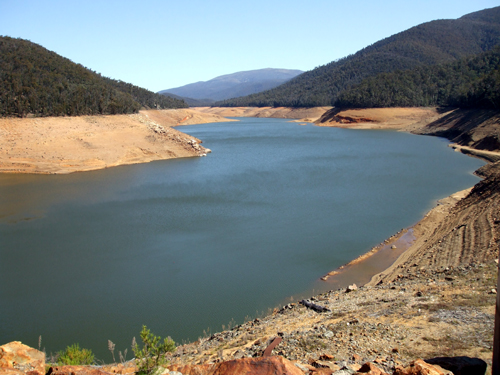
Corin Dam, 2007 [partial]
The storage levels of Australia’s dams are available online. Canberra's largest dam, the Googong, at 124500 M/L is slightly above 55% of capacity. Australia-wide, water supplies are of increasing concern. A recent report indicated Adelaide’s dam volumes are so low that trucking in bottled water is being considered. The quality of water in South Australia’s dams may soon become unfit for drinking if capacity falls too low.
I would like to hear a lot more from the major parties about water. I’m not sure how happy the general public would be if they were forced to buy bottled water to supplement what they would be allowed to take from the tap.
the natural order
I wandered the streets of the CBD in Adelaide yesterday afternoon for an hour or so with my camera and I stumbled across this image amongst the bill posters in an alleyway near the Central Market in Gouger Street.

Gary Sauer-Thompson, natural order, Adelaide, 2007
The website address at the bottom the natural order.com.au. It does not exist. You can see the way the address is incorporated into the frame on the next image over the page. The male is a fox--a predator. Does this represent an art of dissent? I could find no mention of this work on the internet. Not even inside the pages of Rip it Up.

Gary Sauer-Thompson, natural order, Adelaide, 2007
The woman is a dominatrix. S+M is the natural order of things. I guess it is where sociobiology meets a porn culture.
October 21, 2007
a surreal moment in Adelaide
We caught the free tram yesterday morning and went shopping-- to buy new sheets and linen etc. It was hot--a warm north wind was blowing. We were part of a great mass of people spending their Saturday morning going shopping in Rundle Mall. I looked through the tram window with an innocent eye---as if I was visitor/tourist to the city---and saw a giant toad:
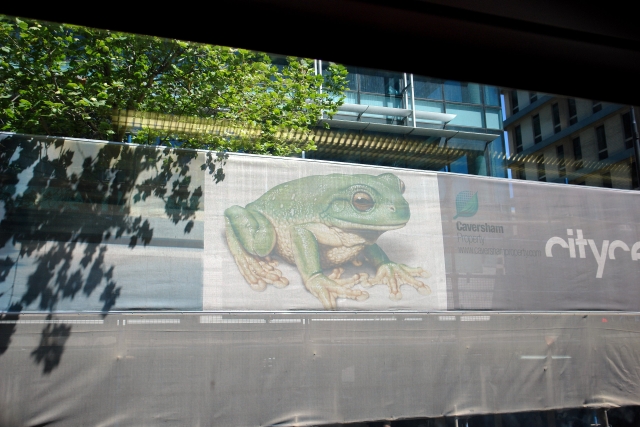
Gary Sauer-Thompson, toad, King William Street
What was that image about? A cane toad? Are the cane toad's marching to Adelaide? Or was it a frog signifying the effects of global warming? It was a new building site----Murdoch's old Advertiser building, in factr, which was being upgraded into what? Clearly, it was part of the big urban renewal of the CBD that signifies a prestige location of Sensational Adelaide.
The tram moved on and the surreal moment passed. Next stop was the shopping and entertainment precinct. We shoppers were full of eager anticipation to maximize our utility. Our credit cards were ready.
This kind of consumer imagery was everywhere in the David Jones arcade.
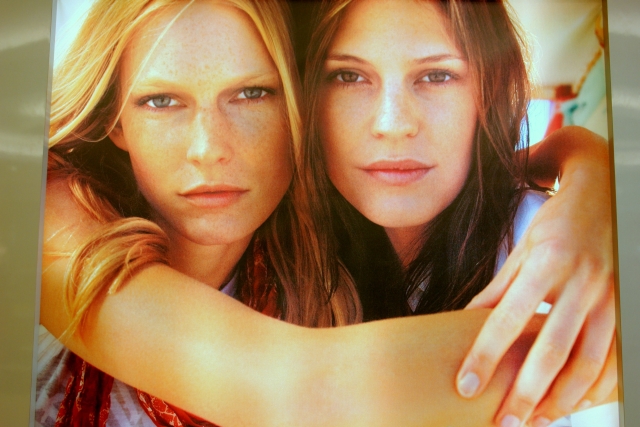
Gary Sauer-Thompson, Esprit poster, Adelaide, 2007
This was an environment that pulsated with ambiance shopping music.The overall effect was that I forget who I was before one entered the shopping environment. I was just a consumer in the moment surrounded by mysterious objects designed to catch my eye and entice me to max the credit card.You can tell who I really am by what I buy.
It wasn't long before I was tired of being a good consumer shopping off the aesthetics of beautiful/good living. I fled the consumption palace, and we walked home with our parcels. The free tram was no where to be seen and the tram stop was jamed packed with shoppers.
I had a late lunch then the dogs and I went looking for something different whilst on our afternoon walk:
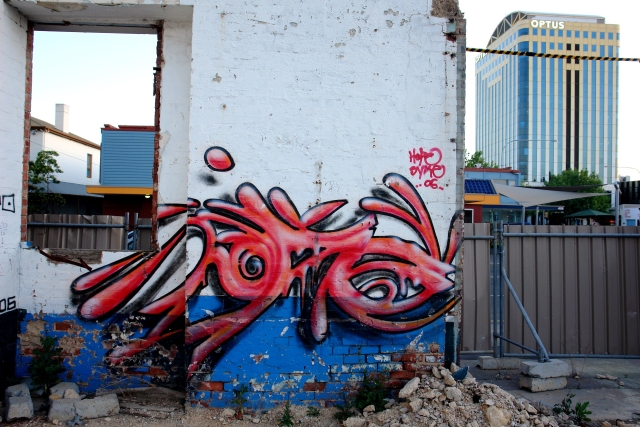
Gary Sauer-Thompson, graffiti, King William St, 2007
It is surreal street imagery in empty building sites that have signs that promise new buildings----"creative destruction" opportunities that never happen. The years come and go and the empty sites come to represent the the erasure of history, of culture, of memory. These empty spaces are the other to the world of "What did you buy?"; a space where you can to start ask "Is my life good?" and count on the answer to mean something more than buying consumer goods.
October 20, 2007
Freedom From Suicide
The Golden Gate Bridge does not have suicide jumper protection. The fence separating bridge pedestrian traffic from the Bay is a standard stomach height one. I like that. Apparently every year it gets debated as to whether suicide prevention fences should be added but so far those arguing for it have not been able to get their policy instituted. It makes the Bridge a much nicer and open public space without them. I hope the fence remains as it is.

I wish the Sydney Harbour Bridge would do the same.
Tasmanian visual politics
It is good to see that a new Tasmanian logging weblog is up and running---- it is entitled Forests Now Tasmania. It is visual, and so is another example of using images in a political way on forestry issues in Tasmania.
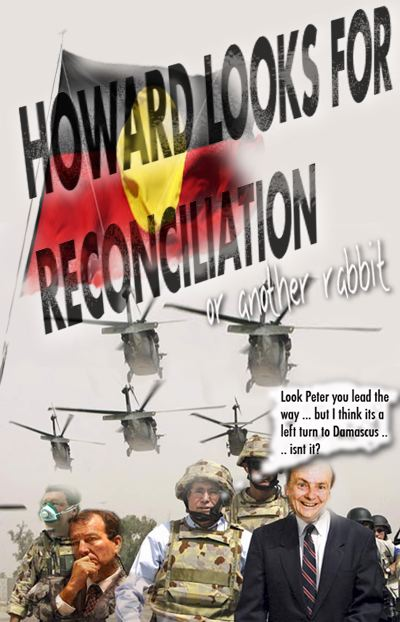
Anon
The political art is placed in a montage with text that provides a commentary on forestry events in Tasmania. Alas there are no links on the weblog to show or highlight the online presence of Tasmanians working along similar lines. So we cannot explore this regional world online. It remains hidden from us apart from those associated with the Tasmanian Times.
Tasmania is in a difficult spot energy wise. A key part of the Basslink business case was that Tasmania would make money by selling power to the mainland. The drought has reversed that. The effects of the drought have severely cut Hydro Tasmania's water storages, and the state is relying on imported power. Basslink is not a revenue-raising venture for Tasmania because its hydroelectricity storage lakes are less than 25 per cent full, making it impossible for Hydro to produce even enough power for local needs let alone export energy.
an aesthetics of violence
I became interested in an aesthetics of violence---after reading Monica Dux's There must be than hating Howard op ed in the Age. It reminded me of Edmund Burke early writings on the aesthetic and the sublime, which were intimately connected to his political concerns.
The heart of his aesthetic addressed itself to the experience of terror, a spectre that haunts Burke's political imagination throughout his career. Burke's preoccupation with violence, sympathy and pain actually allowed him to explore the dark side of the Enlightenment.
Isn't that dark side of the Enlightenment (social liberal version for Dux) what is disclosed by the deeper current of Dux---both her talk about hate, venom, intoxicated by blood lust etc---and the political violence in her 1990s feminism? Violence, pain and terror (Tampa and Howard's jackbook Intervention into the Northern Territory are Dux's examples) are all sitting there in her text---as Sandra saw. Isn't this terror the spectre that is haunting Dux and her Howard hating thirty somethings?
Burke's Philosophical Enquiry into the Origin of Our Ideas on the Sublime and the Beautiful (1757), introduces the idea that sublimity is constituted by a fear of alterity whereby the sublime is achieved artistically by a tantalizing obscuring of otherness. Burke argues:
Whatever is fitted in any sort to excite the ideas of pain, and danger, that is to say, whatever is any sort terrible, or is conversant about terrible objects, or operates in a manner analogous to terror, is a source of the sublime; that is, it is productive of the strongest emotion which the mind if capable of feeling. (39)
So we have aesthetics bound to politics and vica versa. Burk's text is one of the three theoretical "arche-texts of the sublime" ---ie., Pseudo-Longinos, Burke, and Kant
Dux, as an independent literary writer, is talking about the relationship between the sublime and terror in politics and her words --- hate, venom, intoxicated by blood lust ---refer to the experience of the sublime. If we dig back to the text of Pseudo-Longinos we find the sublime linked to ethics----which is what Dux is doing.
October 19, 2007
Centre Place
In his The Writing on the wall piece in The Guardian about Melbourne's stencil graffiti, Banksy says that:
The street art destroyed in Melbourne will survive on graffiti's new best friend - the internet. The web has done wonders for graffiti; it perfectly reflects its transient nature, and graffiti is ludicrously overrepresented on its pages. The ability to photograph a street piece that may last for only a few days and bounce it round the world to an audience of millions has dramatically improved its currency.
He adds that the graffiti will not be removed so it can be replaced by vistas of clean urban space,, since every meaningful spot will be clogged with giant billboards by the likes of McDonald's encouraging you to get fit by staying at home and watching the games on TV.
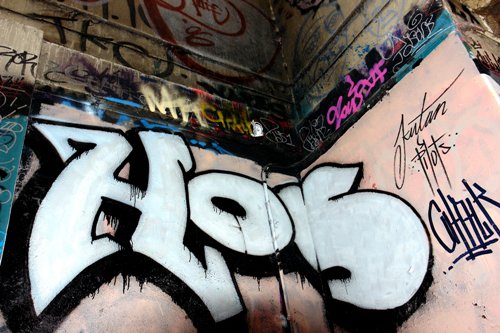
Gary Sauer-thompson, Central Arcade, Melbourne, 2007
He adds that Melbourne and London are genuine epicentres of the skewed human touch that can bring a little sparkle into the drudgery of public space. As Mark Holesworth over at Culture Critic @ Melbourne observes Centre Place has become a mess because nobody is showing any respect for the street art.
Marcus Westbury’s excellent program Not Quite Art (Tuesday 10pm ABC) promises to explore Hosier Lane and street art next week.
October 18, 2007
Central Arcade Melbourne
This stencil graffiti is from Central Plaza, Melbourne that I mentioned here. I've been meaning to return to it.

Gary Sauer-Thompson, Central Arcade, Melbourne, 2007
A lot of clever stencilling can be found in a little cul de sac that runs of Central Arcade. If Melbourne is the proud capital of street painting with stencils, then it is unclear why it became so. Or why this kind of street art become a core mode of expression of the city's witty, creative and socially aware underbelly.
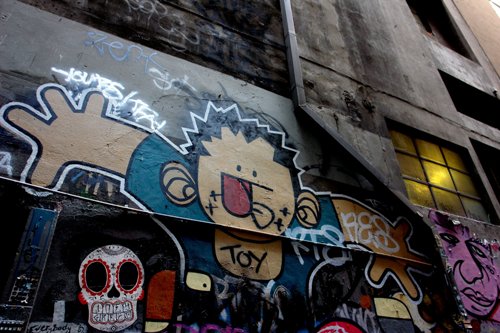
Gary Sauer-Thompson, Central Arcade, Melbourne, 2007
October 17, 2007
Axis of Awesome
It's Aussie hip hop. Their Rudd versus Howard video--- a musical satire on the election battle:
It shows how the cutting edge of political satire has shifted to video and YouTube.
reinventing internet cafes
The dream of free public wireless internet has found a new business model - flashing advertising at coffee drinkers.The newly launched CafeScreen business has placed big digital screens in 25 cafes in Melbourne and Sydney. In offering a choice to the exorbitant hotel internet rates it discloses how the 'online presence’ of individuals means that there are more of us online, in more places, more often.
The screens carry paid advertising, as well as information and entertainment. But they also come with free high-speed wi-fi internet access for the nearby caffeine quaffers. The system, hardware and internet access are free to cafe owners as well. In addition, they receive a share of the advertising revenue from ads featured on the screens.

Why so?
Cafes have become the new meeting and study rooms where people expect to be connected. They increasingly include free internet access as an bonus to dine-in customers increasingly conducting their office meetings, desk research and sundry work assignments on a laptop or PDA over a cup of coffee.
In Adelaide, people have free internet access in the central business district through a city-sponsored wi-fi network built by Internode. Using the lap top instead of the cafe computer enables me to access most of the blogs I read via RSS, which underpins the idea of blogging as a networked practice. Jean at Creativity/Machine notes that the interlinking within blog entries is occurring nearly so much as it used to, due to the obsessive characterisation of blogs as a kind of ‘personal publishing’ (or at most ‘journalism’), and the continued reification of ‘authorship’, rather than as a conversational or networked form of cultural production.
The last thing we want as we develop the conversational form of cultural production are large screens carrying paid advertising and entertainment of the culture industry. Can you imagine smart inner city professionals trying to do business with one or two LCD screens blaring political advertising and gossip about the latest stars in the entertainment world?
When I was in Melbourne I had trouble finding wi-fi public access points. Melbourne says that it is the wi-fi capital of Australia. They are there---the locations are listed by Azure Wireless on its website--- but in most cases there was little evidence of their presence. I asked, but few seemed to have the faintest idea of what I was talking about. Then there was the additional problem of their being no power point available in the cafe I'd chosen to prevent the laptops batteries from being drained.
October 16, 2007
image + television
Marx’s critique of political economy was based on the fact that all the mechanisms of the capitalist economy and its extended social relations were based on a specific illusion: things appeared to relate to each other as things, when the reality consists of relations among people.
He argued that capitalism has to find a way to extend the relations of production forged at the workplace to the rest of the human world. Consequently, a “culture of representation” is forged as the relations of production already established at the workplace are extended to the entire social world. We are cultural beings and no economic or political process can ever take place without culture.

Gary Sauer-Thompson, Banksia, Victor Harbor, 2007
The quintessential space of representation of late capitalism is the screen. In the contemporary global form of late capitalism the large screen of the cinema has yielded centrality to the small screens of television and computers that have become inserted into the domestic flow of everyday life. The television captures the viewers’ undivided attention by fixing the consumptive process of mass communication to a single point in space.
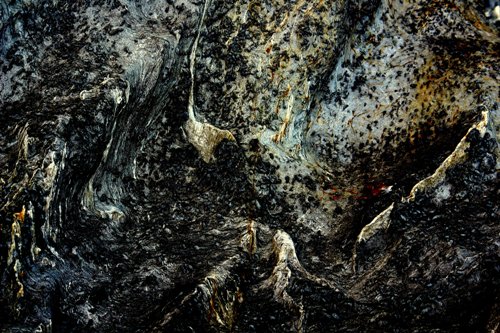
Gary Sauer-Thompson, rocks, Encounter Bay, Victor Harbor, 2007
Television creates a new practice of domestic space, in which activities must be interrupted or altogether abandoned because one must stay pinned to a single place, paying attention to the screen. With television entertainment becomes interspersed with commercials and attached as a form of programming flow to the stream of everyday life activities.
The point to this flow is to gather and hold the attention of a stable percentage of the viewing audience in order to lure advertisers to that network. Programming is simple filler between commercial breaks, and mass audiences are the actual commodity that is being “sold” to the advertisers.
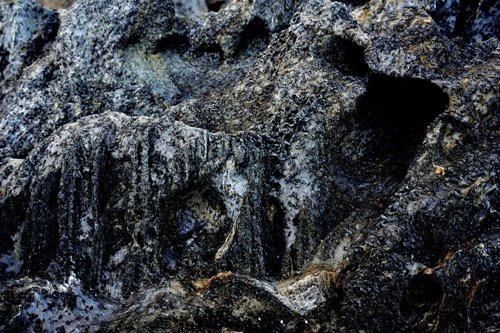
Gary Sauer-Thompson, rocks, Encounter Bay, Victor Harbor, 2007
Over the past two decades we have seen a transformation of mainstream television in which news and “reality” shows take up greater parts of the schedule once reserved for narrative (drama and comedy) and variety programming.The greatest impact that cable has had is in the all-news area, where the lines of demarcation between reality and televisual representation, and between awareness of real events and the construction of this very awareness(if not of the events themselves), becomes highly blurred.
San Francisco Public Transport
San Francisco is hemmed in by the Pacific Ocean on one side and the Bay on the other. There is one large highway, Route 101 running north-south but unlike other cities such as New York there isn't the large feeder highways coming from all directions. The access is limited by the size of bridges and the thin peninsula of land San Francisco is located on. The public transport is similarly hamstrung by geography and civil engineering works.

San Francisco's public transport is more like Melbourne than Sydney. There is a mix of heavy rail, light rail (trolleys) and buses. The city is still very car friendly as most cities are; the car is after all the main form of transport for the majority of people. The city is also reasonably pedestrian and bike friendly as well.
The photo above is a little unfair to the light rail station. It makes it look far more claustrophobic than it was. I liked the contrast of the wavy pattern against the hard rectangular shapes.
October 15, 2007
on the road
I was traveling back to Adelaide from Victor Harbor in the late afternoon, as I had to catch the early morning flight to Canberra. The sun was going down as we were coming into Mt Compass and this scene caught my eye:
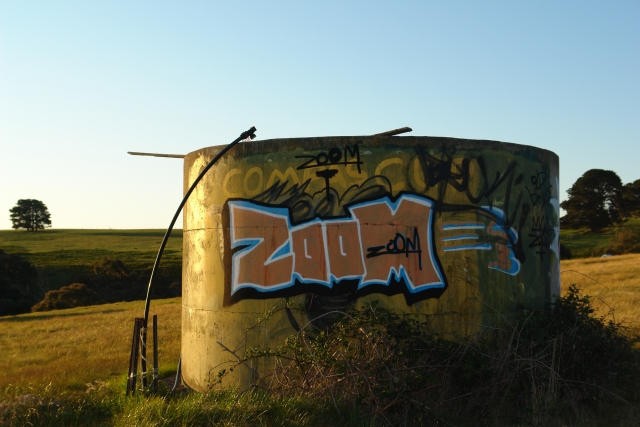
Gary Sauer-Thompson, on the Victor Harbor Rd, South Australia, 2007
I'd been thinking about it still rains regularly in the southern part of the Fleurieu Peninsula and so the land will become prime agricultural land. The dairy farmers will eventually go as the price of water goes up. Will they be replaced by vineyards exporting quality wine?
There is more graffiti appearing on the Victor Harbor Road:

Gary Sauer-Thompson, on the Victor Harbor Rd, South Australia, 2007
Though it was a quick shot I realized that I'm really struggling with making the transition to digital photography. I'm really glad that I'm no working in the chemical darkroom. However, digital cameras nowadays resemble computers more than anything. They have all the features you may like, they can be tweaked infinitely, and they are more flexible than ever before and you can tweak the image in a darkroom or in Photoshop. So the photographer becomes an image builder rather than a image taker.
My reaction is to all the complexity is to restrict myself and forget about the tweaking.
October 14, 2007
Caravaggio + Baroque
It's the light on the face of Mary Magdalen that captures one's attention. Then you notice the chiaroscuro, or the use of light and shadow.

Caravaggio, Martha and Mary Magdalen, c.1598-1599, Detroit Institute of Arts
Martha is in the act of converting Mary from her life of pleasure to the life of virtue in Christ. What I find so appealing is the naturalism ---that reappeared with Dutch painting and Vermeer. We have the darkening the shadows, a transfixing of the subject in a shaft of light, and acute observation of physical and psychological reality.
Update: 15/10
Caravaggio’s innovations---including using ordinary people as models--- inspired the Baroque, whose key concepts included theatricality and excess, spectacle, sensation, and the intensification of emotional expression and response.
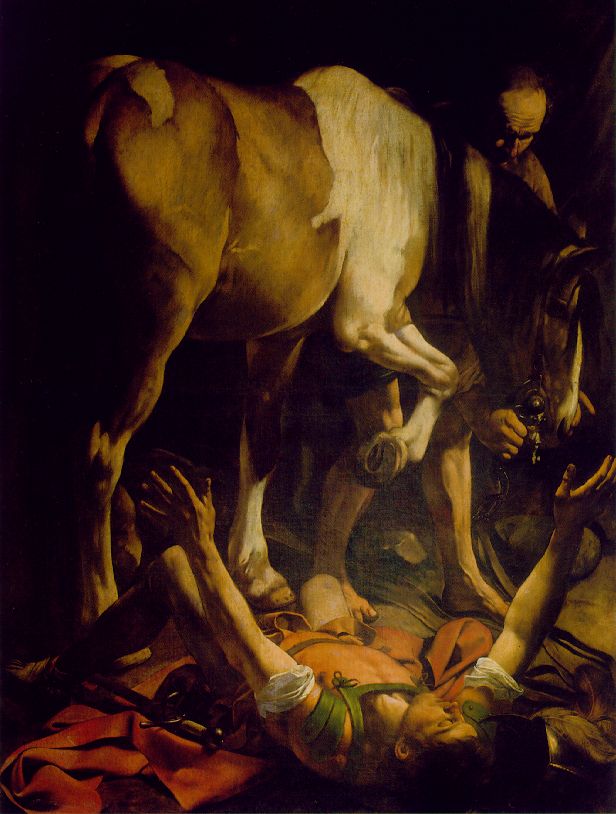
Caravaggio,The Conversion of Saint Paul, 1600-1601, Oil on canvas

Caravaggio's latter religious works featured violent struggles, grotesque decapitations, torture and death.
October 13, 2007
image, television,
I remember Neil Postman arguing that television confounds serious issues with entertainment thereby demeaning and undermining political discourse by making it less about ideas and more about image. He also argued, from memory, that television is not an effective way of providing education, as it provides only passive information transfer, rather than the interaction that he believes is necessary to maximize learning.

Gary Sauer-Thompson, Ari, Encounter Bay,Victor Harbor 2007
I was thinking about Postman after watching some television for a couple of hours or so on Saturday night after, I'd returned from walking the dogs and taking a few snaps. I was bored by the production line action sequences and over-reliance on fireballs and explosions.

Gary Sauer-Thompson, Ari + Agtet on the Victor Harbor Rd 2007
Postman argued that television is the primary means of communication for our culture and it has the property of converting conversations into entertainment so much so that public discourse on important issues has disappeared. Since the treatment of serious issues as entertainment inherently prevents them from being treated as serious issues and indeed since serious issues have been treated as entertainment for so many decades now, the public is no longer aware of these issues in their original sense, but only as entertainment.
Radiohead's In Rainbows: not a review
Radiohead has a new experiment. They are no longer signed to a major record label, and have decided to sell their new album online, just 10 days after the completion of recording and mixing, for download from their own website. You can choose to download In Rainbows, or purchase the more expensive boxed set.
 What makes the download different from other sites is that you can choose how much you want to pay for the album.
It seems a standard e-commerce transaction until you add the album to your purchase basket.There's an empty box where you must enter the price you want to pay. If, confused, you click on the nearby "?" icon: a message pops up saying simply: "IT'S UP TO YOU. Radiohead is planning a traditional CD release sometime in early 2008.
By taking things into their own hands Radiohead will make the record companies unhappy because they are being cut out of the loop. They can’t rip off artists any more and take all the money from their albums, as this connects the band directly with the listener.
The recording industry faces an uphill battle if it intends to turn things around as the music buying public has not been impressed with how they’ve gone about things lately in response to the seismic shift from compact discs to digital download in the way consumers acquire music.The recording industry are the “pirates” in the music ocean, as consumers are overpaying for poor quality, disposable music and the industry is still paying artists pennies and suing teenagers who are those artists’ biggest fans.
By all accounts the music industry, an oligopoly where a few gatekeepers control revenue streams, is undergoing involuntary democratization due to new digital technology and the Internet. Technological advances have rendered the music industries long-established business model obsolete.
We appear to be returning to an age when touring artists will earn their income from live performances, and use CDs to market their concerts.technological advances which have rendered its long-established business model obsolete
I've downloaded In Rainbow and a free evaluation copy of WinZip and started listening to the tracks on my tiny little computer speakers at the weekender:
1.15 STEP
2.BODYSNATCHERS
3.NUDE
4. WEIRD FISHES/ARPEGGI
5.ALL I NEED
6.FAUST ARP
7.RECKONER
8.HOUSE OF CARDS
9.JIGSAW FALLING INTO PLACE
10.VIDEOTAPE
My initial impressions are that this traditional anguished, songcraft based album is more accessible than the minimalist electronica of the techno sounding, atmospheric Amnesiac or Kid A or the earlier OK Computer. I have yet to hear Hail to the Thief (2003) or Thom Yorke's The Eraser. It's more akin to the guitar driven Bends.
The first two tracks of In Rainbows are electronic tinged, harsh and edgy, the next four are softer, even mellow; the pace picks up for the next three, with house of cards almost lyrical. The last track--- Videotape -- is the standout one. It's an interesting and melodic album.
On first hearing it seems more like a bunch of songs on a disc rather than a singular body, with the shifts of mood, tempo, volume. And I'm still listening to my digital music in the old fashioned way --- a laptop with a playlist of mp3s--rather than a Bose Sounddock with an i-pod
October 12, 2007
travelling
I'm on the road today---to Canberra for a one day conference on health policy and health research at ANU, being put on by the Menzies Centre of Health Policy---and there will be little time to take photographs in and around Canberra.
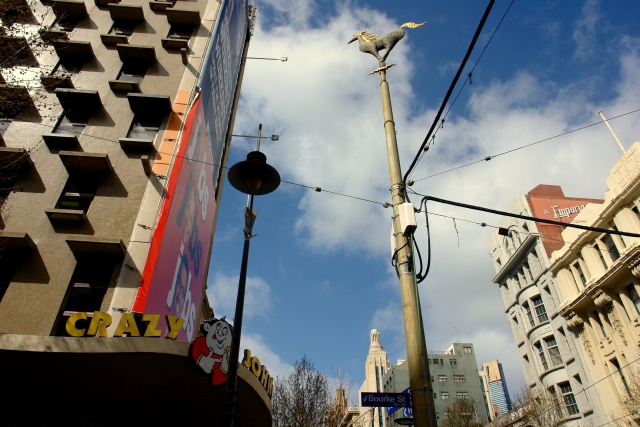
Gary Sauer-Thompson, cnr Bourke+ Swanston, Melbourne, 2007
A pity. I was looking foward to having a close look at the architecture of the John Curtin School of Medical Research situated in the lyrical bush landscaped setting.
October 11, 2007
urban desire
Now we may not have to "use' psychoanalysis in art history, but we sure need it in a visual analysis of the street imagery of our consumer culture; even though many conservative theorists confidently say that we are a post-theory moment.
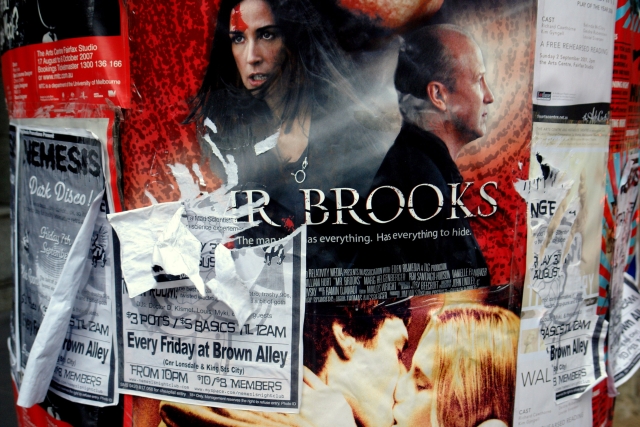
Gary Sauer-Thompson, posters, Melbourne, 2007
The street images constantly refer to the deep structuring of human subjectivity and sexuality in sexual difference as both an axis of power, meaning and pleasure. These are no innocent visual objects disconnected from difficult theory in the academy.
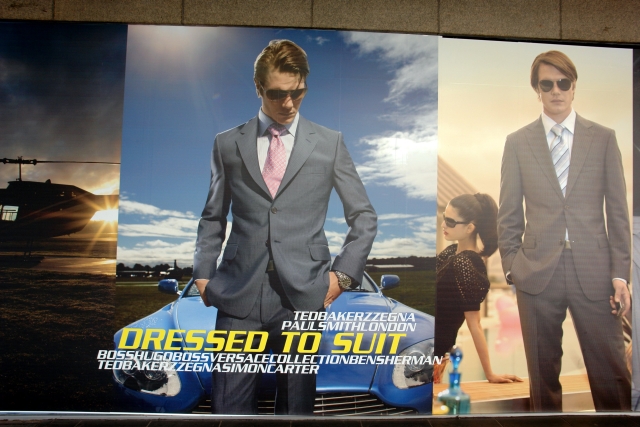
Gary Sauer-Thompson, posters, Melbourne, 2007
The theory is embodied in the image, not imposed on it. Sure, theory may not be the key to the highway as some academics claim, but it sure helps us to come to grips with, and explore the relation between sexual difference, power and subjectivity.
October 10, 2007
Urban Arboreal
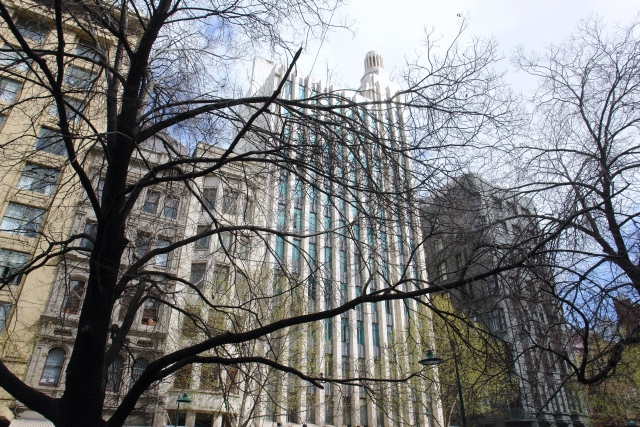
When I was in Melbourne I dropped into the Urban Arboreal:The Tree in the Grid exhibition in the City Gallery in the Melbourne Town Hall. This exhibition explores images of trees in the city environment. Guest curator David Hansen combined archival images and objects selected from the City of Melbourne's Art and Heritage Collections with sculptures, drawings and prints by eight contemporary artists: Robert Bridgewater, Julie Gough, Lucy Griggs, Kristin Headlam, Vin Ryan, Andrew Seward, Catherine Truman and Kim Westcott.
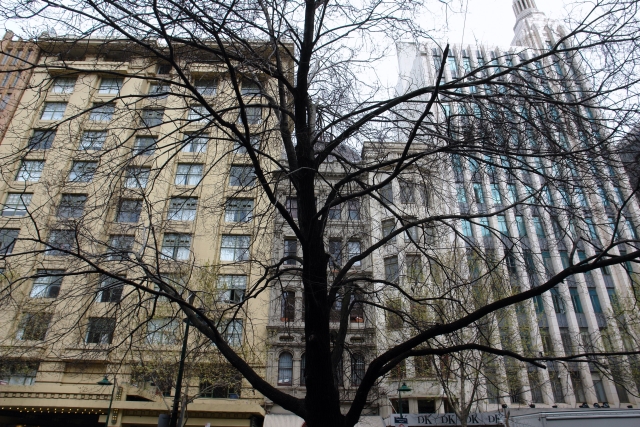
Gary Sauer-Thompson, urban tree, Swanston Street, Melbourne, 2007
Nature has been banished from the city to produce the built environment and this is the way nature makes its cultivated reappearance.
Gary Sauer-Thompson, urban trees, Swanston Street, Melbourne, 2007
I lost the exhibition catalogue when I was exploring Hosier Lane and I cannot recall the words.
October 9, 2007
If Turnbull hugs trees, where's Garrett?
Environment Minister Malcolm Turnbull's recent approval of the Gunn's pulp mill for the Tamar Valley with 48 conditions is beginning to cause some fallout:
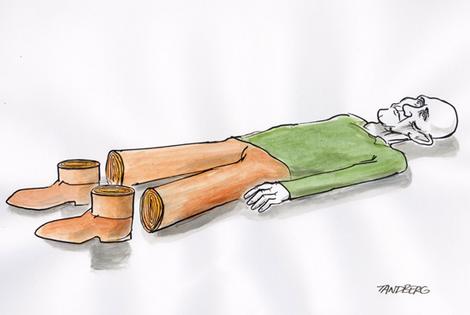
Tandberg
Apparently Peter Garrett, the Opposition spokesperson, is comfortable with his current position of mirroring the Liberals. He ain't going to hug any trees. No sir. That's for the extreme Greens. Nor is he worried about the contradictions in his words between now and then.
Jan Billycan+Bidyadanga: emerging art moverment
I'm continuing with my exploration of the works in APS Bendi Lango Art Exhibition This is a work from one of the Yulparija artists of Bidyadanga, a community situated in the desert of Western Australia. The work is defined by its freshness, strong sense of colour and linear quality.

Jan Billycan, Untitled,#11528
My understanding is that Bidyadanga is a coastal town situated 250km south of Broome and is traditional land of the Karrajarri. For many years it was known as La Grange station. In the 1970's the station was taken over by the Catholic Church who ran it as a mission for various community groups. The introduction of the equal pay decision in the 1970's resulted in many aboriginal people being forced from their traditional country by station owners and into such missions and towns.

Jan Billycan, Bidyadanga,
When the Karrajarri were returned their land last year, many of the elders started thinking about their traditional country, and the fact that many of their grandchildren will never know it. This lead to their desire to start painting. They have used their talent to combine their intimate knowledge of the desert landscape with the rich colours of the salt water country which has resulted in a unique style of painting.
The Bidyadanga artists--- Weaver Jack, Donald Moko, Bertha Linty, Sally Liki Nanii and Daniel Walbidi---- constitute an emerging art movement.
October 8, 2007
AC/DC Lane + city identity
What I found interesting about Melbourne's 19th century lanes within Hoodle's grid was how they had become interwoven with 20th century popular culture:

Gary Sauer-Thompson, AC/DC Lane, Melbourne, 2007
One of the most interesting was AC/DC Lane, which was just northwest from Federation Square. It was nothing special in terms of its visual street culture---there was no City Lights Project here, and the lane cannot be called funky, stylish, intimate, evocative, quirky and full of unexpected delights’ despite the existence of the Cherry Bar in the lane. But it has come to signify Melbourne rock and roll and gutter poems of excess.
AC/DC Lane cannot be marketed as a place of sophistication and culture which, when combined with others, combines to ‘make Melbourne a world class city’ and ‘truly a city that has it all’ --what is signified by Centre Plaza or Block Place. These signify European sophistication and urban character. If the 'Euro-look' signifies Melbourne as a European city’ that is capable of producing its own urban centre, then AC/DC lane is gritty working class otherness of signature sleaze, sweaty, dirty, and a rowdy partying to the death.

Gary Sauer-Thompson, AC/DC Lane, Melbourne, 2007
Yet the laneway has become an object for the national and international tourist’s gaze: AC/DC’s international appeal enhances Melbourne's claim to be a global city. As Pamie Fung argues in The seduction of the laneways: making Melbourne a ‘world city’:
City identities are therefore increasingly made appealing through marketable images of place, in which the culture and the arts thrive as businesses dedicated to leisure and consumption. As Zukin states ‘culture is more and more the business of cities – the basis of their tourist attractions and their unique competitive edge’. Governments need to attract what has variously been termed as ‘footloose capital’... ‘flexible capital’... or ‘transcendental capital’ ... The laneways’ appeal is crafted and consumed within the context of international and inter-city competitions to attract and retain global professionals.
It's along way from ACDC, who formed in Sydney in Sydney, Australia in 1973, are still going, have an image of being socially maladjusted and are concerned with sex and drink and rock & roll.
October 7, 2007
Federation Square: a postmodern island
If Federation Square is common space of the public then this space is also an island disconnected from what lies on the north side of the CBD across Flinders Street. I'm thinking of the disconnect to Melbourne’s nineteenth-century structure of streets and lanes: to the little lanes, such as both Hosier Lane and AC/DC Lane that run parallel with Swanston Street.

Gary Sauer-Thompson, Federation Square, 2007
Federation Square is an example of post-modern restructuring of urban form which accompanies the shift to a global information economy and it signifies a shift in the urban imaginary-- a change in the relationship between our images of reality and empirical reality itself.
Federation Square as a public undertaking was to designed to both revitalize the Yarra waterfront, enhance both the city and the state and to create a space that would become integrated into Melbourne’s overall economic and social fabric.

Gary Sauer-Thompson, Federation Square, 2007
Though it gives Melbourne an urban sense of identity and an urban focus for community activities that a spread out-Adelaide lacks, it remains isolated or cut off from the lanes that represent the other side of Melbourne's new urbanity.
October 5, 2007
political judments
Is Peter Garrett "a shadow minister who doesn't cast a shadow"? , as Geoffrey Cousins claims? Cousins asks good questions: "Is Malcolm Turnbull the Minister for the Environment or the minister against the environment?" These are tough judgements.

Weldon
Another question: is Howard willing to sacrifice Turnbull's seat in Wentworth seat to save two seats in Tasmania?
October 4, 2007
Australian Blogging Conference
I missed this event --the Australian Blogging Conference at Queensland University of Technology (QUT) Kelvin Grove campus in Brisbane, even though I was in Brisbane on the 28th of September. If I'd had some free time during the Australian Psychology Conference I would gone to see the Bendi Lango Art Exhibition.
I never even knew about the conference so I am playing catchup. In quickly checking the Queensland research/cultural blogs I can see that the conference was mentioned on Home Cooked Theory, on Creativity/Machine, and on Snurblog. They were all participants.
The conference was hosted by the ARC Centre of Excellence for Creative Industries and Innovation and the Queensland University of Technology. It was a user-focused conference for the Australian blogging community; one where people were invited to lead discussions on various topics throughout the day – some practical, such as how to build a better blog, and some theoretical on the role, influence and future of blogs.

So what happened? What did people say about the role, influence and future of blogs? We need to turn to the participants as there is nothing much online at the main site about what was said by whom. A blogging conference would have been blogged.
Some are saying what happened. The comments by Andrew Bartlett and Mark Bahnisch addressed to political blogging, which was the opening formal session.
Bartlett argued that the real value of blogs is their ability to encourage wider discussion of issues, with the blogs becoming almost an alternative commentariat – but with more diversity--due to the quality of their posts. He mentions the art and literary blogs in passing. I presume they also encourage a wider discussion of issues.
Bahnisch highlights the significance of the art of public and political conversation that creates most value for Australian political blogs, and suggests that this form of civic conversation, which is based on civic obligation and responsibility of the gift economy, has the potential to migrate beyond the blogging platform itself. It is the conversational nature of blogs that is distinctive from both literate and oral forms of communication.
striking the right note
This is one of the better cartoons on AWA's.
AWA's are designed to lower the minimium wage--its to high---and it needs to fall, in real terms, to allow the country to compete internationally, and to keep prices low; and to create flexibility so that in bad economic times, companies can shed staff or lower wages quickly and without penalty, to stay afloat.

Bill Leak
As you can imagine these are not popular arguments. A big of muscle is therefore needed to ensure that people accept the new work regime in a deregulated, individualised labour market.
October 2, 2007
Mysterious Minamalism
I’ve just discovered that the trente oiseaux label has been discontinued. trente oiseaux released minimalist music – although some might object to that definition of the works and prefer the term sound constructions. Many of the cd’s were barely audible through normal speakers and the listener was required to purchase a good set of headphones, find a quiet place and focus intently on what they heard and the space that was created in between. Each release was a discovery in intensity and perfection, with a focus on texture and space.

B.Günter / Heribert Friedl - Ataraxia, CD Cover, 2005 (image taken from here).
Naturally, this type of music only appeals to a small number of people, and bernhard günter, the sound artist who ran the label, was forced to discontinue TO because sales weren’t covering expenses. It’s disappointing because I found the experience of listening to this music extremely rewarding and not unlike the appreciation of minimalist paintings. And too, I feel somewhat responsible, because I stopped buying TO releases about 6 years ago, unable to find the focus required to enjoy and appreciate these unusual works.
I shared my appreciation of TO with a small number of people in Melbourne. I continue to find it fascinating that, although we often disagreed, we frequently shared the same opinion on which releases were of better quality than others. There is so little that is tangible in minimalist art, and yet often an appreciation of a work is shared within the community of those who appreciate the genre.

Kazemir Malevich, Black Square Red Square, 1915 (image taken from here).

I can certainly understand why people do not respond to works such as these, but I am mystified as to what it is I find so compelling.
evoking a moment
Joni Mitchell was being played on the car radio ---it was a track from the confessional story telling of Blue. That was no coffee table record. This Mitchell is a poet of personal revelation in the Anne Sexton & Sylvia Plath tradition; one who explores the quandaries of desire and love inside a relationship.

Gary Sauer-Thompson, at Middleton Beach, Fleurieu Peninsula, 2007
The moment reminded me how I've started re-listening to Mitchell-----going back to her earlier jazz-influenced work of the 1970s, such as Court and Spark the more experimental The Hissing of Summer Lawns and Hejira. Mitchell is an artist, whose experiments in music were rejected.

Gary Sauer-Thompson, Middleton Beach, Fleurieu Peninsula, 2007
Though her records age well over time, Mitchell's albums during the '80s (on Geffen) are not given the same respect as her classic '70s albums for Reprise. I do not know the work of the '90s at all. One was a collection of standards with Joni Mitchell performing as an interpretive singer reaching towards a tone poem:
I understand that Mitchell gave up making music in the early part of this century, after the revisionist Travelogue work. Mitchell railed against a corrupt music industry--the whole conglomeration of media, musicians and record labels that loosely defines the music version of the culture industry-- as a "cesspool" populated by "pornographic pigs" and returned to painting.
The sixty panels comprising “Green Flag Song” grew out of an experimental series of photographs Mitchell began taking about a year ago, photographs made with a camera and taken off to a malfunctioning television set. The images, transferred to canvas, are of current events, historical events, and fictional events – all of which interrelate both thematically (through war and ritual) and visually (though their green cast and negative reversal of light and shadow).
This visual work is very different from Mitchell’s previous paintings of figures and landscapes, best known from their appearances on her album covers, the panels of “Green Flag Song” nevertheless continue to address major moral and political issues in a highly distinctive, personalized voice.
October 1, 2007
critiquing the culture industry, Australian style.
When I was at the Australian Psychological Society's annual conference in Brisbane last week I asked the psychologists how they interpreted the Howard Government's Workchoice adverts in terms of the psychological impact of the messages on voters. The common judgement was the messages were working for the ALP.

Bill Leak
The Government was shooting themselves in the foot with their own adverts. I wonder if the culture industry knew this---that the adverts were a rhetorical failure--- and they were just happy to do the work, stay mum and take all the money? After all the culture industry is a n business.
Modern Church Architecture
In the centuries past the Kirke and Glebe would be on the best land in a city. Usually a hill or a local high point to be nearer to God. Religion has lost its prestige since those days and now must compete for land with modern residential subdivisions and commercial properties. Smaller churches often rent out civic buildings such as local schools on Sundays, however, some Churches have achieved economies of scale and locate themselves on the same strips of land that larger commercial buildings occupy.

This church is on Route.7 in Virginia. It is next to the old Worldcom/MCI Headquarters which was caught up in many of the accounting scandals that ended the telecommunications boom. The internal structure of the church is exactly the same as a medium sized office building. It is a steel skeleton and the external materials, despite the church-like architecture, are the same as the office buildings that surround it. Basically creme stone trimmings, brick walls and aqua steel roof.
The logistical points for the Church are the same as a large commercial or office building as well. There is a delivery section which includes a large hopper for garbage and the car park is as large as any office building. Despite its outward appearance, in scale, structure, support facilities, etc; it is indistinguishable from a modern commercial building.
This is mainly because this area is so new. There just isn't the low cost land for a small or medium sized church. Across the road from the Church is a high-tech Hospital across a large sprawling campus, while a little further down the road is a government subsidised Biotech campus and two Universities. Either side of it are two very wealthy subdivisions and developments. The commercial building next to it contains Sun Microsystems amongst others.
This is how some Churches are adapting to the local suburban and economic environment.