Thought-Factory.net Philosophical Conversations Public Opinion philosophy.com Junk for code

Mandy Martin, Puritjarra 2, 2005. For further information on MANDY MARTIN, refer here: http://www.mandy-martin.com/
If there are diverse kinds of knowledge and ways of knowing place, then we need to learn to value the different ways each of us sees a single place that is significant, but differently so, for each perspective.
RECENT ENTRIES
SEARCH
ARCHIVES
Library
Thinkers/Critics/etc
WEBLOGS
Australian Weblogs
Critical commentary
Visual blogs
CULTURE
ART
PHOTOGRAPHY
DESIGN/STREET ART
ARCHITECTURE/CITY
Film
MUSIC
Sexuality
FOOD & WiNE
Other
www.thought-factory.net
looking for something firm in a world of chaotic flux

Modern Church Architecture « Previous | |Next »
October 1, 2007

In the centuries past the Kirke and Glebe would be on the best land in a city. Usually a hill or a local high point to be nearer to God. Religion has lost its prestige since those days and now must compete for land with modern residential subdivisions and commercial properties. Smaller churches often rent out civic buildings such as local schools on Sundays, however, some Churches have achieved economies of scale and locate themselves on the same strips of land that larger commercial buildings occupy.

Church

This church is on Route.7 in Virginia. It is next to the old Worldcom/MCI Headquarters which was caught up in many of the accounting scandals that ended the telecommunications boom. The internal structure of the church is exactly the same as a medium sized office building. It is a steel skeleton and the external materials, despite the church-like architecture, are the same as the office buildings that surround it. Basically creme stone trimmings, brick walls and aqua steel roof.

The logistical points for the Church are the same as a large commercial or office building as well. There is a delivery section which includes a large hopper for garbage and the car park is as large as any office building. Despite its outward appearance, in scale, structure, support facilities, etc; it is indistinguishable from a modern commercial building.

This is mainly because this area is so new. There just isn't the low cost land for a small or medium sized church. Across the road from the Church is a high-tech Hospital across a large sprawling campus, while a little further down the road is a government subsidised Biotech campus and two Universities. Either side of it are two very wealthy subdivisions and developments. The commercial building next to it contains Sun Microsystems amongst others.

This is how some Churches are adapting to the local suburban and economic environment.

| Posted by cam at 12:10 AM | | Comments (14)
Comments

Comments

Cam,
re your comment Despite its outward appearance, in scale, structure, support facilities, etc; it is indistinguishable from a modern commercial building.

The outward appearance is important. There we have the Greek/Roman pillars, the spire, the reference to the dome, and the curved top of the bottom row of windows. Where the windows stained glass?

Gary, Yes there is no doubting it is a church despite its office block endoskeleton. I didnt see if it had stained glass windows, I didnt go in. There is another like it on Rt.9 that I have been meaning to happy snap too. It is about a third again as big as that one.

Horrible, horrible, horrible.
No sense whatsoever of being a Sacred Space.

Cam,
that style of architecture is very familar--I had a sense of deja vu when I saw your photo. Is it an example of regional (Virginia) architecture? Or a retro style from the before modernism? Say the industrial architecture of the eighteenth century?

One of Gary's concerns at junk for code is sustainable regional architecture as a reaction to the way that globalization increasingly enters every facet of our lives--eg., its homogenizing effects on architecture, urban spaces and the landscape.

The concern is the reaction by architects to embrace the principles of critical regionalism: one that respects local culture, geography and climate.

Is your church an example of critical regionalism?

Pam, There is definitely regionalism to it. I think it is quite clever that the architect has managed to give the impression of the Virginian (Jeffersonian really) roman columns while still making the church look like a rural Massachusetts's barn style church. All this with an office building underbelly.

The thing is though, this building, despite architecturally being a church, fits neatly into a row with the office buildings around it. Like the ordnances/economics have homogenized it sufficiently enough that is obvious it is on commercial real estate or land.

Unfortunately the building was too large to get the other office buildings in a photo with it. I may try in the future to put it in context with a photo of the highway/office buildings.

Cam,
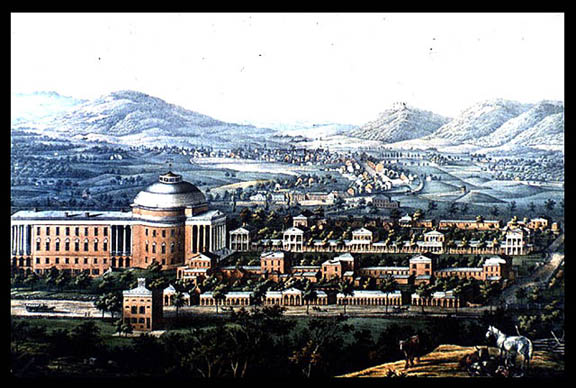
your modern industrial style church definitely refers to Jefferson's (neo)Classical style at the University of Virginia to create associations to Greece and Rome.

This kind of Neoclassicism in the architecture and art of the US was used to show solidity, and order, and as a way of creating the image of a stable government.

The latter image is a representation of J. Robert Hillier's historic preservation project restored Thomas Jefferson’s “Temple on the Hill,” a classical building dating to 1787, and created a modern, underground visitor entrance that seamlessly blends modern and classical forms.

Cam,
Gary's right. The deja vu is Jefferson's work.The deja vu is his home, Monticello, a structure unique in American architecture.

It would interesting to see the church in the context of high-tech Hospital across a large sprawling campus; the government subsidised Biotech campus and two Universities; and the commercial building next to it which contains Sun Microsystems.

The Wikipedia entry on Jeffersonian architecture says:

Even after Jeffersonian Colonial went out of vogue for other public buildings, it continued to have an influence on many Protestant church designs on the East Coast through the mid-twentieth century. The style is still employed on some southern college campuses, particularly in Virginia, and has enjoyed a certain re-emergence among some newer twenty-first century evangelical church complexes.

Is that your church?

Pam, Yes. I did a Monticello post on Jefferson recently when I was in Charlottesville. The roman columns are definately a Virginia architectural device which stemmed from Jefferson's interests. IIRC UVA and the design of the main building was very late in his life. Not sure how much of Washington DC had been built by then but the tall columns were popular with the plantation owners of the day (Madison's Montpelier has a similar design).

Pam, I am an atheist. I just think the church is interesting in its design and location.

Pam,
yes, Cam's contemporary church in Virginia is definitely an expression of critical regionalism. Kenneth Frampton in his position paper "Towards a Critical Regionalism: Six points of an Architecture of Resistance" proposed that Critical Regionalism mediates between universally accepted practice and the particularities of place or locality, recalling the phrase, "think globally act locally." Further, that architects should adopt modern archtitecture critically for its universal progressive qualities but at the same time should value responses particular to the context with emphasis on topography, climate, light, tectonic form, etc.

Critical regionalism may not exist in the contemporary architecture of South Australia, but it looks as if it is bubbling along very nicely amidst the global knowledge/information economy of Virginia.

Cam,
re your comment

Pam, I am an atheist. I just think the church is interesting in its design and location.

Do you mean John instead of Pam, as I'm interested in the design and location of the architecture.

Pam you asked if that was my church. I realise now you didn't mean 'my' church but more does that describe the church in the pic.

On the other hand, you could go this way.
http://perthworst.wordpress.com/2007/09/30/discipline-and-punish/

(By the way, love the site mate.)

WOP,
YIKES--that is bad architecture and urban space. Clever photo.Love the title.

Thanks for the pat on the back for all the authors. Appreciated.

If you ever run out of worst of material in Perth you can always make the trip to Adelaide via Whyalla, Port Augusta and Port Pirie.