November 30, 2007
When the Technical Class is More Powerful Than The State
Via John Robb: Cultural Guerillas. The clock in the Pantheon had been broken for too long and a group of clandestine heritage restorers decided to bring it back to working order. This led to many clashes with the state who viewed cultural heritage and the funding of it as the state's monopoly. The work the clandestine group did is quite stunning.

Robb quotes an UnterGunther spokesman:
We would like to be able to replace the state in the areas it is incompetent, but our means are limited and we can only do a fraction of what needs to be done.
This view of the cultural basis for a cities life blood and soul is a further step from the Situationists. Where the Situationists explored, the modern technical class tinkers, restores, and brings back to life the mechanical heartbeat of a bureaucratically forgotten city suffering at the hands of an inattentive state.
November 29, 2007
on the road
I'm on the road to Sydney and Melbourne for work from Friday to Sunday.

Gary Sauer-Thompson, pilot, Anzac Highway, Adelaide
I'll try and post some photographs, as I plan to visit Union Lane off Bourke Street on Sunday to check out the new street art that I've seen on Flickr as photographed by Hellblazer and Spinsteroo..
I'd explored Union Lane --it runs between Bourke and Collins Street--- when I was last in Melbourne and it seems as if it is part of a street project. So I'm looking forward to it.
November 28, 2007
Franz Kline
It still resonates, doesn't it, 50 years latter.
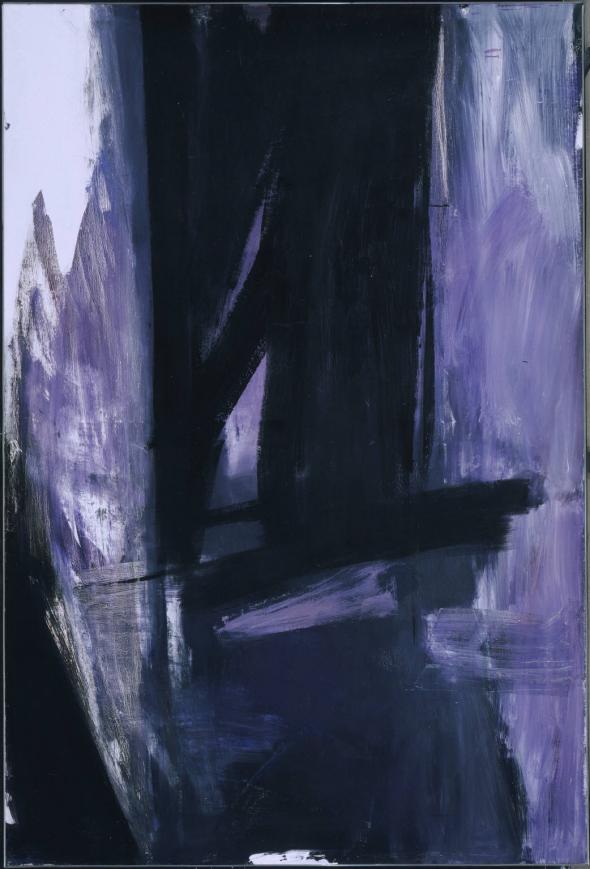
Franz Kline, Torches Mauve, 1960, Oil on canvas
Kline's work still has a dynamic, spontaneous and dramatic impact. We are confronted with starkly simple contrast of mostly abstract black-and-white planes and strokes. The wild beauty of the raw, coarse, elemental, and brutal splinters and vectors distinguishes Kline's pictures.
This abstract expresionist mood expressed itself in an aesthetic of crudeness. This aesthetic embraced the gritty, the rough, and the raw, and sometimes incorporated downright ugliness (e.g., the arts of graffiti and vulgar junk of the city etc)--hence the phrase "tangled shards of debris".
early morning
Early morning in summer is the best time to walk the streets and take photos. The temperature is cool. The air is crisp between 6 and 7 am, the sun is lightening up the city, and people have yet to make their way to the offices in the CBD. In a hour or so the heat of the day will be upon us.

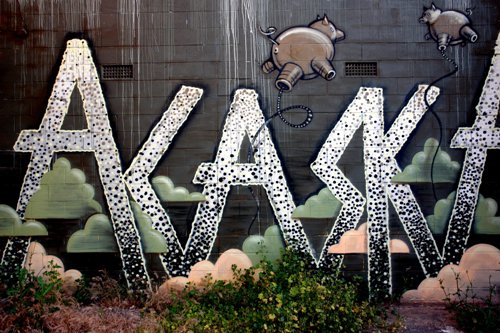
Gary Sauer-Thompson, Benzo: Ants, Adelaide, 2007
Benzo is one of the well known Adelaide street artists whose work can be found on private walls in and around Western Adelaide CBD. So they are protected from the Adelaide City Council's zero tolerance for street art, which reduces street art to graffiti.
Council has no interest in a public wall for street artists to work on. It's a pity because the Adelaide street art scene is moribund.
November 27, 2007
remembering Aaron Siskind's abstractions
Aaron Siskind is interpreted by art historians as an American abstract expressionist photographer. His work, using a large-format camera, created abstract photographs by focusing on the details of nature and architecture. He presents them as flat surfaces to create a new image out of them. These images, he claimed, stand independent of the original subject, and his images ask to be taken on much the same terms as paintings.

Aaron Siskind, Arizpe, 1966
This photography has its roots in the nonrepresentational art of the early 20th century, such as Wassily Kandinsky (an expressionist), Picasso (a cubist), and Kasmir Malevich (a Russian Constructivist), which challenged the power of realism in the visual arts. It took photography a lot longer to displace realism and establish credibility as an abstract art and it primarily came with Aaron Siskind's development of abstract expressionism:

Aaron Siskind, Chicago, 1949
During the 1950s, Siskind’s primary subjects were urban facades, graffiti, isolated figures, and the stone walls of Martha’s Vineyard. Graphic in form, the subjects of each of these series resemble script, reflecting Siskind’s interest in musical scores and poetry. However, Siskind never opted for absolute formalism for all his emphasis on ''pictorial structure'' .
The influence of Siskind can be seen in contemporary photographers, such as James P Blair's recent An Homage to Aaron Siskind

James P Blair, Paris, 1959
This kind of abstraction then broadens to explore the decayed and torn posters on walls that begin to place an emphasis on significance as well as pictorial structure:

James P Blair, Yugoslavia, 1969
And so we come to contemporary photographic practice that is shaped by the Situationist idea of detournement:

Gary Sauer-Thompson, melange, Waymouth Street, Adelaide CBD, 2007
We are a long way from the abstract expressionist concerns about the authenticity or value of a work laying in its directness and immediacy of expression, and the art work being a revelation of the artist's authentic identity as a heroic romantic artist. We are in a much harsher and gritter place, but whilst working there outside the art institution, we should not forget Siskind:

Aaron Siskind, Lima 57, 1975
He is worthy of remembrance. Siskind's photographs forswear any hint of pictorial depth and they seem as flat as any abstract painter's canvas. His latter pictures courts exactly what Abstract Expressionist painters took great pains to avoid: the suggestion of a figurative image within an abstract one.
November 26, 2007
George Grosz, Berlin Street Scene,
This image by George Grosz reminds me of Howard's Australia. It's not the clothes. It is the inequality during boom times:

George Grosz, Berlin Street Scene, 1930,
Suprisingly, many people believed the myth about John Howard's unerring radar for the aspirations of ordinary Australians, when the reality was that the prime minister had lost touch with the electorate and fatally overreached on industrial relations.
Unitary Urbanism: wandering the city
By taking the Situationists advice to wander the city and to feel the emotional flow on the street, I'm starting to uncover lots of hidden treasures in the back alleys and little side streets in the CBD of Adelaide:

Gary Sauer-Thompson, Shopfront, Peel Street, Adelaide CBD, 2007
It's as if I'm getting to know the city I've lived for a couple of decades; coming across the historical cultural layers of yesteryear in the humble and prosaic world of everyday life. This is beneath the gaze of the social sciences and what is disclosed is the historicity of the everyday.
Steward Home in his The Assault on Culture: Utopian Currents from Lettrism to Class War has a chapter on the founding congress of the Situationist International and its declaration. He refers to a:
signed resolution declaring the "necessity of an integral construction of the environment by a unitary urbanism that must utilize all arts and modem techniques"; the "inevitable outrnodedness of any renovation of an art within its traditional limits"; the "recognition of an essential interdependence between unitary urbanism and a future style of life" which must be situated "in the perspective of a greater real freedom and a greater domination of nature"; and "unity of action among the signers on the basis of this to programme".
Unitary Urbanism, which was largely abandoned for the Debordian theory of the spectacle by the Situationist International, rejected the standard Euclidean, almost wholly functional approach to urban architectural design, and the compartmentalized way in which "art" is typically detached from its surroundings.

Gary Sauer-Thompson, Peel Street mural, CBD Adelaide, 2007
Unitary Urbanism connects up with Lefebvre's theory of 'everyday life'. Lefebvre argued that every society - and therefore every mode of production - produces a certain space, its own space. The city in the world of capitalist modernity cannot be understood as a simple agglomeration of people and things in space - it has its own spatial practice, making its own space.
November 25, 2007
Politics: end of an era
The conservatives have gone along with their negativity, politics of fear and their anti-academic rhetoric. The Liberal/National political and cultural conservatives that is. That is good news indeed. Many of us were tired or bored with the old crowd and wanting something different. That something different included equity or fairness (eg., Workchoices), as much as it was about the quality of life beyond the market, jobs and small business.
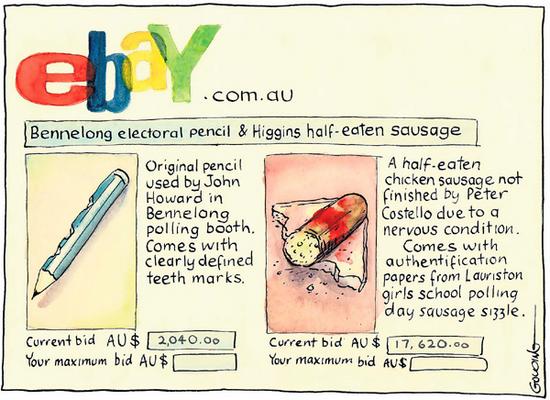
Matt Golding
The caravan has now moved on and we live with the new Labor economic conservatives in Canberra. They had little to say about the arts or the creative industries apart from blowing hot and strong about broadband and computers for kids in schools. Will the development of high speed broadband make a big cultural difference? Or is that more or less about Telstra and competition in telecommunications?
Update: 26 November
It's a new day dawning for some as the days of Howard/Costello have come to a decisive end, and many are celebrating:
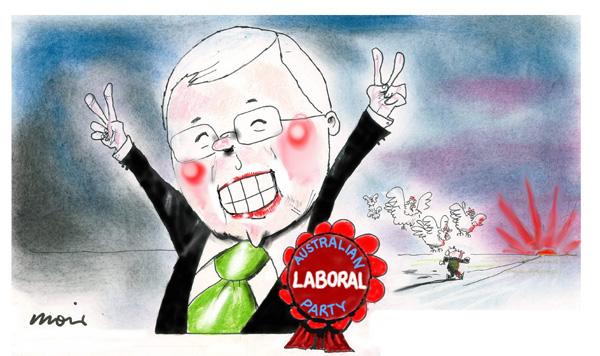
Alan Moir
From all accounts the seachange up along the northern NSW and southern Queensland coast of eastern Australia also made a big difference in the political shift.
What of the anti-academic rightwing trolls who love to bash the academy? Will they retire to their own caves to lick their wounds? Or will the thuggies of the radical right continue to shout everyone down and engage in their on-line muggings?
November 24, 2007
Benzo + Adelaide street artists
I've started a set or an album on Flickr on Adelaide street artists, beginning with Store and Benzo are the ones that I currently know. They, along with Fredrock, are currently having an exhibition in the CBD:

Gary Sauer-Thompson, 22 Currie Street, Adelaide, 2007
Some of the imagery in the underground exhibition and in the studio is familiar from the street art that I have seen:
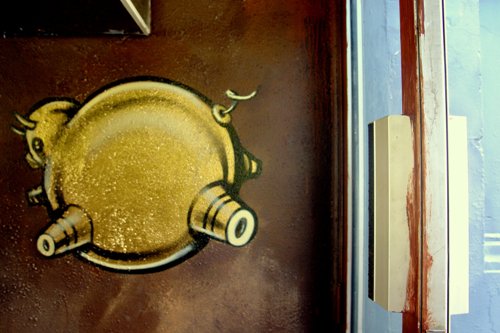
Gary Sauer-Thompson, Benzo, Flying pigs, Adelaide CBD
It is difficult for street artists to work in Adelaide.They are isolated, with little support from the art institution or patrons, and they have limited ways to earn an income so they can live. Many go to Melbourne, where there is more opportunity. The ones in Adelaide have not fully embraced a digital world, as those in Melbourne have done---such as Nice Produce--that flow into the online design scene and give something back to the community.
Is it just a lack of resources? A lack of skills?
November 23, 2007
Camelback Mountain
An Arizonan cowboy perched like an eagle over the city of Phoenix below.

Or another middle-class hiker from Scottsdale, AZ trying to get in some exercise and nature during the Thanksgiving day off?
I hiked up the top of Camelback Mountain. It is a rocky out-cropping in the middle of Scottsdale. The city is in a basin ringed by hard rock mountains. Presumably the left overs of a volcanic range or action. Phoenix has four million in it now, about the same as Sydney, and the suburbs have spread past the inner mountains and are even breaking out past the outer mountain ranges like the McDowell Ranges. Which I live near.
Because Phoenix is so flat and Camelback Mountain so dominant height wise in the city, the summit of the mountain has an unabridged 360 degree view of Phoenix. The climb is brutal. It is only about a mile and a half and the elevation is about 2,000 feet; but the gradient is steep and for the last half of the trail it is all rock climbing. There are sections so steep that hand rails have been cut into the rock face and the only feasible way to get up and down is to use them and your hands to keep a solid footing.
My fitness is pretty good, especially for my age, but at about the mile marker I had to rest for ten minutes and eat an apple until I got my breath and strength back. It kicked my arse.
While I was climbing a police chopper came hooning on from the South and perched itself on the rocks, half on and half off style. Apparently a kid had fallen and split his head open. The police chopper was picking him up. I was near the summit when it happened and the chopper was only about 50 yards from me. Some folks at the summit said the pilot was cool hand luke and hovered near the summit, waved to them and then swung off down the mountain.
The other interesting aspect of the climb was people congratulating me when I got to the top. Nice social touch and convention. As people were coming down they were offering encouragement to climbers that were beaten and weary such as, "The top is not far away, you are almost there."

Water could become currency in Phoenix, Tank Girl or Rum Corps style. Every climber had a bottle of water with them. I had two in my backpack. I went through a 700ml bottle of water on the climb. The temperature was only about 87F (31C) which is not really that hot. The Phoenix sun is just a very hot sun as there is no moisture in the air at all. It is interesting when you go into shops at Phoenix the first thing they do is offer you water.
At the summit I asked a bloke to take a photo of me with Phoenix in the background. He had a seven year old daughter with him. When she was him hold the camera she moved infront of me to be in the picture. I must have had a confused look on my face as the bloke burst out laughing and said, "umm ok". The girl realised what was happening and what her father was laughing at and moved to stand next to him. I think he thought I was a tourist, which was ok. He took a good photograph.
When I hike I wear a wide-brim black straw cowboy hat. My skin colour is normally nuclear winter white and I have to tan from pale blue to get to white. So I consider a wide brim hat essential. I am sure I get odd looks because of it. Even here not many people wear wide brim hats. I counted four that I saw. The baseball cap is far more popular. When I was descending and nearly at the end a bloke coming up said to me, "Now that is a nice looking hat." I laughed and thanked him.
I am really enjoying the active outdoor lifestyle Phoenix offers. The rest of the pictures I took on the hike can be viewed on flickr.

To give an idea of Camelback's height, that is the mountain in the centre of the photo from Squaw Peak.
Rauschenberg, graffiti, time
This image is like a graffiti wall---an eclectic mix of colours and collaged images organised in layers--- that takes its vocabulary from movies, television, the computer, the Internet, and the Xerox machine:

Robert Rauschenberg, Rebus, 1955
If Rauschenberg turned collage into assemblage, then I interpret them as graffiti, archaeology and time. Time in a city in modernity is different: its pace is different, as are its rhythms, its moments and the way they speed up and slow down. The urban pace overlays the natural one of sunrise, sunset, cloud, wind, sun and rain.
Time is change, and change is what makes a metropolis a living entity, subject to an ongoing cycle of birth, growth, decay, and rebirth—not the frozen lines, squares, grids etc of the urban planner; or the shapes and profiles, lifeless artifacts and empty proclamations of a “metropolis” on the pages of glossy magazines that celebrate sensational Adelaide.
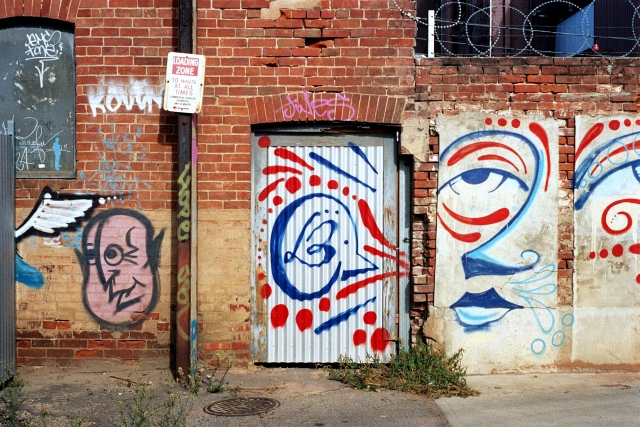
Gary Sauer-Thompson, painted doorway, Adelaide CBD, 2007
This understanding of time enables us to stand between Warhol's alliance with a power that was, effectively, changing things—the media of a corrupted public sphere of the culture industry--- and Bataille's plunge in the other direction, that of the underground cult. The transgressions of the latter open the way to the world of gods, feasts and sacrifice that lay beyond law, beyond prohibitions, and which re-establishes the sacred as a primary force in modernity.
This standing between is expressed by the explorations by Dogmatic in Melbourne.
November 22, 2007
Death to the Pixies
When the Pixies broke up it was interesting to see what path its members took with their solo projects. Frank Black and Joey Santiago collaborated but Black chose the Husker Du genre of music to explore, an area which had been innovated upon since by bands such as Dinosaur Jr. Kim Deal's band, The Breeders, produced far more interesting pop music.
Divine Hammer, euphemism and all, and Saints. The Breeders developed a consistent pop style that had been alluded to in Pixies songs like Gigantic. Still not sure if that song is about walking the dog or rape. It is probably like Single Gun Theory's From a Million Miles - I prefer not to know.
Adelaide street humor
The contested public spaces of the visual urban landscape over time can be viewed from the perspective of urban archaeology----old decaying building sites plus graffiti. This gives us a sense of urban history, as this site has been levelled to make way for a modernist office building:

Gary Sauer-Thompson, redface in urban decay Adelaide, CBD 2007
Graffiti Archaeology is a movement dedicated to recording the ever changing urban art landscape by photographing well known graffiti locations over time and posting them online. Photographers have been documenting the changes through time of graffiti in Adelaide , Melbourne and Sydney---eg., Church on Fire---and treat graffiti as urban revolution and as art.
From New York style graffiti as writing and stylized letters it is an easy step to cartoons, visions of angry streets and whimsical humor:

Gary Sauer-Thompson, Benzo, brown robot, Adelaide CBD, 2007
Who then is carrying the street art forward away from the graffiti as writing in Adelaide into graffiti as art?
Well, nestled amongst the old industrial estates along the River Torrens in Hindmarsh is a new creative space for graffiti artists. Spank Studio and Gallery features five-metre ceilings and over 150 square metres of studio and gallery space; and with rough walls and jarrah floors, it’s more like a factory warehouse than the polished, sterile, white spaces of other artist-run initiatives. It was created by three of Adelaide’s best graffiti artists, Store, Fredrock and Benzo.
I do not know the Spank Studio and Gallery and it's not online. Nor do I know the work of these graffiti artists apart from Benzo, whom I have come across here. It would be good to build up a gallery of their work. But where to start? Are they online? Have others done it? I understand that Store, Fredrock and Benzo collaborate on work around Adelaide.
November 21, 2007
opening up the pictorial field
Today we live in a period that exists chronologically after the breakdown of the notion of art, a breakdown for which the neo-avant-gardes were largely responsible. Moreover, the historical avant-gardes are understandable only through the restaging of their ideas by the neo-avant-gardes from the 1950s onwards.
The 'restaging' is a revision as the postwar American neo-avant garde abandoned o the revolutionary and utopian aspirations that had energized the European avant-gardes of the earlier twentieth century and distanced themselves from politically subversive or oppositional strategies.

Gary Sauer-Thompson, seaweed, Victor Harbor, 2007
We may need to use the notion of Nachträglichkeit--the Freudian idea describes the observation that a trauma can be understood only at a later, post-traumatic moment, and not when it is suddenly provoked. Dada would be the expression of trauma, would it not?
If the neo-avant-garde stilll places the same emphasis on the sublimation of art and life, then their aesthetic focus is undercutting the well-maintained borders separating the mediums of art. Thus Rauschenberg had been making Combines—found objects covered with slashing strokes of paint that blurred the boundaries between high and low—since the mid-1950s, and in the early '60s began transferring photographic images from newspapers directly onto his canvases (via the process of silkscreening) in rebus-like arrangements. Rauschenberg adapted the shock tactics of World War I-era Dada collagists such as Kurt Schwitters to the new postwar context of American hegemonic power.
In Germany, Gerhard Richter began compiling his own private archive of vernacular photographs---amateur and family photographs he found and collected; news images of political and historical events; advertisements and pornography; even shots of the Nazi death camps--- that then became a source of predigested, precomposed imagery from which the painter made his blurred photo-paintings.
For Warhol, photography—mechanical, reproducible, and indelibly tainted with mass culture and industrial production—served to question the cherished notions of authenticity and originality that underlay Abstract Expressionism. Hence his use of the automated "four-for-a-quarter" photo-booth of the kind found in the pleasure centers of urban spaces such as Times Square or Coney Island. While still working as a commercial artist, Warhol became obsessed with this popular, ubiquitous device, and asked friends and portrait sitters to sit for their pictures in order to use the results as the foundation for large silkscreen paintings, magazine illustrations, and album covers.

Gary Sauer-Thompson, squiggles, Adelaide CBD, 2007
The radical streak in Rauschenberg's early practice is neither a repeat of earlier avant-garde gesturings nor simply an accommodation to the values and commodifying mechanisms of postwar American consumer society.The disparate elements brought together in these paintings (combines) have no more guiding logic operating between them than that between the articles arrayed on the page of a newspaper or on a wall marked by graffiti.
November 19, 2007
stepping out
This is more me stepping out of the shadows as a photographer as I slowly switch over to, and find my feet in, the world of digital imagery, than a mirror project as explored by Pippa Buchanan, an Adelaide based photographer.

Gary Sauer-Thompson, self portrait, Victor Harbor, 2007
How does that concern with becoming digital connect with the still modernist art institution? Do the notions of “artist” and “beholder” make any sense as a result of the attack of the neo-avant-gardes on the concept of art? I'm stepping out into the confusion of modernism, avant garde and post modernism. What do these terms mean in a digital world?
I'm unhappy with both the conflation of avant-garde and post-modernism, and with the idea that the post 1945 or neo-avant garde were followers who copied an initial and original idea of the pre-1945 or European avant garde. Are there not differences as well as s similarities between the European and American avant gardes?
Some puzzles about the relationship between becoming digital and the art institution:
Is the neo-avant-garde as an ironical reflection of the historical avant-garde, rather than as an inauthentic repetition?
If letters invade pictures, and language discovers its graphic and pictorial features in prewar Dada avant-garde, then do the letters again have meaning in graffiti, where it is not so much their signification as their visuality that signifies?

Gary Sauer-Thompson, yellow letters, CBD Adelaide, 2007
If the avantgarde is primarily about mixing of art and life, then isn't that what the current street art does? If the neo-avant-garde, attempted to get to grips with the relations between art and life, art and institution, then does not street culture attempt to grapple with similar issues?
So where does street art fit in relation to both the art institution and the neo-avant garde?
Desert Hills Presbyterian Church
The church is still under construction in Carefree, Arizona. This is a northern suburb beyond the city of Phoenix where the nearest Sydney equivalent would probably be Kurrajong. It is well travelled by people on their Harleys, and in their sports cars, seeking to escape the city and head up into the scenic foothills before hitting a touristy saloon for a beer and a nice meal.

This is another church that looks like a mix between an office building and a local resort. The only real architectural cue that it is a church is the cross on the large concrete pillar. It is interesting that they chose to place their church at the base of a dominant out-cropping of rocks.
The scenery in Carefree is quite stunning as it is the first foothills before the Sonora desert plains rise up into the cooler cattle country of central Arizona.

Saguaro cactii are numerous along the hills and roads leading into and out of the town. The local economy is based on tourism. The pubs are called saloons and have 'cowboy' type touches. There is a tonne of them one after the other, with large numbers of motorbikes and convertible sports cars parked in-front of them. The local Indian and Cowboy cultures are traded in on as well. Indian rugs, furniture and cowboy hats are sold everywhere.
It appears that Carefree was originally a bedroom community for retirees but that has been eclipsed by tourism and a bohemian art culture for local aspiring middle-class artists and collectors from Phoenix' northern suburbs. There was an art show and tour on while I was there which was blocking the roads and causing traffic problems.
November 18, 2007
Lettrism + street culture
I've discovered an online text of Stewart Home's The Assault on Culture: Utopian Currents from Lettrism to Class War that Kez referred to when commenting on my earlier post on Lettrism and the Situationist International.

Gary Sauer-Thompson, ST, Adelaide CBD, 2007
I was attracted to Lettrism because of the role of the letter in the image which connects it with contemporary street culture work. Homes, in the Introduction to his Assault on Culture, gives us some of the cultural/political context of Lettrism as a part, and critique of, the pre-war European avant garde.
He says that:
From these pre-war [avant garde] movements the essential features of twentieth-century Utopianism become apparent. The partisans of this tradition aim not just at the integration of art and life, but of all human activities. They have a critique of social separation and a concept of totality. From the 1920s onwards Utopians were conscious of belonging to a tradition that stretched back at least as far as Dada and Futurism...while the movements I am writing about situated themselves in opposition to consumer capitalism, they also emerged out of societies based on such a mode of organisation and thus do not entirely escape the logic of the market place. This is particularly obvious in relation to the obsession many of them display over the concept of innovation, which reflects perfectly the waste inherent in a society based on planned obsolescence.
Lettrism made the break with surrealism, in the form of rupture. Home says in his chapter on Lettrism
If early Lettriste activity was centred on sound poetry, the emphasis soon shifted to visual production. Here, letters were seen to form the basic unit from which works should be created. The resulting forms, which resemble concrete poetry, typify lettriste literary endeavours. From these there grew a Lettriste 'painting', in which, once again, the letter would be the basic subject of aesthetic contemplation.
He adds that where the Lettriste Movement (LM) had created cultural works, the Lettriste International intended to 'live' the cultural revolution. The LI's activities were to be provisional, subject to 'experiment' and change. Thus while abandoning the literary endeavours of the LM, the LI proceeded to pursue certain architectural theories that had reached an embryonic formulation in the LM.
November 17, 2007
Futureshock
I like the otherwordliness of the robo dancing, the camera work and the flat painted backgrounds. The most uniform part of the song is the repetitive musical licks in the song.
The images lead to the feeling of a lot of social alienation in the night. The dancing adds to that sense. Yet in the end the authority figure, the policeman, connects to his surroundings and environment through robo dancing. Arguably he is the free-est character in the video's universe.
Wonderful little pop song and accompanying video.
November 16, 2007
Canberra snaps
I've been in Canberra these last two days and so I thought that I'd post a Canberra image. What I find interesting is the way that words have been incorporated into the image, and so its roots are in Lettrism.
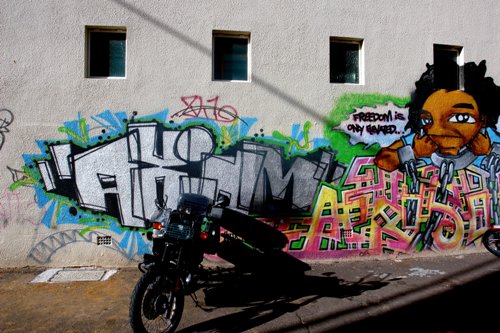
Gary Sauer-Thompson, freedom graffiti, Canberra 2007
This image has little to do with what I experienced in Canberra: the importance and functions of public moods, which are neither the fleeting and misleading companions of reason nor the epiphenomena of chemical facts. The heart of human being, says Heidegger, is neither the things with which we deal nor the moods we have, but our understanding.
These moods are pre-cognitive and are very different to the personal moods of psychopathology. Moods disclose entire situations, do so pervasively, and disclose to us how we are doing and faring. They disclose how things are matter and are atmospheric.
November 15, 2007
election promises
Tandberg kinda captures the way the promises keep on missing the mark---what actually needs to be done for the country.
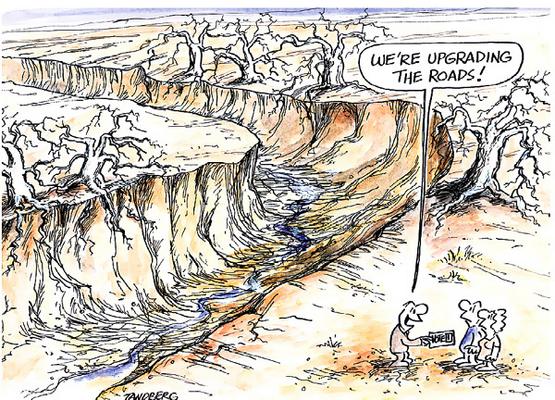
Tandberg
So what has happened on the water front. It's all gone quiet. Too quiet.
November 14, 2007
Moon in HDT
The Japan Aerospace Exploration Agency (JAXA) and NHK (Japan Broadcasting Corporation) have successfully performed the world's first high-definition image taking by the lunar explorer "KAGUYA" (SELENE,) which was injected into a lunar orbit at an altitude of about 100 km on October 18, 2007.
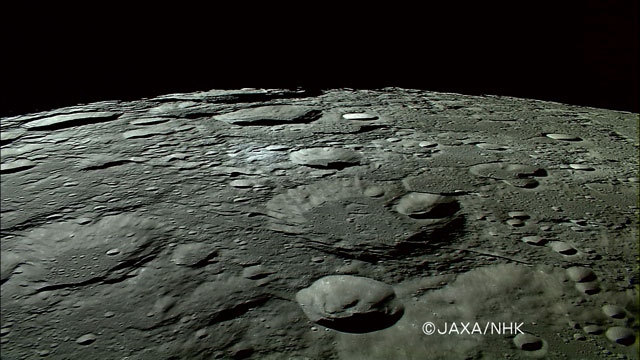
It's of the North Pole Area and it is a still image cut out from the first image shooting.
Social networking: SA photographers
This image refers back to the urban arboreal post, but is more minimalist. Summer has arrived in Adelaide--- we are in a couple of works of temperature in the mid-thirties and I am very conscious of the lack of shade in walking the streets. I don't bother.
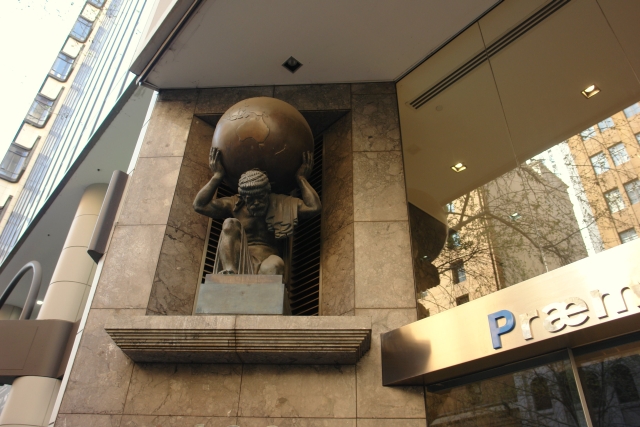
Gary Sauer-Thompson, Atlas, Collins Street, Melbourne, 2007
I've started a Flickr gallery and whilst getting it going I stumbled on this local photographic exhibition of Flickr-based photographers at the Wheatsheaf Hotelin Adelaide in July 2007. Though I cam across the the work of local photographers: such as Stephen Mitchell and Jennifer Anne, then Mandi Whitten, who has an interesting web design business Weensyweb Design.
So what? Doesn't this happen all the time on the web?
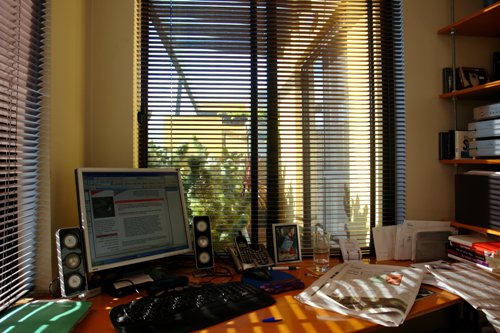
Gary Sauer-Thompson, office, Adelade, 2007
Flickr.com is definitely social networking just as much as MySpace and Facebook. All have good functionality. I know very little about LinkedIn, which is aimed at professionals, or Xanga, a blog-based community site. All are based on the idea of joining online communities and being able to participate in them. Google is currently behind the curve of the social networking trend.
Flickr's stickiness is due both to its functional value and community value, since its online connections enables photographers to talk to one another though photographs, rather than being talked to does the mass media. It helps photographers to meet new people and organize around common interests---in my case photographers interested in street culture.
What this points to is the possibility of social networking sites that really made an effort to allow not just the free flow of data, but also the free flow of relationships.
November 13, 2007
Lettrism, Adelaide, photography
I've been tracing my roots as a photographic flaneur concerned with street art to Lettrism a French avant-garde movement, established in Paris in the mid-1940s. It had its theoretical roots in Dada and Surrealism and formed in reaction to Breton's surrealism. It builds on the surrealist idea of urban wandering and the longstanding concept of the flâneur.
Lettrism was a visual poetry movement that aimed to get poetry back into people's lives, and it was named from the fact that many of their early works centred around letters and other visual or spoken symbols.They incorporated letters, numerals and non-Western calligraphy into painting and fused art with poetry to create a music of letters.
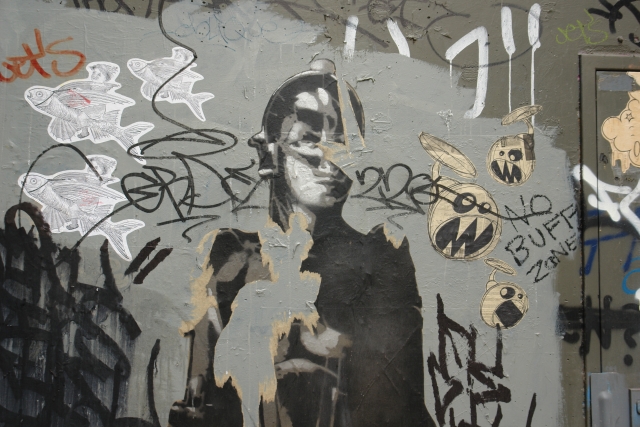
Gary Sauer-Thompson, flying fish, CBD Adelaide, 2007
My interest is in both the movement of Lettrist activities toward the visual manifestations of expression in the later years, as a great deal of activity was in painting and film; and the Lettrist movement's evolution into the Situationists.
The latter aimed reawaken the radical political potential of surrealism: ie., to supersede art, abolishing the notion of art as a separate, specialized activity and transforming it so it became part of the fabric of everyday life.
The bridge between Lettrism and the Situationists is the Lettrist International and its ideas of dérive (or drift) and psychogeography. Dérive refers to an aimless walk through city streets that follows the whim of the moment for hours on end. This urban wandering or exploring is a technique to help us revisit the way we look at urban spaces by stepping outside of our daily route and routine.
If we follow our emotions and look at our urban situations in a radical new way, then we realize that most of our car dominated cities such as Adelaide, Canberra or Brisbane are thoroughly unpleasant because they have been designed in a way that either ignores their emotional impact on people, or indeed tried to control people through their very design.
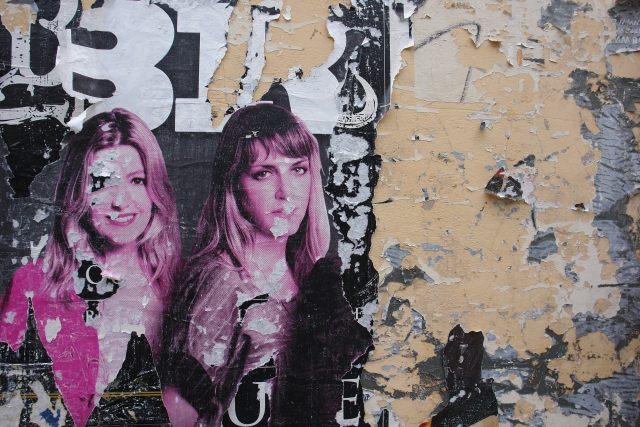
Gary Sauer-Thompson, two girls, CBD Adelaide, 2007
Psychogeography refers whole toy box full of playful, inventive strategies(eg. derive or drift) for exploring cities, and it includes just about anything that takes pedestrians off their predictable paths and jolts them into a new awareness of the urban landscape. and to become aware of a pattern of emotive force-fields that permeates a city.
November 12, 2007
culture industry: a perverted avant garde?
Sven Lutticken in Secrecy and Publicity: Reactivating the Avant-Garde in New Left Review says that, if the historical avant-garde had failed in its attempt to dissolve art as an autonomous sphere as Peter Burger claimed, then the culture industry had become an alternative cultural force, in the form of the mass media, fashion, music etc. Andy Warhol is the often mentioned example of the postwar or neo avant garde who engaged with the culure industry.
In the 1970's Andy Warhol did portrait commissions of the predominately wealthy and famous--- actors, models, royalty, and society figures. Having their image glorified by Warhol was one way of seeking affirmation of their status as a celebrity.The 'Warhol treatment' blurred their image into a uniformed mass of brightly-coloured 'pop' faces.
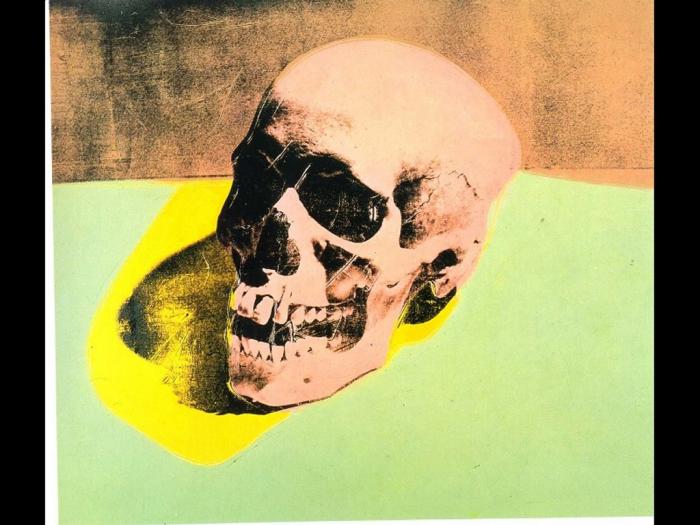
Any Warhol, Skull, 1976, Synthetic polymer paint and silkscreen on canvas.
Warhol's Skull series, produced during this same period, acted as a counter-image to these glamorous portraits. What Warhol signifies is the neo-avant-garde of the sixties and seventies taking the commercial media as a conscious focus for his practice.
Lutticken says:
Andy Warhol, for instance, broke out of the gallery’s white cube by integrating his art into the spectacular economy. His magazine Interview started as an underground film journal, became progressively slicker and ended up as the yuppie-lifestyle magazine of the 1980s. Warhol made the step from the avant-garde to its Doppelgänger, the culture industry. Openings became society events; cameos in soap operas and the labours of the paparazzi put universal recognizability within the artist’s reach. Warholian practice has had perhaps more than its fair share of repetition among contemporary artists: a desire for integration into the worlds of fashion, advertising and pop culture is widespread .... contemporary artists have not abandoned the art world. If anything, they are now able to combine their activities across different spheres with greater ease . ... Now that that world itself has definitively become part of the media, artists who work as veejays or fashion photographers are as welcome in museums and galleries as they are in the glossy art magazines where they might do fashion spreads. Scarcely anyone now makes a distinction between their work appearing in the ‘artist’s pages’, under the editorial control of the magazine, or in an ‘experimental’ ad by some fashion designer targeting an art-magazines audience.
Such phenomena turn Warhol into a prophet, and have undoubtedly contributed to stimulating a wider critical approach to his work that has shed the traditional art-historical focus on his paintings.
In their attempt to escape art’s isolated, autonomous sphere todays neo-Warholian avant-garde often end up as fodder for a perverted avant-garde that they cannot control, or even influence to any significant degree.
Is the culture industry a perverted avant garde? Didn't the avant garde have something to do with utopia? Isn't the theme of utopia tied to utopia being a site in which possible non-capitalist scenarios are worked out, worked through, or otherwise proven not to work at all. Isn't the desire called utopia an imagining of life after capitalism?
November 11, 2007
Nolan: ?
The NSW Art Gallery has a retrospective Sidney Nolan exhibition. I've been ambivalent about Nolan. He is commonly judged to be a great Australian painter but I find a lot of his latter work slick and superficial, including the Kelly series.
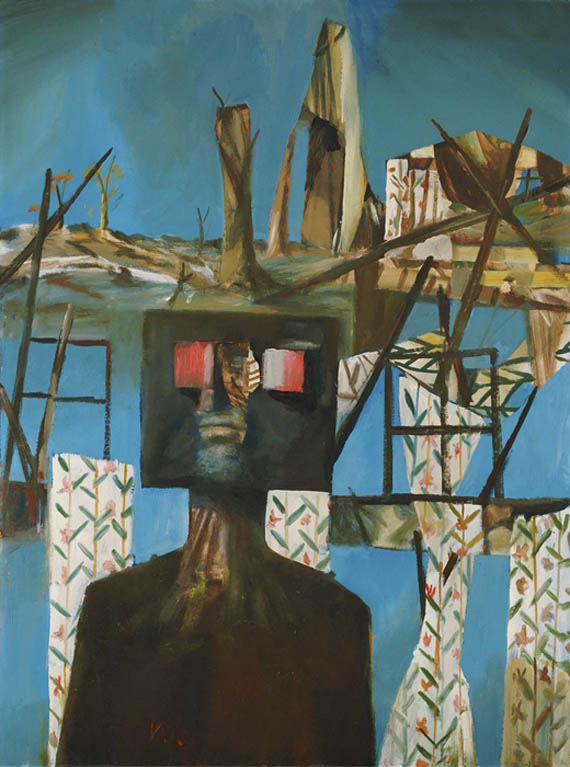
Sidney Nolan, After Glenrowan, (second Ned Kelly series), 1955, enamel on hardboard,
Here we have Kelly rising up with demonic messianic force - the red eyes out of the ruins of the siege of Glenrowan. In this second Kelly series Nolan shows familiarity with contemporary European painting with the mainstream of abstraction making its presence felt in this entrenched figurative artist.
Snowbirds
My car got carted across the US by a semi-trailer. The driver was telling me that the US winter was his busy period as the 'Snowbirds' from the Northern States would fly to Florida and have their cars trucked in. Most of the New Yorkers and New Jerseyites would head to Florida, while the Mid-West states like Idaho and Minnesota would go to Arizona.

I had wanted to drive across the United States from Virginia to Arizona, however my work schedule got moved up and I could not fit in. Which was a shame. I noticed when the driver delivered my car he had cars on his truck with South Carolina and New Jersey number plates. I asked him, "How many times have you driven across the US?"
He looked into the air, thinking, and then said, "You know, I couldn't tell you. I have done it so many times I have lost count."
The car was pretty dirty when it came off the truck. It was carrying five days and two and a half thousand miles of road grime. Though the driver said to me the ones on the front of the truck collect bug litter too and since mine was on the back it wasn't as dirty as they can get. I splashed out some money at a local car wash to have the car detailed, calybar'd and buffed.

It came up nicely.
November 10, 2007
November 9, 2007
Ranciere, image, meaning
In his essays on art and cinema--The Future of the Image ---Jacques Rancière argues that art derives its meaning from the interaction between the image and the audience. Whether the artist produces figurative representations or abstract symbols, their forms are always endowed with meaning; indeed, art remains art insofar as the image stimulates interpretation.

Gary Sauer-Thompson, collar down, CBD Adelaide, 2007.
In this manner Rancière questions the popular notion that 20th century artists merely strove to emphasize the flatness of the medium for its own sake, and challenges us to look at art anew.
If politics is the struggle of an unrecognized party for equal recognition in the established order then aesthetics is bound up in this battle because the battle takes place over the image of society -- what it is permissible to say or to show.
November 8, 2007
interpreting the avant garde
Sven Lutticken in Secrecy and Publicity: Reactivating the Avant-Garde in New Left Review returns to interpretations of the avant garde and to Peter Bürger's Theory of the Avant-Garde (1974). Bürger’s book is the theoretical consummation of the late-sixties’ break with a depoliticized conception of the avant-garde. Lutticken says that:
Clement Greenberg had used the term as a synonym for his idea of modernism, to mean ‘purified’ arts locked up within their own ‘area of competence’, their own history. In Jacques Rancière’s terms, both the Greenbergian and the Bürgerian conception of the avant-garde can be seen as responses to Schiller’s contention that art and aesthetic play, as the essence of man, would bear ‘the whole edifice of the art of the beautiful and of the still more difficult art of living’.
As Rancière has shown, the crucial ‘and’ within ‘art and life’ has been variously interpreted. Like others before him, Greenberg went on to link art and life by conceiving of an independent ‘life of art’, from Manet to Morris Louis. On the other hand, Bürger focused on the way movements such as Dada and Surrealism, whose importance had been minimized by the ‘modernist’ conception of the avant-garde, had attempted to use art to transform life. Modern art’s autonomous and specialist status was treated as a hindrance to be overcome; art should not be limited to its own small sphere, it should revolutionize society.
The ultimate aim of Dada, Surrealism and the ‘historical avant-garde’ in general had been to integrate art into the Lebenswelt, into society and everyday life. For 25 years Peter Bürger's Theory of the Avant-Garde has shaped the understanding of the avant-garde. A quarter of a century on there is a need to take the discussion further.
Bürger's theory, instead of opening up a debate on the neo-avant-garde, closes it down. He argued that the avant-garde "failed to sublating art into the practice of life" and that, in consequence, the neo-avant-garde was "inauthentic". The avant-garde was crushed in its existence in 1933/34 by the political forces of Fascism in Europe and Stalinist cultural politics, regaining momentum only in the 1960s. It is commonly interpreted as repeating things thast were done thirty years ago’.
November 7, 2007
critical writing/reviewing in Australia
I've just stumbled onto Emmy Hennings Fangirl. Emmy appeared on the panel at This is not Art 2007 that was framed as an investigation of critical writing/reviewing in Australia--- meaning a project of undoing and unsettling? One that refers to art or music that provokes, threatens, engages or discomfits its audience as art or music.
Other panelists included Gail Priest, an associate editor of realtime magazine, and Jon Dale, a writer at Dusted Magazine. The debate, from what I can gather from the October post was about 'Australian' as both geography and nationality in culture---eg., as in Australian music or Australian photography---and locality as place.
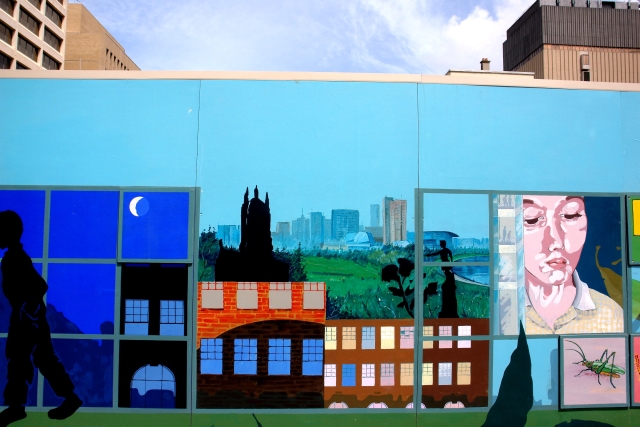
Gary Sauer-Thompson, mural, Adelaide CBD, 2007
No mention of culture and class---given the conservative enframing of class as class envy, hatred and resentment- or of cultural conservatism---given the enframing of Leavisite high culture, dislike of pop culture and middle brow conservative critics being far more in touch with ‘reality’ than anyone involved in Theory. Shouldn't any project of undoing and unsettling address culture and class?
Class, these days under state Labor governments, is expressed as a 'concern' for the 'socially excluded' coupled with the strong fist of law and order. Class is marked by absence in relation to race or gender, even though neo-liberal Australia is a class society, and many working class people, including those who have been to university, bear the psychic wounds of class.
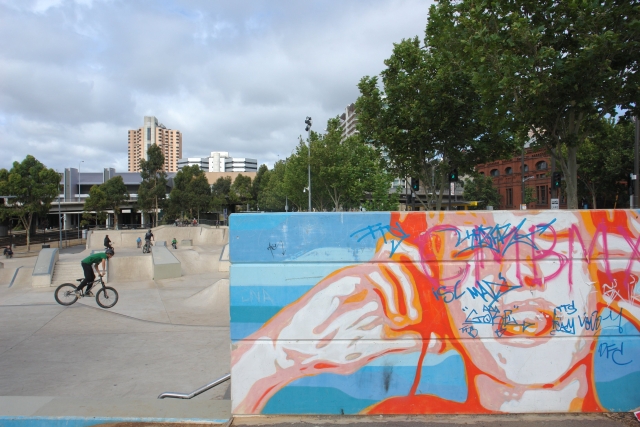
Gary Sauer-Thompson, skatepark, Adelaide CBD, 2007
We are also surrounded by the consumption of false images of freedom, music’s appeal to the unconscious and to the sedimented historical class content behind personal taste, and a consumption of nostalgic motifs completely devoid of true historical consciousness.
November 6, 2007
The global village is not yet
The idea of a city wide Wi-Fi that would be be free, or near-free, because it is seen as public infrastructure is an alluring dream in an information society. What we actually have forming in Australian cities are a few free wireless hotspots plus, in some cases, "private/public" partnerships. That means giving a private company---eg. Internode in Adelaide --- the right to build a wireless network and to try to make money off of it.
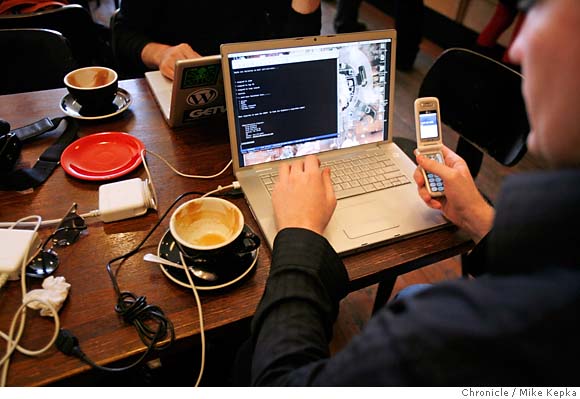
Mike Kepka, office workers, Ritual Roasters, San Francisco.
This has given rise to a new breed of office worker armed with laptop and mobile phone working from independent coffee shops with Wi-Fi -- wireless Internet access.
Tim Wu in Where's My Free Wi-Fi? Why municipal wireless networks have been such a flop in Slate says that:
Setting up a large wireless network isn't as expensive as installing wires into people's homes, but it still costs a lot of money. Not billions, but still millions. To recover costs, the private "partner" has to charge for service. But if the customer already has a cable or telephone connection to his home, why switch to wireless unless it is dramatically cheaper or better? In typical configurations, municipal wireless connections are slower, not dramatically cheaper, and by their nature less reliable than existing Internet services. Those facts have put muni Wi-Fi in the same deathtrap that drowned every other company that peddled a new Net access scheme.
The limited success stories come from towns that have actually treated Wi-Fi as public infrastructure. Real public infrastructure costs real public money, and if you're not willing to invest in infrastructure, you get what we have: crumbling airports, collapsing bridges, and degraded roads.
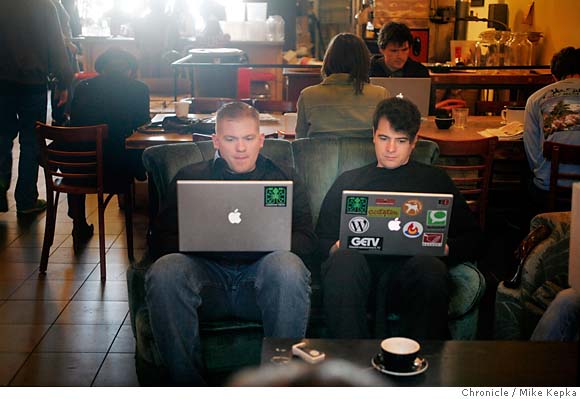
Mike Kepka, office workers, Ritual Roasters, San Francisco.
Adelaide is moving to build comprehensive wireless networks in its central business district by meshing the hotspots.Though I have a telephone connection to my home with ADSL2+ but it would be nice to move around different cities in Australia accessing WiFi hotspots as part of the ADSL2+ account.
From what I can gather a national chains of hotspots, ie., in all major locations across Australia and New Zealand, or a global roaming facility, barely exists--you have to be a geek who loves coffee-- or if it does, it is still outrageously expensive.
What is needed is affordable mass market wireless broadband services across the nation. The global village is not yet.
campaign 2007
The me-too election campaign rolls on along with the spin and puffery.

Bill Leak
Labor is still in the box seat to win the election . But its image has suffered in recent weeks in a traditional area of strength --the environment. But it is increasingly obvious that politicians in this area are afraid to speak their minds, to admit that there are different sides of questions, or to engage in real debate.
No doubt every draft speech written in Peter Garrett office, for example, is sent over for vetting by Kevin Rudd’s office to ensure Garrett stays on message. Garrett dutifully plays the game.
November 5, 2007
McDowell Ranges
Arizona is three hours ahead of Virginia and my body clock is still on east coast time. Consequently I am waking up at 4am in the morning and unable to sleep. Yesterday I took advantage of my out of phase sleeping rhythms by driving up to a bike trail north of me where I caught this beautiful view.

The South-West American landscape reminds me of the Australian landscape over the Great Dividing Range. It is scrub, but the tough kind of scrub that is impossible to dislodge and has survived more hardships than we will ever face. It carries the resilience that a tough, water-sparse, heat-heavy environment demands and is stunningly beautiful for it. You can admire its natural beauty but also its strength.
Near the bike trail was a school library that was also catching the morning sun.

The material appeared to be wood, not metal, and the rust red style soaked in and reflected the rising sun wonderfully. There were several other buildings in the same style and it appeared that the school park was an end to the bike trail. There were numerous cars, bikes and people walking their dogs just past the library.
Adelaide: CBD renewal
Adelaide's CBD is slowly being bulked up and the skyline is becoming more highrise, especially on the western side of the CBD as the new urban renewal developments finally start to happen. The Sensational Adelaide crowd must be pleased.
This 8 story commercial office--on the site of the failed Minster Ellison building from the 1980s --- is on the Gouger side of the Central Market, and judging from its name---Thompson Playford Building, --it will house lawyers.

The architecture looks bland and the shape is boring. But, as it is near the Supreme Court on Victoria Square, it will deepen the way this area of the CBD is becoming a lawyer precinct, that is a part of the intimately scaled setting of restaurants and wifi coffee shops clustered along Gouger Street.

Gary Sauer-Thompson, Supreme Court, Adelaide, 2007
What is crucial about this part of Adelaide is the people---it is alive and vibrant and so the architecture needs to enhance this vitality. Spire living is not appropriate.
Just around the corner from the Thompson Playford Building we have this 13 level mixed use (office and apartment) building development known as 16-20 Coglin Place. Will it be more lawyers?

These two buildingss, a block from where I live, will begin the rejuvenation of the south side of the city of Adelaide, which is currently full of empty buildings, pigeon shit and empty sites. What we need is urban rejuvenation that respects the intimacy of a people orientated precinct:
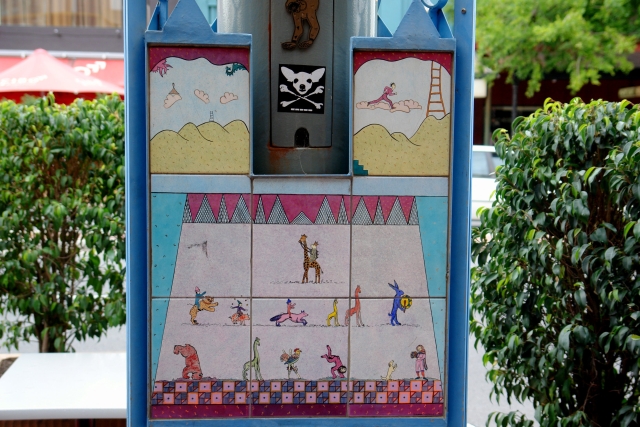
Gary Sauer-Thompson, pole, Gouger Street, Adelaide, 2007
We also need more of is kind of street art to highlight the creativity of the city.
November 4, 2007

November 3, 2007
Mclaren's Rock 'n Roll Swindle: Pretty Vacant
I watched Julien Temple's 1980 directorial debut The Great Rock 'N' Roll Swindle last night. This post modern film is often credited with originating the now-legendary view of the band's manager, Malcolm McLaren, as the mastermind behind the phenomenon that was the Sex Pistols. They had become embalmed as cultural icons after they became a caricature:--act tough, jump up and down a bit, turn up your lip.
The film is interesting in the way the tensions between the band's desire to achieve popular success, the mass media's hegemonic function, and the music (and fashion) industry's reliance on innovation is explored:
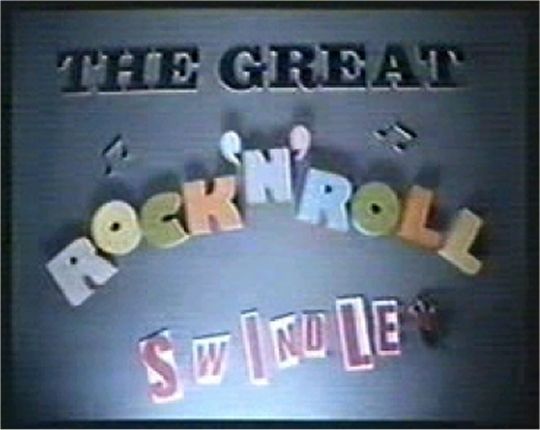
If it is a haIf-frozen souvenir of the end of the punk musical revolution, then the Sex Pistols are presented as a theatre of the absurd for the jaded masses. They were a ruse, a scam, a swindle, to make a ton of dough out of the music industry---hence McLaren's series of lessons on how to screw the record industry for all its worth. McLaren basically asserts that he ran the show and that the Pistols were a bunch of talentless losers who couldn't play.
Structurally, the film is all over the place, jumping indiscriminately from to a naked McLaren lounging in a bathtub to vulgar cartoons, from already-stale concert footage to esoteric images ripped from surrealist shorts. Consistent grain and washed out-colors are visible throughout the picture, which is presented in its original full-frame aspect ratio. The sound is pretty poor: dialogue is often muffled and difficult to make out, with only a few musical sequences showing some degree of sonic dimension.

My view, that the film itself is a bit of a swindle and pretty vacant, is contested here by World of Stuart. He says:
Nowadays the film is widely regarded as a self-publicising, self-glorifying cash-in vehicle for the Pistols manager Malcolm McLaren, which it undoubtedly is. But it's also dismissed as a factless fantasy portrayal of the Pistols' turbulent career, which is a rather more disingenuous criticism motivated by some dishonest vested interests, and as being devoid of artistic merit, which is just plain wrong. And so, World Of Stuart is taking it upon itself to begin the critical rehabilitation of a movie and an album which in many respects depict the punk era and particularly the story of the Sex Pistols the way it really was, and aside from that are tremendous, thought-provoking and ahead-of-their time entertainment and culture, sometimes intentionally and sometimes by accident.
He reckons it is a messy but always-watchable tangle of reality and fantasy, insult to history and insight into it at the same time, never to be taken at face value but nevertheless containing plenty of truth for the attentive viewer who can be bothered to look for it.
It's the music that stands because it says something:--'Pretty Vacant', for instance, is about a vacant mood--an empty feeling inside. The songs sound as energetic today as they did 30 years ago.
a new Brisbane
This issue of Artlink explores the new Brisbane---the Creative City leading the Smart State. The contemporary ethos of creative Brisbane is deemed comparable to Adelaide's cultural renaissance under Don Dunstan. In 'New Brisbane' Stuart Glover and Stuart Cunningham state:
Brisbane's coming of age has been announced a number of times: with the 1982 Commonwealth Games; with World Expo 1988; with the fall of Joh and the National Party in 1989; in the city's re-invention in the 1990s as the ironically cool Brisvegas; and, most lately, with millennial-expansiveness, in its claim to be the Creative City leading the Smart State. Over the past 15 years as the city has spawned new enterprises, a new generation of artists, new cultural policies, new public buildings, and a new sense of grace - alongside a chump-ish, crowing self-satisfaction. It has also spawned new narratives about itself. Only from time-to-time does the city capture the national gaze, but local media and the state and local government regularly present Brisbane as a city transforming upon a number of axis: artistic, cultural, economic, governmental and lifestyle. These changes are sometimes seen as a party to globalisation and to global change, and other times unique to the city's own 'maturation'.
The narrative is one of the Creative city being born out of the cultural wasteland that was Queensland'. The 'Smart State' brand signifies the shift in the state's skill base from a mix of agricultural production, mining and services (including tourism) towards knowledge products and information services.
Though the Beattie Government's Smart State platform concentrated on bio-tech, it also embraces the cultural and creative industries sectors as part of the Smart State mix.
November 2, 2007
DYI street culture
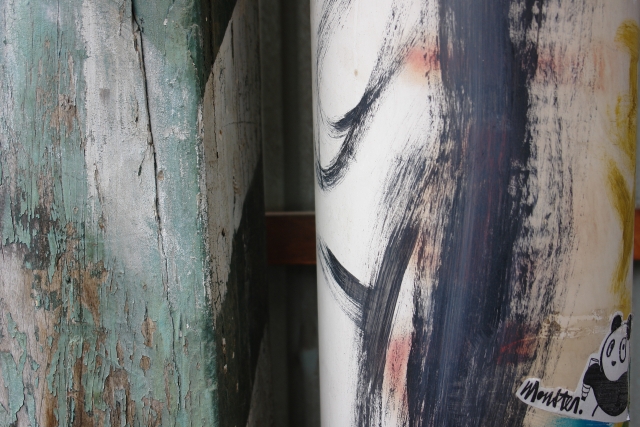
Not quite Art part 3 is about art and money. Derelict spaces taken over by artists and turned into studios and DYI bars have led the revitalization of Melbourne's laneways and the development of the local urban culture. The money earned from the bar funds the art projects.
This DYI street culture has led to Three Thousand, which filters the local art happenings and resources on a weekly basis.
Gary Sauer-Thompson, monster, Adelaide, 2007
This kind of street culture been picked up by advertisers, marketing executives and designers and it provides the support for magazines such as Unseen Magazine.
November 1, 2007
political art, otherwise
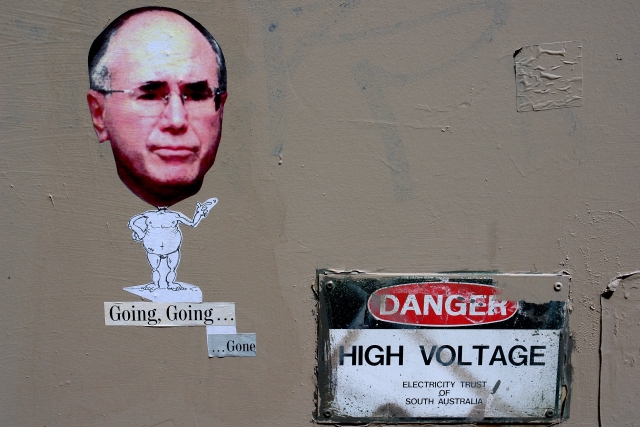
Sometimes the juxtaposition of image and text can create an interesting new image:
Gary Sauer-Thompson, Howard gone, Adelaide, 2007
The art work captures a common public sentiment about politics. It expresses a desire and hope for change. It is a different kind of politcal art to what KeZ Majkut is exploring with is neu konzervativ.
I've been searching for photographers in Adelaide who are interested in street culture and who have weblogs, galleries or websites. Facebook turned up very little. I did come across (sigh)mon via Flickr: Church on Fire and then the world of Mays, which, alas is in Sydney.
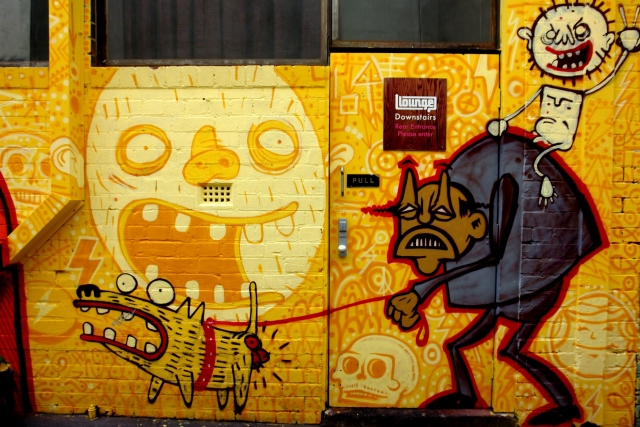
Another kind of political art:
Gary Sauer-Thompson, Dog, Caledonian Lane, Melbourne, 2007
I doubt if there are any re any public legal graffiti areas/walls in Adelaide. The Adelaide City Council still sees graffiti street art as vandalism of private property.
Groovy Dancing
Via mefi, "filmed in slow motion and played back at higher speed, but still synchronous to the music":
The same technique done badly/comically - you never know on youtube. Previous harder, better, faster, stronger on junk for code with poppin' and lockin'.