December 31, 2007
Celebrity today
Paris Hilton, seen through the window of a Los Angeles sheriff's car, weeping as she's being hauled back to prison to complete a probation-violation sentence: a 23-day prison term after repeated probation violations (stemming from a drunk-driving arrest).
 Nick Ut, Paris Hilton, 2007
A suitable image from a celebrity sightings for a modern day Warhol to work upon? Is the pain real? An event in Hilton's "poor little rich girl" performance? Is it pop cultural detritus?
Warhol in Australia
When Suzanne was in Brisbane last week for Xmas she took the opportunity to visit the Warhol exhibition at the Queensland Art Gallery's new Gallery of Modern Art, which was being put on in association with The Andy Warhol Museum in Pittsburg.
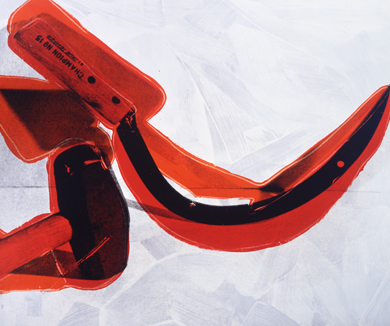
The standard accounts say that Andy Warhol transformed contemporary art as he employed mass-production techniques to create works and challenged preconceived notions about the nature of art and erased traditional distinctions between fine art and popular culture, as can be seen in Warhol's 1976 Hammer & Sickle:
 It's a major exhibition, as it brings together over 300 works, spanning all areas of his practice from the 1950s until his death in 1987. Works include paintings, drawings, prints, photographs, films, videos and installations.
The Andy Warhol Exhibition at the Gallery of Modern Art is exclusive to Brisbane. It is Australia's first major Andy Warhol retrospective.The context of the initial reception of Warhol's work was one of resistance--- it was understood to challenge the modernist assumptions about authorial independence and creativity--- and and ignoring---it merely mimicked popular imagery and was complicit with the trashy forms of mass media and popular culture.
Since neither the Queensland Art Gallery or the Andy Warhol Museum have much Warhol imagery online I appreciate Suzanne buying the catalogue, which I now have next to me.
In an early test that sough tto situate Warhol's woprk historically ----The Work of Andy Warhol, Dia Art Foundation, “Discussions in Contemporary Culture, No. 2,” ed. Gary Garrels, (Bay Press, Seattle: 1989)---- we find this paragraph
The punk period witnessed a renaissance of tattooing- a practice which visibly asserts our ritualistic ‘uncivilized’ past and in whose pictorial language the skull looms large. Because of a slew of ‘primitive’ and sexual associations, the tattoo is proscribed by traditional western conventions. But tattoos persist, serving to decorate, seduce, shock, scare, to declare nonconformity . . . [Warhol’s] own tattoo-like exhibitionism at the 1977 opening for his ‘Hammer and Sickle’ paintings drew together various structures of power and pleasure: the art world/gallery system brand of capitalism; a communist emblem rendered in paintings titled Still Lifes, in which the shadow seems more real (threatening) association with leather, homosexuality, and gay rights and aesthetics; disco madness as the latest social marketplace and entertainment industry.(p.107)
What we tacitly have here is a shift from the narrow world of art history and the art institution to a visual culture that is the object of study of cultural studies.
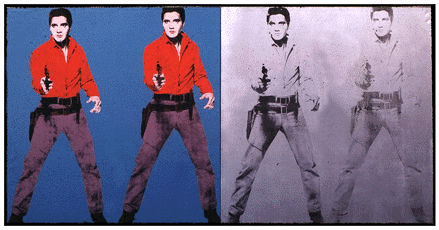 Andy Warhol, Elvis 1 & 2, 1964
December 30, 2007
New Museum of Contemporary Art, New York
The New Museum of Contemporary Art in the Bowry, New York, which opened on December 1, makes most recent buildings in Australia look very ordinary indeed. It was designed by Kazuyo Sejima and Ryue Nishizawa, of the Tokyo-based firm SANAA, and the striking shape layers six off-kilter white boxes above a formerly grungy block on the Lower East Side:
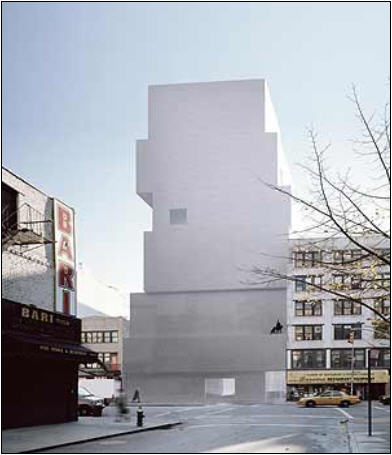
This indicates the globalization of architecture, which is now pervasive. Do any architects still build in their native countries? Are any architects still concerned with a regional style in a globalised world?
The most striking feature inside the seven story museum is the complete absence of internal columns; the building is held together by a series of cross-bracings and the skylights allow natural light to filter through spaces where the stories are offset. The three main floors of galleries are airy but not particularly capacious, creating a cozy, modest context for the work. The fifth floor is given over to an educational center; the ground floor lobby features a bookstore, cafe and glass-walled gallery space; the basement level houses a 182-seat theater. On the seventh floor, an outdoor patio and glass enclosed event space will be used for installations and private soirees; and has a good view of downtown.
Cultural Edges
Bill Mollison's famous insight into biological production was that it was the edges of any system where the greatest dynamicism occurred. Permaculture is a biological design mechanism that maximised edges to increase production. We see the same patterns in culture. It is the edges where the greatest dynamicism occurs. Peter Turchin has hypothosised that it is the cultural, ethnic and violent border areas where new Empires coalesce and fan out from. We also know from the Tasmanian Aboriginies that the absence of a cultural border will cause social regression where technologies are quite simply lost and forgotten. Without a a cultural boundary they are never recovered.

One of the popular grand narratives at the moment is the monolithic view of the epic culture war between East and West. A gigantic showdown, fought across the globe, where the only means of survival is cultural exclusion and a steadfast resistence of any cultural osmosis. Liberal democracy, with its typically open systems of liberty is having trouble dealing with this narrative from either side. As is humanity's will the tension is often viewed openly as violence.
The origins of the West vs East is often traced back to the Battle of Thermopylae where a small group of Spartans, Thebians, Thracians and Helots stalled the invading Persian King, Xerxes, long enough that the Athenian Navy could make the conquering of the Greek city-states impossible. But the Persian-Hellenic divide was not so absolute. In the later Peloponnesian War against Athens Sparta used Persian gold to continue their fight against Athens and maintain their league of allies.
Another example of the cultural divide being fluid is when Alexander conquered the Persian Empire. The Greeks and Macedonians had no administrative technologies to manage such a large domain. Consequently Alexander used the Persian satrap system to manage his new empire including in Macedonia. Additionally the Persians were trained in the latest Macedonian fighting techniques and added to the Macedon forces. One of Alexander's successes included convincing the Greek mercenaries fighting for the Persians to join the Macedon forces.
The cultural, political and martial borders between the Hellenic city-states and the Persians led to an osmosis of technology; both organisational and physical. This was not good news for the Roman Consul Crassus who embarked on a campaign to conquer the Parthians, one of the left over Empires from Alexander's realm. The Parthians not only beat the Roman decisively, they captured Crassus and his standard. In Roman terms this was the ultimate insult and failure.
December 29, 2007
Picasso: after Cubism
After Cubism Picasso devised and explored one new experiment in style after another, shifting back and forth between many different modes of representation. I've always had trouble making sense of them, and never taken much interest.
The Dance, a work Picasso made to commemorate the death of his old friend Ramon Pichot in 1925, is frequently cited as a turning point in Picasso's career almost as radical as that of Les Demoiselles d'Avignon in 1907. From this point on, he invented fantastic mutations of the human body with ever greater freedom and expressive power.
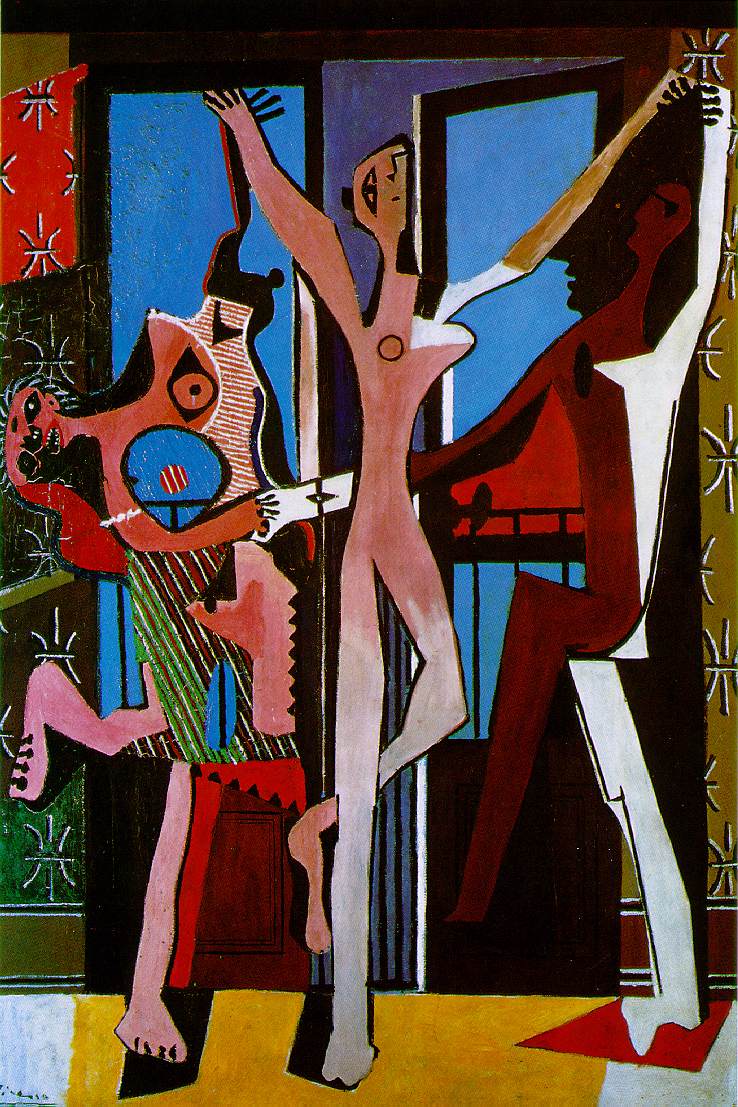 Picasso,The Dance, 1925, Oil on canvas
The shapes are distorted and deformed in the manner of Surrealism, even though Picasso was never a part of surrealism. Picasso's art was always rooted in some concrete reality, no matter how unreal the imagery may seem; even his most hallucinatory pictures are representations of the people in his life and of his emotions for them.
The twinned themes of his new works after The Dance were his erotic rapture for his mistress (Marie-Thérèse Walter) and his anger and loathing for his wife (Olga Khokhlova).
 Picasso, Girl before a Mirror, 1932,Oil on canvas
A love poem painting; but one in which the image of a woman confronts her mortality in a mirror, which reflects her as a death's head.
December 28, 2007
just holiday snaps
A summer kind of image:
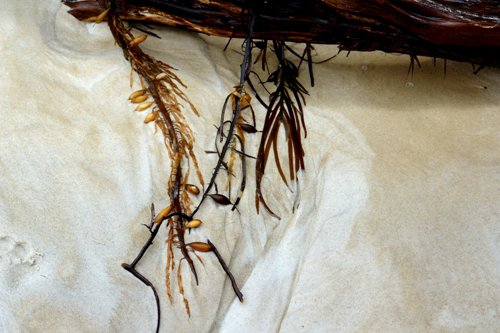 Gary Sauer-Thompson, seaweed, Wilsons Promontory, 2007
I don't work on projects. I don't have time. You have to be full time to do that. Time is what I do not have. So I just do snaps. I find it rather dissatisfying, as it would be good to work on a project.
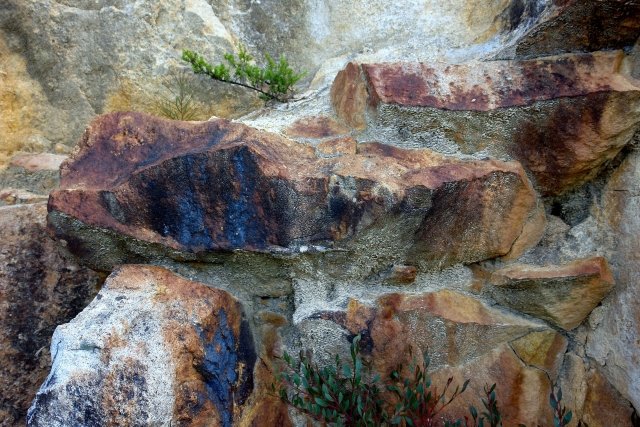 Gary Sauer-Thompson, rock wall, Wilsons Promontory, 2007
It would be nice to work on a project though. However, I am not an artist with a camera. Just a snapper like many amateurs.
December 27, 2007
Martin Parr: The Last Resort
The Last Resort is Martin Parr's photographic essay of Thatcher’s working class at play in a run-down seaside resort of New Brighton on the Wirral Peninsula, a few miles from Liverpool.They were produced between 1983-86.
 Martin Parr, New Brighton, 1985 from The Last Resort
The photographic essay was interpretated by many as a negative comment on working class holidays----people found his work cruel. Henri Cartier-Bresson visiting one of Parr’s exhibitions and chastising his work as being “without humor, where rancor and scorn dominate, a nihilistic attitude symptomatic of society today.”
 Martin Parr, New Brighton, 1985
The use of high saturation colour in photography produces some, at first glance banal and subdued images of everyday life, until you look closely. This series was really a critical study of what people have to put up with in run down areas, and it was the beginning of Parr's studies of the English as a nation.
Parr, one of the leading pioneers in the British new wave of color photography, created a new visual language. He moves away from the classic 35mm, b&w, Leica, humanistic, dignifying of the working class style of Magnum photographer, and builds on the work of William Eggleston.
Parr goes beyond that slightly aristocratic take on the world into new territory — a kind of visual glee balanced by a civilised dismay at the ill-matched but colourfully-multicoded way the world we live in actually looks, once you stop editing the plastic crap and the banality out of your viewfinder.
December 26, 2007
Christmas Day in Phoenix
This is the mall by Tatum Road. Normally it is a zoo. It was dead as a dodo on christmas day.

The trails were being well travelled however. You can see in the photo below the trail to the peak. There are plenty of bodies and groups walking, running and gasping up/down it.

I make a habit of saying hello to as many people as possible on the trail. It is a nice touch from Australia that I enjoy doing. Today I was saying merry xmas as often as I could. Though some people hike with ipods in their ears and are impervious to greetings.
I met an Australian fellow on the trail with the same atonal drawl as me. Always nice to chat with a native. He had come down from Vancouver in Canada for christmas to escape the cold. The temperature was a brisk 20C in Phoenix, in Vancouver it was probably about 16 below.
Radiohead: 7 Television Commercials
I watched a DVD of Radiohead's 7 television commercials last night. These are art videos of 7 tracks from The Bends and OK Computer. It is short--- around 35 minutes. There are no extras, and so we know nothing about the different directors, nor the history of music video and the relation to the work of David Bowie and David Mallet, or even how these videos fit into Radiohead's music video history.
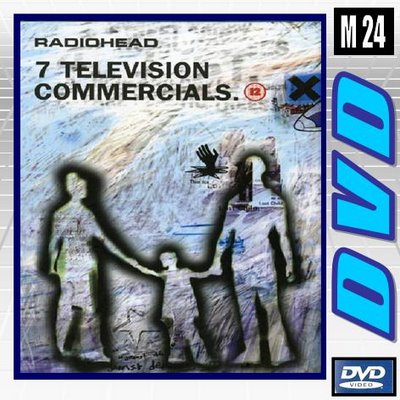
You are just thrown into the video collection. The tracks from The Bends are: Street Spirit, Just, High and Dry and Fake Plastic Trees. The tracks from OK Computer are: Paranoid, Karma Police and No Suprises. I'm not familiar with with The Bends and this was the first time I'd heard the music from that album.
The videos are different, are all mixed up.Plastic Trees, for instance, which was the first to be produced ( by Jake Scott), closes the DVD. This collection represents the cutting edge of music video and the work is interesting and of high quality--the videography would have few equals in terms of overall quality and creativity, and the videos are the work of highly skilled individuals with a strong artistic vision. What comes through is that the world as a strange, confusing and painful place to grow up and live in.
The works stand on their own as video art. I'm going to watch them again to see a sense of the individual videos.Paranoid standout as it is the only cartoon video.
December 25, 2007
Xmas Day
An Xmas post:
 Gary Sauer-Thompson, Stain glass window, Block Arcade, Melbourne, 2007
Enjoy.
December 24, 2007
stencil Christ: a little note of subversion?
A bit cheeky---a Christ-like face and a crown of thorns with a cigarette hanging from the mouth. It refers to the way that graffiti, as a medium of public expression for people, is a traditional art that is a cheap and relatively simple way to make images, has deep historical roots.
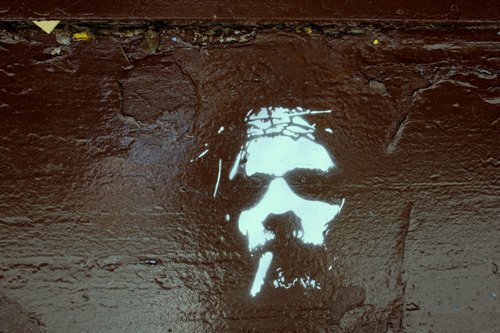 Gary Sauer-Thompson, face, Union Lane, Melbourne, 2007
Crispin Sartwell puts street art into its cultural context well. Referring to the US he says:
...think for a moment about who are the vandals, the taggers, the lovers of ugliness. Out where I live in rural PA, they've recently added a McDonald's, an Arby's, a Wal-Mart SuperCenter, etc. The corporate logos appear on signs along 83. There are huge signs everywhere. The buildings themselves - cheap, depressing architecture - started with the removal of trees, proceeded to the digging of huge pits, eventuated in rectangular concrete bunkers that dominate the landscape. The idea that the people who do this sort of thing, or even people who tolerate it, would turn around and call real art defacement and vandalism of these same structures is not even ironic. It's sick. All over America, police are protecting concrete abutments, shattered warehouses, and filthy freight trains, not to mention advertising itself, from the original, personal, at times brilliant expression and perfect craft of real artists.
The image of Christ is that of a street bum; a poet down on his luck; a human, all too human prophet. Such a contrast with the image of Christ in the established Christian religions. It's a little note of subversion
December 23, 2007
Street Art Project in Union Lane
A biggish image from Union Lane ---to test whether the issue troubling junk for code is my storage space or lack of it. The issue is resolved: it is my lack of storage. There is not enough left to upload my images. This happens about once a year. I keep on needing more and more digital storage.
The image stands on its own though, and it has its origins in Melbourne's very interesting Street Art Project in Union Lane which I mentioned here.
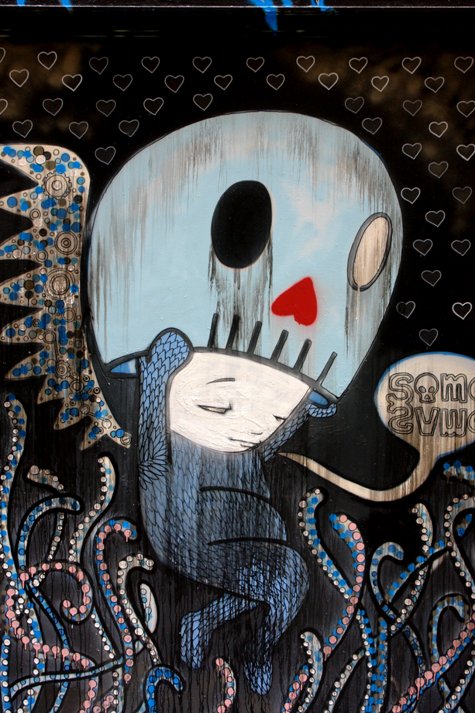 Gary Sauer-Thompson, hearts, Union Lane, Melbourne, 2007
This is an interesting piece of work, as are many of the images along both sides of Union Lane that links two premier shopping precincts in Melbourne. Few shoppers use it. They prefer to use the shopping arcades that run between Bourke and Collins Street.
This indicates that the City of Melbourne is actually committed to creating an environment in which arts activities can flourish on the street. It would appear that the Laneway Commissions are dedicated to commissioning new temporary art works for Melbourne’s unique laneway topography.
Ten Canoes
We watched Ten Canoes on DVD last night. What a great film in the tradition of Australian filmmaking. It is non-linear and evocative, imbued with the tradition of oral storytelling from an Arnhem Land swamp. The collaboration between filmmaker Rolf de Heer and the Ramingining community is one that attempts to tackle the very difficult cultural translation between western concepts and language and Indigenous cultural and storytelling concepts in order to make this film.
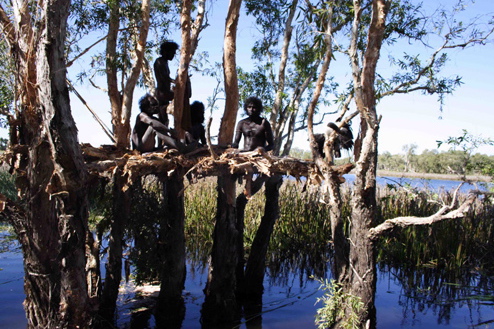 (Photo by Jackson, Courtesy of Fandango Australia and Vertigo Productions)
The look of de Heer's film refers back to Dr Donald Thomson's photography. Thompson went to Arnheim Land in 1937 when it was still deeply, deeply traditional and had never been conquered by white people. He lived there amongst the Yolngu people, learnt languages and took 4000 photographs on glass plates.
Ian Jones, the director of photography, creates the look of Donald Thomson’s photographs in the black and white section of the film, and part of the film’s beauty is the way it shifts between colour and monochrome, but with a reversal of their usual meaning – the black-and-white section here is the present. The rich colour is the distant past.
Union Lane
An image from Union Lane, which runs between Bourke Street and Little Collins Street, between David Jones and 'The Walk Arcade' in Melbourne, when I was there last week to test the image upload function:
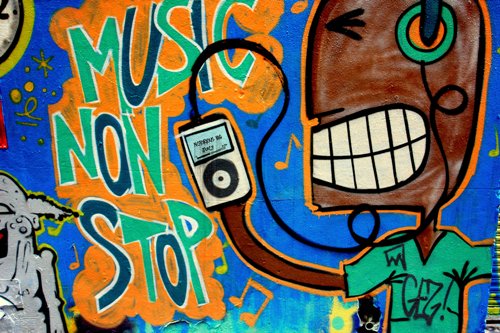 Gary Sauer-Thompson, music, Union Lane Melbourne, 2007
Union Lane appears to have become an official place for students to put up street art images. A community project as it were. It is part of Melbourne's Graffiti Mentoring Program. Whilst there I should have had a look at the Nicholas Building, which is an example of the Beaux-Arts style of architecture in Melbourne and is a Swanston Street landmark.
From what I gather the Nicholas Building is important as it has the only remaining vaulted leadlight arcade (called Cathedral Arcade) in Melbourne, which is surprisingly intact. Most of the ground floor shops retain their original fronts with the exception of a bookshop. The retail shops on the first floor are also extremely well preserved and according to the National Trust are an important example of 1920's office design.
The Nicholas Building has long endured as an important creative hub. Entry to the Deco era building is via the Cathedral Arcade with its vaulted leadlight ceiling and cluster of niche boutiques including Alice Euphemia and Genki. Upstairs is Retrostar’s vintage emporium, the Victorian Writer’s Centre and a diverse vertical community of artists and artisans including jewellers, designers and milliners.
December 22, 2007
down at Victor Harbor
Holidays have started. I'm trying to unwind. I'm tired.I need a break to relax. I am so tense and uptight. I need to find a way to unwind.
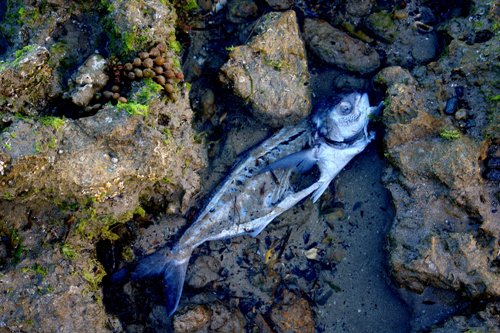
Gary Sauer-Thompson, dead fish, Victor Harbor, 2007
The upgrade has taken place. MT 4.1 is a very different publishing system. It is like starting all over again. I'm having great difficulty in figuring things out. I can post no images, for instance. I'm unsure whether it provides a the tools to deal with the spam problem.
The previous posts have gone, then they reappear. Unlike the other thoughtfactory weblogs junk for code is not working.
December 21, 2007
Nationalist Tensions
One of the tensions in liberalism is that increasing liberty erodes the value of closed technological loops such as nationalism. I was in California this week doing a round of meetings and introductions so I didn't have much time for photography. However on Tuesday night we managed to visit several restaurants and bars; ending in this Karaoke bar in San Mateo.

The karaoke bar sang as much Spanish as it did English. In fact the guy that stole the night did so with a Spanish rendition of "I did it my way" in a wonderfully powerful voice. No one cared. Fun was being had. Drinks were being sold. Liberalism won the night.
An Xmas card
This was the image that I used for my electronic Xmas card:
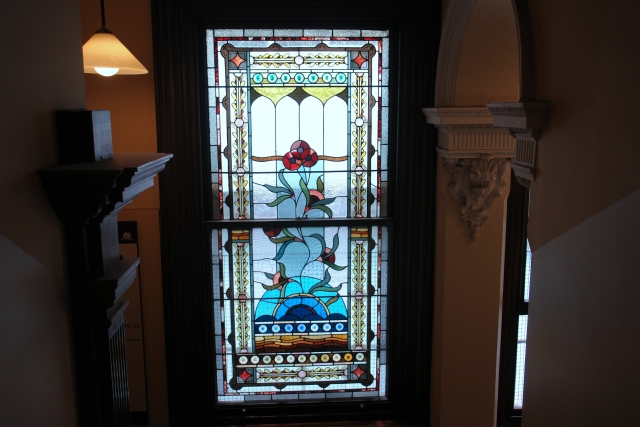
Gary Sauer-Thompson, Block Arcade, Melbourne, 2007
Seasons greetings everyone.
December 20, 2007
Melbourne's Arcades
This photograph is outside the Koko Black Salon in Melbourne's 19th century Royal Arcade. I was waiting on family at the time and watching the chocolatiers work couverture into an array of truffles, moulded pralines and bars, in the European tradition.

Gary Sauer-Thompson, Dorothy, Melbourne, 2007
How did this these kind of arcades survive the gung-ho development ethos of the 1960s and 1970s? Presumably, height restrictions in this part of the CBD. Or so Elizabeth Farrelly argues.
December 19, 2007
a day in Melbourne
I rocked into Melbourne today to spend time with my family for the day. I listened to the Rolling Stones Black and Blue on the flight over---what a miserable, boring, listless record. Two decent tracks at best. What a mighty fall off from the excellent Exile on Main Street.
This is the business section of the Qantas Club, where I often work inbetween flights, along with a lot of other people. Most of them in the morning are salesmen on the road inbetween flights spuiking their wares:

Gary Sauer-Thompson, Qantas Club, 2007
I took some photos whilst l traveling on the bus into the CBD---the Skybus. It makes a welcome relief from being a suit, catching cabs and going to meetings. Skybus is very democrat: all sorts of people use it, everybody is equal and people are at ease with one another. It was a nice feeling. I felt at home. So many people are nomadic these postmodern days, with their mobile phones and i pods.

Gary Sauer-Thompson, Skybus, Melbourne, 2007
I noticed how the billboards shape and dominate the visual field of Melbourne's urbanscape. The Skybus drop off is Southern Cross Station in Spence Street. Along with some of the other passengers I slowly walked up Bourke Street---- I was to join my family for lunch. Spots of rain were falling, the day was growing warmer and Xmas shoppers were everywhere. I ducked into the magnificent Block Arcade to explore the upper floors. It was something I'd always wanted to do. So I caught the lift to the 4th floor and slowly walked down:

Gary Sauer-Thompson, stain glass window, Block Arcade, Melbourne, 2007
Few were aware of this kind of tucked away urban heritage that is a counterpoint to both the happy Xmas shoppers maxing their credit cards as they consumer dream and the less noticed kind of street life :

Gary Sauer-Thompson, Xmas, Bourke Street, Melbourne, 2007
Lunch was in an Italian style bistro in Degraves Street to escape the mugginess and the sun. It was very pleasant and celebratory. I hadn't seen my mother, who lives in New Zealand, in over 20 years. A few family photos, a walk back to the Southern Cross Station, the Skybus to the airport, a few more hours in the Qantas Club writing this post. Then a late plane home to Adelaide:

Gary Sauer-Thompson, just out of Melbourne, 2007
I was tired, so I listened to Lucinda Williams' intriguing Essence rather than explore the old music like The Who's Live at Leeds.
art, pop, advertising
Pop artist James Rosenquist reformulated photographs and advertising imagery from popular magazines into a kaleidoscope of compelling and enigmatic narratives on canvas. The clippings---from magazines, advertisements and photographic reproductions were incorporated into collages that Rosenquist made in preparation for the paintings.

James Rosenquist,Marilyn Monroe I, 1962, lithograph on paper
James Rosenquist worked as a billboard painter, learning to enlarge images from small photographs and to apply thick paint quickly and easily to broad areas. Through that work he also became aware that gigantic images seen at close range can turn into abstract, unidentifiable forms without meaning.

James Rosenquist, President Elect, 1960-1, 1964 oil on masonite
It is argued that Rosenquist's work has poignantly registered social and political concerns and reflected upon the dynamics of modern capitalist culture. I can see the novel imagery and pictorial composition that would have once been in the vanguard and the use of images from popular culture.
December 18, 2007
sex with robots
David Levy's Robots Unlimited (Life In A Virtual Age) explores love, sex, and reproduction among and between humans and robots, as well as the ethical issues raised in having sex with robots. Robots here means androids - robots designed in a humanlike form:

In this interview Levy says:
As long ago as the late 19th century there were manufacturers, in Paris and elsewhere, who made artificial vaginas and even whole artificial bodies, designed specifically to provide substitutes for the female genitals and thereby to allow fornication. These products were known as "dames de voyage" (ladies of travel) and were particularly recommended for use by sailors during long periods at sea. The sex robots that I envisage will, of course, employ 21st rather than 19th century technology, but the basic idea is the same.
Levy's argument is that computers will think, feel, and experience life differently than human beings, but not less authentically. Robots will not only learn to solve our algebra problems but also help us with our love life, and the time will come when humans will even marry robots. Robots will have distinct personalities, and will be allowed to choose between good and evil--just like humans.
private/public
This image is from a cafe in Brighton, Adelaide. We dropped into it for a quick coffee just after returning to Adelaide from Wilsons Promontory before picking up the poodles from the dog minders:

Gary Sauer-Thompson, toilet, Brighton, Adelaide, 2007
Images of Marilyn Monroe were everywhere on the walls of the cafe. There were no references to Andy Warhol from what I could see. We are in popular culture and we are surrounded by one of its iconic images. Images that seem to have an afterlife.
This image was on the wall of the cafe. I do not know who the artist was.

Gary Sauer-Thompson, Marilyn, Brighton, Adelaide, 2007
Brighton, despite the wealth, was so small after Mornington and Sorrento in Melbourne. There were few clothes shops, galleries, lifestyle or health shops. It was just a coffee strip and it looked so underdeveloped. The money is there to support these kind of shops.
December 17, 2007
Yanakie caravan park: welcome
I took a lot of photos of the permanent site caravans at the Yanakie Caravan Park near Wilsons Promontory on the morning we left to begin the two day journey back to Adelaide. Though the place was largely empty on the Monday morning, I was fascinated by this kind of holiday home that provided a hint of a rich holiday community life based around boats, beach and sun.

Gary Sauer-Thompson, Caravan, Yanakie Caravan park, Wilsons Promontory, 2007
It connected with a past that went back to the 1940s and it recalled my childhood when we went to the same spot for our holidays in New Zealand. It was so at odds with all the two story, glass and airconditioned McMansions that now line the wealthier part of Australia's coastal fringe.

Gary Sauer-Thompson, Welcome, Yanakie Caravan park, 2007
If I was an art photographer I would spend the summer living at the caravan park taking photos of the people who make this space into a holiday place where people hang out, interact and fun. Alas I'm not that kind of photographer any more.

Gary Sauer-Thompson, frontview Yanakie Caravan park, 2007
But I would like to be such a photographer and hear the people talk about their lives and concerns. I'd hear many different and interesting stories.
December 16, 2007
urban decay
I'm fascinated by both the shabby and dirty back lanes and alley ways of Melbourne, and the way that their urban decay undercuts the glossy cosmopolitan image of a city on the make. So I find myself exploring and trying to map this complex labyrinth with a Leica whenever I'm in the city.

Gary Sauer-Thompson, laneway, Lonesdale Street, Melbourne, 2007
What we have is the fragmentation of a culture---a fragmentation that Simon Sellars describes on his Sleepy Brain blog in terms of 'distorted cultural mirrors sharding mainline nationalism into fragments.' A lovely phrase.

Gary Sauer-Thompson, Lonesdale Street, Melbourne, 2007
From these urban “non-places”, with their different kind of people, the hegemonic consumer media culture of late capitalism promises us a buzzing, vibrant hub of opportunity, fun and frivolity that will satisfy our sexual desires.

Gary Sauer-Thompson, coke smile , Melbourne, 2007
You have a sense these back lanes that the consumer culture is saying that late capitalism is the end of history- or to put it another way the serpent’s tail of consumerism wins:

Gary Sauer-Thompson, bodies, Melbourne, 2007
It's bleak I know. But it is the labyrinth of the lanes that enable us to find our way out.
December 15, 2007
fashion, art, celebrity, porn
This image is a part of Steven Klein’s work with Madonna as a performance artist, creating a situation where she could respond directly to the camera without constraint. The project was not about photography of celebrity, but about the person and the passions beneath the surface.

Steven Klein, Madonna, 2003
It is a quirky point where fashion meets art. Fashion is no longer a dirty word in the art institution. Once fashion photographers were seen as guns for hire, fashion images had second-class status, and friction existed between practitioners of fine art and fashion photography. No longer. Fashion photography now is not about fashion alone. The material is of interest because there is this strong creative and personal language that expresses, and belongs much to our times.
Pornography haunts late capitalism. It is often scripted by the fashion houses and celebrity photographers they employ; work that reaches back to the images of Helmut Newton, that photographer explorer of the sexual unconscious who opposed the reduction of everything being reducible to sex, and sex being just a matter of meat mechanics.

Steven Meisel, State of Emergency, 2006
As K Punk states that in the high fashion magazines we come across images that:
are more sumptuously arty than fine art, more suffused with deviant eroticism than hardcore porn. Would be impossible for there to be a pornography, sponsored by Dior or Chanel, scripted by a latter-day Masoch or Ballard, whose fantasies were as artfully staged as the most glamorous fashion photo shoot?
Well yes, if we accept with Newton that eroticism is inseparable from violence and humiliation.

Steven Meisel, State of Emergency, 2006
But that linkage is still unacceptable, in spite of---or because of---de Sade and Bataille. Sontag noticed that the pictures existed at the “confluence of torture and pornography.” In “Regarding the Torture of Others” she wrote:
It is surely revealing, as more Abu Ghraib photographs enter public view, that torture photographs are interleaved with pornographic images of American soldiers having sex with one another. In fact, most of the torture photographs have a sexual theme, as in those showing the coercing of prisoners to perform, or simulate, sexual acts among themselves. [...] most of the pictures seem part of a larger confluence of torture and pornography: a young woman leading a naked man around on a leash is classic dominatrix imagery.
Is this a new aesthetics of terrorism a post-9/11 erotic fantasy? But terror-porn? The supermodels became terrorists.
In 1970 British writer J.G. Ballard, who has long discussed the nexus between the police state, technology and sexual transgression, penned experimental odes to eroticised violence, "obscene mannequins" and disfigured beauty queens in The Atrocity Exhibition.
December 14, 2007
Leica snap
This is an oldish shot from my holiday on Kangaroo Island. It was shot on film with an old Leica whilst I was waiting for the ferry.

Gary Sauer-Thompson, Cape Jervis, SA, 2007
Film, I'm beginning to realize has a different quality to digital, and a Leica is very different to the Sony digital. I'm finding that I'm wanting to work in both mediums.
December 13, 2007
appropriation
Another attempt at a photographic reworking of abstract expressionism and street graffiti on decaying walls.
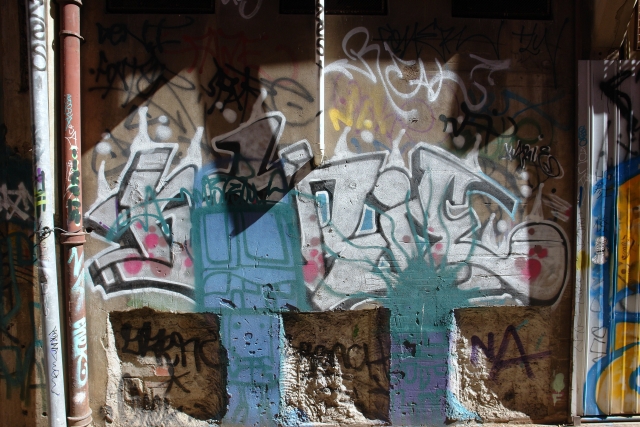
Gary Sauer-Thompson, graffiti wall, near Hindley Street, Adelaide 2007
I guess it's an appropriation. To appropriate something involves taking possession of it. In the visual arts, the term appropriation often refers to the use of borrowed elements in the creation of new work. But what sort? Dada and Surrealism established the idea of "appropriation" early in the century, a tool for innovation used in other mediums, including the visual arts.
The brief postmodern era, beginning in 1972, saw artists appropriated to enlarge historical ideas, imagery, and, especially, authorship, from the history of modern photography and art. Postmodernist discourse was, in part, conceived as a self-referential echo that mirrored the modernist past and reconfirmed the culmination of modernism.
The Band, sort of; Dylan maybe
I've returned from my brief holiday in Wilsons Promontory to find that the comments function has been closed by my hosting company because of heavy comment spam. They are being battered by waves of spam, and so I will have to upgrade the MT publishing system this week so I can throttle the comment spam and turn off old comments.
A musical interlude:
I always had a soft spot for The Band--‘the 'sprung quality’ of the music, the Americana feel of the brown album and the historical songs.This video is a reunion of some members in 1983--long after they had broken up as a working ensemble in the mid 70s signified by The Last Waltz. It is the reformed Band.
The death of Richard Manuel in 1986 cast a dark pall on any future reunions of the post-Robertson Band. I do not know any of the post Robertson Band albums with their call back to the past. However, Levon Helm's recent Poor Old Dirt Farmer resonates with the rural present.
I'd been listening to Dylan's gritty Time Out of Mind (1998) with producer Daniel Lanois and the latter Love and Theft off and on before I went on holidays. These albums are held to herald a return to form by Dylan, and they are the first albums I've listened to since Blood on the Tracks in 1975. I've never viewed Dylan as a 20th-century literary icon that tries to legitimize Dylan as a poet or celebrated his once mythic celebrity stature. Dylan, however, deserves a place in academia concerned with the masterworks in Dylan’s canon.
Dylan had spent seven years without a record and two decades without one of consequence before:

\I'm in two minds about this new material. Once I'd adjusted to contemporary Dylan---my first introduction to the modern Dylan was with 'Love Sick' and had put aside the memories of the music of his heyday I noticed the excellent production on Time Out of Mind has rather than being thick and suffocating, the dark, swirling atmospherics expresses Dylan's negativity--all that pain, weariness and longing.
The world-weary delivery and overall feeling of decay is attractive, as Dylan was on the musical cultural fringe confronting his advancing years and the prospects of failing health and irrelevance-- somewhere between a joke and a relic.You know Dylan Sings Streisand. Though some of the songs are strong ---eg., 'Love Sick', 'Not Dark Yet'-- some of the other material is pedestrian--eg., the 12-bar blues ditties that often sound as if Dylan is making ’em up as he goes--- and I skip them.
December 12, 2007
Janelia Farm
I was in Virginia last week and heard on the local radio a program on Psychogeography. The host and Will Self walked from La Guardia Airport to Manhatten. Suburbia has many areas that are not intended to be walked to. Their isolation is intentional and the only mechanism of incorporating them into a wider social and communal environment is by road. So loaded with a big-ass rental car, I explored the newly developed area of Route 7.

That is Janelia Farm. It is part of a Biotech Research Campus which was given heavy tax-breaks by the local County for it to locate there.
The campus is nearly 700 acres and the Biotech building itself is in a hillside. You cannot see it from Route 7 nor can you see it from many of the access roads surrounding the campus. The only thing that gives it away is that there are small concrete cones rising up over the crest of the hill near the historic farm buildings.

The Howard Hughes Medical Institute has more pictures of the building and its architecture.
on the road
A large part of the Wilson Promontory trip was spent traveling in the car from Adelaide to Wilsons Promontory and then back again. As it was two days each way, so we spent half the holidays viewing the landscape from the perspective of a car passing through landscapes, cities and places.

Gary Sauer-Thompson, bathing sheds, Sorrento, Melbourne, 2007
Slowly I realized that we were now seeing the landscape differently---the frame was the car window and our experiences in the car were just as much a part of 'getting away' from work as the walking amongst the bush and along the beaches in Wilsons Promontory.

Gary Sauer-Thompson, commercial signs, Fish Creek, Victoria, 2007
It's become a normal way of seeing the country:

Gary Sauer-Thompson, wheat silos, 2007
It took me a while to get into the 'from the car window' groove----on the drive back to Adelaide actually. It proved hard to get the shots traveling at high speed.
December 11, 2007
leaving the picturesque
We left Wilsons Promontory for Penola in SA yesterday morning. We farewelled the dairy country that surrounded Wilsons Promontory and headed to check out Fish Creek.

Gary Sauer-Thompson, rock and tree, near Wilsons Promontory, 2007
I kept on thinking about some of the photos that I'd taken in the National Park in my attempt to break away from the pre-modernist picturesque. I needed to break away despite my appreciation that the picturesque had been used by artists to protest the appalling rate of destruction that accompanied the manifestations of ‘progress’, such as land clearing, in colonial settler society and that it embodied an incipient environmental consciousness.
I felt that my images were a mixed bag. There were some closeups that required reshooting with a larger format camera:
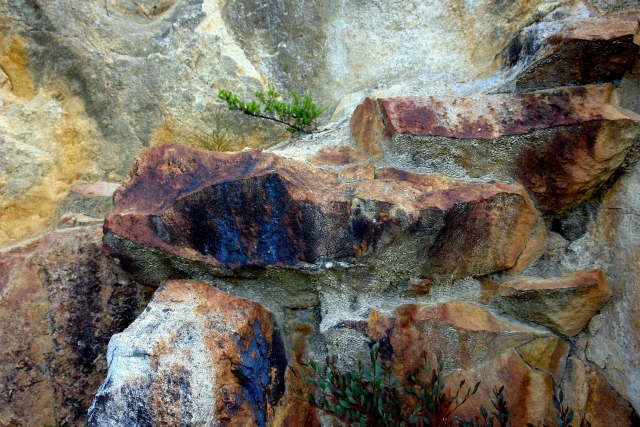
Gary Sauer-Thompson, rock and plant, Wilsons Promontory, 2007
There were some distance shots that remembered or recalled the work of Eugene von Guerard and which succumbed to pretty views evoking a benign wilderness setting:
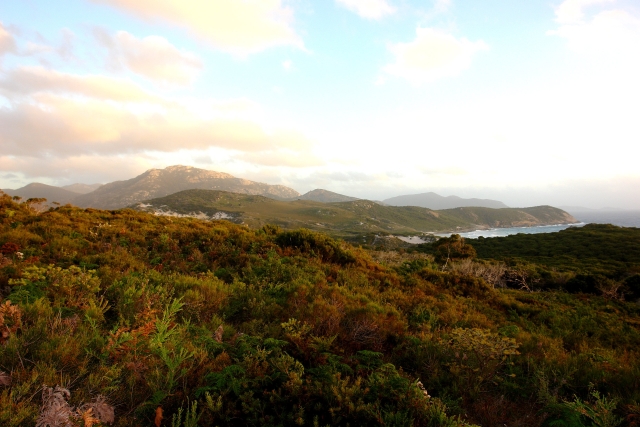
Gary Sauer-Thompson, towards Tidal River, Wilsons Promontory, 2007
Fish Creek was an eye opener. It was situated in the middle of dairy farmer country, had lots of street art and had an art gallery---the Gecko Studio Gallery, which held regular exhibitions and it was supporting a photographic Workshop at Wilsons Prom with Lloyd Godman and Silvi Glattauer in association with the Baldessin Press. This work was a long way from the picturesque.
December 10, 2007
Wilsons Promontory + the picturesque
Most of the imagery of Wilsons Promontory that I’ve seen works within the picturesque. The picturesque form was popularised in 18th century Britain in the travel writings of William Gilpin, who said that ‘The purpose of [picturesque] landscape was to arouse the emotions, stir the imagination, and to delight the eye with its naturalness.’
The ‘picturesque’ approach was used in white settler Australia to depict Australia as a natural Garden of Eden, as an Arcadia in the Antipodes waiting to be occupied. It was central to the act of the colonists constructing a known place. Their ‘landscape’ resonate with an enduring sense of place, suggesting physical presence and embodying symbolic values. Australian ‘picturesque’ representations were a direct reflection of the English country park estate, and the grazing landscape, portraying a model of high civility and nature in the Antipodes.Colonial Australian landscape paintings often portray a humanised foreground with water in the middle ground, set against a backdrop of sublime nature.
The Prom, in contrast, is represented as wilderness by a variety of pleasant images of white uninhabited beaches nestled by green trees with odd patches of granite rock; or sun drenched lichen covered rocks, blue sea and white beaches. These images of beauty stand in opposition to the market civilization of the farmers and small business people in Foster.
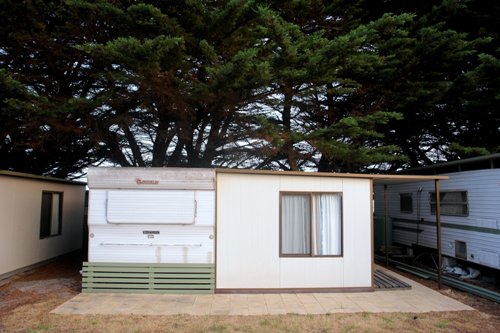
Gary Sauer-Thompson, caravan, Yanakie, 2007
There is not a hint of the effects of the human use of the peninsula, or even people. Yet the traffic into the park on the weekend is a constant stream. So the picturesque is used to sell tourist images of wilderness to Australians and international tourists.
The picturesque dominants, just as it did around wilderness in Tasmania. I have seen very little close up images of the habitat, little exploration of the different moods and habitats of the prom, or the effects of human inhabitation, or the nature of tourism. The image of the prom is that of picturesque wilderness.
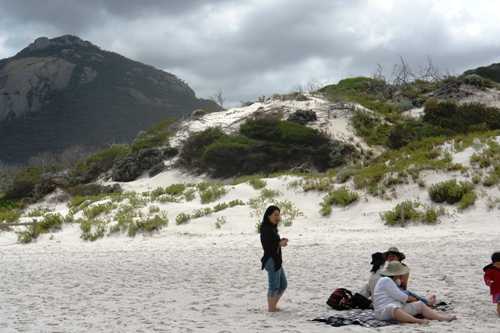
Gary Sauer-Thompson, Squeaky Beach, Wilsons Promontory, 2007
Maybe there is a Flickr group—friends of the prom ---in which different kinds of photos are being taken. Everywhere I went international tourists were taking photos of themselves in various popular locations with digital cameras. These snaps are a different kind of photography and represent a different and more realistic view of the Prom.
But where were the contemporary landscape artist/photographers?
December 9, 2007
Wilson's Promontory--discourse
The discourse around Wilsons Promontory is development versus wilderness with the emphasis being on preventing development (commercial exploitation) to ensure wilderness. Yet, judging by the amount of people turning up on the weekend, the Prom is basically a leisure/holiday place for Melbournites wanting to get away from work. The Victorian National Parks is an industry that is selling leisure for urbanites.

Gary Sauer-Thompson, Suzanne, Tidal River, Wilsons Promotory, 2007
Certainly that is the case for the western beaches---Whiskey, Picnic and Squeaky—in the north of the peninsula and especially for Tidal River itself. These places, especially Tidal River, are jam packed with people having fun on the weekend; just like any beach an hour or so drive from a capitol city.
The wilderness areas are accessible by bushwalking for a day or so with over night stays in campsites with limited facilities. We stayed in cabins outside the park and did day trips in which we explored the day walks.
We found the Yanakie Caravan Park—Gateway to the Prom--the best place to stay. It had a genuine community feel, had a good and constant power supply with little to no surge in the power supply, and wireless broadband. The self-contained cabins had enough power plugs to recharge cameras and mobile phones and a table to work on the laptop computer. The possibility was there for to take photos in the morning, work on them during the heat of the day and post them in the afternoon, then take more photos in the late afternoon.
Gary Sauer-Thompson, road, Wilsons Promontory, 2007
Only a possibility though: the wireless broadband was not working on the weekend that we were there. They were waiting for the technician for Melbourne. Since the Foster Community House was closed on the weekend I had no internet access. What was offered at Tidal River was pitiful---for checking emails only—despite the Parks HQ having a high speed cable.
December 7, 2007
Wilson's Promontory
I've been at Wilson's Promontory for a couple of days now. I'm staying in a cottage just outside the park. The weather has been very changeable. Yesterday was still and stifling hot whilst today is cool, overcast and raining.
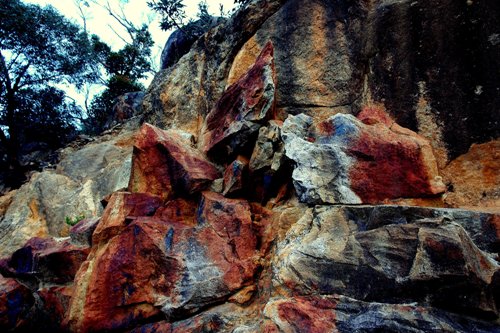
Gary Sauer-Thompson, roadside rocks, Wilson's Promontory, 2007
From what I've seen so far the Prom---as it is is known---is a huge national park with high hills, beaches, rivers and a very variable habitat.
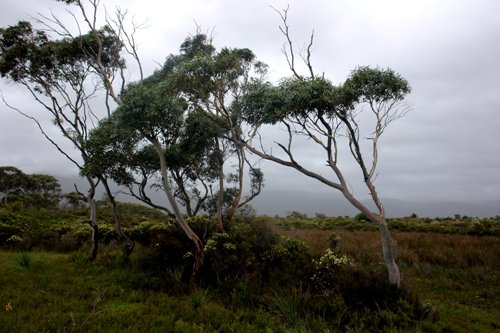
Gary Sauer-Thompson, trackside trees, Wilson's Promontory, 2007
I'm am only going to see bits of the Prom on this trip. The banksias in the woodland we walked through this morning have all flowered..
December 6, 2007
Port Campbell + beyond
This is an iconic site on the international tourist route--the Twelve Apostles on the Great Ocean Road. It's a national park.
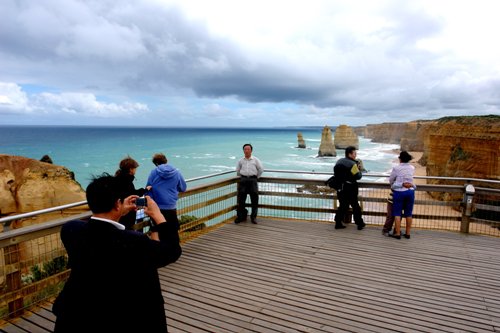
Gary Sauer-Thompson, Port Campbell, Victoria, 2007
This part of Victoria has been sucessfully marketed. It is not as dramatic as Wilson's Promontory yet the international traffic flow has been enormous. The new tourist information centre that is still being built does not have solar panels on the roof, nor water tanks.
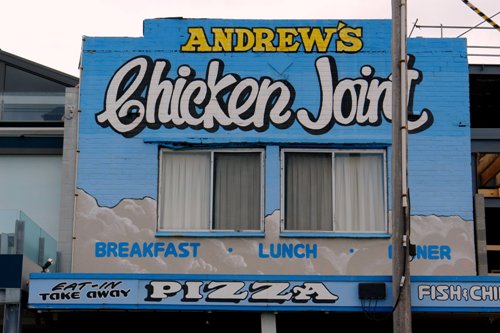
Gary Sauer-Thompson, streetsign, Lorne, Victoria, 2007
Lorne was downmarket; a suprise, even though it was schoolies week. I thought that Lorne had gone upmarket like Port Fairy. It was the opposite. I fled onto Melbourne:
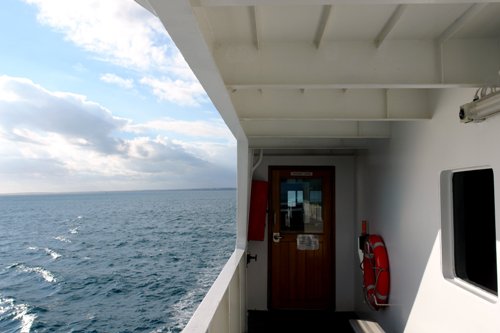
Gary Sauer-Thompson, Queenscliff Ferry, 2007
December 5, 2007
Water As Poison
A recent NYT article, The Future Is Drying Up, tagged the US South-West as problematic for fresh water. Towns are having to buy water licenses and rights from farmers to supply their citizens. States are making water a political issue by refusing to pump fresh water across state lines. Fresh water is an issue in the US South-West, however, like NSW, eighty percent of fresh water usage is by agriculture. Residential makes up less than 8% of all fresh water usage. The statistics are the same for Australia. Maybe we should outsource food production to wetter countries and stop subsidising uneconomic agricultural locations through government.
In the wild some denizens of the desert find too much water downright poisonous.

A cactus that gets too much water rots, and collapses in on its own weight. In some cases Saguaros actually explode outward from containing water fatness. It seems leaving a Saguaro in place and subject to over-watering is more terminal than transplanting them. But what of those that don't survive?
Some fall like a dinosaur fossil, collapsing lengthwise along the ground.

While others have strong wooden skeletons which poke out stubbornly toward the sky while the Saguaro's carcass slowly falls and drips off it.

Like all ecosystems, death is an important component of its vitality. However some stand out triumphantly against the water sparse and sometimes water rich environments (it thunderstormed all weekend); expressing their health and vitality through sheer size. These are the Eastern Grey male Kangaroos of the Cactii world.

That is me in the blue. I am 6 foot 1. That Saguaro must have been about 40 to 50 feet high.
December 4, 2007
on the road to Port Fairy
Yesterday we travelled from Adelaide via Victor Harbor to Port Fairy in Victoria where we stayed the night. I manged to find a wireless network at the Comfort motel we stayed at, but there are internet connections everywhere as it is an upmarket holiday town.
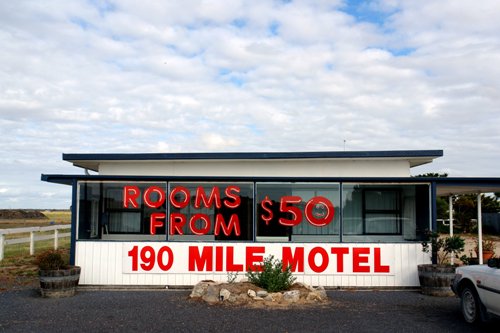
Gary Sauer-Thompson, motel, Kingscote, 2007
The internet worked on the electricity lines not the phone lines. After a slow start it worked quite well. Sometimes it got blocked, but I manged to administer thoughtfactory, post to the weblogs, and even posted to Flickr. The latter was slow but I got there.
Update
We explored Port Fairy after checking out from the hotel. It is the home of a folk festival and is on the international tourist route of Halls Gap and Port Fairy in Victoria and Robe and Kangaroo Island in South Australia. There is a lot of money here--wealthy retirees and professionals who work in Warnabool.
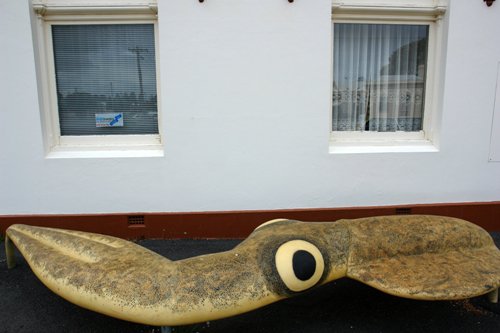
Gary Sauer-Thompson, sculpture Port Fairy, 2007
There were up market clothes shops, non-medical health professionals, spar baths, cottages and murals:
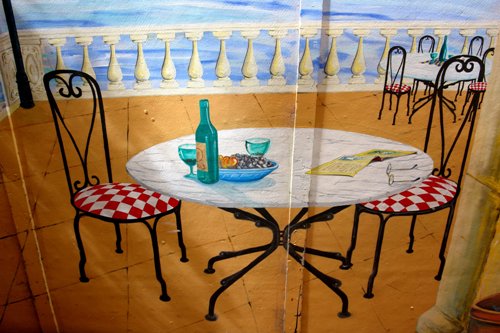
Gary Sauer-Thompson, mural, Rebecca's, Port Fairy, 2007
This is the jewel in the Victorian crown.
December 3, 2007
on holidays: Wilson's Promontory
I'm off for holidays for a week or so at Wilson's Promontory in the south eastern corner of Victoria. I'll try and post images and comments, if I can find internet access at a public library or internet cafe as I doubt if there will be free wireless near the Promontory:

Gary Sauer-Thompson, rocks, Penneshaw, Kangaroo Island, SA, 2007
I've never been there. People say it is quite remarkable.I imagine that the rocks will be similar to those on Kangaroo Island and around Victor Harbor.
I've been directed to Whiskey Beach near Tidal River by photography friends. There will be lots of walking. by the looks of the website. The Prom, as it is known, is mostly about walking.
December 2, 2007
oh dear
Well, I managed to take a whole lot of photos of street art in Melbourne's lanes today in the searing heat. I came to upload them from the camera to the computer at the Qantas club and I was told that there is no memory stick. At this stage I have no idea what that means. Are the photos lost irretrievably? Does anybody know?
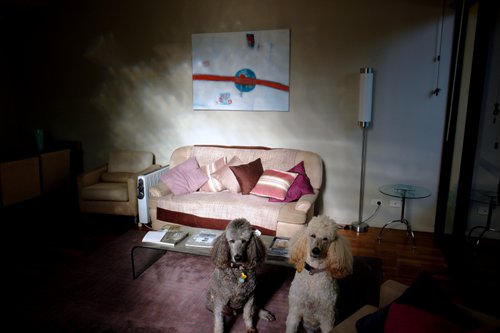
Gary Sauer-Thompson, Agtet + Ari, Sturt St., Adelaide, 2007
I cannot even read the taken photos in the camera. I could before I came to the Qantas Club when I was in David Jones cooling down from working in the laneways I have no idea what is going on at the stage. It must have something to do with my camera settings. They must have shifted when the camera was put into its case.
Colourful Symbols
Flags are important. They are concise, colourful representations of the intangibles; community, liberty, love, solidarity and often dreams or hopes for the future.

The issue for Australia is the Union Jack. At the state level it makes the flags meaningless. The national flag is a far better balanced design and will be more of a problem to replace due to a lot of empathy for it. However flags are often looked upon as static and timeless. Yet John Howard will be buried in a different Australian Flag to the one he was born under. The American President, George Bush, will too.
Flags are vibrant, dynamic and transient symbols which survive on their relationship to the now; not the past, nor the future. Without that grounding they are dry as dust and devoid of power.