|
December 31, 2007
When Suzanne was in Brisbane last week for Xmas she took the opportunity to visit the Warhol exhibition at the Queensland Art Gallery's new Gallery of Modern Art, which was being put on in association with The Andy Warhol Museum in Pittsburg.
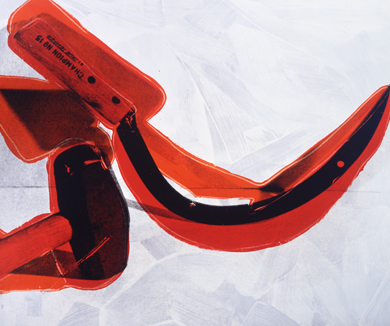
The standard accounts say that Andy Warhol transformed contemporary art as he employed mass-production techniques to create works and challenged preconceived notions about the nature of art and erased traditional distinctions between fine art and popular culture, as can be seen in Warhol's 1976 Hammer & Sickle:
 It's a major exhibition, as it brings together over 300 works, spanning all areas of his practice from the 1950s until his death in 1987. Works include paintings, drawings, prints, photographs, films, videos and installations.
The Andy Warhol Exhibition at the Gallery of Modern Art is exclusive to Brisbane. It is Australia's first major Andy Warhol retrospective.The context of the initial reception of Warhol's work was one of resistance--- it was understood to challenge the modernist assumptions about authorial independence and creativity--- and and ignoring---it merely mimicked popular imagery and was complicit with the trashy forms of mass media and popular culture.
Since neither the Queensland Art Gallery or the Andy Warhol Museum have much Warhol imagery online I appreciate Suzanne buying the catalogue, which I now have next to me.
In an early test that sough tto situate Warhol's woprk historically ----The Work of Andy Warhol, Dia Art Foundation, “Discussions in Contemporary Culture, No. 2,” ed. Gary Garrels, (Bay Press, Seattle: 1989)---- we find this paragraph
The punk period witnessed a renaissance of tattooing- a practice which visibly asserts our ritualistic ‘uncivilized’ past and in whose pictorial language the skull looms large. Because of a slew of ‘primitive’ and sexual associations, the tattoo is proscribed by traditional western conventions. But tattoos persist, serving to decorate, seduce, shock, scare, to declare nonconformity . . . [Warhol’s] own tattoo-like exhibitionism at the 1977 opening for his ‘Hammer and Sickle’ paintings drew together various structures of power and pleasure: the art world/gallery system brand of capitalism; a communist emblem rendered in paintings titled Still Lifes, in which the shadow seems more real (threatening) association with leather, homosexuality, and gay rights and aesthetics; disco madness as the latest social marketplace and entertainment industry.(p.107)
What we tacitly have here is a shift from the narrow world of art history and the art institution to a visual culture that is the object of study of cultural studies.
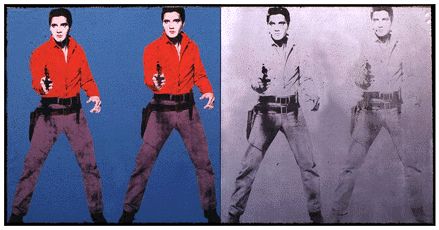 Andy Warhol, Elvis 1 & 2, 1964
|


