May 31, 2006
Rover Thomas
I'm tired of all the negative stuff about the aborigine people in the media and the public debate about the sickening stories of domestic violence and sexual abuse, and the way these aspects of a grog culture are deemed to be part of an Aboriginal culture.
I want something positive.
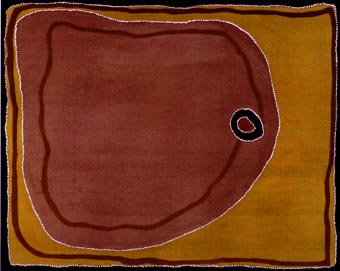
Rover Thomas, Lake Gregory 1985
Why not some stories about this kind of success to emerge from the Warmun community at Turkey Creek, in the Kimberley Region in North-Western Australia.
Rover Thomas (1926– 1998), is a most remarkable artist.
May 29, 2006
controversial cartoon?
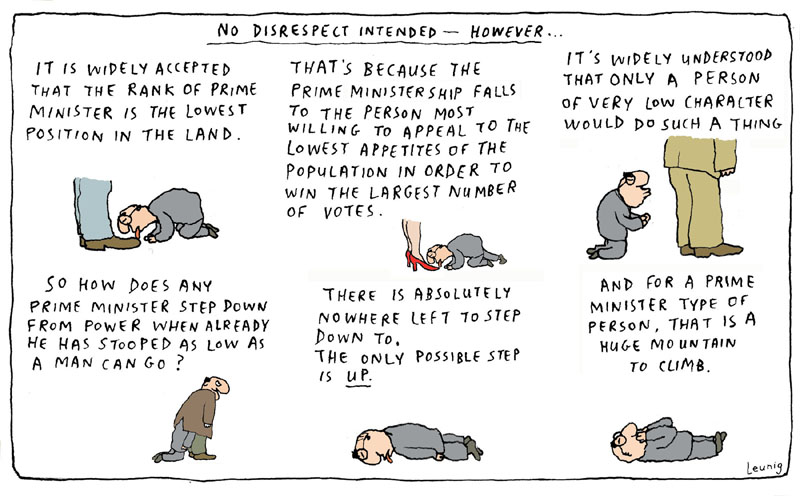
Media Watch says that the Leunig cartoon below was published by The Age but rejected by The Sydney Morning Herald on the grounds of taste.
Leunig
Gee. It's edge is sharp, but it is fairly mild. Aren't cartoons meant to offend?
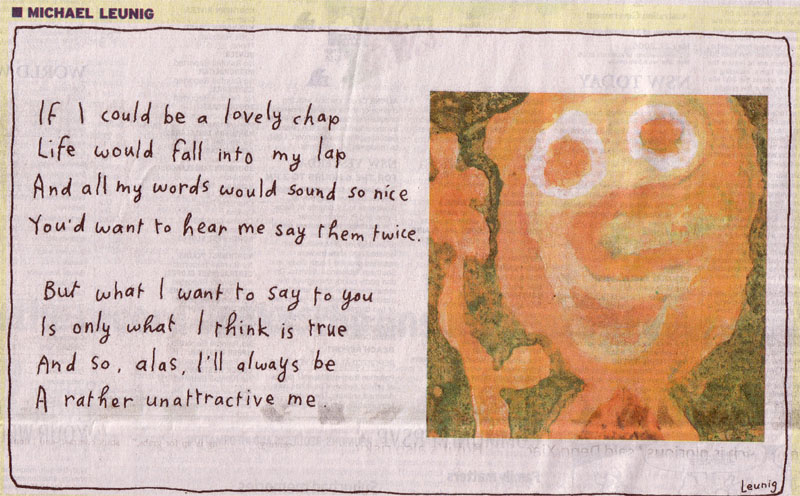
Leunig's response:
Leunig
That is a mild response to censorship, isn't it.
Update 1 June
Some commentary on cartoons by Robert Phiddian. He says:
Cartoons are the hub of the surviving anti-spin and shaming devices in the mainstream media at a time when spin and shamelessness are a ballooning element in public life. Think everything from Big Brother to the AWB inquiry, from Shane Warne to weapons of mass destruction. Cartoons have increasingly been at the heart of storms over free speech and the pressure from governments, corporations, and opinion-makers to control the message.
I agree.
May 28, 2006
aesthetics & beauty
In Aesthetic TheoryAdorno writes:
To put a complete ban on the concept of the beauty would be as damaging for asethetics as would the removal of psyche from psychology or that of society from sociology. The definition of aesthetics as being the theory of the beautiful, however, is sterile because the formal character of the concept of beauty tends to miss the bountiful content of the aesthetical. If aesthtics were nothing but he an exhaustive and systematic list of all that can be called beautiful, we would gain no understanding of the dynamic life of inherent in the concept of beauty.
May 27, 2006
cartoonists flop
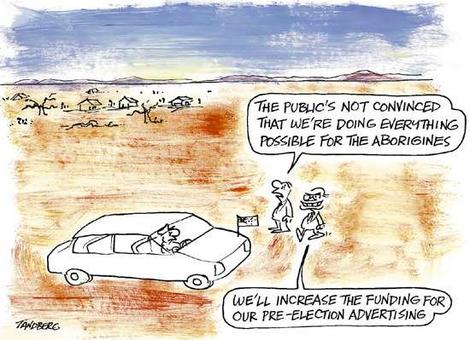
Have you noticed how feeble the editorial cartoons are on the issue of aboriginal violence Bill Leak was the only one who had a go
Tandberg
This is pretty feeble give the horrible stories about sexual violence and the emphasis on law and order. Are Australian cartoonists scared off the topic? It's too explosive? It's difficult for lefties to deal with?
May 26, 2006
expressionism
Expressionism is what we deploy to understand art --as in science reflects, photographs picture, art expresses.
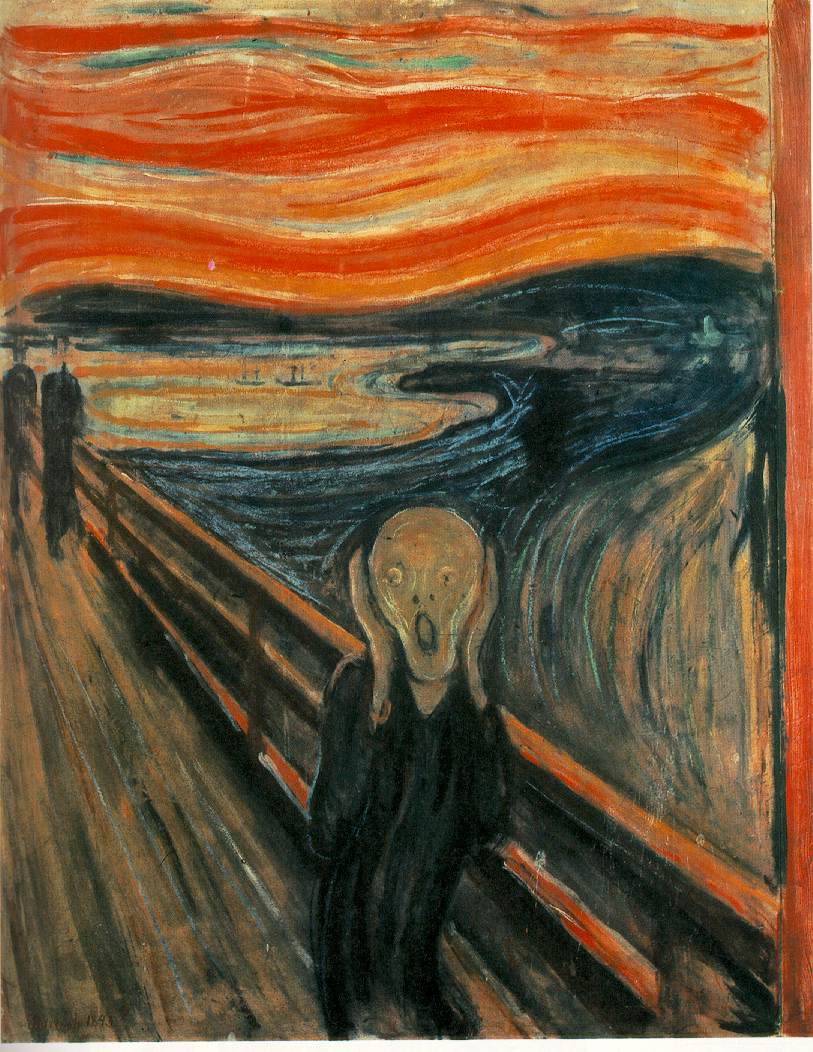
The Scream" (1893) by Edvard Munch.
That crudeness needs to be modified since expressionism has taken a bit of a bashing recently because it presupposes an uncritical subjectivism. Expressionism recalls the self-governing individual whose inner life can be conyveyed, or communicated to, a public composed of similar sovereign individuals.
It is part of the critique of the referential nature of language with expressionism presupposing a content that assumed to have an objective existence prior to the form of its expression. Content is the beginning and end of communicative expression.
May 24, 2006
discomfort
I have trouble with this cartoon, which refers to this context

Bill Leak
It is the aboriginal stereotype that is being used. It makes me uncomfortable. Why not play around with the role played by traditional cultural and law? That is where the current bone of contention is.
May 22, 2006
defending boundaries
One way to enforce our immigration laws and protect our borders:
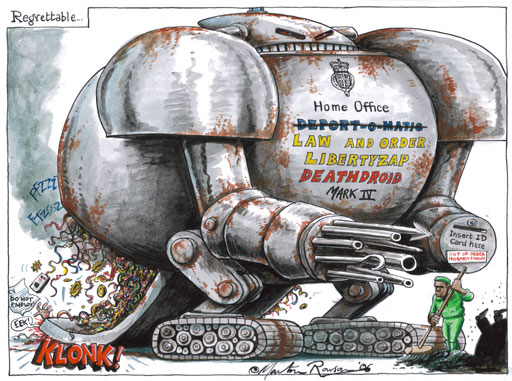
Border security has become a big issue arround the world, hasn' t it.
May 21, 2006
Charles Blackman
A sense of threat and vulnerability is how I read the image today.
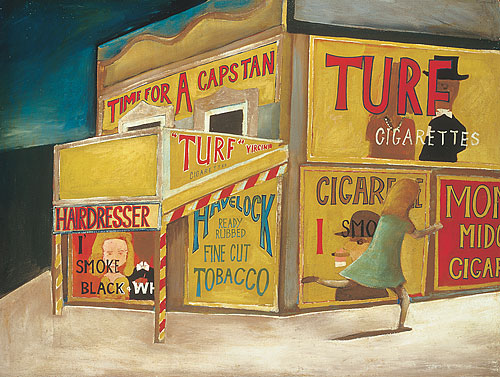
Charles Blackman, Running home, 1954
An interview.
May 20, 2006
it needs to be confronted
This distresses me. The nature of the violence to children and women----- they are routinely raped, set alight, mutilated and murdered---- is beyond my experience and comprehension.
I don't buy the culture argument. The traditional culture--ie., Aboriginal culture practices do not benefit the victim. These practices benefit, more often than not, the offender.
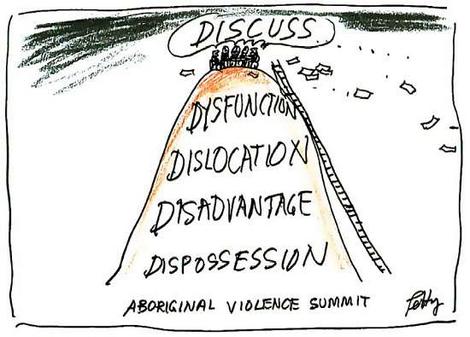
Bruce Petty
Another summit is not need on this.
May 18, 2006
Reforming transport
The Brack's Labor Government in Victoria has the reputation for being the most reformist state Government in Australia. It has just released its transport plan after 6½ years of studying and planning. The $10 billion package that touches on the full gambit of transport modes, from a $1 billion upgrade of the Monash and West Gate freeways to fixing up local bike paths is seen as a vision of making Melbourne a more liveable place.
The core features are: the addition of a third rail track on the Dandenong line, $1 billion for extra lanes on the Monash and West Gate freeways; a $1.4 billion upgrade of suburban bus services; $1.3 billion for outer metropolitan arterial roads;$800 million for new metropolitan trains;$500 million for a new tram fleet;$750 milllion for rail safety, including a communications upgrade;$350 million for new regional trains;free public transport for pensioners on Sundays.
Sounds big. How does it stack up? Does it get Melburnians out of cars and onto public transport? Royce Millar in The Age says:
Labor's aim in 2002 was that by 2020, 20 per cent of all motorised trips would be by public transport. The figure then was about 9 per cent and has increased a little since. Effectively the Liveability statement is the belated action plan to achieve this goal.
Does it achieve the goal? No.
Millar says that to be on track for 20/20/20, 130 million more public transport trips would be needed per year by 2011 yet as a result of the Liveability initiatives, Melburnians would only make 50 million more public transport trips per year by 2010.
How come? Millar says:
One of the major disappointments for many is that the statement rules out any extension of the rail system for at least a decade. Rail spending will focus on building up capacity in the existing system. So that means no new trains or trams beyond the spread of the existing network and, therefore, few new customers...Work on the Dandenong third track project will take a decade to complete, with likely disruption to train services that will not endear commuters to an already struggling system. At the same time, the Government and CityLink operator Transurban will spend $1 billion upgrading the Monash and West Gate freeways and CityLink, including putting extra lanes on the Monash. Clearly extra room on the Monash, a direct competitor to the Dandenong train, will encourage more cars, at odds with the Government's stated transport objectives.
We have a similar situation in Adelaide.
May 17, 2006
urbanism
As we know Jane Jacobs classic text, The Death and Life of Great American Cities (1961), established her as a founder of contemporary urbanism. She was amongst the first to argue for the human, rather than the car, as the city's basic unit; for pluralism over planned sterility; and for the urban-village over the suburb-ringed CBD.
Elizabeth Farrelly in the Sydney Morning Herald argues that:
Now, 45 years on, we're still fighting the battles. Urbanism, long resisted in Australia, has slowly gained recognition as environmentally sound and culturally fertile. But now comes the backlash, reviling urbanists as a latte-soaked elite and defending suburbia as the Great Australian Way.The suburban tradition sprang in Australia from England; from Ebenezer Howard's 1902 polemic, Garden Cities of Tomorrow.
The result of Howard's garden suburb in Australian cities has been suburban sprawl, which we are now trying to limit, by encouraging people to return to the inner city to live. In these cities were are building urban villages to make our cities more human. Despite this we continue to frame our cities as a suburb-ringed CBD.
May 16, 2006
May 15, 2006
Mike Davis ---the new slums
As we know globalization has reorganized the economy of our cities, rewiring it in dramatic ways, with many people were being left behind in the process of de-industrialization and offshoring. Australia's response has been to construct borders designed for total exclusion -- except for a limited, tightly regulated flow of high-skill labor.
A quote from Mike Davis, author of City of Quartz, on the new urban slums in what is known as Third World:
Stunningly enough, classical social theory, whether Marx, Weber, or even Cold War modernization theory, none of it anticipated what's happened to the city over the last 30 or 40 years. None of it anticipated the emergence of a huge class, mainly of the young, who live in cities, have no formal connection with the world economy, and no chance of ever having such a connection. This informal working class isn't the lumpenproletariat of Karl Marx and it isn't the "slum of hope," as imagined 20 or 30 years ago, filled with people who will eventually climb into the formal economy. Dumped into the peripheries of cities, usually with little access to the traditional culture of those cities, this informal global working class represents an unprecedented development, unforeseen by theory.
In the First World we have features of a Third World economy in a First World city characteristed by McMansions with 4WD's parked in front. The environmental footprint of this suburban middle-class is a lot heavier than the suburbs of the 1950s.
Is a Dickensian world of Victorian poverty being recreated in our cities?
May 14, 2006
Guy Maestri
A gestural abstractionist who derives his inspiration from the landscape. Noted for his fluid lines and a rich colour palette :
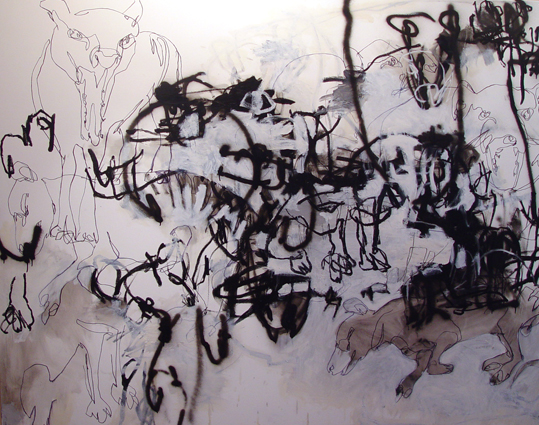
Guy Maestri, 'What is, and what should never be', 2005. oil and acrylic on canvas,
May 12, 2006
May 11, 2006

May 8, 2006
Quadrant's view of the humanities
i don't read the conservative magazines much these days but I thumbed through an old copy of Quadrant tooday and came across this editorial on academic research funding written by P.P. McGuiness. It's a shocker in terms of its bigotry and prejudice.
McGuiness is strong on the intellectual rigor of the natural sciences. Then we have this:
Bluntly, the intellectual rigour of the sciences is increasingly absent from the humanities and social sciences. In a university system where pop songs are studied along with (or instead of) genuine culture, where low-grade “political economy” is taught along with economics, where entry requirements are constantly being debased along with the schools and where “cross-disciplinary” has come to mean the same as jack of all trades--at best superficial knowledge, at worst none—it is increasingly the case that non-scientists simply cannot be trusted to supervise the sciences nor operate a managerial system designed to produce experts.
And:
The reality is that the humanities are being, and largely have been, destroyed in the name of the meaningless subject of “cultural studies” and corrupted by “postmodernism”, which has become a substitute for thought and scholarship. Little of value is produced by the adherents or fellow travellers of this school, who are more concerned with political fashion amongst the lumpen intelligentsia than any analysis. Much of what they produce is propaganda or worse. Absurd subjects like “gender studies” or, even worse, “queer studies” are solemnly treated as worthy of respect, and projects of research are proposed which add precisely nothing to the sum of human knowledge.
It is these who have contrribnuted to the debasement of intellectual and academic standards and contributed to a climate of intolerance and retribution for unorthodoxy.
May 7, 2006
big TV's
An odd story one about buying a big tv.
The things that had stopped me buying such a big TV before were a belief that it was essentially vulgar, and would make me look poorly educated and a bit stupid, as well as a sense that no toy, now matter how amazing its performance, was worth that much. However, I was feeling sentimental, I'd just got back from the US and for some reason I associated big TVs with the US. I assumed I was alone. What amazed me was that in the three months almost everyone I knew bought a similarly enormous telly, and not because they were feeling homesick for Silicon Valley. Somehow, having a big TV was no longer essentially vulgar, but The Thing to Do in my part of North London.This formerly impressive piece of kit is now languishing in the garden shed, covered in black bin liner to protect it from weed killer. It has been replaced by a 32-inch widescreen LCD from a very reputable vendor. It's now worth a fraction of what I paid for it. You can now buy TVs like it at your local supermarket for next to nothing, but they're cumbersome to move and nobody wants them anymore...Ours is in the shed because I think that TV is crack cocaine for the brain and I haven't made the psychological journey that will allow me to feel comfortable with two TVs in the house
Snarred by it being the thing to do even though tv is crack cocaine for the brain.
Michael Parsons goes on to say that the big battle for the living room is now about how consumer electronics and personal technology companies figure out the gestalt of modern family life and provide products that people want in their living rooms.
May 5, 2006
the end of art photography?
Sebastian Smee, the well-known visual arts writer and critic for The Australian, says that photography's grip on the public imagination is in decline. Or more speficially photography as an art form is on the wane and that it's losing its grip on the public imagination. I'll spell it out as the article will go off line.
Smee says that photography has finally become just another way of making images.That's partly because of the sheer number of photographic images that surround us, many of which we take ourselves, digitally, and partly because the photo is losing its association with capturing reality. Smee says:
Plenty of photographs appear in survey shows of contemporary art. But for the most part, that the medium is photography is incidental. All the strange idiosyncrasies that once made photography so beguiling are breezily ignored by most of today's photographic artists (as they are called). Instead, the camera is used as a device simply to record or illustrate something else (be it an idea, a fantasy or a thin slice of reality).So photography's hard-won victory - its gradual acceptance as an art form during the course of more than a century - turns out to have been a pyrrhic one. The medium's special aptitudes, described but never quite pinned down by astute practitioners and critics in 150 years, no longer seem quite so special. Instead, photography has become ubiquitous, frictionless and trivial.
What backs up the claim?
Smee says that:
It was a conviction that photography's great purpose was to record historical truth. Thus the documentary, or realist, strain of photography has always been strong. In recent years, it has enjoyed something of a revival in the art world, which occasionally grows ashamed of its navel-gazing tendencies and looks to photography to reconnect it with the outside world. But in terms of the culture at large it is a faux revival. In truth, the status of documentary photography, or photojournalism, has been slowly draining away since its golden era in the 1970s. To compensate, some of the best photojournalism has shifted sideways into a cultural arena it previously spurned: the art world.
I cannot see why photography can be both documentary photography and art photography as opposed to one or the other. But Smee plays off the oppostion:
Sadly, this awkward new context has only added to the insecurities of the great photojournalists. Displayed in art galleries, their work tends to meet with popular, but rarely critical, success. Their claims to represent objective truth inflected with moral urgency have been thrown into doubt by critics and philosophers of the image. [the Brazilian Sebastiao] Salgado, for instance, has been repeatedly accused of falsifying and even betraying his subjects by making images of trauma and destruction too artful, too beautiful.
In contrast to Smee's claim that photography's strength is to record historical truth, I would argue that photography is an interpretation of reality, with the interpreting starting with the photographer's choice of what's included in or left out of the frame. Photography probably only won recognition as an artistic medium when it moved beyond merely attempting to depict reality.
Smee says that photography today has been thrown back on itself and the question of what it must do to retain interest as art is once again freshly alive.
The problem is that, thanks to the digital revolution, the frisson of excitement that used to accompany photographs (the knowledge that the image was evidence for something real, a trace of something that happened) is slowly disappearing. It's not as if photographers haven't been involved in fabrications and manipulations since the outset. The early days of the medium were full of trickery and theatre, cases of day being turned into night just to suit the photographer's purposes. But today the whole context has shifted: the layers of artifice seem unending and the thread connecting photography to the real has been snapped.
I would have thought that the digital revolution has given an energy boost to photography.
Smee concludes on an upbeat note:
There are photographers who are still making great art. Henson is one of them; so are American Sally Mann and New York-based British photographer Adam Fuss. What they seem to have in common is an acute sensitivity to the medium's inherent aptitudes, its original, fragile relation to reality. The liberties they take can be breathtaking: artificial staging, deliberate obscuring and ghostly distortion of the image. But somehow (primarily by resisting the siren call of digital manipulation) they manage to hang on to photography's precarious connection to reality.
There 's the argument.
May 3, 2006
rock paradigms
Theodore Gracyk states in his Rock Music and the Politics of Identity that the Sex Pistols can be seen as a rock paradigm and not just another short-lived punk band amongst the hundreds that flourished from 1975-1978.

They occupy a defining moment in rock history and there is a general consensus that these artists and their music were most significant as models for future practice.

What did the paradigm suggest by way of future practice. DIY music? Semiotics? Production values?
a quiet moment
From the Tasmanian Times website---Leatherwoodonline
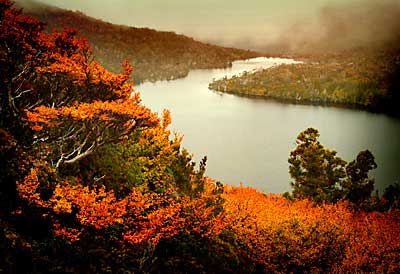
Pam Verwey, Lake Hanson
Beautiful nature fits in with Tasmania-as-wilderness theme I've previously explored.
May 1, 2006
rock outrage
Theodore Gracyk states in his Rock Music and the Politics of Identity that popular music is always more popular as a resource for circulating familar ideas than as a source of new ideas. He adds:
What's at issue, then, is what can be done within the context of rock to resist its conservative impulses as a mass art whilst recapturing some of its earlier disruptive power.
Gracyk answers this in terms of 'woman in rock' and the performance of gender within a dominant phallocentric discourse.
The standard form of resistance to the conservative impulses of popular music is the calculated outrage of rock. That disruptive strategy has worn rather thin --for example, the bad boy behaviour of Oasis is tiresome and designed to sell product. This calculated outrage has little disruptive power.