October 31, 2010
Nadav Kander: I wish i were near you
Nadav Kander has appeared before on junk for code with his Yangtze River project, which explored the banks and waterways of The Yangtze River that provide home and livelihood for hundreds of millions of Chinese.
An earlier series was 'I wish i were near you', which was centred around Los Angeles freeways
 Nadav Kander, house under highway, Los Angeles, USA, 2005
The signs of human habitation are over whelmed by the modernist industrial structures for the car which dominate. It makes us uneasy and suggests a troubled relationship with these imposing freeways:
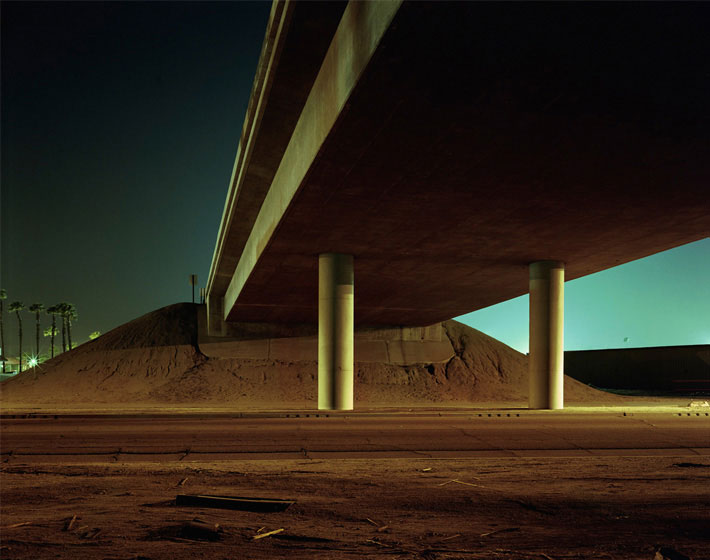 Nadav Kander, highway 865, La Quinta, USA, 2005
We live in the shadows of these giant concrete structures.Though shot at night the style refers back to the social landscape work of Richard Misrach.
October 30, 2010
the American pastoral
'The New American Pastoral: Landscape Photography in the Age of Questioning,'' was an exhibition of the work of eight photographers at the Whitney Museum of American Art's branch at the Equitable Center in the 1990 that explored the altered landscape the concern is the marks that humans make on the land. It was organized by Robert Sobieszek, senior curator at the International Museum of Photography.
The American pastoral is concerned with natural beauty --the beauty of nature in an altered, damaged or desolate landscape. The exhibition includes the work of David Taverner Hanson, Lewis Baltz, John Pfahl, Richard Misrach, Emmet Gowin, David Maisel, Patricia Layman Bazelon, and Ray Mortenson.
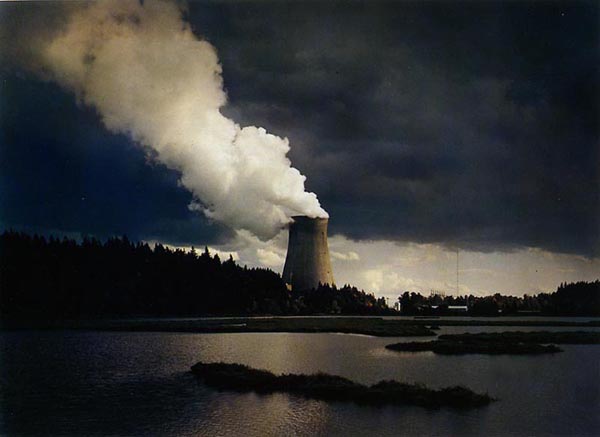 John Pfahl, Trojan Nuclear Power Plant, Columbia River, Oregon from "Power Places" (Type C print, 1982) It's an odd title, as American pastoral is usually associated with the rural South and the Far West and the picturesque manners and customs of the rustic, unlettered folk and rural working class, sharecroppers, and migrant farm workers.
In his review of the ''The New American Pastoral'' exhibition in the New York Times Andy Grundberg says that in terms of its theme the exhibition is a successor to the ''New Topographics'' exhibition of 1975, and that both exhibitions reflect photographers' attempts to devise a documentary style able to call attention to environmental issues that defy conventional description. Grunberg adds:
What separates the two exhibitions is the matter of the picturesque. The photographers in ''New Topographics'' sought to purge any trace of it from their pictures, while most of those in ''The New American Pastoral'' rely on it as a sign of both loss and possibility. One has to wonder, of course, whether they can have it both ways, and whether the picturesque can be enlisted for what are at heart political statements. There is after all something old-fashioned looking about these new pastoral landscapes, which may have to do with their implicit faith in the ability of traditional photography to illuminate contemporary problems.
Presumably, the questioning refers to a questioning of the different strands of the American photographic landscape tradition and the picturesque.
October 29, 2010
David Maisel
David Maisel is an exponent of aerial photography who documents American landscapes from a birds-eye view, revealing the context of abstract environments severely impacted by human intervention.he images are often paired with descriptive text which connects the tragic environmental context to its surprising visual equivalent. Inspired by the writings of Robert Smithson, Maisel says that he:
began to consider my pictures ... not as simply documents, but as poetic renderings that might engender contemplation of these sites and what they mean to us. In this work, and in work produced in subsequent years, I seek to frame the complexities of an environmentally impacted landscape with equal measures of documentation and metaphor, beauty and despair.
The Lake Project, deals with Owens Lake, once a 200 square mile lake which in 1913, was diverted into the Owens Valley aqueduct to become a water source for Los Angeles residents. Drained by 1926, the exposed lakebed has become the highest source of particulate matter pollution in the United States, emitting some 300,000 tons annually of cadmium, chromium, arsenic and other materials.
 David Maisel, Untitled #20 The Lake Project
The history of this region is the stuff of California legend: a story of engineers, politicians, and big land owners working together to divert water to the rapidly growing desert city of Los Angeles, generating a thriving agricultural industry and an environmental disaster in the process.
Diana Gaston in 'Immaculate Destruction: David Maisel's Lake Project' in Aperture, Volume 172 states:
Beginning in 1913, the now infamous Los Angeles reclamation project effectively diverted water from Owens Valley to the Los Angeles Aqueduct, providing a substantial amount of the city’s water supply. By 1926, the lower Owens River and Owens Lake were essentially depleted of water, leaving a vast exposed salt flat with unusually concentrated mineral levels and extremely vulnerable topsoil. The situation has been exacerbated by fierce winds that sweep through the valley and dislodge carcinogenic particles from the lakebed, creating a pervasive dust cloud known as the Keeler fog (named for the town on the east side of the lake). The Owens Lake region, the largest source of particulate matter pollution in the United States, is now undergoing an EPA approved, state implemented plan to control the spread of this hazardous matter. After decades of accelerated destruction, the ground is once again flooded, this time by EPA officials in an effort to diminish the toxic dust that settles in the soil, vegetation, and lungs of nearby inhabitants. From the air, high above this damaged wasteland, the ground assembles itself into something spectacular and horrifying. This is what David Maisel sees through his camera, a contemporary version of the sublime.
Owens Lake has become the locus of water's absence. The lake is a negation of itself, a void.
 David Maisel, Untitled #22 The Lake Project
With each successive layer of intervention, the landscape becomes more complex. Previous scars are covered over, and cycles of negation and erasure expand into a grid system overlaid on the barren lake. From the air, a new map emerges.
The Lake Project, as the Owens Lake pictures have come to be known, is part of a larger, ongoing series loosely titled Black Maps. The early thinking for this series actually began during his undergraduate work at Princeton, when he accompanied his photography professor Emmet Gowin on flights over Mount Saint Helens and the heavily logged forests of the Pacific Northwest. The experience of that aerial view, and the realization that the overwhelming destruction of the logging industry was essentially on par with the damage brought about by a volcanic eruption, established his future direction as a photographer.
October 28, 2010
the photographer at work
It was an afternoon of large format photography down at Victor Harbor today. It was warm, overcast and still. Ideal conditions for this kind of landscape photography:
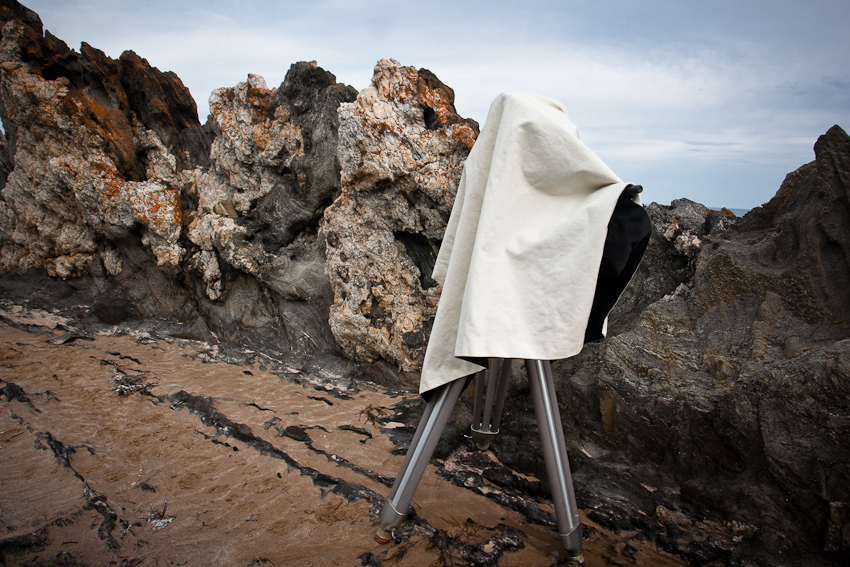 Gary Sauer-Thompson, near Petrel Cove, Victor Harbor, 2010
I was using the Linhof 5x4 Technika not the 8x10 Cambo. I'm simply unable to carry the 8x10 Cambo camera plus the the big Linhof tripod to support it's weight and on my own for a kilometre or so from where I park the car down to the rocks. I was even struggling with the 5x4 in a Lowe Pro Trekker pack, a Linhof tripod, and a digital camera.
This is much more sensible:
 Gary Sauer-Thompson, Port Elliot, 2010
A DSLR and a carbon fibre tripod. The gear can be carried in one hand.
October 27, 2010
Victor Harbor: national broadband network
I've just attended a national broadband network briefing at Victor Harbor that was hosted by the Victor Harbor Council. It was more information about a fibre network that goes beyond the political point scoring that pours out of Canberra these days or The Australian's campaign against the NBN that is is based on fear uncertainty and doubt and a mantra about cost benefit analysis. The NBN Co talked about ubiquitous access, which is also intended to be affordable as well (unlike mobile data services) and bandwidth, lots of bandwidth (here though, you get what you pay for).
Stilgherrian's Patch Monday podcast for ZDNet.com.au discusses this:
This is the information we received. Victor Habor's regional backhaul to Adelaide, which is being constructed by NetGen, will be completed by March 2011. That means we wait for the National Broadband Network Co to build the last mile from the local exchange to the premises. When will that happen? That is unclear. What I gathered is that the first site in SA is Willunga, the second sites are McLaren Vale and Seaford. The third site? Nothing is settled. What we were told is that the infrastructure building will be organic----moving out from what has been already been built.
So we can move beyond the ADSL in the near future? We need to because the backhaul chokes up often and it becomes impossible to work.
What we have with the NBN Co is a concerted attempt to fix a decade of failed telecoms policy, breathe life into a privately-controlled network even Telstra is winding down, and improve communications services to people that haven't a snowball's chance of getting it otherwise.
October 26, 2010
European photography: Dana Popa
The Romanian photographer, Dana Popa, works in the documentary tradition that creates work that is faithful to reality. She says.
I started photography because of Josef Koudelka’s work. His sensitivity and proximity to the subject still motivates me. I just want to tell stories, not only stories that interest me, but things that are not seen or talked about.
Her latest project is entitled not, Natasha, which she talks about to Jim Colberg here. It is an informative interview.
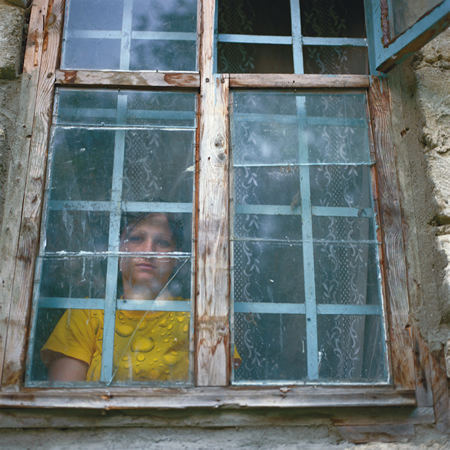 Dana Popa, Maria, from not, natasha
The Republic of Moldova is the poorest nation in Europe. Every year, thousands of young girls and women ages 12 to 40 leave the country looking for a better life. An overwhelming majority of these women, especially the younger ones, become sex slaves. Sex trafficking is the most profitable illegal business.
October 25, 2010
a highway of death
I've been working on a new series or project based on me being down at Victor Harbor. It is landscapes with road signs that signify death and injuries on the Victor Harbor Road. As I drive up and down the road I kept on noticing the accident markers. These are mostly after McLaren Vale as the road winds through the southern part of the Mt Lofty Ranges down to the coast.
 Gary Sauer-Thompson, road signs, from Highway of Death
The red post accident marker represents injuries caused by a car crash. The black post accident marker represents fatalities.
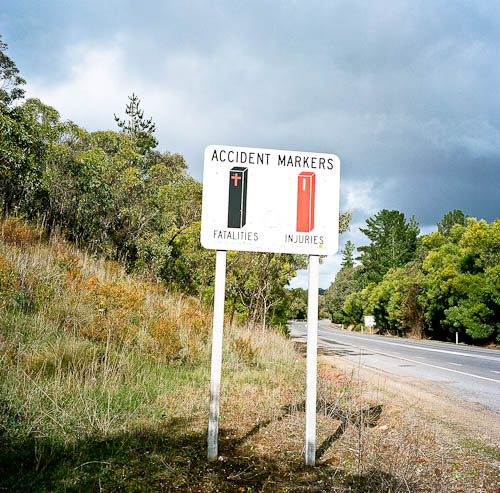 Gary Sauer-Thompson, road signs, from Highway of Death
There have been, and continue to be, a staggering amount of accidents on this road. The Department of Transport has said its mostly driver error (speed +booze), but a lot of the accidents have been caused by a lot of traffic to and from Victor Harbor with very few passing lanes. The road has since been upgraded with passing lanes.
The accidents continue, though not as frequently.
October 24, 2010
studio photography
I've been trying to get my Sinar P 8 x 10 camera working at Encounter Studio. I bought it well over a decade ago and I have rarely used it as I gave up photography soon after. It is too heavy and too engineered to be used in the field, which is what I bought it for originally. Why I have no idea.
Since I now use the old Cambo 8x10 as a field camera, the Sinar has become a studio camera, which is what it is originally designed for. That has meant acquiring a large studio stand, a big geared head to hold the weight of the camera and reflectors.

As I only have a normal lens (300mm) I am limited to what I am able to shoot in the studio. I cannot do closeups at all, nor portraits with ease. Nor can I afford to buy more gear--such as additional lenses. So I have to work within the limits of what I have got.
So I will try and do some constructed black and white images with a model--ie., Suzanne. What 'constructed images' will be I have no idea at this stage.
October 22, 2010
Australian Photography: Rebecca Shanahan
Rebecca Shanahan, a photo-based artist, is Head of Photography at the National Art School (NAS) in Sydney. This is the oldest visual arts Institute in Australia, is an independent school, and offers fine art degrees with intensive studio-based teaching in small classes.
New Zealand-born Shanahan has been based in Australia since 1988. Her The Acclimatisation Project speculates on the relationships between identity and place, and between bodily and photographic experiences of place.
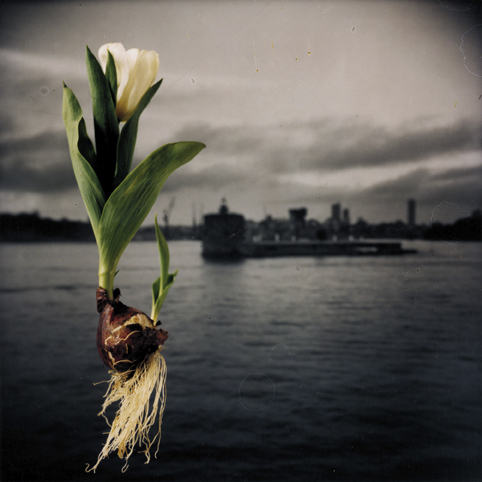 Rebecca Shanahan, Untitled, 2001 The Acclimatisation Project
Foreign plants and indigenous landscapes share the frame in each image with the degraded surfaces interrupting photographic illusion of being a window on the world.
October 21, 2010
DIY photography
I've spent the last couple of days teaching myself how to scan some of my old medium format negatives with the Epson V700 scanner and then processing them in Lightroom 3. The Silverlight and Adobe elements software that came with the scanner were of little use --they would not load on the Mac Pro as they were not compatible with the Mac OSX 10.6.4 operating system.
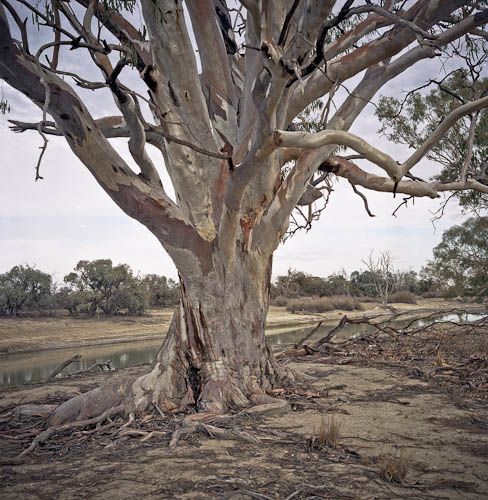 Gary Sauer-Thompson, redgum, The Chowilla Floodplain, 2004
The initial problems I encountered with the scanner were the flimsy filmholders, the dust, and inability to do 5x7 negatives. It is a prosumer scanner rather than a professional one. The second level of problems came with the colour balance. It was shockingly off--eg., rich orange in the rocks was purple. I have no idea how to correct the colour.
October 20, 2010
Australian photography: Glenn Sloggett
Glenn Sloggett's colour photography (done with an old Rolleiflex twin lens reflex camera) is structured around Melbourne's suburbia. This is a suburbia that is down-at-heel and Sloggett explores the dereliction, failed aspiration and abject domesticity.
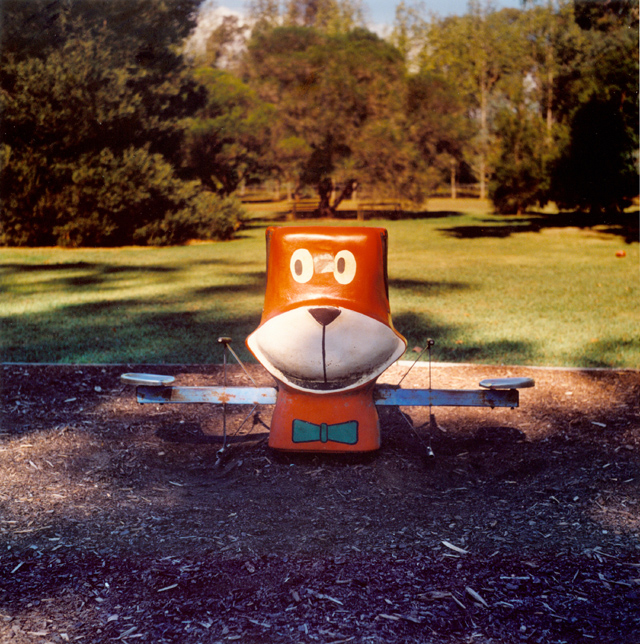 Glenn Sloggett, Hound, from Playgrounds 1998-2004
There is also a quirky humour at work in Glenn Sloggett's photographs of suburban Melbourne that has expresses affection for the neglected, dysfunctional and the out of date. It's a world of failed hopes and abandoned dreams.
 Glenn Sloggett, Picket Fence, from Lost Man, 2003
Robert Cook, the Associate Curator of Contemporary Art, Art Gallery of Western Australia, says that lows us to start to think about the suburbs we live in as places not just where art might be made, but as places to stay, rather than escape. He adds:
He brings the drift and float of suburban time into the structures of contemporary art, therefore, not as a glib spectacle, yet another in a line of minor transgressive episodes, but as part of the experience of being fully human. It is, therefore, a highly structured addition to the history of humanist realism that includes both literature and the visual arts.
The experience of the suburbs expressed in art. I recall the painter Howard Arkley and the shopping trolley opera photos of Matthew Sleeth.
October 19, 2010
Newton on recent Australian photography
In her Generations: Australian Photography Since the 1970s essay for the 2002 Photographica Australis exhibition at the Australian Centre for Photography Gael Newton describes the recent trends in Australian photo-based art.
The main point she makes is that though photo-based art now plays an important role in contemporary Australian art it was once otherwise:
As recent as the 1970s photographic practice was dominated by men, and 'photographer' meant either a professional in commercial practice or an amateur exhibitor in specialist photographic venues. The term did not include the concept of the photographer as being in the vanguard of contemporary art. Throughout the seventies there was a rapid growth in public awareness of photography. Government funding via the newly formed Australia Council for the Arts allowed for the establishment of the Australian Centre for Photography in Sydney in 1973 and later the Centre for Contemporary Photography in Melbourne. Meanwhile, museums began to collect and display photography as an art. Surveys of the period show a preference among selectors for personal documentary and especially street photography in the American mode. Works were usually small-scale black and white and mostly by men, although Carol Jerrems (1949-1980) was regarded as the exemplary figure of her generation. In the 1980s postmodernism powerfully attracted students, in particular women, many of whom sought out art school photography courses as a conscious choice of expressive mode and vocational direction.
In the seventies and eighties photographers were shown in dedicated photography galleries but rarely included alongside painters and sculptors in the stable of major dealer galleries, or even in the publicly funded contemporary art spaces
She adds:
It was only in 1982 at the first Australian Perspecta exhibition in Sydney that curator, Bernice Murphy, recognised photographers as contemporary artists. Murphy included an installation by Bill Henson as a major work and also groups of works by Fiona Hall and Douglas Holleley. Hall and Holleley both showed small-scale works, but subsequently in contemporary art shows throughout the eighties and nineties photographic works increased in number and indeed in scale and impact. The 1982 Perspecta exhibition was also the first major occasion in which recent Aboriginal works were included as 'contemporary' art. Photography was in the slipstream in these years but came to have an ever more prominent role in defining contemporary art in Australia.
That is just over 20 years ago.
October 18, 2010
Square Magazine
Daniel Palmer, a writer, curator and teacher, and Information Coordinator at the Centre for Contemporary Photography, Melbourne, observes that perhaps inspired by overseas exemplars, new Australian photography:
has turned its attention from the discursive, deconstructive edge of the past two decades towards an embrace of what we might term 'real fictions'. Indeed, there has been something of a revival of interest in once heavily maligned documentary practice....Given that no one seems to believe in the ability of a camera to record the whole story any more, it is perhaps not surprising that the critical project to unmask photographic 'truth' no longer retains its urgency....artists have turned to uncovering what is around them, the hidden meanings of the banal and the trivial in everyday habits and places. Perhaps indicative of a general alienation from the social landscape, photography has become a tool for an anthropological investigation of the 'otherness' of contemporary everyday life.
It is not quite that clearcut with Square Magazine--- a bilingual online quarterly about square format photography created in February 2010, and which has produced three issues so far. However, the second issues features the work of two photographers I know from Flickr: Phil Bebbington and Sander Meisner.
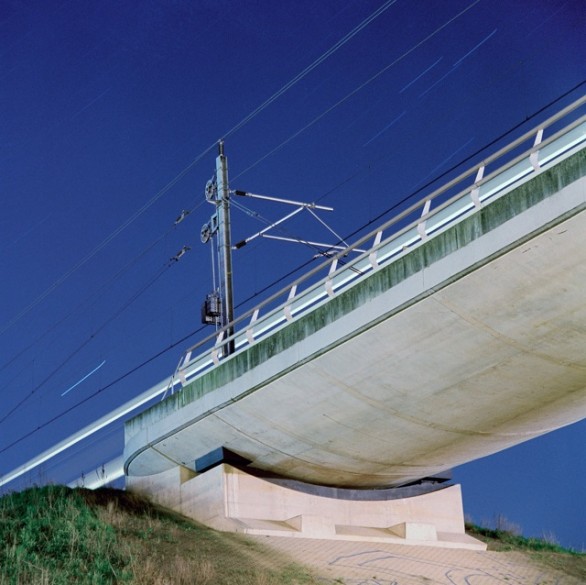 Sander Meisner, Viaducts #3, 2010
Both photographers belong to The Shashin Collective and in their explorations of the everyday world they make it strange.
Reading Palmer's text for the Australian Centre of Photogrpahy has made me realize how isolated I am in the world of photography --on the fringes as it were.
But then changes maybe afoot in Australian art photography circles as I understand that the Australian Centre of Photogrpahy's magazine Photofile is to close down. This, the only publication dedicated to Australian photographic discourses and practices, will end its 30+ year run this year. It wasn't online so I didn't bother.
In fact I've never really connected with the Australian Centre of Photography. It is Sydney based and its exhibitions have such a minimal online presence that it is difficult to make sense of them. Consider Hijacked 2 Australia / Germany that was curated by Mark McPherson (Aus) and Ute Noll (Ger) in July 2010. It sounds interesting:
Hijacked explores the socio-cultural landscapes of Germany and Australia through the diverse talents and perspectives of 32 contemporary photographers. With a focus on the young, the boundary-riding and the fringe-dwelling, Hijacked is layered with imagery that is variously evocative, confronting, dreamlike and incisive. Building on the unprecedented success of Hijacked 1 (2008), Hijacked 2 - Germany / Australia is both a substantive book and a major exhibition that reinforce and expand upon each other: the exhibition through its experiential immersion and the book through its reflective analysis. Both eschew a simple linear critical argument in favour of a multiplicity of dialogues between works and commentators. What happens between images is as important as any given image content.
There are three images online with no text describing photographer or the title of the photo and and no links to Hijacked 1, which provides a voice for some of the most exciting and provocative new photography from Australia and America, erases traditional boundaries between art, document and snapshot, and points towards the future of contemporary photomedia. 4 photos and a link to an exhibition catalogue that costs $100.
You have to be in Sydney to see the works. So I don't bother with the Australian Centre of Photography.
October 16, 2010
'it is happening' at Port Adelaide
I've pretty much come to a cross roads with my photography. I've reached a plateau of sorts. The Flickr archive has been built up, photos are being taken regularly, and the quality of the images is improving. So where to next?
 Gary Sauer-Thompson, Penrice Soda Holdings, Port Adelaide, 2009
The answer I've generally given to myself is that the next stage is to shift to exhibitions and to producing books. I have some sets --eg., Port Adelaide and waste---that are beginning to develop into something more than a set on Flickr.
But what to say and what to write? That is where I come to a halt. The problem is that don't know what I'm going to say. Take Port Adelaide, an urbanscape dominated by empty warehouses, closed pubs and under-utilised shops. All the signs say 'it is happening' but the consensus is that in Port Adelaide not a lot is happening but it is full of promise.
The conventional way of interpreting the emerging urban renewal project at Port Adelaide is to construct it as bad development versus the need to protect good built heritage. There is a clear community concern that the heritage value and culture of Port Adelaide might be lost through the Port Adelaide redevelopment. This concern raises heritage, urban density, place and identity issues.
It is a crucial and pressing issue as Port Adelaide has been named one of Australia's top 10 heritage places at risk by the National Trust of Australia. There are so many derelict historic buildings--eg., the wool stores or Harts Mill-- that could become a cultural hub. An example of such imaging.
My work is not about heritage per se --it is more about the industrial sites, pollution (water and air) and urban decay. Port Adelaide is now a seedy, grubby, dilapidated port town with dirty industry that imagines its future to be a thriving tourist destination, but it is unable to make it happen. The land along Port River and on Torrens Island has been marked for new allotments for industry. So much for the dolphin sanctuary.
So I just plug away taking photos and putting them on Flickr, and dropping in bits of text into the comments section of the project on Flickr. I need to do some research to give the project a bit of a lift off or momentum so that it takes the form of an e-book broadening the issues out as I go--eg;--that of quarantine at Torrens Island.
October 15, 2010
Block Projects: David Ralph
There is a new gallery located in Richmond in Melbourne, Australia called Block Projects that mostly exhibits painting and sculpture. No photography. The current show is entitled Threshold and it features seven painting by David Ralph,
 David Ralph, The Tempest
From what I can make out a tree has dissolved into a suburban house which is spotlighted by a harsh glare. The house appears to be on some sort of hill. It is not possible to achieve this kind of imagery with straight photogaphy--but it could be done with photoshop.
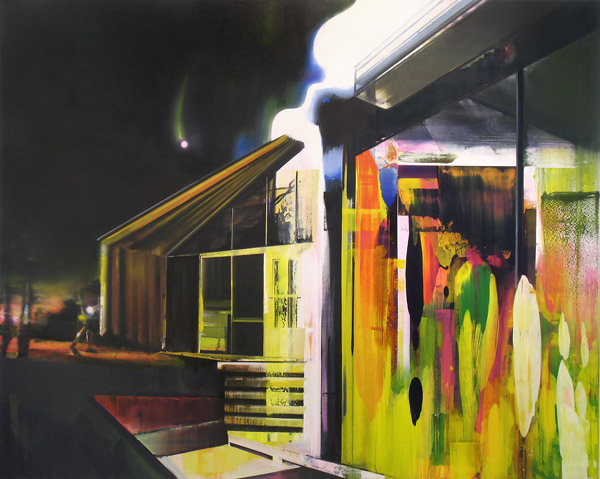 David Ralph, The Synesthesiac1
A blurred figure walks towards a building at night. Here is what the artist says about this work:
Over the past few years I’ve been interested in painting environmental scenarios that focus on unusual or alternative dwellings such as mobile homes, caravans, tents, cabins and tree houses. These kinds of informal, mobile or temporary dwellings are for me potent metaphors for many of the existential issues facing humanity in our time. They raise questions about where we live, how we live and why we chose to live in the way we do. The recreational/escape vehicles in my work symbolize a vital connection with a longed for natural paradise beyond the confines of the cities most Australians live in.
October 14, 2010
Thomas Joshua Cooper
Thomas Joshua Cooper is the head of photography at the Glasgow School of Art. He only works with an 1898 AGFA 5×7 field camera, only makes images outdoors, and only ever makes one image in any one place. Each work begins as a location found on a map, researched and tracked down, before the picture is made. Each site, the subject of a single frame.
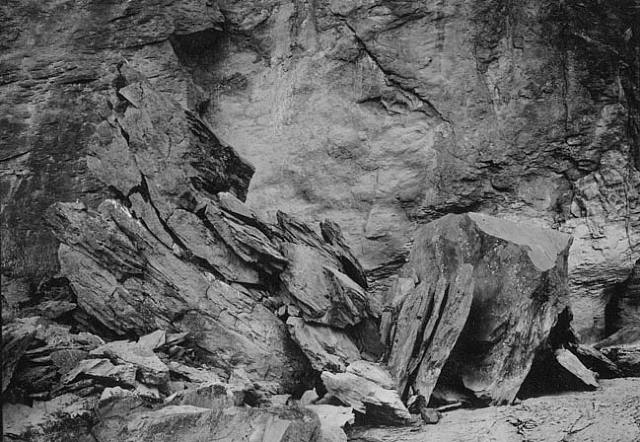 Thomas Joshua Cooper, Broken Boulder, Remembering Timothy O'Sullivan 'Along Snake river, Pillar Falls Canyon, Idaho, USA, 2003-4, silver gelatin print
The World’s Edge – The Atlantic Basin Project---is an ambitious mission, begun in the early 1990s, to photographically ‘map’ the extremities of the lands and islands of all five continents that surround the entire
Atlantic Ocean.
Cooper is best known for his Atlas Project. Inspired by reading about Magellan’s circumnavigation of the world in the 16th century and the lasting impact that has had on world history, Cooper set out about 20 years ago to “chart” the Atlantic Basin, capturing points of land he had picked out on a map.
 Thomas Joshua Cooper, Pillars of Hercules, The Strait of Gilbaltar, 2003-4, Siiver gelatin print
Cooper has published the photos from each segment of his photographic journey, from South Africa to Scandinavia (point of no return, 2004), along the eastern coast of South America (Ojo de Agua, 2006), in the Arctic and Antarctic (true, 2009), and, during his Guggenheim Fellowship term, up the eastern and Gulf coasts of North America, exploring the Rio Grande, Mississippi River and Hudson’s Bay as well. Once this final section is completed, Cooper will collect these parts into a single work titled “An Atlas of Emptiness and Extremity.”
October 13, 2010
the Antipodes: place or relation
For Bernard Smith to be Antipodean, a deliberately Eurocentric marker, is to imagine one’s identity and the places one belongs to, in transnational ways. It means, at least within Smith’s temporal and spatial positioning, being both an Australian and European. The relationship between the periphery (or should this be semi-periphery?) and the centre is always seen as a dynamic interactive process.
 Gary Sauer-Thompson, Junction Mine, Broken Hill, NSW
As Peter Beilharz stresses in in his book Imagining the Antipodes, ‘the Antipodes is not a place so much as it is a relation, one not of our own choosing but one which also enables us’. This is a perception that does not ‘set the local against the global but rather re-presents the local as the global’ in myriad relational ways.
The concept of national identity is seen as ‘relational’, implying the intentional establishment of relations. This definition of identity as relational has been developed by Bernard Smith. Beilharz interprets Smith’s argument thus:
Culture is relational, as is identity; neither is usefully viewed as essential, emanating from spirit, place, land, language or race. To imagine the antipodes is to imagine the relations upon which identity rests and changes.
Smith, for example, identifies nationalism at the end of the nineteenth century as primarily a response to imperialism, which he in turn identifies as the first real wave of Australian identity formation. Beilharz says in his Australia: The Unhappy Country, or, a Tale of Two Nations in Thesis Eleven (Number 82 2005) that:
The image of the Antipodes, having the feet elsewhere from the centres of metropolitan civilization, suggests that identity results from relationship between places and cultures rather than emerging from place, or ground. We, in the Antipodes, do have practical as well as romantic connection to or affection for our place; but we are placed in it by the movements of empire and world system, migration and cultural traffic. We feel, in Australia, or at least many of us do, that we are simultaneously here, and there, home and away. The image of hybrid- ity or grafting appeals, however clumsily. But the image of the Antipodes captures our predicament better, as it suggests movement rather than fixity, as the hard physiological metaphor of hybridity does.
October 12, 2010
transgressing conservative culture critique
In Adorno and Mass Culture: Autonomous Art Against the Culture Industry in Thesis Eleven August 2006 György Markus says that in the early twentieth century the phenomenon of particular artistic forms – photography, film and jazz – evoked a broader cultural resonance beyond the art institution.
He says these forms are actually the kinds of cultural production that originated as popular or as mass cultural forms, but ultimately either split apart into artistic versus commercial kinds or, like jazz, demarcated in an appropriate way, crossed over to high art. This development was a long drawn-out process, achieving completion only in the late 1940s or 1950s. Or the 1970s for photography with respect to aesthetic modernism.
He then says that there is a rather direct continuity between the representatives of high culture from Matthew Arnold through Eliot and Ortega y Gasset, the Leavises and Greenberg to Dwight MacDonald and Adorno (to mention only the most familiar names in the critique of modernity and market-based culture). In these theories the relation appeared as that between universal human/aesthetic values of high art and the worthless, the trashy, or even destructive counter-value of mass culture. Markus adds:
This was not a matter of inherent conservatism, it followed from the way they understood the character and function of high art and the situation of contemporary culture in general. The assumption that film in general is capable of becoming authentic art would have contradicted their premises concerning the destiny of high art in our times. It was a diagnosis of an encompassing cultural (and social) crisis that oriented their aesthetic analyses and evaluations, including the rejection of mass culture in general.
What initially was regarded as aesthetically worthless, one of the minor symptoms of the ills of modernity, increasingly became conceived as a weighty, not merely cultural, but also moral and/or political counter-value, to some degree itself responsible for these ills, or at least significantly contributing to their preservation.
The analysis is based on an assumed dichotomous contrast between authentic art and mass culture, or in Adorno's case the culture industry. The negative characteristics of mass culture are negations of the basic traits of the ‘classical’, organic work of art which, was understood as a dynamic totality, the unity of expression and construction and whose whose serenity prefigures utopian happiness.
Adorno makes a fundamental distinction between pleasure and happiness that underpins the relation between mass culture and authentic art, legitimating the unreconcilable opposition between them:
Objects of the culture industry promise pleasure that always means the satisfaction of some pre-existent need. They are presented as objects of enjoyment, amusement, delight. In fact this very promise is mendacious. Its illusion is actually based on the surface similarity of such products with works of art (from which all their devices are borrowed), but works of art as they are misunderstood (as usual in our society) in a philistine way or artistically misused in the pursuit of popular success... The pleasure always on offer by the ‘goods’ of the culture industry also fails to materialize; they merely provide a momentary distraction, which inadvertently discloses the true social meaning of the pleasure principle itself.
In contrast works of art do not offer thoughtless pleasure:
What they offer is – according to Adorno’s beloved Stendhalian-Baudelairean formula – the promesse du bonheur. This happiness not only differs from, it is fundamentally opposed to pleasure....The happiness promised by the authentic work of art lies beyond the satisfaction of all real or imagined needs with their attendant pleasures; it means emancipation from a life governed by the pursuit of such a ‘fulfil- ment’, a liberation from all the compulsions dictated by self-preservation.
Markus comments that Adorno both overburdens the ‘culture industry’ serving as the ‘cement’ for a system of impersonal domination, and overburdens high art with a task, which as art, as the source of aesthetic experience, it cannot fulfill at all today.
What is lacking here with Adorno is the aestheticization of the commodity world that Walter Benjamin explored in his unfinished Arcades Project. Art, once it had submitted to industrial production and been appropriated by advertising, could and did reappear, transformed, in design and aesthetic consumption.
October 11, 2010
Lee Friedlander: America by Car
Taking shots from a car is a particular tradition style of photography. We recall the familiar images of the flatlands of middle America and the iconic, much-photographed Route 66-style gas stations and motels. This is what we call a social landscape.
A notable practitioner is Lee Friedlander who uses the simple conceit of deploying the sideview mirror, rearview mirror, the windshield, and the side windows as picture frames within which to record reflections of America's urban scape. In his America by Car monograph Friedlander takes a road trip through contemporary America.
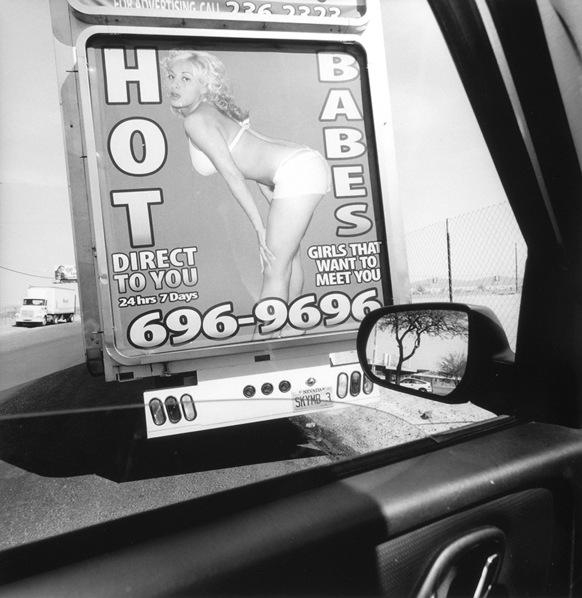 Lee Friedlander, Las Vegas, Nevada, 2007 from the series America by Car, 1995-2009, gelatin silver print
Instead of finding ways to contain and organise the cacophony of the city within the four edges of a picture, he introduces a multiplicity of edges to an otherwise quiet scene – dividing it, complicating it, questioning it, enlivening it – and within the limits of the viewfinder compiles a multifaceted “American social landscape”, a phrase unsurprisingly first coined by the photographer himself.
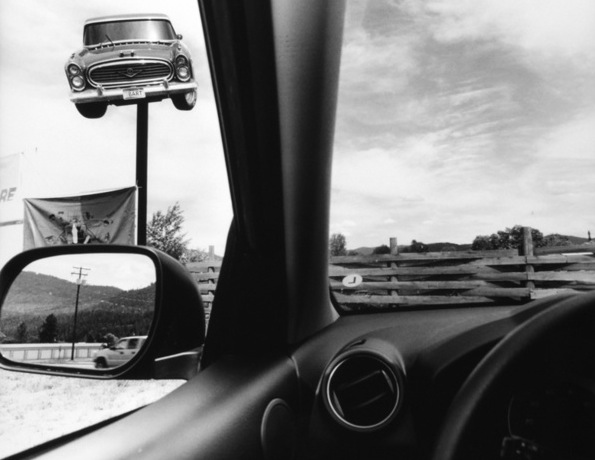 Lee Friedlander, Montana 2008, from the series America by Car, 1995-2009, gelatin silver print
I have a lot of respect for Friedlander's sophisticated design, what he is able to pack into a picture frame, and the way that his photography both explores and define the social landscape and references of American photography’s own obsession with certain vernacular themes (roadside signage, humble buildings, car culture).
October 9, 2010
Francois Robert's bones
I've always wanted to buy a skeleton and to play around with it photographically in the studio. Francois Robert did. He took took delivery of a box containing 206 separate bones, each the real thing, not plaster or resin. He spent hundreds of hours working with those bones, arranging them painstakingly into striking, iconic shapes, each five or six feet wide, and photographing them.
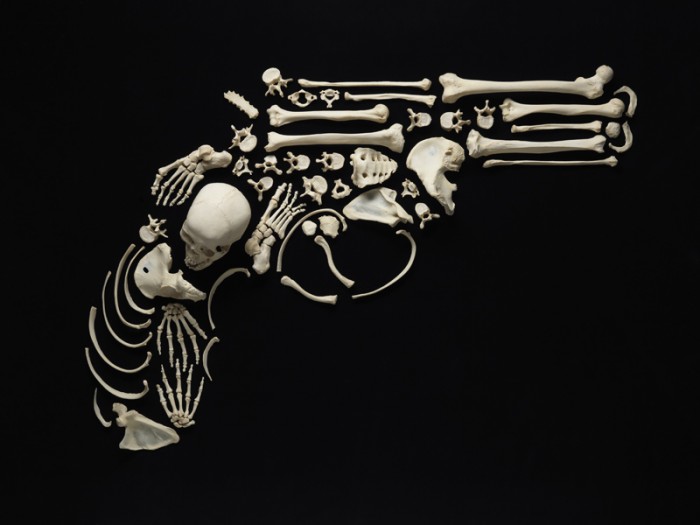 Francois Robert, Gun, from Stop the Violence archival ink jet print
What a stunning idea! Simple, evocative and powerful. Beautiful design but haunting imagery.
Robert had a portfolio that had always featured pictures of animal skulls, recovered from his frequent trips to the desert. He had also spent five weeks amongst the collections of the Field Museum of Natural History, taking photographs of different animal skulls.
Another series by Francois is called Faces, which finds friendly, odd and interesting facial characteristics in everyday objects. Another is called Contents.
October 8, 2010
Art + Soul: Ricky Maynard
Art and Soul is showing at the NSW Gallery.The background is being shown on ABC by Hetti Perkins, senior curator Aboriginal & Torres Strait Islander art and it explores the diversity of Indigenous culture through three themes: ‘home and away’, ‘dreams and nightmares’ and ‘bitter and sweet’.
One of the artists mentioned in the first episode was Ricky Maynard, the Tasmanian based photographer.
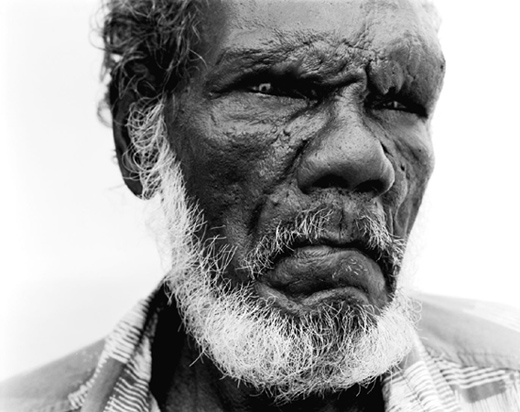 Ricky Maynard, Wik Elder, Arthur, 2000, from Returning to Places that Name Us series, Gelatin silver print
This series consists of black and white portraits of the struggles of the Wik elders those who had toiled so long for native title and the overturning of Terra Nullius.
Some 204 years after the British flag was planted on Australian soil, the High Court of Australia's 1992 Mabo decision established that native title is recognised under Australian law.However, the Mabo decision, and the subsequent Native Title Act, left unresolved the issue of native title on pastoral leases.
In December 1996, the High Court made another important decision in the Wik case. The High Court's Wik decision allowed the possibility that hunter-gather tribes on the Australian mainland could enjoy native title in co-existence with pastoral leases. All hell broke loose as pastoralists and state premiers were consumed by fear and loathing and who demanded that native title be extinguished, or wiped out, on pastoral leases. The Howard Government used the decision as an excuse to severely attack native title rights with its Native Title Amendment Bill, based on the so-called Ten Point Plan for native title.
The Wik decision was significant not only because it recognised native title rights on pastoral leases, but also because these leases cover a vast area - some 42% of the Australian land mass. The coexistence of native title provides the means whereby thousands of Aboriginal people, previously the backbone of the grazing industry, who were locked off cattle and sheep stations in the late 1960s and early 1970s, may gain some rights to their traditional lands.
October 7, 2010
harrassing photographers
Here is some confirmation of an earlier post on the unconscious hostility to photographers in public places. Rosemary Neill in The Australian says that art photographers are increasingly frustrated by a climate of regulation and suspicion that means spontaneous images in public spaces are becoming increasingly difficult to capture.
Rex Dupain, a Sydney photographer, said he has several times been approached by lifeguards or police at Bondi Beach when taking pictures, and has had his camera temporarily confiscated several times. He has abandoned his attempts to create an authentic visual record of contemporary Sydney beach culture:
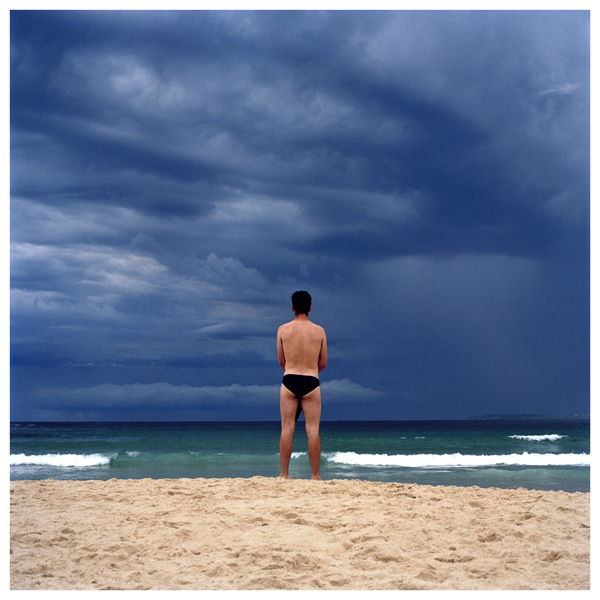 Rex Dupain, Coming storm, 2005, type C photograph, from Bondi Colour
Dupain says that a lone man with a camera these days is not a good look, even though in Australia, it is legal to photograph anyone on public land without permission, so long as the subject is not compromised (for example, getting undressed).
This technique -- pursued for decades by masters of street photography including Henri Cartier-Bresson, Robert Doisneau and Robert Capa -- was also Dupain's modus operandi. Dupain says he encountered so much hostility from the public, lifesavers and the police, he quietly stopped taking unrehearsed photographs at Bondi months ago.
The usual reasons for the antagonism stems from public anxiety and paranoia (a moral panic) about pedophiles but it goes deeper than that anxiety about childhood sexuality and pornography that came to the fore around the Henson case two years ago. There is the emergence of anti-terrorist legislation-- it is assumed that as terrorists use photography to plan an attack, photographers who are following the letter of the law are harassed by security and/or police for photographing our transportation infrastructure and buildings. And there is in Australia the emergence of an extensive regime of censorship and suspicion that reinforces entrenched ideas about the need to control images.
Neil comments:
It is ironic that photographers feel under siege when voyeurism has been turned into a national pastime. Witness the enduring popularity of reality television, the celebrities who tweet compulsively about the most mundane details of their lives and ordinary individuals who post dozens of photographs of themselves on Facebook. Our multimedia society is arguably the most narcissistic and (superficially) self-revealing in history.Yet, paradoxically, the rise of online and mobile media has also bred mistrust of professional photography and has entrenched ideas about the need to control images -- and who makes money from them -- whether the subject be a private citizen or a well-known landmark.
The result is an erosion of the photographers' rights to freedom of expression. All three levels of government--federal, state and local--are involved.
October 6, 2010
Adelaide photographers: John Hodgson
A book entitled Adelaide: Water of a City has been published by the Barbara Hardy Centre for Sustainable Urban Environments at the University of South Australia.
Adelaide, the capital city of South Australia, is an isolated community of about 1.5 million people on the south-central coast of Australia. Water security is a big issue in Adelaide, given its historic reliance for water on the River Murray, which is now dying. Adelaide's warmed up future necessarily depends on it becoming a sustainable city. The history of Adelaide is a story of water and the city must rethink the way it uses water, and move to embrace sustainable water management.
The water book features the photography of John Hodgson who is currently having an exhibition at the Epson Gallery.
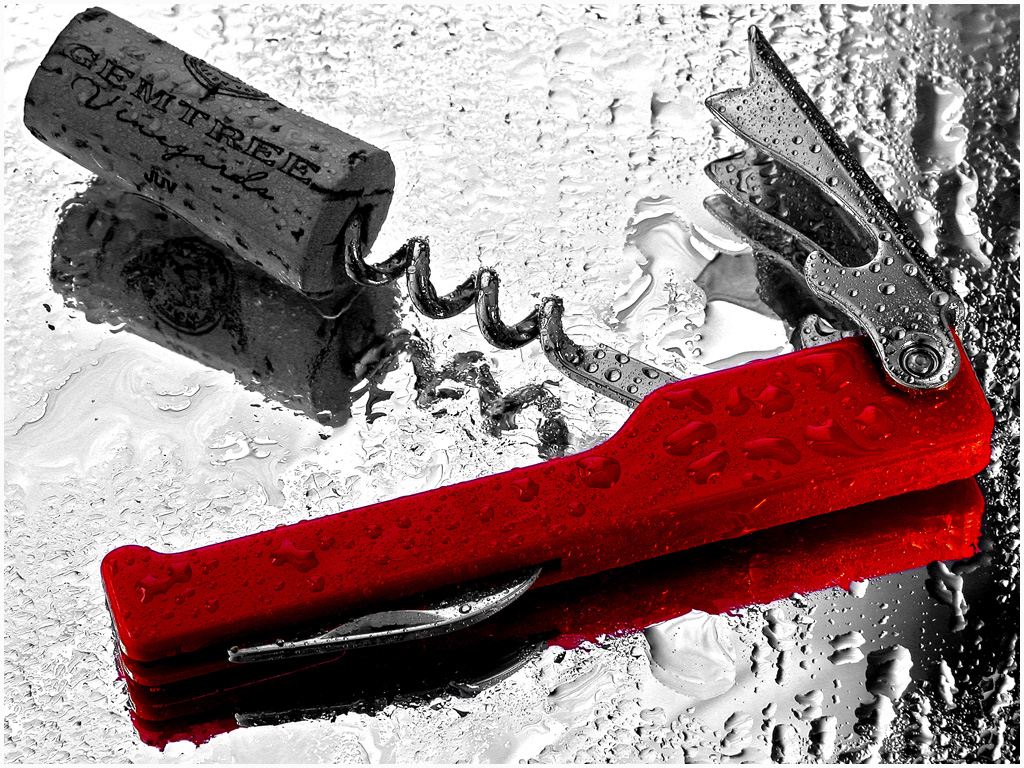 John Hodgson, Red Corkscrew.
None of the images from the exhibition are online. Those produced for the book are here as thumbnails. This online thinness is a pity because we are dealing with a public policy issue.
What is online is the Introduction to the book, which costs $150. How many citizens are going to buy that to inform themselves of water issues in the city of Adelaide? The commitment to open source is close to non-existent.
The Introduction makes a crucial point about the state government's growth plans for the city up to 2036; namely, these do:
not address water sustainability. Water sustainability is over- ridden in this document, which is driven by conventional theories for the planning of growth corridors to accommodate traditional forms of dwelling and their spatial locations. This plan compromises the inherent productive landscape, its natural resource qualities, water catchment and harvesting, and the scenic landscape imperatives of the peri-urban regions surrounding the Adelaide metropolitan area.
The Rann state Labor government has its heads in the clouds on this. Their old fashioned conception of urban growth --ie., urban sprawl--- is not linked to the need to manage our water according to the principles of sustainable water systems.
October 5, 2010
Australian Photography: Richard White
My turn to shooting 8x10 black and white photography leads me into the world of traditional photography chemicals, darkroom, the zone system and the fine print. This world of film and the traditional darkroom is often pronounced dead.
One Australian exponent of this kind of fine art photography is Richard White who lives in the North East of Victoria (the (studio and darkroom is in Mansfield), mostly uses a Linhof Technika 5 x 4 field camera and writes for Silvershotz.
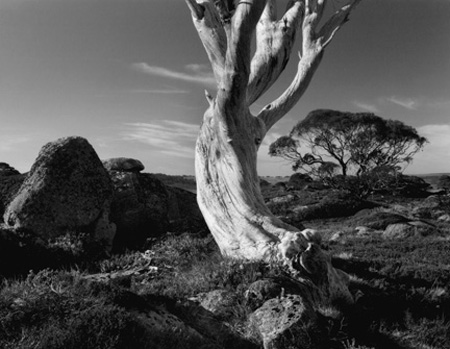 Richard White, Snow Gum, Sunrise, Bogong
This is the world of Ansel Adams, Wynn Bullock, Emmet Gowin and John Sexton--- the hand made crafted print and so a another world to the one digital photography, the computer and photoshop. The contrast is the latter recognizes computer skills and graphic design and the former photographic excellence.
October 4, 2010
photographic character
Stacy Oborn has a post on photographic character at The Space in Between. I don't know about the concept of 'photographic character'. So I am intrigued as to what it means for both photo criticism and the practice of photography.
Oborn says:
Projects + Ideology + Temperament + Social Group + Psycho-biography=photographic character to understand photographic character is to (1) enter a similar frame of mind [as the photographer's]; (2) experience their photographic experience, and (3) understand it [them] in a total way. once you understand what a photographer would never do (e.g. walker evans would never make a nude), you can begin to understand the parameters of a given artist’s photographic character.
I find that a bit vague even though I comprehend what Oborn means by Walker Evans would never make a nude). This suggests that 'photographic character' is different from the use of art history's concept of 'style' in the special field of the history of photography.
Oborn then adds:
douglas nickel’s notion of photography and photo-history as being a discursive, social practice based on an entire set of discourses and commentaries in our lifetimes can serve as a basis for understanding how to approach the notion of photographic character. photographic projects should be viewed with these questions in the back of our pockets: what were they trying to do with photography here? what of their character is evinced in their photography–what have they put of their person in here? what was their attitude? what was their disposition?
Oborn says where one points the camera is where your psyche pointed it. If a photographer does not deal with that thing the psyche is putting forth, the psyche will in turn relentlessly keep pointing them there.
Is this important? Do we actually know what the photographer intends? What are they trying to do? Do we know what their psyche is saying? How do we know this? How do we know that the psyche calls the shots? How is the psyche different from the unconscious?
October 2, 2010
Doug Moran Photographic Prize
I did not know about the Doug Moran photographic prize until I stumbled across it in a post by Paul Atkins. I had thought that the Moran prize was for just for portrait painting and I hadn't realized that a contemporary photographic prize had been introduced in 2007.
I was taken by this image:
 Sonia Esposito, self portrait, 2010
The majority of the finalists appear to work in the photojournalism or street photography style and there is little in the way of landscapes or urbanscapes. In this context of photography as a form of documentation, a way to detail something that already exists, it was the self portraits that caught my eye.
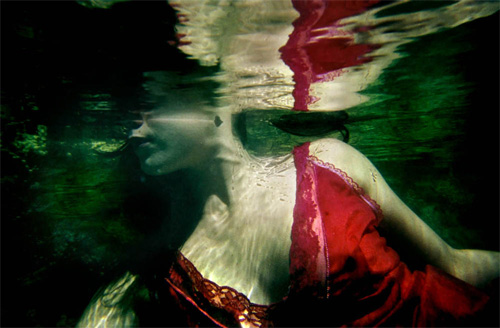 Samantha Everton Surrender, from Utopia, 2009
Everton's work is typically highly stylized and staged; choreographed and planned to the finest detail in the controlled studio environment as can be seen in Vintage Dolls. The work in the Utopia series is more spontaneous as it is under the sea relying on the sunlight and the were shot using an old, ($A39) plastic camera with only two light settings - for shadow and sun. The sea gives the murkiness and mud, seaweed and rocks, atmosphere and ambiguity.
dam
As mentioned in an earlier post earlier post I started shooting 8x10 black and white film last week when I was down in Victor Harbor. The image below was the kind of subject I had in mind to begin with: rocks don't move; I'm protected from the wind and it is easy to work there once I've transported the camera to the location:
 Gary Sauer-Thompson, orange rock ledge, Petrel Cove, 2010
It's a question of re-learning to see in b&w again.
When I returned to Adelaide during the week I decided to check out which pro-lab would be able to process the b+w negatives. To my horror Atkins Technicolour informed me that they didn't, and that nobody else in Adelaide did either. There was maybe someone in Sydney they added, but they weren't sure. They would have to check. They could process 8x10 colour film though. Now they tell me.
I had started with B+W cos it was cheaper than colour and I thought that I would be more willing to accept mistakes on re- learning this style of large format photography, even if it did mean re-learning to see in black and white.The whole 8x10 thing was to do it as cheaply as possible.
Now I have to find a pro-lab in Australia that would have the facilities and skills to process 8x10 black and white film. I should have just started with colour and imported some film from the US
Update
Transporting the Cambo 8x10 is a two person operation. Suzanne carries the tripod legs and head over each shoulder whilst I carry the camera in one hand and the dark slides in an old computer bag slung over my shoulder. We move slowly along the clifftop path, and gingerly make our way down the cliffs to the beach. Once down there things are okay using the camera. It's the transportation that is the issue. That and processing the film.
Update 2
I've found someone who can process 8x10 b+w film. It is done by Chris Reid at Blanco Negro in Sydney, the last dedicated professional black & white darkroom in Australia. Blanco Negro is a small custom lab who process black & white film and do high quality printing using the finest products. Chris is an expert B&W printer and chemical guru and prints all things for pro and amateur photographers, exhibitions and galleries.