|
October 18, 2010
Daniel Palmer, a writer, curator and teacher, and Information Coordinator at the Centre for Contemporary Photography, Melbourne, observes that perhaps inspired by overseas exemplars, new Australian photography:
has turned its attention from the discursive, deconstructive edge of the past two decades towards an embrace of what we might term 'real fictions'. Indeed, there has been something of a revival of interest in once heavily maligned documentary practice....Given that no one seems to believe in the ability of a camera to record the whole story any more, it is perhaps not surprising that the critical project to unmask photographic 'truth' no longer retains its urgency....artists have turned to uncovering what is around them, the hidden meanings of the banal and the trivial in everyday habits and places. Perhaps indicative of a general alienation from the social landscape, photography has become a tool for an anthropological investigation of the 'otherness' of contemporary everyday life.
It is not quite that clearcut with Square Magazine--- a bilingual online quarterly about square format photography created in February 2010, and which has produced three issues so far. However, the second issues features the work of two photographers I know from Flickr: Phil Bebbington and Sander Meisner.
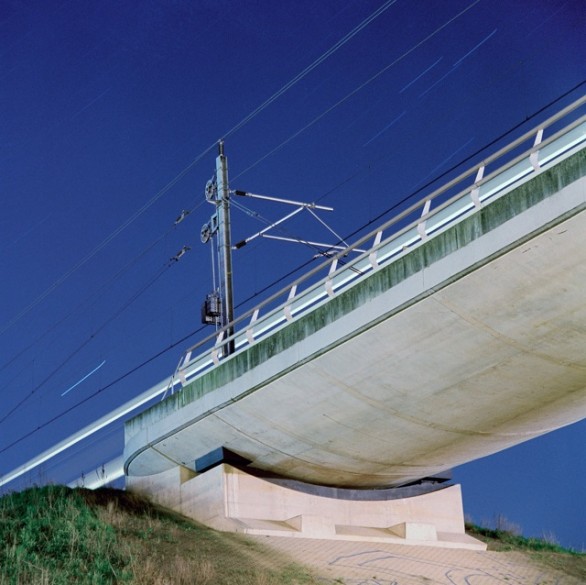 Sander Meisner, Viaducts #3, 2010
Both photographers belong to The Shashin Collective and in their explorations of the everyday world they make it strange.
Reading Palmer's text for the Australian Centre of Photogrpahy has made me realize how isolated I am in the world of photography --on the fringes as it were.
But then changes maybe afoot in Australian art photography circles as I understand that the Australian Centre of Photogrpahy's magazine Photofile is to close down. This, the only publication dedicated to Australian photographic discourses and practices, will end its 30+ year run this year. It wasn't online so I didn't bother.
In fact I've never really connected with the Australian Centre of Photography. It is Sydney based and its exhibitions have such a minimal online presence that it is difficult to make sense of them. Consider Hijacked 2 Australia / Germany that was curated by Mark McPherson (Aus) and Ute Noll (Ger) in July 2010. It sounds interesting:
Hijacked explores the socio-cultural landscapes of Germany and Australia through the diverse talents and perspectives of 32 contemporary photographers. With a focus on the young, the boundary-riding and the fringe-dwelling, Hijacked is layered with imagery that is variously evocative, confronting, dreamlike and incisive. Building on the unprecedented success of Hijacked 1 (2008), Hijacked 2 - Germany / Australia is both a substantive book and a major exhibition that reinforce and expand upon each other: the exhibition through its experiential immersion and the book through its reflective analysis. Both eschew a simple linear critical argument in favour of a multiplicity of dialogues between works and commentators. What happens between images is as important as any given image content.
There are three images online with no text describing photographer or the title of the photo and and no links to Hijacked 1, which provides a voice for some of the most exciting and provocative new photography from Australia and America, erases traditional boundaries between art, document and snapshot, and points towards the future of contemporary photomedia. 4 photos and a link to an exhibition catalogue that costs $100.
You have to be in Sydney to see the works. So I don't bother with the Australian Centre of Photography.
|


