February 29, 2012
Francesca Woodman
Francis Woodman studied at Rhode Island School of Design (RISD) from 1975 to 1979. In 1977 she received a grant to spend a year in Rome to continue her studies at the Rhode Island School of Design overseas study program at Palazzo Cenci.
She died in 1981, aged just 22, when she threw herself off a building in New York in January 1981, following a long bout of depression. She was just 22, but left an archive of some 800 images, many of which have still not been seen. Her work was discovered in the late ’80s
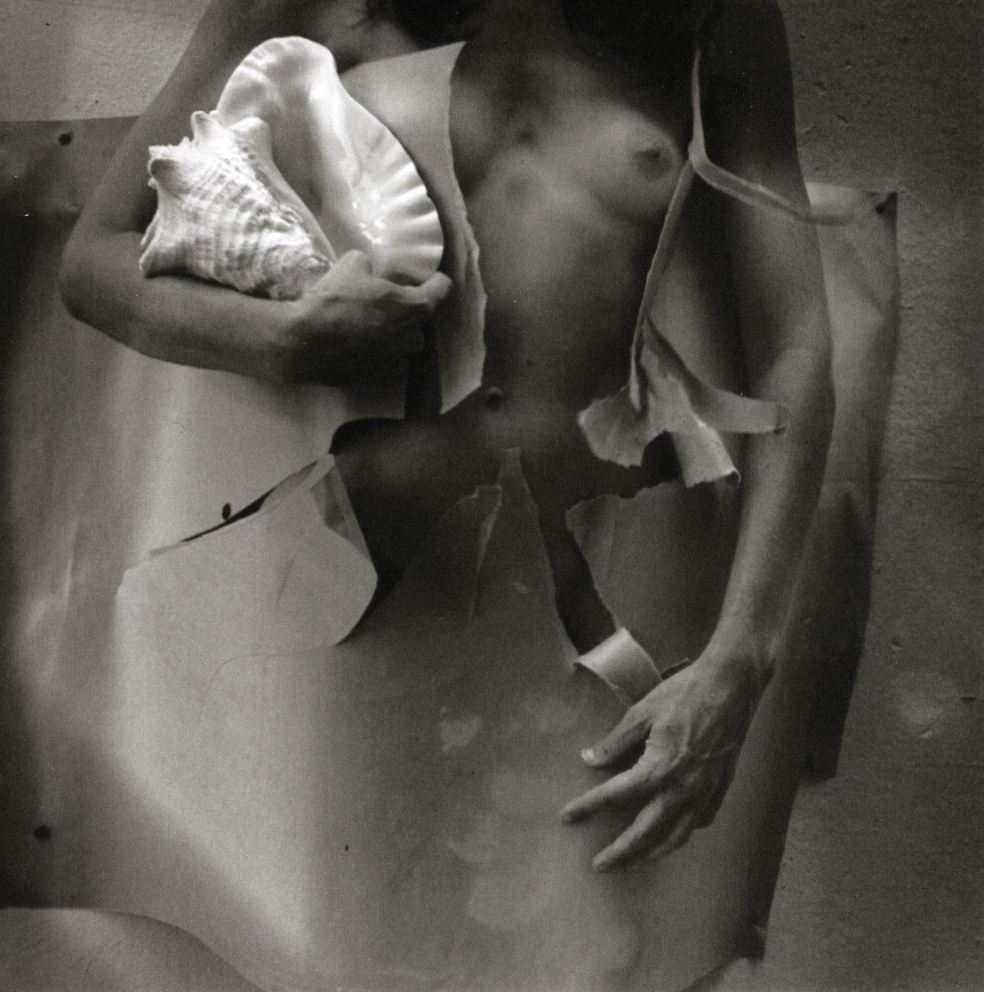 Francesca Woodman, untitled, Rhode Island, 1975-77.
In the spaces of the old Cerere Pasta factory she found the decadent atmosphere that characterized her photographs, documenting the peeling walls, the traces of the past and the industrial ruins. There is also the modernist exploration of experimenting with shadow and light, flesh and form, stillness and motion.

Francis Woodman, untitled, From Eel Series, Rome, 1977-1978
Her work reveals an interest in the process and an exploration of identity and subjectivity and with signs of performativity, with seriality and repetition, with the scenes often enacted by Woodmanare pre-conceived for the camera. Everything is planned in advance and in detail. She prepares the space for her shooting, she sets up the props and through trials and tests, she builds the frame where she will be in.
Many photographs of Woodman, mostly naked, often posing in empty rooms with peeling paint and fading wallpaper often utilize surrealist props such as mirrors, gloves, birds, and bowls.
February 28, 2012
exploring conceptual documentary
Melissa Miles in The Drive to Archive: Conceptual documentary photobook design in Photographies (Volume 3, Issue 1, 2010) says that there is an international trend in international trend in contemporary photography that is known as Conceptual Documentary.This is a term used by Martin Parr to describe the blurring of the two genres of art photography and photo-journalism to create a more concept driven documentary rather than an assignment / editorial project.
Miles states that the term Conceptual Documentary refers to the cool, distanced and analytical approach to documentary photography that is also associated with the work of Frank Breuer (Germany), Paul Shambroom (United States), Matthew Sleeth (Australia), Hans van der Meer (the Netherlands), Raphaël Dallaporta (France) and Mathieu Pernot (France) amongst many others.
Miles says that the British Magnum photographer Martin Parr is a prominent promoter of Conceptual Documentary, and dedicated much of his curatorial programme at the 2004 Arles photography festival to this style of photography. Miles says that:
According to Parr, Conceptual Documentary photography is characterized by a desire to explore a single, often banal idea from many different angles. ...Rather than submerging themselves in dramatic events, Conceptual Documentary photographers seek out and frame their subjects according to a pre-determined idea or scheme. Processes of repetition and categorization are central to Conceptual Documentary.....The central idea is made evident over a series of photographs and there is less emphasis upon the singular photographic moment......Parr argues that Conceptual Documentary is the most pertinent form of documentary practice today because it addresses a desire for order in a visually chaotic world. In a context in which we are bombarded with thousands of images every day, Conceptual Documentary responds with an aesthetic based on careful selection, repetition and classification
Consequently, conceptual documentary can be understood as a symptom of the larger “archival impulse” that pervades contemporary culture. Conceptual Documentary’s emphasis upon seriality and its framing of documentary photo- graphs according to a pre-determined scheme attest to a rejection of the decisive moment that is spontaneously “captured” by the documentary photographer, and a comparable distrust in the notion of singular, authentic or original photographic meanings.
February 27, 2012
Thomas Struth: multiple layers of historical traces
Donna MF Brett in The Uncanny Return: Documenting place in post-war German photography in Photographies (no. 3, Issue 1, 2010) says that in the late 1970s Düsseldorf-based photographer Thomas Struth began an ongoing series photographing the urban landscape, exploring, in particular, cities in West Germany and in the former East Germany, recording places in which, to a certain extent time had perceivably stood still.
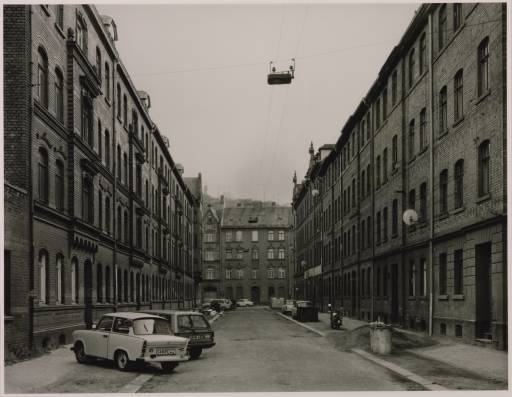 Thomas Struth, Hermannsgarten, Weissenfels, 1991
Brett says of Struth's Berlin street photographs that:
His interest in photographing the post-war German landscape was in exploring the relationship of the individual to historical time and in analysing urban structures in terms of all that has come since the Holocaust and as a witness to the emblematic structure of post-war German cities... His series of empty, almost anonymous streets, which he has referred to as “unconscious places”, render the street as void yet present the void as a concrete visual experience.
Struth’s typological repetition of vacant streets becomes the images of our half-awakened wanderings and memories of streets once known, familiar but strange, or of streets we encounter in glimpses as we lose our way.
The multiple layers of traces reflect the various histories that are marked through time, by lives lived, centuries of building, destruction and loss.
February 26, 2012
Charles Bayliss: Sydney Harbour
Charles Bayliss photographed the transformation of Sydney over more than two decades from around the 1880s. Although he advertised himself as a landscape photographer, his specialisation included the built environment, and his subjects were the major city buildings, civic projects and engineering feats of the colonial period
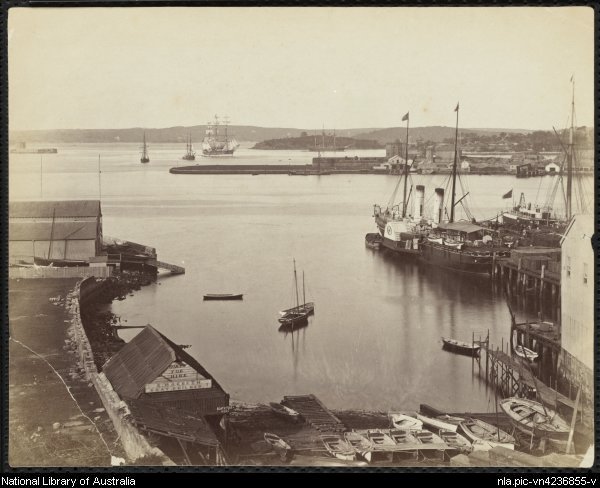 Charles Bayliss, Sydney Harbour with MacBeth boat builder in foreground and Fort Denison in the distance, circa 1880s. NLA
A favourite subject was Sydney Harbour--as evidenced by his panorama of Sydney Harbor. Today the favouite subject is freeways.
February 21, 2012
Donna Brett: post-war German photography
Donna MF Brett in The Uncanny Return: Documenting place in post-war German photography in Photographies says that:
The photographs discussed in this essay are similarly at a temporal disjunction between the moment of the photograph and the present and also suggest various returns: the return home, the return to the street and the return to the past. Each example explores the notion of the return in terms of the “photographic return” to places and sites of historical unease and to an urban topography as a site of alienation – erased and empty. This idea of the return will be considered in terms of Sigmund Freud’s analysis of the “uncanny” or “unhomely” as that which is familiar yet becomes strange and Siegfried Kracauer’s “homeless” image in as much as the images themselves reference a history of place that is estranged from contemporary experience and from the place it records. Like Benjamin’s angel of history, the photography I will discuss in this essay is similarly caught – staring into the abyss of the past and yet propelled towards the future – in a spatial and historical lacuna that I will consider as not only unhomely but by its very nature as existing in a space of temporal disjunction, is homeless
One example is mentioned by German curator and photographic historian Rolf Sachsse with respect to the topographic photography of the nineteenth and twentieth centuries. He considers considers topographic photography to have a specific relationship to time in that it is able to concentrate on the peculiarities of a city or landscape over an extended period.
One example is the representation of erasure, destruction and absence in Germany effected by the Second World War. Friedrich Seidenstücker, for instance, returned to the Tiergarten after the war to re-photograph the same locations and sculptures he'd photographed before the war, thereby opening up the images to the melancholic tones of the city’s ruins.
Brett says:
The subtle changes of the urban landscape recorded by the topographic image make us conscious of time and the minor alterations in the fabric of our environment – a coat of paint here, a new store there or the growth of a tree – all indicators of time passing. In addition, the comparative topographic image, as a lacunae image, is anticipatory and incomplete, hanging in an air of expectation, constantly between what-has-been and what-will-be, with both (before and after) images in a state of constant referral to the other.
While the photograph simultaneously holds the moment at which it was taken and interrupts or fractures history in the moment of the capture, the second photograph of a site taken at a time in the future could be seen as a further fracture, which in its attempt to fold back time to the first image reflects Kracauer’s consideration of the photographic spatial continuum.
February 19, 2012
photography and abstraction
An Aperture Panel: Abstraction in Photography, at the Hammer Museum. It is based on Lyle Rexer's The Edge of Vision: The Rise of Abstraction in Photography
Abstraction in photography in Australia has historically had a low profile and it is rarely mentioned in the photographic histories. My own black and white rock studies photos at Victor Harbor refer back to the work of Charles Bayliss at the Jenolan Caves:
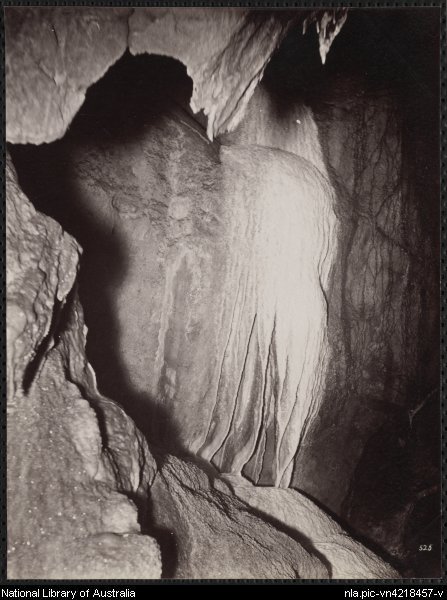 Charles Bayliss, Brides Veil, Imperial Cave, Jenolan Caves, New South Wales, 1888, NLA
The photographic curators would talk about this kind of work as a document or a record, but it transgresses this positivist understanding of 19th century photograph; and it does so without linking abstraction to spirituality.
February 18, 2012
mobile technologies + place
The way we engage in media -- and the widespread, rapid exchange of information via social media and other tools -- has changed things drastically. The way in which we're having discussions about -- on blogs, on Twitter, on our Facebook pages, and in an overwhelmingly participatory, everyone-has-a-voice fashion -- has changed the political and social landscape forever. Networked mobility in general and mobile phone use in particular, lead to altered or transformed understandings of place and place-making.
Rowan Wilken in FCJ-036 From Stabilitas Loci to Mobilitas Loci: Networked Mobility and the Transformation of Place in Fibre Journal says that mobile technologies point to the need to a significant shift in our traditional understanding of place as stable and fixed (stabilitas loci):
it would seem a shift is being initiated from the notion of stabilitas loci or “stable place” to what I have been terming mobilitas loci: the difference between place experienced as stable (if not fixed), to multiple places experienced in and through mobility. ....To conceive of place in this way is to come almost full circle in our understanding of how place is experienced: from the “mobile gaze” of the nineteenth-century, via what Anne Friedberg terms the “virtual mobile gaze” of late-twentieth century postmodernism (1993), to what might be understood as a “re-mobilised (virtual) gaze” with the advent of mobile (particularly image-enabled) telephonic technologies.
Networked mobility prompts a renegotiation of place, much like strolling (flânerie) and the “technologised” spaces of the grand arcades did in the nineteenth century .
February 16, 2012
by passing the art gallery
Flakphoto indicates how the art gallery is being bypassed in a digital world,. The art gallery is the gatekeeper to the visual arts --excluding architecture: it defined who could enter the canon, what the canon was, and how to talk about the canon and to evaluate a picture. It does so in the name of defining and protecting the national heritage. The key terms in the traditional notion of ”museum” are:
· the white cube: the elimination of context in terms of architecture and space as well as of institutional conditions
· cultural consensus: a broad consensus about hierarchies and values defined and perpetuated by the museum
· timelessness: the claim to represent these values without being affected by any changes in the world outside, without having to reconsider the criteria that lead their decisions.
The art gallery's collections mean that it is the home and guardian of our cultural memory. In many ways the gallery is a museum, as it protects a fossilized fixed historical culture through the carefully rehearsed ideological script of masterpiece and genius by the art historical curators.
As a result, much of the art that took place was not curated or archived--a lot of photography or lens-based media, for instance--- as it was excluded from the gallery or museum that acted as cultural gatekeeper, judge and executioner. The visitors to the art gallery/museum are not prompted to seek out books or more information on artists they never encounter in the art gallery. So this institution, now increasingly corporatized, fails in its responsibility for the continuous development and sustenance of a lively artistic community.
We can talk in terms of “after modernism”. This refers to both the modern framing of the museum-as-institution that has, following the founding by Alfred Barr of New York’s Museum of Modern Art in the 1920s and its as a chronologically contextualized progression of art styles and the way the modernist framing has ossified into a straitjacket. This framing can be engaged with and it is one which we can operate against without reducing this to the postmodernist framework of irony and reflexivity.
The avant-garde during the age of modernism intended the abolition of autonomous art, by which it means that art is to be integrated into the praxis of life. This has not occurred. We got pulp fiction and commodity aesthetics instead. What is needed is finding new ways of working within the museum, to broadening the public's relationship with the museum, to better collaboration with artists and with the museum's publics and to reassessing the way in which museums deal with contemporary art and contemporary issues.
Given the selectivity of the modernist museum's tradition that is based on the notion of the artist-genius and the cult of art distilled as style, we need to reframe the art gallery or museum by thinking in terms of museums after modernism in a postmodern world that celebrates difference and diversity, pastiche and forgetful recycling. The museum or gallery after modernism is a more opened space, one of conversation, engagement and performance across a wide range of disciplines and practices. Within this opened space the artist works on a project that often has an educational value.
February 15, 2012
Jeff Wall: Steve's Farm
The location of this picture is on the fringes of Jeff Wall's home city of Vancouver. The scale of the work evokes traditional landscape painting but it is a far cry from the idealised visions of pastoral landscape:
 Jeff Wall, Steve's Farm, 1980,
This represents of the encroachment of the suburbs on farm land, as a housing development seen in the distance on the right side of the picture seems to march across the landscape. The expanding suburbs are extinguishing the farm.The traditional notion of landscape as bucolic or idyllic is significantly disrupted and it causes discomfit or unease in the viewer
Wall distinguishes between unstaged "documentary" pictures, and "cinematographic" pictures produced using a combination of actors, sets, and special effects.
February 13, 2012
Jeff Wall: The Destroyed Room
Jeff Wall considers this large-scale picture to be his first successful attempt to challenge the norms of photography through the use of transparencies mounted in lightboxes. In doing so, he references both popular culture (the illuminated signs of cinema and advertising hoardings) and the sense of scale he admires in classical painting. As three-dimensional objects, the lightboxes take on a sculptural presence, impacting on the viewer's physical sense of orientation in relationship to the work.
 Jeff Wall, The Destroyed Room, 1978, Transparency in lightbox
The Destroyed Room is a staged scene of destruction in the bedroom of a young woman in which only the lithe figurine on the bureau and one black stiletto- heeled shoe remain standing. The discarded objects are the debris of commodities that promise personal beauty, but are subject to constant changes in style and planned obsolescence.
Wall has said that he “filtered” the work through Eugene Delacroix’s Death of Sardanapalous (1827), a painted depiction of aggression and violence. Thus, Wall has associated his picture with the tradition of Western painting just as it was turning from the idealization of history painting toward a preoccupation with the late Romantic emotional turmoil or psychological disruption.
The personal possessions strewn across the floor invoke not only images of aggression and anger, states of mind that the imagined gestures would have revealed, but, also, the notion of the abject embodied in commodity fetishes in a culture of waste. This photographic tableau is a beautiful picture of a devastated interior in an present marked by the commodity culture of late capitalism.
Jean-François Chevrier: photography in the 1980s
Steven A. Mansbach in his study of the a meta-critique of the discourse surrounding the emergence of large-scale, color photography around 1980 (Jeff Wall, Andreas Gursky, Candida Hofer and Thomas Struth) and the concurrent “return to painting” refers to the work of Jean-François Chevrier. Mansbach says that beginning in the 1980s, photography changed notably in terms of its physical enlargement and adoption of the tableau form, thus moving it into the realm of “high” art. He adds:
Chevrier distinguishes the photographic tableau that emerged around 1980 from photographic forms prevalent during the late 1960s and 1970s, such as those considered by Crimp. For conceptual artists, the typically black-and-white and often amateurish photograph was a document, often combined with text and exhibited in open-ended series; it sometimes functioned as a means of experimenting with and demonstrating human perception. The conceptual art photograph was not an object before which one would pause, did not face the viewer at the level of the body, and had no real visual authority. The tableau is a singular work, neither visually nor conceptually connected to any other.
Chevrier approaches contemporary photography from a historical perspective by reciting the history of the medium in art. He is critical of Douglas Crimp claims for conceptual photography. Crimp and his colleagues were unalterably opposed to contemporary painting and the museum as it had historically evolved, and valorized postmodern photographic strategies utilizing multiple mediums in the (vain) hope that they could confound the art establishment.
Chevrier argues for the exhaustion of conceptual strategies for photography and for the importance of the tableau format that draws upon painting and theater. Below is a video on Chevrier's seminar on The Tableau Form: Methodology & Composition Part I
February 10, 2012
Japanese photography: Shintaro Sato
Via Japan Exposures.
Shintaro Sato is a photographer known for his iridescent images of Tokyo’s twilight taken with a Toyo 4 x 5 camera from the various 10th floor fire escapes that serve as his observation deck. He walks around during the daytime scouting locations to find a good location. He carries a map and notebook and marks down the place, the name of the building, the address.
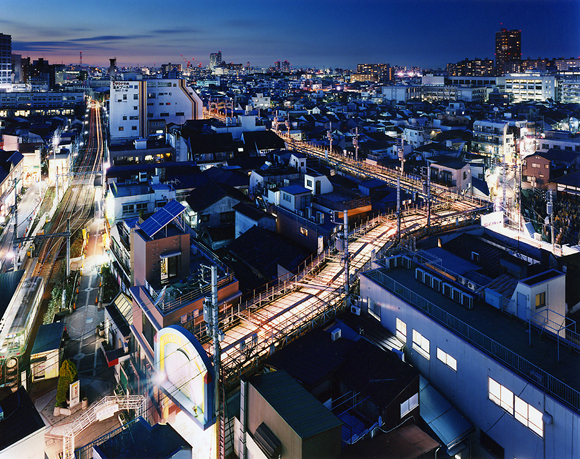 Shintaro Sato , untitled, Tokyo Twilight Zone
He is asked these questions in this interview: Why did you shoot the Tokyo Twilight Zone project with film? Why not even then use a digital camera? Sato says its:
Just a quality problem. Resolution, quality. I needed high resolution. If I could have used a digital camera equal to large format film, maybe I would have used that....I want to see much more details in my picture. If possible, I want to be able to see the expressions on the faces of people who are standing in the distance, after enlarging the photo. You can sometimes see people in my picture, after enlarging. I want to show what kind of face, what kind of person is there. So high resolution is important. And if I make a very large picture, for example 1 meter wide on one side, you can see a man who is lying on his side in his room. I can see that in this picture
He has now switched to digital.
February 7, 2012
Joni Mitchell: "Night of the Iguana"
This Joni Mitchell song is from Shine, which was recorded and released in 2007:
Shine was her first album of new songs in nine years, after 1998's Taming the Tiger.
February 6, 2012
English photography: Mark Edwards
Mark Edwards' recent landscapes around Bath and in East Anglia, which were made on an 8 x 10 inch field camera, were commissioned to accompany the Gainsborough landscape exhibition that was shown concurrently at the Holburne Museum.
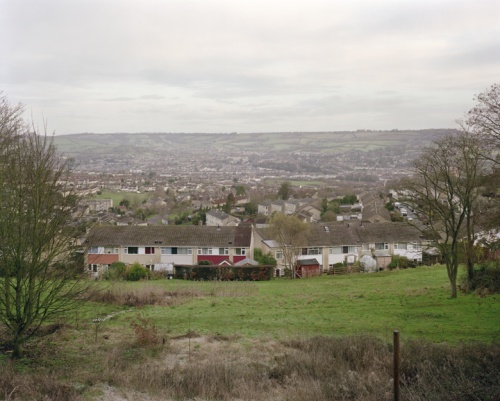 Mark Edwards, Bath, 2011
This rather drab landscape subverts the classic postcard view of the city--usually a series of symmetrical golden terraces with hilly gardens and the occasional spire. It is is composed with a Claudean symmetry that viewers will encounter in many of Gainsborough’s pictures. Trees frame the distant city and a scrubby, rocky foreground leads the eye to a dominant middle ground with a misty landscape beyond.
February 5, 2012
Helen Ennis on Australian landscape photography
Helen Ennis in her Australia and Photography says that the viewpoint in landscape photography in Australia has been almost exclusively European, as it has been the practice of settler Australia and the expression of a settler colonial culture.
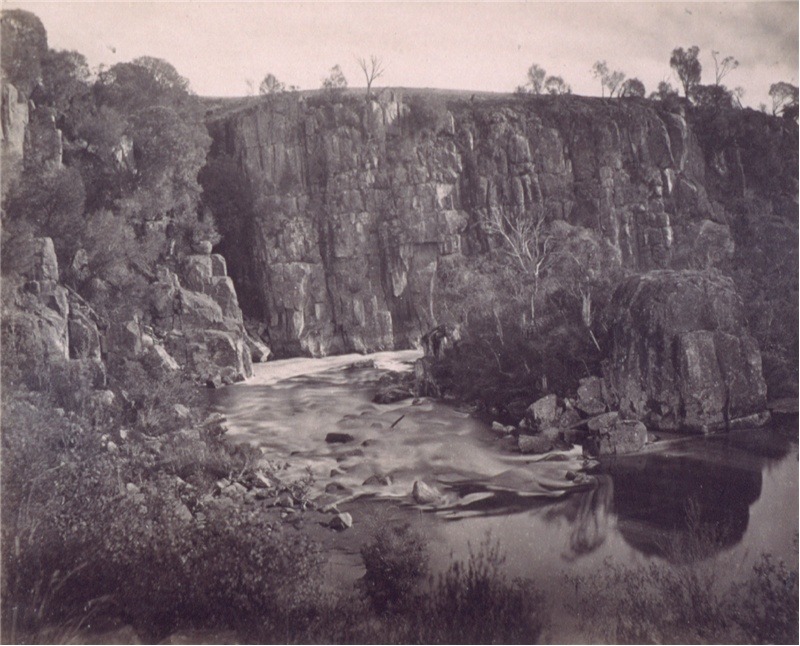 Anson Bros, Battery Rocks, Corra Lynn, Launceston, circa 1885, sepia toned
Ennis adds that:
In contrast to the United States where photography went hand and hand with the opening up of the American frontier, in Australia it did not ... From the outset landscape photographers in Australia have tended to base their practice on an extended and often intimate engagement with a particular area or site---for example, or through return visits ... The approaches developed by landscapists have proved remarkably consistent. The predilection has been for the settled, humanized landscape above all else, and inland areas rather than the coast. The modes of representation used most widely have generally been undramatic: the picturesque and a more prosaic that emerged in the 1890s and persistent for decades. The latter, a landscape of the everyday, can be seen in part as a response to the hugely influential work of of the Australian Impressionist painters known as the Heidelberg School. (pp. 53-54).
Consequently, the sublime, which flourished in early nineteenth century painting, had little sway on photographic practice. The natural world was not represented as overpowering or beyond human reach.
Photographic culture in the nineteenth century was primarily utilitarian and focused on documenting compelling proof of the success of colonization:
Landscapes that were ordinary rather than awesome provided a measure of reassurance to settlers who found themselves, not only displaced from 'home' on the other side of the world, but living in a vastly different, even alien natural and culture environment ... photographers and their clients did not seek out what was strange, wanting instead to reconcile difference.They shared the desire the desires for comfortable, palatable images of a landscape that in becoming domesticated was also becoming familiar---'possessed' in both literal and imaginative terms.
The picturesque, as expressed in photographs of rural properties where the worlds of nature and culture co-exist, was formalized in the view trade during the 1870s. The main task of photographers such as J.W. Beattie, Charles Bayliss, N.J. Caire, Charles Kerry, Henry King, Fred Kruger , J.W. Lindt, Charles Nettleton, Captain Samuel Sweet and Charles Walter was to define the unique and distinctive features of the Australian continent and Australian flora.
February 4, 2012
Dave Rowe: political cartoonist
This is a superb political cartoon about contemporary political events in Australia. David Rowe is one of Australia's best political cartoonists and Fairfax should be credited with allowing his work to be in the public domain and not hidden behind behind the Australian Financial Review's pay wall.
 David Rowe
One of the consequences of newspapers transitioning to a digital world is that their revenue drops, their capital value drops and they are obliged to cut costs until new revenue streams can come online. That means journalists, photographers, sub-editors etc are laid off as the news desk is downsized.
Is this happening to political cartoonists? I'm in no position to judge. I do know that David Rowe's cartoons are an integral part of Australian visual culture.
Mike Key: Queenstown, Tasmania
I've been looking at my photos from my phototrip to Queenstown, Tasmania in 2011 to see what would work for large format (5x4) when I'm there next month.
I've also been and doing a bit of research on the region as well as background to my phototrip, and I came across the Mike Key photographs of Queenstown around 1995:
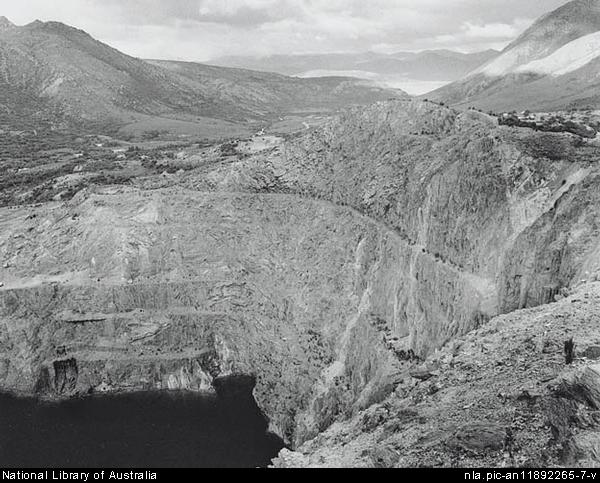 Mike Key, Iron Blow open cut mine,1995, silver gelatin print, NLA
I know next to nothing about Mike Key. He did an architectural photographic study of Newfolk on the Derwent River in 1995. It breaks away from the wilderness work of Olegas Truchanas and Peter Dombrovskis, which was centrally concerned with the protection of the natural environment and of wilderness in particular.
Key's work is not a political landscape even though he recognized that this landscape was heavily shaped by the mining industry. It has more in common with 19th century photography
February 2, 2012
obesity: the surgical option
The 2007-08 National Health Survey (NHS) measured the height, weight, hip and waist circumference of respondents aged 5 years or more and found that 61.4% of the Australian population are either overweight or obese. outliers. Victoria had the lowest incidence of obesity, at 17.0% of the population, with South Australia reporting the highest numbers at 19.6%.
Obesity has overtaken smoking as the leading cause of premature death and illness in Australia. In 2008, the costs associated with obesity in Australia were estimated to be more than $58 billion and it is only going to get worse.
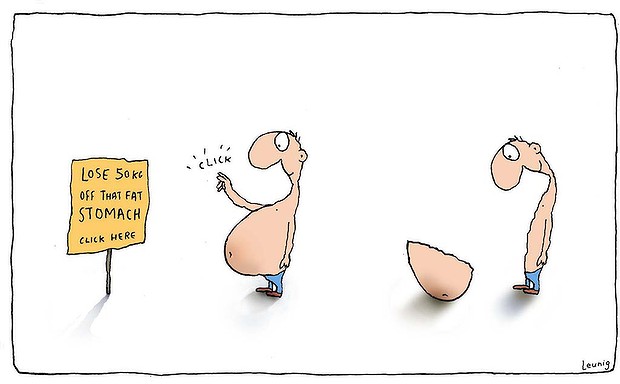
Australia today is ranked as one of the fattest nations in the developed world. On average, obesity reduces life expectancy by six to seven years.