|
July 4, 2011
Thomas Struff is a German photographer who trained at the Düsseldorf’s Künstakademie from 1973 until 1980 where he initially studied painting with Peter Kleemann and Gerhard Richter before settling on Bernhard and Hilla Becher's photography studio.
Struth began his survey of cities in his native Düsseldorf, Germany:
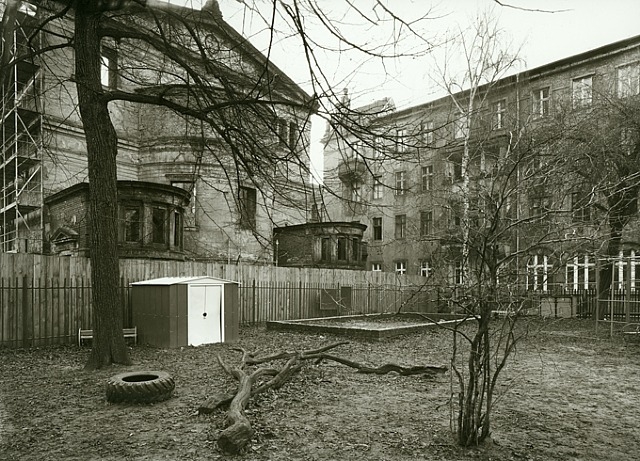 Thomas Struth, Elisabethkirchstrasse, Berlin, 1992
Avoiding subjectivity through a centralized viewpoint and comparative technique, Struth catalogued with clarity and dispassion the unselfconscious structures that characterize a culture—that irreducible mélange of textures, shapes, and the scale of its streets.
His German street work purposely does not focus on anything in the field of vision of the photograph, everything is sharp, nothing is blurred. These are views of views of banal buildings, prospects of streets without qualities, anonymous facades. Usually in black and white, they present a frontal, eye-height view, with no optical distortion to disrupt the impression that this is a neutral, objective recording of reality.
It was on a scholarship to New York in 1978 that the artist found an ideal combination of conceptual order and practical chaos to hone his rigorous vision. Over the next decade, Struth expanded his project geographically to include many other cities in Western Europe, America, and Asia. He also abandoned one-point perspective and serial comparison to locate meaning within individual images, rather than between them, creating distinctive portraits of place that chart the historical transformations affecting our urban environments.
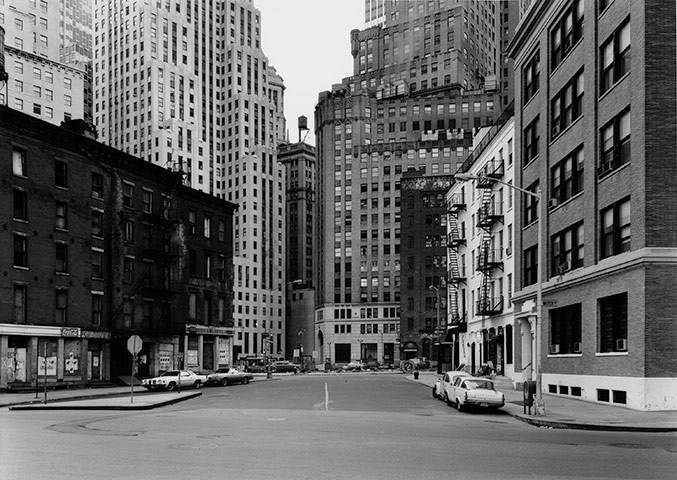 Thomas Struth, Coenties Slip, New York/Wall Street 1978
In this interview in The Guardian Struth says his photographs of Düsseldorf's streets and buildings, where the old and austere meets the modern and faceless, suggest:
a kind of embedded history of German power and identity that, in the long years of post-war silence, was not acknowledged either by those in power or by ordinary German citizens. For me, initially, the question was: how do you live with history? Then I began to ask: how is history embedded in the architecture of a city? How does a community represent itself in its architecture, truthfully or otherwise?
He adds:
Many people think that the impulse to take a photograph comes from the subject matter. But, for me, it comes from a wish to talk about certain things that fascinate or bother me, politically or socially. And then I choose the subject that will enable me to address that subject. Otherwise I would go around aimlessly photographing anything and everything.
|


