April 30, 2012
'I Spy' photography
Beat Streuli shoots images for his large-scale photographs, videos and photographic installations in dense urban spaces. Often focusing on single people in amidst the constant flow of the street, his works captures both the daily drama of individuals and the rhythm of the multitude.
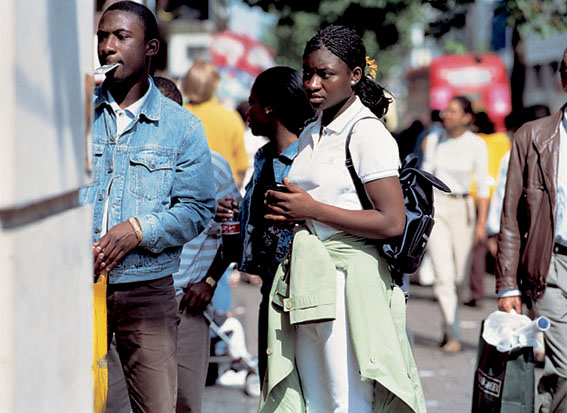 Beat Streuli, Oxford St, England, 1997
He is included in this I Spy: Photography 1938-201 and the Theatre of the Street, 1938-2010 exhibition at the National Gallery of Art in Washington --along with Walker Evans, Harry Callahan, Robert Frank, Bruce Davidson and Philip-Lorca diCorcia. The text by Sarah Greenough, senior curator and head, department of photographs, says:
All these photographs and videos court happenstance, and all these artists view the city as an endless spectacle. In this age of cell phone and security cameras, YouTube and Google Earth, the photographs also make us aware of our uneasy relationship to the camera, suggesting both our fascination and discomfort with its intrusion into our daily lives.
But there are no photographs from security cameras on the street, Google Earth, or the Google's Street View in the exhibition. So it is reduced to the 'theatre of life' on the street and to the personal expression of the artist photographer.
Greenough ought to have been a little more critical of "I Spy" as there are surveillance issues with respect to Google's street view camera on top of a car --ie., the Street View's intentional Wi-Fi data collection program which it processed to see what the "favourite" sites appeared to be.
The Street View project was an ambitious plan to photograph and map the world’s streets that also involved gathering information about local wireless networks to improve location-based searches. It also included code to collect unencrypted data sent from homes by computers — e-mails and Internet searches — as specially equipped cars drove by. That data collection occurred from 2007 to 2010 and Google knew about it.
If we limit ourselves to the frame of the art institution, then we can see that Streuli is part of the "I Spy" world because his ongoing series depicts individuals and crowds caught and framed unawares by the imperious gaze of the camera’s telephoto lens. The photographer remains visibly ‘invisible’ in the sea of pedestrians on the shopping streets of the world’s big cities: London, Tokyo, New York, Sydney.
Streuli, who is sometimes ensconced inside a cafe, then presses the shutter release when the people on the street are in an unguarded state--- when they let the mask of their public persona slip in order to be alone with themselves for a moment in a public place.
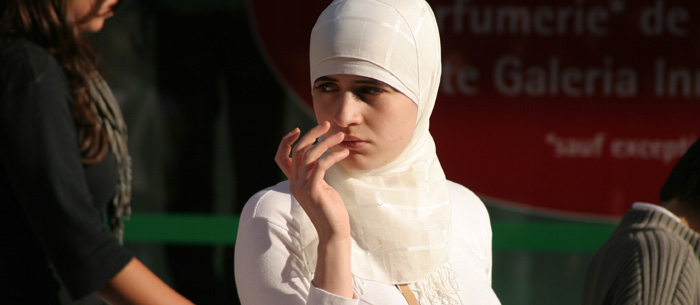 Beat Streuli, Bruxelles Midi, 2006
Bruxelles Midi (2006), a series of photographic portraits made in Brussels at the Bruxelles-Midi railway station and a nearby market, both of which are situated in proximity to the largely Muslim immigrant neighborhood where the artist lived at that time. These are excellent images and Streuli captures the grace and elegance of people often reinforced by the way that he frames them and the way that he balances formal and perceptual concerns.
My problem is with the curator's text. Greebough ought to have been critical of her "theatre of life" concept. Streuli presents a fragmented collage of portraits utterly disassociated from the complexity of the urban high shopping street, because these streets are framed by the signs of conspicuous consumption that seduce potential consumers into buying goods they do not need. The consumer context has been cut out.
April 28, 2012
photobooks
I've been working on my photobooks whilst Suzanne is in Europe to walk part of the Santiago de Compostela pilgrim trail. There's been lots of rain in southern France in the early spring and the mud is everywhere.
Whilst working on the photobooks I have found that the Posterous micro publishing software allows me to go back to an old post and add large photos to it. In contrast, though Tumblr allows me to edit the text and swap a large photo in an old post, it does not allow me to add additional large pictures. So I cannot build upon the initial sketch in an old post.
I didn't really know much about either publishing platform when I started the photobooks so I decided to experiment with them. I started a different book on each one to see how things turned out. It then took me a while to get used to the software.
Unfortunately, the Adelaide book was started on the Tumblr publishing platform, and its that book that I want to add photos to. So I've started the process of moving the old material of the Adelaide book from the Tumblr platform to the Posterous one.
I have found that Tumblr is much more suited to posts of individual image and minimal text. So I'm reworking the early posts on the old Tumblr blog for an 'on the road' book. Most of the pictures for this book will come from my archives that have been built up from various trips over the years.
April 27, 2012
Paul Foelsche: landscape studies
Paul Foelsche's photography might have remained a hobby if it wasn't for the International Exhibitions of the 1870s. The South Australian Government was keen to promote its 'northern territory' to international investors, and Foelsche was asked to contribute photographs of Darwin and of the townships, mines, and country to the south.
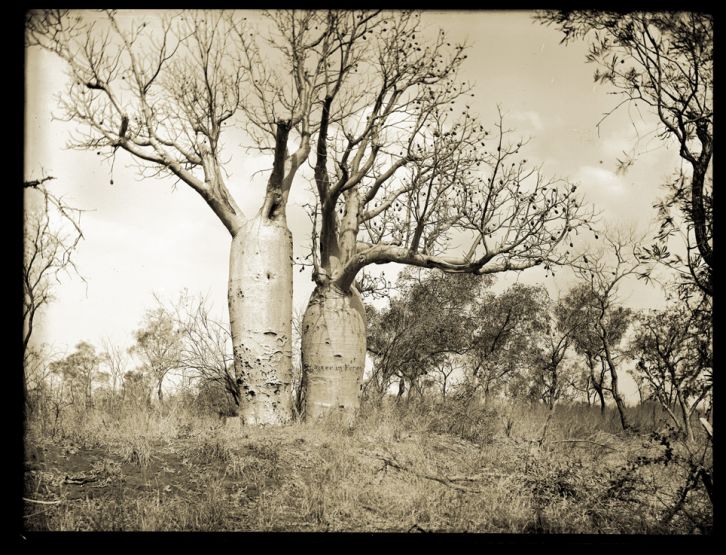 Paul Foelsche, Boab tree, Victoria River, Northern Territory, 1891
This is frontier photography made by an police Inspector who commanded the Northern Territory police force for 34 years from 1870 to 1904 and who explored the landscape around Darwin. He appears to have built on the work done by Captain Sweet in the Northern Territory.
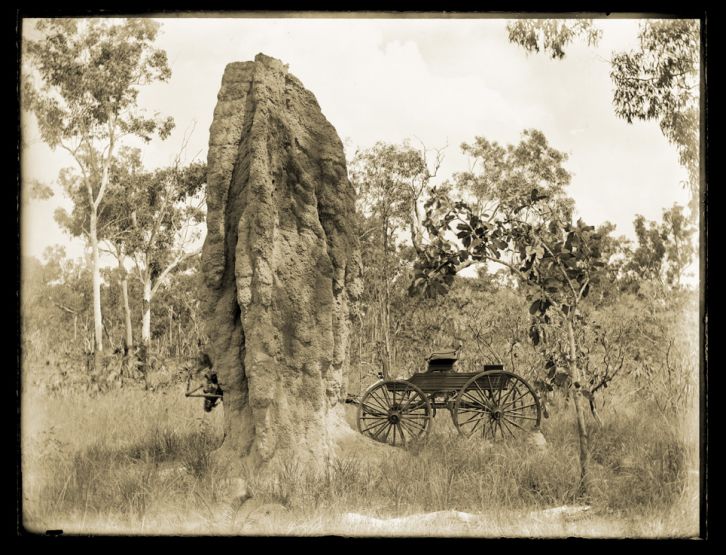 Paul Foelsche, Termite nest, with Corymbia foelscheana, early 1880s
Foelsche generally avoided large panoramas over a wide extent of country.
April 26, 2012
Martha Rosler: photography + the crisis of the real
I'm at a bit of a loss to know how to continue with my Rethinking documentary photography after returning from Tasmania. So I thought that I'd do a bit of re-reading of some old texts on documentary photography that I'd read some time ago. Richard Bolton, ed., The Contest of Meaning: Critical Histories of Photography (Cambridge, Mass.: MIT Press, 1990) was one such text.
I came across an old essay by Martha Rosler, and in digging around on the internet I came across her 1990s essay 'Post Documentary, Post Photography' in Decoys, Disruptions: Selected Writings 1974-2001. She refers to the various challenges that radically undermine photography's fundamental claim to a unique capacity to offer a direct insight into the real. Or to put it another way the Enlightenment ideal that drove the invention of photographic technology in the first place—a form of representation that promised unmediated knowledge of the material world.
The challenges to this ideal of photography as a window on the world,t have, in turn, produced, something of a crisis among artists and intellectuals, and troubled some in journalism and the legal profession. This 'crisis of the real' is understood in terms of reality being sold out in favour of manipulation and artful practiced, as for example computer programs that easily manipulate and alter the image. This leads to a turning away from an interest in indexicality, the privileged viewpoint of witness, and embeddness in a particular moment in space and time.
Her argument is this:
documentary, a polarizing practice that must inevitably provoke opposition, is perpetually on the brink of its demise. Those hostile to the demands of "crusading " documentary may find it easier to call for its end, ironically enough, in the name of ethics and "responsibility. Second, as postmodernists claim, demands for "straight information" without interpretation are unrealistic, for there is no voice from outside particular human communities. Strict objectivity, a standard derived from journalistic ethics, may prove an inappropriate ideal for documentary---as documentation and photojournalists already know---but so is an alibi of personalization, sentiment and disengagement. Third, the partial melding of the photographic audience and its subjects has put great pressure on the institutionalized methodologies of documentary for interpretation has become a field of perpetual contestation. Finally, the art world embrace of photography can squeeze documentary to death---or maybe I've got cause and effect reversed, for it could be that all of photography is already a nostalgic craft, given the explosion of computer-based manipulations that drive our stepping off into the post-photographic moment, leaving behind both photograph and photographer.
Rosler says that we continue to defend documentary because we need it and because it is likely will to continue, with or without art world theorizing. This is because the division between rich and poor will widen in the US and that her idea of postmodernism does snot extend to the idea of a world with no coherent explanation of differential social power and advocacy of ways to right the balance. She finishes:
Documentary's best course, it seems to me, is to provide a balance between observing the situation of others and expressing one's own viewpoint--which ought to include some form of analytic framework identifying social causes and remedies.. In pursuit of this documentary will continue to negotiate between sensationalism on the one hand and instrumentalism on the other.
My initial reaction to re-reading this essay is that by documentary Rosler means social documentary photography, that is one dedicated to showing the life of underprivileged, disadvantaged, or marginalised people and highlights issues of power, representation and communication. Rosler, like Alan Sekula, was arguing for a new social documentary photography that could function as both as a form of social critique and an oppositional cultural practice.
What is missing is an account of the documentary mode of picture making . We could envision, for instance, probing how photographs are used to convey messages, how photography is related to consumerism, and how photography is employed to exert political control. It could be a critical commentary on questioning and commenting on photographic practice itself as employed in advertising, or modernist art photography where a photo with its concern for the value of originality and authorship.
The documentary mode of picture making is important because it would include include Eugène Atget, Karl Blossfeldt, Walker Evans, Albert Renger-Patzsch and August Sander. Rosler makes no mention of the Dusseldorf school of photography with its roots in the industrial landscapes and structures of Bernd and Hilla Becher in the 1970s. This reached back to the 920s German art tradition of Neue Sachlichkeit or New Objectivity, and to August Sander, and it was continued in very diverse ways by Andreas Gursky, Thomas Ruff, Thomas Struth, Elger Esser , Jörg Sasse, Simone Nieweg and Candida Höfer.
This suggests that hotography's distinctive value lies more in its humble documentary function, its intimate examination and commemoration of everyday life, than it does in its obsolete technology.
April 24, 2012
Ed Ruscha: photography + conceptual art
Since the weather was no good for photography at Victor Harbor I've spent the afternoon working on a section of my Victor Harbor book in which reference is made to the photographs of Ed Ruscha
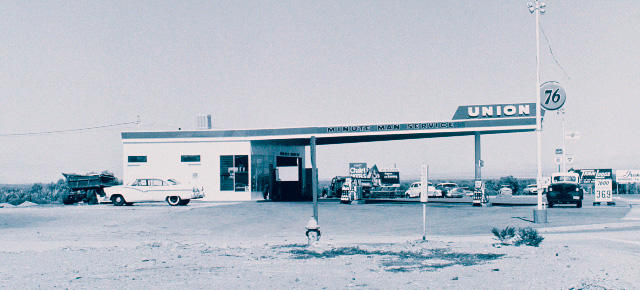 Ed Ruscha, Union, Needles, California, from Twentysix Gasoline Stations
This particular text was important in art history terms---in the context of American-style formalism, Abstract Expressionism and Colour Field painting--as Ruscha started from architecture as referent, deployed photography systematically as the representational medium, and developed a new form of distribution, ie., the commercially produced book as opposed to the white cube art galley.
The mode of photography chosen was explicitly situated as much outside of all conventions of art photog- raphy as outside of those of the venerable tradition of documentary photogra- phy, least of all that of "concerned" photography. This was a deadpan, anonymous, amateurish approach to photographic form that was referenced by the New Topographics movement in the US in the 1970s.
April 23, 2012
Captain Sweet: views
Captain Sweet arrived in Adelaide to set up his photographic practice in 1866 and he spent the next twenty years photographing the most important period of South Australia’s development. He photographed the growth of the city from its infancy to economic, cultural and industrial maturity; witnessing the construction of some of Adelaide’s most important buildings and the establishment of its first major transport and communication systems. He remained the foremost landscape photographer in South Australia until his death in 1886.
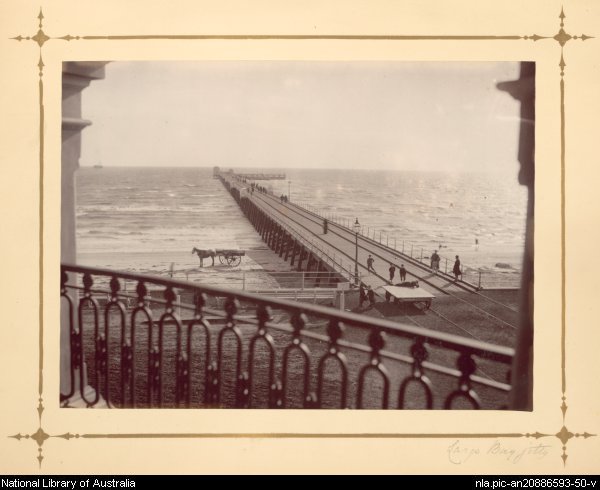 Samuel White Sweet, Largs Bay Jetty, between 1869--1889, albumen silver, NLA
Captain Sweet worked with wet plate negatives and albumen silver paper for most of his career. In 1880 he introduced dry plate negatives to South Australia. Dry plates were glass plates coated with a gelatin emulsion of silver salts. They did away with all the messy chemicals of wet plate negatives, were far easier to use and much more sensitive, requiring shorter exposure times. Glass plates continued to be used into the early twentieth century, when nitrocellulose roll film became generally available.
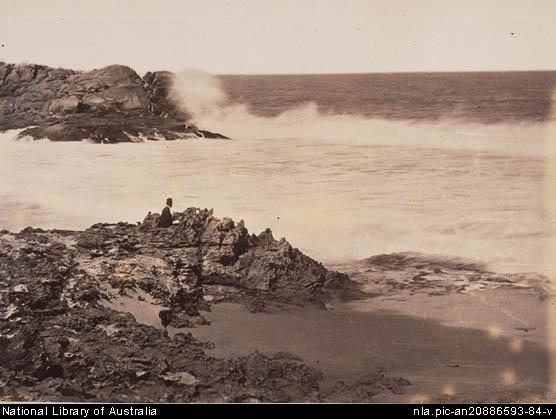 Samuel White Sweet, Port Elliot,] between 1869 and 1889, gelatin silver, NLA
This style of photography was prior to Pictorialism which as the first 'art movement' in photography in Australia and internationally.
April 22, 2012
Frank Hurley: Adelaide
I've been searching for pictures of Frank Hurley in Adelaide, given my work on my book on Adelaide. Most of Hurley's Adelaide work--a city portrait-- is pretty pedestrian--a celebration of modernization (Adelaide University) and a representation of the statutes of imperial wars. This is one of the more interesting pictures:
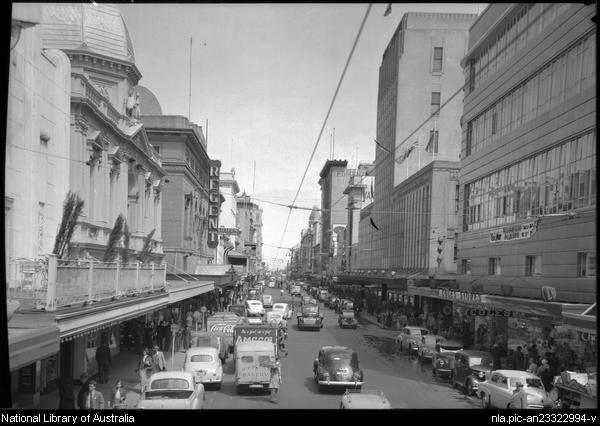 Frank Hurley, Rundle Street, Adelaide, NLA
Hurley represented Australia as a privileged place, open, spacious, rich in resources and with a manifest destiny to achieve greatness—'the most valuable acquisition Great Britain ever made'. In this last phase of his life --the 1950s he created a large body of work which reflected his own obsessive celebration of the land, the people and the abundant opportunity of Australia.
John Thompson says that the definitive Hurley title during these latter years was Australia: A Camera Study first published in 1955. It Similarly from the late 1940s and throughout the 1950s Hurley published camera studies of Queensland (1950), Western Australia (1953), Tasmania (1953) and Victoria (1956) as well as for Sydney (1948) and the Blue Mountains and Jenolan Caves (1952).
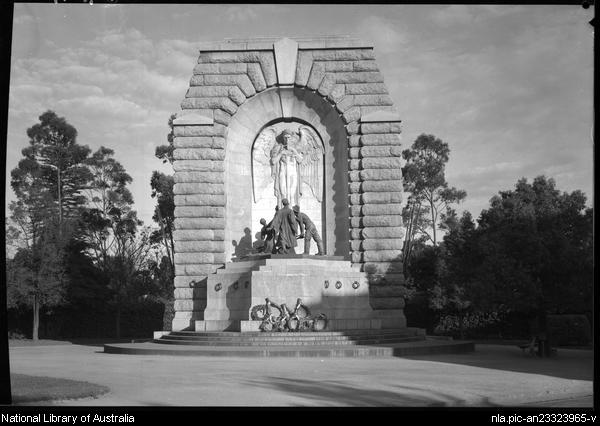 Frank Hurley, War Memorial, North Terrace , Adelaide, NLA
Thompson says that in the Australia: A Camera Study text:
Hurley's purpose and his overall interpretation was largely celebratory. He presented a vision of wide open spaces, successful rural industries, the happy assimilation of migrant families, industrial development, modern spacious cities and a well-ordered but highly conformist society.
Australia was a modern and dynamic country premised on the commercial exploitation of the country's abundant natural resources.
April 20, 2012
Levon Helm: Only Halfway Home
This is a short film inspired by and featuring music from Levon Helm's album Dirt Farmer.
The album is an absorbing look back at his roots as the son of a farm family in the rural South. It is a compassionate and full-hearted set of roots music from a master of the form.
A song from Dirt Farmer is The Mountain:
The video has mining photographs by Lewis Hine.
April 17, 2012
photography: gear acquisition syndrome
I've been caught up buying a new digital camera to replace my first digital camera---a Sony DSC R1--- which had been stolen in Melbourne last November. I'd decided that digital photography had improved to the point where it surpassed film at the 35m level, and so I wanted to step up in image quality.
Given the rapid obsolescence of digital technology---digital cameras are like computers--- my decision was to buy a camera body that I could use my Leica lenses with. That would then allow me to change camera bodies when needed and to keep the expense of the continual digital upgrade down. I intensely dislike the upgrade treadmill we are on with respect to computers, software and digital cameras.
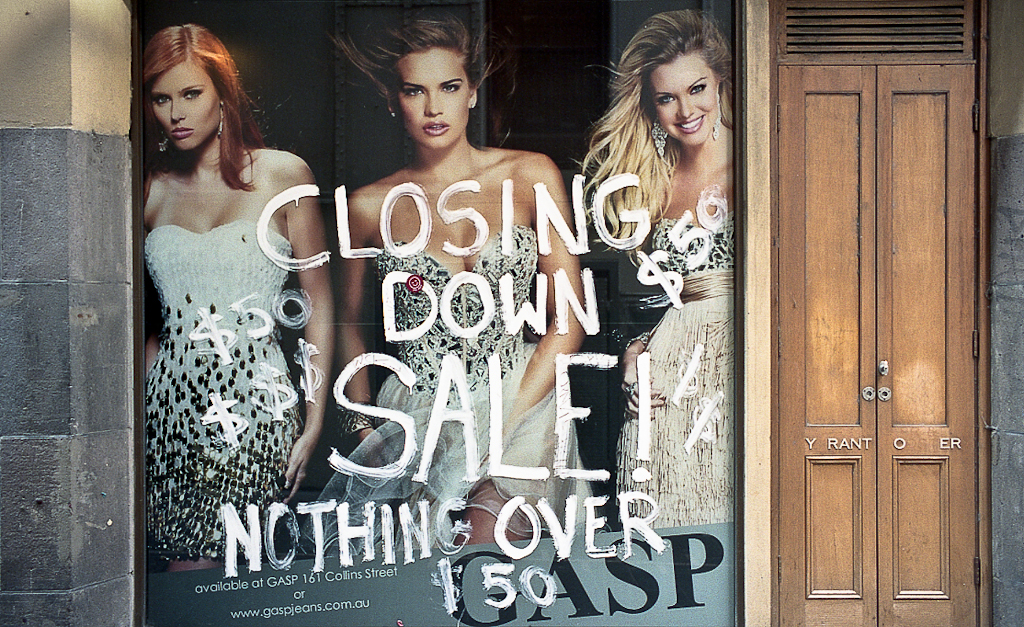 Gary Sauer-Thompson, Flinders Lane, Melbourne, 2011
It boiled down to a choice between a Sony Nex-7 and a Fuji X Pro-1. I spent a lot of time-- too much time--- on both various websites reading the reviews and the comments by the gearheads and frequenting camera shops to hold the cameras.
In doing so I became aware of the technological culture of photography. This wasn't just the gear acquisition syndrome--the urge to acquire and accumulate lots of gear --and the endless discussions over the comparisons with different lenses, at different apertures, the sharpness and “characteristics” of each lens, as well as the flaws and strengths of the different camera bodies.
The culture was one in which the technology determined the photography. Photography was the gear not the picture produced by the camera. Photography had been put in the box--the frame of technology, as it were, and not as a visual art. We often think of technology as the "application" of a particular machine or tool--the camera---technology as an instrument, a means of getting things done.Doing the job for the client.
But what if this standing of human beings to technology, this orientation to the world, this instrumental way of thinking is misleading or wrong?
What I saw on those blogs and websites is that we are enframed by technology. We photographers are a set of raw materials, a "standing-reserve," to be used by the multinational digital camera industry. They've got us on a treadmill. They too are on a treadmill--enframed by technology.
looking for Atget in Paris
Suzanne flies out to France tomorrow to walk part of the Santiago de Compostela pilgrim walk. She asked me to find out where she could see the photographs of Eugène Atget in Paris.
One reason is that Agtet, our grey standard poodle whom we recently lost at the end of our Tasmanian trip, was named after Eugène Atget.
I'm dammed if I can find any of Atget's work on show in Paris at the moment. I did come across the digital collection of the Bibliothèque nationale de France called Gallica, which has a collection of Atget's images.
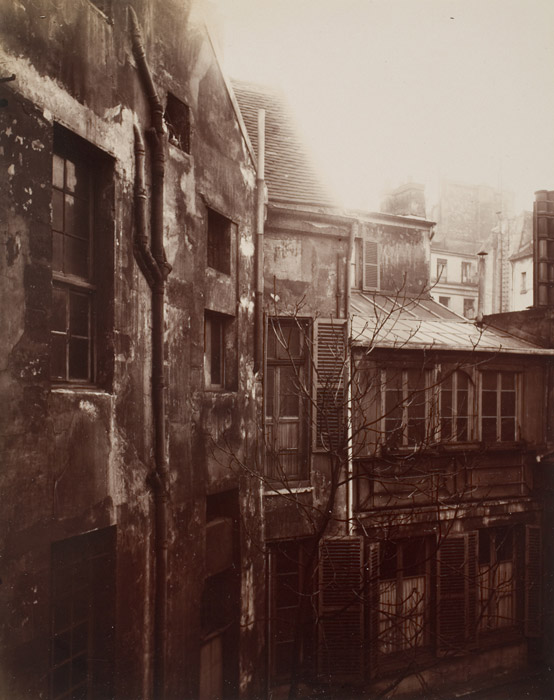
Eugène Atget, Cour du Rouen, 1922
In his early views of Paris, Atget the documentarian sought to illuminate his subject with an even clarity, the best to convey information. He usually made such images in the middle of the day, when shadows were minimal.
Atget's late photographs, however, are frequently marked by light and deep shadows. The ones of the parks and gardens in and around Paris were often made early in the morning. These pictures use light and shadow to create a mood rather than to describe a place:
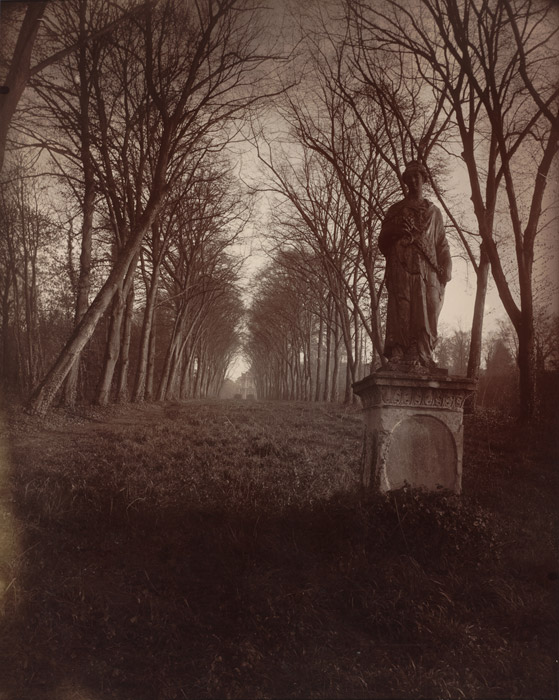 Eugène Atget, Parc de Sceaux, 1925
According to the National Gallery of Art in Washington, Atget made a series of 66 photographs at the Parc de Sceaux between March and June 1925.
Like the other grandiose estates near Paris to which Atget was drawn, Sceaux was saturated with history. Built in the 17th century for Jean Baptiste Colbert (1619–1683), finance minister to Louis XIV (1638–1715), the Versailles-like property was badly damaged in the French Revolution and then partly reconstructed and renovated in the mid-19th century. The regional government acquired the estate, which had fallen into disrepair, in 1923, and Sceaux's buildings and outdoor sculptures were classified as historic monuments in 1925, the year in which Atget made his photographs.
Atget worked at Sceaux just before renovations were undertaken to transform it into a public park. The images that Atget made in the overgrown and partly ruined grounds are suffused with melancholy.
April 15, 2012
the last Grateful Dead show
The last show was on the 7/9/95 @ Soldier Field in Chicago. One month later Jerry Garcia would be dead.
The song in the video below is from this concert and it is entitled "So Many Roads":
It's been stripped down to its basics. It is a world weary interpretation. It was the end of the road.
April 11, 2012
Adelaide Festival: Visual Arts
The Adelaide Festival of Arts was on whilst I was a phototrip in Tasmania. So I missed the visual arts program.
I was interested in seeing Parallel Collisions at the Art Gallery of South Australia as it was a presentation of contemporary Australian art. I was curious to have a look at the novella in pictures and words by Max Pam (photographer) and Robert Cook (writer).
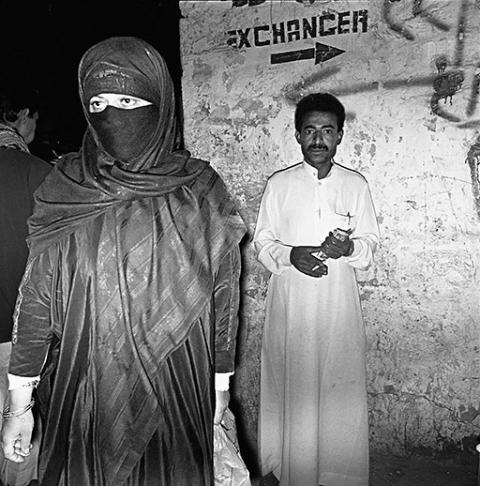 Max Pam, Yemen, 1993, silver gelatin print
I wanted to see how Cook and Pam developed the relationship between image and text as I was exploring this with my Adelaide book. They made it a collision --a modernist opposition.
Robert Polidori: Zones of Exclusion
Robert Polidori is a New York based architectural and urban photographer and a staff photographer at The New Yorker. His able to combine his personal work with his job.
The series Zones of Exclusion: Pripyat and Chernobyl (2003) is what intrigues me from his body of work --- representations of the devastation both inside the Chernobyl nuclear plant and in the nearby town of Pripyet.
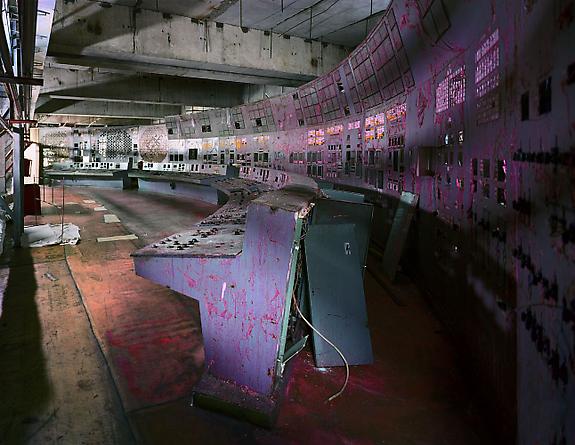 Robert Polidori, Control Room, Reactor 4, Chernobyl, 2001
In 1999 Polidori photographed what had been left behind in the area surrounding the nuclear power plant, which were declared unfit for human habitation in April 26, 1984 The zones of exclusion includes the towns of Pripyat and Chernobyl. He photographed vacant apartment blocks, highways, classrooms, and dachas being reclaimed by the forest, and the control rooms themselves.
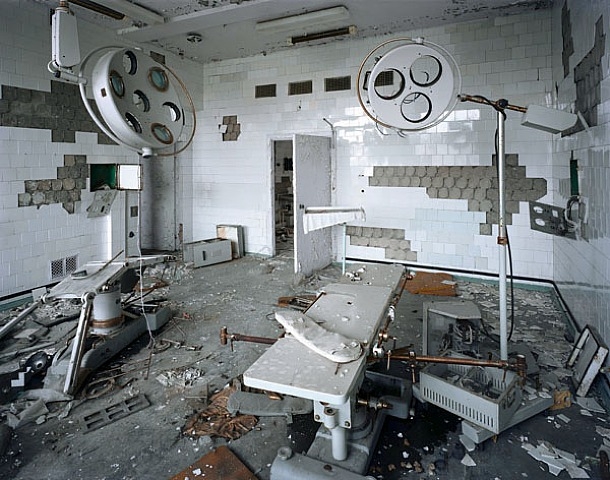 Robert Polidori, Operating Room, 2001, from the series Zones of Exclusion
April 7, 2012
caricature
In its purest form caricature—from the Italian carico and caricare, "to load" and "to exaggerate"—distorts human physical characteristics and can be combined with various kinds of satire to convey personal, social, or political meaning. It is a "loaded portrait" and so it is different from a cartoon, which is the satirical illustration of an idea.
In Fantastic, Deadpan & Deadly in the New York Review of Books David Bromwich refers to the exhibition of caricatures recently on view at the Metropolitan Museum of Art entitled Infinite Jest: Caricature and Satire from Leonardo to Levine.
 David Levine, Lyndon Johnson
The above drawing originally appeared in the May 12, 1966 issue of the New York Review of Books with the article Vietnam: The Turning Point. It refers to LBJ with lifted shirt, revealing the scar of a removed gallbladder in the exact shape of a map of Vietnam in front of reporters at Bethesda Naval Hospital. It allude to Johnson's obsession with the bombing maps.
The exhibition is a history of a mode at once fantastic and deadpan, which was made possible by Hogarth and brought to perfection by his successors during the Napoleonic Wars and which includes the great names of caricature—James Gillray, Thomas Rowlandson, Honoré-Victorin Daumier. Caricatures and satires are generally created to comment on specific events or moments in history.
April 4, 2012
Philip Wolfhagen: northern Midland landscapes
The Academy Gallery at the School of Visual and Performing Arts of the University of Tasmania. They were showing Hits and Memories: ten years at the Academy Gallery exhibition. The exhibition will include a showcase of Academy Gallery archive media, exhibition catalogues and memorabilia associated with the Academy Gallery's history.
The work of Philip Wolfhagen, the landscape artist, is included:
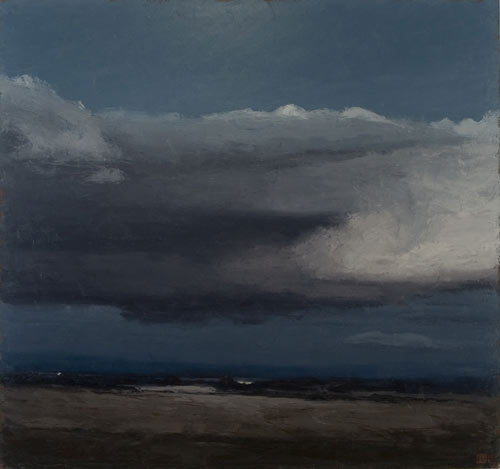 Philip Wolfhagen, Winter Nocturne IV, oil on canvas
If Wolfhagen is a painter of the Australian landscape, then he is one whose atmospheric work has focused on Tasmania, and on the northern Midlands (around Longford) in particular. He works in the landscape tradition begun in late 1800s with the work of John Glover.
These are pastoral landscapes --not those of wilderness ---as Wolfhagen look at the land from a white settler point of view. They are about place. These are studio- based works, created as memories of particular places and cued through photographs as well as sketchbook notes and often are, as in The Inner Edge (2004), a tonal narrative of the changing light across the land.