May 29, 2012
May 27, 2012
on Flickr
Matt Honan in How Yahoo Killed Flickr and Lost the Internet at Gizmodo says that until three years ago Flickr was the best photo sharing service in the world. Nothing else could touch it. If you cared about digital photography, or wanted to share photos with friends, you were on Flickr.
That was my judgement when I joined Flickr. However, Honan says that today:
The photo service that was once poised to take on the the world has now become an afterthought. Want to share photos on the Web? That's what Facebook is for. Want to look at the pictures your friends are snapping on the go? Fire up Instagram.Even the notion of Flickr as an archive—as the place where you store all your photos as a backup—is becoming increasingly quaint as Dropbox, Microsoft, Google, Box.net, Amazon, Apple, and a host of others scramble to serve online gigs to our hungry desktops.
The site that once had the best social tools, the most vibrant userbase, and toppest-notch storage is rapidly passing into the irrelevance of abandonment. Its once bustling community now feels like an exurban neighborhood rocked by a housing crisis. Yards gone to seed. Rusting bikes in the front yard. Tattered flags. At address, after address, after address, no one is home.
Today Flickr is under attack from Facebook and Instagram. Honan adds that:
Flickr's mobile and social failures are ultimately both symptoms of the same problem: a big company trying to reinvent itself by gobbling up smaller ones, and then wasting what it has. The story of Flickr is not that dissimilar to the story of Google's buyout of Dodgeball, or Aol's purchase of Brizzly. ....As a result, Flickr today is a very different site than it was five years ago. It's an Internet backwater. It's not socially appealing.
Yahoo strangled it for resources, and today Flickr is an archive of nostalgia that you love dearly, on the rare occasion you stumble across it.
My own understanding is that Flickr is becoming, or has become, a niche place where people who take photography more seriously go. I have started to use Flickr more for samples and for creative sharing.
Australian photography: Stephen Spurling 111
When I was in Queenstown I started to do some research on Stephen Spurling 111. Spurling's' photographic legacy--both landscape and industrial---is usually mentioned in brief overviews--eg., Roslynn Haynes 2006 text Tasmanian Visions: Landscapes in Writing , Art and Photography or overlooked. These do not provide enough information to make any judgements about his body of work.
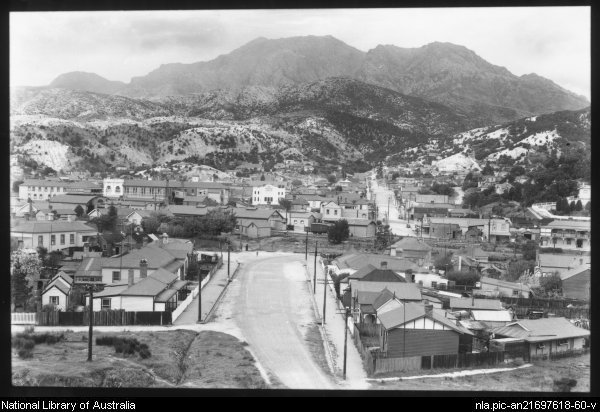 Stephen Spurling 111, Queenstown and Mount Owen, circa 1912, NLA
For instance, Gael Newton only made passing reference to the photographic work of Stephen Spurling 111 in her texts of the 1980s, namely her Silver and Grey: Fifty Years of Australian Photography 1900 - 1950 and Shades of Light: Photography and Australia 1839-1988.
Spurliing11 is also absent from Helen Ennis' Intersections: Photography, History and the National Library of Australia despite the NLA 's extensive collection of Spurling's photographs.
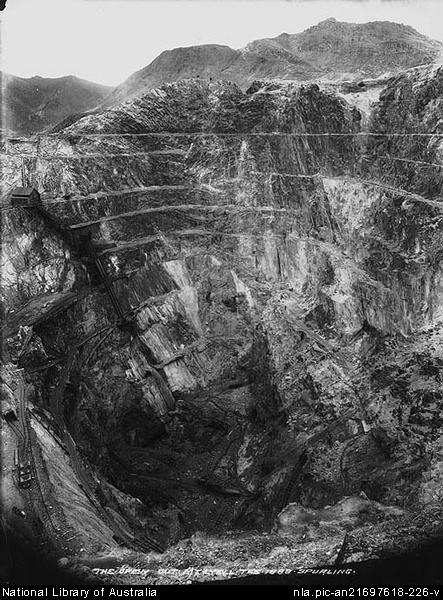 Stephen Spurling 111, The Open Cut, Mt Lyell, circa 1912, NLA
Burgess' interpretation of Spurling 111's work in her PhD thesis---- The Spurling legacy and the emergence of wilderness photography--- is that his photographic legacy is not his industrial---mining and railway---landscapes, which Burgess interprets as records or documents of progress and development.
The legacy is associated with exploration, bushwalking and adventuring in the unknown wilderness, as it is the emergence of wilderness photography from his long treks in the Tasmanian bush and mountains. Burgess links the wilderness photography with scenic views (the picturesque), the promotion of tourism, the scenic tradition, Romanticism and the paintings of William Charles Piguenit.
May 18, 2012
researching John Watt Beattie
I'm in the Queenstown library searching online for photos by JW Beattie of the Queenstown Mt Lyell mine for their rephotography project.
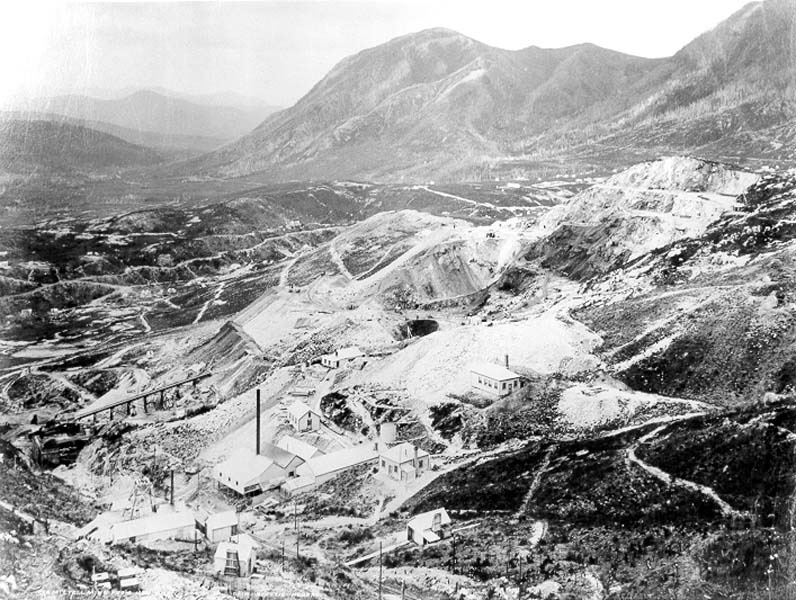 John Watt Beattie, Mt Lyell mine, 1890s
Beattie had been employed by the North Mount Lyell Company to photograph between Gormanston, Tasmania and Kelly Basin in the 1890s. I understand that he produced a substantial body of work.
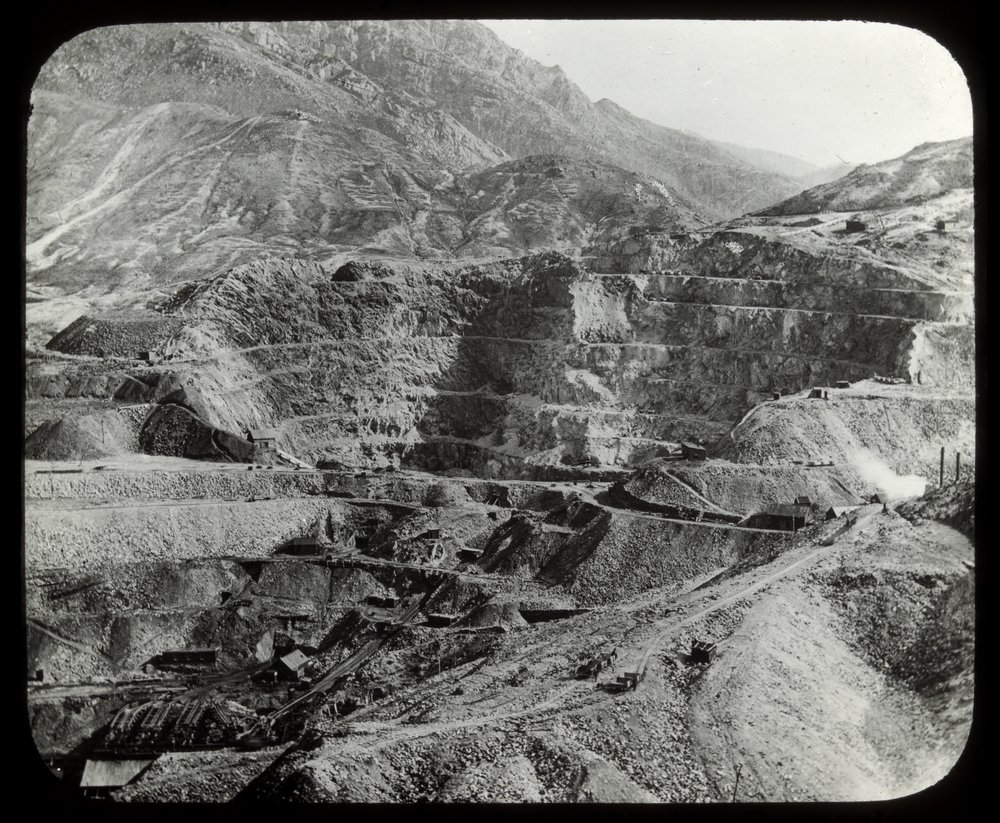 John Watt Beattie, Mt Lyell copper mine, 1890s
I'm sure that he did more of the Lyell open cut mine but these do not appear to be online. It would have been nice to compare a now and then picture of the open cut mine for the re-photography project. The open cut mine was abandoned in the 1990s.
May 16, 2012
a surrealist conversation
The latest issue of Surrealism and the Americas is a special issue on Women in the Surrealist Conversation. Katherine Conley, the editor, says that the proliferation of academic research means that it is not possible for critics to claim that women did not play a significant role in the surrealist conversation.
By the latter Conley means:
the launch, exchange and constant adjustment and reformulation of circulating ideas , images, metaphors, and jokes typical of a group conversation conducted in a cafe or over a dinner table or a banquet ... Women had a place at the table and their work in art and writing reflects their visible presence in the intellectual economy of Surrealism .... The voices, paintings drawings, poems, writings, sculptures, photographs, essays, dances and films by women only consolidated what had always been a movement rooted in intimacy, of the self with the self as well as with others.
This edition of the journal shows how women in the Americas contributed to the Surrealist conversation through their responses, interventions, and appropriations of the questions that concerned the core group as it migrated from France to Spain, New York, Connecticut and Mexico.
May 12, 2012
industrial landscapes
Now that Suzanne has arrived back from her trip to Europe I've made arrangements to return to Queenstown, Tasmania to rephotograph the Mt Lyell Open Cut mine with my 5x4 Linhof. I wasn't able to do that on the March trip because of lack of access to the mine. I only had time for a quick look using a digital camera.
The classic work in this kind of industrial landscapes is that Edward Burtynsky's Australian Minescapes; a series structured around the aesthetics of the industrial sublime.
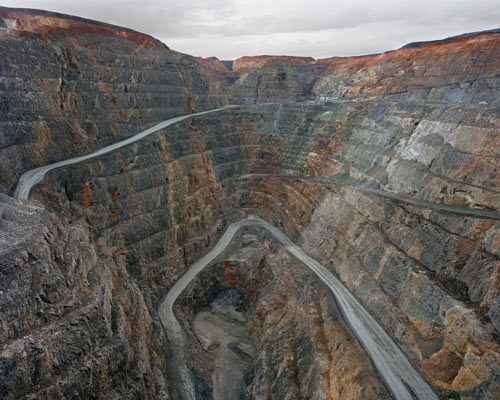 Edward Burtynsky, Superpit, Kalgoolie, #1, Western Australia’, 2007
Australian Minescapes, was commissioned by FotoFreo, with the support of BHP Billiton Iron Ore and the FotoFreo Angels. It was done in 2007 and exhibited at the Western Australian Museum - Maritime for FotoFreo in 2008. The series includes 27 large scale framed chromogenic photographs and 1 triptych taken at various minesite locations in Kalgoorlie, Dampier and Lake Lefroy in Western Australia. This collection were subsequently gifted to the Western Australian Museum by Edward Burtynsky.
Burtynsky photographed these minescapes from a high viewpoint – sometimes from the air, in a helicopter. What we see is often unrecognisable as landscape at all because of the sheer size and brutality of the human intervention by the Big Mining multinationals.
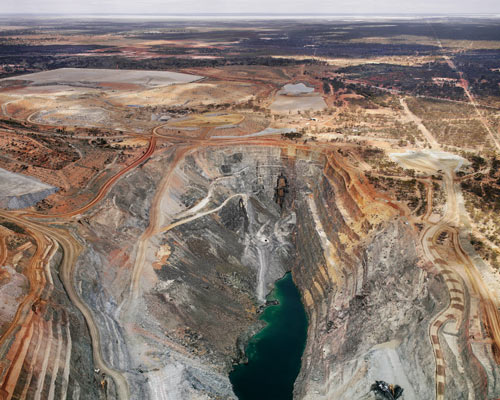 Edward Burtynsky,Jubilee Operations #1, 2007
My work to represent the degraded nature of the Queenstown environment will be far more modest---I'll be working with a tripod on the ground in selected spots that have been selected for their safety by a guide.
May 10, 2012
motherhood, sexuality, media
An image by Martin Schoeller on the front cover of the recent issue of Time magazine features Jamie Lynne Grumet, a slim, blond 26-year-old Los Angeles mother of two, breastfeeding her younger son Aram, who turns four next month. Aram stands on a chair to reach his mother’s chest and casts a sidelong glance at the camera as he feeds. He is at an age most kids have been weaned by. As part of that shoot, Schoeller also photographed members of three other families from across the country
It is attention grabbing--look at me. Is it what Americans call link-bait, given the huge drops in circulation experienced by Time? "The words "are you mom enough" suggests this, given that the cover refers to the magazine’s feature story on “attachment parenting”.

"Attachment parenting” is designed to foster a secure bond to the child. It promotes practices such as baby wearing (carrying a baby close in a slinglike cloth carrier), co-sleeping, or the “family bed,” and and extended breast-feeding ie., well past babyhood are sometimes the hallmarks of attachment parenting.
 Martin Scholler Time magazine shoot, 2012.
I personally don't find the cover picture shocking or inappropriate. However, the image's reference is to the mommy wars in the US, conservative Americans' puritanical discomfort with the body and the conservatives cultural taboo over breast-feeding in public.
Schoeller worked as an assistant to Annie Leibovitz from 1993 to 1996 and is known for his portraits of people. His close-up style emphasizes, in equal measure, the facial features, both studied and unstudied, of his subjects and he works in a series that build a platform that then allows you to compare.
May 9, 2012
Saatchi Gallery: Out of Focus: Photography
Out of Focus: Photography is the Saatchi Gallery's big contemporary photography show in London. It is Saatchi’s first major photography exhibition in a decade, and a self-styled cross-section of the world of photography now. The show has been interpreted as a mirror of the fractured world of contemporary practice.
The exhibition does not pretend to be a survey, or overview of contemporary photography. Rather, it demonstrates both Saatchi’s eclectic taste and the huge variety of uses to which the medium is being put now the rulebook has been thrown out and anything goes.
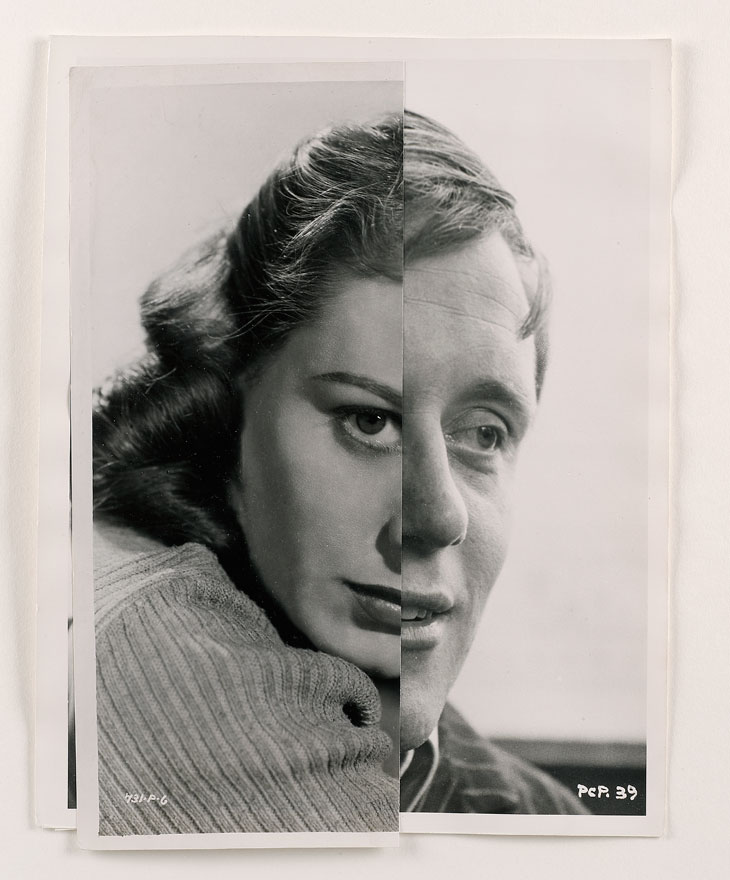 John Stezaker, Marriage L, 2007, Collage
One body of work that does stand are the collages of John Stezaker who splices together the publicity shots that film stars once sent to adoring fans; two faces unite to form a monstrous hybrid whose Jekyll and Hyde plausibility is extremely beguiling even when different genders are involved.
Equally intriguing is the site-specific sculptural installations of Paris-born, London-based artist Noémie Goudal:
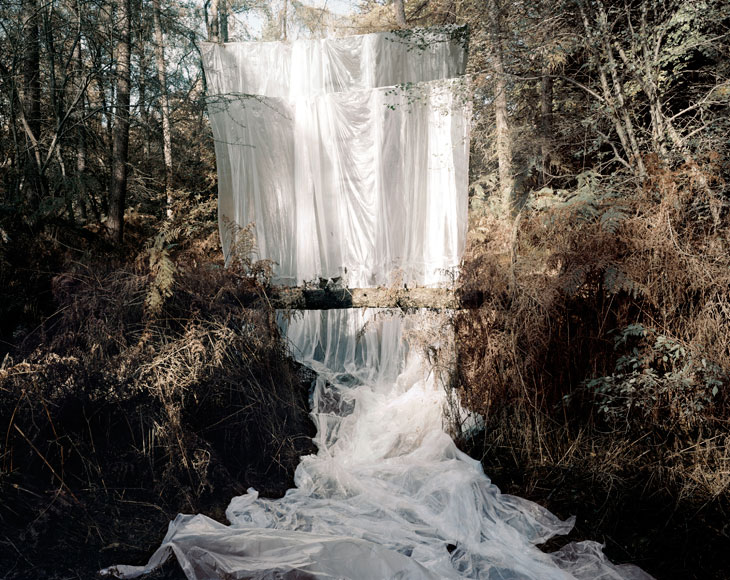 Noémie Goudal, Les Amants (Cascade) 2009, C-type, lightjet print
Goudal explores the interface between nature and culture in images that are beautiful but melancholic. The water cascading down a woodland stream turns out to be polythene draped from strings and crumpled to replicate a babbling brook. The wild is contaminated.
May 7, 2012
iPad+photography
I understand that the iPad has become a presentation platform for photographers to present or showcase their work or portfolio to others. The screen or retina display of the iPad 3 is now an excellent tool to showcase photography and there are now are variety of portfolio applications to choose from.
My own interest is less in presenting a portfolio than in producing and reading an e- book, such as the Adelaide book I'm currently working on; or the rethinking documentary photography one.
May 6, 2012
links
I've just come across the Fascinating Photography e-letter. From what I can gather it used to be a new bi-monthly PDF fine art photography e-magazine. I'm not sure what has happened to it.
There is an e-book, which is a compilation of interviews that were originally published in the first three issues of Fascinating Photography e-magazine (from August 2011 to January 2012). The PDF e-magazines are no longer available.
There are interesting links eg., to Burn magazine; to Camera Obscura--a literary and photography magazine; and to Lenscratch, a blogzine that explores contemporary photography.
They are interesting because they take us to a world that is beyond, outside, the art photography that is shown in art galleries or museums. The art institution appears to be stuck in the past showing the same old photographers rather than expanding their walls by engaging with the good photography that is on the internet.
May 5, 2012
Gordon Bennett: Eddie Mabo, 1996
This portrait of an aboriginal man is in marked contrast to Paul Foelsche's photographic portraits of aboriginal people in colonial Australia.
Gordon Bennett's image recognizes that Mabo himself is only knowable to most of us through the images and discourses that make him present in the public domain.
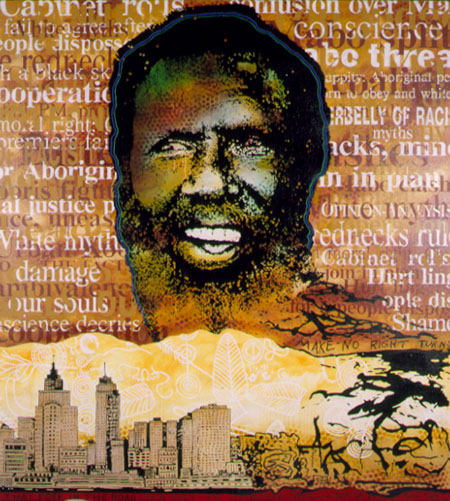 Gordon Bennett, Eddie Mabo, (after Mike Kelly’s ‘Booth’s Puddle’ 1985, from Plato’s Cave, Rothko’s Chapel, Lincoln’s Profile), synthetic polymer on linen, 1996.
The partial words that frame Mabo's head are taken from newspaper headlines, a multi-layered jumble referring to the toxic environment of race relations and the complex discursive field of conflict that erupted as Mabo's claim to ownership of his customary lands in the Torres Strait was interpreted in law and subsequently legislatively enshrined in the Native Title Act.
May 4, 2012
Paul Foelsche: aboriginal portraits
As noted in an earlier post Paul Foelsche joined the South Australian Police Force in 1856; in December 1869 he was officer-in-charge of the first police detachment posted to the Northern Territory. He was promoted to inspector in 1873. He succeeded Captain Samuel Sweet as leading photographer of the Northern Territory where his work became the main pictorial record of Aborigines (the Larrakia people).
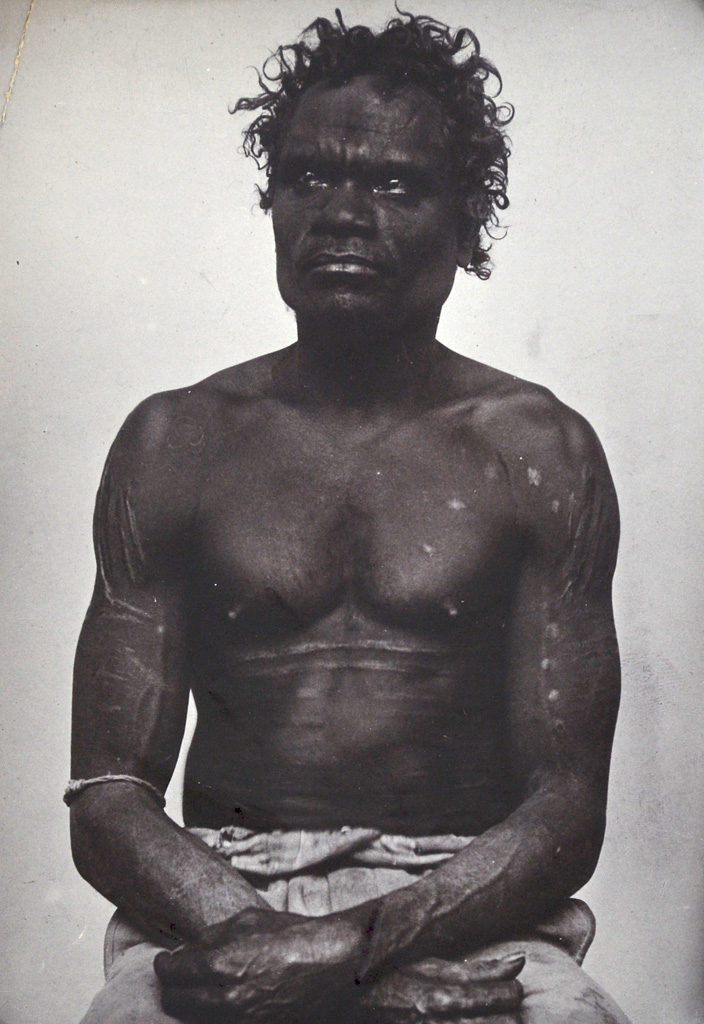 Paul Foelsche, studio portrait, aboriginal man, Darwin
In the late 19th and early 20th century photographs of Australian Aborigines came to be of great interest to European scholars. Aborigines formed the outstanding example of so-called 'primitive society'. The idea of a people still living in the Stone Age (in popular parlance) made information about these 'contemporary ancestors' of utmost importance to the scientific community. Museums played a major role in the dissemination of the evolutionary hypotheses to the general public. To illustrate the earliest stages of human life and culture, the 'primitive' artefacts, skulls and photographs of Aborigines were in demand.
Foelsche's portraits in the late 1870s often took the form of the Aborigines sitting in a chair (a Thonet chair?) next to a graduated ruler. Humiliated and expressionless they are objects of study and they have been given numbers and measurements.
 Paul Foelsche, Studio portrait if Aboriginal man, hand chained at right c.1875, Northern Territory
May 3, 2012
Kodak: In memoriam
The precious Kodak moments and memories of yesteryear are now being captured with an iPhone or an Android phone, then uploaded to the computer or to Instagram. At the heart of Kodak’s tragic demise is the digital camera, a technology invented by Kodak in the 1970s, only to be ignored by its creators and championed by its rivals.
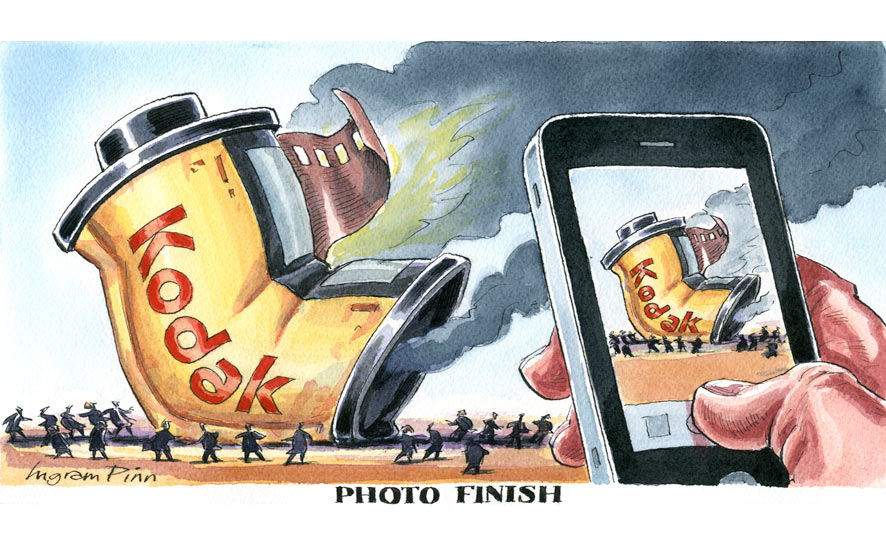
The smart phone is rapidly replacing the small point and shoot digital cameras. Sales of the point and shoot camera are in decline, not because people are taking less photographs, but because of the rapidly improving cameras in the smart phones. Image capturing quality is now a key consideration in the engineering process of new smartphones as is their integration into network technology.
I've started using an old feature phone Blackberry Bold on my poodlewalks. It replaced an old cameraless Nokia, but it is not a computing device--its a voice-oriented phone--- and it only allows me to upload photos to Windows-based PC's. Several years ago Microsoft ruled the computer world and especially the corporate world.
I understand that the current market disruption in the telco market is the migration of a large number of demanding customers away from phones-as-voice-products to phones-as-computing-products. Mobile computing is where the market has shifted. The Blackberry (Research in Motion) has failed to make the shift and there is now a question mark over their independence--can they develop the software and the ecosystem to ensure that a Blackberry (a feature phone) can become a mobile computer?
At the moment its existing handsets are not competitive. Hence the need for a turnaround to mobile computing.
May 2, 2012
Head On photographic festival
Head On is the largest photo festival in Australia with 200 photographic events---exhibitions, events and seminars--- staged in Sydney between 4 May and 3 June 2012.
One exhibition that aroused my curiousity was the work done by Peter Elfes, who has over the past four years, photographed Lake Eyre and the Central and Eastern desert regions of Australia. The Green Desert exhibition features low level aerial image of this landscape.
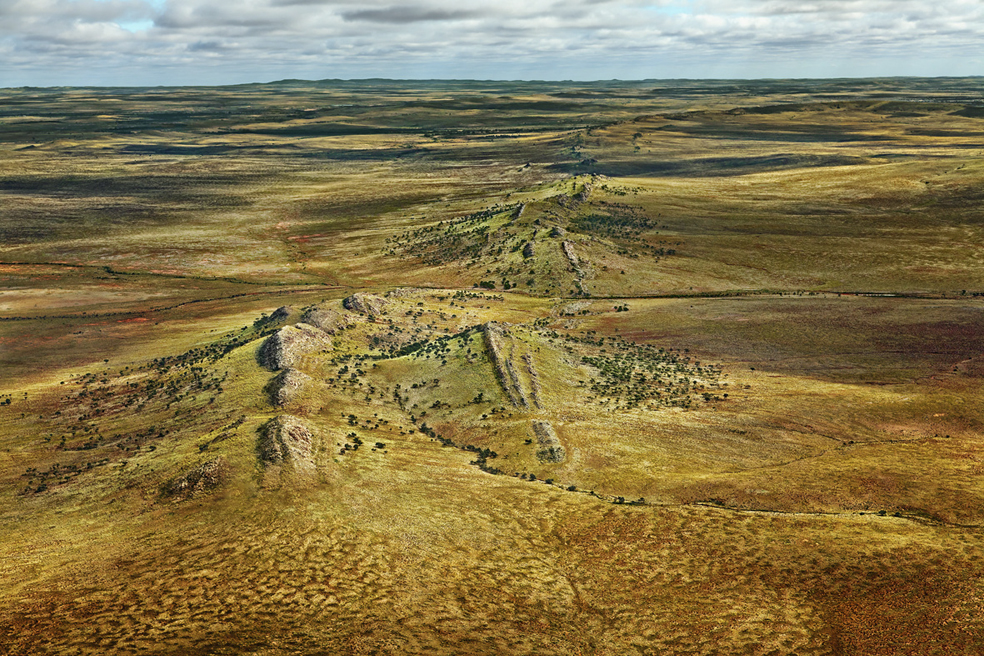 Peter Elfes, Sturts Meadow, The Barrier Range, NSW, 2011
The Barrier Range, is about 50km north of Broken Hill in eastern NSW and it is part of the Broken HiIl Bioregion. I must have gone quite close to the Barrier Range, when I visited Silverton a couple of years ago.
These rock formations now weathered were part of mountain ranges 10,000 metres high that existed during the
Proterozoic Era more than 2000 million years ago, before Gondwana separated from the Pangaea super continent.