|
May 21, 2009
In exploring the photographic reference points for the Port Adelaide project I reflected that some of my photography was part of a genre of photography that captures the decay we see around us in the run-down, dilapidated parts of the towns and cities that we live in.
This showing the process of industrial decay does not have the same appeal for us as the romanticised ruin ---ie., the "ivy clad" or grown over ruin that we associate with the idea of the ruined or abandoned town or city, such as those of the Maya in Central America that have been reclaimed by the jungle or Chernobyl Nuclear Power Plant and the town of Pripyat.
Then I chanced upon the work of Edward Burtynsky. I was much taken by his photographic exploration of ruins that linked back to the Romantics. Only these are the ruins of industrial civilization not those of classical Greece or Rome or the Romantic imagery of ivy clad collapsing ruins:
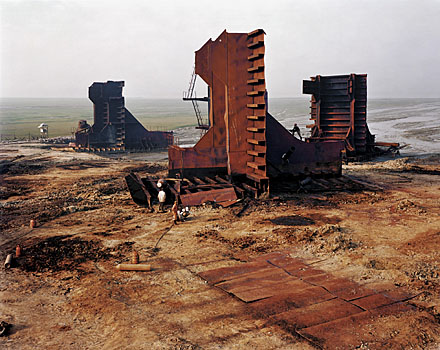 Edward Burknsky, Shipbreaking No. 27 with Cutter, Chittagong, Bangladesh 2001
I puzzled over what ruins signified for the Romantics. What was their meaning of the decay? Was it melancholy and monumentality? Arre ruins set in opposition to what the Romantics perceived as the spiritual bleakness of town and city— a "healthy distrust of the metropolis"? Was it an understanding of the world as fragments, as ruins? Did the fragments indicate that this was the limit of our capacity for understanding the world around us?
If ruins for theRomantics signified the contrast between the frailty of human achievement and the immensity and inevitability of nature's triumph, then an exceptions to those are representations of the blasted city in which humanity is directly responsible for the devastation:
 Edward Burknsky, Three Gorges Dam Project, Wan Zhou #4, Yangtze River, China 2002
My responses to this destruction of one city to make for the Three Gorges Dam is a mixture of shock, awe, sorrow, and ironic detachment. There were several cities that were destroyed. Then wondered whether the images of the modern city/ building in decay present us with an appreciation of their fragile, ephemeral character versus the inevitable advance of natural forces associated with climate change.
|


