July 30, 2008
representing death
I've been a bit interested in death lately as a result of taking photographs in the West Terrace Cemetery in Adelaide.
The image below is from the Exposition Anatomie des vanités exhibition at the Erasmus House Museum in Belgium.
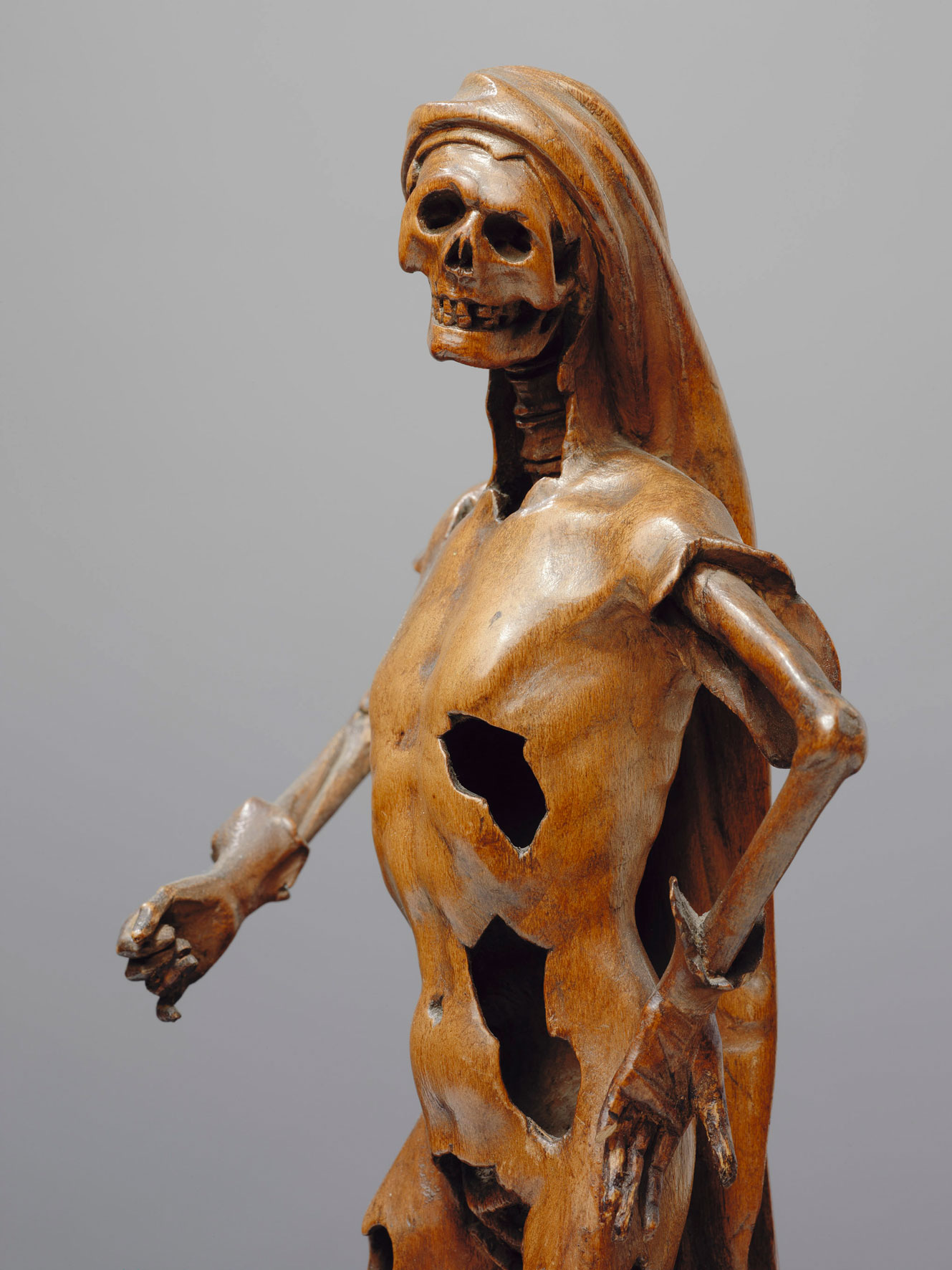 Écorché dansant (Tödlein),German, private collection
This exhibition on vanity shows many representations of death, at the confluence of the traditional memento mori' of the Middles Ages and the birth of scientific thought in the curiosity cabinets.
July 29, 2008
urban modernism
I guess there are modernisms and modernisms: the modernism of the freeway and skyscraper that is built on tearing down the old, and then the modernism of the urban street and public spaces that preserves and reinvents the old. The former modernism is Brasilia, a city, like Petersburg, built ex nihilo - without any public squares.
Once it was the dictators like Peter the Great who sought to eliminate public space; but the destruction of public space today is cloaked in the neo-liberal language of 'choice', 'development', and 'wealth creation'. We are haunted by the lost modernism of the street and we feel that our bodies have been sacrificed on the altar of the excess of the new.
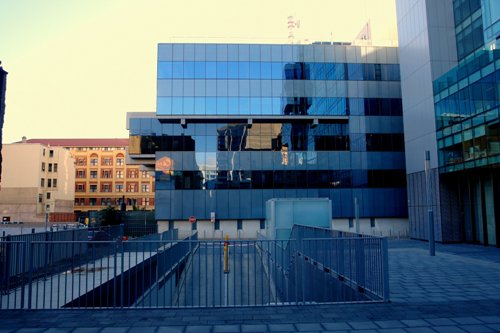 Gary Sauer-Thompson, creative destruction, Adelaide, 2008
So far, governments' main attempt to reduce car congestion in cities has been by increasing the supply of motorways and tunnels. It's been a dismal failure. Few state governments in Australia have the courage to introduce congestion charges. So congestion will increase. Nor do they seem to be willing to give up on motorways and put their money and effort into improving and expanding public transport.
We’re wandering through the modernist spectres, haunted by the past, sensing that there is no future outside of that of corporate capitalism. I look at the urban waste land and realize many of my photos are assembled from the discards of corporate modernism.
Maybe we need to think of photography as a darker art than most people--- eg., those on Flickr--- routinely practice. A lot of the photography is a celebration of beauty.
July 28, 2008
Mundoo Channel
I am on holidays down at Victor Harbor. It's a budget holiday, given the money I've recently spent on an Apple Macbook and on a Rollei 6006 (still on layby). This image of the River Murray is near the mouth of the river and south of the barrages. The barriers were constructed seven decades ago to pool freshwater behind them, providing drinking and irrigation supplies to farms and towns. So the water is sea water, not fresh water.

I plan to do some photography of the River Murray around the lower Lakes as mentioned earlier.
The situation is one whereby the levels of the freshwater lakes continue to drop behind barrages that currently keep out the sea. Scientists warn they could within months turn acidic, irretrievably damaging them.Topping up the stricken Lake Alexandrina and Lake Albert with saltwater would compromise existing freshwater ecologies, but it had to be considered when doing nothing would hasten their total destruction. Before the 8km of barriers were built (between 1932 and 1940) the lower lakes were part of the Murray River estuary.
Just how saline, or fresh, the estuary was depended on how strong the flows were down the river. In very low flows, they would have been estuarine: that is, salinities halfway between the sea and fresh water perhaps as far as the middle of Lake Alexandrina and beyond.
Grateful Dead: Bertha
I thought that I'd link back to this trucking post I couldn't find a good live version on YouTube, but I came across this late version from a revitalised Dead:
I first came across Bertha on the Skull and Roses live album, which I thought was pretty poor. Bertha opened the album and its spirited playing promised much in terms of energy driven by the dynamic bass playing that propelled the material along its path. The promise was not delivered on the album.
This was a transitional period for the Dead, a fallow period between the heights of the classic expression of free-form, improvisational San Francisco psychedelic sound on Live Dead and the classic expression of the return to their American musical roots in American Beauty.
A much slower version of Bertha can be found in the May 1977 run of concerts--- Buffalo Memorial Auditorium on 1977-05-09.
'Trucking' was on American Beauty:
July 27, 2008
reworking images
I have made a few steps in learning how to use the Apple Macbook and so I am basically functional.
It is often disconcerting to see the way visual images are reused and transformed. This one cleverly reworks images of Jerry Garcia, the Grateful Dead's song 'Trucking', and the Grateful Dead's Europe '72 album cover design:
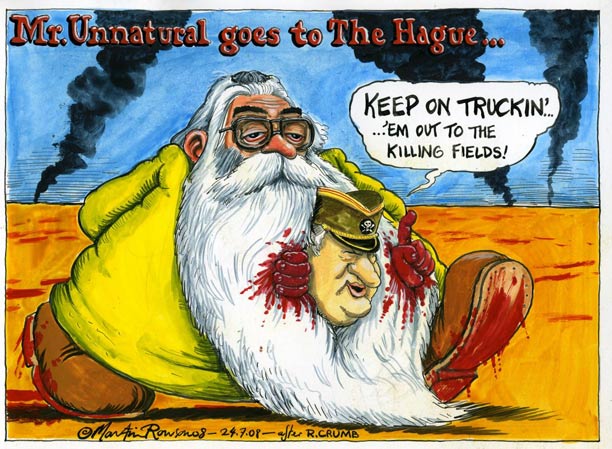 Martin Rowson
It is disconcerting, as we go from an image that is part of an alternative or hippie culture to that of a mass murderer. The rebellions of the ‘counter-culture’ and May ’68 involved a challenge to established cultural hierarchies and this post-1960s popular culture, with its transgressions, enthusiasms, rebellions and anti-structures, was a along way from a blood and soil Serbian fascism based around ethno-nationalism.
The Grateful Dead in turn reworked the work of underground cartoonist R. Crumb. In 1965.Crumb, whose work was (and still is) beloved by college students and hippies, introduced a character called Mr. Natural. His famous slogan, Keep on truckin’, used the word in the first sense of “keep trying” or “keep moving along .”he Grateful Dead were undoubtedly familiar with Crumb’s work. Their song uses the expression in a similar way, to mean “traveling.” Truckin’, first recorded in 1970, tells the story of a journey around the United States and contains one of the most often repeated catchphrases of that era: “What a long strange trip it’s been.”
July 25, 2008
gone to Apple
I've finally made the switch to Apple and to the Macbook. The computer works quickly and efficiently. I had expected things to fail--a habit from using Windows and Vista--- but nothing has, so far. My initial response is that I'm just thankful at finally having left the Microsoft/PC world. I had yearned to escape from its limitations for so long.
I'm still unsure of what I'm doing as the Macbook has a very different operating platform environment and I'm not used to the lack of a docking station. At the moment I'm doing things on the cheap-- using the big screens and back up discs from the old Toshiba.
I detest the snobbery in the licensed Apple reselling shops with their studied arrogance, consumer status and indifference to the consumer's lack of knowledge about how the Apple products are integrated. They just sell top design stuff, rather than educate.
Presumably, this snobbery can be avoided by turning to people who link digital photography and Apple and are willing to help educate the novice.
July 23, 2008
David Jensz
Fractal Weave is made from two woven curved forms in copper piping and sits on the pedestal in front of the Canberra Theatre and the Civic Library:
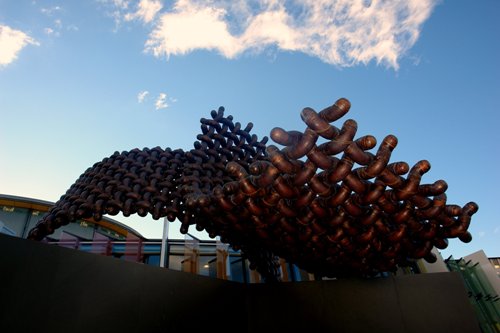 David Jensz, Fractal Weave, Civic Square, Canberra
His work often refers to theories about space/time and is motivated by the gap between an abstract concep that is the motivating force behind my work.
July 22, 2008
Australian photography: Stephen Dupont
Another Australian photographer from Degree South group:--- Stephen Dupont. He is a war photographer who has produced a large body of work on Afghanistan
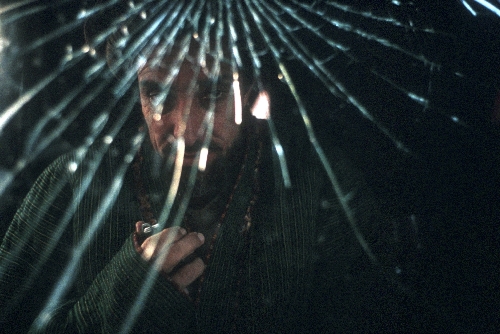 Stephen Dupont, untitled, Afghanistan, ?
Dupont, 40, who has spent much of the past 20 years covering conflict zones, was awarded one of the most prestigious photography awards, the W. Eugene Smith Grant for Humanistic Photography. In the 15 years of largely self-funded work in Afghanistan---since 1993-- Dupont, has borne witness to the civilian victims of the Afghan civil war, the rise of the Taliban, and been embedded with US troops in the "war on terrorism". He mostly works alone on the streets of Kabul.
An interesting body of work is the portraits of violence series about the gangs of Port Moresby and and Gaza Strip published in the Digital Journalist.
July 21, 2008
leaving a PC world
I've made the decision to switch from PC Toshiba laptop to a MacBook for my personal work today, after Windows was damaged and the DVD loader would not work. Trying to do my photography on a PC/Windows environment was a bloody struggle with software and a lemon of a computer. I'd had enough of badly designed equipment and software that cost a packet. Nothing worked very well at all.

The PC world is the business world. I will continue to struggle, and put up with, the truely awful Vista, for the text based work. I just got sick of the viruses and spyware, the computer becoming overburdened by defensive programs like Nortons that are a total resource hog and slow down the PCs, and limited graphics capacity. It was not a suitable platform for photography.
So I will live a split digital existence after the end of this week. I will slowly invest in Apple gear for my photography and music. Until the Apple arrives I will have to work with Vista--it often takes half an hour or so to upload a resized photo from the computer to my Flickr stream. Vista is horrendous. Its normal mode of operation is 'not responding', with only occasional flashes of quickness. More often that not it just grinds to a halt, despite the continual automatic updates each day. It's a junk operating system.
July 20, 2008
River Murray inflows
Holidays are coming up and I'm going to revisit the Corrong and the Murray River in order to take shots of the decline in ecological health. The decline is partly due to the River Murray being fed by the high country in Victoria/NSW where rainfall has been well below average, plus the over allocation of water licences to irrigators by state governments.
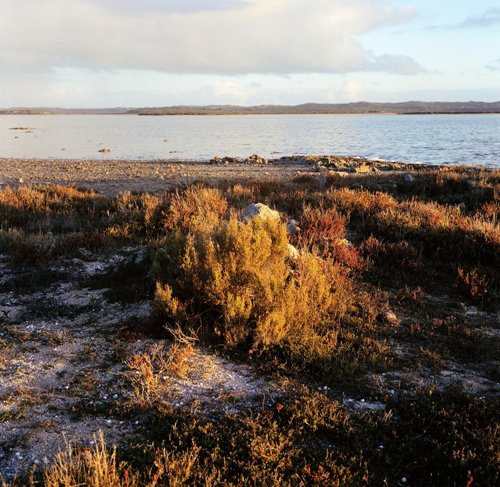 Gary Sauer-Thompson, Corrong National Park, 2007
The drought is not easing in the southern Murray-Darling Basin and it is worse than that of 1895 and World War Two. This drought, according to a policy consensus, is due to the impact of climate change. The higher temperatures have accelerated evaporation, created drier ground conditions and lead to less runoff.
Monthly inflows in the year to June are tracking close to, or below, those of 2006-7, which was the worse on record. The storage levels --water held upstream in storage during winter to release when demand from irrigators increases--- are trending towards record lows in August. The two years to May 2008 were the driest 24 month period on record for total inflows into the river.
The situation has never been worse at the mouth of the basin - South Australia's lower lakes in terms of ecological health., While there should be enough water to meet critical human needs up until next year, governments are working on what to do beyond that.

The water is sea water that comes into the channel via the Murray Mouth, only because the two dredges are working 24/7 to keep the mouth open. It hits the barrages that keep the lower lakes "filled" with fresh water from the River Murray.
Only there is no water coming down the river due to the lack of rainfall. So what stored water there is, is slowly evaporating. The policies to address this leave much to be desired.July 19, 2008
Sci Fi: Brazil
Terry Gilliam's Brazil (1985) is a comedy set in a nightmarish, fantasized dystopic future where a Kafkaesque, controlling, technocratic bureaucracy has invaded all aspects of daily life in civil society. The reference is to Orwell's Big Brother, the state (bureaucratic) terrorism of the sort Hannah Arendt described as "the banalization of evil," in the style that refers back to Monty Python.
 screenshot from Cyberpunk Review
A random chain of events kicked off by the Ministry of Information's (the internal security agency),own error is seen from inside ministry as further evidence of a terrorist conspiracy. A core theme is the desire to escape from an ordered oppressive totalitarian state through terrorism and, primarily, imagination. Humans survive in this world by keeping their real selves bottled up inside as a cocoon, while overtly serving their role as a specific cog in the totalitarian system. A dream trapped inside of a nightmare, as it were undercutr by the desire to escape the limits of the body through technology.
What I found more interesting was the way the strong visual and surreal imagery overwhelms the plot: the use of a powerplant as a torture set, the ducts as tentacles, the backward technology that harken back to the Industrial Revolution (the complicated heating ducts, the huge, pollution-belching factories, the mail tubes that criss-cross the floors of Information Retrieval, the computers as little more than glorified typewriters).
July 18, 2008
professionalism/amateur in photography
Professsional and amateur in photography has usually meant the person who makes money from their photography or has a career in it ( art or commercial) as opposed to someone who does photography as a hobby. But the rise of digital photography at an amateur level has a dynamic that leads to a 3G mobile phone network and increasingly powerful cameras in the phones The consequence is that people are abandoning the traditional film cameras, and in the next step are abandoning cameras altogether.
So does that mean those who work with traditional film cameras are now professional photographers? It has to be more than buying a Rolleiflex 6006 outfit from a retired commercial photography since the issues is one of aesthetics. the photo must look good as well give visual pleasure.
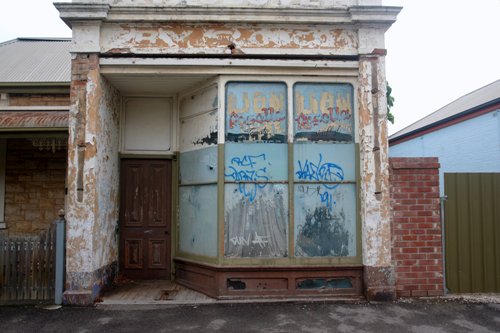 Gary Sauer-Thompson, shopfront, Bowden, Adelaide, 2007
With is kind of cultural formation happening it may pay to concentrate on the functions to which photography is put. Amateur photography is about constructing personal mythologies through snapshots in the form of family and travel albums that are intrinsically linked with nostalgia, longing, and presenting the best view of ourselves.
So maybe it is moving beyond taking snaps to working on specific projects that is the new way of being seen as a professional as opposed to amateur?
July 17, 2008
Mathew Sleeth
The 2008 Melbourne Arts Festival will exhibit the work of Matthew Sleeth, a Melbourne photographer
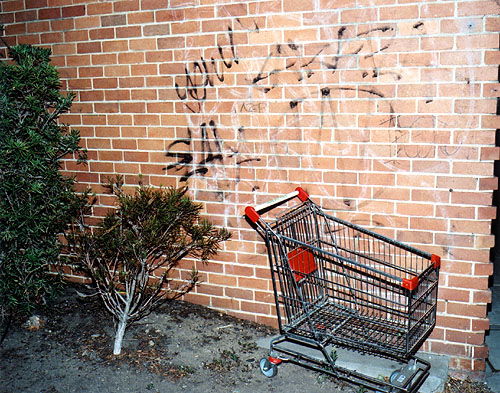 Mattthew Sleeth, untitled, from the series Call of the Wild, 2004
Sleeth is well established in the art institution and has a book on East Timor entitled Tour of Duty (2002). His earlier books include Roaring Days (1998), The Bank Book (2001), Away (2002).
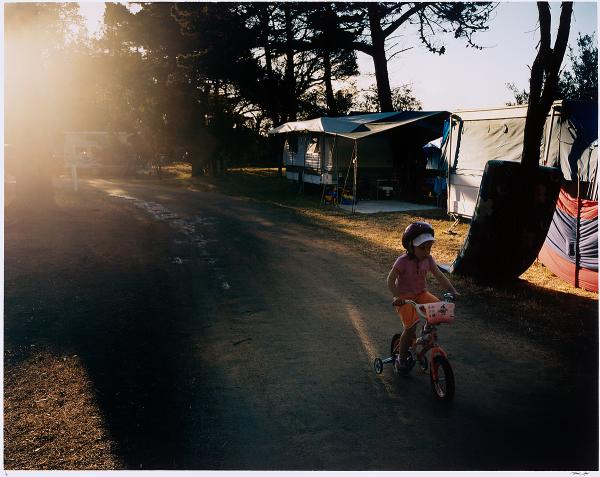 Mathew Sleeth, untitled, from Rosebud Series, 2003-4
An interview
July 16, 2008
Patti Smith
Though Patti Smith is regarded as among the most influential female rock & rollers and her music was hailed as an exciting fusion of rock and poetry I have listen to little of her music after Horses, the first album of simple, crudely played rock & roll. I missed the next albums of the 1970s ---Radio Ethiopia, Easter and Wave and remembered her mostly for the cover photos taken by Robert Mapplethorpe.
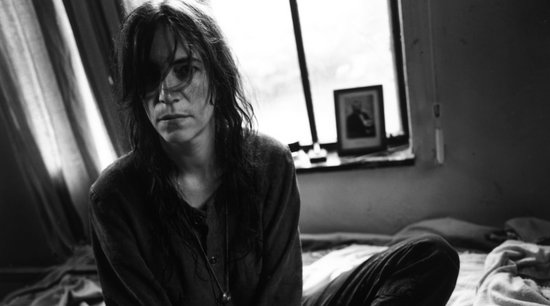 Steven Sebring, Patti Smith, from the film "Dream of Life"
Smith basically dropped out of the music scene until the 1990's, becoming quite productive after 1995 with a series of albums. Mapplethorpe has been replaced by Steven Sebring
I've hooked back into Patti Smith because she is appearing at the 2008 Melbourne Arts Festival, and according to Alison Croggon, over at Theatre Notes, is a central performer:
Patti Smith isn’t merely jetting in to do a concert appearance or two. Her residency permits a good look at this multifacted artist, and includes an exhibition of her photography, an installation, the screening of a documentary and a not-to-be-missed tribute to Allen Ginsberg in tandem with fellow festival attraction Philip Glass.
iPhone: telco ripoff
The iPhone sure has been hyped in Australia as a most desired consumer object. The device is both a status object as well as breaking new ground, as it is a phone, an ipod and a web browser that offers mobile computing with an excellent screen and touch pad technology. So you'd expect to pay a premium to purchase iPhone 3G.
However, the Australian telcos (Telstra, Optus, and Vodafone) are treating the iPhone as a sexy phone, if we judge them by their data plans. There are lots of cheap phone calls, but little allowance for downloads using the internet via their 3G mobile phone networks. There are limited downloads limits with heavy charges for excess downloads kicking in at $1 a MB.
The general consensus holds that Optus has the most generous plans of the three carriers and yet their iPhone plans only provide a maximum of 1GB of internet usage per month — for a hefty $179. You can use that by reading The Age online twice a day during the month. The excess data in that kind plan with its $1 a MB excess charge will easily max the credit cards in no time.

There has been little discussion about the breaking of new ground involves or its significance in terms of living with digital technology and its software. One exception is Stephen Ellis in The Australian, who argues that there are two closely related strands of thought embodied in Apple's iPhone.
The first was that as everything - all content and data - became digital, hardware continued to get smaller and more powerful, and networked mobility became ubiquitous, traditional general-purpose desktop computers would become less important, and a range of more limited task-specific computers (or appliances) would emerge. The rise of consumer laptops and media centre computers were important, but the iPod is an even better example, and now the iPhone (and other smartphones) are rapidly pushing further along this path.So we have mobile internet connection--as the iPhone is really a pocket-sized internet-connected computer. Yet the Australian telco's iPhone plans are all skewed towards cheap voice calls and expensive data.
Apple's second internal premise seems to have been that for everyday users to accept and adopt these appliances (that were really simplified computers) en masse, they would have to be superbly easy to learn and use - qualities Apple had a history of delivering in products.The simplicity and polish of good design in other words. It will probably allow Apple to win the battle of the mobile Internet.
The iPhone heralds the beginning of a new platform, especially with the third party applications (ranging from business to game applications, entertainment to educational applications) through the APP Store. However, to use the iPhone as it has been designed to use, you need to hang out in WiFi hotspots, which apart from Adelaide, are few and far between in our capitol cities.
The reason? As Mark Pesche points out I can buy 3G mobile data service for my laptop from Optus, with the Hauwei 3G/HSDPA modem and SIM card, plus 5GB of data, for $39.99 a month. The iPhone, in contrast, is 1GB of internet usage per month — for a hefty $179. it's the same data! The telco's are screwing their iPhone customers.
July 15, 2008
visual politics: New Yorker + Obama
The July 21 cover of The New Yorker was drawn by Barry Blitt. It depicts Barack Obama as a Muslim U.S. president knocking knuckles in the Oval Office with his AK-47-toting, Afro-wearing, revolutionary wife, Michelle. Blitt completes the tableau with an American flag roasting in the fireplace and a framed portrait of Osama bin Laden looking down from the wall in the Oval Office. All that is missing is a vest bomb.
 The joke by The New Yorker's barbed drawings is that its satire is cataloging and sending up the most extreme and common of the anti-Obama smears launched by the Republicans. There the smears are in their full glory--the media's emerging, distorted portrait of Obama, exposed for all to see. The caption reads "The Politics of Fear."
What is missing is any suggestion that this is how the Republicans want the world to view Obama. The Republican connection is absent and so the The New Yorker bares is not picturing the antagonist whose opinions it is satirizing with this visual politics.
So we have satire that is subject to differing interpretations once it is taken out of the liberal context of the New Yorker and shown on Fox News for instance. The latter's viewers would read the image literally and as the truth.
Geoffrey Gurrumul Yunupingu: Djarimirri
Geoffrey Gurrumul Yunupingu, a former member of Yothu Yindi, now with Saltwater Band, also has a solo profile. On 'Djarimirri', which is about Gurrumul's spiritual connection with the land, Geoffry is supported by bassist Michael Hohnen, the producer of Yunupingu's new album, Gurrumul.
The album Gurrumul is on Skinnyfish Music. He is using a modern medium - an voice and guitar plus the musical styles of gospel, soul and folk - to tell the traditional stories of his people and his culture.
What is produced is a form of Aboriginal music that is accessible to Western audiences.The effect is often very emotional--people get goosebumps or cry.
July 13, 2008
Vivid, Degree South, Joyce Evans
Vivid, the National Photography Festival, is being held for the first time in Canberra from 11 July to 12 October 2008., and it celebrates the vital role of photography in Australian life and history. There is a lot to explore by way of exhibitions. It builds upon the earlier Fotofreo in Perth, the Queensland Festival of Photography.
I stumbled upon Degree South a new collective of Australian photographers based throughout the Asia Pacific region mostly working as freelance photojournalists. The emphasis is on ‘gathering evidence’, truth, and making a difference. An exception is to this ethos of photojournalism Joyce Evans, who was the founder and owner of the vibrant Church Street Photographic Centre, Richmond, Victoria between 1976 and 1982.
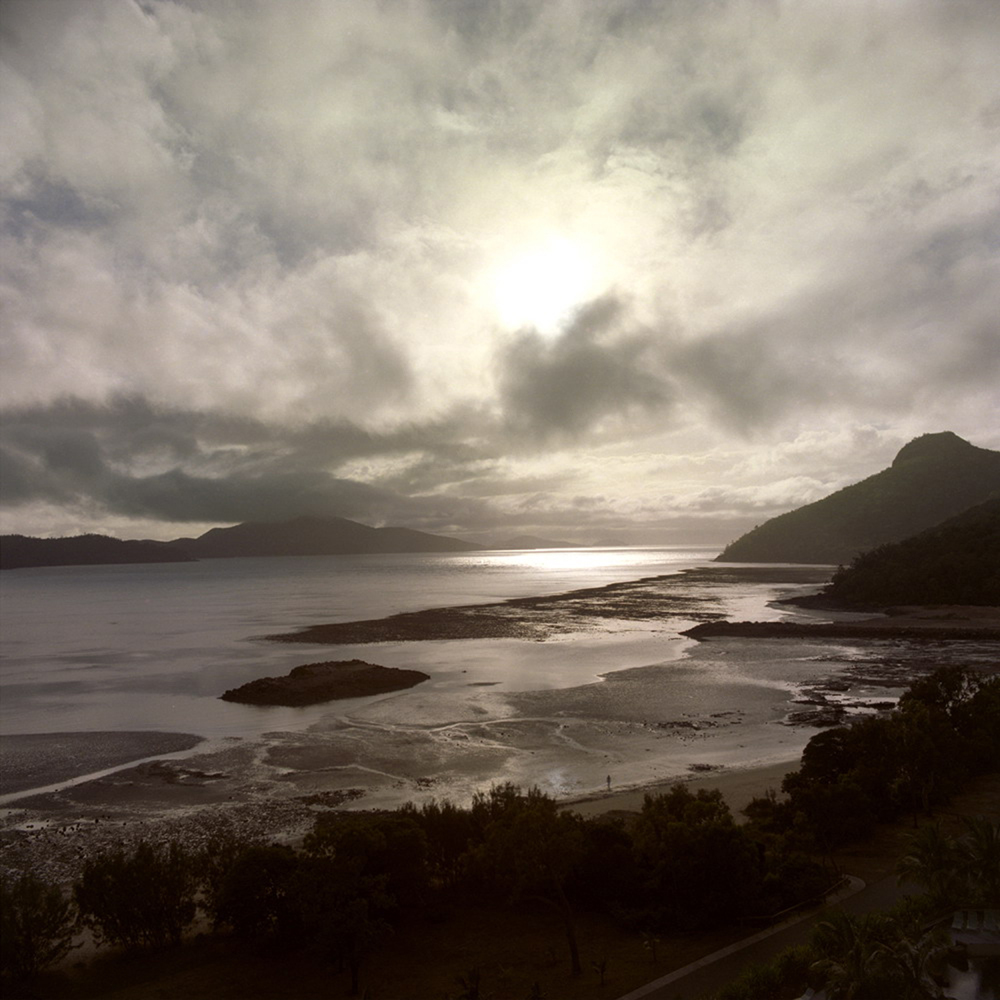 Joyce Evans, untitled, circa unknown
Evans' latest work is Only One Kilometre, (1991) about the Balcombe Estuary Reserve in Mount Martha, a picturesque location along the Mornington Peninsula in Victoria.The phtotographs are accompanied by with literary texts from Australian writers, poets and conservationists.
July 12, 2008
Bill Henson opens Picture Paradise exhibition
Bill Henson gave a speech to open the Picture Paradise: Asia-Pacific Photography1840s-1940s at the National Gallery of Australia.
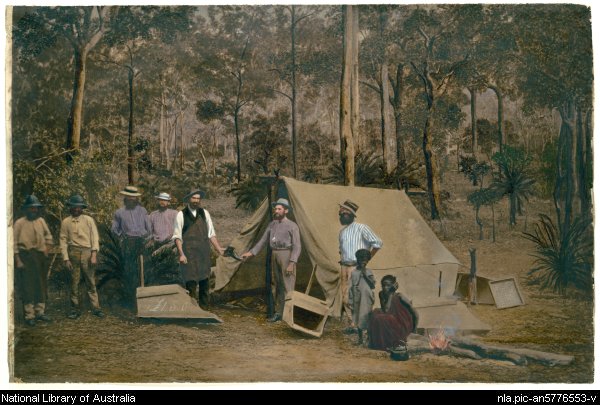 Richard Daintree, Gold diggers, Queensland, circa 1864-1870 albumen photograph overpainted in oil on canvas
Henson says that the Picture Paradise exhibition gives us a encyclopedia catalogue of a vanished world as it was first caught and envisioned by photographers, from the beginnings of photography to the eve of World War II.
And whatever history has revealed, we should never presume to see this vanished world as those who lived in it saw it. Of course, the past is another country and they not only do things differently there; we can only guess at the nature of that difference. And just as we should never presume to fully grasp what for us would be the strangeness of the world-view held by those who lived long ago and far away, so we should be absolutely clear that we cannot know, or fully grasp, the experience that others have, when they are alone -- staring quietly and intently into this strange little mirror on the world -- when they bring life's experiences to bear in each encounter with a photograph. We cannot know what the long-ago subject knew and you and I cannot know precisely what the other sees when she looks at a picture.
He highlights the uniqueness of photography, which he says comes from its profound contradictions: the evidential authority of being a window on a world that can only be reached by the imagination.
Henson's argument is that there the lesson of photography is that there are many truths, not one:
[August] Sander thought he wanted his Spenglerian types, like the Nazis, but instead he gave us a world of subtleties and half-tones. What this exhibition gives us, with great richness and subtlety, is the ambiguity and mystery of a thousand lost worlds what are brought back to us by the power of the imagination and the capacity to wonder. There are signs and there are contradictions of signs.
The use of the word 'signs' opens to another way of talking about the images of photography than Henson's many truths Daintree's image, for instance, creates social meanings, which are then interpreted by differently by diverse viewers in different situations. The black seated female figure produces a multiple of meaning in the colonial context of the destruction of indigenous society. What is the indigenous family on the right doing there?
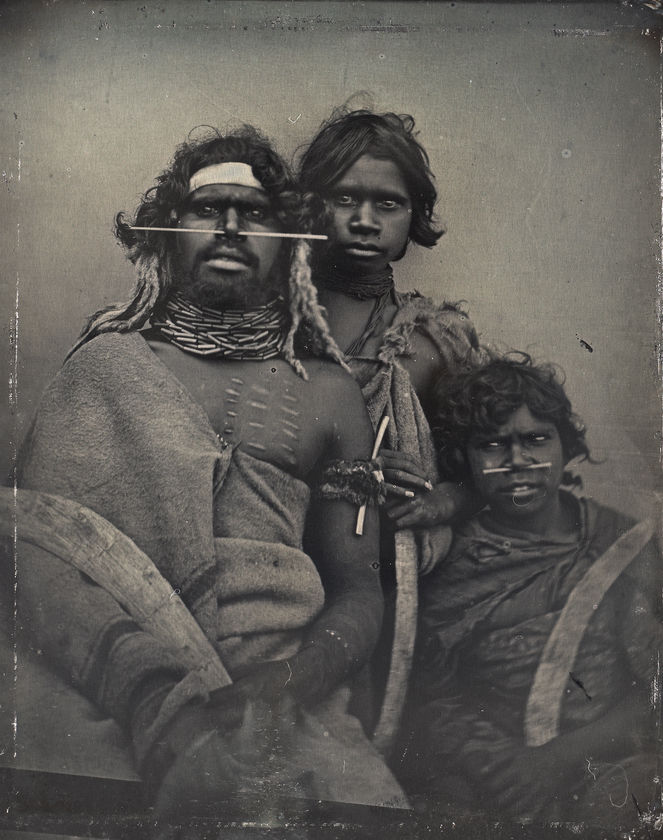 Douglas T Kilburn, daguerreotype of a south-east Australian Aboriginal and two companions, 1847
The daguerreotype was popular for about 20 years before the revolution of photography on paper. Once the latter happened from the late 1850s, photography really took off and had a much bigger public life. Kilburn's ethnographic 'portraiture cvn be interpreted as part of ‘anthropological gaze’, which is one way of describing the dominant character of modernity’s encounter with Indigenous Australia.
July 11, 2008
Rhizomes1 on the way
Finally there is the promise of some action on getting my photoblog--Rhizomes1 -- up and running and integrating it into the Thought-factory home page. Next week, it is said. This stuff sure takes time to get up and running.
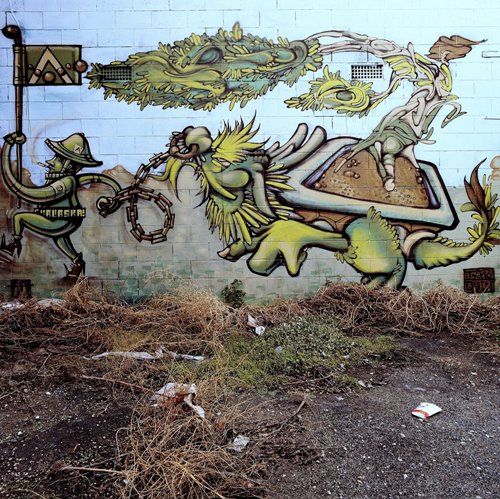 Gary Sauer-Thompson, Benzo and DrewFunk Adelaide, 2007
A photoblog means taking photos regularly and continually to provide the material for the necessary material. I've started to broaden the way that I take photos as I am beginning to return to working off a tripod with a medium format camera. It is slow work, requires time, and it means that I need to be continually thinking about photographs.
Update: 14 July
No action on rejigging Rhizomes1 so that it can go live.
July 9, 2008
Forbidden Lie$
Anna Broinowski's Forbidden Lie$ is a feature documentary surrounding Norma Khouri, the best-selling author of Forbidden Love, who was exposed as a major literary fake due to both her questionable account of real life honour killing in Lebanon, and the glaring inconsistencies in the book.

Khouri, the central figure in the film, isn’t simply lying and isn’t simply telling the truth. Broinowski's non-linear stylised narrative unfolds more and more layers of the web Khouri has woven around her. Broinowski also films her subjects watching each other's testimonials on television monitors and laptop computers, to capture their uncensored, real-time reactions and responses. It's more akin to a psychoanalysis of a fantasy world in the form of fiction.
Broinowski breaks out of the director's traditional objective position and becomes a character in her own film, travelling with Khouri to Jordan to allow her the chance to prove herself on camera. More layers of deceit or fantasy unfold. Does truth matter more? Why hang onto it? Why not accept the fiction and mythmaking. It's a way to counter the media's demonising Khouri ,
July 8, 2008
Into the Wild: Hollywood's mythmaking
Over the weekend I watched Sean Penn's film adaption (2007) of Jon Krakauer's Into the Wild; (1996) a non fictional account of the adventures or journey of Christopher McCandless. ' Adventures' refers to turning one's back on modern industrial civilization and living in wild nature as a modern primitive. That's freedom.
 Christopher McCandless, aka Alexander Supertramp, Self Portrait, 1992
This is classic Henry David Thoreau, who celebrated living alone in natural simplicity, apart from modern society in Walden. Natural simplicity here is Alaskan wilderness in winter, and Thoreau is interpreted as challenging oneself against an unforgiving wilderness landscape without map or compass, where convenience of access and possibility of rescue are practically nonexistent. It is also Hollywood's vision of the Last Frontier.
There is no critical judgement made of McCandless as a flawed character by Penn, only a celebration. The 24 year old McCandless starved to death on the Magic Bus (a shelter) after accidentally poisoning himself with inedible berries. If he had a map he could have easily walked out using a bridge over the flooded waters. Penn's account of McCandless's nomadic wanderings -- from soup kitchens and train yards to the landscapes of the Grand Canyon and the Alaska Range presents only the enlightened eternal seeker, not the hapless tenderfoot.
July 7, 2008
art making a political point?
We now have an ongoing debate about the overt manipulation of sexuality by mass culture, the consequent “premature sexualization” of girls in the coming-of-age stages in their lives and the bombardment of sexually-driven advertising specifically oriented to children.
In this debate the cultural and moral conservatives come close to saying that a photograph of a young child is inherently pornographic (ie., nudity is an obscenity) and that every nude photograph of all children in every circumstance should be banned. This, it is argued, is the only way to protect the innocence of children from the perverted gaze of paedophiles.
For these conservatives Art Monthly, in putting the image below on its cover in protest at the treatment of Bill Henson, is being deliberately provocative. The proponents of arts censorship in the New South Wales Government have referred the magazine to the Classification Board, whilst others have called for the removal of all public funding.
 Polixeni Papapetrou’s, Olympia as Lewis Carroll’s Beatrice Hatch before White Cliffs (2003), from the Dreamchild series (2002-3).
Now our cultural context is one of the proliferation of pornography in contemporary visual culture, and, in this context, photographs of children have become problematic as they suggest a defiled innocence and the exploitation of children as sex objects. The assumption is that children are junior members of the family needing a protective and nurturing domestic environment, which involves the discouragement of sexual behaviour.
The issue is not simply that of child protection being the only consideration, as the conservatives are wont to claim. There are also issues of childhood sensuality, play acting and portraits and art history.
Thus Polixeni Papapetrou's Dreamchild series is a re-staging of the staged child tableau found in a selection of photographs of young girls by Lewis Carroll. had done. It is true that as Carroll was criticized for his supposed lewd intent---(the speculation was that he was, in modern parlance, a paedophile) and tarnished, so Papapetrou has also faced criticism for sexualizing children and so creating pornographic images.

Lewis Carroll, Beatrice Hatch, 1873, coloured by Anne Lydia Bond on Carroll's instructions
Papapetrou's Olympia is seated nude on a rock and stares out at the viewer with a naïve yet attentive gaze. The possible interpretation of Olympia as a sexual being is tempered by our knowledge about the gaze being that of her mother taking the photograph. The mother-artist creates a sort of filter between her daughter and the viewer.
Once it is acknowledged that behind the child lies the mother’s presence, we have the possibility of another interpretation. Nudity is then interpretable as childlike play rather than explicit sexuality, and the child’s innocence emerges as a result of this juxtaposition of child, mother-artist and the history of visual culture. As Adrian Martin argues in this essay:
Papapetrou is not out to expose the 'dark side' of Carroll's fancies; rather, she is trying to clear out a space in which to insert her own fantasy and imagination. She confronts the charged history of Carroll's imagery but also, in borrowing his idiom, creates a remarkably intimate mode in which a mother observes her daughter and watches her slowly grow into a woman, as the child tries on and discards a myriad of masks both literal and figurative.
Her body of work draws from traditions of painting, cinema and theatre – and thus coming at the medium of photography sideways to the purism of modernism she has revitalised the practice of mise en scène or staging.
The debate in the debate around the sexualisation of girls in the media has narrowed into a polarized stalematewhich focuses primarily on the effect, if any, of sexualized images on young girls, while discussion of corporate responsibility remains negligible.So does that of artist mothers who have made photographs of children since photography’s inception that express the maternal gaze, with its relational intimacy and mother-child non-sexual desire.This enactment of sexual love and desire is quite different from the pornographic and paedophilic gaze.
Murray-Darling
Australia is already suffering the effects of climate change, with droughts predicted to occur twice as often and be twice as severe. The early signs can be seen in the Murray-Darling Basin. We will experience sharp increases in the number of regions facing years of exceptionally low rainfall in Victoria, Tasmania, South Australia and southern Western Australia by 2040. Professor Ross Garnaut predicted the Murray-Darling Basin would be all but wiped out by the end of the century. Will it last that long?
 Petty
Petty
For workers of every age in every community, industry and service, the transition to a low-carbon economy will require new training and re-training. New technologies will be introduced, energy-wise products developed and older products retired. Communities dependent on farming and forestry will face depopulation, workers will be made prematurely elderly because the cost of retraining is considered uneconomic.
Everyone claimed a victory at the recent CoAG meeting because they had at finally signed an agreement to hand control of the river to an independent national body. But no one said when this body would begin, what it would be called, who would run it, how it would operate, and when its national plan for managing the basin would be developed.
July 6, 2008
Fellini: Il Bidone
Fellini’s second trilogy started with La Strada (1954) and Il Bidone (1955) and finished with The Nights of Cabiria Le Notti di Cabiria (1957). The trilogy on Reconstruction Italy was dedicated to themes of people living on the margins of society (street dancer, swindler and a prostitute) that despite their rough lives eventually experience radical life change, call it redemption.
I watched a DVD of Il Bidone over the weekend.Il Bidone ends with mortally wounded swindler reaching toward a passing religious procession, unsuccessfully crying for help. The possibility of joining the procession after a painful death is left open. The contrary case could be that this is Fellini's tragic tale of salvation.

It was rather stark portrait of confidence men who trick the poor out of what little money they have. There are some moments of good cinema, most particularly a party scene that lasts about ten minutes and is almost perfectly put together, and the climax, in which Augusto, suffering from terrible injuries, crawls towards his death.
July 5, 2008
Sugimoto's Seascapes
Via designboom: Hiroshi Sugimoto is having a retrospective that includes his seascapes. Like Kenna's work there is a simplicity to these photographs but without the stark and strong contrasts that dominate Kenna's compositions.

When working in a public space Sugimoto chose to use the technology of the camera to shroud the visuals in a blurry mist to see what remained. This is closer to Titarenko's visual capturing of human movement through an area. Both use photographic technology to seek non-obvious forms that are permanent in transient and fluid scapes.
July 4, 2008
Michael Kenna's Silent World
Micheal Kenna explores a meditative and silent world in black and white. His pictures are absent humanity but contain the urban, suburban and industrial components of human society. The landscapes are very contemplative in what are often very crowded areas.

Kenna's work is in contrast to Alexey Titarenko's which are filled with layer upon layer of human movement in a public space. Kenna's work is dominated by the absence of human movement in photographic space and consequently is less ghostly and more serene despite the similarity of the landscapes chosen.

I find Kenna's images quite beautiful and more attractive than Titarenko's despite the latter's being more visually grabbing initially. In graphic design a strong principle is not making the viewers eye 'work'. The purpose of white space is to please and sooth the eye so that it runs automatically through areas. It is the subjective difference between a work being easy or hard to look at.
Kenna's work is very easy on the eye.
July 3, 2008
photography as an apparatus
In his Towards a Philosophy of Photography Vilém Flusser describes a world fundamentally changed by the invention of the "technical image" and the mechanisms that support and define industrialized modern culture. For him, two major events divide history: the first was the invention of writing (supplanting images); the second was the invention of photography (supplanting or beginning the process of supplanting writing). He argues that whereas ideas were previously interpreted by written account, the invention of photography allows the creation of images (ideas) taken at face value as truth, not interpretation that can be endlessly replicated and spread worldwide.
As writing was a way to bust magical image thinking, photography can be a means to bust linear thinking for a fresh approach to making sense by using a new kind of images.
Photography for Flusser is more than a tool in the hands of the individual. He thinks in terms of the camera and its user as the ‘apparatus-operator complex’ that is coded by various programs - for instance, that of the photographic industry that programmed the camera; that of the industrial complex that programmed the photographic industry; that of the socio-economic system that programmed the industrial complex; and so on.
What is of interest here is firstly, the notion that a technology is a bearer of forces and drives, is indeed made up of them. Secondly that it is composed by the mutual intermeshing of various other forces that might be technical, aesthetic, economic, chemical: that might have to do with capacities of human bodies as affordances- and which pass between all such bodies and are composed through and amongst them.
July 2, 2008
dead tree
It's a case of walking backwards isn't it, when it comes to saving the River Murray. They--irrigators, river communities and state governments, are still looking back to the golden times, and hoping that they will return. History turns in circles apparently. What goes round comes round as it were.

Too little, too late, and far too slow. That's my judgement on the big plans by the state and commonwealth governments to save the stricken reaches of the lower Murray River. It's mostly talk and little action, isn't it.
I'm going to try and get down to the Murray Mouth on the weekend if I can, and take some photos of what is going on down there. People are talking in terms of an ecological collapse of the lower Lakes and the Ramsar listed Corrong wetlands. Large format landscape photography, based on looking at the world through a groundglass, needs to engage with this issue rather than just express the beauty of the landscape in the sense of having moved the beyond the pretty picture.
July 1, 2008
Rock Island Bend--25 years on
I have posted this image of the Franklin River in South West Tasmania before in relation to wilderness photography in Tasmania. This time it is the poster used by the Wilderness Society in its successful political campaign to save the Franklin River from being damed by the Hydro Electric Commission.
 Peter Dombrovskis, Rock Island Bend, Franklin River, Wilderness Society poster, 1979
Conservationists had previously lost a campaign in the early 1970s to prevent the powerful Hydro Electric Commission flooding Lake Pedder for a power scheme. On July 1, 1983 -- 25 years ago today -- the High Court ruled by a majority of one that the Hawke Government had the power to stop Tasmania building the dam. The Franklin continues to run wild. It was an iconic victory.
The township of Strahan has boomed on the back of tourism to the south west corner of Tasmania showing that tourism is better way to make use of Tasmania's natural resources to ensure economic growth than the big industrial projects, such as Gunn's proposed pulp mill in the Tamar Valley. The Tamar Valley food, wine and tourism industries are more sustainable and valuable than the pulp mill that will pollute the air and estuary with its effluent.
Tasmania is not an industrial site, nor can it compete due to its isolation or remoteness. But remoteness is an advantage for wilderness tourism. Therein lies Tasmania's future.