June 30, 2008
Mars robot
The task of the Mars Exploration Rovers, which were launched to Mars on June 10 and July 7, 2003, are to search for answers about the history of water on Mars. The indications are that Mars had a wet past. The twin rovers landed on Mars in January 2004, 45 months ago, on missions originally planned to last 90 days.
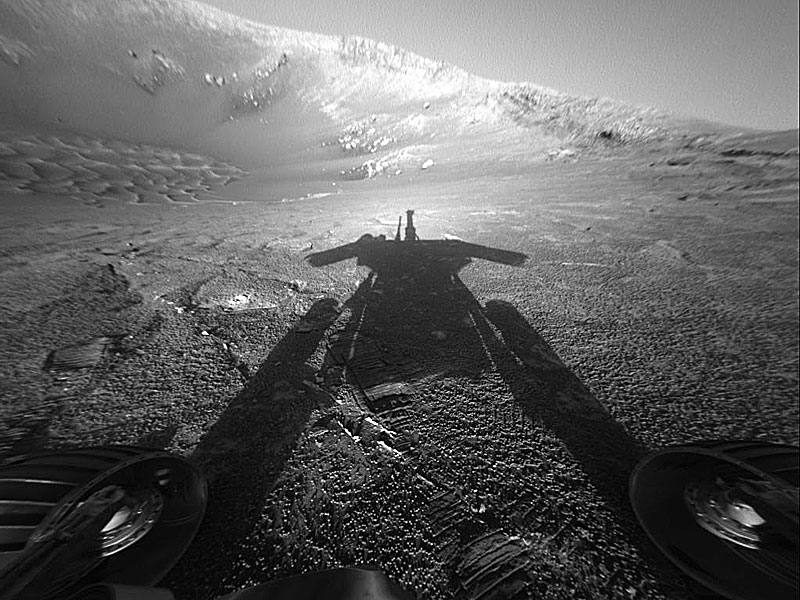 Shadow of a Martian Robot, Opportunity Rover, 2008
Moving from place to place, the rovers perform on-site geological investigations. Each rover is sort of the mechanical equivalent of a geologist walking the surface of Mars.
June 29, 2008
Photographing the Passage of Time
Alexey Titarenko uses the technology of the camera to trace the passage of time in a public space; visually capturing the dynamics of mass human movement through an area. The resulting imagery is quite stunning.

The ghostly aspect of the images is impossible to avoid and gives the photos a stark haunting quality. I suspect the use of black and white photography for this is necessary as colour would ruin the uniform nature that grey scale gives to the ghostly apparition of mass movement.
June 28, 2008
Joni Mitchell
I watched a DVD of Joni Mitchell earlier this evening. It was Mitchell Joni-A Woman Of Heart And Mind: A Life Story. Like most commentary it concentrated on the early singer songwriter period rather than the experimental artist.
This track is from Shine, her latest album:
Mitchell would have to be the most significant female musician in popular music, even though the music business had worn her down to the point where she couldn’t write and didn’t want to write. There was also little public recognition for her work and none at her record company.
Australian photography: Ingeborg Tyssen
Ingeborg Tyssen (1945 - 2002), the Sydney based photographer, is often acknowledged as one of Australia's leading art photographers. Along with Carol Jerrems and others she became part of the canon of Australian art photography. We seemed to lost contact with the canon for some reason. Does digital represent a new start?
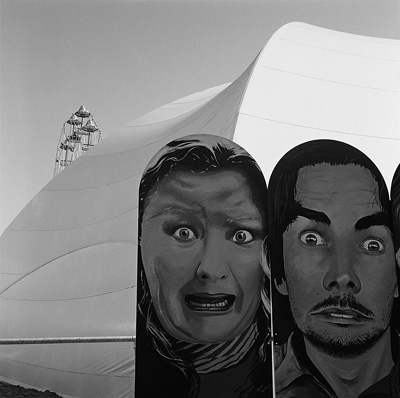 Ingeborg Tyssen, Royal Easter Show, 1982
Tyssen’s early photographs were taken in the streets and suburbs of 1970s Australia and America and they depict urban aloneness and isolation mixed with a hint of surrealism. This would now be seen as pretty straight, old school black and white modernist photography.
June 27, 2008
photo angst
Photographer harassment has become a hot topic as photographers are increasingly being treated as perverts and terrorists. It is not clear that you would be able to take this kind of work today. It is much safer to do this. Or this.
Basically though, if you are on public property, you can shoot it. However, public property and publicly accessible places are two different things. Train stations and beaches are public property, Westfields and other shopping malls aren't. They are private property. See Andrew Nemeth's excellent account.
The irony is that if you go to a shopping centre, service station, train station, carpark, office block (your office block) then you are probably being photographed. The law would say that once you own land you get to control what goes on there. The basic problem is that so much of our space these days is out of public hands and in control of private enterprise.
June 26, 2008
amateurs + professionals
Are we going to see the Internet remain a uniquely open space in which people can create and borrow and learn? Will it break down the elitism in the arts? Or will it become just like television and be all carved up with advertising, where everybody’s directed here or there based on the presence of some advertiser’s investment?
My gut feeling--reinforced by these comments---- is that the digital divide has morphed into a cultural divide, which involves not only access to technology, but also access to the money, training, and time that it takes to be a full participant in online work.
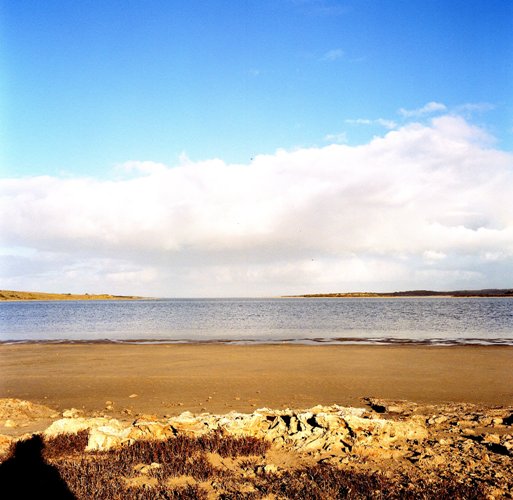 Gary Sauer-Thompson, Murray Mouth, circa 2007
The internet has fostered the amateur in opposition to those people who are held to have special talent, and are separated, given special attention, and are seen as professional artists who "serve" society.The obverse is the tendency to denigrate the amateur.
The Arts Council fosters this denigration by concentrating much of its supportive work on professionals: using the term 'excellence' as a kind of euphemism for professional art-making, concentrating on elevating the top pros and the organizations that they work with, and pretty much leaving the amateur unincorporated art-making piece of the Australian scene off to the side. The amateur's form is the internet---YouTube or Flickr---and this form is largely ignored by the various art councils even though these are very vigorous and very much alive
The aim of the official arts bodies appears to be one of bringing more fine art to the Australian people” without encouraging more people to actually create. Amateurs who might like to dabble in photography, for instance, aren’t empowered by our society (or our schools) to do so.
June 25, 2008
art's critical edge?
Our desperation to break the spell of instrumental economic reason-- eg., by turning to beauty as the unexchangebale or non-commodifiable ---can lead us to fetishise art. We want to believe that art has power that points toward a better world by modelling a non-instrumental relationship with a thing.
This desire can become a trap. Art as the imago of the unexchangeable leads us to believe that there are things in the world that are not for exchange’ in a commercial culture that corners the market in all appearances of alternativeness. Roses are bought and sold just as much as soap powder in the marketplace.
Beauty cannot be contrasted with the ugliness of an industrial culture because is beauty is utilized to sell clothes in a consumer culture. Consumer culture has wrapped itself in beauty to persuade us to buy commodities on the credit card.
But what exactly does art photography transgress besides a few advertising and design l clichés? Can we seriously, for example, claim that abstract colour photography generates an experience of the sublime? And is it not hyperbole to describe art photography as horrifying or terrorising?
When the act of transgressing becomes ‘hot’ as in the fashion industry, then transgression no longer stands in a critical relation to an affirmative culture.
Art is a commodity and it admits it is one. In doing so art renounces its own autonomy and proudly takes its place among consumption goods
June 24, 2008
Australian photography: Flickr SA
I spent part of Sunday afternoon walking around my old photography ground in the industrial areas of Bowden and Mile End. Bowden was where I had a photographic studio and where I taught myself photography with a 5 X 7 view camera. My old photographic stomping ground was Bowden, Mile End and Port Adelaide.
I had a studio/darkroom in Bowden and I shot in black and white as I explored the decaying life in a rustbucket industrial South Australia, studied philosophy at Flinders University of SA and tried to disengage from photography mirroring the world.

Returning there I noticed there were a lot of changes, especially Bowden, which is being transformed into new suburban housing estates. The old Gas Works had gone along with the working class cottages, the street artists had appeared, and there were even street trees.
This return to my roots was part of gaining a perspective to explore, and get to know how the state of play in photography in South Australia was becoming a culture of art photography now that digital photography has become the norm.
The photos in the Flickr SA group's exhibition is part of the SALA annual state-wide event that aims to widen audiences for exhibitions by SA artists, all venues are free and local artists have open days in their studios. Their work, which explores movement, is to be exhibited in The Austral Hotel in Rundle Street, Adelaide.
Some of the participating photographers have their own portfolio pages on the SALA site eg.,
Australian romanticism
Romanticism in the nineteenth century was a protest against the dark satanic mills of industrial modernity, utilitarian calculation and market capitalism conducted in the name of beauty, or wilderness. This understanding of Romanticism is what shaped my photography when I was teaching myself to shoot black and white photos with a 5 X 7 view camera in, and around, Bowden, Mile End and Port Adelaide in South Australia. This was a world characterized by industrial decay as South Australia was undergoing de-industrialzation.
Today some argue that beauty, which can be found in the most unexpected places in every day life, functions as a tacit critique of the slick advertising and crass commercialism in the business districts of the city. Or the contrast would be between those who sell minerals and see only their mercantile value and the artist who sees the beauty of the stones.

On this account capitalism has, by default, become the primary lens through which we interpret the world. From within the profit-driven perspectives of capitalism, a world-view more widespread than any other in history, all things are squeezed into financial concepts and therefore look like exchangeable commodities.
 Gary Sauer-Thompson, Bowden foundary, 2008
It is argued that beauty transgresses this world view, as beauty is what is left over when everyday life is squeezed into the market concepts in a world of universal commodification. The remainder to conceptualisation now becomes an enigmatic object of study rather than being denied or ignored.
The claim, which goes back to Kant's Critique of Judgement, is that something could be ultimately meaningful without regard to its instrumental value. or to put in another way things have auratic individuality because of their very particularity. Beauty, on this account, is the doorway to other concepts such as imagination, feeling, sensibility, sublime. The sensuous and particular experience of art now reveals a form of knowledge more complex than the categories of instrumental reason can contain.
June 23, 2008
credibility
Peter Garrett's credibility has suffered ever since he became a federal Labor politician, and then Minister for the Environment.
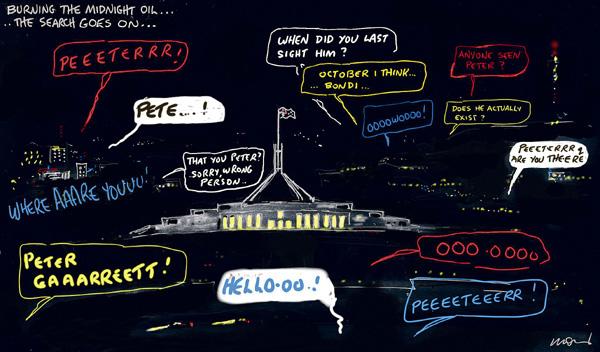 Moir
Moir
He used to speak up as an eco-warrior for saving the Murray River and its wetlands. Now he's rarely heard from. Essential Media, a communications and government relations firm, conducted polling this week on the standing of seven key ministers. Garrett's performance was rated by 47per cent of respondents as poor or very poor, the worst result of any minister.
June 22, 2008
street hassles
I was taking street photos of my local neighbourhood during my lunch break one day last week and I was accosted by police.

I was actually taking a photo outside my house when a cop demanded to know my identity. His attitude was one of suspicion, which remained in place even when I gave my name and address and pointed to where I lived. He continued to demand proof of my identity I refused.
Photographers taking photographs in public places are clearly deemed to be suspicious by the police who seem it to be linking taking photos to terrorism. Try taking a photo of a central police station to test this.
The police's antagonism and aggression towards the 'suspicious public' suggests that we live in a different world now. The devil is very much in the details of this developing post-constitutional domain of power, governance, surveillance, and control.
June 21, 2008
So Much For The City
Michael Wolf explores the humdrum and the ordinary in the city of Chicago. After years of photographing architectural and space form he was surprised to discover a tiny figure in one of his photos giving him the finger. Wolf went over his photographs expecting to be excited by action in every window, but discovered the opposite.

But it was a little sad to see, night after night, in all these buildings, that it was really just single people between the ages of twenty-five and forty, tired after work, sitting on the sofa watching TV. I was a bit disillusioned. I thought it would be more exciting than that.
Originally via rolu dsgn.
June 20, 2008
Nine Inch Nails: Zero Sum
This song Zero Sum is from the Nine Inch Nails 2005 Year Zero album, which Trent Reznor composed on a laptop and recorded as he went on the road touring in support of the group's previous release, With Teeth (2005).
This kind of composition opens up a different way of making music and brings it into play with remixing and the music public's participatory role in interpreting compositions at home through Apple's Garage Band software.
David Hajdu in I Me Mine in The New Republic says that Reznor has made the musical stems of several past Nine Inch Nails available for re-mixing at no cost through the Nine Inch Nails site.
Hajdu says that:
Reznor is so eager to be aligned with the home-remixing phenomenon that he has sponsored a compilation album of fan remixes. Called The Limitless Potential, the album of 21 selections can be downloaded free, although the individual stems of the tracks that the fans contributed are not accessible for further remixing through the Nine Inch Nails site. (Evidently the "open" in open-sourcing has its limits.) Most of the Nine Inch Nails remixes posted, like the Nude remixes, are efforts to move the songs from one mode - industrial rock, the style Reznor practically invented in the 1980s - to some other style: house music, or psychedelia, or an approximation of funk. The remixes tend to take lateral steps, hopping across category lines from stylistic box to box. They do not, as a rule, try to differ from the originals in point of view or depth or aesthetic value; they seek to differ primarily in kind.
The other aspect of Year Zero is that it was accompanied by an alternate reality game by 42 Entertainment and a possible film project that lasts three years. An interesting approach to viral marketing.
June 19, 2008
visual culture
Flickr is an example of the emerging visual culture. Some of those with a professional interest in words and the literary culture tend to bemoan the rise of the image and its banality. Flick is multitude of photostream— flow of images both interesting and mundane and it indicates the shift or transition from a written culture to visual culture. A visual culture presents a challenge to the textual model of the world that dominates so much thinking about culture.
The visual is replacing the linguistic as our primary means of communicating with each other and of understanding our postmodern world. If visual culture used to be seen as a distraction from the serious business of text and history, It is now the locus of cultural and historical change. Just think of architecture, art design, advertising, photography, film, television, video, computer imagery. Our experience of culturally meaningful visual content appears in multiple forms, and visual content and codes migrate from one form to another:
Our workplaces are visually saturated environments and our dominant pastimes (films, television, video games, and the internet) are visual media. Moreover, we communicate visually when we are trying to cross over cultural boundaries; think, for example, of the graphics devised for international signage
June 18, 2008
Flickr experiments
This is a test post from  , a fancy photo sharing thingy that enables me to post photos from my Flickr stream. It works----Movable Type was meant to create lots of difficulties. I have yet to send a photo--that is the next step. Here goes:

This is an example of the fauna in the landscape of the Fleurieu Peninsula around Victor Harbor. They are hard to grown in private gardens.
Hoorah, it works. A few hiccups along the way. The wonders of Flickr. Now I can do more things with my digital archive. I'm not sure how to integrate Rhizomes1 the photoblog.Melbourne photography: Meme exhibition
Another step in exploring and getting to Melbourne art photography.
This step is 5 Melbourne photographers are having an exhibition at The Guildford Lane Gallery in Melbourne. The exhibition, which opens at 7pm, on the 19th of June 2008, is entitled 'Meme' and it is based around the idea of photographic narrative. The blurb says:
Memes are the face of the connections that join us across nations and cultures.The Meme exhibition is a visual narrative of this connection by a collective of 5 Melbourne photographers who intersected through the landscape of new media. Stories from the streets of Singapore, through Kyoto, Nanjing, Phuket and Hong Kong to the beaches of St Kilda. Each work connects from one to another, weaving a story that begins and ends at any point.
As the images of the exhibition are not online at the Guildford Lane Gallery we have to work off the links provided:
lynt on Flickr---Karl Stanton
aagctt on Flickr ---Nickie C. Chan
memetic on Flickr ----Christian Were
Joanne Ho, whose can be seen at Lighting Love
Velco Dojcinovski, whose work can be seen at Andante Bar
It is Nickie C. Chan who has given some idea of his work in the exhibition as he seems to posted some in his aagctt on Flickr stream. It is hard to get a sense of the visual narrative about memes. I'm not sure about Christian Were's memetic on Flickr stream. Maybe they both listed reference to the exhibition under their latest photos.
June 17, 2008
German Photography: Bernd Kleinheisterkamp
The online work of Bernd Kleinheisterkamp is more accessible than that of other German photographers.
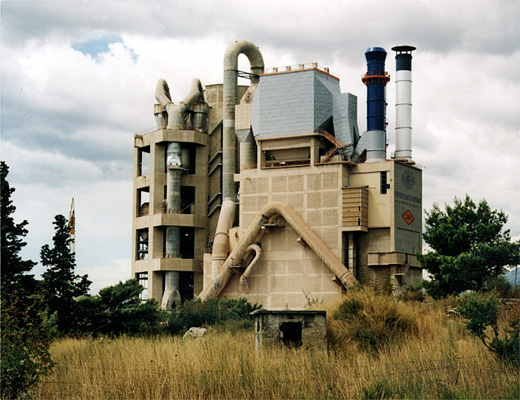 Bernd Kleinheisterkamp, Cement Factory, 2001, from Dinosaurier series 2001-2003
However, know very little about Kleinheisterkamp as I am working off Barbara Fischer's comments in this post. Most of the google entries are in German so I cannot assess the books that he has published. Two series of work after the Dinosaurier one are also archcitectural--- NEUE LÄNDER and Siedlung.
This changes with the latest body of work entitledStills.
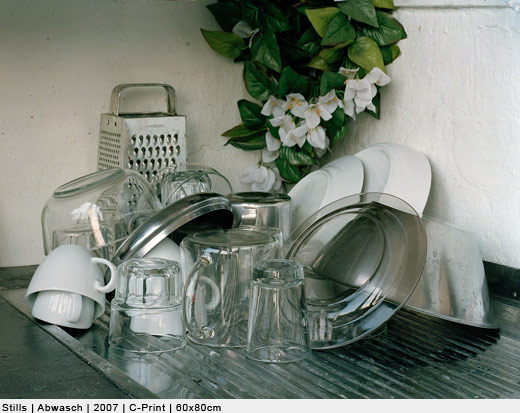 B Kleinheisterkamp, stills, 2007
June 16, 2008
political humour
So John Della Bosca, ex-Education Minister in the Iemma Government, being a henpecked husband of Belinda Neal. He's the nice bloke but Belinda Neal, the MP for the NSW central coast seat of Robertson, is the working class thug.
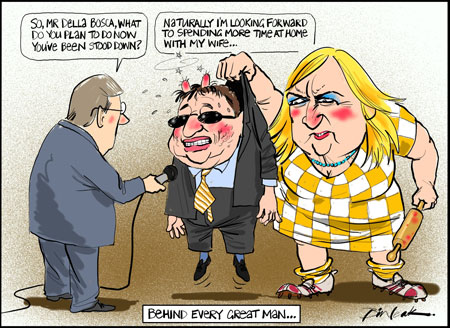 Bill Leak
Sure we have a woman---not a man--- in the standover role at Iguana Joe's as a way of dealing with staff rudely trying to clear away your table and moving you on. But the attack on Neal does seem to have gone too far in the media.
June 15, 2008
Alexandra's Project: Rolf de Heer
Rolf de Heer's Alexandra's Project (2002) is a low budget psychological exploration of the undercurrents of a suburban relationship gone sour through a women's oppression of her identity by the husband in a middle-aged marriage in middle class, suburban Australia. It explores the gaping divide in a gendered understanding of sex, intimacy and companionship.
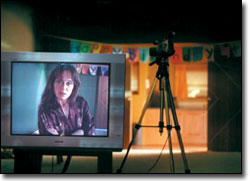 Almost 2/3rds of the movie consists of Alexandra's disturbing taped monologue about her destruction in the relationship broken up only by occasional pauses in the tape and Steve's reactions, as he, a prisoner in his own home, now has to watch the wife's entire tape, and tries to figure out what the hell is going on.It's a happy birthday present--his wife, a suburban prostitute has left him and taken the kids. He falls apart.
The wife gets her husband's attention by putting herself on camera digital video. We see the digital playback, which manipulates the sense of time and space. What is expressed is a feminist text on sexual objectification in which the video serves a cathartic purpose for her, finally providing an outlet for her grievances and resentments for all the things Steve never let her say whilst he fetishises Alexandra's body.
The claustrophic atmosphere recalls Bad boy Buddy (1993) another eerie, original and twisted film. Everything we see and hear in the description of suburban work and family in the first part of the film is imbued with a weighty, unspecified sense of dread that recalls the work of David Lynch. The second part is an exercise in the humiliation of the husband.
June 14, 2008
space, again
The spiral galaxy M51 (NGC 5194) is actually long lanes of stars and gas laced with dust.
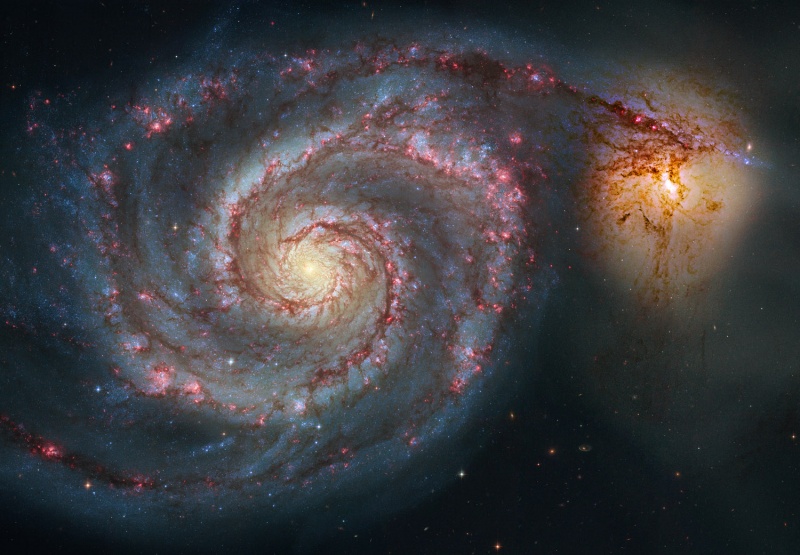 Hubble, J Astronomy Picture of the Day, M51 (NGC 5194)
June 13, 2008
windowless rooms
In classical Romanticism of the 19th century the artist's landscape is that of the artist's subjectivity with objects in the external landscape used as a metaphor for constructing the interior of the humanist self ( in the mind rather than the body). The emphasis is less on being in the world than being the subject who constitutes the world.
This is a literary world that is hostile to the mechanical, eye-driven, arts which is seen in terms of the despotism of the eye---heart-felt rejection of the visual technologies of their day: Romantic ideology was constructed not in opposition to the enlightenment rationalism of the eighteenth century, but as a reaction to the visual culture of modernity being born.
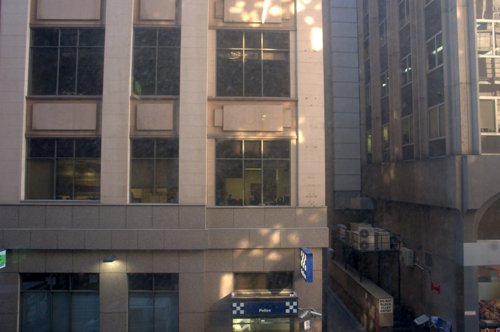 Gary Sauer Thompson, Flinder Lane, Melbourne CBD, 2008
Since then we have the crowding of people in cities, the hurry, the helter-skelter, the proliferation of news and sensational writing,—matters that Walter Benjamin observed. Benjamin added the insight that modernity did not augment perception and sensation by the addition of new media but the contrary of that, that the media actually impoverish our capacity to feel directly and for "the meanest flower."
In modernity we move from the overlap of individualism, consumerism, and the beginnings of a technology-driven entertainment industry based on visual pleasure to the familiar techno-visual dystopia of isolated clumps of incommunicados (formally known as families) who sit together cemented by nothing more than their addiction to television in a windowless room.
Modern life is one where the modern condition of mental life is bereft of stabilising notions of the real. Without such notions we are placed in a dream-world of phantoms and spectres. Modern life has become phantasmagorical or uncanny.
June 12, 2008
an electric car: Tesla Roadster
The Tesla Roadster. The company will even sell you the rooftop solar panels to charge it, with if that’s your desire. In the US that is. There won't be much of a chance to see the roadster in Australia.

Tesla are also planning to make a sports sedan, which is in the works. So we have the classy, eyecatching environmental look that breaks with the petrol engine past and the poor design of previous electric cars. It offers an alternative to the hybrid option favoured by Toyota.
For far too long, Australia carmakers and consumers have had a mutually destructive co-dependent relationship. Car buyers liked big powerful cars in an age of cheap gas and manufacturers were more than happy to supply the demand. As interest began to wane, carmakers started piling on incentives to keep drivers on the hook and they kept buying prompting the manufacturers to keep building, etc.
Unfortunately the lead times to get new product out in this industry are long and although new, smaller, more efficient products are coming, they will take time. In the meantime, carmakers and dealers are feeling the pain.
June 11, 2008
romanticism + photography
An example of romanticism and photography?
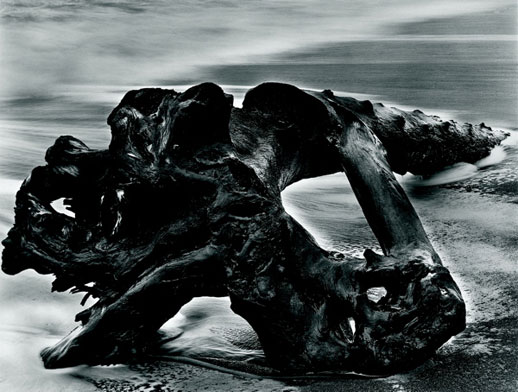 Wynn Bullock, Driftwood Tree Trunk, 195, silver gelatin print
A mystical sensibility underlies most of Bullock’s work in his treatment of both the landscape, in which he uses long exposures to create primordial dreamlike vistas and in his close-ups of trees and rocks which often reveal masks and bodylike forms.
Does the mystical sensibility signify romanticism?
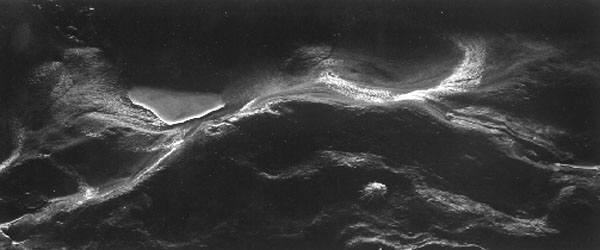 Wynn Bullock, The Limpet, 1969 , Gelatin silver print
So what would romanticism look like in an urban photography?Would it focus on decay and destruction?
June 10, 2008
romantic currents today
I'm not sure what romanticism means in the visual culture of contemporary Australia. It used to mean a national or Australian culture in opposition to the imperial (British and American ) one. But now? Is it still of relevance?
Often it merely means the trite celebration of the beauty of nature in opposition to the economy's destruction of nature under a neo-liberal mode of governance. Or an old long forgotten German oil painting for those with an art historical bent:
 Caspar David Friedrich, Abbey in the Oakwood, 1809, oil on canvas
What does it mean for Australian photographers, writers and artists today in a global world? Does it mean an engagement and identification with the body in pain. Does it mean an emphasis on the sublime (ie., terror and the threat of self-annihilation) with its emphasis on the experience of fear and awe? In Friedrich's work nature emerges not as some benign environment for mankind, but as a frightening threat to civilized life
Is there a tension between the romantic currents in a literary culture and the visual media in the visually saturated cityscape of postmodernity?
Isaiah Berlin's definition of romanticism is a conventional one and doesn't help that much:
Romanticism is the primitive, the untutored, it is youth, life, the exuberant sense of life of the natural man, but it is also pallor, fever, disease, decadence, the maladie de siècle.
if Romanticism was widely used in early colonial art in Australia emphasizing Rousseau’s theory of the ‘noble savage’,and it was caught up in the political struggle to define an Australian national identity, then the decadence strand can be rephrased to mean despair in a world shorn of all hope.
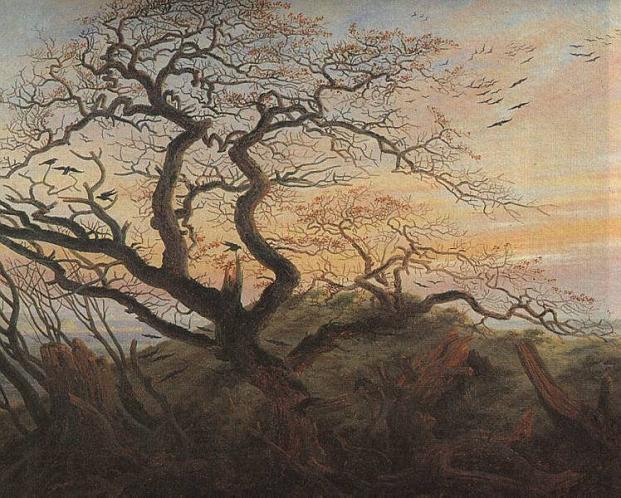 Casper David Friedrich, Tree with crows,1822, oil on canvas
The latter strand would contest the nationalist narrative characterizing Australian history as a linear progress from penal colony toward 'civilization'.This suggests that Romanticism's modernity: it represented a break from the past, and it inaugurated an historical moment that is still our own.
Does it mean criticizing "modern technological hubris" and affirming the ecological interdependence of all living creatures, whether human or non-human? What is the relation between the Romantic and the postmodern?
 Caspar David Friedrich, Monk by the sea, 1809/10, oil on canvas
If postmodernism can be interpreted as a repetition of Romanticism in viewing knowledge as a local, poetic and narrative construct, then it could be argued that both Romanticism and postmodernism are reactions to, and critiques of, an instrumental Enlightenment reason. Thus romanticism can be seen as a reaction to the rationalism of the Enlightenment, one that can be understood in terms of embodied emotions. On this interpretation Romanticism swing away from the optimistic Enlightenment idea of human dominion over nature and the credo that abstract reason would ultimately reign supreme.
 Casper David Friedrich, Sea of Ice, 1824, oil on canvas
The reaction to these images is a jarring one.They look cliched and tired, especially after the abstractions of modernism. What if we step outside modernism to postmodernism---how would we rework these images today so they express our disquiet with our own mode of life? In the Sea of Ice the icebergs hold the almost invisible small ship on the right in a crushing grip.
June 9, 2008
bodies, sexuality, conservatism
In a paper entitled Teenage Sexuality, Body Politics and the Pedagogy of Display Henry A. Giroux says:
Traditionally, the body for youth has been one of the principal terrains for multiple forms of resistance and as a register of risk, pleasure, and sex. It has been through the body that youth displayed their own identities through oppositional subcultural styles, transgressive sexuality, and disruptive desires. The multiple representations and displays of the body in this context was generally central to developing a sense of agency, self-definition, and well-placed refusals. The body as a potent marker of youthful resistance served to set youth off from the adult world and suggested that the body was outside of the reach of dominant forms of moral regulation and sexual containment.
Within the new representational politics of youth, the body is increasingly being commodified and disciplined through a conservative cultural politics. Within the terrain of such a politics, the struggle over the body and sexuality as a sign becomes as important as the more traditional practices of containing and disciplining the body as a threat to the social order.
There is irony at work in a conservative discourse that defines its notion of family values, in part, on an image of the completely pure and sexually innocent child (read white and middle class) while it refuses to acknowledge the immense sexualization of children within consumer capitalism.
June 8, 2008
home entertainment
We had a frustrating night last night trying to access ABC 2 through a digital set top box so that we could watch Dr. Strangelove. We gave up after an hour or so.
We decided to watch a DVD of an early Federico Fellini film I Vitelloni--- it is one about alienated middle-class parasites confronted with their worthlessness and with the bleakness of their futures. I was interested in the camera work and the use of black and white. Only the film was in Italian with no subtitles. For a while we thought that it was the TV not working because of us playing around trying to access ABC2. Silly us.
So we watched 8½ instead---a film about the making of a movie and a director's block.
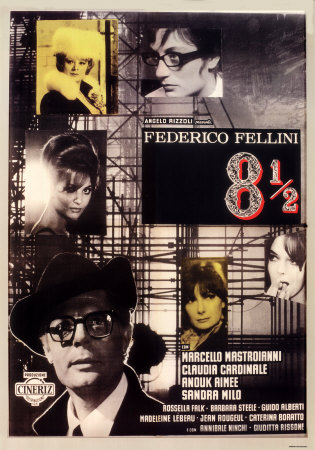 The central character is supposed to be directing an ill-defined science fiction film but has lost interest amid artistic and marital difficulties. As he struggles half-heartedly to work on the film, a series of flashbacks and dreams delve into his memories and fantasies. They are then frequently interwoven with reality.
The complexity lies in the delicate balance of real world vs. fantasy world vs. flashback scenes. It signifies Fellini's turn toward dream, imagination and memory after La dolce vita that drew inspiration from the dream theory of Carl Jung. If what is presented is a subjective collection of episodes and images, the embodied spectator’s bodily experience of this cinema lead to us falling asleep!
June 7, 2008
reading photographs
A lot of the negative responses to the Bill Henson images of androgynous adolescents adrift in a nocturnal wilderness assumed that the way to read these images of teenage sexuality is in terms of reader response, with the reader coded as the sick paedophile desiring to prey on children.
The image is equated with the implied response of the paedophile. So we have images of sexualized teenagers as porn for the viewers (paedophile) lust.
 Bill Henson, untitled
This separation of the implied reader's emotional life from the textual codes and conventions, as well as the form of the work, is covered by an attack on contemporary art as vile, sick and depraved. The more sophisticated cultural conservatives implied that the reader/image relationship involves readers who are formed as particular social subjects (paedophiles).
This conservative aesthetic denies any space to include a category to encompass analysis and critique of this way of interpreting Henson's images; or the possibility of alternative interpretations.
The idea that a photography presupposes a reader actively involved with image may be shocking to those formalists who prioritize an objective, fixed text, and who seek to emphasize the objectivity of their interpretations by saying that it is erroneous to hold that a reader’s response is relevant to the meaning of a photographic work. However, to see a photographic work purely as an object is to describe what it is and ignore what it does, and so this misconstrues the way that a photograph signifies meaning when it is read. The reader is an active maker of meaning.
If we make the shift from reader-response criticism to reader-oriented criticism with its emphasis on interpretive communities (of paedophiles ), then we need to accept the existence of other interpretive communities (the art institution ) or feminists. There are real differences among real readers in the way they interpret images.
June 6, 2008
An old favourite
It is possible to make music in a huge arena as distinct from just performing or entertaining the crowd. This is shown by this video:
It is Standing on the moon from Built to Last, which by all accounts, is a poor album with only minor material by the old Garcia Hunter songwriting powerhouse. This video shows what can be done with such minor material, even though the Grateful Dead were on their last legs in the early 1990s.
The raw experimental energy of the 1960's has long gone. It is replaced by an expression of world weariness that leads into a depressed mood and into a sense of angst.
Friday humor
It would appear that sex offenders are perceived as so great a threat that the law and order conservatives hold that sex offenders should never be released from prison. If they are released under some form of supervision, then they are hold that the community needs to know who these sex offenders are and where they live so that they can protect their children.
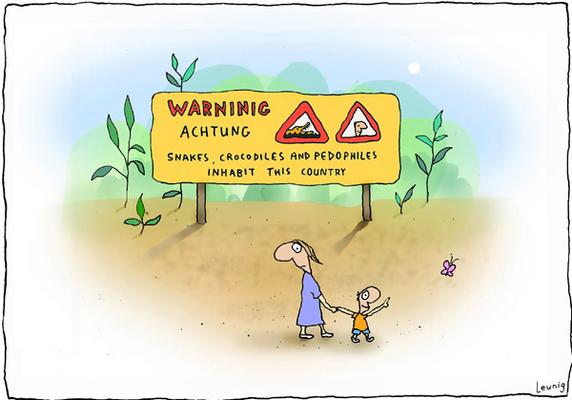 Leunig
That most sex offences are committed by a family member or close friend-- not a stranger--- makes no difference to these conservatives. They need the Other ---the pedophile as stranger---to justify their fear and to maintain their moral outrage about the sexualization of children and the teenage nudity on the internet. The politics of the law and order is about managing public fear.
For outraged moral conservatives, such as Hetty Johnston, the images of naked teenagers taken by Bill Henson are seen as 'handing our children on a bloody plate to pedophiles'---even though the Classification Board regards them as mild and safe for children to view. They are not porn. They have a PG rating.
June 5, 2008
Melbourne photography: Chris Zissiadis
When I was in Melbourne last weekend doing a bit of photography I decided to explore those Melbourne photographers who also have websites, weblogs or photoblogs. Since Melbourne has a very active photographic community I was interested in seeing how they were developing their digital presence in the form of creative culture.
This work---and I'm thinking of what is called art photography here---is Flickr based, and unlike the German work, uses 35m and medium format rather than the view camera. I'm not sure to what extent the Melbourne Flickr photographers are a part of the art gallery scene, or stand outside it. Since I unaware of any magazines that discuss what is happening photographically in Melbourne in terms of art criticism that I can turn to for a map, I decided to adopt a bootstrap approach.
One photographer that I came across, and whose work I often turn to in order to improve my own photography, goes by the name of ziz on Flickr. Ziz is Chris Zissiadis, and his photoblog is entitled urbanlight, which is very active. Alas, as there are few images in the public domain on the internet, we have to mostly work in terms of exploring the links.
The work is mostly black and white with some colour, it is often in a square format, urban based and film based. The city's pulse, signs and form is explored by someone who spends a lot of time in the city and knows its rhythms, light and moods well:
 It is very much people in an urban life, whose architecture and forms shape their flow or movement. The modernist forms are those of the contemporary Melbourne CBD --the laneways, the small streets and the walkways and the buildings around them.
For instance, this recent black and white photo
 is a spare, classically modernist celebration of industrial form that refers back to both the early American modernists ---Paul Stand and Charles Sheeler ---and the modernist work in Australia of Max Dupain.
In the Australian context both Dupain and the older Harold Cazneaux fully embraced the modern in photography, shifting from pictorialism (defined as a romantic approach with its roots in impressionism) to one aligned with the New Photography or New Objectivity emanating from Europe, and in particular Germany, in the 1920s and 1930s. This was photography concerned less with representation and more with formal relationship and composition
In Chris's work people are moving through the urban spaces and they are, more often than not, blurred shapes overwhelmed by the looming or dominating architecture. What is being produced is the development of an Australian modernism that looks back to, and builds on, Strand's Wall Street:
 Paul Strand, Wall Street, 1915, gelatin silver print
It is an Australian modernism that focuses less on Charles Sheeler's industrial forms of the Ford Motor Company's River Rouge Plant, or Dupain's representations of Harry Seidler's architecture and more on the forms of Melbourne's freeways as a sign of industrial modernity. Whereas Dupain's modernism celebrated a modern industrial Australia as a form of utopia, Zissiadis is more discordant and dialectical. So we have a tension between the cool, often abstract surfaces of modern Melbourne and the discordent alternate or underworld that flickers at night. Modernism jars.
Bo Diddley
The Bo Diddley beat is one of rock & roll's bedrock rhythms. He produced a catalog of classics in the late 1950s---"You Don't Love Me," "Diddley Daddy," "Pretty Thing," "Diddy Wah Diddy," "Who Do You Love?," "Mona," "Road Runner," "You Can't Judge a Book by Its Cover" —that rival Chuck Berry's songs in quality whilst being more primal:
After 1963, he never wrote or recorded any original material on par with his early classics. It was Chuck Berry of the early rock & roll artists who was most crucial to the development of the music.
Some light-hearted fun at the expense of the British bands that covered Bo Diddley's material:
June 3, 2008
Melbourne: erasing the past for the future
I was in Melbourne on the weekend and I took the opportunity to spend some time on Saturday to wander around the CBD in an around the Southern Cross Railway station and the Lonsdale St Power Station.
I had a plan: after exploring the railway station I would take some photo of the "Save the Tarkine" slogan on the power station's imposing chimney stack, a quick wander around then Docklands, then suss out the Bolte Bridge, before I caught the train down the Mornington Peninsula.
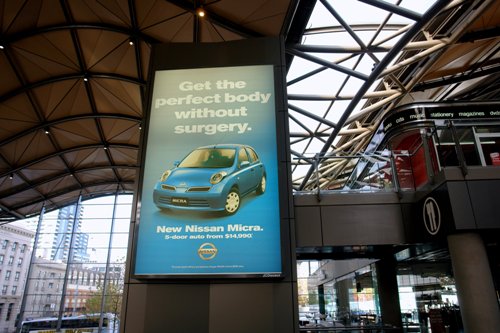 Gary Sauer-Thompson, Southern Cross Railway Station, 2008
The old power station on the corner of Lonsdale and Spencer streets was a hulking, asbestos-riddled concrete brute of a building, and it had lain eerie and abandoned for 26 years. It was a classic example of Brutalist industrial architecture that celebrated concrete. It stood for the provincial, grimy industrial Melbourne of the 20th century.
I was too late.Soldis Capital, a Russian consortium who paid $7.6 million for the site last year, has cleared the site of asbestos and are now clearing it of old buildings.The latter's chimney had been dismantled and the site was closed off for demolition to make way for commercial office redevelopment, that is styled as a lifestyle retail precinct.
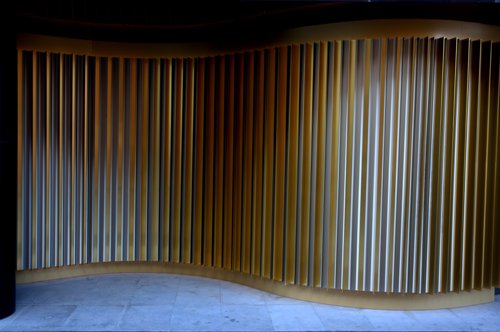 Gary Sauer-Thompson, copper facade of hotel on Londsdale /Spencer St cnr, Melbourne, 2008
It is an example of how Melbourne has changed. Back in the 1980s and 1990s Melbourne had an empty, useless city centre, as the CBD was the dead heart of a dreary, unexciting provincial city. The changes started happening with the opening the first bars in the CBD's laneways that have since become Melbourne's international face. In the decade from the mid-1990s, Melbourne's CBD $1 billion resurrection has produced Federation Square, the Melbourne Museum and the Australian Centre for Contemporary Art, and revitalised the State Library and NGV International.
The city was pulled out of its modernist provincialism by restoring public space and civic engagement, exciting, postmodern public architecture and the interesting corporate architecture. The latter is increasingly to be found in the market driven developments developments in, and around, the Docklands precinct.
I ended up in Digital Harbour--- a specialist IT precinct ---- poked around 1010 LaTrobe Street, before exploring the Victoria Harbor, that is deemed to be the heart of the Melbourne Docklands. I never made it to the Bolte Bridge.
June 1, 2008
photography in a time of moral panic
Christopher Deere makes some good points in an op-ed in The Age about the way that the prevalent public fear and moral panic about paedophiles in our culture impacts on photographers working today. This moral panic, for instance, has resulted in me, as a photographer, working in the inner city. It is here that I can find spaces and the freedom provided by big crowds to avoid the paranoia associated with the moral panic. This paranoia represents photographers as folk devils.
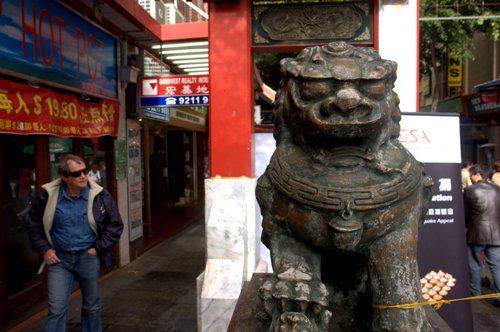 Gary Sauer-Thompson, Chinatown, Sydney, 2008
In his op-ed Deere argues that Australians were fairly relaxed about the confluence of sexuality, young girls, ballet and photography in the 1970s, but now things are very different. He describes this change thus:
That was then, this is now. Now, as a balding and bespectacled nearly middle-aged man, I can hardly walk through a public park without looks of guarded alarm and gestures of defensiveness from the mothers of the children playing there. It probably doesn't help that I still carry a camera almost every time I step out of the house. That instrument immediately turns me into a figure of open suspicion in any public place. I can almost hear people thinking, and sometimes aloud: What is he doing here? Why is he carrying a camera? He looks a little odd; I'd better keep my eye on him.I have sensed this public fear and suspicion in the suburbs of Adelaide around the 1990s when I lived in inner suburb of Parkside and walked the suburban streets with a camera. It was that experience that caused me to return to living in the inner city. This public fear is much worse now.
Deere describes his own reactions as follows:
I suppose that I should be accustomed to it by now, but I'm not. I can still feel a flash of offended realisation when a young woman gathers her children towards her as I pass nearby, or when a security guard in a supermarket follows my movement along the aisle towards the raw sugar. I'm innocent, I sometimes want to say; I'm really not here to cause you any harm. But that would be pointless, and might only make matters worse. Better to simply go about my own business and leave everyone else in peace.
Behind the current moral panic, he says, are real concerns about the safety of children and young women in this technology-heavy age of the internet. He adds that the apprehension is about who has the right to possess a person's image (and, by implication, his identity), and that this has spread to the point where, not so long ago, a suburban council tried to prevent parents from taking photographs of their children at the local pool.
Update: June 2
Frank Furedi is quoted in Lesley Sands' Moral Panics as observing that reaction to events such as the Henson event:
‘reflect far wider concerns about the nature of society today, in circumstances where people sense that things are out of control’. It is when the ‘traditional norms and values no longer appear to have much relevance to people’s lives’, yet there is the belief that there is little with which to replace them, that a very real sense of loss can occur. And set against this background; people’s awareness of this loss of control over their lives, makes them all the more susceptible to moral panics, and perhaps those that would orchestrate them
If we have the politics of fear, then moral panics are usually expressed as expressions of outrage rather than unadulterated fear, and they are framed in terms of a dominant morality threatened by the activities of a stereotyped group. This group, it now seems, now includes photographers. Photography is now being framed as deviant behaviour within todays conservatism of fear.