|
June 10, 2008
I'm not sure what romanticism means in the visual culture of contemporary Australia. It used to mean a national or Australian culture in opposition to the imperial (British and American ) one. But now? Is it still of relevance?
Often it merely means the trite celebration of the beauty of nature in opposition to the economy's destruction of nature under a neo-liberal mode of governance. Or an old long forgotten German oil painting for those with an art historical bent:
 Caspar David Friedrich, Abbey in the Oakwood, 1809, oil on canvas
What does it mean for Australian photographers, writers and artists today in a global world? Does it mean an engagement and identification with the body in pain. Does it mean an emphasis on the sublime (ie., terror and the threat of self-annihilation) with its emphasis on the experience of fear and awe? In Friedrich's work nature emerges not as some benign environment for mankind, but as a frightening threat to civilized life
Is there a tension between the romantic currents in a literary culture and the visual media in the visually saturated cityscape of postmodernity?
Isaiah Berlin's definition of romanticism is a conventional one and doesn't help that much:
Romanticism is the primitive, the untutored, it is youth, life, the exuberant sense of life of the natural man, but it is also pallor, fever, disease, decadence, the maladie de siècle.
if Romanticism was widely used in early colonial art in Australia emphasizing Rousseau’s theory of the ‘noble savage’,and it was caught up in the political struggle to define an Australian national identity, then the decadence strand can be rephrased to mean despair in a world shorn of all hope.
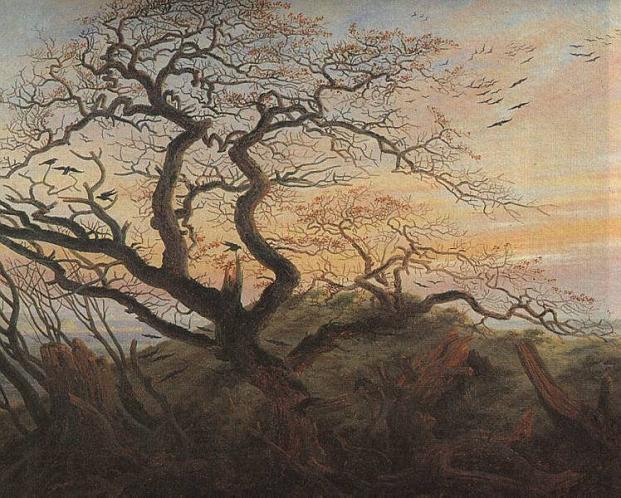 Casper David Friedrich, Tree with crows,1822, oil on canvas
The latter strand would contest the nationalist narrative characterizing Australian history as a linear progress from penal colony toward 'civilization'.This suggests that Romanticism's modernity: it represented a break from the past, and it inaugurated an historical moment that is still our own.
Does it mean criticizing "modern technological hubris" and affirming the ecological interdependence of all living creatures, whether human or non-human? What is the relation between the Romantic and the postmodern?
 Caspar David Friedrich, Monk by the sea, 1809/10, oil on canvas
If postmodernism can be interpreted as a repetition of Romanticism in viewing knowledge as a local, poetic and narrative construct, then it could be argued that both Romanticism and postmodernism are reactions to, and critiques of, an instrumental Enlightenment reason. Thus romanticism can be seen as a reaction to the rationalism of the Enlightenment, one that can be understood in terms of embodied emotions. On this interpretation Romanticism swing away from the optimistic Enlightenment idea of human dominion over nature and the credo that abstract reason would ultimately reign supreme.
 Casper David Friedrich, Sea of Ice, 1824, oil on canvas
The reaction to these images is a jarring one.They look cliched and tired, especially after the abstractions of modernism. What if we step outside modernism to postmodernism---how would we rework these images today so they express our disquiet with our own mode of life? In the Sea of Ice the icebergs hold the almost invisible small ship on the right in a crushing grip.
|


A quote:
There's an account of really existing romanticism for you.