March 31, 2006
blast from the past?
I'm tired. It's been a long day in Canberra, and then there was the shuttle flight home.

I could not resist this cartoon since I wandered through the Canberra Press Gallery in federal parliament and heard stories about the old style journo. You know the one who also hates academics and postmodernists.
March 29, 2006
mums and dads
Have you noticed the use of 'working families' and ordinary 'mums and dads' in our public discourse presents a vision of the nation as an imagined commmmunity where conflict between different groups has already been reconciled?
It's just clicked. What is covered over is a racially and sexually diverse nation. We are an Anzac nation now. It is 'Anzac' that informs our national identity not the ethnic and sexualkdiversity of Mardi Gras in Sydney.
March 28, 2006
a folk painter
A people's painter who was shunned by the art establishment.
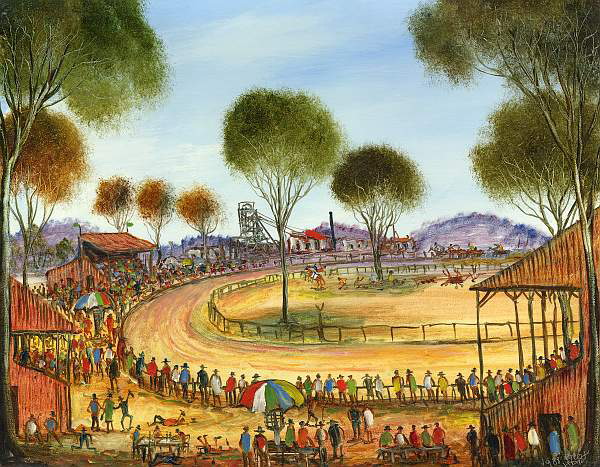
Pro Hart, St Pats Races
He is a household name in Australia and one of the most popular contemporary artists of our time.
March 27, 2006

March 26, 2006
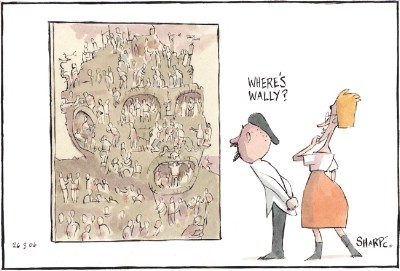
March 25, 2006
Archibald Prize, 2006
The winner of the Archibald Portrait Prize2006 is an innovative one: a medieval looking painting of a large head like a landscape, comprising hundreds of tiny figures:
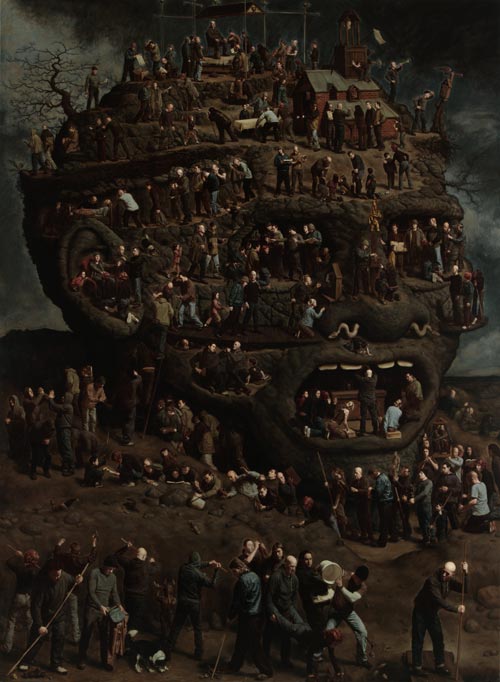
Marcus Wills, The Paul Juraszek monolith (after Marcus Gheeraerts), 2006
Marcus Willis is a little-known Melbourne artist and he says that a reference point for the work was a 16th century Flemish etching by Marcus Gheeraerts---preumably Marcus Gheeraerts the Elder (c.1516-bf.1604). His son, Marcus Gheeraerts the Younger (1562-1635), was an English court portrait painter, and it is Marcus Gheeraerts the Elder who was the engraver.
Alas I cannot find any of Marcus Gheeraerts the Elder's images on the net, let alone the etchings.
The The Paul Juraszek monolith work is innovative because the aim of the Archibald fostering portraiture supporting artists and perpetuating the memory of great Australians. So each year resident Australian artists are invited to submit portraits painted from life of men or women “distinguished in Arts, Letters, Science or Politics. It is Australia's oldest and most prestigious art prize, and it attracts national attention and fosters ongoing attention and debate within the community.
March 24, 2006
on Lies
I'm reading Montaigne's Essays. The one I'm currently reading is called On Lies. In it Montaigne says:
Lying is an accursed vice. It is only our words which bind us together and make us human. if we realize the horror and weight of lying we would see that it is more worthy of the stake than other crimes.
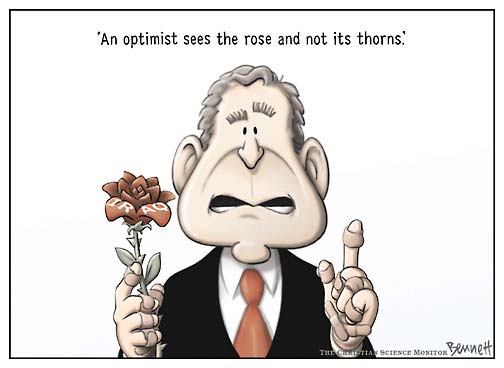
Quintilian observed that a liar had better have a good memory. Memory comes into it because the standard lines of the Howard Government and its hand-picked sycophants suffer from a case of collective amnesia in political history. Its bywords after 10 years are 'I cannot recall', 'I do not recollect', 'I wasn't told' and 'I don't remember'.
March 23, 2006
desire thwarted
The Commonwealth Games in Melbourne are drawing to a close. Presumably, there been increased tourism? Have the restaurants and bars done well? Or has business been slow during the Games? The bits of the broadcast that I have seen suggest that the coverage is nationalistic.
I'm afraid that I haven't that paid much attention to the Games. But I did like the way the cartoonists linked them to the British monarchy's fleeting visit and used them to weve lots of interesting ideas :
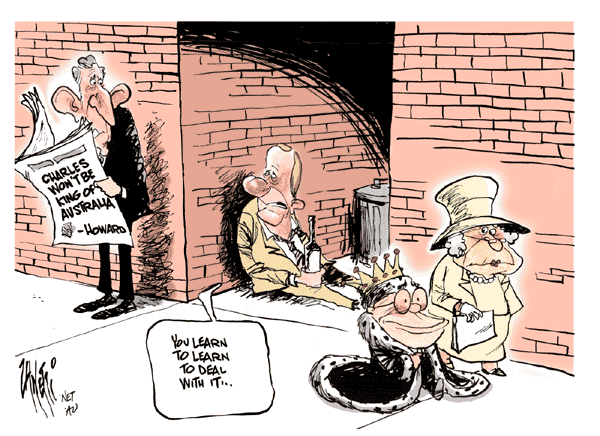
The visit of the Queen of England is used as reflecting mirror that illuminates some of the darker corners of the negative effects of political power and desire.
March 22, 2006
nationalism & sport
The Commonwealth Games in Melbourne have underperformed everywhere. That is the word on the street.The exception is the cultural nationalism. If the Games are staged as a nationalist competition, then they provide a strong platform for representing nationality. Hence we sporting nationalism. And Channel Nine has been hot to trot on this.
Swinburne University's senior lecturer in media, John Schwartz, said local coverage of the Commonwealth Games had been ridiculously nationalistic. International athletes were marginalised and those stepping up to collect their medals are just cut off.
Mr Harnden, presumably a Channel Nine spokesman, rejected complaints about the television coverage:
Australians are very parochial and the media is obviously following that. But crowds in all of the venues, have absolutely cheered on everybody.
That contradiction indicates that Channel Nine are constructing nationalism, just as their news breaks between the Games events construct crime.
What we see here is the workings of langauge and power--pumping up the hero Aussies by Channel Nine to increase the ratings, and then use the increased audience to charge more for advertising. It's all pump pump pump. I presume the audiences are not there and the advertisers feel as if they've been short changed.
March 21, 2006
Colliding Worlds: first contact
It is first encounters between the two peoples--non-indigenous and indigenous--- that the moral, cultural and political foundations of Australian nationhood are defined and contested.
The most interesting visual exhibition in the Adelaide Festival was about one such encounter Colliding Worlds: First Contact in the Western Desert 1932-1984 at Tandanya which mapped the contact between white people and Aboriginal people in the Western Desert, Australia in the early to mid 20th century.
The Aboriginal people of the Western Desert in Central Australia were among the last Indigenous communities to make contact with Europeans. The exhibition, explores both the Aboriginal and non-Aboriginal perception of first contact, incorporates the ethnological photographs of Donald Thompson, previously unseen artefacts and significant artworks of the Western Desert, and is self reflexively critical about imperial anthropology.
It was out of this first encounter that the Western Desert (arcylic) Art movement based in Papunya in the 1970s arose:

William Sandy, Bush Bean Dreaming, 2003
March 20, 2006
hope i die before i get old--naah
The rock group that's become synonymous with commercialism and hype:

It's a well-oiled machine that plays recreations of a back catalogue that requires one sift through a couple of decades' worth of mediocrity. Why bother? It's showbiz.
If you define a sell-out as one who compromises all artistic integrity to create something he doesn't believe in for monetary gain, then are the Rolling Stones a sellout?
March 19, 2006
Ali Farka Toure, Ry Cooder, Talking Timbuktu
It is Sunday morning after the SA state election, that was won by the Rann-led ALP as expected. We've been listening to Ali Farka Toure --the CD he made with Ry Cooder called Talking Timbuktu.

It's very beautiful, bluesy world music that explores the nexus between American blues and west African music and ilustrates the way that American blues has been shot through with African forms That particular musical debt is more often acknowledged than heard, but it is highlighted in this
this interview by Toure for Acoustic Guitar in 1995.
Toure says of his music:
My music was always part of my work of education, love, evolution, and criticisms. I take the tradition, and I translate all that I can of the music of my country. I find an indigenous guitarist who gives me the tunes, and I learn them and practice. The words are already there, they are legends that I know. So I only adapt, I translate that which has been dictated to me by the old people. I speak nine languages, because I am there for everybody, not only for one individual. Honey is not good in only one mouth. And that is what has made me popular and successful, because I play for everyone.
He then relates this tradition to Amercian blues:
"The first time I heard John Lee Hooker's music, I recognized it immediately. I argued with people, I said 'This is not possible, how can this exist in America?' Because these are not Western tunes. Not at all. This music is 100% African, and particularly from Mali. The tunes he plays are some of them in the Tamashek style, some in the Bozo style, some in Songhai style and some in Peul. John Lee Hooker does not know the sources of his music. I respect him and appreciate his genius as the translator of African music in the United States, but my music is the roots and the trunk, and he is only the branches and the leaves. These are our tunes, and he plays them without understanding them."
I'm not sure about the tree metaphor. Why not rhizomes?
March 18, 2006
political realities
Says it all, really:

Alan Moir
That's the way of empires. They rely on client states to govern indirectly.
March 16, 2006
about aesthetic concepts
The passage below is courtesy of Nicholas Gruen over at Club Troppo. The quote Nicholas has posted is from John Armstrong's The Secret Power of Beauty.

Edward Weston, Shell,
Armstrong says:
In one of his more memorable --- but typically obscure--- formulations, Hegel writes that: 'The owl of Minerva spreads her wings only at dusk.' What is the thought behind this poetic image, an image which is supposed to communicate something important about the nature of philosophy? Hegel was obsessed by one of the big problems of thinking and, by extension, of writing. The 'owl of Minerva' stands for the process of understanding. So, he says, we begin to understand what it is we are interested in only as we approach the end of our inquiry.This is to contradict one of the most beguiling ideals of philosophy. Couldn't we start with absolutely clear and precise propositions ----as Descartes did when he tried to deduce every important truth from the simplest and clearest of starting points: 'I think, therefore I am'? To apply the point locally: couldn't we first of all say what beauty is and then move on to a discussion of its significance?.

Edward Weston, White Dunes, Oceano California, 1936
Armstrong continues:
Less idealistic, Hegel's point reflects a painful fact. We start in confusion, so we cannot immediately come up with the right definitions. Sadly, knowing where to start is something we only really see afterwards ---when, of course, it is too late. It is only at dusk that we become wise ----by which time we have already had to endure our own midday follies.
Tis well said.
March 15, 2006
Quadrant vomits
This is why I have little time for the cultural conservatives in Australia. In this editorial in Quadrant written by P.P. McGuinness we find this statement:
The reality is that the humanities are being, and largely have been, destroyed in the name of the meaningless subject of “cultural studies” and corrupted by “postmodernism”, which has become a substitute for thought and scholarship. Little of value is produced by the adherents or fellow travellers of this school, who are more concerned with political fashion amongst the lumpen intelligentsia than any analysis. Much of what they produce is propaganda or worse. Absurd subjects like “gender studies” or, even worse, “queer studies” are solemnly treated as worthy of respect, and projects of research are proposed which add precisely nothing to the sum of human knowledge.
Really? It indicates an ignorance of the texts of postructuralism that is covered up through bluster and avoidance of intellectual engagement of this attempt to free us from the limitations and distortions of the bourgeois cultural and social order inherited from the Enlightenment, so that we may understand the inadequacies of concepts and presuppositions that are taken for granted by and so imprison most of our contemporaries.
And then this:
The ARC, advised by experts who are drawn from such fields (or from the modern school of history-as-propaganda) allocates money to ridiculous projects on the advice of people who are products of the same belief system or secretly nurse their residual loyalty to Stalinism or Maoism, many of them to be found in the phony areas of the social sciences, like most sociology, much anthropology, and the tendentious mish-mash called political economy. The scientists are incapable of understanding just what rubbish is proposed for funding (with few exceptions, as in America with Alan Sokal and his famous hoax). The collegiality to which they still give lip service prevents their pointing to the emperor’s nakedness.
The phony areas of the social sciences? The dismissal is based on politics rather than the critique of limitations and distortions of the dominant world-view in contemporary Western societies
This view is based on a conception of choices and actions as expressions of individual subjective preferences, a conception of the point and purpose of knowledge as deriving from its usefulness in enabling us to predict and control our environment, and a conception of the rules that are to govern our moral and political lives as constraints upon our interactions with others in the form of universal laws or principles about which we would, under certain circumstances, all agree.
This view is part of the kind of social order which we inhabit not only frustrates the satisfaction of human needs and oppressively distorts human relationships, but also inculcates illusions about its own character, illusions that inform not only many of our everyday beliefs, but the standard academic disciplines. Hnece the need for critique.
March 14, 2006
witty
Courtesy of Jon at Posthegemony

Michael G. Laster, Girl Refuting Hegel's Dialectic Model of History, from the exhibition Based on a Thorough Understanding of the Way Things Are"
Strictly speaking, it should be Hegel's philosophy of history not a model of history; and it should be Lectures on the Philosophy of History
the vision is one of the world developing toward freedom, rationality, and understanding albeit with tendencies working in opposite directions, which are over time are reconciled.
Which bit is being refuted? The dialectics or the development of freedom?
March 13, 2006
Commonwealth Games: yawn
So the 2006 Commonmwealth Games are due to start in Melbourne next Wednesday. Yawn. And the Queen of Great Britain is in Australia to open the Games. Yawn.

I cannot get enthused about either event. Yawn. Maybe that's me. I'm the arty type.
Then again we can ask: Do the Commonwealth Games hold any credibility as an international sports events anymore, or are they now just a colonial relic, an imperial anachronism? Can and should the Commonwealth Games be re-invented to find a new and distinct place in the political and sporting cultures of the countries of the Commonwealth?
It's a television media spectacle, is it not?
March 12, 2006
Velvet Underground: postmodern rock music
A classic essay--White Noise/White Heat by Larry McCaffery revised. McCaffery's argument is that Andy Warhol Presents the Velvet Underground and Nico is an album which contains the origins of postmodern rock.

It was that here that rock music began co-evolving with avant-garde branches of the art world, cinema, and jazz though establishing a feedback loop of influences and borrowings that have been mutually supportive.
I've previously explored this intertexuality in terms of the music and light shows of The Grateful Dead but I've never considered theitr music in terms of postmodernism. I would not have made the connection, despite the Dead's music having characteristics of a postmodern musical style that favors eclecticism in musical form and musical genre; often combines characteristics from different genres, or employs jump-cut sectionalization (such as blocks); tends to be self-referential and ironic, blurs the boundaries between "high art" and kitsch; and is marked by randomness.
I would argue the Grateful Dead's musical roots were in blues, folk, R and B, and bluegrass and that in their relation to mass media and high-tech modes of production, their music has been self-conscious and full of irony from the beginning. Despite this I never made the link to postmodernism. It was MTV that smuggles postmodernism into rock, and I woud have held that it was Madonna who was the paradigmatic figure of the newpostmodern-music TV culture.
What then is McCaffery's argument about the Velvet Underground? He says:
Like fictional innovators from the same period (Robert Coover, Donald Barthelme, John Barth, and Thomas Pynchon, for example), the Velvet Underground systematically and self-consciously began to re-examine and then openly disrupt their genre's conventional assumptions about formal unity and beauty, about the "proper" ways to manipulate their medium's elements into a structure, and about the nature of the creative "self" and "authenticity." Sponsored initially by Andy Warhol, whose role in the postmodernist breakdown of the division between avant-garde and the mainstream is central and ongoing, the Velvets mixed musical styles (folk, minimalism, thrash, jazz, gothic rock) and messages in a way ideally suited for expressing the multiple, contradictory textures of postindustrial urban life. In their early performances in Warhol's multi-media happenings (the "Plastic Exploding Inevitable"), the Velvets' music was presented within a dissolving, multi-genre display of Warhol movies, dance, light shows, and improvisational poetry - a bewildering cacophony of avant-garde noise, light, humans interacting with images and sounds, and the Velvets' deliberately dissonant, minimalist three-chord progressions.
That is a classic example of intertextuality that transgresses the familiar function of music as providing "background" or "atmosphere," to the point where music and musicians now are playing a major collaborative and intertextual role. It highlights the way that artists found themselves simultaneously immersed in and critical of mass culture - a culture "industry" of ever-expanding proportions which seemed increasingly impossible to ignore.
It is argued that in postmodern fiction, poetry, art, and music there emerges a parallel attitude - arising from a mix of affection, put on and put down, and joyful freeplay - toward the images, sounds, and language that we consume as they consume us. In all these postmodernist art forms we see artists deciding to plunge into, digest, and often subvert the profusion of visual, sonic, and information sources that bombard us every day. The result is an immersion within and command of the imagery, sounds, and verbal elements that comprise the postmodern milieu we all inhabit.
Here is the rest of McCaffery's argument about the postmodern significance of the Velvet Underground:
He says that the Velvet Underground's performances:of this period were:
....composed of discrete parts - photographers taking photos of the audience, dance, different Warhol movies being continuously projected onto the bodies of musicians and other performers, etc. - all presented in a non-hierarchical simultaneity that defiantly refused to cohere in any traditional sense. Although the Velvets were, like the Beatles, interested in the way technology could be used to produce unusual sound effects and distortions, they used technology to capture a raw, "naked" sound; thus, in songs like "Sister Ray" and "European Son" (both influenced by jazz innovator Ornette Coleman's equally unconventional notions of dissonance and harmony) they experimented with the effects of repetition, of the accumulated and chance effects of feedback, even the concepts of boredom and willful crudity (cf. Warhol's movies such as Sleep and Empire from the same period), so that a tension develops between the tight, monotonous formal structure and bursts of piercing sounds and pure noise. Often playing with their backs to the audience, and occasionally abandoning the stage altogether while their guitars continued to shriek and drone on, the Velvets also foregrounded the concepts of rock musicians as image or mechanical simulacrum (essentially an extension of Warhol's fascination with the mechanical and reproducible qualities of life and art, the artist-as-machine) in ways that anticipated the more elaborate and playful methods of David Bowie, punk musicians, and more recently, Madonna.
McCaffery's conclusion is that:
In short, the Velvet Underground ushered in the postmodern era of self-conscious, self-referential rock - the rock music that would segue into the glam and punk phenomena of the l970s, into the New York art rock scene of the same period that produced Patti Smith, the New York Dolls, Jim Carroll, and Talking Heads, and which during the 80s would eventually mutate into the rap/scratch/dub and funk collage-sounds of urban blacks, the performance art music of Laurie Anderson, and the peculiar synthesis of jazz/pop/rock of John Zorn, Lester Bowie, and Hal Willner.
It's a good argument.
March 11, 2006
About culture
A review of two recent books on culture--- Francis Mulhern, Culture/Metaculture (London: Routledge, 2000) and Terry Eagleton, The Idea of Culture (Oxford: Blackwell, 2000) by Jeffrey J. Williams.
I have little interest in Eagleton---I stopped reading him after his The Illusions of Postmodernism (1996), which was a polemical tract. Mulhern'd text, Culture/Metaculture, looks interesting on William's interepretation. William says:
Mulhern's argument turns on an unexpected but forceful reconstruction of the origins of cultural studies. He recasts its starting point from the Birmingham Centre to the longer and wider net of modernist Kulturkritik. The first half of the book surveys a group of modernist European writers who criticized modern society, including a range of writers such as Thomas Mann, Julian Benda, Karl Mannheim, Ortega y Gasset, Freud, Virginia Woolf, Orwell, T.S. Eliot, and Leavis, leading up to the inaugural moment of British cultural studies. What these writers have in common, and what Mulhern recoups, is their critical stance toward modern life under capitalism. What they also have in common, but what Mulhern discards, is their elitist remove from common culture and politics.
That's how I read it too only I connect it with the Frankfurt School and the cultural critique of Adorno. Mulhern, however, is more interested in British cultural studies and its links to Kulturkritik.
Williams says that :
Mulhern fuses this tradition [Kulturkritik] with British cultural studies. Why his account is unexpected is because cultural studies typically casts itself in opposition to Kulturkritik, whereas Mulhern argues that they both participate in the same "metacultural" discursive formation. Kulturkritik privileges an elitist minority culture, that draws upon a high tradition and sets itself against popular culture; cultural studies retains the same coordinates, but inverts Kulturkritik's values, privileging the popular and abnegating tradition, arguing not for a minority culture but for the worth of minority cultures. Both also claim the political authority of the cultural; the mistake is that they overestimate that authority. In Mulhern's narrative, Raymond Williams is a bridge figure, asserting the politics of culture but dispatching the paternalism of Kulturkritik.
That's a goos interepretation--one that I concur with.
March 9, 2006
the new aspirational middle class
The opening of Australia to the global economy in the last two decades has given rise to a middle class politics of my/me. This new suburbia is structured on being fearful, a desire to keep the home safe, and downward envy. As long as the economy is strong these contractors, consultants and self employed will vote Liberal.

A description of the aspirations by Michael Duffy in The Age
March 8, 2006
desire

Mimmo Rotella, Fertish, 1999
Desire as otherness? The image indicates the gendering of desire.
March 7, 2006
more than a torn poster
"Tearing up posters from the walls is the only compensation, the only means to protest against a society that has lost the joy of fabulous transformations..." says Mimmo Rotella

Mimmo Rotella, Omaggio a Marilyn , decollage
Rotella's decollages are a creative re-appropriation of urban images such as the advertisement posters, which because of their redundancy, fail to make a lasting impression anymore. These "Dadaist" collages of movie posters or advertisements as an objet trouve which have had certain details developed and reworked.

Mimmo Rotella, Cinema Scope, 2000, decollage
These images are the surface of the walls of our cities, and they can be read and interpreted as the images disclosing the history and mythology of our consumer society.
a quiet moment
An exhibition at The Quicksilver Mine Co in Northern California:

Christiane Vincent, Adrift, mixed media, 2005 (detail)
It caught my eye.
March 6, 2006
Adelaide Art Festival
I'm looking for an exhibition of contemporary indigenous art at the Adelaide Art Festival. Surely there must be one I ask myself. Surely? I've found Colliding Worlds. So far I haven't found any, but I will keep looking through the Visual Arts Programme.
In the meantime we have Eubena Nampitjin who had an exhibition in the 2000 Adelaide Festival of Arts:

Eubena Nampitjin, Kinyu, 2005
Eubena paints her country south west of Balgo that is centred around Kunawarritji (Well 33) along the along the middle stretches of the Canning Stock Route in Western Australia. The central circles represent warniri (rockholes). . Surrounding these warniri and dominating the country are tali (sandhills).
March 5, 2006
Adelaide Arts Festival
I flew back to Adelaide from Sydney late yesterday afternoon, changed my clothes, walked the dogs in the Adelaide parklands, had dinner, then walked to Elder Park along the River Torrens to experience II Cielo che Danza----the Dancing Sky,
the site-specific, open-air show by Studio Festi on the River Torrens.
It was very romantic with lights, ballons, trapeze or arial ballet and a crescent moon. The music--popular romantic classical---was the low point. Some photos and some description of the Dancing Sky.
The Adelaide Festival started up whilst I was away working in Sydney on the weekend.
Suzanne had seen Three Furies on the weekend. There is a Francis Bacon triptych1970s loaned from the National Gallery of Australia but I cannot find it online. So the central panel from another triptych:

Francis Bacon, , Studies from the Human Body, 1970
People didn't hang around the city after the show. They just walked back to their cars and went home. You know why? There was nothing open. It was Sunday night. That's a regional city for you. It closes down even when there is a big festival happening. Amazing. Poor tourists.
March 3, 2006
politics
I'm on the road to the delightful and beautiful global city of Sydney. I will post tomorrow if I have the time. As my days are loaded up with work from the time I arrive early in th emorning so I will have little time to sample the delights of an "urban paradise"; or walk the laid back streets of Cronulla to see why the beach needed defending from the Lebanese-Australians.
Meanwhile a definition of parliamentary politics:

Matt Golding
Politics as it is framed by the media. The media loves the politics of leadership and dislikes the politics of policy. It's attracted by the blood and guts, treachery, obsesssion and death of the struggle of leadersship. That is what politics as power is about in the media.
March 2, 2006
the uncanny in the everyday
We accept that images are an integral part of our lives to a point where we decode them in a quasi-automatic manner. We have been trained to recognize and understand representations of all kinds and we increasingly have a comfortable familiarity with the visual .

Ralph Eugene Meatyard, IUntitled, (Boy with Flag), 1969
Deconstructionist criticism is responsible for a cultural turn that has helped redefine the status of culture. Whereas cultural phenomenon was previously seen as the mere response to social, political and economic processes, now it has now come to be perceived as having a life of its own.

Ralph Eugene Meatyard, Untitled, ("Motion Sound" Landscape), 1969
If modernism believed the image of the past to be a trace of reality, a form through which the past could be reexperienced and memories relived, postmodernism allows no such easy resting. .The relationship of images to the past has become problematic and the role of the image in producing memory and allowing for forgetting is central to this shift.
The origin of this change toward an ironic view of the past and its representations can be seen to have been given its most symptomatic invocation in Theodor Adorno's famous statement that "To write poetry after Auschwitz is barbaric. Adorno's statement, with its implication that the horror of the Holocaust made aesthetic representation deeply problematic, has haunted theoretical work about the conflict of memory and history and of fact and fiction in relationship to the Holocaust.
March 1, 2006
a dam good question
Now this is interesting---thinking of environmentalism in terms of Nietzsche's revaluation of values in a nihilistic world.
The Differance Engine asks: 'how might ecological footprint (re)duction amount to a revaluation of values?'
We can connect this question to issues like this and to this: reducing the ecological footprint in our cities. Or in relation to global warming.
The Differance Engine suggests a linkage back to Nietzsche's Thus Spoke Zarathustra, where Nietzsche says that "Man is something that should be overcome" and he asks: ,"what have you done to overcome him?" The Differance Engine asks: 'Environmentally, what could this mean? Moreover, what could this mean in itself?' The interpretation is along these lines of an overcoming that involves a shattering of statutes in which:
the creator represents an outsider, an outlaw reviled by those standing in judgement, the good and just who "hate the creator most: him who breaks the law-tables and the old values, the breaker – they call him the law-breaker"... Could this dramatic persona, this outsider, be conceived of as the environmentalist, the one who practices minimising their ecological footprint? If so, perhaps not intentionally: is there not an injunction from the environmentalist for everyone to change, to belong? In this, does Nietzsche, like the environmentalist, introduce beyond the personal and ethical an extension into politics?
Well, I've always read Nietzsche in terms of the self-assertion of the human will and the will to power as instrumentally appropriating the earth. Maybe I should re-read Nietzsche's Thus Spoke Zarathustra in the context of global warming.