|
February 04, 2006
Some thoughts on urban living arising from my week trip in Tasmania.

Wharf area in Hobart, Tasmania
This story caught my eye when I picked up an old copy of The Age as I came out of the 'wilderness' in Tasmania into Hamilton, a small country village or town in the dry farming/pastoral country of the Midlands. The MIdlands reminded me of the South Australian landscape. Only it had more trees and lots of gracious Georgian houses beside the Heritage Highway running from Hobart to Launceston, which are all in the process of being lovingly restored with a heritage eye.

Under Melbourne City Council's draft transport strategy, commuters would be "weaned" off cars, plans for a multibillion-dollar cross-city tunnel would be abandoned, and speed limits in the CBD reduced from 50 to 40 km/h. The strategy is a recognition that the car can no longer be king in Melbourne and that cities are also about people walking and enjoying themselves.
Are we leaving the 20th century behind? The draft strategy would work only if the State Government invested more in public transport and cycling alternatives. It is not evident that Bracks government would move in this direction.
Poor Adelaide. Flying back to it from Hobart in Tasmania yesterday it quickly became obvious that the car is king in Adelaide. The Adelaide City Council and Rann state government are not willing to make the changes to have car free zones in the CBD. Hobart is way ahead in preventing the car from eating up urban life.
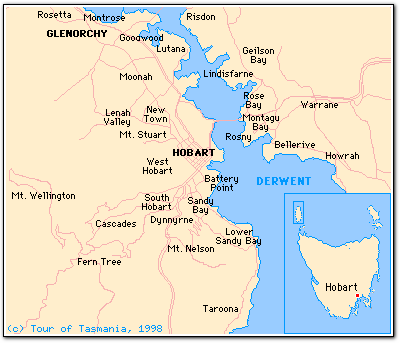 The wharf area (eg., the area around Salamanca Place & Elizabeth Street Wharf) show the way in what can be done in returning a city to people. The wharf area (eg., the area around Salamanca Place & Elizabeth Street Wharf) show the way in what can be done in returning a city to people.
Hobart acepts that it is a regional city.Unlike Adelaide it fosters no fantasy to become another Sydney or Melbourne. It is proud of what it is, and it is concerned to create a visually interesting and cosmopolitian regional city that offers a pleasant urban way of life in the inner city.
It does this by fostering and building on its strengths--- geogrpahy, keeping the old Georgian buildings, making creative use of the old warehouses along the wharf, putting all the craft and wood skills to great use inside the buildings and creating an architecture that is appropriate to the climate.
Adelaide comes across as a poor country cousin in contrast. Despite its compactness in being nestled between hills and sea, It looks poor, shabby and visually uninteresting. It is not a nice urban space for people to be in. It has yet to come to terms with its searing summer climate.
|


Gary, I don't agree that the Bracks government is ultimately responsible for the success of the new plan. Except for major arterials that are under VicRoads the roads are the local council's responsibility, and they could make such a difference to so many people regardless of public transport.
To put it in perspective, there are 300,000 people living within walking/cycling distance of the CBD (4-5km), and another 630,000 within easy cycling distance (10km). Yet only 2% of people cycle to work in every Australian capital except Canberra (which has extensive cycling paths) where it is 4%. Walking is the same (3-4%) except (as you indicated) Hobart where it is 7%. The comparable numbers in Scandinavian countries or the Netherlands are 20-30%!
Melbourne is more spread out and larger in population than those European cities, but the inner areas are not so different, and most people in outer areas also work in those areas. I seriously believe -- and there is no compelling reason not to -- that if local government actively discouraged driving and parking in and around business and shopping areas that Melbourne could reach those sort of figures. Dollar for dollar it is a much better investment than public transport and better for people in the local area. So I hope Melbourne is successful and other councils follow suit.