March 30, 2004
The Tarkine
I didn't know that the Tarkine rain forest, on the north west coast of Tasmania has a coastal dimension.

P. Dombrovskis, pigface in flower
The Tasmanian Government plans to log the old growth forest of the Tarkine for the myrtle timber.
March 29, 2004

March 28, 2004
Australian pop art?
What I was trying to sketch in my lost posts last week was an critical urban culture that would be able to tackle this and this and this. I had adopted a historical approach to get some sense of a map of what had happened.
What I had sketched was something along the lines that an urban culture only got going in the 1950s and 1960s in Australia. This was a movement towards a metropolitan culture, as distinct from a romantic suburban one linked to the bush and the beach. It was a movement because Australia did not have high density urban concentrations in its capital cities. The initial 1950's existential theme of alienation and isolation became predictable and glib:

Jeffrey Smart, Man with Bouquet, 1982
I argued that we could turn to pop art for an expression of this critical visual culture. It was pop art that had historically developed a critical response to the newly forming industrial society with its consumer culture culture of images that said buy this, buy that; be happy; Spend spend spend.

Richard Larter, Blonde Bomshell (Peta,) 1992
It was pop art that historically expressed the feelings of youth culture of Dylan and the Beatles, rejected aestheticism and acted as an opposition to abstract expressionism:

Robert Boynes, Black Site, 1983
Like surrealism before it, pop art never really got going in Australia. It was too ironic and satirical for the conservative art institutions that defended an autonomous art. The conservative establishment culture spent a lot of its time in the 1960s charging visual artists (eg., Michael Brown's Mary Lou) and writers (eg., Oz magazine ) with obscenity and trying to get them to do hard labour.
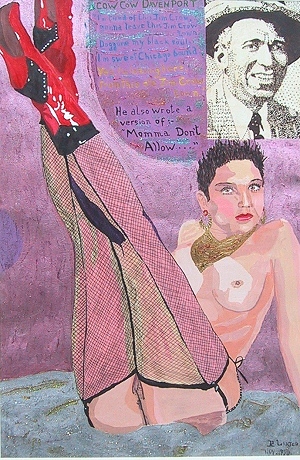
Richard Larter, "Cow Cow Davenport", 1990
An urban based art concerned with sex, violence and satire was repelled pop has continued through the work of Richard Larter:
March 27, 2004
Urban culture
I've had a terrible time these last few days with a wave of spam comment attacks, lost posts (Wednesday and Friday) and dialup internet not working. It is also difficult to run this blog when I'm on the road, since it requires time for image searching and a high speed broadband. Dialup makes it all too difficult.
Things are looking up. I've been able to recover an image from the lost post of last Wednesday:

Robert Boynes, In the Moment, 2000
And the image from the lost post on Friday:

Robert Boynes, Black Neon, 2000
However, I've lost all the written material on urban culture in Australia. I was trying to argue that a modernist, urban visual culture arose from film and montage, from Dada and surrealism, from Duchamp and Braque.
Boynes comes out of a cool ironic pop senibility in Australia with its hint of the unusual or disturbing in the common life.

Robert Boynes, Leisure Machinery, 1968
Pop art, as an expression of the urban culture of New York, never really caught on in Australia. It was overwhelmed by the romantic suburban character of Australian society. For a brief moment then was a radicalized urban culture:

Robert Boynes, Lets Make Things Perfectly Clear, 1975
Probably the most well known Australian painter of the urban is Geoffrey Smart who started out painting bleak industrial settings in Adelaide then shifted to modernist alienation:

Jeffrey Smart, Cathedral Street, Woolloomoolooo.
You get the general idea from this portrait of Smart:

Greg Weight, Portrait of Jeffrey Smart, 1992
Though Smart broke with the preoccupation with the landscape in Australian art, the work reached a dead end:

Jeffrey Smart, Second Study for House at Intersection, 1977
He didn't really engage with the consumer culture and the society of the spectacle . He seemed to remain in the time warp of the 1950s.
March 25, 2004
Urbanscape
I see this scene around me all the time in Adelaide:
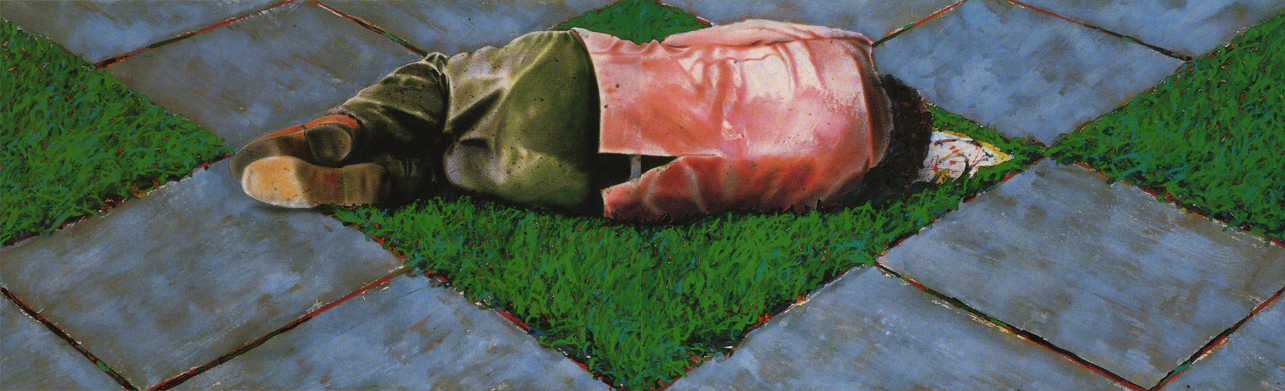
Robert Boynes,
City Square 2, 1979
I see that scene far more so than this one of wasted drugged lives. Drugged bodies lying in alleyways and back lanes is more common in Melbourne and Sydney.
Yet appearances can be deceiving. Though homelessness is a visible indication of the existence of poverty in Australia it is the old face of poverty. Welfare poverty. The new face of poverty in Australia is the working poor.
This form of poverty is caused by many people having to work casual jobs that have arisen from the opening up of the Australian economy to the global market. The working poor can be found amongst the working class and the middle class. The working poor is denied by those whose horizons are bounded by the free market.
Do we have any images of the working poor?
March 23, 2004
Scary monsters
Too busy. Will post latter.

Turner, Sunrise for Scary Monsters, 1845
Turner is the exception to the exhaustion of the naturalistic tradition in the nineteenth century with its window into the world. He moves colour from the depiction of natural particularity of the landscape to the rendering of the universal effects of light. Though pre-modernist, Turner stands on the threshold of the shift to an autonomous abstract art. He is a forerunner.
For the romantics light is the most dramatic element in the drama of nature. You can see this in the late Sydney Harbour images of Conrad Martens. I cannot find any of these atmospheric Marten images online.
March 22, 2004
Landscape
I'm back on the road for a few days.
I will pick up on the pictorial turn with respect to the landscape and Mandy Martin and the Stephen David Ross interview and the sublime that I let drop.

William Turner, Landscape with a River and a Bay in the Background, c. 1845, Link courtesy of social fiction.org
There was a revival of the tradition of European landscape painting in the nineteenth century due to romanticism. Turner pushed the dissolution of forms into light to the edge of abstraction.
Exploring fragments in a loose constellation is the only that I can post when I'm on the road.
March 21, 2004
Different ways of looking?
In looking back over the recent postings on the male gaze I can that they do two things.
They initiate, or enable, a break with the assumption in aesthetics that an aesthetic look is a neutral, distanced, disinterested mode of perception. This gives us a critical distance from Anglo-American aesthetics. The male is interested and connected to power and mastery.
They also indicate the possibilities of other kinds of looking to the male gaze. The possibilities here could be an oppositional one, in which there is a self-consciousness about the embeddedness of gender within one's gaze, especially an awareness of the way in which masculinty and power determines the visual construction of sexuality.
Another possibility is a woman centred way of looking that is a pro-active, self-conscious, interested form of looking:
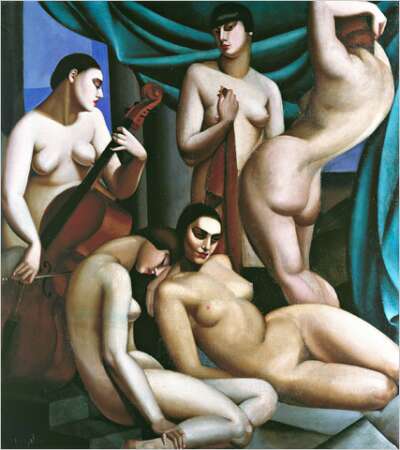
Tamara de Lempika, the rhythm
Thus we have a particularly female look or gaze that might give rise to a particularly feminine sort of pleasure.
This leads away from Laura Mulvey's classic essay entitled, "Visual Pleasure and Narrative Cinema,"which presupposed that women gaze at women in films as men do. Women viewing women as erotic objects on view for the pleasure of heterosexual males as potential possessions of males, and as objects of male fantasies and desires.
March 20, 2004
The male gaze#5: mastery to bondage
I want to dig a little deeper into the male gaze with this post----to peer into the dark pit. Just to make sure there is no misinterpretation of what is being explored here, this is an example of female looking.

Tamara de Lempika, The two friends
It is quite different to the male gaze.
The male gaze is a projection of the ego and is an expression of control and mastery. The target is the female body:

Max Pritt
The mastery is connected to aggression:

Guy Lemaire
This aggressive mastery of the female body is often intertwined with sadism:

Guy Lemaire
This bondage is an expression of aggressive desires of the male subject to win the struggle for power to gain possession and then to punish the female body: through inflicting pain.

Max Pritt
However, I do not think that this kind of male sadistic aggression is a consequence of a condition of imposed passivity; a sort of destructive response. That would response would come from the women as the passive object of sadism; but not the man as the cruel master.
Does the aggression in the male gaze come from paranoia?

Giko
Do you think that the desire to possess and paranoia is on the right track?
March 19, 2004
our mediascape
The context for the cartoon is the exposure of rugby leaque and AFL footballers pack raping young women in Australia. It's a sex scandal that has highlighted the patriarchal locker-room culture of football in Australia.

Wilcox
A suitable definition of our mediascape is it not?
For those who are curious here is a suggestion for what happens inside the footy lockerooms:

Bruce Petty
Many in the locker room are not critical of violence against women; see women as inferior objects who need to be conquered; see those women who consent to sex with a particular player as consenting to having sex with the team; and actively plan team rapes.
Update
This article by Liz Porter in the Sunday Age is a good summary of the commentary in the last two weeks as more allegations surface about sexual violence directed against women by AFL footballers. Liz says the response by a misogynist football culture has been:
"....too busy documenting the possible effect of the allegations on sponsorship, on the image of the game, and on the ramifications for St Kilda's on-field performance for any serious examination of the consequences for the alleged victims......the important distinction between sexual shenanigans and sexual crime is one that appears in danger of being lost......The problem we are facing....is not about sexual hijinks. It's about an abuse of power and a misogynist culture that pervades certain pockets of the football subculture - a culture most aptly summarised in the apparently indestructible belief that "women who have lots of sex are sluts (and therefore get what they deserve) whereas the men are studs."
The footballers even fancy themselves filling the moral vacuum left by the churches. They will take on the role of moral guidance in society. What to achieve I wonder? To teach young men that rape is good and getting caught is bad?
The clubs market their sport in terms of sex appeal but are unwilling to address the sexual violence against women they have tacitly condoned in the past.
March 18, 2004
The male gaze#4: inversion
There is some material on the male gaze posted by Mike over Collective Lounge. Mike references and works off this source.
Mike's post is about the ideas of John Berger.The ideas are familar from previous posts. He argues that from the seventeenth century, paintings of female nudes reflected the woman’s submission to the owner of both woman and painting. Berger noted that "almost all post-Renaissance European sexual imagery is frontal - either literally or metaphorically - because the sexual protagonist is the spectator-owner looking at it."
Mike says that this male gaze continues today. In advertising males gaze, and females are gazed at. In ads addressed to women and female models "treat the lens as a substitute for the eye of an imaginary male onlooker. So when women look at these ads, they are actually seeing themselves as a man might see them.''
What happens when the camera as the instrument of the male gaze is turned on the male spectator?
We enter the world of Pierre Molinier.

Pierre Molinier, Travesti (with corset and nylons), manipulated self portrait, 1969
Molinier's working methods involved Surrealist inspired portraits and montaged images composed of favorite body parts. His stylized thematic preoccupations were an exploration of sex exclusively his own sex and sexual fantasies.
March 17, 2004
The male gaze#3
This is pretty standard in terms of the male gaze:

Gilles Berquet Link courtesy of Jahsonic. com
Berguet says that he was influenced by the work of Pierre Molinier. At the end of his life, Molinier turned to photography. He used himself as a model; he would cross-dress as a woman and then take photographs of himself. Molinier had a whole fetishistic universe at his disposal; he had wax mannequins which he repainted and made up. Most of his photographs are self-portraits of himself as a woman, though.

Something has happened to the male gaze has it not?
The latter picture subverts the former. The male gaze becomes otherwise. The woman is doiminant and the man submissive.
The otherwise is also a turn towards the sexual fetish.
frustrations
I used to read this when I had access to a university library. Now I'm limited to just this: a page of an article.
It is frustrating.
I'm interested in both Deleuze and Bacon and Deleuze's book on Bacon.
All we get is one page online. The bits there are okay. We can rephrase them for Australia:
"The prospect that a professionalized abstract art would take hold in [Australia] was threatening to an older class of literati and dilettanti for whom art was a ‘civilizing’ rather than a ‘professional’ tendency. It had become apparent that the rising cultural bourgeoisie perceived modernist abstract art as autonomous, driven by the dialectic of its own technicality. The technicality of its action enabled it to assume a practical (and a moral) legitimacy which devalued the authority of the older civilizing class. Cosmopolitan modernism accounted for its practice in terms of coherent ideology."
That happened in the 1950s. A reaction to the foreign otherness set in. A counter that was based on a ‘humanistic’ vocabulary and a civilizing discourse of the authentically human. This humanist discourse opposed:
".... the outlandish vocabularies used by the foreign-seeming intellectuals of international abstract art. While surrealism recognizable as such was rejected for its unsightly political ramifications, in so far as its mannerisms were adaptable they were domesticated as picturesque detail. Acceptable deformations entailed the reinvocation of a form of romanticism: depoliticized, de-psychologized, [Australian,] and all right."
And that's all we get. How does Bacon fit into that? Or Delueze? Dunno.
What I do know is that European surrealism was effectively banished.
March 16, 2004
Beauty#2: bodies
This post picks up on an earlier one about deconstructing aesthetics.
Recently I wandered into an academic bookshop and cast my eye on various books on analytic aesthetics. I was looking for something beyond the male gaze. I reckoned the male gaze was broader than 'being a tool to transform the power of female sexuality into a malleable reflection of male desire.'
What I was looking for was not along the lines of the way women look at themselves or at each other:

Nicole Eisenman, Untitled (kisses), 1996, lipstick and gouache on magazine page
What I had in mind was something more along the lines of insights into visuality, the male gaze, nationality, hostility towards the phobic object, the permeation of rigid borderlines, the existential void and the regression to the archaic. I was trying to figure out why Australia has become more extreme in its policies toward asylum-seekers than any other Western country.
Dunno why I thought analytic aesthetics would help me here. I just did.
Many of the arid texts were concerned with beauty---I should say Beauty. I read some pages. Then some more. Then I flipped some pages.
I did not really understand what they were about. Somehow beauty made an object an artwork.Yet within the pages I discerned a theology of art and the worship of idols.
I shook my head. Maybe I'd been watching too many hours of Sky News. I didn't get it.
So okay. Let's try this.

Jan Saudek, In the Fine Art Gallery, 2001
If you saw that photo on the white walls of a prestigious art gallery would you say that you understood that it was art because it was beautiful.
Is it beautiful?
Another thought. One can argue that works of art contain some truth of their own and that the only appropriate way of dealing with them would be to enforce that truth. We can regard a work of art is a cognitive medium; there is something to be known, something to be learned from it about historical reality -- hence the task of understanding it as well as the history of its reception. The expression of private feelings of pleasure or disapproval has little to do with the truth core attributed to the work of art within the Romantic tradition.
March 15, 2004
the male gaze and nature
The male gaze is based on the individual male subject as a spectator viewing an object. There is a distance between subject and object marked by the camera standing in for the spectator. We view the image as a spectator disconnected from the object.
The male gaze often positions female sexuality with wildness:

Jan Saudek,Who Cares?, 1987
Wild female sexuality gives us the seductive animating force, or the irrational other, or sexual freedom uninhibited by the customs and habits of a western Christian culture.
March 14, 2004
The male gaze & phenomeology
The reifying power of the male gaze:
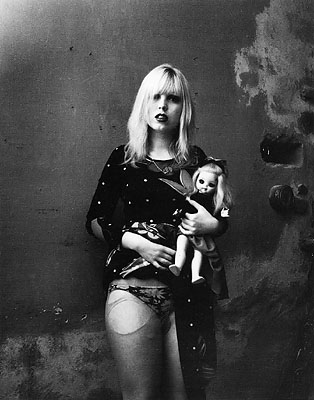
Jan Saudek, The Doll, 1975
That is a different way of looking than this one:
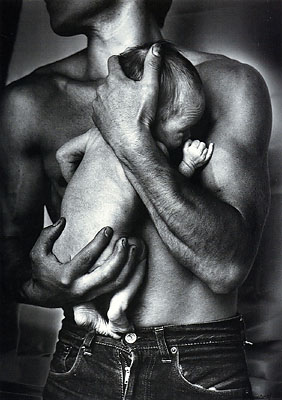
Jan Saudek, Life, 1966
One could say that this male gaze is essentially pornographic; a vision that looks at the world through a keyhole. It is also paranoid:

Jan Saudek, Suzanne, 1979
I am free when I'm looking through the peephole. Then I hear footsteps. Someone is looking at me. It's the Other.
It is my lover. She is looking at me looking through the peephole. She suspects something behind the visible.
My being is filled with shame.
She sees things differently. The male gaze makes the feminine an object and strips woman of her freedom.
I lose my freedom from her look. I feel dead from the look of the Other.
Basic stuff huh?
March 13, 2004
The pictorial turn#2
The pictorial turn mentioned in the previous post that "the eye "or the "gaze"or "looking" has been opened up to historical and cultural interpretation. Hence we have different ways of seeing in reponse to an older theory of the eye as passive receiver.

Goya, Nude Maja, 1800
This pictorial turn involves a probing of the hidden effects of the fundamental assumptions of the visual metaphors and visual practices. Thus the assumptions of the Goya image is that men are the sex that looks and women the sex that is looked at. The nude figures rarely have much personality; they exist simply to be contemplated and enjoyed by men.
One of the prime examples of this was the feminist account of the male gaze. This gaze was seen to be one of the primary mechanisms by which oppressive patriarchal relations are maintained.
A distinction is sometimes made between the gaze and the look. The look is a perceptual mode open to all, whilst the gaze is a mode of viewing reflecting a gendered code of desire. The gaze was related to cinema. Hollywood cinema was seen as an instrument of the male gaze, producing representations of women, the good life, and sexual fantasy from a male point of view.
The general line of argument is that women have been fetishized by the male creative subject. They have both been revered and feared as "Other;" admired for the formal aspects of the female body (the beautiful) and cast in a passive role as object of the male gaze.

Velazquez, Venus at her Mirror, 1649-51
Photographers continued producing ‘woman as image’. The image becomes a ‘spectacle’ for men who do the looking.

Jan Saudek, Phorographer as Jesus, 1991
In the society of the spectacle women are there to be looked at.
Consequently, women's visual representations of women has been mitigated by the cultural awareness of woman as object, particularly in the visual arts. They contain a certain self-consciousness of the social construction of the feminine as surface and image: the narcissistic gaze in the mirror.
March 11, 2004
the pictorial turn#1
I've just returned from being on the road since last Sunday. Whilst flying into Adelaide this everning I thought about the different modes of seeing, as we flew across the Australian landscape from Canberra to Adelaide.
Flying into Adelaide across the Adelaide hills the landscape looked kinda like this:
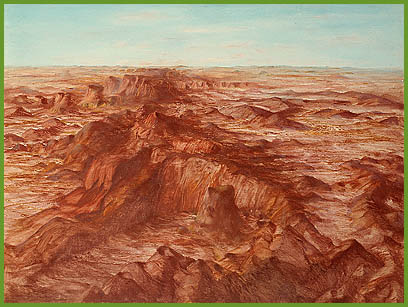
Sydney Nolan, Durack Range, 1950.
There are different ways of seeing it.
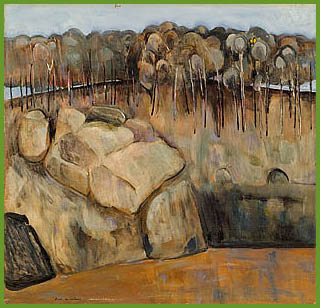
Fred Williams, The Nattai River, 1958
And this mode of seeing:
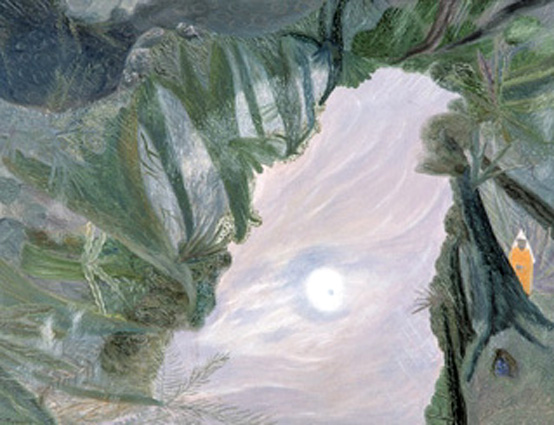
William Robinson, rain Forest with Bower Figure
Can we talk about the pictorial turn I wondered as the plane descended into Adelaide?
Yes.
Earlier, at the begining of the twentieth century analytic and continental philosophers talked in terms of the linguistic turn with its idea of reading tests.
Images are not texts. You do not interpret pictures the same way as you interpret texts, even if both have rejected a naive mimesis.
I'm not sure what the difference is but my gut feeling is that there is a difference.
March 10, 2004
sustainable cities
This article asks a good question and gives a good answer.
"What would our future built environment be like if we put sustainability as the chief driver? The first major difference to the path that is inherently unsustainable is that we would have a future."
Have a read. Then contrast it with this development path.
March 9, 2004
Mandy Martin

Mandy Martin, Flood below the shearing shed, 1999
The image is from Watersheds: the Paroo to the Warrego series. These unregulated Queensland rivers are the headwaters of the Murray-Darling Basin.
March 8, 2004
beauty
It is often thought that aesthetic value is beauty.
We have attempts to resurrect beauty as a blanket term for aesthetic merit.
Should beauty be identified with aesthetic merit?
Not all works of art lay a claim to beauty.
Nor do we commend a work of art just because it is beautiful. It may be erotic, profound, challenging, innovative:----as with the work by William Robinson
March 7, 2004
Smile: live
By all accounts Brian Wilson has pulled the mythic lost song cycle off.

The tangled, glorious symphony of celebration and sadness with its Americana and ecological themes performed by "a psychedelic barbershop quartet" is a long way from the fantasy of Southern California life as an endless summer of perfect waves, hot rods and blond beauties.
Producing Smile involved similar production techniques to those used on Pet Sounds. Wilson used the studio as an instrument to work with unconventional arrangements that combined modern rock instrumentation with orchestral touches as well as nonmusical objects including water jugs, Coke bottles, hammers, saws, and bicycle bells. Each song written for SMiLE was recorded in pieces, in various studios, during different sessions, and edited later into completed mixes. Recording in this way was a long and painstaking process.
Hence the complexity of putting it all together and the histories.
Apparently the album will be released this year. Times of London critic Stephen Dalton wrote on hearing the Smile concert that it was a:
"...40-minute crazy-paving collage of song fragments and Looney Tunes jingles, all bookended by the lush glory of 'Heroes and Villains' and the rapturous warble of 'Good Vibrations' ... It was clearly adventurous for its era but it is not difficult to see why Wilson's label and fellow Beach Boys balked at releasing it."
Today the question is: can this reworked three-movement pop suite with each section having its own self-contained thematic suite be considered art rather than entertainment?
March 6, 2004
Adelaide Festival of Arts
Returned to Adelaide exhausted only to discover that it is the middle of a festival on the periphery of the global culture circuit. Suzanne has spent the last week going to Writers Week and visiting the art galleries. She mentioned Don Watson whom I'm currently reading.
I've a day or so in Adelaide and then I'm off again.

William Robinson, Creation landscape--fountains of the earth, 2002
Reading the catalogues of the various exhibitions I see that landscape is back along with the idea of the return of beauty and ecological concerns in postmodernity. There was a forum on this, but I have no idea what was discussed at this tribal gathering for artists called Artists Week. I guess the return of beauty is a gesture back to the Sydney Biennale 2000 with its faded gatekeeper role and hotline to New York as the renewed old centre. The 'search for Spirit ' is a gesture to Hegelian aesthetics and the idea of a progressive spirit which can be concretised by art.

William Robinson, Ridge and gulley in afternoon light, 1992
March 4, 2004
landcape & beauty
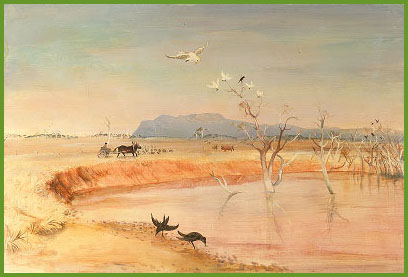
Arthur Boyd, Irrigation Lake Wimmera, 1950
I drove through the Wimmera during the drought last year. It was so so dry. The Wimmera River barely flowed. Yet the farmers are wanting to extend the pipeline so they can access the river's water. Development, development development. I could see little by way of ecological concern.
These Australians were much more concerned with subduing nature than with perserving it. Their focus was on technology and expansion, not in protecting the natural spaces around them. The wild nature of Australia was something that fascinated the Europeans, but not the settlers themselves. The destruction of the natural landscape by the farmers is counterbalanced by the attempts attempts to recapture some of what had been lost to expansion, development and technology.
What the farmers forgot was that the natural landscape was important for Australians. It has played an enormous role in the Australian culture that continues to this day. The beauty of the Australian landscape was seen as a way to express certain ideas about the Australian national character, its uniqeness and sensibility.
March 3, 2004
exploring
I'm on the road yet again. Blogging will be light.
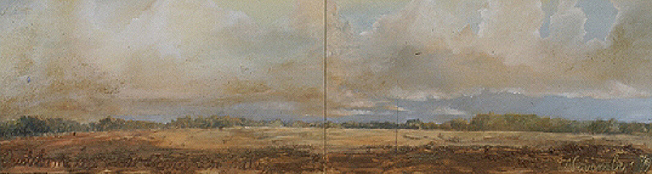
The landscape is the semi-arid country in north-western NSW. It was traditional pastoral country. It's land degradation has been caused by overstocking and a failure to adopt sustainable land management.
The landscape painting works in the pictureseque mode, which is a blend of the beautiful and the sublime. It is midway between them, a reduced, gentler, less exalted form of both.
March 2, 2004
landscape
How do you think of the landscape in aesthetic terms when it is primarily defined in terms of economic value?

John Perceval, Ocean Beach Sorrento, 1957
Since European settlement the settlers have been attempting to make sense of the land on the Australian continent:

Arthur Boyd
They have done so with a Eurocentric reading and interpretation of the landscape. In the semi-arid western districts of NSW or Victoria they rapidly exceeded the carrying capacity of the land.