|
March 28, 2004
What I was trying to sketch in my lost posts last week was an critical urban culture that would be able to tackle this and this and this. I had adopted a historical approach to get some sense of a map of what had happened.
What I had sketched was something along the lines that an urban culture only got going in the 1950s and 1960s in Australia. This was a movement towards a metropolitan culture, as distinct from a romantic suburban one linked to the bush and the beach. It was a movement because Australia did not have high density urban concentrations in its capital cities. The initial 1950's existential theme of alienation and isolation became predictable and glib:

Jeffrey Smart, Man with Bouquet, 1982
I argued that we could turn to pop art for an expression of this critical visual culture. It was pop art that had historically developed a critical response to the newly forming industrial society with its consumer culture culture of images that said buy this, buy that; be happy; Spend spend spend.

Richard Larter, Blonde Bomshell (Peta,) 1992
It was pop art that historically expressed the feelings of youth culture of Dylan and the Beatles, rejected aestheticism and acted as an opposition to abstract expressionism:

Robert Boynes, Black Site, 1983
Like surrealism before it, pop art never really got going in Australia. It was too ironic and satirical for the conservative art institutions that defended an autonomous art. The conservative establishment culture spent a lot of its time in the 1960s charging visual artists (eg., Michael Brown's Mary Lou) and writers (eg., Oz magazine ) with obscenity and trying to get them to do hard labour.
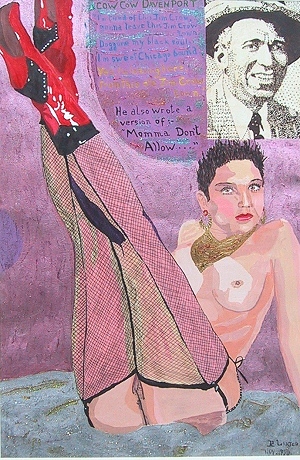
Richard Larter, "Cow Cow Davenport", 1990
An urban based art concerned with sex, violence and satire was repelled pop has continued through the work of Richard Larter:
|


