April 30, 2007
Cape Willoughby: snapping beauty
Beauty is what comes to most people's minds when they stay at the lighthouse cottages at Cape Willoughby on Kangaroo Island and take in the scene. Apart memories of being there isn't tourist photography mostly about snapping beauty?
What then is beauty? Many say--ie., common sense-- that beauty is in the eye of the beholder. Moreover, there is no need to talk about beauty since everybody knows what it is. Aesthetics is not necessary.
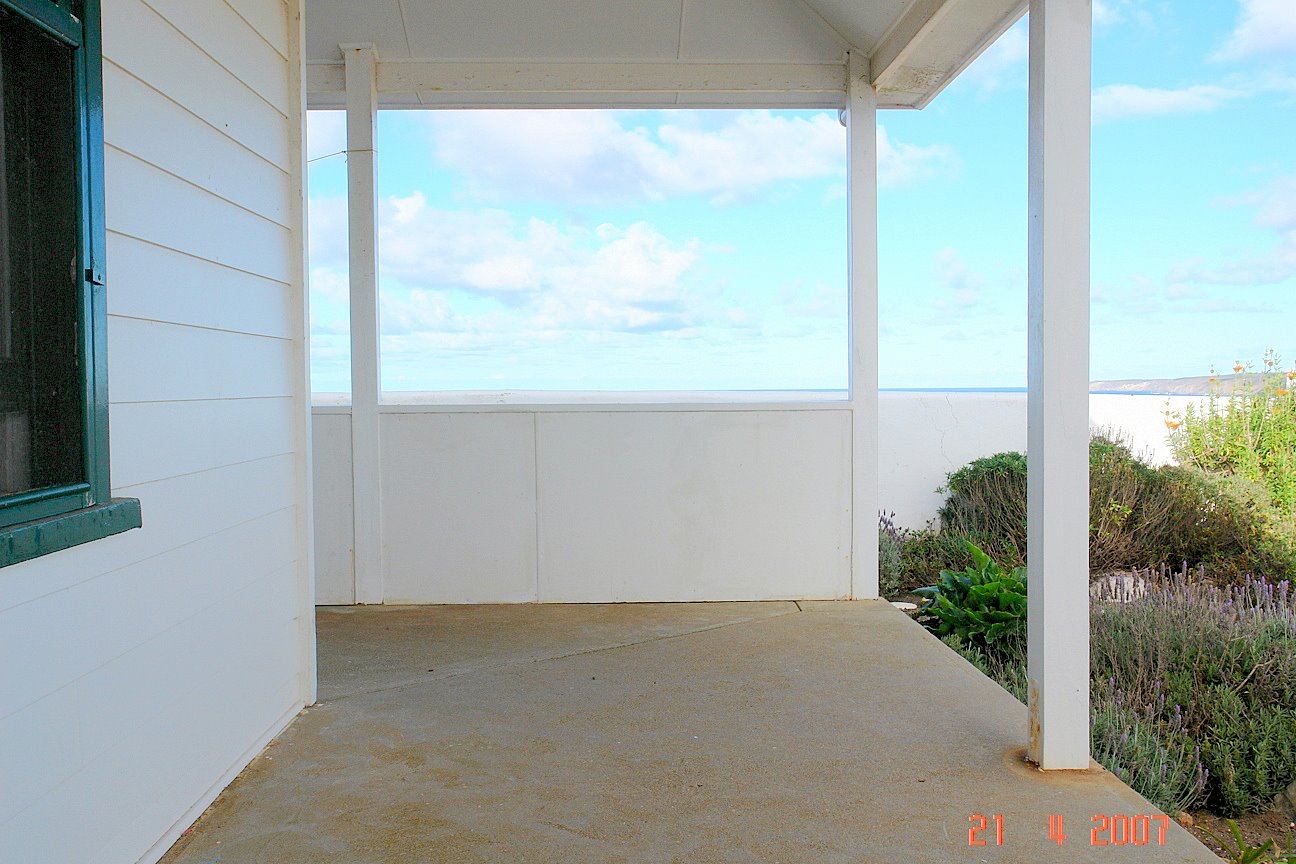
Gary Sauer-Thompson, Lighthouse cottage, 2007
Admittedly, what is considered beautiful in Australia need not, and often isn't, considered to be beautiful in Greece. However, if you challenge someone who says that this porch scene is beautiful by asking them in what way is it beautiful,--ie what makes it beautiful--- they usually say, 'well it looks beautiful to me.' They beat a quick retreat from the objective to the subjective.
Not many, for instance, consider a bunch of rocks to be beautiful:
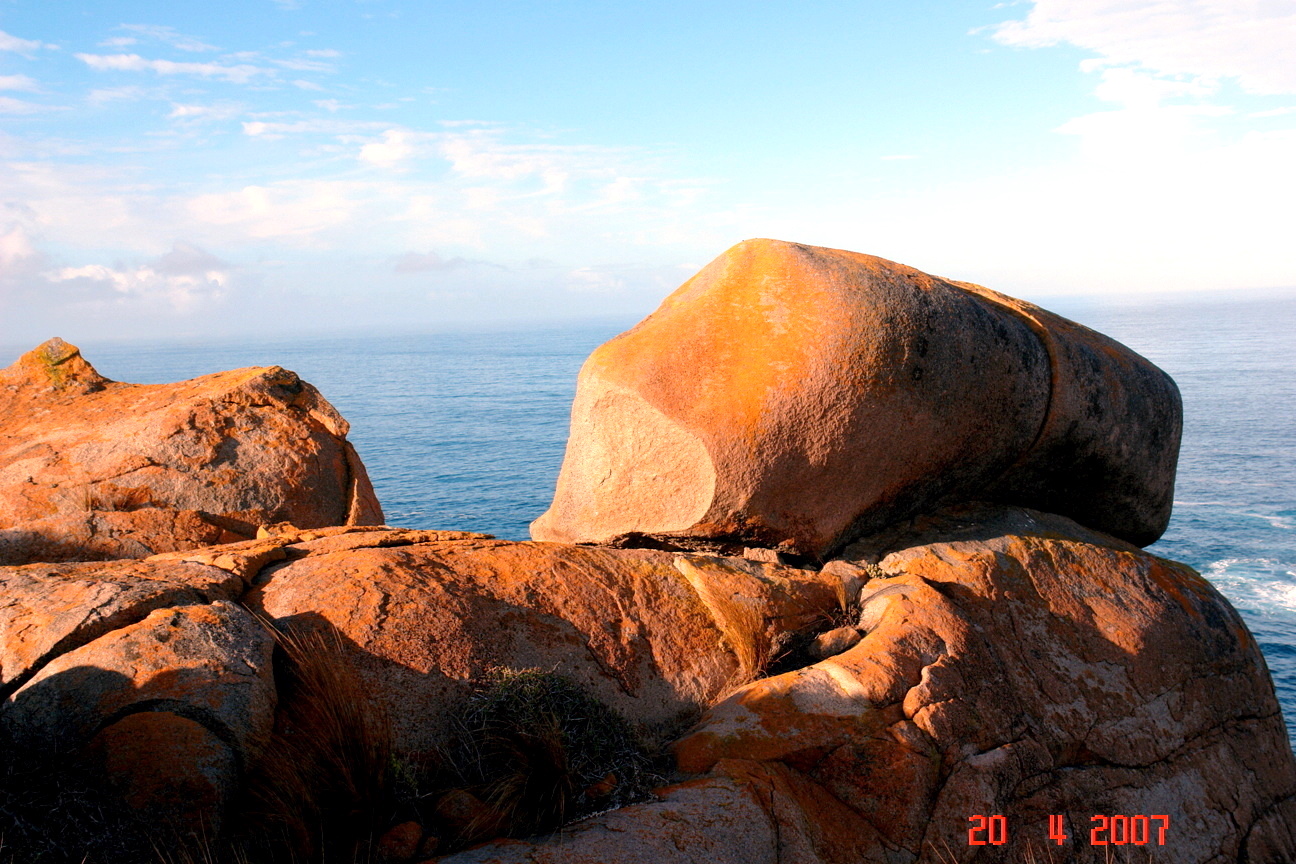
Gary Sauer-Thompson, 7am, 2007
Rocks cannot be considered a beautiful object in the sense that sunset or a shell are. So says common sense. Well a few people might feel that way, it is conceded. They are like the few who find seaweed beautiful. And that is the end of the matter. What more can be said? Well, why aren't rocks beautiful in the sense that a shell is? That's philosophical talk is the reply. It confuses things.
Over some glasses of crisp white wine on the front porch, whilst watching the sun go down, taking in the broad sweep of nature, in a blissed out way that borders on a vertigo of rapture they will add that natural selection has no need for beauty. It's a useless luxury for survival. Or they will say that arresting climate change depends upon protecting large areas of wilderness.
What's happened to beauty then? Philosophically speaking it is being projected onto nature by the tourist eye. it is not a feature of nature. Intrinsic values do not exist.
Sam Peckinpah: Cross of Iron
I watched a DVD of Sam Peckinpah's ---the cinematic poet of violence---Cross of Iron(1977) last night. It is about World War II: on the Russian front in 1943 in the Crimea.The German s are retreating after the Battle of Stalingrad and the war is lost.
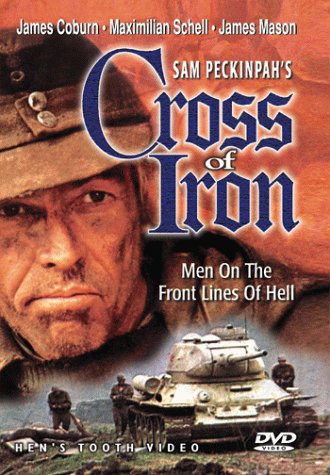 It is told from the German's perspective and that of the common soldier, and it explores the horrors of the war and the psychological damage the unremitting violence inflicts on its participants. However, it doesn't glorify violence.
Peckinpah, who saw himself as the rebel, the outlaw, also uses a film about the Germans to make a comment about America’s involvement in Vietnam. It becomes a boys own annual of survival amid the chaos of war.
The American west is dead and is reinvented in war and so we have war as the shootouts from The Wild Bunch. The world is l death-infested and men are hard-wired for killing.
Our dreams of a better life give way to finding affirmation in a violent death even though the cause is lost. Male friendship, misogyny, hatred of authority, freedom found in anarchy, living by one's own moral code, and affirming individuality in the ecstasy of violence.
You choose sure death to living life as a compromised failure.That's redemption.
April 29, 2007
Kangaroo Island snaps: more than the Greek Islands
Looking back on the holiday I realize that I would go back and stay at the lighthouse cottages at Cape Willoughby for several days. It was one of the places on Kangaroo Island that I would like to sit for a while. It looked like a Greek Island with the white cottages and blue sky and blue/green sea, but it is without the mass postmodern tourism.
Cape Willoughby is off the beaten tourist track, which goes from the ferry at Penneshaw to Seal Bay and Cape de Couedic, and it has a "sense of place" that transgresses the dominance of "space and time" in modernity. Cape Willoughby signifies a return something more primordial, even if it appears as a special in a tourist sense:
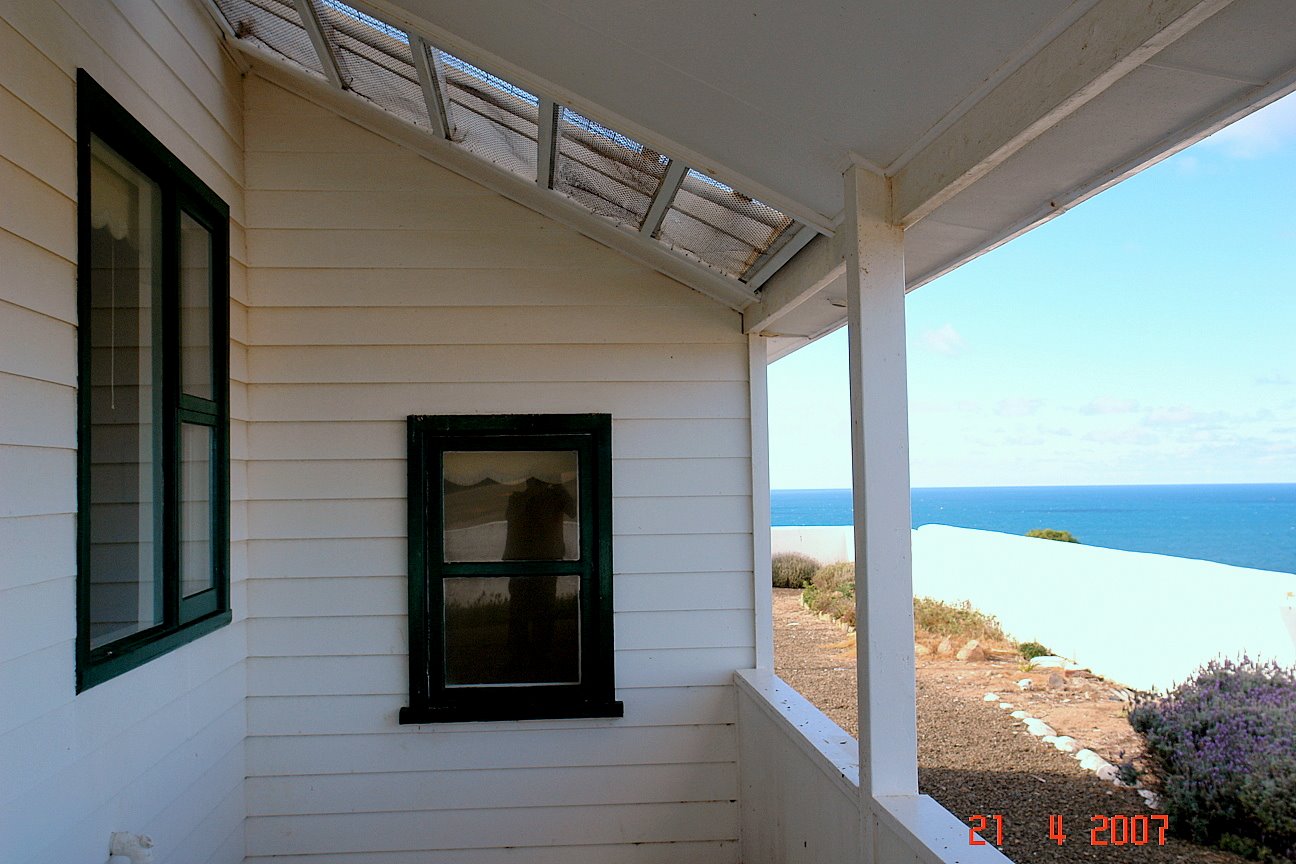
Gary Sauer-Thompson, Cape Willoughby cottage, Kangaroo Island, 2007
Cape Willoughby itself is dominated by a lighthouse, which was the first lighthouse built in South Australia (1852). It looks over the calm but treacherous Backstairs Passage, which is situated between the southern Fleurieu Peninsula and Kangaroos Island. The lighthouse is located on a spit of the Dudley Peninsular. From the front porch of the heritage lighthouse cottages, rebuilt in 1927, one looks back to the island with sea views of the Backstairs Passage on the left and right. The lighthouse signifies wildness, destruction and death.
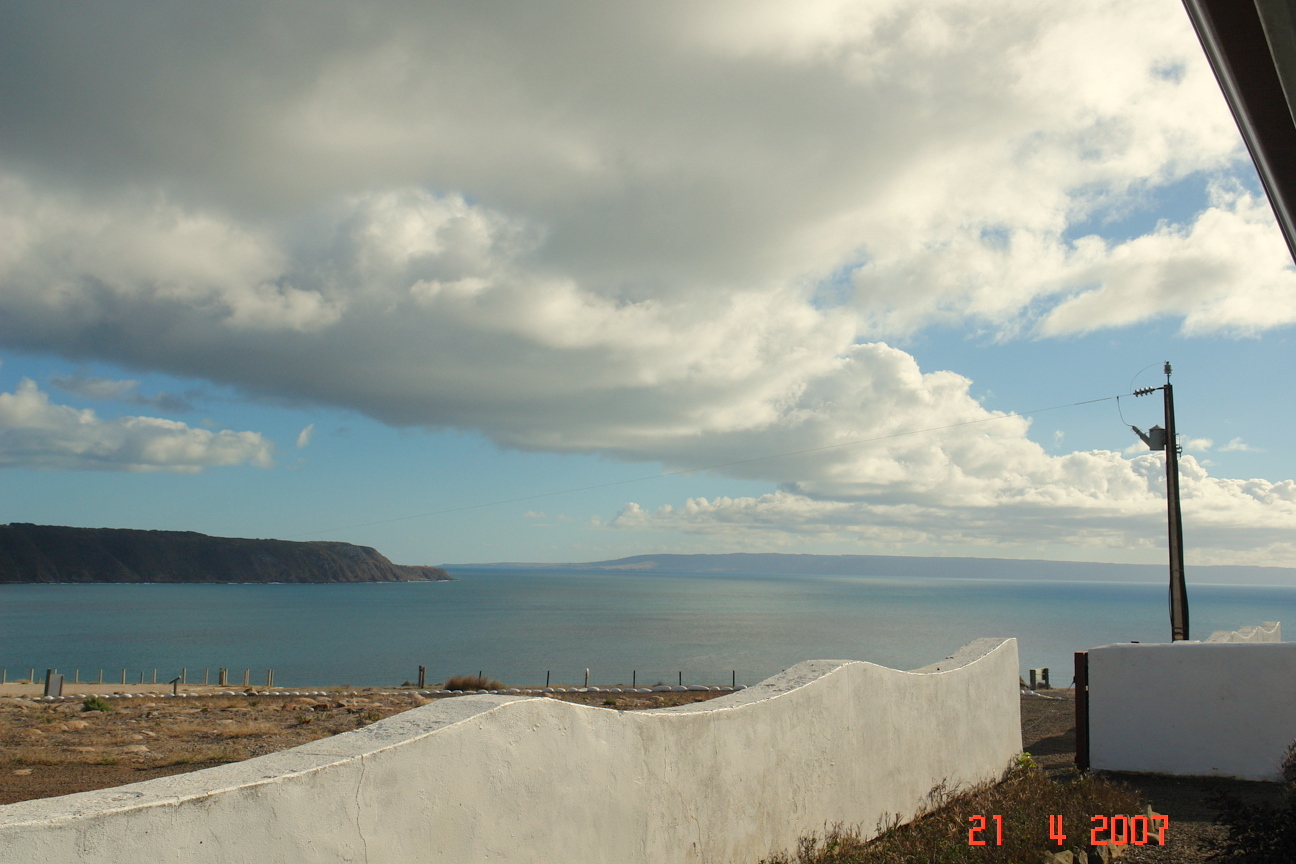
Gary Sauer-Thompson, view from porch,Cape Willoughby cottage,Kangaroo Island, 2007
Cape Willoughby is a small conservation park that is mostly about wild seas and towering cliffs. The difference from the Greek Islands was the sublime---in the sense of the awesome power of nature. As I noted earlier Eugene von Guerard’s Cape Schaank came to mind. The sublime is the surging sea.
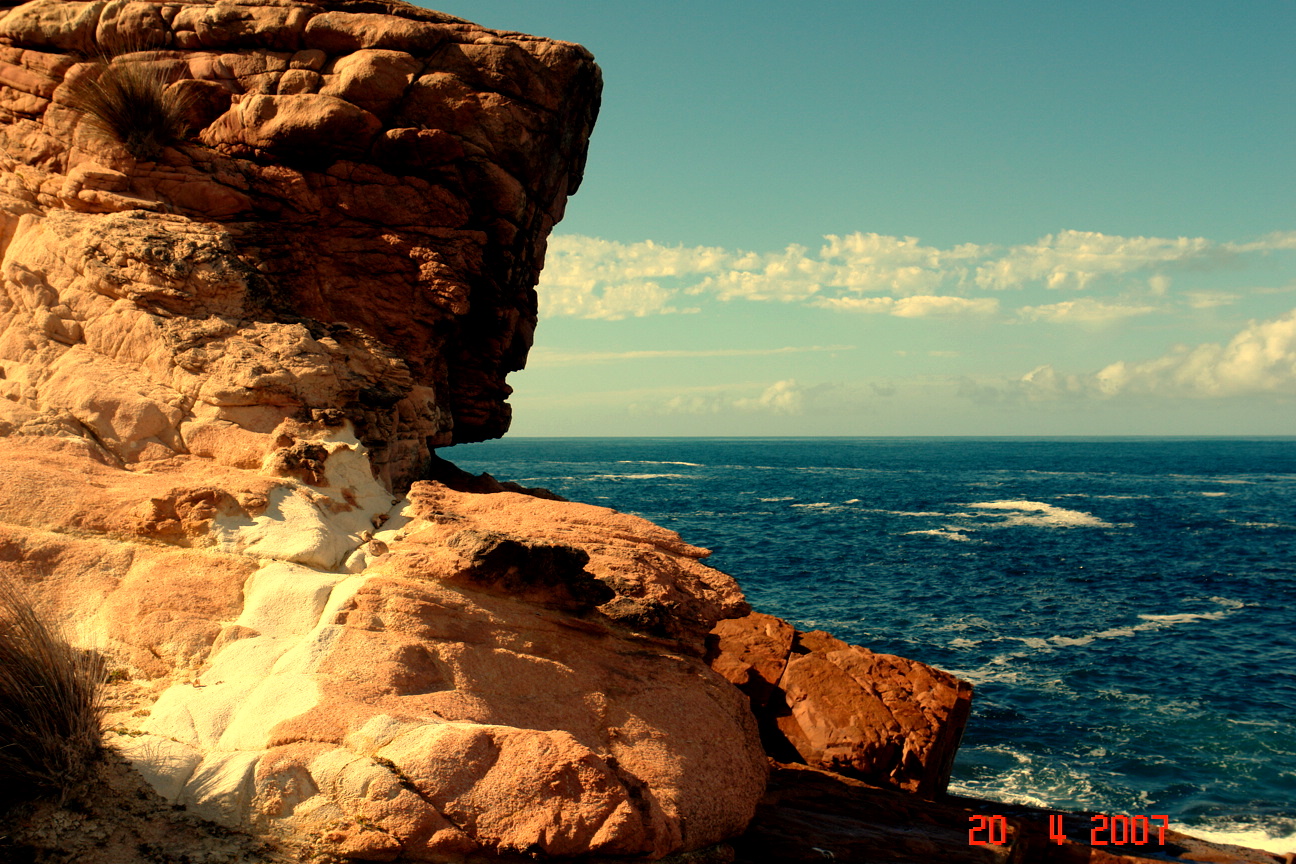
Gary Sauer-Thompson, rock + sea, Cape Willoughby, 2007
The weather was very summery, even though it was autumn, and so the long summer continued into mid-April. There is no rain. Nor was any expected when we were there. So the Island is drying out and its ecology is beginning to change—the correas, stingybarks and banksias are struggling, if not dying. The agriculture and pastoral industry looked to be on its last legs, whilst water was being trucked in to all the cabins we stayed at around the Island. The recent rains will not address the long decline in rainfall.
As I noted above Cape Willoughby is about place---in the sense of human beings are always and already human being situated in place rather than just a space. As Edward Casey set out in his The Fate of Place the history of place within the Western philosophical tradition has generally been one in which place has increasingly been seen as secondary to space—typically to a particular notion of space as homogeneous, measurable extension— and so reduced to a notion of position, simple location, or else mere “site.”
Cape Willoughby was no mere site-- a more or less arbitrary region of physical space. It is concrete and particular--- a place-world that resists to the imposition of our modern ways of giving order to the world. There are aspects of another kind of order to be found in th\is landscape, most importantly the dichotomy of heavy (of the earth or rocks) and light (of the sky), and movement (of the sea) and engaging with these leads to an orientation among wild places.
April 28, 2007
Death Valley
From the archives of the NASA image of the day series:
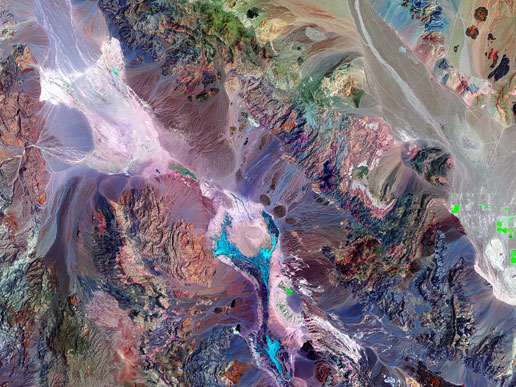
NASA, Death Valley National Park, 2000
I haven't been there. It would be an interesting place to visit.
The NASA blurb interprets the image thus:
In this image, green indicates vegetation, which increases with altitude. The peaks of Death Valley National Park sport forests of juniper and pine. The dots of brilliant green near the right edge of the image fall outside park boundaries, and probably result from irrigation. On the floor of the valley, vegetation is sparse, yet more than 1,000 different species eke out an existence in the park, some of them sending roots many feet below ground. The varying shades of brown, beige and rust indicate bare ground; the different colors result from varying mineral compositions in the rocks and dirt. Although they appear to be pools of water, the bright blue-green patches in the scene are actually salt pans that hold only a little moisture.
The 1,000 different species eking out an existence in the park' is an example of what we mean by biodiversity. It is what needs protecting.
April 27, 2007
Kangaroo Island: snapping the sublime
A snap that attempts to express the sublime as the power of a surging or raging ocean that evokes an archaic shudder, since our own preservation is at stake:
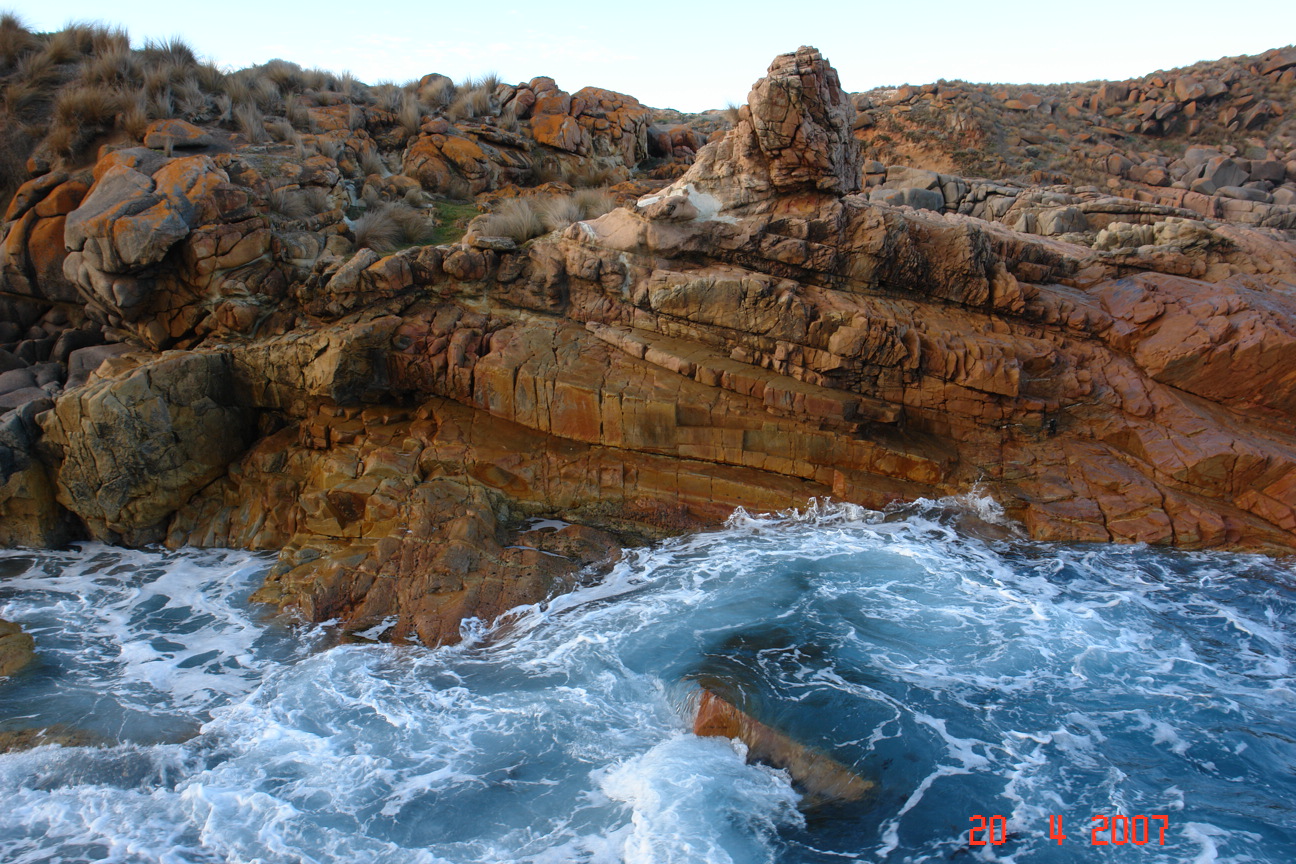
Gary Sauer-Thompson, Cape Willoughby, Kangaroo Island, 2007
The sublime halts the easy play of beauty that is so noticeable amongst wilderness photographers as it introduces a note of seriousness---fear. Shudder is the touch of what is other to modern subjectivity.
The natural sublime is not the same as the political sublime---ie., state terror, the gruesome torture of the Gulag or horror of the Holocaust. Nor is the natural sublime just a subjective experience or an imagined one (as held by the Lockean empiricists), since we are concerned with the quality of the object--a wild and rugged nature. Thus the waves of the surging sea can rise over the rocks the photographer is standing on and sweep her away in an instant. The situation --of taking the photo or merely looking is a dangerous one, as the threat from the extra large wave is always unexpected.
It this raging , threatening sea that induces the aesthetic judgment of sublimity. From it follows awe and respect.
There is no privileging of the subject over against an object here----eg., the object must be negated in order to achieve the experience of sublimity. The sublime reminds us of the limitations of being masters and possessors of nature. It is the outside that conditions and makes the inside of modernity possible, whilst eliding its grasp. In this aesthetic space our rationalized, narcissistic subjectivity is interrupted; a fracturing takes place in our interested, instrumental gaze at nature as something to exploit.
Does the Sublime have the capacity to crack open the commodification implicit in (Kangaroo Island as) the Beautiful. It is it is vain to expect a negation of the logic of commodity production from the image as beauty.
Australian identity
I had posted on the conservative interpretation of Australian identity and Anzac Cove over at public opinion yesterday:
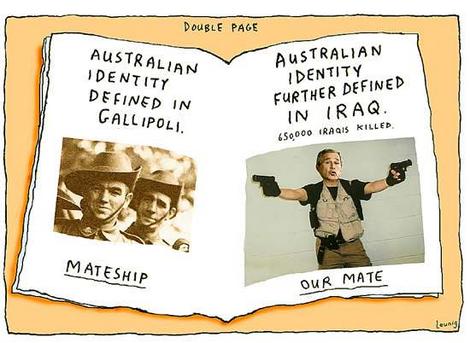
Leunig
Leunig is right. The conservative nationalist account of Australian identity is based on military values and fighting wars. It implies that all wars fought by Australia are good, and it is intolerant of dissent by citizens about that judgment. It is an account of national identity that tacitly denies a multicultural or even a liberal pluralist Australia, as it implies assimilation rather than a nation based on the rights of individuals to different cultural identity, ethnic recognition and respect.
Cultural conservatives--John Hirst, Janet Albrechtson, Piers Ackerman and Andrew Bolt---say that a distinct Australian national identity was forged at Anzac Cove in 1915. Therein lie the roots of Australian nationalism. Multiculturalism threatens this national identity because they assume that it necessarily denies the importance of Australian culture. Their mode of discourse works with a "horror" of the Other that remains other.
April 26, 2007
cinematic images as capital
I want to return to Jonathan Beller's The Cinematic Mode of Production: Attention Economy and the Society of the Spectacle, a Marxist analysis of cinema as a mode of production in what many call “post-industrial” capitalism. I posted on this here, and I found myself intrigued by Beller's argument that cinematic images are not just representations of capital, but that they actually are capital.
In the Introduction to the Cinematic Mode of Production Beller says that:
it is today possible to mark clearly, at the outset (a luxury not available when I began this work), that the industrialization of vision has shifted gears. With the rise of internet grows the recognition of the value-productive dimensions of sensual labor in the visual register. Perception is increasingly bound to production ..... As in the history of factory production, in the movie theater we make and remake the world and ourselves along with it.
What we have is the organization of the visual by technology so that we suture on image to the next with the elevation of commodity production to the visual realm.
Beller says that he uses the term cinema:
not only to refer to the set of institutions traditionally configured as "the cinema," in popular usage, but to refer to the manner in which production generally becomes organized in such a way that one of its moments necessarily passes through the visual, that is, that it creates an image that (while the tip of the iceberg) is essential to the general management, organization, and movement of the economy.
Beller goes on to say that under the rubric of the cinematic mode of production, "cinema" refers not only to what one sees on the screen or even to the institutions and apparatuses that generate film but to that totality of relations that generates the myriad appearances of the world on the six billion screens of "consciousness."
"Cinema" means the production of instrumental images through the organization of animated materials. These materials include everything from actors to landscapes, to populations, to widgets, to fighter¬planes, to electrons. "Cinema" is a material practice of global scope, the movement of capital in, through, and as image. "Cinema" marks the changeover to a mode of production in which images, working in concert, form the organizational principles for the production of reality. The whole regime of classical value production extends itself into the visual.
Kangaroo Island Snaps: Cape Willoughby
I intend to post an image a day from the Kangaroo Island series for a while, as well as doing some other posts. The images can be seen as an exploration of a particular and special place (Kangaroo Island) in a globalised world, whilst the commentary makes a space for understanding art outside of the discourses of truth (value-neutral knowing) and morality (right action), which have dominated a positivist and utilitarian modernity.
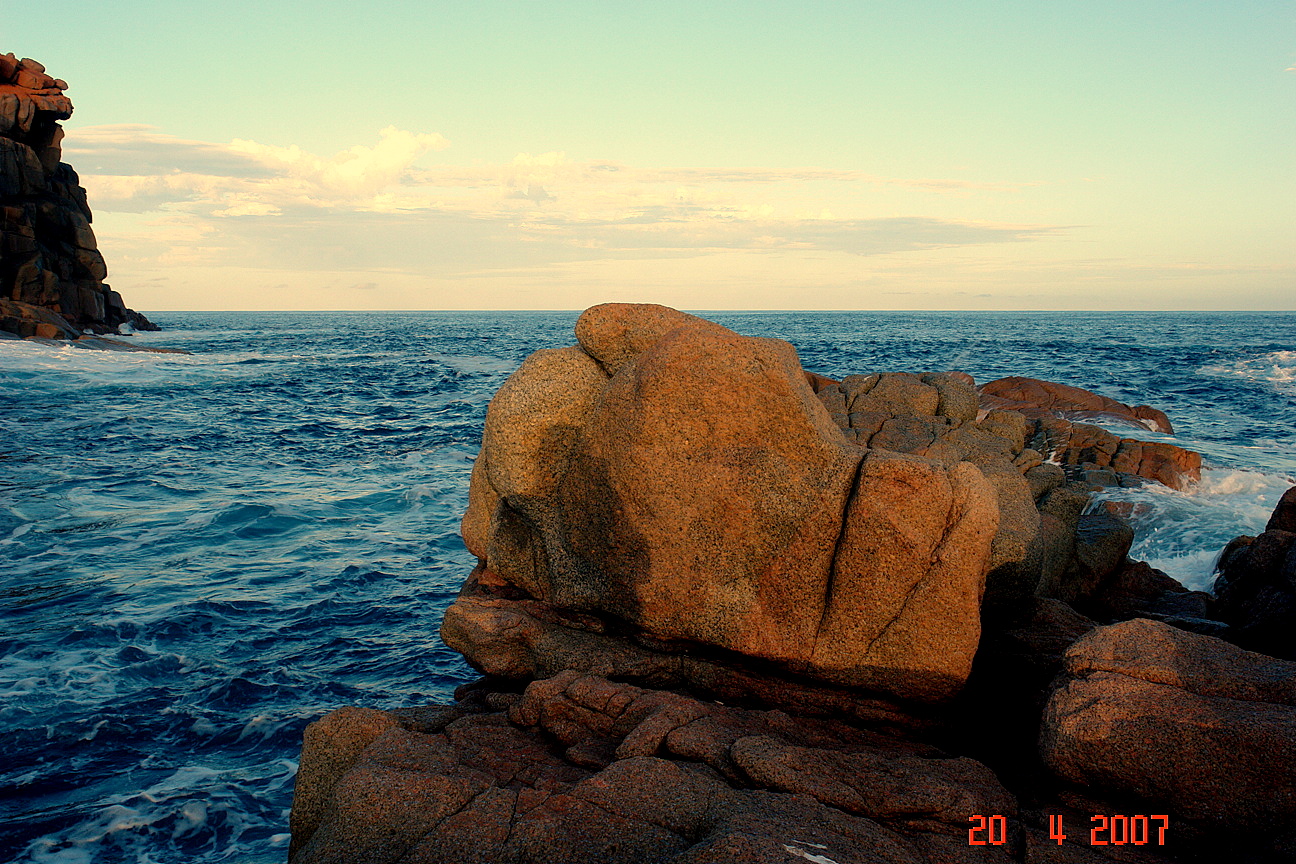
We stayed a couple of nights in one of the lighthouse cottages:This particular image is of a little bay to the east of the Cape Willoughby lighthouse. It can be read as a representation of the beauty of wild nature as it has a degree of calmness about it:
Gary Sauer-Thompson, Cape Willoughby, Kangaroo Island, 2007
This particular wild space was both beautiful and sublime. Whilst tin this space I kept on thinking of Eugene Von Guerard's Cape Shanck. In this case the spectator of natural sublimity experiences a situation of being overpowered by the size or energy of the sublime phenomenon: the power of a surging or raging ocean.
Could we argue that for around the last century, the arts---as opposed to tourist images--- have not had the beautiful as their main concern as some contend, but something which has to do with the sublime?
If we go back to Edmund Burke we find that his reconceptualization of the sublime consisted in adding the factor of fear or terror. The fear or terror in this instance is one of being swept away by the seas. It spells danger. Schiller contended that the sense of well-being that arises when one contemplates a stormy sea from the safety of the shore can never by itself become a source of the sublime. The sea needs to be sufficiently threatening to pose a danger to us.
For Kant in The Critique of Judgment (1790) the very idea of a sublime artwork is a contradiction in terms. The sublime does not designate the product of an artistic practice as such. Even when experienced the sublime is entirely contained in a subjective experience determined by a certain relation between the powers of reason and imagination. I would want to change the Kantian feeling of the sublime into the characteristic or a property of artworks themselves.
A well known European example of the sublime:
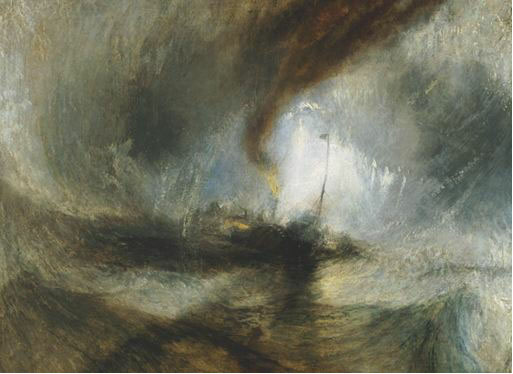
J. M. W. Turner, Snow Storm: Steamboat off a Harbour's Mouth, 1842, Oil on Canvas.
We can then begin to read the sublime and art historically and so grasp and understand a certain kind of history.
April 25, 2007
Gillian Welch
I've started listening to Gillian Welch courtesy of fellow photographer Lariane, with whom Suzanne and I travelled Kangaroo Island with. I decided to begin with Time (The Revelator), with its Louvinesque high harmonies, vintage guitar, and pop/rock ballads with strong narratives--- 'I Dream a Highway' is a 15 minute looping, meandering journey.
Like many others I first came across Welch on the soundtrack to the Coen brothers' film O Brother, Where Art Thou? and Return of the Grievous Angel: A Tribute to Gram Parsons.
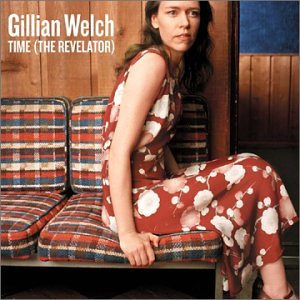 Welch seems to have grown up on old country material like The Carter Family, the bluegrass work of the Stanley Brothers, Appalachian music, and the near-forgotten popular styles of rural American music that you find on Smithsonian's Anthology of American Folk Music. Welch and Rawling's debts to these artists of America's past are obvious and they are clearly acknowledged.
Though Welch and Rawlings are often portrayed as defenders of a faith-old-time string musicians, they are not mere revivalists in the old-timey style. They are independent musicians who write their own music--even on the debut Revival.
There are strong songs on Revival, and these go beyond rustic folkiness and nostalgia, for all the stark roots-based simplicity and echos of the past.
As Alec Wilkinson writes in The New Yorker:
The music they play contains pronounced elements of old-time music, string-band music, bluegrass, and early country music, but they diverge from historical models by playing songs that are meticulously arranged and that include influences from R & B, rockabilly, rock and roll, gospel, folk, jazz, punk, and grunge. Welch’s narratives tend to be accounts of resignation, misfortune, or torment. Her characters include itinerant laborers, solitary wanderers, misfits, poor people, outlaws, criminals, love-wrecked women, etc.
Like the earlier work of Linda and Richard Thompson the music of Welch and Rawlings sound modern. I know this music, even though I have very heard only one or two the songs (eg., Orphan Girl on Revival).
April 24, 2007
Kangaroo Island Snaps
The little holiday on Kangaroo Island is now over. I wasn't able to access the internet whilst on the Island. The locations were too remote and I was only in the main towns--Kingscote and Penneshaw---for brief moments either to pick up supplies or to catch ferries.
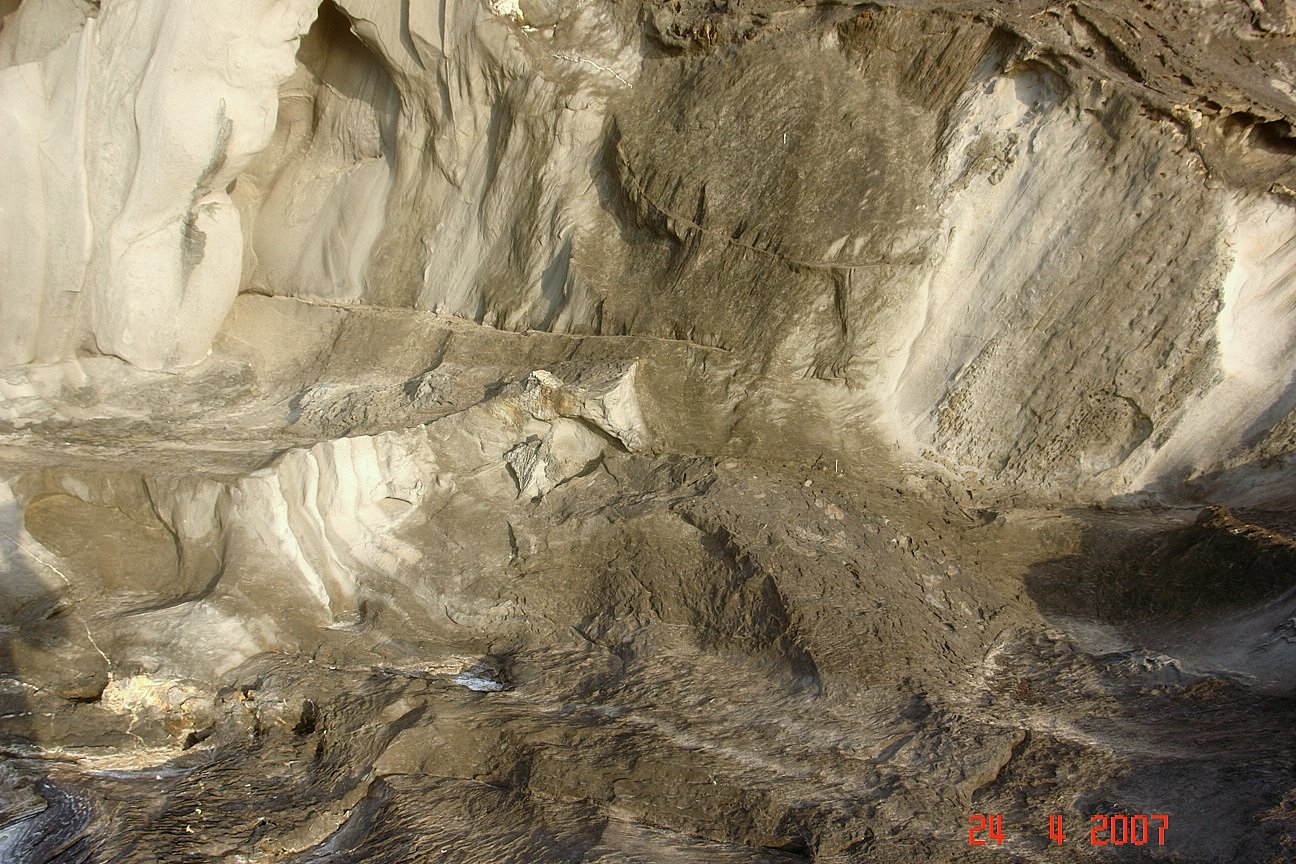
Gary Sauer-Thompson, Rocks, Kangaroo Island, 2007
So I had to wait until I returned to Adelaide in order to be able to re-enter a digital world and be able to post. I guess being outside the digital world is a postmodern meaning of wilderness.
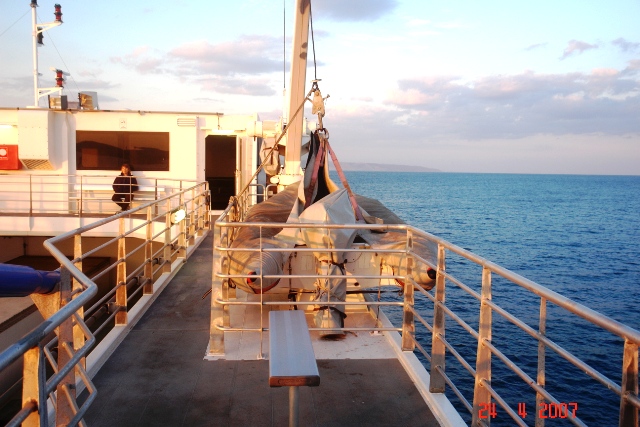
Gary Sauer-Thompson, ferry, Kangaroo Island, 2007
The Island is not all wilderness as most of the centre is farming. The wilderness is the national parks with the wild places along the coasts where land and sea meet. The Island was very dry, and the talk was of rain---it was on the way.
Will the future of agriculture on the Island be the museum tourist agriculture of many OCED countries?
April 19, 2007
mosaic of Io
This mosaic is from from NSA's image of the day. Io is the most volcanically active body in the solar system, with volcanoes that erupt massive volumes of silicate lava, sulphur and sulphur dioxide, constantly changing Io's appearance.

Tammy Becker and Paul Geissler, NASA, Io
This basemap of Jupiter's moon Io was produced by combining the best images of the Voyager 1 and Galileo missions.
Urban renewal + the neo-liberal city
An interesting review at American Prospect online of a book on neo-liberalism and urban renewal: Jason Hackworth's The Neo-Liberal City. Some theoretical debates about urbanization and neo-liberalism can be found here.
Hackworth has found a common theme among those trends -- gentrification, privatization, corporate invasion, and public-private revitalization projects -- that have come to symbolize renewal in the urban core in recent years.The common theme is neo-liberalism, which he defines as "an ideological rejection of egalitarian liberalism in general and the Keynesian welfare state in particular, combined with a selective return to classical liberalism.
Adelaide appears to have adopted Richard Florida's "creative class" theory of urban revitalization, in which hope for the city to rescue itself from post-industrial depression comes from an invigorating influx of young creative professionals. In Adelaide the ideas about urban renewal, creativity and innovation come from Florida and more from Charles Landry.
Kangaroo Island holidays
We are off for a 5 days holiday on Kangaroo Island. We will be staying in the heritage lighthouse accommodation in the island's national parks.

Gary Sauer-Thompson, Suzanne +Lariane, Second Valley, 2007
Internet access is difficult, as this is a remote region. True, Kangaroo Island is a high tourism site with strong international traffic. Though we are staying in national park lighthouse cottages these have no phones or internet access. I was hoping for island-wide wireless coverage---ie., Kangaroo Island would have gone digital given its high tourist profile. It is not so.
Not even a mobile phone works apart from the Telstra network--- and that is maybe.
So it looks like I am limited to the internet cafes in the two main towns of the island --Kingscote and Penneshaw ---if I want to post images from the digital camera. More than likely this will happen when when we are staying at Cape Willoughby, rather than the more remote Flinders Chase in the south west of the island.
Heidegger, art
At the center of Heidegger's philosophy of art is the claim that works set up a world that comes forth from and sets forth the earth. The concept of earth in Heidegger corresponds to artworks being embodiments of meanings and thus bound to the constraints of a medium; hence the concept of earth means to give unconditional legitimacy to what is arguably an utterly central feature of artworks.
But the notion of earth in Heidegger operates as a principle of transcendental opacity, as what conspires to make truth itself finite rather than infinite, and hence as a limit to the claims of disembodied reason and the dreams of technology.
Karsten Harries plausibly claims that "the presentation of the earth requires art, and because it does, Heidegger's postmetaphysical thinking does not lead to a philosophy of art but seeks to enter into dialogue with artists and poets . . ." What goes along with this thesis is the claim that the kind of art which can provide world-disclosure, "great art," is not now extant; there is art now, but not great art.
April 18, 2007
self-publishing and democratisation of the media
The growing availability of access to the means of production of images, sounds or text means that there is a lot of digital self-activity in art and politics happening. Lots of people are making images, good ones. The images in postmodernity appear, are everywhere, and then vanish, leaving barely a trace. It's all about the flow.

Gary Sauer-Thompson, mural, Goolwa, 2007
If self-publishing on the internet is a welcome development, then the buzz words, ‘user-generated content’ and ‘democratised media’, express a deep-seated unhappiness with the current media; an unhappiness expressed in blogging, photo-sharing sites and other forms of personal publishing. Self-publishing on the internet is less vanity publishing as claimed by some journalists, and more an expression of our desire to have more control of our representations.
Remember how Time magazine has voted us digital wannabes “The Person of the Year” for “seizing the reins of the global media, for founding and framing the new digital democracy, for working for nothing and beating the pros at their own game”? It is true that access to the media of visual representation has undergone a radical democratisation, one driven by the same digital technologies that are consolidating the ability of global capitalism to project its power across cultures. Hence we have a much welcomed pluralism and diversity of voices heard and their images visible.
I'm not sure what the connect is between self-publishing on the internet and the democratisation of art and media in the digital age? How does junk for code further the process of digital democracy? It has nothing to do with beating the ‘pros’ at their own game as I have no desire to be a photojournalist, a professional artist, an academic in cultural studies, or part of the corporate media. How does junk for code challenge the power of the media companies? Though a digital world has given people space to express themselves that is quite different to building forms of democratic governance that can listen and take account of what is being said by these voices and images.
April 17, 2007
Jacopo Tintoretto + the Baroque
There is an exhibition at the Museo Nacional del Prado in Madrid of the paintings of Jacopo Tintoretto; a Renaissance Italian painter who worked in Venice, but who who seem to step outside the light and logic of the Renaissance. This is a late work:
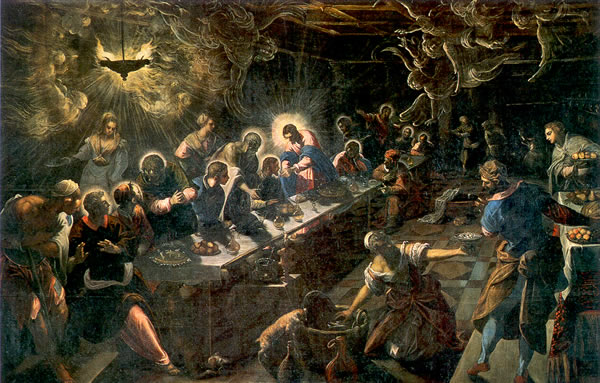
Tintoretto, Last Supper, 1594
There is dramatic distortion, restless dynamism of the composition, dramatic use of light, and emphatic perspective effects point towards the Baroque. I selected this image from Tintoretto's body of work because I'm currently reading Deleuze's The Fold: Leibniz and the baroque.
I'm much taken with the text's concern for movement, pleat, curves, folds and twisting surfaces. For Deleuze the Baroque is defined by a fold that goes out to infinity and involves a rupture with Renaissance space.
Andrew Butterfield, in this review of the exhibition in the New York Times states the significance of Tintoretto ion art hisorical terms:
Brushwork is the key to Tintoretto's artistry. Given the relative simplicity of layering in the preliminary strata of paint, the forms in Tintoretto's pictures would appear nearly unmodeled were it not for the strong brushwork on the surface. It is with the final mighty blows of the brush that Tintoretto gives shape to the figures and objects in his paintings. It is with these same strokes, too, that he adds the accents of hue and light that so powerfully enliven his pictures. For Tintoretto, it was through his new method of painting that he could achieve his ideal and unite drawing and color.
What I see in the Last Supper are the different orders of space and surface in a crypt or sacristy with its dark background. Everything seems to be drawn out of it. There does not seem to be an outside. All the activity takes place inside. Bodies came out the dark background by virtue of the regime of light that appears to come from a vent or opening.The light appears to be angled or folded from polished twisting surfaces.
April 16, 2007
The Cinematic Mode of Production
An interesting book on cinema: Jonathan Beller's The Cinematic Mode of Production: Attention Economy and the Society of the Spectacle is a Marxist analysis of cinema as a mode of production in what many call “post-industrial” capitalism. So cinematic images are not just representations of capital, but that they actually are capital.

Courtesy of le Colonel Chabert
Steven Shapiro over at Pinocchio Theory describes it thus:
Beller describes cinema.... as a machine for circulating images and their affects, for exchanging them one for another, for inciting us to consume them in their very distance (or “alienation”) from us, and for swallowing up the entirety of society and social action (production) in this fantasmagoria of images and their circulation.
This political economy of vision is a building on Adorno & Horkheimer's Culture Industry and Guy Debord's Society of the Spectacle in an innovative way that incorporates the body as desiring subject
The Introduction to the Cinematic Mode of Production is heavy going, so I will leave it to another post after I have my way through it. So I'll need to ease my way into this work on attention economy'; where cinema is understood as a deterritorized factory in which spectators work. If visuality reigns (not print technology), then cinema has industrialized vision, and then shifted to an electronic form based around reader attention.
In the meantime we have this earlier article in Postmodern Culture, which starts from the Coen brothers 1992 film Barton Fink. Beller says:
In the film, Capital Cinema is the name of the late 1930s pre-war Hollywood production studio which, makes cinematic expression possible. This company, as a representative of the studio system, is used by the Coen brothers to demonstrate that cinema is at once a factory for the production of representation and an economic form, that is, a site of economic production. As factory and as economic system cinema is inscribed in and by the dominant mode of production: specifically, industrial capitalism and its war economy. As a factory of representation Capital Cinema dictates limits to the forms of consciousness that can be represented, but as an economic form inscribed by the larger cultural logic, Capital Cinema dictates limits to forms of. consciousness per se.
Straight marxism really----the development of culture as a sphere of the production line and so creating new pathways of commodity flow. The spectacle which we consume in late capitalism is the spectacle of late capitalism itself; but one that performs a retooling of the sensorium by initiating a new disciplinary regime for the eye.
April 15, 2007
Bit Torrent, networks, music
Web 1.0 is the internet network I've been familiar with in my experience of file-distribution methods in a digital world. I open a Web page and click a link on its structured database to download a file to my computer. If the file is both large and popular, the demands on the server are great, and the download will be slow. Usually the download is fast with ADSL2+broadband.

This business model has defined the technology road map and it enabled businesses and government departments to reach out to their customers and stakeholders online, but with limited feedback opportunity.
The internet continues to evolve. We have Web 2.0 where much of the content is generated not by the centre but by its user community. The examples that comes to mind are YouTube, MySpace, or Wikipedia, not your traditional business company or government department. The latter's digital platforms have little connection with user-generated data, other than as a coat of paint. In Web 2.0, the focus shifts from the computer to the internet, and to a more decentralized network.
When I was looking around for an online copy of the 5 CD of the Band's A Musical History over the internet, using the free BitTorrent software I've downloaded onto my PC I enter another kind of network. I pick the title from a list. I've stepped into a peer-to peer one network, which some commentators view as a giant bandwidth-suck.
P2P technology basically began with Napster in 1999 as a method for users to share MP3 files (digital music) over the Internet. P2P technology uses a system of end-user computers that facilitates the transfer of digital information. P2P used to fall into two models, Napster and Gnutella, which have many variations. Both models do not use the classic client-server configuration but a client-client configuration. The significant difference in the two models is the Napster model maintains a master list of files and users while the Gnutella model has no such list.
The new development was bit torrent: a technology that will probably change the landscape of broadcast media since people getting their TV online, will drastically change the nature of the medium.

Leslie Ellis describes what happens next:
In the background, you get what’s called a “tracker,” which watches every other BitTorrent downloader of that title. In the BitTorrent lingo, the thing you want is the “torrent.” Those who have the whole thing are the “seeds.” They dole out chunks of the digital thing you want. Your tracker interacts with seeds and other BitTorrent trackers, to fetch the chunks you need. For a popular movie, it’s not unusual to see 30,000 downloaders pulling from each other, and from 200 seeds, the authors found. Once you get swarmed with the whole file, you, too, can become a seed. The more you share, the better download performance you get.
That's a simplified view of how swarming works in a peer-to-peer network. In my case I searched for an obscure or old file (the Band's A Musical History) that was probably available on only one or two hosts.

Apparently BitTorrent accounts for an astounding 35 percent of all the traffic on the Internet -- more than all other peer-to-peer programs combined -- and dwarfs mainstream traffic like Web pages. P2P has become one of the most prolific sources of viruses, worms, Trojans, spy-ware, and other undesirable software, and so represents the personal risk the user incurs from the use of P2P software.
I presume that those who desire music are pulling it on the Web. Like me they’re going out and finding it, but unlike me, most of them are they’re searching for great new stuff.You can hear music before buying it. Suddenly, the major the labels’ business model is in trouble as they no longer controlled exhibition and distribution. However, distribution is only one part of the music industries much larger business structure, as they are also in the business of A&R, the finding, filtering and amplification of new talent. The recording industry has lost everything on the cultural and artist side of things and so what they do is use their money and lawyers to bully the competition and consumers.
April 14, 2007
graffiti in Adelaide
It's odd isn't it. The City Council sells the right of speech on public sidewalks to corporations for kiosks, billboards, mobile advertisements, newsstands as well as other bulky steel and umbrella street furniture for cafes and restaurants.
But graffiti on old walls of run down, disused buildings is commonly seen as the first step to criminal behaviour and as representing gang activity:
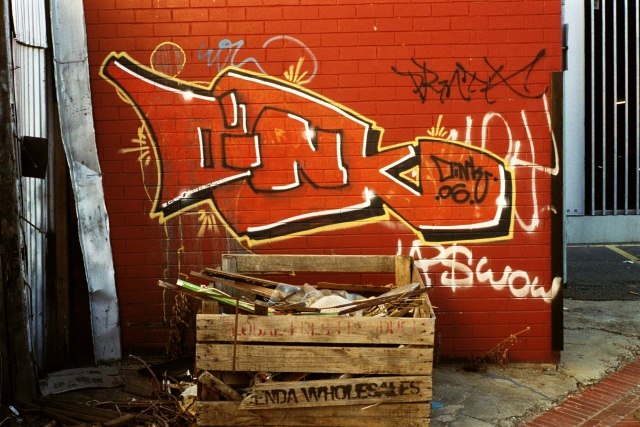
Gary Sauer-Thompson, graffiti, Central Market, 2007
Political parties can use public spaces to hang their own leaflets, election literature and announcements about local community meetings. But leaflets, billposters and sidewalk art displays are seen as defacing public spaces. So why not graffiti artists?
Public art is something that is official---a commissioned piece by an artist. What disturbs many is the way that artistic graffiti invades personal property and so offends property owners and this leads to community pressure on politicians, who respond by ordering police pressure and declare war on graffiti artists.
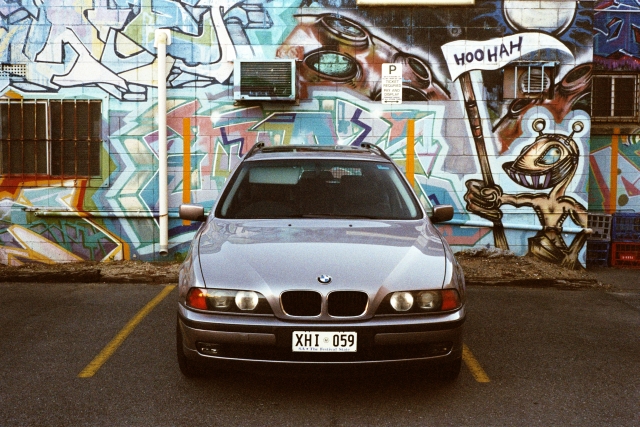
Gary Sauer-Thompson, BMW, Central Market, 2007
But artistic graffiti changes public walls in car parks, urban wasteland sites and empty empty buildings. There is so much of these dead spaces in the western part of the CBD, as the urban renewal is only just beginning. Most of the proposed renewal is on the drawing board.
This influences the formation of more positive conceptions of this form of cultural expression--- art with aerosol. We can then begin to understand the changes in graffiti culture. What we begin to see is that instead of being one rebellious monolithic culture--- a group of delinquent individuals who have little self-regard and an obvious lack of regard for public property---it is a representation of a diversity of urban voices.
April 12, 2007
going digital
I see that the big end of town is continuing to squabble over plans to broadband the nation. The national debate in Canberra is pretty much about finger pointing over who is at fault over what has not been done and why they cannot do it.

Scratch, Broadband, 2007
Now I have high speed broadband--thanks to Internode, not Telstra. I am struggling to make the shift to a digital world. It is an expensive shift for photography --new computers, software, camera and iPod for portable storage. It's $5 grand and I'm going light on the camera --a prosumer model not a DSLR.
With digital music I have problems in downloading a BitTorrent, file----it is so slow from this site, despite the high speed broadband. Yet I understand that BitTorrent is often used for distribution of very large files, very popular files and files available for free, as it is a lot cheaper, faster and more efficient to distribute files using BitTorrent than a regular download.
Then I have difficulties trying to play the file that has been downloaded on my PC media player. They do not recognize a Bit Torrent file. I find the Windows tools pretty poor. Presumably, this means I need a different kind of media player.
April 11, 2007
Scorsese Presents the Blues
I've been working my way through the seven parts of Martin Scorsese Presents The Blues: A Musical Journey series. I've just watched Marc Levin's Godfathers and Sons I am suprised that it does not link to what Americans call 'Southern Rock' --especially the Allman Brothers Band
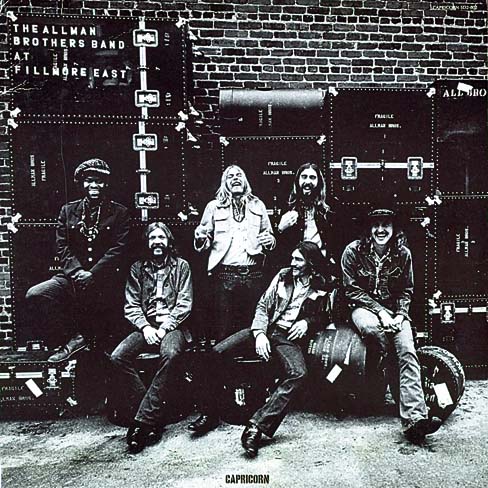
I've just been listening to At Fillmore East.This kind of music---a hybridity of blues, country, jazz, and even classical influences, and their powerful, extended on-stage jamming---has definitely died; probably around the late 1970s. This rock & roll with a distinctly Southern twang is a reaching back to the South--before ruralness seeped out of the south, and it went all stars and stripes Republican with Reagan.
True, the Allman's latter work became a kind of watered down roots music from the South--fitting music for the strip mall culture of suburban Atlanta---and the Allman Brothers became a has-been group trading on past glories---arena rock's big oldies act. If Southern Rock went country, the roots of the Allman Brothers Band roots are in the blues---one fruit of the blues. Southern rock has too often relied solely on superficial signs. Lynyrd Skynyrd's use of Confederate visual codes and miracle tones evokes not the true Southern past, but merely plays a self-referential game within the genre.
The early work of the Allman Brothers Band could be seen as one of the sons, as much as, if not more so than the Rolling Stones, who were still doing covers on 12 X 5. But nary a mention. Strange.
April 10, 2007
Queensland: toughening water restrictions
Queensland has shifted to level 5 water restrictions for Brisbane and south-east Queensland-- roughly equivalent to Melbourne's stage 3. The difference between the previous level of restrictions (2, 3, 4) and level 5 restrictions, which come into force today, is that the effort to reduce consumption has shifted the focus from the garden and washing the car and driveway to cutting down the using water inside people's homes.
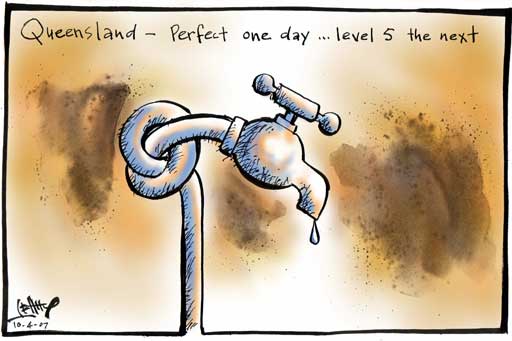
Queensland Water Commission's aim is to cut household water use from the current 180 litres a day to 140 litres a day. It suggests cutting the average seven-minute shower to four.
That scarcity means increased prices for water. The scarcity value of water should be reflected in tmost users facing higher charges for some of their consumption. So why is urban water is controlled through restrictions and not the market? Why are Queenslanders be told how much water to use?
The longer term solution is investing in water efficiency and the reuse of wastewater by households.That means starting to rethink the way we run and construct our houses.
Another implication of the scarcity of water is the depletion of the availability of hydro-electricity from the major generators in the Victorian and NSW alps, as well as in Tasmania. Hydro power requires water to generate electricity. Victorian and NSW do not have the water to run the generators. Since power is generated from more expensive sources that means increasing power bills. Time for households to invest in solar power.
April 9, 2007
Beachport snaps
Though it is Easter time it still feels like summer time--blue skies, hot days, warm winds and mild evenings. Easter this year is 'the beach' and al fresco dining.
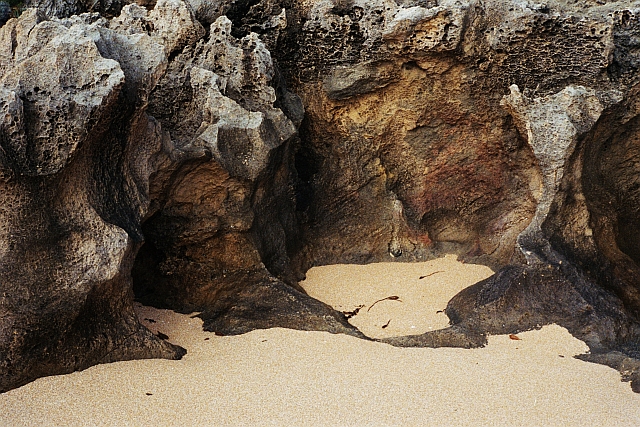
Gary Sauer-Thompson, Rocks, Beachport, 2006
There is not even a hint of a rain cloud in sight. Who would have thought that sun and blue skies would make one feel depressed? This is the continuation of summer weather way into autumn. The seasons have become all mixed up. Why they were picking the fruit off the vines in McLaren Vale in January-- the first time in 100 hundred years.
April 8, 2007
Easter: life and death
Easter has changed. Good Friday is now just an ordinary public holiday--a secular holiday with shops and pubs open. Australia is no longer a Christian nation. Easter is about music festival and family days. Though not all experience this festivity --especially in the global city.
Though Easter is the most important of the Christian holidays---it celebrates the Christ's resurrection from the dead following his death on Good Friday--it is about not religious days. It has been replaced by the folklore mythology of Easter bunnies and baskets filled with chocolate and colored eggs. Easter Bunny and eggs go together?

Matt Golding
It is the easter Eggs that are a symbol of new life these days. Christ's resurrection is only for Christians. The Easter Bunny, as a sign of fertility also stands for the celebration of spring----it doesn't make sense in Australia, where it means celebrating the return of autumn.
In Australia, rabbits are an invasive species and generally considered pests. Why celebrate the Easter Bunny when new life in the form of rabbits cause such widespread ecological devastation that great efforts are continually being made to wipe them out? It's odd that the rabbit continues to remain the sign for treats as opposed to Easter Bilbies.
April 7, 2007
development, photography, the blues
I'm down at Victor Harbor for the Easter break. It's jumping with people, even if there is no blues and roots festival, as is happening in Bryon Bay. I'll be content to watch some blues DVD made under Martin Scorsese's direction. I missed it when it was shown on ABC television; probably the most extensive an television presentation of the blues on Australian television.
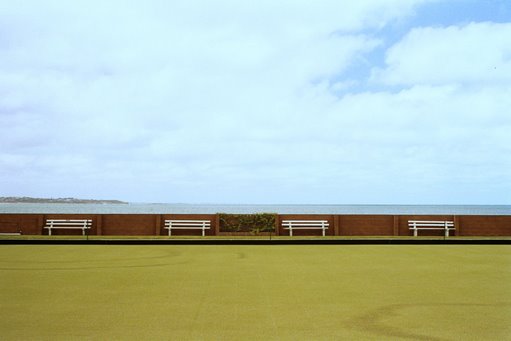
Gary Sauer-Thompson, Bowling green, Victor Harbor , 2007
Development is a big issue --lots of conflicts about proposed big new shopping centres, especially the one along the lines of Wal-Mart on the outskirts of the city proposed by the Makris Corporation. This has been given major major development status by the state government, and so bypasses local government planning processes.
Even those who say the Fleurieu Peninsulal is being held back by mealy-mouthed naysayers and councils that iareonly interested in constructing one string argument about why something shouldn't happen in the region are taken back and singing the blues. The Wal-Mart development would suck all the life, vitality and profits out the local business centre. So we have conflict within the development crowd who say Victor Harbor and should be prosperous, populous and progressive.
I watched Scoreses's own Feel Like Going Home last night, the first in the seven-part film series 'Martin Scorsese Presents The Blues'.This homage to the blues was more like a musical journey from the Mississippi Delta to Mali in West Africa with young bluesman Corey Harris. What is highlighted is the political and social conditions that the blues gives expression to and the common features between Malian music and the blues. Son House was a revelation: the right hand guitar technique was really flailing away, yet the resulting sound was crisp and precise.
However, it was a play around the Authentic Black Bluesman
April 6, 2007
Festival Express---art v entertainment?
I watched a DVD of Festival Express last night. It is an account, or record, of a little-known moment in rock n' roll history in 1970, when groups including Janis Joplin, The Band, and the Grateful Dead, slept, rehearsed, jammed, and had a drunken, bacchanal time aboard a customized train that travelled from Toronto, to Calgary, to Winnipeg, with each stop culminating in a concert.
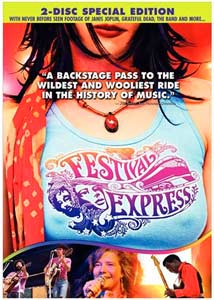 If the trips between cities were a mix of jam sessions and partying, then the music of the drunken jam session was not of high quality. It may be a great time for the participating musicians breaking down the musical boundaries (especially Jerry Garcia) and experiencing the flow of the music on their magical mystery tour, but the drunken jams and musical melange are not that much fun to listen to.
It's mostly a travelogue/concert film with a wistful, nostalgic reminiscing by the performers about the good old days---everything was better back in those days.The Grateful Dead had just released its seminal "Workingman's Dead;" The Band was coming off the double triumphs of "Music From Big Pink" and "The Band"; and Joplin had released the successful "Pearl." A faded, forgotten past now, but a highpoint in rock music's golden 1967-1976 period; a moment that celebrates its affinities with other forms of popular music, such as the blues and folk and country. Rock music looked strong and vital, not fragile and insipid.
What the film highlights is the difficulties of Ken Walker, the principal promoter, who put together a show of headliners, and lost a lot of money. In the spirit of the time, rebellious crowds in Toronto and elsewhere decided that the music should be free, and were hostile to commercialism and the police who were holding them back. Hence the violence--the spirit of Altamont--that highlights the contradiction of the counterculture. Consequently, the Festival Express was, like Woodstock, a financial disaster for its promoters even as it identified with Nietzsche's celebration of the radical autonomy of art.
Though the film shows that rock music did not change the world (the rock=rebellion equation) the music is raw and immediate. Even if, apart from Janis Joplin, the concert musical performances weren't that great, this music still has affective power, and hasn't been choked by money and commercial interests. We have Richard Manuel's anguished and haunting reading of Bob Dylan's "I Shall Be Released". Janis Joplin's ferocious rhythm-and mostly-blues renderings of "Tell Mama" and "Cry Baby", which were full of raw emotion, were the film's most powerful filmed performances.
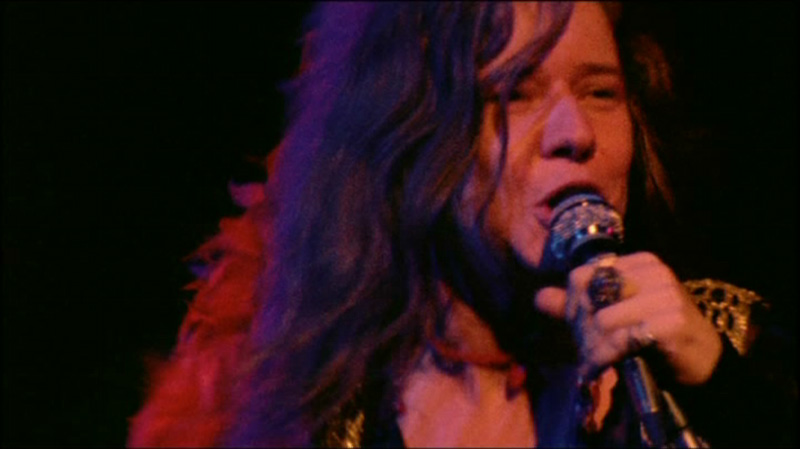
Less than three months later, Joplin was dead of a drug overdose. The Flying Burrito Brothers, without Gram Parsons, were solid and strong on "Lazy Day" and sounded nothing like the Eagles. Neither did the New Riders of the Purple Sage.
This music did not look or sound dead at the centre. The spectre of the 'death of rock' is still a rumour that is heard somewhere offstage. Amongst the fans on the counter-culture street? This music has not lost touch with its sources of power and energy.
Bob Smeaton constructed Festival Express from the 75 hours of raw footage. It has a retro feel----it looks how it would have made had it been made it in 1970--- and so utilizes a split screen familiar from the period documentaries about Woodstock and the Monterey Pop Festival. However, in this 'Woodstock on wheels' there is no reflection on the deaths of rock musicians caused by the overdose of drugs and alcohol. The Grateful Dead's 'Riding that train, high on cocaine' is apt. Nor is there any critical concern with the high modernist romanticism of the artist-as-rocker steadfastly refusing the Mephistophelean commercial temptation of late capitalism.
What is highlighted is that the formal concert gigs became to be seen to be more of a distraction from the "real" happening of the music utopia--or rock excess---on the train. This allows us to see in the music a genuine feel and a sense of vitality, which demolishes the boundaries between ostensibly discrete and distinct genres of popular music; an anarchic vitality that rock may never resurrect in today's manufactured pop landscape. The classical way of expressing this is to say that art refuses, and protests its unwillingness, to serve as simple entertainment.
April 5, 2007
Autumn time in Tasmania
I saw a clip Paula Wriedt MHA, Minister for Tourism, Arts & the Environment, in the Lennon Tasmanian Government on free-to-air TV last night----I think it was the 7.30 Report. Wriedt was talking about why her government was doing nothing about working with the Commonwealth to prevent the ecological destruction of Macquarie Island, given Tasmania's previous commitments. She was incoherent and unconvincing. The Lennon Government is walking away from its environmental responsibilities.
The Minister is similarly incoherent about the consequences of the proposed Gunn's pulp mill being located in a wine growing, small tourist business, small farming community area on a scenic tourist route. She covers the contradiction between economics and environment with 'best practice'.

Ray Norman, You always know when its autumn in Tasmania #2, 2007
Shouldn't the Minister for tourism and environment be defending tourism and the environment ---not the pulp mill? Presumably the damage to tourism, the environment and the health of a few thousand local residents can be seen as akin to the collateral damage of economic growth. Shouldn't the Minister be questioning Gunn's claims about the effects of the pulp mill?
William Christenberry
William Christenberry's photographs--from his earliest Brownie photographs of the early 1960s to his later work with a large-format 10x8 camera---- are of a place, time and way of life that are vanishing, if not vanished. His photographic exploration of the American South has been ongoing for forty years. His work builds on Walker Evans, and parallels the work of international practitioners like Bernd and Hilla Becher.

William Christenberry, White Door, Moundville, Alabama
This is a photograph of what once was---so what we have representations of disappearing and memory haunted places.
April 4, 2007
the land of 'Kath + Kim'
There is an article by Patrick West in Spiked in which Australia is represented as the land of 'Kath and Kim'. I've only seen bits and pieces of the Kath & Kim comedy television series, but it appears from what I've seen to be about the struggles of life and relationships once material comfort ---the house, the garden, the car, holidays, shopping--- has been achieved. They are coming to grips with their tradition of understanding their own well-being in terms of possessions or economic wealth. Very contemporary.
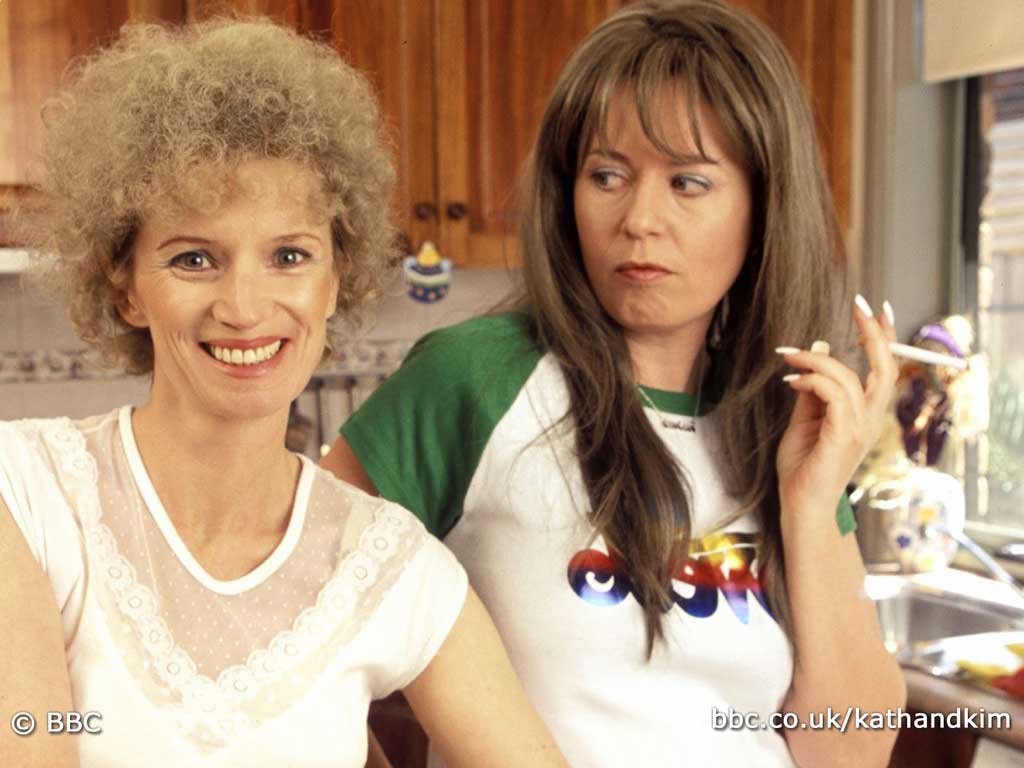
West reworks the traditional English cultural elitist account about a nasty, uncultured suburban working class Australia. It's pretty thin in analysis and thick in value judgement. He says:
Australia is not the paradise it is portrayed to be on Neighbours. One of my Aussie colleagues is often asked why she chose to live in miserable, rainy Britain. I asked her the same question the other day. Her answer was simply: ‘Australia is nothing like Neighbours. It’s more like Kath & Kim.’ She went on to explain that the Land Down Under is not populated by the hearty, the gregarious and the welcoming, but by white trash (I don’t particularly like that phrase because no-one has the courage to use its equivalent, ‘black trash’, but you get the point). Australians are some of the most coarse, racist people on earth, as Kath & Kim rightly portrays.
According to West that is why so many Australians, especially the clever ones, move to Britain or elsewhere.They all want to get away from the rough" and "coarse" land of Kath & Kim that is full of the dark and dangerous passions that so threaten the sweetness and light of a progressive liberal culture.
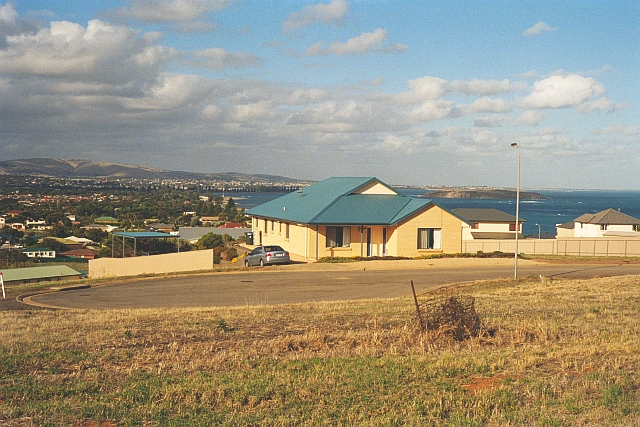
Gary Sauer-Thompson, suburbia, Victor Harbor, 2007
You can hear traces of Matthew Arnold's culture and politics--- the 'vice and hideousness' of the yobbos who need to be civilised --- in West's text. It's core is Culture and Anarchy with its spectre of civilisation laying in ruins.
My quick response to West is that Australia’s diaspora is composed of professionals working in a global marketplace in jobs that are unavailable in their homeland, rather than elite intellectuals such as the old English standbys of Clive James and Germaine Greer. Secondly, there are intellectuals who continue to live in Australia. Thirdly, the more cosmopolitan lifestyle of the professional /middle class inner city culture in the capital cities is quite different from the working class suburbia represented by Kath and Kim.
Guy Rundle makes an interesting response in Spiked about the article being West's response to a cultural crisis in Britain. The left-liberal elite fear that mainstream conservative tabloid pop culture is actually winning – and that the remaining institutions of liberal elite culture (Radio 4, the Guardian, Independent etc) are being pushed to a position of utter irrelevance. Rundle says:
What is really awry in West’s piece is that he has missed the way in which the image of Australia is used within British culture and debate for purposes that have nothing whatsoever to do with the southern continent. The fashionable disdain in Britain for the suburbanism that dominates the image of Australian life is a barely disguised form of prejudice directed at working-class and mainstream culture, displaced in such a way that it can avoid charges of naked elitism.
Rundle says that more and more British liberals project their fears for their own self-preservation against the hordes on to a nightmare vision of Australia, where they imagine the hordes have been victorious.
If we come back to West's imaginary account of Australia, then we can argue that multicultural Australia has given rise to a new kind of cultural critic, one who addressed issues of ethnic, sexual and gender diversity.
April 3, 2007
political correctness
From what I can make out the term 'political correctness' as used by cultural conservatives is part of the long-running assault by conservative opinion on progressive secular liberal values. Valerie Scatamburlo points out in Soldiers of Misfortune:
Redirecting the wrath once reserved for commies and pinko compatriots, the New Right concocted a new adversary comprised of Left intellectuals and multicultural sympathizers, and embarked upon an ideological struggle to reclaim the last bastion allegedly controlled by radicals – the academy [...] Suddenly, those intellectuals who had begun to speak out against sedimented forms of racism, debilitating practices of patriarchy, and xenophobia were cast as anti-democratic and anti-Western. Conservatives interpreted demands for inclusive curricula, canon revision, and pedagogical reform as signals that Western civilization itself was under siege by the "new" barbarians clamouring at the gates.
What we have is a conservative anti-PC campaign built around conservative hates such as multiculturalism, affirmative action, speech codes, and gender and sexual politics.
Scatamburlo argues that political correctness is a useful form of ideological shorthand brought into play by today's guardians of the status quo to decry any position that challenges the virtuosity of capitalism, the nobility of right-wing cultural values, or the notion that oppressive relations of racism and sexism are still pervasive in America, Australia or the UK. It is deployed by conservatives (the openly partisan Fox News and Murdoch Press) to project themselves as moderate and objective in relation to Left-wing lunatic extremists.
In this discourse the Coalition becomes the party of the common man and the ALP is a party beholden to a powerful New Class of liberal elites that wishe to impose its will upon "ordinary," "average" Australian through its control of the media, academia, and government bureaucracy. Conservatives argue that this liberal elite is responsible for a decadent liberal Australian culture that assaults family values, produces obscenity, embraces pornography, disrespects authority, coddles criminals, stymies initiative, foments revolution and so on
April 2, 2007
a sense of things falling apart
I look at the American law and order shows on free-to-air television and I think the end has come. History has ended. Instead of a modernist utopia we have is murder, destruction, violence amidst great wealth and a sense of decay and emptiness in an urban world. The excess of the street is the world of the lower orders. When we glimpse the world of the stylishly presented elite---- the Americans no longer eat their beautifully presented cuisine in the shadow of the Old Masters----we also see power and psychosis.
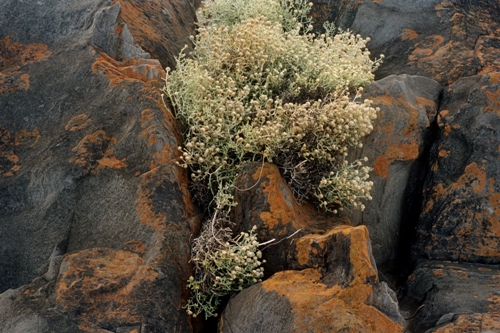
Gary Sauer-Thompson, rocks + plants, 2007
America as a neo-liberal utopia is deeply wounded or damaged. It's a black, depressive desolate world inside the triumphalism of capitalism, its business culture and the glossy Krispy Kreme consumerism of the market. I recoil from the depression of the schizophrenic nightmare world, and move back to nature to keep my sanity.
It's a retreat, I know, time out as it were, from the belligerent libidinal forces that lay beneath our superficially benevolent liberal world.
April 1, 2007
a militia painting
An old style banquet and an old style portrait from another world of yesteryear that I have no sense of:
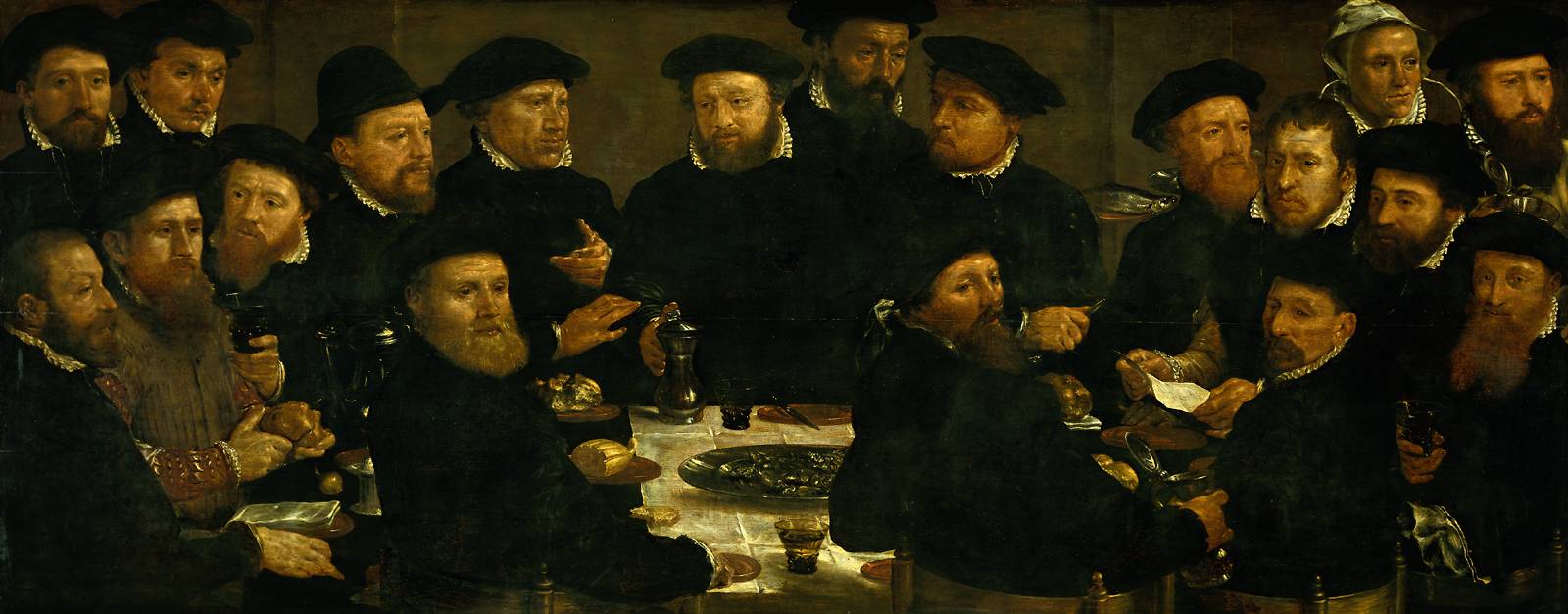
Dirck Barendsz, Banquet of Eighteen Guardsmen of Squad L, Amsterdam, 1566, Oil on panel
This painting is known as the 'Perch Eaters' because the fish they are eating is perch. It is what you would find in an art gallery tucked away in some secluded part of inner Sydney; away from the pulp trash, brutality and horrors of the streets. The painting belongs to the privatised world of the cultural and bussiness elite.
amidst the global flows in Sydney
I was in Sydney Friday and Saturday working at the Marriott Hotel, Hyde Park. Dinner was by candlelight when the lights went out for Earth Hour. Not that many lights were turned off in the Hyde Park area of the global city from what I could see.

Sydney
This morning I walked around the East Sydney, Darlinghurst area with a camera. Disappointingly I took few photographs. I was suprised by the street beautification of the little back lanes in this primarily residential area. It was very pleasant inner city living. However, Oxford Street looked very tacky indeed. The drunken Saturday night gay revellers were still going strong and wild around Taylor Square.
In the fluid, uncertain flows of the global city----the "melting of the solids" leads to the fluid and fragmentary nature of social bonds and individual identity---the inner city world of East Sydney offers some security and dignity----albeit in a privatised sense. So our troubles--there were many troubled , despairing souls on the streets--- become private in a neo-liberal mode of life that is premised on consumer freedom. There were a few political signs---Vote Green--- around but I realized that postmodernism presupposes the collapse of Utopia. We just have these flows, a private existence, and psychosis. I shuddered.
At the Qantas club, whilst waiting for a plane to Canberra, I read the Australian Financial Review's boost about exciting new property developments in Adelaide's CBD property market ---regional Adelaide is increasingly becoming a modern metropolis full of vitality from the resources boom, with lots of affordable housing for Sydney investors---and Chris Milne's 'Adelaide Renaissance' from being the rusk-belt city of the 1980s.
A mood of confidence is returning to Adelaide, despite the continuing decline of traditional manufacturing in the face of cheaper products from China. The regeneration of socially progressive Adelaide is bolstered by BHP Billiton's $6 billion expansion of the Olympic Dam copper-uranium mine.
'Adelaide gets its groove back' reads like a marketing campaign to me whose storyline is China to the rescue. It's the praiseworthy interpretation of Donald Horne's The Lucky Country; a story that pretty much ignores the low spending on infrastructure projects and the slow shift to becoming a sustainable city. We get our groove back by going nuclear. It's dystopia.