|
April 17, 2007
There is an exhibition at the Museo Nacional del Prado in Madrid of the paintings of Jacopo Tintoretto; a Renaissance Italian painter who worked in Venice, but who who seem to step outside the light and logic of the Renaissance. This is a late work:
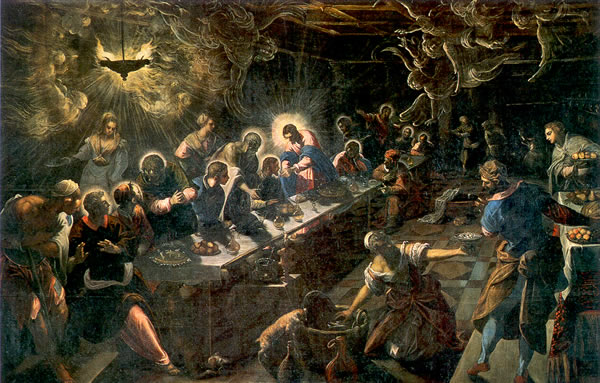
Tintoretto, Last Supper, 1594
There is dramatic distortion, restless dynamism of the composition, dramatic use of light, and emphatic perspective effects point towards the Baroque. I selected this image from Tintoretto's body of work because I'm currently reading Deleuze's The Fold: Leibniz and the baroque.
I'm much taken with the text's concern for movement, pleat, curves, folds and twisting surfaces. For Deleuze the Baroque is defined by a fold that goes out to infinity and involves a rupture with Renaissance space.
Andrew Butterfield, in this review of the exhibition in the New York Times states the significance of Tintoretto ion art hisorical terms:
Brushwork is the key to Tintoretto's artistry. Given the relative simplicity of layering in the preliminary strata of paint, the forms in Tintoretto's pictures would appear nearly unmodeled were it not for the strong brushwork on the surface. It is with the final mighty blows of the brush that Tintoretto gives shape to the figures and objects in his paintings. It is with these same strokes, too, that he adds the accents of hue and light that so powerfully enliven his pictures. For Tintoretto, it was through his new method of painting that he could achieve his ideal and unite drawing and color.
What I see in the Last Supper are the different orders of space and surface in a crypt or sacristy with its dark background. Everything seems to be drawn out of it. There does not seem to be an outside. All the activity takes place inside. Bodies came out the dark background by virtue of the regime of light that appears to come from a vent or opening.The light appears to be angled or folded from polished twisting surfaces.
|


