February 29, 2004
Stephen David Ross Interview#10-A
I'm on the road--as I have a plane to catch to Canberra.
In the tenth part of the Stephen David Ross interview conducted by Rick over at Artrift Ross says:
"A moving impetus behind The Gift of Beauty [GB] was to be able to think about art and aesthetics beyond the boundaries of art, yet not from another bounded place. I mean not only the institutional forms and practices of art‑‑museums, galleries, and recognized artists‑‑but the restrictions of whatever art called us to beyond art to science, nature, and the world. Beauty served that purpose, both for me and historically. Throughout the world and for the Greeks, beauty has transcended every limit set up for it. Beauty appears at once as the apotheosis of the limit, the superlative of superlatives, and as beyond measure, beyond superlatives and achievements. And if that were not enough, through time other terms came to resonate with beauty to express its transcendences‑‑the sublime, horrific, traumatic."
I will come back to this. Things are too rushed. The passage is very complex. How do you think beyond the boundaries of art but yet not from another bounded place?
If it is not from the institutional forms and practices of art (museums, galleries, and recognized artists) & the restrictions or limits placed on art from science, nature and society, then how do we think beyond the boundaries of art?
Is a negative dialectics meant here? An aesthetics thinking against aesthetics?
It does not appear to be so since Stephen Ross says thinking about art and aesthetics beyond the boundaries of art, yet not from another bounded place. Are we following Nietzsche and making a turn to the sensations of the body?
That is one is a bit of a puzzle.
Stephen goes onto make another point about the gift of beauty that points to moving beyond the boundaries of art. He says:
"The gift of beauty, the expressiveness of things, the world as aesthetic phenomenon, become the proliferation of the image. I'm interested in the production and dispersion of images as the expressiveness of things‑‑that is (my mantra), as exposition: exposure as expression, calling; as aisthêsis, mimêsis, poiêsis, catachrêsis, technê; as image, aesthetics, beauty, art; calling as giving. I mean to understand the expressiveness of things as calling and as giving from the good, that is, as ethical. I see the exposition of things as calling us to respond to them and to care for them, to cherish them, insofar as they always promise more than we take them to be, promise more than they are. "
I can understand the proliferation and dispersion of images in the sense of us living in a visual culture and understanding these as images as exposure and expression.
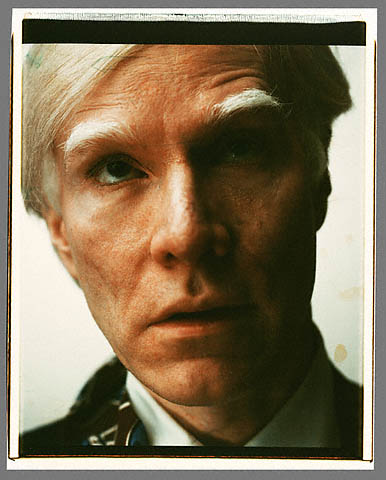
Andy Warhol, Self Portrait, 1979.
With Warhol we step from the art institution into the wide visual culture
Ross makes another point. Art as a calling, as a giving that invites us to respond to things and to care for them, to cherish them? Well I can get that:
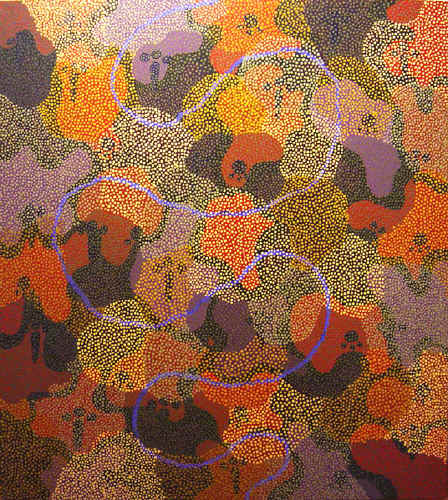
Malcolm Jagamarra,Lander River, 1999.
It is care for country.
What this kind of work does is reconnect artworks to the ethical (by which Ross means the good.) I accept that move because I accept that art in a society which harms people should help to ease their suffering.
That is the best I can do under the circumstances.
February 28, 2004
Stephen David Ross Interview#9
The nineth part of the interview with Stephen David Ross conducted by Rick over at Artriftis a series of quotes about beauty and judgement. I did not really understand them, other than tograsp ay that beauty is at odds with making distinctions.
What came into my mind when I read the Ross quotes was the new Parliament House in Canberra. Why? I'm not sure. Maybe because it is a beautiful place.
It is full of fluorescent light, vast spaces, long corridors punctured by light galleries, vast parquetry floors in canyons of space. it is lifeless but beautifully designed. Art works are everywhere and these are not just the row of portraits in oils of past male politicians. There were some Bill Henson' similar to this moody romantic image:

Bill Henson Untitled no 99, 1983-84
It is supposed to be a beautiful place. Ross's words 'beauty knows nothing of estimating judgment' made no sense. This beautiful place was dead---the emptiness of the avoidance of human contact and interaction. The only place of human communion as a coffee shop. You cannot help make the judgement and compare it to the human life of old Parliament House.
Should not beauty affirm life? Is not what affirm life good and what stunts life bad?
February 27, 2004
Stephen David Ross Interview#8
In the eight part of his interview with Stephen David Ross over at Artrift Rick raise the old question of autonomous as an art for art's sake.
Rick asks:
"You say ‘beauty is one name for an infinite multiplicity of questions, possibilities, experiences, and meanings.’ And so are goodness and truth. And that beauty is also ethical and political. In his essay, ‘Artistic Commitment’, Isaiah Berlin says, “The doctrine of art for art’s sake, and the corresponding denial of social responsibility or function of the artist..... the notion, that is, that the justification of art is art itself – is a late doctrine, a reaction to the older, traditional view grown oppressive or, at any rate, no longer convincing.” (Berlin, The Sense of Reality, 196-197) Does ‘art for art’s sake’ have a place in this infinite multiplicity of questions and demands of which you speak?
This is an old issue in aesthetics that has been made irrelevant by the work of Bellmer and Mandy Martin and Bill Henson. Ross acknowledges that this form of aestheticism is an historical one. He says that the implication of Berlin's intervention is that the conception of the autonomy of art as art for art's sake, is that it "someone's, some group's, view of aesthetics. Not everyone's. And not forever."
Well, we know that. Ross goes on to make a good point. He says:
"...though it is not my view, that the view that art is for art's sake and nothing else's---one reading of the autonomy of art---is not necessarily extreme and irrelevant aestheticism. That is one possibility. Another is that the aesthetic and artistic point of view refuses to succumb to the powers that surround us. If art has no place of refuge, no room of its own, no shelter from the storms of economics, scientific expertise, the state, and divine authority, what can allow it to be?
My own view is that art has no place of refuge, and is besieged by all these powers and threats. Art is institutionalized everywhere, and institutions both support it and suffocate it. For a moment, however, let's keep our eyes on the support and on the ways in which art, no matter how institutionalized, offers a different way of being, different ways of knowing, perceiving, sensing, thinking, feeling from economics, science, etc."
The question is:' in what way is art a different mode of knowing today from the instrumental reason of natural science and economcs. It is not clear that Bellmer, Martin or Henson are working in the same way of perceiving, sensing, thinking, feeling, knowing. It is one that Adorno called mimesis. (More here.)
Ross does not say. What he does say is that:
"Aesthetics is the name of two interrelated human perspectives and practices. One is productive of images, poems, all the things we think of as art, but other images, sounds, poems as well. I think of this under the headings of the aesthetic, the image, and exposition. The other is the institutionalization of the aesthetic as art, in museums, concert halls, poetry readings, the university, but also other institutions such as corporate design, advertising, etc."
So how is art in both of its aspects a different mode of knowing to a hegemonic positivist economics? Aesthetics does need to spell that claim out. The surrealists have given one answer--the unconscious. Is that a viable one?
February 25, 2004
everyday life

Bill Henson, Untitled, circa 1983-4
Change the architecture to tacky urban buildings and clothe the young body with a thin blanket, and this is what I see each day. What is missing from the image is the sounds of street violence and the presence of cops. Welfare is giving way to law and order.
This is in a city that continues to pride itself on being a child of the English Enlightenment. What is disturbing is the acceptance of street kids as a fact of life and an indifference to their life chances.
February 24, 2004
Grey Tuesday
It's Grey Tuesday. The day to protest against the attempts by EMI to censor Danger Mouse's Grey Album. This remixes Jay-Z's The Black Album and the Beatles White Album to create innovative hip-hop music.
EMI has sent cease and desist letters demanding that stores destroy their copies of the album and websites remove them from their site. EMI claims copyright control of the Beatles 1968 White Album. That creates resistance.
You can download the Grey Album on a filesharing network from illegal-art.org
Copyright laws need changing to allow more fair use.
The Free Trade Agreement with the US will change Australia's intellectual property (IP) laws. The FTA means that copy right protection will be available for 70 years after the author's death. It also means harmonisation of patent law with the US, which favour the interests of producers. Since Australia is a net importer of IP the overall effect of stronger IP protection is that Australians will end up paying more in licence fees to the US producers.
Update
It looks as if the GreyDay Tuesday resistance was a success
The legal issues are discussed by Lawrence over at Lessig Blog and at the Electronic Frontier Foundation.
This piece shows Australia going soft on the intellectual property regime under the Free Trade Agreement with the US. It's a victory for corporate America.
February 23, 2004
Bill Henson#2
Some of the images I posted here by the Bill Henson, the Australian romantic photographer, have created a bit of controversy in the comments section. Many people react negatively to Henson's images of romance and squalor.
So I thought I'd post some more about the forgotten places, neglected areas and urban wastelands barely illuminated by dim streetlights:

Bill Henson, Untitled #62, 2000/2003
It's sex, dirt and squalor. It's street kids and prostitution. It's what Bataille would call a base materialism. Low life that lives in shadows---bleak spaces of destruction and despair--of an enlightened society:

Bill Henson, Untitled 55, 2002-3
The images indicate a society adrift beyond repair. They suggest that human life that can be, and is sacrificed, by an uncaring society. Youth are being sacrificed for what reason?
This social low is then contrasted with the cultural high or peak:

Bill Henson, Untitled, 1983-4.
Poverty and squalor. Low and high. But it's not bestial unreason. It's smudgy, naked street kids living on the margins.
February 22, 2004
Cheesecake & Bellmer's dolls
This is cheesecake.
Cheesecake is basically pinup for the locker room boys. Unablogger works within, and develops Playboy cheescake. The cheescake plays on the old 'peering through a keyhole', with its thrill of voyeurism, the desire to look, and the anxiety of being seen to be looking.
Only now, with the internet, this voyeurism is out in the open. Still the old line marking a taboo remains.This is:
"...the line that separates "innocent" erotic art, quaintly known as cheesecake, from pornography. Cheesecake is a secondary representation of sexual beauty, like the "myths" described by Roland Barthes: it represents the desirable without directly arousing desire, which appears only through its mimetic detour. In contrast, pornography alludes directly to sexual activity... it displays such activity in detail. Its effect... is mimetically to induce the spectator to equivalent activity."
Where's the subversion with cheescake? Cheescake is associated with entertainment, the culture industry, Hollywood stars, identification and the calculations of instrumental reason to stimulate consumption. Sex fuels Hollywood and cheesecake stars sell products.
Hollywood cheesecake was calculated to provide access to the sacred. The modern culture industry fused the sacred and the everyday using mass media (radio, film, the press, advertising --eg. all the big-titted Hollywood stars atop the cover or on p. 3 of the Murdoch tabloids). So we have the spectacle, myth and the expression of a violent unconscious---the irrational. The sacred is reconnected to everyday reality by the culture industry.
This is art:

It has a critical edge.
True, an old reading of Bellmer is that the work is sadistically masculine. Yet give me Hans Bellmer anyday:

Doll, 1938
Why?
Bellmer captures the reality of what often happens to women in a patriarchal society.
With Bellmer's dolls we enter a world of sexual repression, anxiety, and obsession. It is a world of tortured women. In a culture where women are a sex object for men's desires, their bodies becomes a series of phallic projections in which their body parts --eg. breasts, the mouth, the vagina---become objects of sexual fetishes filled violence.

Bellmer
My online inbox regularly contains an invite from various porn sites to 'drill her' or to treat the female body as only meat. In this context Bellmer's images can be interpreted as a critique of a porn-obssessed society that evades discussion of porn in everyday life:

Bellmer
This prespective of the truth content art as a critique of society gives an alternative reading Bellmer to the conventional one of Bellmer being a twisted and sick individual.
February 21, 2004
resisting the corporate music industry
I've never liked nor enjoyed hip hop all that much, even though I recognized its social importance. But I reckon this Grey Album by DJ Danger Mouse is pretty good.

Link courtesy of William over at Abstract Dynamics.
The Grey Album is innovative remix music. Danger Mouse married vocals from Jay-Z's recent The Black Album with beats made from the Beatles' The White Album to create The Grey Album.
The record industry was not pleased with the postmodern, rip, mix and burn.
The record industry (Recording Industry Association of America) is using copy right law to attempt to closedown the rapidly developing P2P file-sharing network down. People are different ways. And they are doing so because buying a CD just isn't worth it anymore as a way to get music or as a way to support musicians. It's time to just walk away from the corporate music industry.
At issue is defending a free culture as the corporations plunder the public domain. It is proving very difficult to protect our commons in our market society from market closure by those who try to patent everything. That represents a theft of our common culture.
It is a fight since the RIAA is talking in terms of rights of the copyright owners to launch attacks on P2P machines--by using code that goes out there and tries to bring down P2P machines. The RIAA sees itself as fighting pirates and evil terrorists. But as Illegal art says:
"The laws governing "intellectual property" have grown so expansive in recent years that artists need legal experts to sort them all out. Borrowing from another artwork--as jazz musicians did in the 1930s and Looney Tunes illustrators did in 1940s--will now land you in court. If the current copyright laws had been in effect back in the day, whole genres such as collage, hiphop, and Pop Art might have never have existed.
The irony here couldn't be more stark. Rooted in the U.S. Constitution, copyright was originally intended to facilitate the exchange of ideas but is now being used to stifle it."
Peer-to-peer filesharing is a widespread act of civil disobedience, one that could completely transform the corrupt, corporate music industry.
So go and listen to DJ Danger Mouse's Grey Album It's pretty good. And remember Grey Tuesday
February 20, 2004
to be elsewhere
It's hot in Adelaide. We are in the midst of a heat wave--- 16 days of temperatures between 35-44 degrees. It does not really cool down at night. The city is an oven. We bake.
This looks so attractive:

Geoff Murray Mount Geryon and Pool of Memories in Autumn. Southern Cradle Mountain-Lake St Clair National Park, Tasmania.
Geoff's photos are published at Leatherwood Online Check them out. They've only been up a week.
I long to be in Tasmania. I've had enough of the heat. The heat stress during the day and lack of sleep at night from the heat wears you down. The airconditioners cannot cope once the brickwork of the house becomes hot. At the end of a heat wave you are barely able to function.
Update
The heat wave has broken. It's cool in Adelaide this morning with just a few spots of rain. Maybe it will even rain? The ground sure needs it. Parts of the parklands are cracked wide open.
Urban Design: Places for people
This post is courtesy of Russell over at Civil Pandemonium. Renowned Danish urban designer/architect Jan Gehl, author of the report Place for People, 10 years ago that was commissioned by the Melbourne City Council is back in Melbourne to give a public lecture.
Jan Gehl has played a similar role in Adelaide. His 2002 Report Public Spaces and Public Life in the City of Adelaide led to the Council's New Directions Strategy. This was a response to Adelaide becoming a city invaded by cars.
Gehl has raised the issue of the quality of our public spaces in Adelaide (they are poor) and fostered the development of a city culture, which is the way people think about cities and conceive them. He argued for increase in the city's residential population, a reduction in traffic through the CBD, the growth of a cafe culture and the widening of footpaths.
There is still a long way to go to make the city more pedestrian-friendly. We need more small parks and plazas within five minutes' walk of every city building, less cars and more greened streets.
Gehl's central concern is the quality of our public spaces. His key argument is that need to create well-designed public spaces to encourage life between buildings. He concerned is with how people use and perceive public space, and how good urban design can improve the function of city space and people’s experiences with it.
In this interview in Metropolis Magazine Gehl says the key questions about the virtue of public spaces are:
"What are public spaces good for? How can we make them more comfortable for people? How can we invite people to use cities and public spaces and prevent cities from being empty and abandoned? On the contrary, we want people to do the opposite: for people to walk and use their bicycles."
The city of Adelaide needs to work steadily to improve the quality of its street life by taking small steps to transform the city from a car-oriented place to a people-friendly one. Adelaide becomes a pedestrian city.
February 19, 2004
For Tasmania
One reason why the category of the beautiful should be retained in aesthetics:

Geoff Murray, Evening light on dolerite boulders, Mount Mawson. Mount Field National Park, Tasmania
Geoff's photos are published at Leatherwood Online. Check them out. They've only been up a week.
Natural beauty was dropped from the agenda of aesthetics--repressed---in favour of the beauty of the work of art. Adorno writes:
"The price that aesthetics had to pay for repressing the theme of natural beauty was the shift in the nineteenth century towards an ideological 'religion of art', a term coined by Hegel..."
There is a need to step outside of art back to nature. Geoff Murray says:
"Tasmania's wild areas deserve to be cared and nurtured. We have a unique blend of wild and beautiful landscapes here, but it is all too easy to forget just how special it is. To see it through the eyes of visitors is a perfect way to remove our tendency to take it for granted. Some say tourists will "love the place to death" but it would take an awful lot of tourists walking through the bush to equal the damage a log truck does."
If you want to know the connection between the beauty of nature, its destruction and the logging trucks in Tasmania, then read the transcript of the ABC's Four Corners program The Lords of the Forest
February 18, 2004
Stephen David Ross Interview#7
In the seventh part of the David Ross interview conducted by Rick over at Artrift a distinction is drawn between techne and poesis. To put it more plainly, between the modes of knowing associated with work and those with artistic creation. Or in the language of junk for code between instrumental reason and aesthetics.
Ross says:
"Nature in its enormity, monstrosity, terror, fearfulness, fearsomeness, nature in its plenitude, haunted by Dionysus’s revelries, obscured by Dionysian masks, calls to us as endless desire to pursue its truth, a truth hidden from techne, demanding the mad resources of poiesis."
You can see this aspect of nature in this painting:
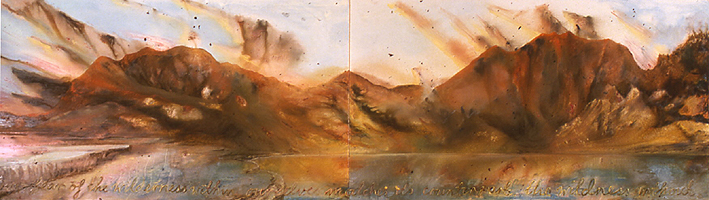
Mandy Martin, Salvator Rosa Series 5, 2003 .
In Australia the upper part of Australia (south western Queensland and north western South Australia is flooded from the tropical rains, whilst southern Australia bakes under unrelenting heat and is crying out rain. The water will not reach southern Australia because Lake Eyre--the so-called dead heart of Settler Australia -- is a sink hole. This huge dry salt lake below the sea level is bursting into life from the flood waters flowing into it from Coopers Creek and the Diamintina River.
As Ross says " nature is abundant, plenitudinous, beautiful."
I woud add 'and destructive.' Floods destroy as well as create. Moreover Southern Australia is filled with dread from the possibilities of bush fires. We are lucky so far. But conditions are conducive to raging bush fires that are out of control. We live our every day lives with death from fire caused by a lightening strike.
next previous
start
February 17, 2004
Steven David Ross Interview#6-2
With some understanding of the romantic sublime in Australia under our belt we can turn back to, and pick up on, our previous comments on the Stephen David Ross interview that was conducted by Rick over at Artrift.
In our previous post we were considering part six of Rick's interview which dealt with the relationship between art and beauty. In his remarks Ross distinquished between beauty and sublime: beauty was grand, fulfilling, proportionate, and complete,consummatory, fulfilling; the sublime was the unbounded, infinite, transfigurative, uncanny. Ross then goes on to give priority to beauty. He says:
"To Danto's suggestion that something can be art without being beautiful, I would say, more provocatively, there is beauty in art and nature and human life without being beautiful, without being complete, formed, and satisfying. There is beauty in downright ugly things and places. Indeed, recent art---and I hope, some recent philosophy---have shown that the two sides of beauty can be brought into a relation that is more beautiful, more generous, more disruptive, and more fulfilling than either alone. Here beauty is not one pole of a binary with the ugly or the sublime but beyond any binary, thereby calling every binary, every opposition into question."
Okay, you can have a middle ground between a duality. It was give a name here: ---the romantic sublime, or the moment of inspiration when someone sees beauty in what may have seemed a hostile landscape:

Mandy Martin,Salvator Rosa Series IV, 2002
Ross colonizes the middle ground with beauty. For him beauty becomes everything. He is quite explict on this. His conception of beauty is:
"...a beauty that displaces every boundary and separation. In this sense beauty is everywhere, everything is beautiful, everything is aesthetic, everything matters in its ways. And we may live so. And love so. It is also what I mean by ethics."
Beauty becomes infinite futue possiblities:
"What we do not know, have not yet experienced, what exceeds our expectations, is unfamiliar and strange, remains yet to come: this is beauty, is presented by art‑‑and just as frequently betrayed; it is also ethical, that to which we must answer‑‑other people, other experiences, possibilities yet to arrive; it is also political‑‑community, democracy, sociality, peace, ways of living that we do not know how to accomplish; and it is philosophical, epistemological‑‑ways of thinking, forms of truth, we have not begun to imagine."
Beauty can, and has, functioned as a form of critique that highlights the ugliness of the urban world. So ignores beyond form and opens up into the political. So beauty needs something to actualize itself. That something is ugliness.
When beauty becomes everything all tension and conflict within the artwork is lost. The Mandy Martin image is full of tension. There is beauty (colour and shape), and it is important to highlight the beauty, given all the colonial settler talk about the dead centre, this is a harsh landscape.
February 16, 2004
Mandy Martin & Romantic sublime
New worlds from old. It's one way to read the landscape. It involves looking to the aesthetics of the Old World to visually define the New--just like Conrad Martens and W.C. Piguenit:
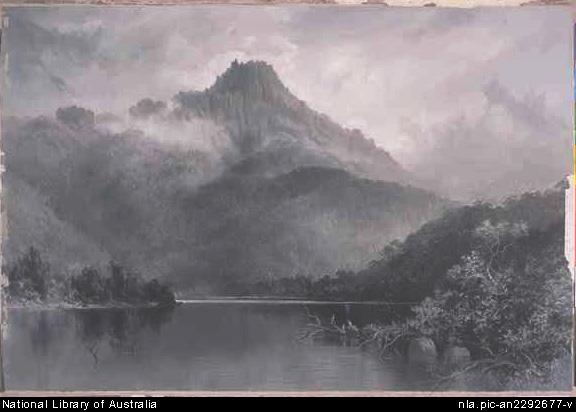
W.C. Piquenit, Mount King William from Lake George, Tasmania, 1887
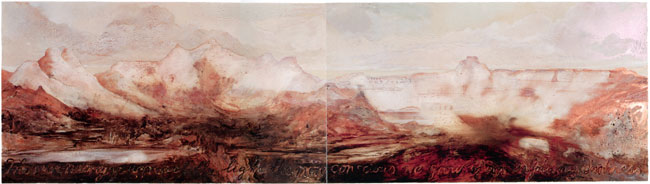
Mandy Martin The Pyramids, Salvator Rosa Series IV, 2002
This text on Martin refers to the category of the “romantic sublime”. This means the moment of inspiration when someone sees beauty in what may have seemed a hostile landscape. Often that is found in the vortex of clouds?
In aesthetic theory the sublime is contrasted with the picturesque (the small-scaled, elegantly balanced, and pleasingly irregular) and the beautiful (that which pleases through absolute harmony of proportion). The sublime was usually associated with limitlessness and grandeur, even terror, and with overpowering awe. Edmund Burke called the sublime "productive of the strongest emotion which the mind is capable of feeling."
In this tradition the Australian landscape dramatically embodied the sublime.It can be contrasted with the imperial gaze of the colonial settlers: an objective representation characterized by the singularity of viewpoint or trig point or compass reading and the formal geometries of perspective and cartography. From this 'imperial gaze' comes the apparatus of occupation: the survey, the map, the leasehold and the fenceline.
February 15, 2004
Romanticism & the sublime
In aesthetics the category of the sublime is an important one for the representation of the Australian landscape. It enables us to make sense of the harshness of the landscape; a menace of nothingness that threatens death. The sublime refers to the endless desert, the white heat and death by thirst. This conception of the sublime is very pervasive in colonial settler discourse, where has historically been contrasted with the lovely, soft green English garden in the civilized cities. (More here on the sublime in Australian cinema.)
In his 'A Philosophical Enquiry into the Origin of Our Ideas of the Sublime and Beautiful' (1757) Edmund Burke equates the sublime with astonishment, fear, pain, roughness, and obscurity and the beautiful with a set of opposite qualities (calmness, safety, smoothness, clarity, and the like). With the romantics the sublime becomes associated with the turbulent chaos of mountain behind mountain, rolled in confusion; dark rocky crags that impede ones way; Alpine precipices etc:

Turner, The Passage of the St Gothard, 1804
The sublime referred to awe-inspiring works of nature such as the cataract, avalanches, volcanoes, black jungles full of wild beasts and earthquakes. It was linked to the appalling or the horrible that threatened to overwhelm human beings. The colonial settlers put new content into the sublime as the awesome power of nature.
In exploring the romantic pictorial conventions in Australia Mandy Martin reworks the pictorial convention of the sublime. It's no longer the European dark and gloomy one found in Salvator Rosa (also here.)
The sublime in Australia is lighter and much more light filled:

Mandy Martin, Horizons of Expectation, Salvator Rosa Series 2----1999.
Major Mitchell's explorations in Queensland involved, and evoked, colonial settler dreams of conquering the vast inland space. Settlers are emigrant with little hope of returning home. Their narrative is one of displacement and traumatic severance from their home. They project their expectations into the future. Mitchell's explorations were an early version of 'on the road again' heading for the unknown. Hopefully, they will find El Dorado.
And:

Mandy Martin, Passage, Salvator Rosa Series 111-----2000.
There is little hint of the technological sublime in this romanticism. Technology has yet to join, and supplant, nature as the source of the sublime.
When it does it becomes the sublime becomes technology out of control: a Frankenstein.
February 14, 2004
Romanticism as spectator
Whilst returning to Adelaide I read somewhere in Adorno's Aesthetic Theory that romanticism has decayed.
Has romanticism decayed? Well, it depends on what we meant by romanticism.
If we go back to Nietzsche and his conflicts with Wagner, we find that romanticism is identified with the celebration of life's poverty. In the nineteenth century the content of romantic art was unrequited love, longing for death; martyrdom; a focus on live's miseries and provide redemptive rewards for those who experience them. Romanticism is all about describing the scorned lover's misery and pain to express the pain and his tortured feelings. The scorned lover then becomes a martyr to love and an apologist to suffering.
That romanticism has surely decayed.
Here is an example of some contemporary romanticism in Australian visual culture:

Mandy Martin, After Salvator Rosa, Landscape with a Mill Salvator Rosa series IV, 2002
This is both a looking back and a reworking visual conventions:

Salvator Rosa, Landscape with Tobias and the Angel, circa 1660-73
It is another kind of romanticism. Is it a form of a nostalgia for a lost past--a lost wilderness? That is what romanticism is now seen as.
The Martin image is about the Australian present---a certain kind of wilderness. And there is an unease and tension in the image.
Does that unease mean the work of Mandy Martin is unable to resist pandering to the `system of illusions' of capitalist consumerism, and so her images lapse into premature reconciliation with the status quo?
Does that unease mean that Romanticism is an ineffectual spectator in modernity, uttering literary and painterly laments without socioeconomic force—the Cassandra of modernity?
If it is an unease, then what is the nature of this romanticism's relation to modernity?
Is it a dialectical one?
So many questions, so few answers.
February 12, 2004
Romanticism & empire
I've been on the road and the computer system in Canberra has been down for two days. So there is little blogging. I will continue with the work of Mandy Martin in the Salvator Rosa section of the Carnarvon National Park in south west Queensland:
First a photography of the park.
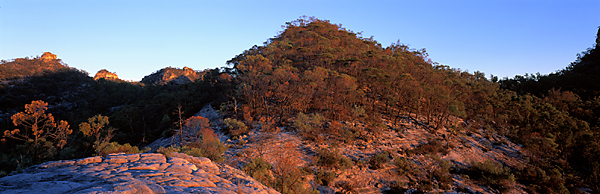
Mark nemeth, Early morning light on an unnamed knoll near Sentinel Bluff, Salvator Rosa
Then a painting by Mandy Martin:
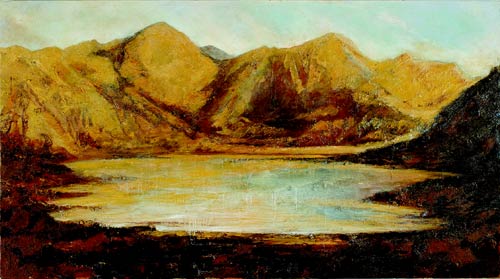
Mandy Martin Omnus Inclusum, Salvator Rosa series IV 2002
Is this a romanticism that has not degenerated into sterility? Martin is exploring the visually connections between S.T.Mitchell’s association between this place in Australia and the 17th century Italian artist.
I haven't read Major Thomas Mitchell's journal. From my googling I understand that he explored the western area of Queensland in 1845 as part of a search for a route from Sydney to the Gulf of Carpentaria. This part of Queensland is a very low rainfall belt in the Salvator Rosa National Park. Major Mitchell dragged horses and carts through it and he spoke of the hills in the distance. He called them the Salvator Rosa hills because they reminded him of the works of the painter of that name.
Did Mitchell have something like this in mind?

Salvator Rosa, River Landscape with Apollo and the Cumean Sibyl
Rosa's landscapes are moody evocations of the sea and mountain and they stand in stark contrast to the classically calm, sublime landscapes of Claude Lorrain, for example. Accordingly, Rosa is considered a precursor and exemplar for the Romantic-era Anglo-Saxon landscape painting in the late 18th and 19th centuries.
By the 1840s Australia was part of the imperial core and periphery of the British empire. Australia was the periphery and Mitchell stood at the beginning of the hsitory of imperial colonisation in Australia. Mitchell's 'exploration' ideology (eg. that of the 1800s) was designed to foster Australia's development of trade and commercial links within this region. Mitchell the explorer was the precursor to the extension of pastoralism and the development of natural resources.
Within the core and periphery of empire Romanticism has been prrimarily defined through its relationship to the modernizing core. It was a quest for otherness to the cash nexus and instrumental reason of industrial capitalism; an otherness in the form of troubling quest for criticism in the name of pre-modern values.
February 10, 2004
on the road to....
I'm on the road for a few days. I will be in Canberra. So posting will probably be light. Hopefully I will be to post. What I've decided to do is explore the work of Mandy Martin whilst I'm on the road. I can post bits as part of a little series.

Mandy Martin,Landscape with Fisherman after Salvator Rosa, 2002, From the Salvator Rosa Series
A renewed romanticism that highlights the extraordinary features of landscapes -- chasms, precipices and rocky prominences ---of the Salvator Rosa section of the Carnarvon National Park in South West Queensland:

Mark Nemeth, Salvator Rosa Sunrise
The park was so named after the 17th century Italian history painter because of its rugged and gothic features, by the explorer Sir Thomas Mitchell in 1848.
Mitchell is probably referring to Rosa's innovative, rugged landscapes rather than the religious or historical subjects of his history painting. Is the reference to the craggy sandstone outcrops?
In the park the spring-fed Nogoa River and Louisa Creek wind through a picturesque broad valley beneath the craggy sandstone outcrops in the Salvator Rosa Section of Carnarvon National Park. At the western edge of central Queensland’s sandstone belt, Salvator Rosa contains deeply eroded and spectacular rock formations, such as Spyglass Peak and the Sentinel, which dominate the skyline. Were these rock formations what reminded Mitchell of Salvator Rosa's landscapes? Such as:

Salvator Rosa, Bandits on a Rocky Coast,
It would not have been the eucalypt woodland and open forest, which covers most of the park; or the spectacular wildflower displays in spring, or the 10 of the park’s recorded 300 plant species being rare or threatened.
Another example of the work of Rosa:

Salvator Rosa, Harbour with Ruins, 1640-43
These two paintings are a long way from the Salvator Rosa section of the Carnarvon National Park in South West Queensland. Mitchell was seeing the Australian landscape through the visual conventions of the romantic eye. Deploying this convention was the colonial way to make the new, comprehensible to eyes unfamiliar with these strange landscapes. This form of nostalgia for the European home became a way to connect the old European world with the new Australian world.
Martin is revisiting this way of seeing:

Mandy Martin, This Eldorado of pure recognition and desert of pure non-recognition, Salvador Rosa Series 1---1998
She is exploring the way romanticism has contributed to our visual culture. The key category is the sublime, which is recoded in Australia as a remote and rugged wilderness.
February 8, 2004
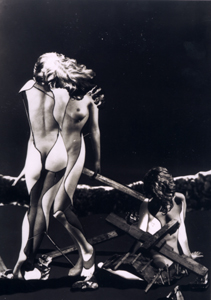
I'm struggling to find work by this Belgian surrealist photographer to read it against the grain of the decayed (Greenbergian) formalist modernism of traditional art history with its presupposition "significant form," "the autonomy of the work of art," "pure visuality," "transcendence," the quest for "the essential," etc. That understanding of modernism would highlight ths:
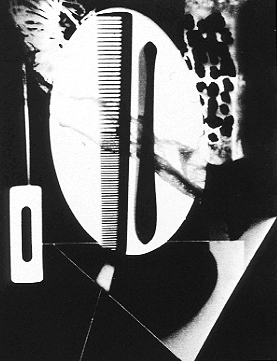
Man Ray, Rayogram
I want to see if I can interpret this photography in terms of what is debased, abject, formless: the shift from "from the sky above to the mud below" and the loss of meaning and descent into chaos that this shift entails. Hence we have the return of the repressed" in an economy of excess, overflow and unreason: what Bataille has termed "expenditure without reserve."
Why this path of base materialism? To avoid the common type of "postmodern" discourse on the arts.
February 7, 2004
surrealism & photography
Photography is rarely mentioned in the art history books on surrealism. These have focused primarily on painting and drawing. Few question this interpretation as surrealism and photography do seem to be incompatible.
Surrealism and photography do seem to make strange bedfellows. The former, springing from Dada and Freud's descriptions of the subconscious mind and inner, subjective life, is otherwise to a photography rooted in the visible, material world. And surrealism was also deeply critical of the camera as a mirror of the world that records a moment of reality as it appeared.
This view was challenged by the major exhibition L'Amour Fou: Photography and Surrealism (Abbeville Press, 1985, curated with catalogues she curated and produced catalogues by Jane Livingston and Rosalind Krauss. This text concentrated on the constructed nature of surrealist photography----ie., those made by surrealist artists such as Man Ray.
Photography could be used to express the unconscious, intoxications/hallucinations and the dreams of the city of interwar Paris. A classic example is Atget's photos of the streets of Paris.

This image of corsets in shop window can be given a surreal interpretation.
This interpretation would focus on the bizarre or the strangeness of the image.
It is in the strangeness of the subject matter----the corsets---- as obects of repressed desire that the moment of ‘surreality’ lies.
It is not necessarily in the effect of the constructed photo of the visual artist.
That strangeness of subject matter can also be highlighted by situating Atget's photographs in surrealist texts; or through a surrealist editing process which juxtaposes his images in a meaningful way.
There was a wide range of photographic material in surrealist journals beyond the standard appropriation of the work of Atget, eg:

Jacques Andre Boiffard, Untitled, Big Toe series, for Documents, 1929
So surrealism in photography exists. You could make an argument to wrest attention away from painting (and Breton) and towards photography (and Bataille.
Two more examples from the constructed strand of surrealist photography:

Andre Kertesz, Distortion #88, 1933
The distorting perspective challenges the dominant understanding of straight photography as a window on the world.
And then this:

Dora Maar, Portrait of Pere Ubu, 1936
February 5, 2004
bodies
The body is a central part of the aesthetic. The aesthetic is commonly seen as a discourse about the [Platonic] beauty of high art. However, it is, in many ways, a discourse of the body, of the whole region of human perception and sensation; a discourse about our lived embodied sensate life.
The body in aesthetic discourse is seen as a constellation of pleasures and pains. It's movements are determined by desires, instincts, and appetites. Written and visual language traces this constellation by following the perpetually arcing trajectories of sensation. Language invests these trajectories with the energy of words and brings all these perverse entanglements to the surface, and revels in their ecstatic excretion.
In many ways the aesthetic is a rebellion against the rational scientific enlightenment, the valorization of systematic theory, and the focus on the mind.
This rebellion is marked by de Sade and then continued by Bataille, Genet, Klossowski, and Artaud. Here language sings the glory and pain of the polymorphously perverse. The upright body of the language of the liberal Enlightenment is penetrated from behind, and gives birth to all kinds of monstrous offspring.
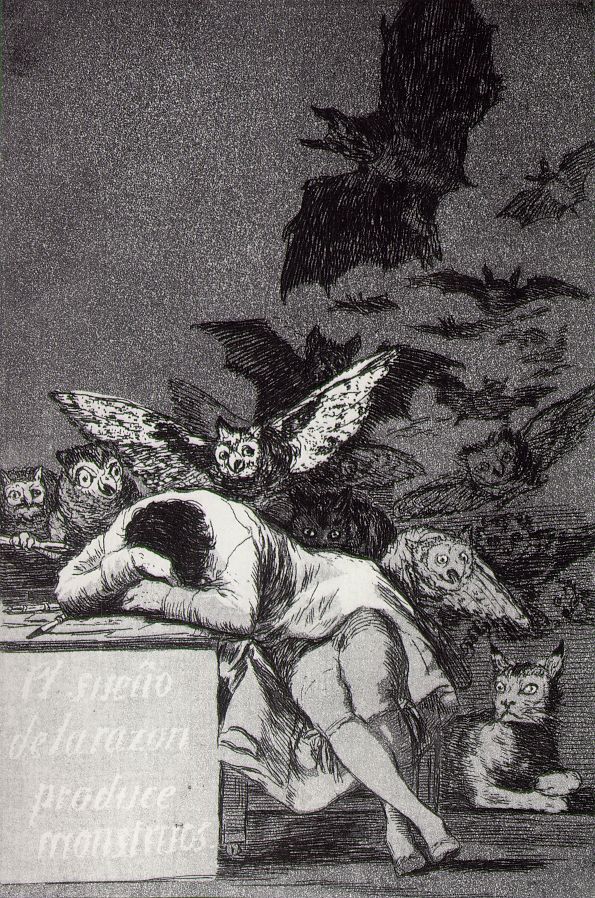
Goya, The Sleep of Reason produces Monsters, 1797-98, Plate 43 of The Caprices (Los Caprichos)
Goya was a follower of the Enlightenment and so the artist saw reason as an important means to demolish the 'monsters.' However, he was also strongly interested in superstitions about witches and demons, a popular belief among the Spanish folk, and was almost engulfed by the uncontrollable dark fantasies in his very mind. The horrific images of the Black Paintings were created a during the period when the restored Spanish monarchy brought a new wave of repression after the defeat of Napoleon. Goya gave expression to, the dark side of society.
The Spanish word 'sueno’ can mean either ‘sleep’ or ‘dream’. So the fearful monsters are created either by the absence of reason, or by an ‘unconscious’ desire of reason itself. Goya subtitled the piece "Imagination abandoned by reason produces impossible monsters; united with her, she is the mother of the arts."
For liberal conservatives Goya's image is fairly straightforward. It means something along the lines of Marxism producing the fearful monster communism and the gulag; and then the monster of rebellious postmodernism of today.
In contrast, the body language of the aesthetic rebelling againstt the instrumental reason of the Enlightenment means that the body is no longer an organic unity. The body becomes a set of different erogenous zones between which pleasure and pain flash, transmitting impersonal affects and sensations. You can see this exploration of these erogenous bodily zones in some of the sexblogs
As the Art and Culture Network says, in the literature of transgression:
"Language is no longer easily distinguishable from a scream or a cry; the power of the inarticulate inheres within it. All signs become duplicitous, marking at once a sensation and a meaning, an affect and an idea. What emerges is a language of the flesh, a language of the cut and the caress, a language that flows in streams of blood, urine, semen, and saliva."
The signs of this language are no longer a transparent medium of communication as they are for instrumental reason. Rather, in this aesthetic discourse, the words and images cry out in pain and in pleasure and they become visceral thresholds and expressions of sensation.
February 4, 2004
La Fura dels Baus XXX: shock, sex and the internet
This piece picks up on the earlier post on Bataille, the cinema, shocking the audience through the body and transgression.
The news reports say that the Spanish experimental theatre company, La Fura dels Baus's old multimedia show XXX is in Australia. It will open in Melbourne after a season in England. The group's name translates roughly as "the fury from the sewer" and the group describes itself as "detonator(s) of the urban situation". Very Bataillian.
XXX is sexually explicit.

La Fura dels Baus has designed XXX to shock the audience. Hence the nudity on display in XXX, the simulated sex and a live internet link to a porn movie from a porn site projected onto the back screen.

A description of the show can be found here.

Hannu Harju, a theatre critic in Helsinki, says that:
"The performances describe different types of dystopias and extreme situations in human life. People turn against one another, and killings and violence are everyday events. The performances tread the field of primitive instincts. A central role is played by masculine testosterone, an aggressive release of energy."
We Australians should be comfortable with that, given that Europe saw Australia as dystopa and Australia began as a penal colony for Britain's rejected.
The sensory overload tactics in their work are used for a reason. The XXX show is designed to highlight society's hypocrisy over people's involvement with internet sex. The company's music director and founding member, Miki Espuma said:
"We were really shocked when we started our research to discover that 80 per cent of the internet is about sex... But no one talks about this, even though no one can avoid sex on the net. So we decided to take the bull by the horns and put it all on the stage....We want people who come to our shows to leave shaken to their core. We want them to be thinking about the way society operates as a narcissistic screen culture."
The technique of sensorial bombardment of the audience is used to shock people into bodily feeling.
The audience is confronted with the full gamut of sexual practices.

It is hoped that the assault of XXX on their bodies will lead to an awareness that the internet is being swamped with porn and to reflect on sexuality in our culture.
No doubt the tabloids will be outraged as will the family value groups. After all, XXX is based around the Marquis de Sade's Philosophy in the Boudoir.
More is ethically involved than a concern about porn going mainstream. We live a cultural when sex is seen to be dirty, bad and outrageous---witness all the fuss made about Janet Jackson's exposed left breast at Super Bowl----yet we are bombarded daily with images of violence, terror and death on free-to air television in the living room. The latter is tacitly accepted as wholesome family viewing but not the former. As DWD points out over at Just One Bite violence was involved in exposing the Jackson's breast to public view. As she says:
"I hope that the next time a female nipple is shown on network TV, it's because a smart, successful woman opens her own clothes and proudly bares it, rather than a staged scenario where a creep like Justin "rips" her top. Bravo, CBS. Nude female breasts are verboten, but apparently they're a little more palatable as long as their revelation involves an act of assault."
Itds the bare breas that is the cause of the fuss not the act of assault.
Our mainstream consumer culture is outraged by the exposed breast but not violence by the man. It is a strange conception of what is right and wrong, don't you think?
February 3, 2004
Franz Marc: beyond harmonious form
I'm tired of reading texts.
So an image from German expressionism to seduce the wearied eye.
An image by Franz Marc for the eye to wander over the surfaces and take delight in the play of colour.

Franz Marc, Fighting Forms, 1914 Links
For Marc appearances suggest something more beyond themselves. The phrase 'something more beyond themselves" is usually meant to mean that the abstract forms convey spiritual experiences.
The art history texts link this to German idealist philosophy. So behind appearances stands the reality of spirit.
Intrigued I ask: What does spirit mean? Which philosopher? Which texts? Which ideas?
The art historians leave it at that gesture. They always do. They quickly return to talking about the beauty of the harmonious arrangement of distinct forms; swirling colors; style of representation, spatial illusion, and so on.
Ratrely do they connect the tensions within the work of art giving expression to tensions in society. Exploring social mediation as tendencies in the art work, or the truth content of what is expressed, is just not their style.
Heres a bit of Adorno as a contrast:
"The process that occurs in art works and which is arrested in them has to be conceived as being the same as the social processes surrounding them. In Leibnizian terminology, they represent this process is a windowless fashion....All that artworks do or bring forth has its latent model in social production."
Artworks as windowless monads.
To ask questions about social mediation for Adorno is to ask about the structure of the autonomous artwork as a social monad, whose internal processes brings forth the social processes surround it.
We might find artworks as windowless monads problematic. That's fair enough. It's a diffciult concept. But at least we have stepped away from just talking about the 'harmonious arrangement of distinct forms' in a Platonic world.
February 2, 2004
Bataille & Cinema
There is a post on the eye in the Dali and Brunel film Un Chien Andalou (1928)over at philosophical conversations. After writing it I went back to what Bataille had written about the film in his text, 'Eye' (reprinted in Visions of Excess)
In the footnotes Bataille writes:
"This film can be distinguished from banal avant-garde productions, with which one might be tempted to confuse it, in that the screenplay predominates. Several very explicit facts appear in successive order, without logical connection it is true, but penetrating so far into horror that spectators are caught up as directly as they are in adventure films. Caught up and even precisely caught by the throat, and without artifice; do these spectators know, in fact, where they-the authors of this film, or people like them-will stop? If Bunuel himself, after the filming of the split-open eye, remained sick for a week . . . how then can one not see to what extent horror becomes fascinating, and how it alone is brutal enough to break everything that stifles?" (Visions p.19)
Bataille judges Un Chien Andalou to be a powerful film because the bodily sensations it evokes in its creator and its spectators breaks what stifles the audience and makes us complacent. The sliced-open eyeball and the fragmentary, illogical cuts of Un Chien Andalou disrupt this complacency by causing felt bodily sensations of fear and disgust in us. The opening scenes of Un Chien Andalou makes us cringe, look away, perhaps even vomit.
The violent disturbance to the ordinary, habitual way of sight. Does that then lead to the pure visionary wonder of childhood-----the romantic's innocent eye---of a Paul Klee?
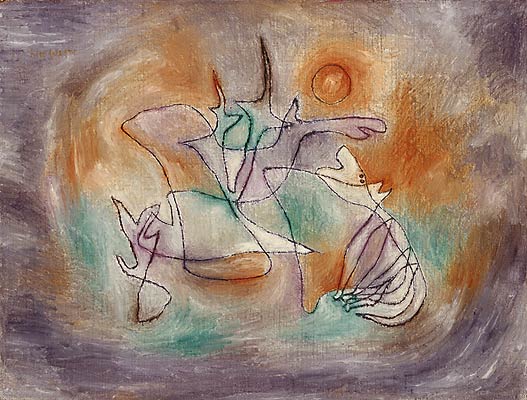
Pau Klee, Howling Dog, 1928
With Bataille we have left the world of the disembodied mind of modern philosophy, and are now in the world of bodily sensations that leads to loss of self.
Can we make use of Bataille idea's to understand cinema?
February 1, 2004
surrealism & rock
I lost the plot yesterday when I was going back through my back pages to where I'd once been. That was a time when popular music seemed to burst with cultural possibility. I was going back to where I'd been many years ago; a point in time when the 1968er's fed their head, and reckoned they were going to change the world. I've moved away, but many of the rock declinists have devoted some time to figuring out how they could have got it so wrong.
On this cultural journey through yesterday to recover my childish things, I wore the hat of a rock critic disenchanted with rock; one whose aesthetic roots lay in Kant, Hegel and Adorno. This perspective approaches popular music as both a tradition and an industry; and as both a way of entertainment and a way of art.
In the afternoon I became caught up in exploring 'art works' in the pop music industry, the role of the avant garde in a rock music and the commercial and intellectual vacuum of the industry. The conventional rock terms for my aesthetic concerns are 'underground music' and 'mainstream music' that stands resolutely opposed to the crudities of the pessimistic cultural theoriests.
These terms of 'underground' and 'mainstream' sit comfortably in an way of thinking that holds rock music is proudly popular music, is progressive and of the people; whilst painting, as a high art is conservative and despised. Underneath this habitual mode of thinking sits a Nietzschean narrative of Dionysist rock versus Apollonian" pop, with rock as the triumphal stage (historical end point?) in the evolution of popular music.
Did the surrealist movement become a part of the innovative rock music that transgressed the boundaries of the conventional pop song? In rock music excess was generally associated with the rock lifestyle, not the musical form or composition.
Composition in rock music? Rock was about monster riffs and showmanship a la the Rolling Stones. And lipstick traces.
In a nostalgic mood in the afternoon, I wandered the empty city streets pulsating with the moral apocalypse. I made my way to the bookshops in the city, looking for books on the history of rock/pop music to help me recover my past. Alas, most books on the subject I came across were either books about the music industry, or individual musicians with the better ones giving a national interpretation of the history of rock music.
I found nothing I was looking for. So I ordered Lester Bangs' Psychotic Reactions and Carburetor Dung; a reader, edited by Greil Marcus. I didn't know about the latter Mainlines, Blood Feasts, and Bad Taste: A Lester Bangs Reader (edited by John Morthland) this afternoon. Why Lester Bangs? Lester clicked to what Beefheart did to musical form, and did with ensemble improvisation.
My memory said surrealism in rock = Captain Beefheart and the Magic Band. I remembered I once owned Safe As Milk; or was it The Spotlight Kid? Maybe both. The covers look familar. After much searching and listening I judged that Trout Mask Replica is the classic example of the surrealist avant garde in rock music.
I walked back to the inner city apartment hear bits and pieces of old songs floating out from AM and FM radio in the shops and cars. I was acutely aware of the threatening, but veiled presence, of the law and order machine responding to the felt nihilism of the moral apocalypse.
I thought about whether I could play the Trout Mask Replica. Suzanne finds even the simmering flowing and exploding lines of The Grateful Dead's innovative Live/Dead pretty inaccessible, distorting and alienating. Music that straddles the border between blues, jazz, rock and classical music is going to sound like the sound track from hell on Sunday mornings. Honestly, I have no hope of selling this musical language that violently questions received western notions of harmony.
Captain Beefheart gave up making music in the early 80's and turned to painting in the Mojave Desert:

Don Van Vliet, Last Of A Dying Breed, 1982
The image is more abstract than surreal. Its very painterly, and though produced by West Coast hermit, it is linked to the abstract expressionism in New York.
The surrealism was in the music. In his History of Rock Music Piero Scaruffi pinpoints this. He says:
"If the rest of rock music put its heart into music, Van Vliet put his mind into it, but not the rational mind, rather the instinctive and primordial one, the mind torn to pieces by the frustrations and the contradictions of modern society, the mind of the collective subconscious that expresses itself in twitches, growls, roars and howls, like an animal in a cage."
You get a hit of this expressionism in this painting:

Don Van Vliet, Check Bif, 1986
Piero then introduces surealism. Captain Beefheart, he says, achieved:
"...the musical equivalent of a frightful visual deformation, a sort of demented exaggeration of the artistic dogmas of surrealism, Dadaism and cubism.
In order to realize that crazy deformation, that spatial-temporal warping, that apocalyptic and blasphemous perspective, Van Vliet exploited his outrageous vocal versatility that allowed him to impersonate all kinds of different and extreme characters in a subliminal performance of schizophrenia, often within the same piece, and to visit states of psychic depression and hallucination with all the grace of a charging rhinoceros."
Beefheart is the musical equivalent of surrealism in the visual arts.