January 30, 2004
Dali's shitty pants
I've been caught up this last day or so with exploring the visual turn in our culture over at philosophical conversations.
I noticed that when Jacques Derrida was here in Australia for the Sydney Seminars in 1999 (called Deconstruction Engaged) the issue of the suspicion of vision was briefly raised as part of developing a critical relation to visual culture.
Junk for Code is part of, and reflects, the visual turn in its exploration of our visual culture.
In these explorations I noted the visionary model of artistic creation favoured by romanticism. With the surrealists this inner eye signified the expression of the imagination as revealed in dreams, free of the conscious control of reason.
I came across this surrealist image by Salvador Dali:

Dali,The Lugubrious Game, 1929
Dali is everywhere in this image. Surrealism allowed Dali to portray his own life, his obsessions and sexual trauma in his works. So I presume the above image is all about Dali's unconscious or dream world.
Dali cultivated genuine delusion (as in clinical paranoia), whilst remaining residually aware at the back of his mind that the control of the reason and will has been deliberately suspended.
On another level, surrealsim was about the personally repressed being shouted aloud. For surrealists like Dali sexual explicitness was designed to shock the bourgeoisie. Apparently, the Lugubrious Game was found to be disturbing: a terror image; a "terror picture" about castration and enucleation.
It doesn't shock me. It actually bores me.
The shit-stained pants in the bottom right is a Bataillian gesture that would have upset Andre Breton, who loathed Bataille's embrace of filth, excrement and animality. It helped to create a fissure within surrealism between the Breton and Bataille groups. Breton, who identified the aesthetic with beauty, actually excommunicated a number of visual arts (eg., Andre Mason) who gravitated to Bataille's orbit.
I'm hard put to see the link between the romantic inner visionary eye, transgressive sexuality and the eye as a target of mutilation and scorn in Dali's image. I'm also hard put to see this Dali image as part of an anti-visual discourse.
January 29, 2004
getting away
Often I feel like getting away from it all. Going back to wilderness.

Arthur Ollman, Untitled, 1978
You know the feeling. It's the one the 4 wheel drive adverts on television appeal to, and then turn into the rugged middle class man (& family) bashing the bush to escape from the city and whatever it is that is eating him up inside.
The seaside equivalent is the wave bashing jet ski driven by single men who get high on machine noise.
January 28, 2004
Once upon a time
This is what Mars looks like from the Opportunity's mother ship:

Looks like an old river channel does it not?
Hence the fascination with Mars. We know that Mars today is a hostile world, blanketed in toxic soil and zapped with radiation.
This is the landscape close up after the Opportunity Rover had landed on the surface of Mars:

It is from within a small crater on Meridiani Planum Mars.
It is looking up the side of the crater?
January 27, 2004
Steven D. Ross Interview:#6-1
In picking up on the Stephen David Ross interview conducted by Rick over at Artrift, I had difficulty with the tight link between art and beauty that I discerned, even though I have no desire to place a ban on the category of the beautiful in aesthetics.
I suspected that Ross' aesthetics had identified or equated the two. That troubled me as 'art as beauty' would not have made sense of Dada; the ugliness of Goya (eg., the Black Paintings) or the sublime that I previously connected with historical human suffering.
In the sixth part of the interview Rick raises the relationship between art and beauty. Rick asks:
"You wrote a book titled, ‘The Gift of Beauty:The Good as Art” at a time (1996) when the relationship between beauty and art had already become questionable and, in many cases, had simply dissolved or was of little interest to many artists. Do you agree that art and beauty have, to a significant degree, parted ways in the last ninety years or so? Or, is the situation more in line with Agnes Martin’s thought that all art is about beauty even when it is not about beauty; that when it is not about beauty, it is a response to the lack of beauty in the world?"
Good question.
This is how Ross responds by linking beauty to the sublime:
"Beauty has always been interpreted in the two ways I described: as consummatory, fulfilling, and as transfigurative, excessive. Even to the Greeks, and in other cultures as well, there have always been a sense of beauty closer to the grand, fulfilling, proportionate, and complete, and another closer to the unbounded, infinite, transfigurative, uncanny. Sometimes these have been described in terms of the beautiful and the sublime. Sometimes they have been understood to pertain to art, aesthetics, and beauty in unclassifiable ways. One reason is that the discourse and experience of art is frequently beyond words, beyond categories, a secular expression of infinity. So one might employ Levinas's terms: a sense of beauty in being much closer to totality, and a sense of beauty beyond being, excessive, closer to infinity. Infinity here is beyond comprehension, intelligibility, classification, and sensibility. The point is that art and aesthetics and sometimes nature present us with experiences beyond our ability to know and to grasp them. And yet we can grasp and know and experience that."
I accept Ross' understand of beauty as "the grand, fulfilling, proportionate, and complete" and the sublime as "the unbounded, infinite, transfigurative, uncanny." But should beauty and the sublime be considered separate aesthetic categories? Kant, for instance, set the sublime apart from art, located it in nature and described the feeling of the sublime as a trembling sensation of the subject caught between nature and freedom.
Why can we not transplant the sublime into the art world? The sublime becomes a a historical constituent of art after Kant. Can we not redescribe the sublime as art works that quake and vibrate and transgress what is taboo. What is then etched into the sublime is the awesomeness of domination and power. With the idea of historical tremor we have moved a long way from the formally beautiful.
And what has happened to the ugly as an aesthetic category?:

Goya, Old People Eating, The Black Paintings, circa 1820
To understand the beautiful don't you need the ugly? It's a Hegelian point --to know what something is you need to understand how it defined by what it is not.
Was not a lot of cultural product of earlier civilizations----what the modern art institution now calls art---about religion, myth, dread, sex, death?
January 26, 2004
Mediascape
Is this a postmodernist space that we inhabit?
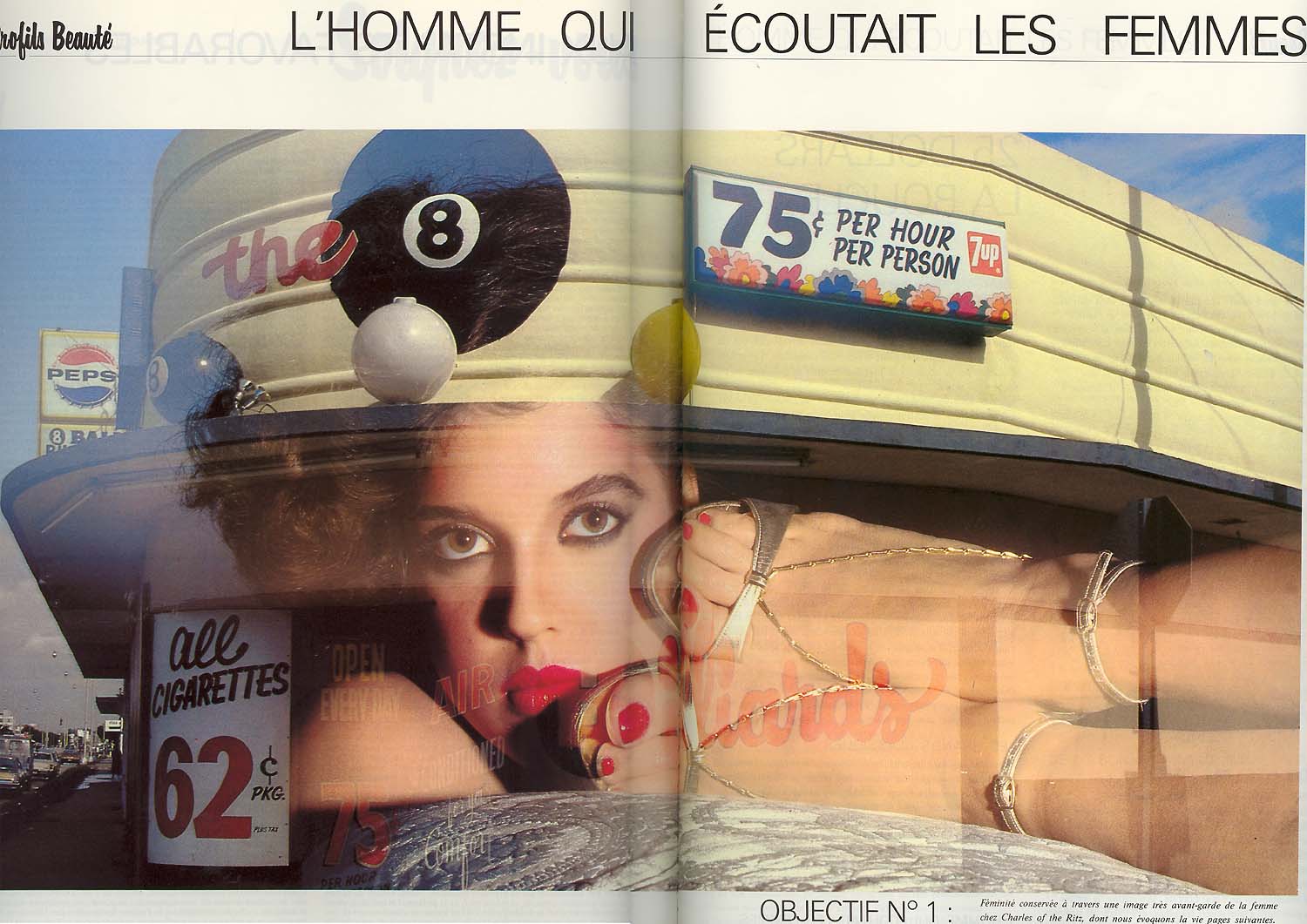
Is this a world without guarantees now that the master narratives have collapsed under their own weight, gone underground and become part of our political unconscious?
The idea of a mediascape means that we live within or inhabit a world of visual signs that enframe our world. These signs are not only in books, films, exhibitions or television. They are also on the billboards as we walk or drive around around the city.
Often we are not conscious of these signs. Nor do we stop to read them critically read them as we would a newspaper or television. But they effect us and they help shape our visual culture.
Most of the emphasis in cultural studies in the university has been in overcoming the old modernist division betwen high and low culture, and highlighting the active and critical way we read the signs produced by the cultural industry. As Jean Burgess over at Creativity Machine says in describing her PhD project:
"Mass culture theory, whose influence persists, attributes little agency, creativity, or even individuality to the “consumers” who are held to be the receivers of a standardized and homogenous mass-popular culture. Even in cultural studies, theories of the popular in relation to media (with the previously mentioned exception of fan culture, and also gaming) are predicated on a divide between the production of content and its eventual consumption—however “active” that consumption is thought to be."
So a cultural studies theorist such as Catherine Lumby would contest cultural elitism and its traditional demonising of mass culture; give an account of the reader's interpretation of the art object (eg., ethical conflicts in reality TV); and argue that today's products of the culture industry (eg.,reality TV) is the heir of Shakespeare, that popular Elizabethean bard.
Two quick points. First, after rejecting the old cultural lament about the evil effects of "popular culture", criticism in cultural studies becomes an act of reading by divided and unstable subjects, who seek aesthetic enjoyment in the signs produced by the culture industry. This aesthetic hedonism takes a subjectivist approach, which locates aesthetic quality in the effect a work of art has on the viewer, rather than in the artistic object. However, the cultural studies assumption that reception is everything is questionable, as there is more to the culture industry that what effect it has on people as reading consumers.
Secondly, though we do need to learn our way around the new mediascape of consumer culture we should question we should remember the truth content of a work of art in the process: what is true and false in what it says:
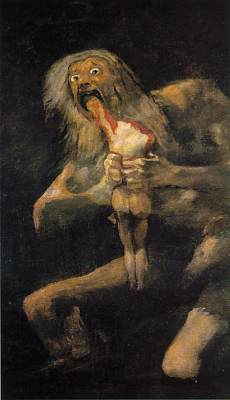
Goya, Saturn [devouring his sons] from the Black Paintings, circa 1820
January 25, 2004
Helmut Newton: remembered
The news is carrying reports that Helmut Newton is dead. He died from a heart attack whilst driving.
His work has appeared on junk for code here and here and here and here. Quite a lot in fact. There has also been a discussion of Newton's work in relation to Bataille over at philosophical conversations for those interested in such things.
Newton was primarily a fashion photographer. with a strong graphic sensibility:
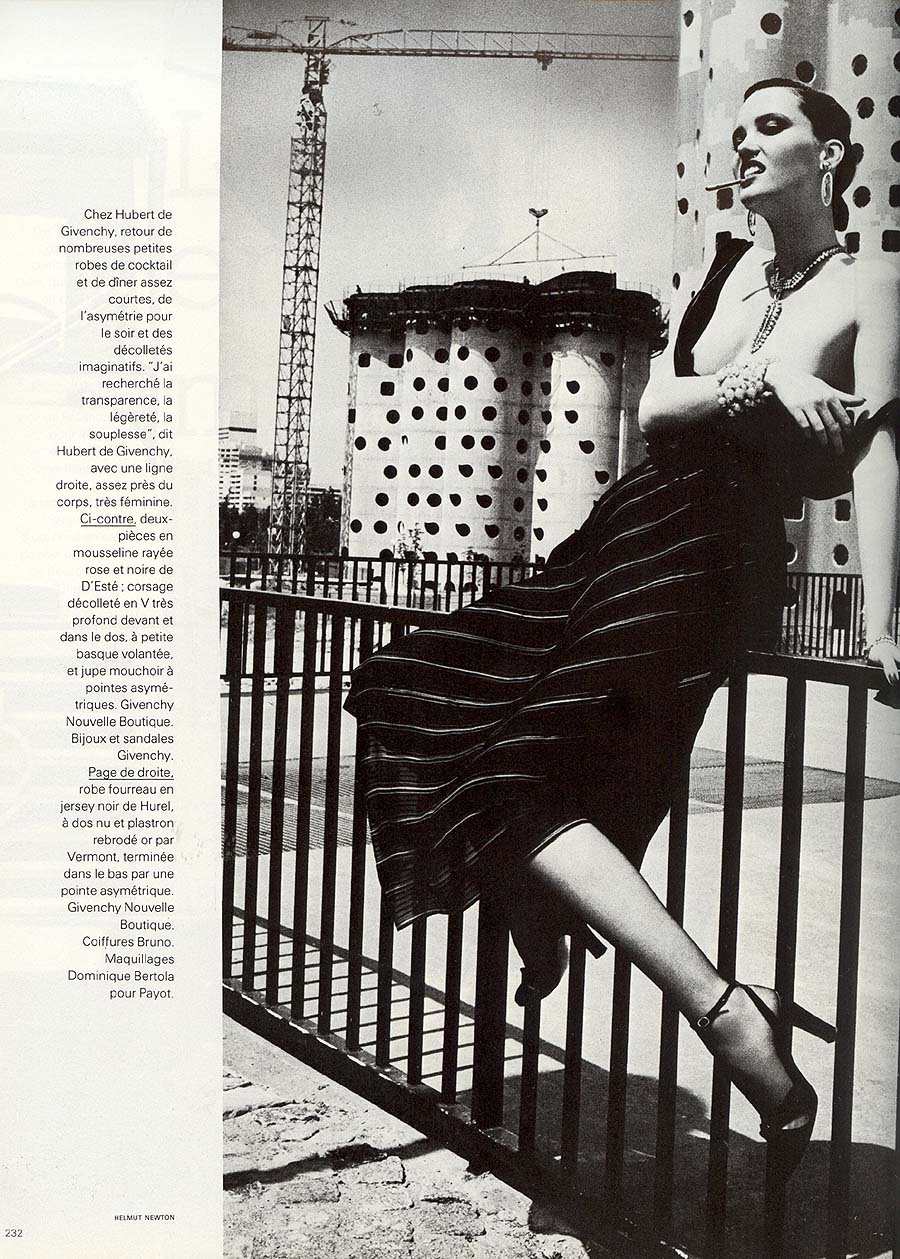
Paris Vogue, August , 1978
But he was an interesting fashion photographer. Consider this shot from Paris Vogue, March 1979:

That turns things around, does it not?
Newton explored the nexus between power, gender roles and sexuality in his fashion photography, as in this 1975 shot for Yves St Laurent:
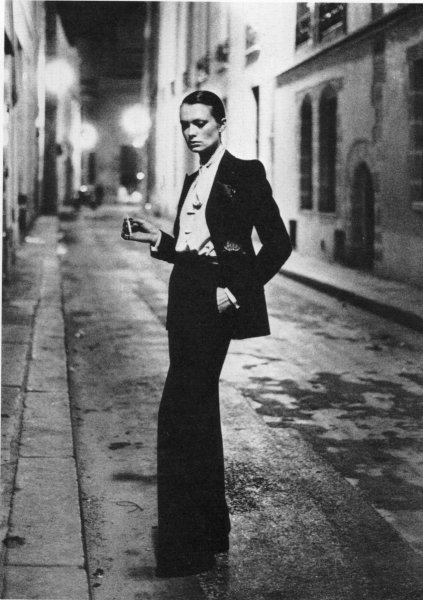
and in this shot:

ParisVogue, March, 1979
Newton turned high fashion into a form of erotica.
In exposing the way sexuality is transformed into power Newton transgressed the beyond the boundaries of fashion photography,
January 24, 2004
beauty in ugliness
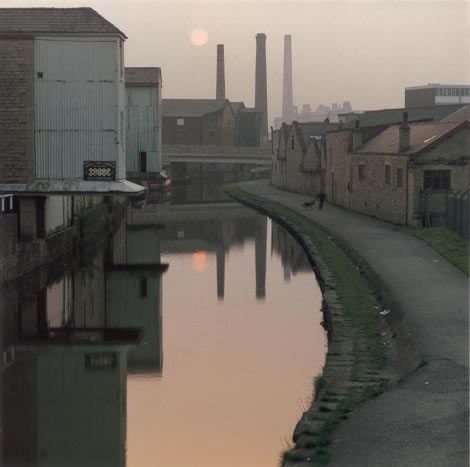
The image reminds me of Friedrich Engels description of the working class urbanscape from Ducie Bridge in his Condition of the Working Class in England and the romantic reaction to the urban ugliness of the emerging industrial capitalism in nineteenth century England.
English romanticism is a recoil from the early Industrial Revolution (ie. Blake's dark Satanic mills) as well as to the recoil from the empiricism of Bacon, Newton, Locke and the utilitarianism of Bentham.
January 23, 2004
Smile returns:"Goodbye Surfing, Hello God".
I see that Brian Wilson, the former Beach Boy, is going to present his long lost Smile album live at the Royal Festival Hall in the South Bank Centre in London.
It would be great to hear the intertextual exploration of the fragments of the diverse landscape of pop music 40 years on. Smile was to be an album constructed from fragments of different kinds of American folk/pop music.
 It was worked on during 1966 and '67. It would have been more along the lines of Pet Sounds, but moved beyond the lived experience of boy/girl relationships to an expression of social criticism and the sacred.
Though a product of the culture industry, Smile was to have been an experimental artist pop album, not a commercial one to keep the band financially alive. It would have been difficult for the rest of the band to go out night after night and perform such complex songs on the road. But that is art not commerce. The rest of the band was into commerce.
Here is a link to the songs on the album.
Pet Sounds had said goodbye to the fun-in-the-sun from the surfing Doris Days, who so longed to be accepted as hip. Smile was the Beach Boys attempt to move beyond the Californian hedonism of cars, surf and girls in an endless summer by creating teenage symphonies to God.
The suburban Californian dream was over.
There is an aura around this never completed album. Smile is now enveloped in myth. But Smile had already been enveloped in the myth of Brian Wilson as the romantic musical genius. Many fans see him as akin to a demigod rather than original, despite Wilson's well-known history as a fallible human being with a neurotic and damaged personality.
In Aesthetic Theory Adorno oberves that:
"Though subjectivity is a necessary conditon of the work of art, it is not by itself an aesthetic quality. It does become one, though, as a result of objectification....Works of art are their own standard of judgement." (p.243)
Adorno goes on to say that what:
"What is wrong with the aesthetics of genius is that it denies the importance of the moment of making or fabrication (techne) overemphasizing the aspect of art's absolutely primordial status and viewing art as natura naturans. In doing so it helped foster the misconception of the organic, unconscious nature of art which eventually emptied into the murky stream of irrationalism."
With Brian Wilson it is important to focus on the fabrication of Smile as an artwork.
Adorno does qualify this throwing out the category of genius as a residue of romanticism. He says:
"The concept of genius has an element of truth. It can be found in the art object, more specifically in the openness of that object rather than in what is trapped in it and what can reiterated.....The redeeming feature of genius is its subservience to a work of art. We might rightly speak of a passage in a work as being ingenious when the term 'fantasy' does not adequately describe what is present. The ingenious is the dialectical knot signifying the presence of the unstencilled, the unrepeated, the free----in the midst of a sense of necessity."
We should concentrate on Smile as an artwork and les on Brian Wilson as a tortured romantic genius.
January 22, 2004
Tracey Moffatt
Tracey Moffat has appeared briefly before in this post. She currently has an exhibition at the Museum of Contemporary Art in Sydney.
What initially attracted me to the studio-based work of Moffat was the way she blurred the boundaries between cinema, photography and the visual arts. The form is a set of stills for a film whose narrative was about the trials of a poor but restless coloured girl in rural Australia who wanted 'something more' out of life than her lot in the white patriarchical 'colonial' society.
This is an image from an early piece of work:
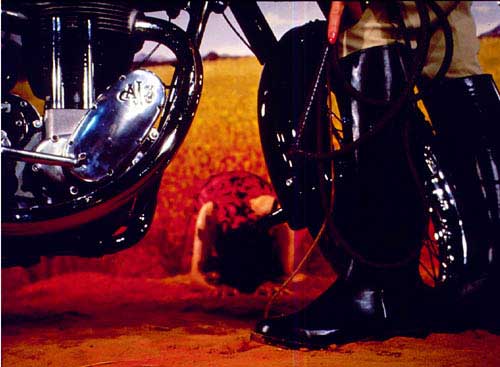
Tracey Moffatt, from Something More, 1989
A racist fantasy?
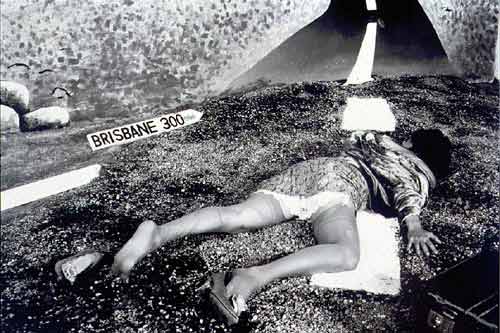
This is the image I previously posted is from the same body of work and it expresses the dreams of a young women in an Asian dress who desires to escape rural Australia---and move to Brisbane?

And a third image from the same work highlights the violence in the sexual relationships in post colonial society:

What strikes me now is the interplay between sex, violence and race in a society scarred by colonialism. Moffatt shows 'the native' in various contexts that include sexual slavery. This art depicts a white patriarchical domination that it opposes.
These images are contaminated with domination even as they produce something distinct from domination (a desire for liberation). They do not produce a positive or utopian image. Rather they express a negative image since they show the negative aspects of the social reality that aboriginal women live in regional Australia. In doing so the images contest the conservative Australian nationalism that celebrates settler Australia, its positive values and achievements, and glossing over the violence wrought by the settler's domination and conquering of nature and indigneous peoples.
The images express the violence of our historical reality that has been made mute. Moffatt recognizes the repression and exploitation in the white black relations are the actual conditions of existence.
It's a tragic photo-narrative, as the young women dies on the road to Brisbane--and freedom:
We've heard it all before

Bill Leak
I prefer the cartoon to this text. Leak comes closer to putting a finger on Conservative Australia that parades itself as mainstream.
The text is by Germaine Greer. She says that she belongs to the left. But her criticisms of Australia seem to have a lot in common with those of Barry Humphries, minus the humor of course. Australia is the big negative--the land of nowhere from which the talented and creative few have to escape, if they are to be true to themselves as free spirits. With Greer we have a modernist scorn for the common suburban life that most of us Australians inhabit.
How else can we make sense of what Greer says here about the oceanic tracts of suburban doldrums:
"I love Australia with a fierce passion that churns my guts and makes my eyes burn with tears of rage and frustration. But I would rather not be there. For the vast majority, life in Australia is neither urban nor rural but suburban. The reality is [an] endless, ever-expanding replications of Ramsay Street that spread out as rapidly as oil stains on water, further and further from the tiny central business districts of the state capitals.Each street has a nature strip; each bungalow faces the same way, has a backyard and a front garden, all fenced, low at the front, high at the back. Somewhere nearby there'll be a shopping centre with fast-food outlets and a supermarket. If your ambition is to live on Ramsay Street, where nobody has ever been heard to discuss a book or a movie, let alone an international event, then Australia may be the place for you."
Greer says that she cannot live in Australia because she loves the country too much.
I wonder what sort of country she has in mind? One in her imagination? One where you live in romantic harmony with nature?
Well, I'm off to the beach this long Australia weekend to relax amidst the sand, surf and sun
Update
Having just come back from the beach to notice PP McGuiness's reponse to Greer. He says that it is the lefty chattering classes living in the inner city who either sneer at mainstream suburban Australia, or wish that those living in the outer suburbs were deprived of the vote.
Yawn. It's the old anti-democratic totalitarian song endlessly replayed.
I also notice that Susan Mitchell is defending Germaine Greer. She stirred us. Mictchell says:
"Germaine Greer, professional provocateur, ideological bomb thrower, maestro of the eye-grabbing headline, won again. We fell for it. She must be sitting in her garden, squawking with all her geese at the gullibility of all the television, radio and print commentariat who attacked her recent spray on Australia in this newspaper last Thursday. That one post-menopausal expatriate woman can create such a stir in her home country is truly astounding. What power she has...She's the original leg-puller. And we get sucked in every time."
This is a bit of sisterhood in action. Mitchell gives Greer too much credit.
My judgement was that Greer 's construction of Australia as sport-obsessed suburban nation was that it was a voice a voice from the past. She is trapped in the 1960s. She is a historical curiosity playing the same old song over and over again. The mirror image of John Howard really.
January 20, 2004
Stephen Ross Interview: #5
I want to pick up on this---the Stephen David Ross interview conducted by Rick over at Artrift. I have let this important interview slip.
We had got as far as discussing the fourth part of the interview, where Stephen David Ross was talking about the intensity and transfigurative experiences of art that are not only disturbing but threatening; and then connected them to Nietzsche's concept of the Dionysian, which identified suffering with existence.
The fifth part of the interview is a David Ross quote on mimesis.This is the quote:
"I wish to consider the extreme possibility that the distinction between great art and other art, high and low art, whatever and wherever that distinction may be, betrays the responsibility in art expressed by mimesis, to take every difference seriously…I think that we will never be able to tell at any time whether a work we consider poor, or weak, or broken, may not be found to be wonderful at some time in the future, because of changes in the nature of art, and the world. And second, more extreme, the distinction between good and bad, high and low, betrays art and the good…In its different works, popular, folk, kitsch art reveals the gift of the good because it opens, reveals, interrupts, touches heterogeneity, differences among individuals and kinds, everywhere in nature. Even familiar works hung on motel walls interrupt the blankness of empty space, ask us if we notice them at all why they are there, what they reveal, and what might illuminate that space instead. The possibility of art, high, low, mediocre, whatever – all distinctions that do not bear on poiesis or mimesis – bears the touch of the good in relation to the “finest differences,” differences beyond differences, toward heterogeneity. This bearing, expressing, of heterogeneity belongs to art as mimesis, is the gift of beauty." (Ross, GB,p. 93-94).”
Mimesis. I've always struggled with that aesthetic category, especially after reading Dialectic of Enlightenment where it was an integral part of a complex interplay of mimesis, negativity and utopia.
In that text Adorno & Horkheimer use mimesis as counter rationality to a calculative instrumental rationality that has swept all before it modernity. Mimesis has a wider connotation than the conventional understanding of mimesis as the idea of art as an imitation of nature. It is connected to their thesis of a fissure or divorce between sign and image with sign operating in the domain of science and image in the domain of art. What they say is this:
"As a system of signs, language is required to resign itself to calculation in order to know nature, and must discard the claim to be like her. As image, it is required to resign itself to mirror-imagery in order to be nature entire, and must discard the claim to know her....The separation of sign and image is irredemiable."
The argument is that though social practice is increasingly dominated by instrumental rationality, the institution of art is not totally permeated by instrumental rationality.
If instrumental rationality is a form of identity thinking (ie., it subsumes the heterogeneous under the sign of sameness), then art is a refuge for the experience of the non-identical. The mimetic aspect of autonomous art lies in its expressing aspects of reality through its innovative form that were not perceivable before. Through mimesis art establishes a critical relation with social reality.
That is one account of Stephen Ross's conception of art as mimesis that expresses difference. I lot of what Ross says I do not understand, eg., "The possibility of art, high, low, mediocre, whatever.... bears the touch of the good in relation to the “finest differences,” differences beyond differences, toward heterogeneity."
What does "differences beyond differences, toward heterogeneity" mean?
January 19, 2004
From Hubble
I heard on the news last night that the Hubble Space telescope is be phrased out with the servicing missions being wound up, begining with SM4, the next servicing mission.

Hubble Site, Antennae Galaxy
The implication? Hubble is to be prematurely retired. What a pity. I enjoyed the images of our universe.

Hubble Site, Eskimo Nebulae
Update
This article decribes the disappointment of the astronomic community. The reaction has been one of absolute shock.
January 18, 2004
Hollywood Sleaze

Helmut Newton, Allure Los Angeles, 1997.
It strips the glam of Hollywood away, does it not? We sure get enough of that. Recall the Nicole Kidman image spin of recent months with its gesture towards, and celebration of, elegance, weath, power and luxury. This cosmopolitan global culture of wealth elegance and taste explictly rejects the petit bourgeois and suburban world of Australia as provincal tacky and seedy, and it erects formidable barriers against any encroachment from the outside world.
How nice to see this glamour being subverted from within by Helmut Newton:
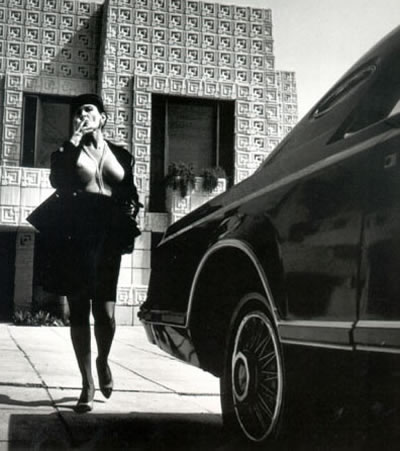
Newton,
Fascist chic.
These models look at us with an imperious, critical stare. The woman looks in control. When she looks back, at the camera it is as if the spectator doesn't exist. It is a look of indifference to the male voyeur that shrivels you up.
January 17, 2004
Dystopia
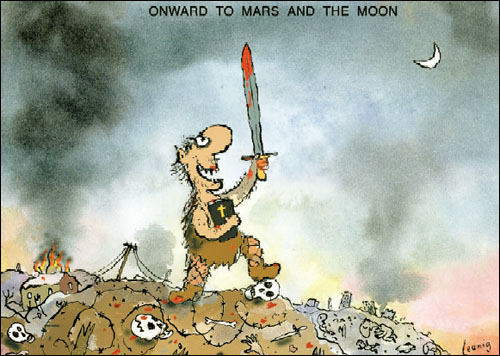
It's black humor I know. And it's onesided response to President Bush's speech for a renewal of manned space exploration, capped by a return to the moon and an eventual manned mission to Mars.
Leunig does load all the negativity onto Christianity thereby ignoring the destruction wrought by the free market and the power politics of nation-states.
But he does capture the fouling of our nest and the moving on onto a new planet.
January 16, 2004
Domination of nature
The beauty of the Tarkine rainforest in Tasmania:
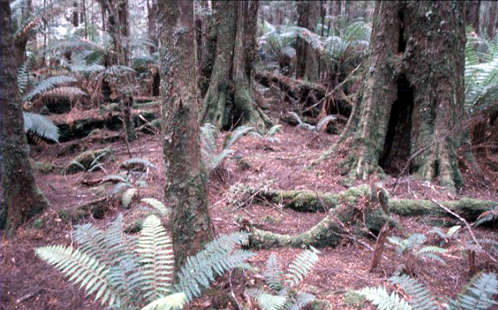
M.Thomas
It can be contrasted with this celebration of the heroic forestry worker:
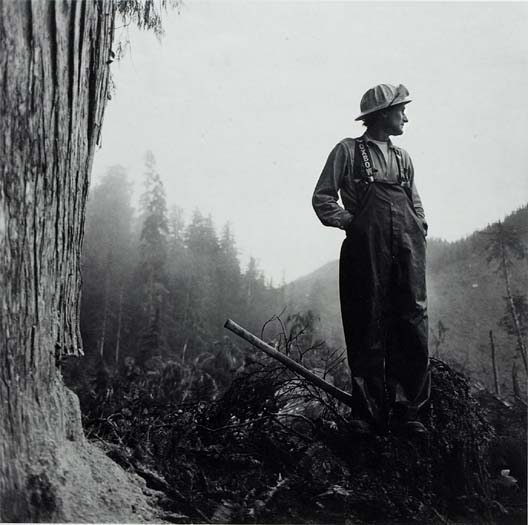
Larry Fink
The forestry worker clears the wilderness and paving the way for wealth creation:
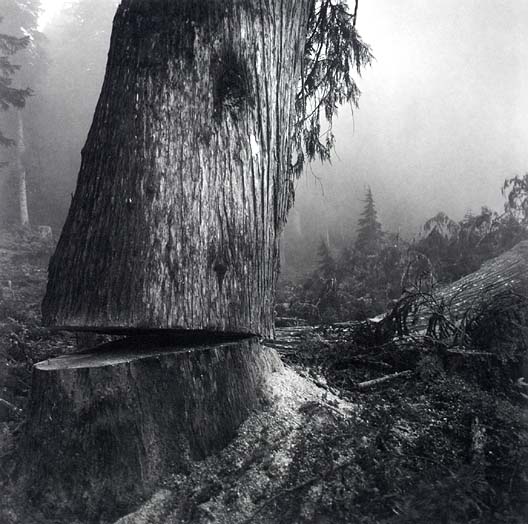
Larry Fink
The above photographs are American images but they apply to Tasmania in Australia, as they capture the pionering ethos. That ethos was about liberating human beings from fear and poverty and establishing their sovereignty.
The consequence of clearing felling is this:
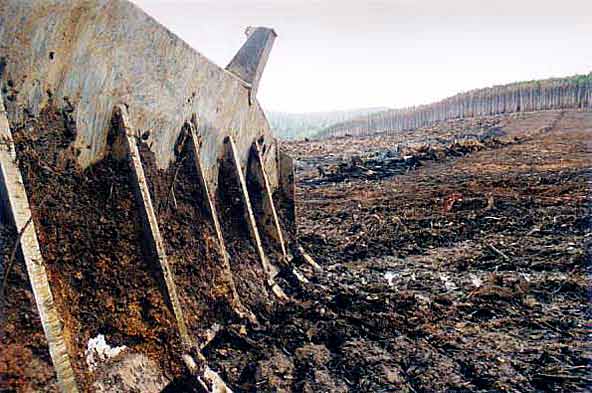
Discover Tasmania
Tasmania is a clear example of how the enlightened earth radiates disaster triumphant.
Of course, that understanding of the heroic worker, power over nature and stewardship is way out of date. Clearfelling the old growth native forests for woodchips in Tasmania is now undertaken by two corporations--Gunns Ltd and Forestry Tasmania. Bulldozers aren't efficient enough. They clear the land in a modern way:
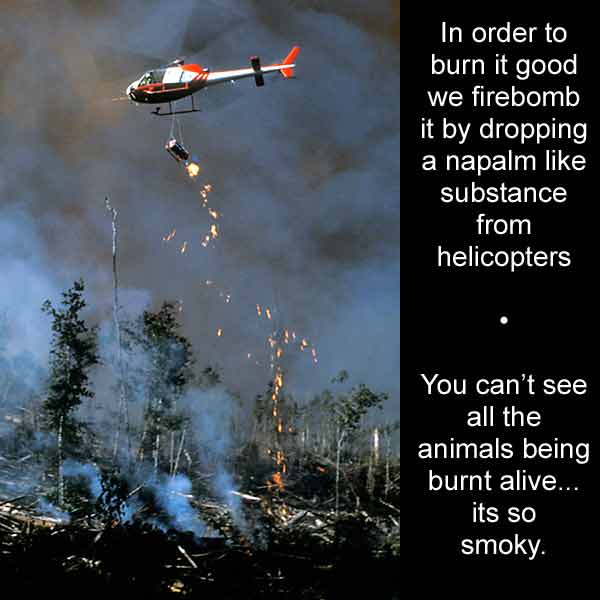
Remember this is public land that is coverted into plantations owned by private companies. It's a land grab.
Around 70% of Tasmanians want an end to the clear-felling of old-growth native forests. They undestand the value of Tarkine River:
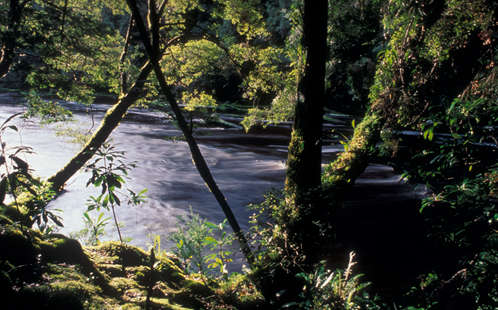
E. Sarafik
January 15, 2004
[grid::ritual] strenghtening social bonds
In the previous entry I briefly mentioned the rituals of the endless summer at the beach and wondered whether the rovers on Mars would have rituals. Or is it only a human thing?
Rituals are usually associated with religion--eg., a high mass for Catholics, or a baptism, or death. Religion can be seen as a way of expressing social realities: they are ceremonies that awaken certain ideas and feelings, attach the past to the present and the individual to society or a moral community. Rituals are far more than as set of fictions. They seek to strengthen the bonds between people.
We can broaden this expressive aspect of rituals as rites to everyday activities of birthing, birthdays, Xmas, flirting, romance and marriage, shopping and death. These activities--those around love or shopping--- involve an element of interpretation, that are than elaborated and transformed until they become unrecognizable. So we have a partly imaginary world--eg., romance and love or consumer culture around handbags and shoe--- that gives cultural form to our intense and deep feelings of everyday life.
Machines are excluded.
There is a surplus of expression that is not contained by these cultural forms and they develop a life of their own that goes beyond the ends of rituals to become something that has no purpose. They become games--eg., those of dating and relationships that go beyond the single girl’s hunt for a good man, as expressed on the tv show Sex in the City. See Gianna's discussion of this show at She Sells Sanctuary.
Associated with the search for love by the single urban women is the ritual game of dating and sexuality. This goes beyond devising hunting strategies for a mate (Mr Right).
 (Getty Images) with its intersection of commerce and romance.
Here the hunting urban woman turns herself into a product with her own unique brand and then devises market strategies to sell herself as her own unique selling proposition.
In this market language of romantic investment single women research and develop their personal brand that has a broad appeal.
How do we move beyond this marketplace of love talk in which bodies, romance and love are commodities?
Reflecting on Sex and the City show Gianna at She Sells Sanctuary says:
'Naomi Wolf... argues the girls are feminists because they “do not settle. They move on [rather than stay with the wrong guy], because the sexual revolution means that women have the right to select.” I think she’s closest to the mark. The girls are single for the most part because they choose not to stay with men just for the sake of being in a relationship—and many of us know someone in real life who has done exactly that. For example, the fear of being alone can drive some people to stay with abusive partners or in stale relationships. So the girls actually demonstrate a self-confidence that makes them good role models for female viewers—even if ultimately, they all do crave love more than anything else.'
It is through female friendship that social bonds are affirmed in Sex in the City. As Gianna says:
"One thing I used to like about the show....was the realistic portrayal of female friendships. It was probably alarming to some people to find out that girls really do talk about sex that much, and that they so openly and ruthlessly dissect each others’ relationships. But there is a real intimacy, honesty, nurturing and, yes, love between the characters that many modern girls will recognise. Single girls do have a lot of their emotional needs filled by their girlfriends—and that’s valuable and worth reflecting on the small screen.. "
Thus rituals have a social function: they are both a system of communication of ideas and emotions and a way of specify and regulate social relationships.
January 14, 2004
Mars, water, life
I tried to download a panoramic Mars image tonight. I wanted to move beyond Mars and deserts and Mars and frontiers.
I couldn't upload the image it was too big for my computer to upload. This then is a smaller image:
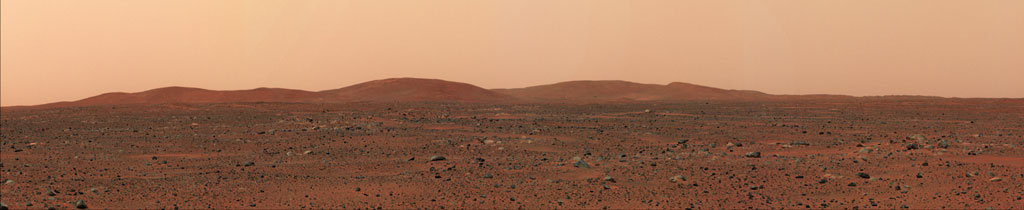
Mars Exploration Rover Mission
The full image can be found here The fullscreen 360 degrees panorama can be found here. Link courtesy of James' Mars blog.
The current Mars exploration by the rovers, Spirit and Opportunity, is for water, which is deemed essential for the formation of life. Or is it for minerals to mine as well? The rovers will be closely examining rocks.
Water. We take it for granted on earth. And we pass by rocks without looking at them
My mind has turned to Victor Harbor, rocks on the seashore, the southern ocean and people (and children) swimming in dangerous places such as Petrel Cove:
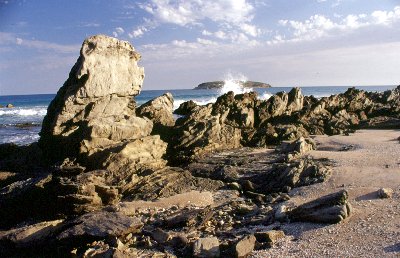
This place is very beautiful during summer, but it is full of dangerous rips. It used to be deserted, but it has become fashionable for the Adelaide holiday set. It has become a place for summer rituals and games in and around the swirling waters of the southern ocean.
The news tonight reported a child being swept away, yet again at Petrel Cove. This time fortune smiled.
Me, I just love the rocks: the detail in the landscape.
David T. Culverwell, Stones, Pt. Lobos, 1982
They help to define a place. They situate place and locate that place in a region.
Did you know? In talking about the power of place we are stepping beyond the horizons of philosophical and scientific modernity.
We can ask? Do machines on Mars have rituals? Or are rituals only for humans?
January 13, 2004
Cultural heritage
I've been painting the electronic cottage all day, getting it ready to rent. Most of those applying to lease it have been young professionals who work in the public service in the cityand want to walk to work. That is what I did when I lived there--- when I worked as a researcher in State Parliament after chucking in academia as a very bad joke.
Mine is a heritage cottage surrounded by trees and parklands located within a loose community where the people in the street still talk to one another. It is situated in an area that is well maintained by the Adelaide City Council.
Inner city living in Adelaide is a very attractive mode of living. Such a contrast to Leeds:
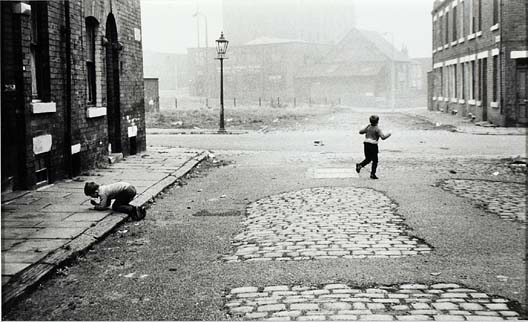
Jeffrey Blankfort, Leeds, England (Two Boys Playing in Street), circa 1971.
Not a tree in sight.
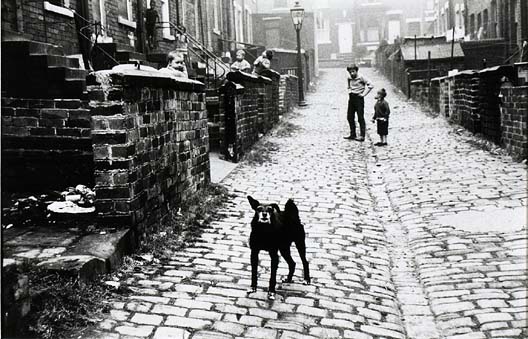
Jeffrey Blankfort, Leeds, England (Alleyway between Rowhouses, Boys Playing, Dog), Circa 1971.
The heritage cottage is a working class one built in the 1890's and it was a part of working class life and culture during 1940s and 1950s. The inner city was seen as a slum in the 1960s and destined to be cleared in the name of modernization. But they were saved as heritage in the 1970s through the gentrification of the inner city.
My cottage cannot be pulled down. The street front can only be restored. The back can be modernized. I've been doing neither this past fortnight. I've just been plugging away giving the place a facelift inside.
The street is filled with Queensland Native Fragipanis' even though most of the little gardens behind the heritage picket fences are mostly roses. Such a contrast to Ireland:
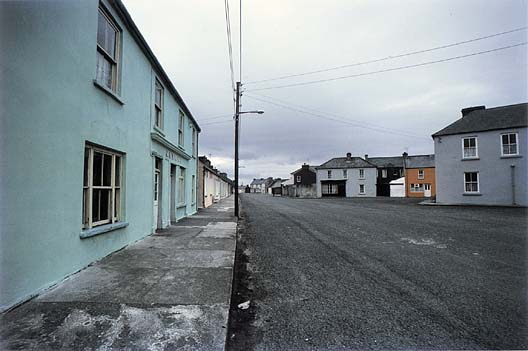
Harry Callahan, Ireland, 1979
I used to sit on the front porch in the late afternoon sun and leaf through photography books about America:
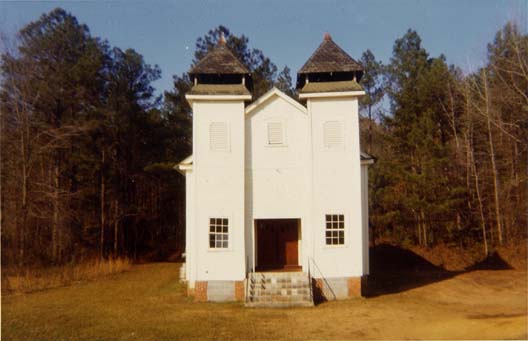
William Christenberry, Church--Sprott, Alabama, 1971
And I wondered. We have churchs like that in the country. And barns too:
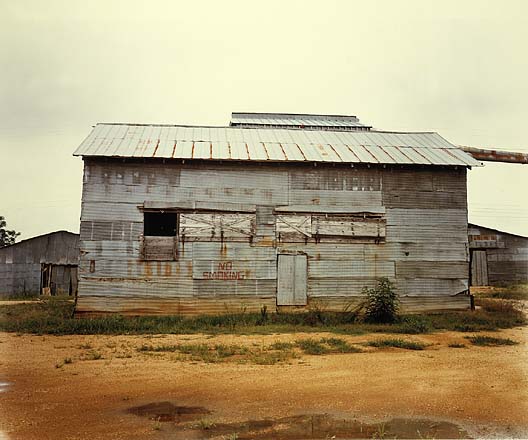
William Christenbury,Cotton Gin--Havana, Alabama, 1978/printed 1981
So why isn't anyone photographing them.
January 12, 2004
urban culture
There was an interesting article by Guy Rundle on urban culture in the Sunday Age as part of its series Challenging Melbourne. Despite the standard postmodern blindness to all things sustainable Rundle's piece picks up some themes discussed on Junk for Code about the poverty of urban design.
Rundle poses some good questions in relation to the dilemma faced in forming a cultural urban policy. He asks:
"How do you satisfy the domestic demands of the bulk of the population while trying to present yourself to the world? More particularly, how do you distinguish between encouraging actual culture (the things people do as an expression of lived meanings, myths and values) and cultural production (the industrial manufacture of images and texts upon which contemporary economies rely)? How do you promote the latter without using the former as raw material? In key areas of culture, we must make decisions that will ensure that the market serves life, rather than vice versa."
What Rundle highlights is the conflict between market and life. Like Junk for Code he sees this conflict most clearly expressed in the urban environment that is marked by money, concrete, junk buildings and middle class slums. He rightly says that the urban environment has not been handled as well as it could have. The reason? Our planning systems has a great deal to say about what should be saved and why, and very little to say about the aesthetic value of new stuff that goes up. Speaking specifically of Melbourne Rundle says:
"Although some stunning buildings have gone up in recent years, such as the Australian Centre for Contemporary Art---half rusting hulk, half Uluru---on Southbank, many standard buildings, particularly apartments, have plumbed new depths of public ugliness. Pseudo-Tuscan, pseudo-Georgian concrete slabs leant against each other, they are instant yuppie slums. The failure of governments to insist on better standards has greatly degraded the city....And then, of course, there is Federation Square. It is one of the most cutting-edge buildings of 1961....it is the ideal example of an innovative project that fell short of its ambitions. Was that really the sort of chance we should have taken with the gateway to Melbourne?"
On the issue of practical lived urban life Rundle puts is his finger on the big shift to inner city that has taken place in the last decade. He says:
"...nothing has changed more fundamentally in any Australian city than the way Melburnians eat, drink and socialise. The hundreds of small shopfront bars that have sprung up have changed not only the look and feel of the city and suburbs, but individual comportment itself - how the sexes mix, how people celebrate and so on. The chief casualty of this has been the pub, which, like the traditional milk bar, is on the way to being an endangered species. To a degree, that was inevitable, but the process has been sped along by the apartment boom. In earlier years, this process would have generated its own action group. Today, there is a different attitude, either postmodern - seeing the city as a fluid nomadic zone of signification - or defeated, conceding all to yuppies and developers. Yet it would be a pity for a whole pub culture to more or less disappear. Regulation for continuous use would help, as would incentives to maintain mixed use, so that pubs retained some of their traditional roles."
Rundle ends by saying that the problem of cultural policy is not to prescribe a set of cultural goals implied by one design fits all. Rather it is to develop a reflexive relationship to how one lives. It is to ensure that culture is not merely a raw material for the tourism industry or a byproduct of the knowledge industry, and that we do not become a society in which money and concrete crowds out life.
January 11, 2004
that a nagging feeling
I'd rather be exploring this landscape at the Breakaways:

than exploring the landscape of Mars myself.
The photo was taken on the Jarntimarra Expedition of The Mars Society. The Jarntimarra Expedition had been searching for an analogue Mars site in South Australia, on the grounds that the Australian "outback" features some of the best Mars-like environments in the world. The Breakaways were one of the options considered.
A different view of the Breakaways:
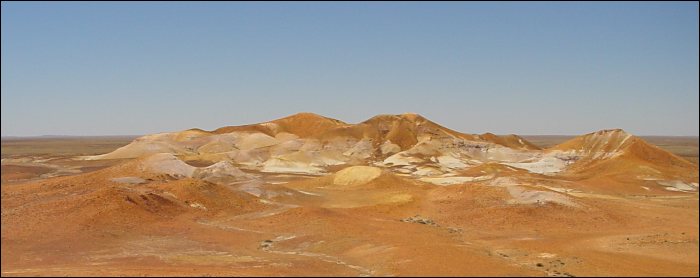
G Sully/C Leel
A site for the research facility has been found near Lake Frome, Arkaroola in the Flinders Ranges. Some of the previous research has been to uncover microbial organisms in high-temperature ecosystems (eg., hot springs) that may hold the key to finding life on Mars.
The Rover robots will search for signs of water on Mars. Behind this search sits the search for evidence that we humans are not alone, even in our own solar system. Hence the perennial question:'Is there life on Mars?' Beyond that question is lies the search for the origins of life. But pure science is not what the Mars Mission is about, since it is technoscience that enframes this mission.
It is all very upbeat at the Mars Society. They say it is likely that several human missions to Mars will have been accomplished by 2050. They say that a human Mars mission could be successfully achieved within 10-15 years, since the technical barriers are not nearly as great as the political and economic ones.
However, I have a nagging feeling that there is a connection between the human colonization of space and the destruction of life on earth, as is currently happening with the clear felling of old growth temperate rain forests in Tasmania. Putting it bluntly, we humans can lay waste to the earth because we have developed the technology to move to other planets. Since we can live on other planets we do not have to develop a more caring way of relating to nature.
I can remember reading that Martin Heidegger thought along the same lines when he saw the first images of earth taken from the moon in the 1960s. Though Heidegger has been dismissed as anti-technology by the techological utopians, I canot shake off the nagging feeling that it may have put a finger on the pulse of our mode of life.
January 10, 2004
Logging in Tasmania
Tasmania brands itself as the tourist state for the international market. It entices us with experiences of cultural heritage and pristine wilderness.
All is not as it seems:

Discover Tasmania
Stripping the landscape impacts on the water in the creeks:

Have a look at Good Weekend for the contradictions.
January 9, 2004
Similarities: Mars and Sturt Stony Desert
This particular reference on the Mars Society of Australia website has some images of the Sturt Stony Desert. The link is courtesy of D. Stuart, a reader of junk for code.
The two images of the Sturt Stony Desert in South Australia are:

and:

This desert landscape in South Australia is very similar to the landscape of the Gusev Crater on Mars, don't you think?

Mars Exploration Rover Mission
One way of putting the similarity is to talk in terms of Mars on earth. Hence we have Mars analogue sites in South Australia. These sites are then explored as part of the Mars Mission.
Look at the above mages again. Hardly the place to raise a family eh. Those are images of inhuman landscapes suitable only for robots.
It makes you wonder what all the rhetoric about manned space flight and colonizing Mars is about doesn't it? And, as this article points out, Mars has far less life than the Sturt Stony Desert:
"Not only does the planet have no life, it has no air, no water, no warmth. The temperature on the Martian surface hardly rises much above minus 18 degrees, and can drop more than 100 degrees below that.... Even leaving aside the cold, the lack of atmosphere and the absence of water, there is the deadly radiation. If the average person on Earth absorbs about 350 millirems of radiation every year, an astronaut travelling to Mars would absorb about 130,000 millirems of a particularly virulent form of radiation that would probably destroy every cell in his body."
Presumably they are searching for fossilized evidence that billions of years ago there might possibly have been a few microbes.
So why bother with suggstions of the imminent construction of condo units on Mars? Why all the rhetoric about manned space travel now being just around the corner?
Me I'm quite happy remaining earthbound. I haven't even walked the Sturt Stony Desert yet.
January 8, 2004
Mars: deserts and frontiers
Apart from the different colour it does look like a stony desert in the Australian outback doesn't it. I'm having difficulty in finding images of Sturt's Stony Desert to compare the landscape of desert with that of the Gusev Crater on Mars.

Mars Exploration Rover Mission
Is Mars the new American frontier? The new site for their old imaginary? Didn't Star Trek talk in terms of Space as the final frontier?
The imaginery in the cultural encoding of the inland deserts in Australia is that of the 'Dead Heart.' It is an encoding that evokes of images of heat, vast tracts of sand, no water, a featureless wasteland where little grows and nothing lives. It is a desolate and lonely place where nothing moves during the day.
This encoding forgets that the desert areas of Australia have a history. They were once coverd by sheets of polar ice, and before that by great areas of shallow seas. And they have a future. Since the continent continues to edge slowly northward its desert regions may well become tropical regions.
The encoding also forgets that the desert by moonlight is alive. Animals that are nowhere to be seen during the day are everywhere.
The difference betwen the Australian stony desert and the Gusev Crater is that the former is alive and the other is not.
If we come back to the cultural encoding of the desert we find that it is an encoding that is embodied in Russel Ward's The Australian Legend(1958). Ward argued that the Australian ethos - egalitarian, collectivist, anti-authoritarian and practical - had its origins in the response of convicts and bush people to 'frontier' conditions. This elides the difference between desert and frontier highlighted by the film Rabbit-Proof Fence. Here one of Australia's greatest 'frontier,' was a 1600 kilometre dingo-fence in Western Australia beyond which stood the desert: a nothingness that spelt death for whites but not blacks.
If we displace the pioneer/pastoralist elision between frontier and desert we can grasp that the pioneer identity of Australian white settlers (Ward's Australian Legend) was in clearing the land for European-style agriculture. The wilderness of the varoius deserts, in contrast, induced environmental agoraphobia.
January 7, 2004
a circle
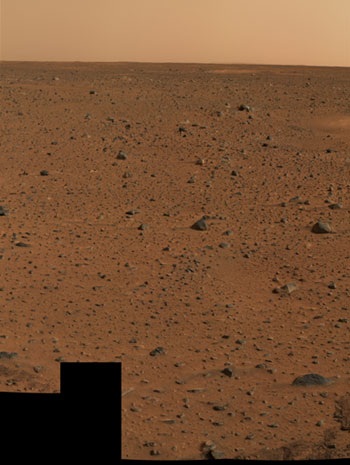
Mars Exploration Rover Mission
The flat and jagged face of the Gusev Crater, an ancient basin on Mars, looks like the ancient Australian stony desert, doesn't it.
Strange. We go so far into space chasing our dreams only to find that the landscape is so familar. We know it. It is like seeing our own world (wilderness) with a navigation camera on a rover. The "window in the interior of Mars" is an image that connects to the Australian interior.
January 6, 2004


martian landscape

The Martian landscape of the Gusev Crater as seen by the navigation camera on Mars Exploration Rover Spirit. This panorama is the first 3-D stereo image from the rover's camera.
%20in%20diameter%20and%20located%20approximately%2010%20to%2020%20meters%20(30%20to%2060%20feet)%20away%20from%20Spirit,%20is%20either%20an%20impact%20crater%20or%20a%20product%20of%20wind-erosion.%20Image%20credit:NASA/JPL)
The traffic to this site would be enormous. The hit counter must be going through the roof, with all the extra servers that have been bought into action to handle the traffic.
a different way of relating
I'm painting and cleaning the electronic cottage this week before it goes back on the rental market. I'm living in the world of instrumental rationality of the market where reason is pure calculation, as are the signs (words) of the language we use in order to exchange money for renting.
My heart is elsewhere:
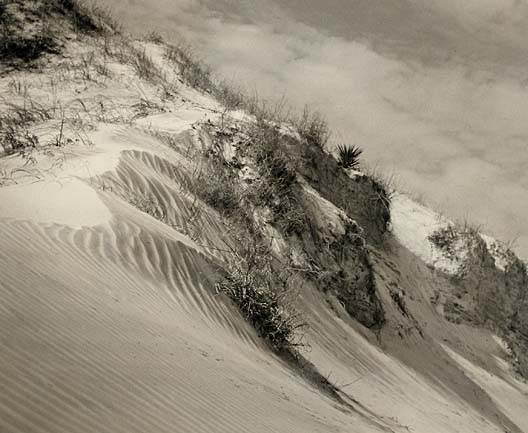
Grace M. Ballentine, Up from the Sea, ca. 1940
Oh for some quiet magic moments at the beach.
The above photographic image is not a sign used for calculation. It is something other than a sign of instrumental rationality.
It is also something more than a simple visual similarity between a photograph and sunlight sand dunes.
As an image it opens up the possibility of approaching the world in a different way to that of instrumental reason: an opening up to concrete and specific individual experience that is excluded by the identity of mapping reality through the unambiguous and abstract concepts of instrumental reason.
January 5, 2004
signs of modernity
It is elegant is it not?:

Bernice Abbott, Rockfeller Centre, 1937
You can see why people were dazzled by them in the late 20th century, and why every big corporation that wanted to celebrate its power reckoned they just had to have one.
America ruled.
That is what I see from my perspective here in Adelaide Australia living on the hinterland of the US empire of capital. New York was modernity. it was the home of abstract expressionism, whose technique of action painting was a direct expression or revelation of the unconscious moods of the romantic artist:

Jackson Pollock, Autumn Rhythm, (Number 30), 1950
I see these skyscrapers as signifying more than a changing New York.
This image of corporate America signifies a modernist utopia; a utopia blocked by the real functional order of corporate capitalism.
This kind of modernization based on the liberation ideals of the enlightenment turned into the opposite when put in practice.
That's the criticism directed against modern architecture.
In contrast, Bernice Abbott sees the changing face of New York:

Bernice Abbott, Rockfeller Center, Collegiate Church of St. Nicholas in Foreground, 1936
The old makes way for the new. It's a reworking of Atget in America.
But truth not only relates to the world as it is. It also refers to what the world as it might be; to its utopian content. What was that content? A life of freedom and happiness.
January 4, 2004
Urban design sucks
It has been very hot in Adelaide this last week or so--in the mid to high 30's. As I moved around the inner city doing my shopping I could not help experience the city as a heat zone. The urban environment of the inner city traps heat and it builds up. It is like walking in a furnace.
Despite all the talk about planning strategies and redefining Adelaide starting from the 2001 City as Stage Forum----nay Michael Lennon's 2020 Vision (1991)---the city has become a hell hole in summer. It has not been designed as a city for people let alone quality of urban life.
Like most of the houses, the brick and the asphalt of the city street has not been designed to provide shelter from the sun. The streets have been designed to move traffic so they become heat traps for people walking. There is very little greenery or shade provided, apart from shrubs in planters on the footpath and a few plane trees. There is nothing to make you pause, relax, or walk with dignity.
So why not reduce traffic flows and introduce more greenery? Is there not a push for more people to live in the inner city. Yet the city is more than a ugly space full of depressing buildings --a renovator's dream. It is also inhospital during the heat of the summer. If sustainable development depends on higher standards of urban design and making cities liveable, then Adelaide falls well short.
Then it occurred to me. Those who designed the city had no bloody idea how to deal with the summer heat. The city was not a place to enjoy and live in.
It was designed for utility: as a space for making money and for the paying customer. It was designed with a core called the central business district (CBD), which was a place to work for the managers and white collar workers; it had industrial estates and suburbs for living with lots of transport routes from the suburbs to the CBD. The inner city (CBD) is now being transformed as a consumption space: it is full of shops and cafes. The footpath becomes a cafe and there are few public spaces or seats.
So it becomes a hell hole in the summer. Jan Gehl, the urban designer, talks about cities invaded, deserted and re-conquered. Well Adelaide has been invaded by the car; deserted by local authorities, state government and people; with a few pockets of rehabilitation by progressive City Councils.
Russell over at Civil Pandemonium addresses this. He has two photos of urban streets: one of Strasburg and one of Melbourne. One is green one is not. Guess which is more green? The European one.
Adelaide has not begun to re-envision itself as an ecocity. In terms of change it has been in a state of paralysis for over a decade. Things just go round and round in a circle. You can see the dead hand of Treasury everywhere.
January 3, 2004
Green delusions?
In the imagination of the business/political circles of the right-wing Bacon ALP in Tasmania lurks a fantasy that environmentalism is killable. Why so? Because they believe that there is nothing in the biophysical world of Tasmania to explain or justify an environmental movement.
Crazy huh? Well, we are dealing with a collective fantasy of their pioneer political unconscious fixated on economic growth. There is nothing wrong in Tasmania's t magnificent old growth forests being turned into woodchips and exported at rock bottom prices to Asia. While large areas of temperate rainforest are temporarily "devastated" by forestry, these regenerate to regrowth dominated by native trees rather than exotics.
Environmentalism is seen as a sort of religion created by cant and mischief of ratbag, doom and gloom greenies. No environmental crisis exists. They who say otherwise are deluded by their anti-development fundamentalism.
All's not right in Tasmania's ecology:
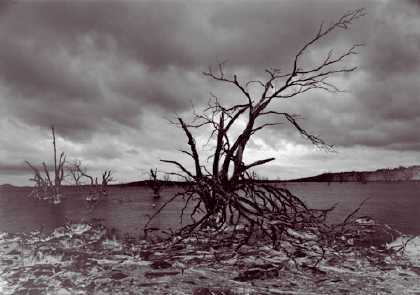
David Stephenson, Drowned, No. 34 (Arthurs Lake, Tasmania) 2001
That is objectively there in the biophysical world. it is the consequence of Tasmania becoming a heavily hydro-industrialised State that now faces potentially the biggest expansion in river regulation in decades.
The destruction of flooded trees was caused by human beings concerned with water development to meet Tasmania's economic and social objectives. That is why there is opposition to business-as-usual in Tasmania.
January 2, 2004
the old and the new
I have been unable to find good images of the ecological devastation of Tasmania's old growth forests. The historical images of logging at the State Library celebrate the industry and are all copyright.
There were references to previous wilderness exhibitions and landscape in the galleries, but few are online. I did come across photographs of drowned trees by David Stephenson:

Drowned, No. 121 (Lake Echo, Tasmania) 2002
In a state that successfully brands itself for international tourists as clean and green in a polluted world, their political/business world sure loved to drown, clearfell, poison and burn their old growth native trees. It was if they found the rainforests too claustrophic; a wilderness that was threatening and a lair for the wild beast.
We can take a different tack to such vandalism:

Janet Long, Seed Dreaming
An image from the Tanami Desert that points towards renewal and a different way of relating to nature.
However, things become a little twisted in Tasmania as they try to figure out the contradiction between 'clean & green' and 'ecological devastation.'
Tamanians have been embattled since the Franklin Dam days. In the old mining town of Queenstown, on the West Coast, famous for its lunarscape, the pioneer culture celebrates the devastation wrought on the temperate rainforest.

Martin Walch, West Lyell euclid tyre
A community, which had historically celebrated the heroism of taming nature, mining and progress, resisted rehabilitation of the lunarscape. It was deeply anti-green community, which rejected any (deep green) wilderness conception of natural value or beauty.They fought to keep the hills denuded and scarred. The greenies could go to hell along with the greenie (ecological) history of wilderness.
Queenstown would trade on the disgust of tourists for their ecological vandalism. What would be preserved was the mining heritage. The only history that mattered was the 100 year human history of the mining industry. The hills would remain bare.
January 1, 2004
devastation
I've been having trouble finding online images of the ecological effects of the clear felling of Tasmania's old growth native forests. What has happened to Tasmania's wilderness photographers?
So an American image will have to do as a placeholder until I find Australian work:
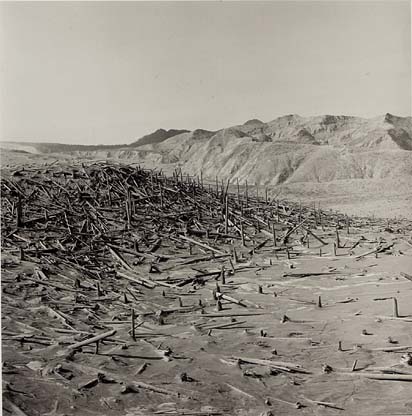
Emmet Gowin, Mount St. Helens Area, Washington, 1980
I've been looking for landscape photographers producing images of the ecological devastation caused by the air pollution from smelters downwind of the Mt Lyell copper mine in Queenstown Tasmania.
The ecological devastation of temperate rain forest resulted in a lunar landscape.
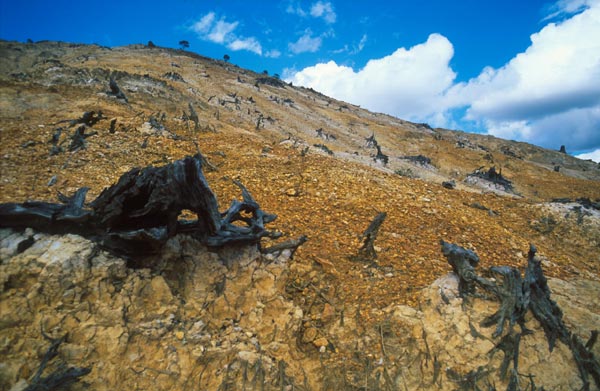
Martin Walch, Erosion, Mt Lyell
In my search I came across the photography of Martin Walch:
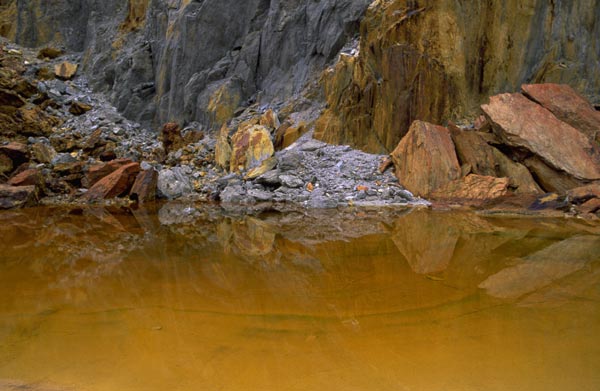
Martin Walch, Acid Drainage, West Mt Lyell mine,
In 1998 Martin was an artist in residence at Queenstown’s Mt Lyell mine.
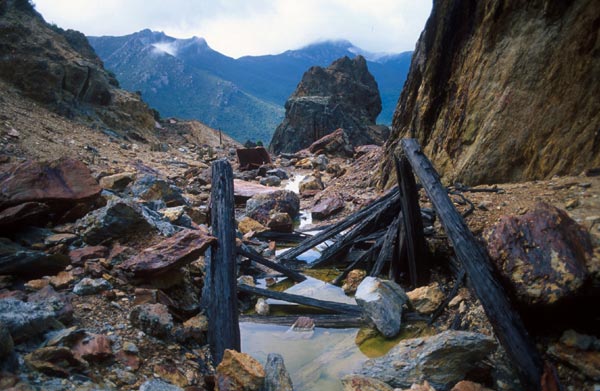
Martin Walch, Comstock Mine.
The old copper ore mine is now back in production just four years after its leases were relinquished by the Mt Lyell Mining and Railway Company.
The landscape tradition in the visual arts has been very strong in Tasmania.
So I will keep digging away for images of the ecological devastation of Tasmania's old growth forests.