|
January 11, 2004
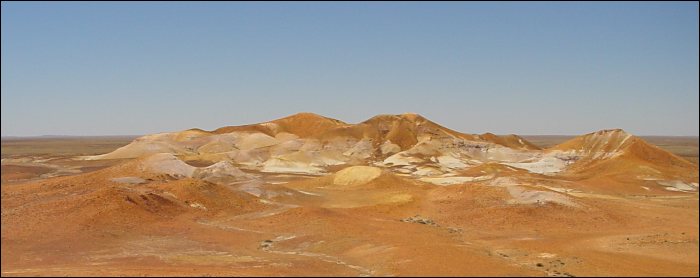
I'd rather be exploring this landscape at the Breakaways:

than exploring the landscape of Mars myself.
The photo was taken on the Jarntimarra Expedition of The Mars Society. The Jarntimarra Expedition had been searching for an analogue Mars site in South Australia, on the grounds that the Australian "outback" features some of the best Mars-like environments in the world. The Breakaways were one of the options considered.
A different view of the Breakaways:
G Sully/C Leel
A site for the research facility has been found near Lake Frome, Arkaroola in the Flinders Ranges. Some of the previous research has been to uncover microbial organisms in high-temperature ecosystems (eg., hot springs) that may hold the key to finding life on Mars.
The Rover robots will search for signs of water on Mars. Behind this search sits the search for evidence that we humans are not alone, even in our own solar system. Hence the perennial question:'Is there life on Mars?' Beyond that question is lies the search for the origins of life. But pure science is not what the Mars Mission is about, since it is technoscience that enframes this mission.
It is all very upbeat at the Mars Society. They say it is likely that several human missions to Mars will have been accomplished by 2050. They say that a human Mars mission could be successfully achieved within 10-15 years, since the technical barriers are not nearly as great as the political and economic ones.
However, I have a nagging feeling that there is a connection between the human colonization of space and the destruction of life on earth, as is currently happening with the clear felling of old growth temperate rain forests in Tasmania. Putting it bluntly, we humans can lay waste to the earth because we have developed the technology to move to other planets. Since we can live on other planets we do not have to develop a more caring way of relating to nature.
I can remember reading that Martin Heidegger thought along the same lines when he saw the first images of earth taken from the moon in the 1960s. Though Heidegger has been dismissed as anti-technology by the techological utopians, I canot shake off the nagging feeling that it may have put a finger on the pulse of our mode of life.
|


