July 31, 2010
bringing history into the present
Today’s digital camera is essentially a computer with a sensor and a lens. It opens up the possibility of what Wired Magazine calls computational rephotography. The rephotography refers to the photos taken from the exact same viewpoint as an old photograph there by highlighting the differences of a place over time. This brings history to life.
The computational bit refers to the software that compares the scene in front of the camera with a historical photograph. It then works out the difference between the two and gives the photographer instructions along the lines of “up a bit, left a bit more.”
At the moment the software runs on a laptop linked to a digital camera. The software compares the camera's view to a preloaded historical scene and provides instructions to adjust the camera's position and zoom to best match the scene.The laptop is a temporary measure as it is envisioned the software running directly on the camera.
Another possibility is bringing history into the present. This is explored by the Russian photographer Sergey Larenkov:
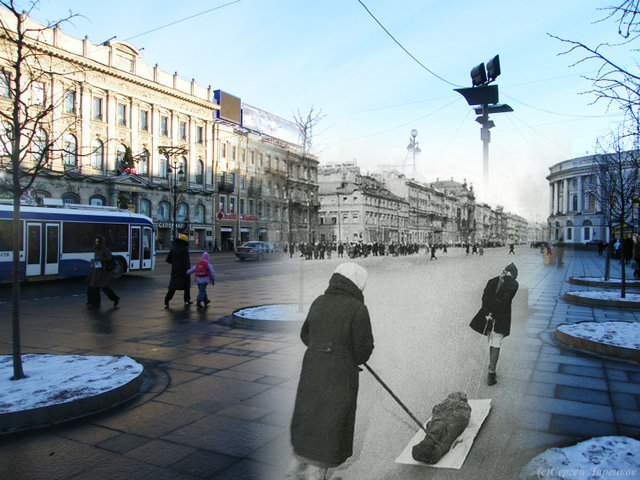 Sergey Larenkov, untitled
Larenkov brings WWII into the present---in this instance the Siege of Leningrad (now St Petersburg). The siege lasted from September 9, 1941, to January 27, 1944 with the estimates of death toll for the 900 day siege ranges from 632,000 to nearer 1 million.
Larenkov takes some pieces of those old photos made during those days and overlays them onto the modern city views, respecting the place and angle of view.
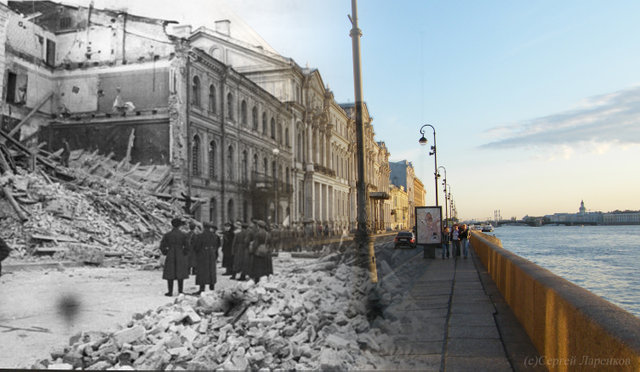 Sergey Larenkov, Palace Embankment
Larenkov's work is essentially a Photoshop-mask-heavy collection of World War II-era prints overlaid on modern snaps. The mergers are jarring in their contrasts, but that's the point.
July 29, 2010
Australian Photography: Michael Riley
The exhibition archives of Stills Gallery features the work of Michael Riley--his flyblown series of 1998, which appropriated Christian iconography to express his 'creepy' religious experiences.
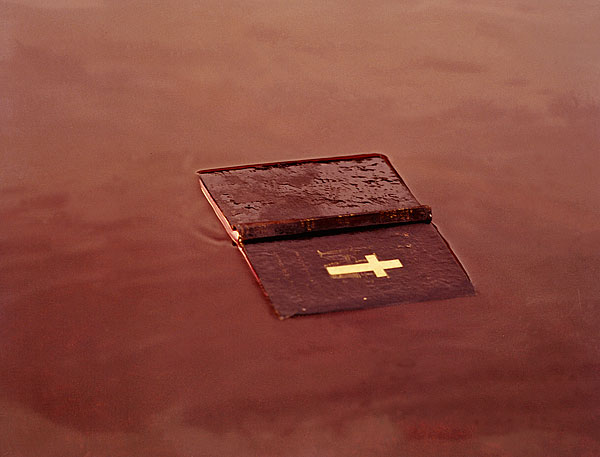 Michael Riley, Untitled, from the series flyblown (bible), 1998 Flyblown series bible 1998
He was an indigenous photographer and filmmaker who moved moved easily between working as a creator of stills and moving imagery. flyblown closely echoed the imagery in the short film Empire and it represents the ‘sacrifices Aboriginal people made to be Christian’ --the ‘loss’ of culture and land in enforced, and sometimes embraced, ‘exchange’ for Christianity.
 Michael RILEY Untitled, from the series flyblown (water), 1998
Michael Riley (1960-2004) was one of the most important contemporary Indigenous visual artists of the past two decades and his contribution to the urban-based Indigenous visual arts industry was substantial.
July 28, 2010
personal: computers etc
I've bought the Apple Mac Pro and the 30 inch Cinema Display today, and then spent most of the afternoon setting it up, loading the software (iWorks, Lightroom, Indesign, Silver Efex Pro) and getting it running at the office in Adelaide.
So my switch from the world of Microsoft PC's running Windows XP to Apple, at great expense i might add, is almost complete. The iPhone is next, to replace the Nokia that has died. One question is: How much do I shift to cloud computing, which for Apple means syncing with individual computers?
 Gary Sauer-Thompson, office, Sturt St, Adelaide, 2010
The next step is to hook up the Epson V700 scanner to the Mac Pro and then to start scanning some of my old medium format negatives into the computer. I've started shooting a bit of black and white medium format in the last week or so to explore the potential of the Silver Efex Pro software.
Update
The iMac, which I have been using in Adelaide for the last month, is now down at the studio at Victor Harbor to replace the old Windows-based PC that is on its last legs. The iMac is all wireless and so all the wires go and I have a clean and minimal desktop. What needs to be done next at the studio is to bring in tech support to get the network in place and to ensure that the various back ups working.
I just want the computer systems to function smoothly so that I can get on with my photography.
July 27, 2010
Camilo José Vergara: urban decay
Camilo José Vergara is known for his photographic representation of American slums and decaying urban environments. He often does this through rephotography--- photographing the same buildings and neighborhoods from the exact vantage point at regular intervals over many years to capture changes over time.
 Camilo José Vergara, gas pumps, South Broadway at Lester Terrace, Camden, N.J., 2007.
This work stands in marked contrast to the images of urban renewal commissioned by city boosters and c developers: gleaming office towers, lively streets bordered by cafes, of housing whose residents can gaze out on landscapes, sailboats nestled in downtown marinas, and couples and families strolling along riverfront parks. The focus is on waterfront, entertainment, middle class housing.
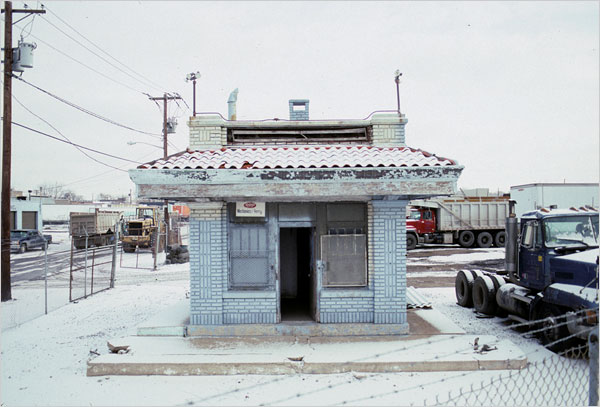 Camilo José Vergara, 200 Second Street, Camden, N.J., 2004.
His concern is the disinvestment and physical decay of a city in decline that triggers the need for reinvestment and urban renewal; images of decline and the effects of decay and abandonment.
July 26, 2010
industrial ruins + the gothic
Shaun O'Boyle has been consistently photographing modern industrial ruins across the United States--interpreting the present past, places and things that still exist, and in some cases, were still in use until quite recently but today are abandoned.
An example is Bethlehem Steel, one of the most powerful symbols of American industrial manufacturing leadership, which shut its doors for business in late 1995:
 Shaun O'Boyle, Bethlehem Steel
How are we to interpret these kind of industrial ruins? Ruins whose depredations are wrought by cycles of capitalist reconstruction which either obliterate buildings or render their contents and the activities which they house instantaneously obsolete, turning solid things and places into air.
Rather than a romantic aesthetic of ruins as archaic monuments, contemporary industrial ruins are more likely to epitomise a sort of modern gothic, part of a wider sentiment which emerges out of a ‘post-industrial nostalgia’, which focuses on ‘dark urban nightscapes, abandoned parking lots, factories, warehouses and other remnants of post-industrial culture’.
For a gothic sensibility, ruins possess the attraction of decay and death, and to enter them is to venture into darkness and the possibilities of confronting that which is repressed. Gothic interpretations usefully foreground continuities with the romantic tradition in which ruins rebuke scenarios of endless progress. Ruins always constitute an allegorical embodiment of a past, while they perform a physical remembering of that which has vanished,
Representations of dereliction echo through resurgent popular gothic cultural forms which espouse the idea that the structures of the modern world are falling down, a notion which extends to an envisioning of the city as a disaster zone. If industrial ruins question the persistent myth of progress, then the gothic is concerned with the disintegration of the ordered.
Gothic interpretations have connotations of gloominess and darkness, and tend to involve a wallowing in melancholia and sense of foreboding of dystopia.
July 25, 2010
Australian photographers: Lauren Hewitt
The images below are by Lauren Hewitt, a Canberra -based photographer who was trained at the ANU School of Art, is from a series on suburbia in Canberra, entitled Familiar Fable; a series about the ordinary places of the urban landscape that draws on the traditions of film noir. Film noir arose from the collision of German expressionism with documentary realism, paralleling the emergence of "the city" as a character.
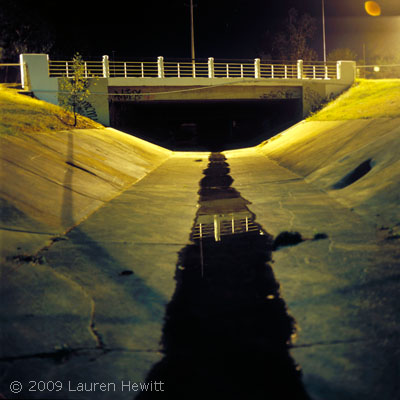 Lauren Hewitt, away from view, from Familiar Fable, 2009
The work was shown at the Huw Davis Gallery at the Manuka Arts Centre in Canberra in August 2009. Cinematic film noir (1940s-50s) is often identified with a visual style that emphasizes low-key lighting and unbalanced compositions, an atmospherics or mood, of small towns or suburbia.
The conventions are dark', downbeat and black and the films express fear, mistrust, bleakness, loss of innocence, despair and paranoia. The primary moods of classic film noir were melancholy, alienation, bleakness, disillusionment, disenchantment, pessimism, ambiguity, moral corruption, evil, guilt, desperation and paranoia. Hewitt says:
This body of work attempts to explore the way the local landscape is represented in the imagination. Capturing locations where sometimes something has occurred, an event, or where there is a hint of a happening, and locations that harbour that potential. Drawing from the traditions of film noir, the familiar scene becomes the unfamiliar. Suburbia, seen from the car window, what we see everyday passes through our awareness, becoming swiftly invisible and unnoticed. Yet glimpses of these shadowed corners can spark the imagination for a fleeting moment, causing the birth of a brief fable, shortly lived, yet lingering.
Film noir films were marked visually by expressionistic lighting, deep-focus or depth of field camera work, disorienting visual schemes, jarring editing or juxtaposition of elements, ominous shadows, skewed camera angles (usually vertical or diagonal rather than horizontal), circling cigarette smoke, existential sensibilities, and unbalanced or moody compositions. Settings were often interiors with low-key (or single-source) lighting, venetian-blinded windows and rooms, and dark, claustrophobic, gloomy appearances.
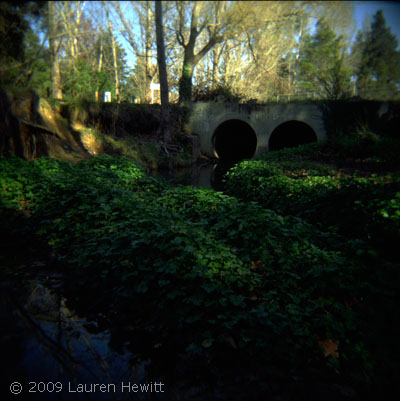 Lauren Hewitt, and here was perfect, from Familiar Fable, 2009
Exteriors were often urban night scenes with deep shadows, wet asphalt, dark alleyways, rain-slicked or mean streets, flashing neon lights, and low key lighting. Story locations were often in murky and dark streets, dimly-lit and low-rent apartments and hotel rooms of big cities, or abandoned warehouses.
Noir is primarily psychological, favoring atmosphere over action.
July 24, 2010
stumbling upon Heidi Romano
I've just stumbled across Tales of Light. It is run by Heidi Romano, a part-time photographer based in Melbourne, who is associated with the Three Stones design studio (that includes fine art photography).
She founded and curates Unless You Will (UYW), a monthly photography journal that showcases some very diverse photography that is primarily European in focus. A quick glance through the different issues indicates that not many Australian photographers have been included, but I haven't checked every photographer in the 7 issues of Unless You Will.
Happy exploring.
July 22, 2010
pretended urban localism?
Andrew Blum, a correspondent for Wired and a contributing editor at Metropolis, has an article on Jane Jacobs and local urban neighbourhoods.
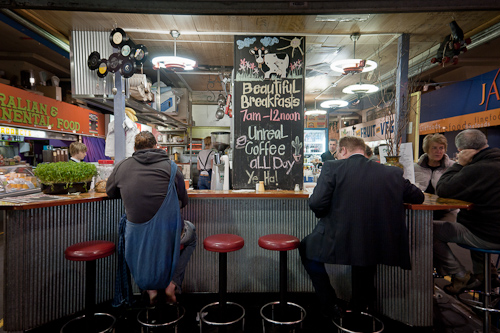 Gary Sauer-Thompson, Central Market, Adelaide, 2010
The preservation of local urban neighbourhoods is a hot issue in Adelaide as people slowly return to the CBD to live. It is mixed use area with low income housing in the south west corner that used to be rejected as a slum. Even though the urban renewal developers have not been really interested there is still a battle for a neighbourhood to help prevent the city from becoming more desolate than it already is. They are not seen as bloggy neighbourhoods.
However, what has been accepted is the idea of lots of people living in diverse, city neighbourhoods. This stands in opposition to the town planning that thins down cities and disperses them over the countryside ie. the Garden City idea that the city just wasn’t any good and that we basically had to replace it with the country. And so we have the fiasco of suburbia.
Blum says that Jane Jacobs:
fought modernist urban planning’s “dishonest mask of pretended order,” and what concerns me today about cities is a corollary: Call it the dishonest mask of pretended localism. Thanks in great part to Jacobs, we talk a lot about preserving neighborhoods, which most often means keeping them the way they are. But for me, preserving an urban community—not merely its architecture, its open space, or its independently owned stores—now means recognizing what the local is made of, the warp and weft of all its pieces, wherever they come from, near or far. And that requires recognizing the global community behind it—for better or worse, in the face of both nostalgia and change.
The conflict for those who live in the inner city is high rise living in the form of a tower of apartments arising from the destruction of some old block. The old must be preserved at the expense of the new is what is often argued by the heritage movement. So we have revival of old-fashioned working class neighborhoods that later have become gentrified.
What is being fought for is a city that is alive. This is an innercity of people in which streets are teeming with people, multitudes of them actually live in the city center in apartment buildings and houses, the footpaths are jammed, in some places until late at night, and the public realm, where the buildings meet the footpath, is activated.
Blum's argument is that the Jacobsean conundrum (and the unspoken subtext of every NIMBY argument) is that the environmental preservation of the future may require the destruction of pieces of the past. But if we can recognize the beauty in its benefit, it won't be a bitter pill. We may be able to reap the global environmental benefit of high-density living without sacrificing the local ties of a medium-density neighborhood.
July 21, 2010
ruined buildings
I have been drawn towards derelict and abandoned buildings. This is not just because they contain the promise of the unexpected, but because they offer an insight into the production of spaces of ruination and dereliction are an inevitable result of capitalist development, the relentless search for profit and economic crises.
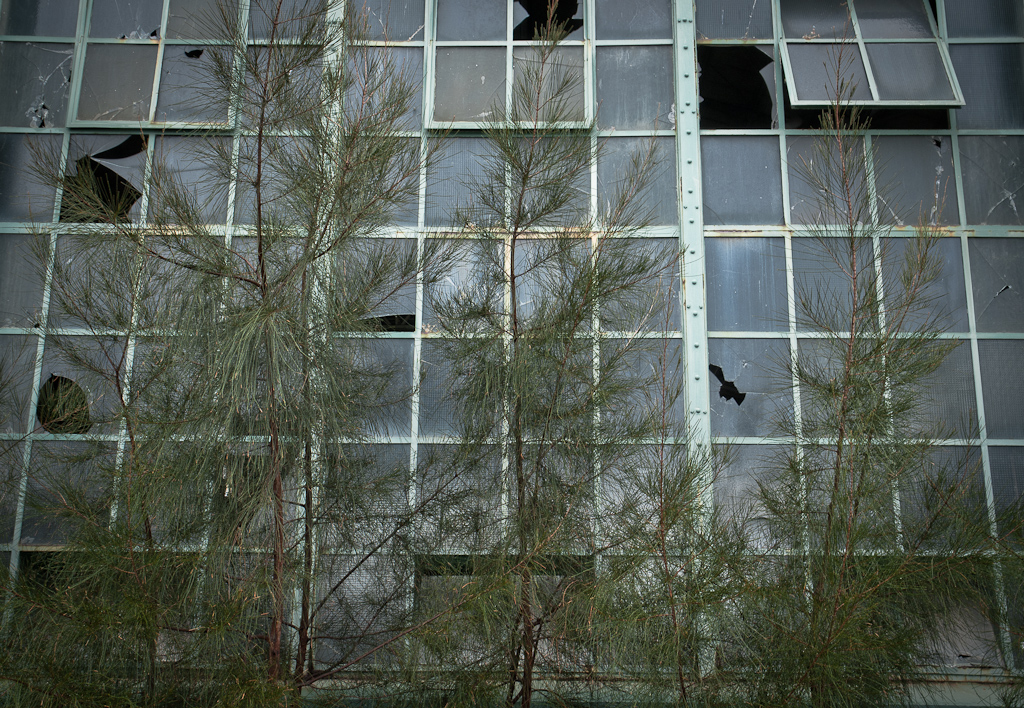 Gary Sauer-Thompson, James Hardie, Port Adelaide, 2010
Some are left to linger and decay for decades, turning into heaps of rubble over the years, whilst others stay for a while until the first signs of decay take hold and then are demolished, and some are eradicated shortly after abandonment.
At present, there are not as many ruins as there were during the 1980s when landscapes of industrial ruination dominated whole areas of cities, as swathes of manufacturing suddenly became obsolete under economic restructuring.
The conventional reading of ruins as spaces of waste is that they contain nothing, or nothing of value, and that they are saturated with negativity as spaces of danger, delinquency, ugliness and disorder. Local politicians and entrepreneurs see the urban landscape of dereliction and ruin as a sign of waste: ruins, for them, signify a vanished prosperity as formerly productive spaces become rubbish and are no longer of any use.
For them neglected land not only looks depressing. It also tends to attract fly tipping, graffiti and fly posting, all of which “uglify” the environment’. Derelict land is identified with crime and ‘deviancy’.
I also see these spaces of waste as spaces of play for children and adults.
July 20, 2010
the cultural landscape
In The cultural landscape at The Philosopher's Magazine David E. Copper spells out the idea of the cultural landscape.
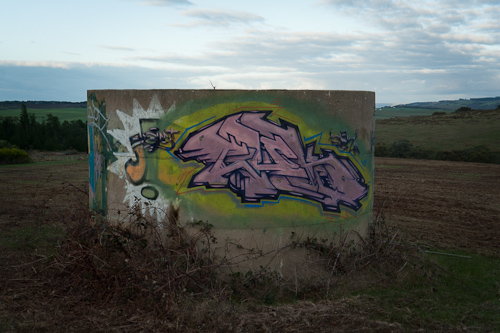 Gary Sauer-Thompson, water tank+ graffiti, Fleurieu Peninsula, 2010
For me attention to the cultural landscape enables insights into the way we do and might behave in our environments, but also provides us access to an understanding of our environments that includes us as part of the landscape.
Cooper says that:
The concept of cultural (or human) landscape has circulated among geographers for a century, but its welcome prominence in philosophical discussions is a very recent development – the result, in large part, of the enthusiasms of several Scandinavian philosophers. Actually, these writers use the expression in two ways. For some, it refers to landscapes – even virgin jungles and mountain wildernesses – that are invested with cultural significance. For most writers, including me, it refers, however, to landscapes that saliently bear the mark of human intervention and control – to farmland, parks and gardens, managed woods, climbed hills, and swum off beaches: to places that, typically, are cultivated as well as culturally imbued.
He adds that if aesthetics is to free itself from the influence of the art versus craft divide, then cultural landscapes, alongside other objects of everyday engagement, must come under its remit.
Copper adds that:
The older environmental ethics presupposed a sharp distinction between nature (“wilderness”) and the human domain – a distinction that has also plagued philosophical anthropology’s attempt to locate the human in relation to the natural. Views have tended to swing between a picture of experience of the world as a Promethean human construct, and a conception of it as, essentially, the passive effect of objective natural processes. Attention to cultural or “hybrid” landscapes can provide a sharp reminder of the implausibility of separating, even notionally, the possibility of human creative practice and a way of experiencing the natural world. The historically and philosophically alert landscape designer and farmer know that the goals they pursue could not have been envisaged except against a background experience of nature that has itself been shaped and enabled by traditions of human practice.
The idea of a cultural landscape helps us to understand the natural environment not only as something apart from us which our modernization has exploited furiously, but also as a series of processes of which we are part, and within which we have had a long history.
July 19, 2010
landscape + memory
Simon Schama in his Landscape and Memory, examines the relationship between Western culture and nature and the way that our cultural framing shapes the land or wilderness as a landscape.
 Gary Sauer-Thompson, Boomer Beach, Port Elliot, South Australia 2010
Schama argues that:
So while we acknowledge (as we must) that the impact of humanity of the earth's ecology has not been an unmixed blessing, neither has the long relationship between nature and culture been an unrelieved and predetermined calamity. At the very least, it seems right to acknowledge that it is our shaping perception that makes the difference between raw matter and landscape. (p.9)
Well we know that wilderness is culturally constructed or framed in terms of the picturesque or the sublime. Schama adds to this by saying that the entire landscape tradition is the product of a shared culture, a tradition built from a rich deposit of myths, memories and obsessions.
Schama goes on to say that some environmental historians have lamented the annexation of nature by culture. Whilst not denying that the landscape my be a text on which generations write their recurring obsessions they--eg., Stephen Pyne, William Cronon, Donald Worster--- have made:
an inanimate topography into historical agents in their own right. Restoring to the land and climate the kind of creative unpredictability conventionally reserved for human actors, these writers have created histories in which man is not the be-all and end-all of the story
Their story, however, is a dismal tale:--of a land taken, exploited and of traditional cultures said to have lived in relation of sacred reverence with the soil being displaced by an aggressive settler capitalism.
Schama contest the dismal narrative by a different way of looking; of rediscovering what we already have but which eludes our recognition and appreciation.
July 18, 2010
Farmers market
We have started to shop for fruit and vegetable at the Farmers Markets in Willunga and Victor Harbor for fresh regional food when we are down in Victor Harbor. I find it the shopping more enjoyable than in the fruit and vegetable shops and the farmers are getting a better deal.
 Gary Sauer-Thompson, Suzanne, Farmers market, Willunga, SA
These community based farmers markets are very successful in South Australia, and I would have thought that the local Councils would support them as they bring people into the area and help to foster local production.
Not so in Victor Harbor. There the local council only sees the successful farmers market as a way of making money. They propose to increase the rents of the stalls from $90 to $250 a week and to demand a $3000 contribution to the upgrade of the supply of power to Grosvenor Gardens. Instead of supporting the community based farmers market and nurturing it , the small traders who run the local council are placing impediments in the way.
July 14, 2010
POOL: the collaborative projects
Whilst writing this post on conversations I came across a reference to collaborative projects for photos and videos that use sites such as Flickr and YouTube to coordinate joint effort. An example given was Pool, the user‐ generated content site operated by the Australian public broadcaster ABC. This provides its own platforms for collaborative multimedia work.
I did not know about the Pool prior to stumbling onto it.The ABC says:
ABC Pool is a social media space that brings together ABC professionals and audiences in an open-ended process of participation, co-creation and collaboration. It’s a place to share and talk about creative work - music, photos, videos, documentaries, interviews, animations and more.The project is using open rights frameworks to explore this new territory with our research, community and education partners. We’re conducting research in action at the intersection of broadcast and participatory media.
The collaborative projects that catch my eye, in so far as they relate to my work, are the Rivers and Country Viewpoint ones. I've joined and posted to the Rivers group.
Alex Bruns says:
produsage is rapidly establishing itself as the standard mode of organisation for community‐driven, collaborative content creation online; produsage communities are building significant new creative and informational resources and in doing so are beginning to challenge the established industries in their fields.
Pool is an example where professional creative professionals and other creative professionals are beginning to find common ground and to arrange themselves in cooperative frameworks.
July 13, 2010
going pro in a high tech world
I'm still recovering from the shock of what Apple's Mac Pro tower computer and Cinema HD computer screen for Encounter Studio is going to cost me. The prices have gone up in Australia, not gone down as they have in the US.
I was thinking of a $5000 outlay maximum. I'm actually looking at $A7000 for machinery that has a short lifespan. No money has been spent on high end software for post production yet. (eg., Adobe Creative Suite) I'm shell shocked after my experience of the aestheticisation of commodities. Going pro sure is expensive.
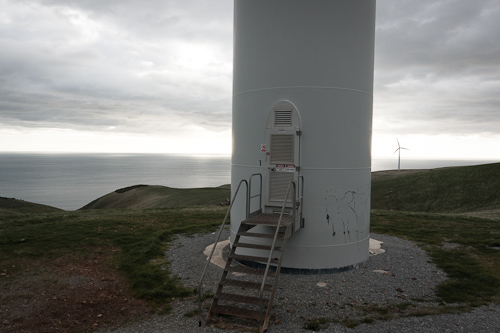 Gary Sauer-Thompson, Starfish Hill, South Australia, 2010
I recognize the way that Apple exploits the productive capacity of representation itself; by which their commodities gain added value by virtue of their mode of appearance. Advertising is the mythicisation of commodities, their transformation into a fetish that openly parades its fetishism and incessantly work to bewitch us. And we are--and so the habit of borrowing and buying becomes an addiction.
There is something strange about being immersed in the mystifying consumer world of the branded factory produced technology, in which the gleaming fetishized objects on display are almost indecipherable. This is a strangeness in the sense of cultural amnesia; a kind of structural forgetting; a destruction of the past. What matters is the latest gleaming whiz bang machine on display. This is celebrated whilst the past is devalued as old and forgotten. The focus is on the future, which somehow resides in the present, shaping it for us.
If the future is always better than the past in this world technology, then it is hard to remember what has been in this glossy world of consumerism, in which buying objects for consumption and so participating in commodity exchange, appears to be disconnected from everything else.
My sense is that what is being, or has been, forgotten in this bewitching commodity form in a world of information-intensive technologies is profound. But what has been lost in this form of cultural forgetting? Our natural roots? Place? Ecological processes?
The classic Marxist answer is human labour. As Paul Connerton says in How Modernity Forgets:
when we speak of a place such as Chicago, or the countryside, or France, we are always in danger of forgetting that these are places created in long processes of labour. Their identity is always, and always has been, in process of formation. The identity of place is always embedded in the histories which people tell of them, and, most fundamentally, in the way in which those histories were originally constituted in processes of labour. Whenever we talk about places, what is at issue, whether we acknowledge it or not, are competing versions of the histories in the process of which the present of those places came into being. Whenever we speak about the identity of a place, therefore, we run the danger of imputing to that place a false ‘essence’, by abstracting it from the history of the place itself.
This abstraction from the history of place, he says, flows from our perception of place being filtered through a spatial mapping, which in turn, entangles us even more in a process of forgetting. Yet place is never a fixed spatial entity but always a social process in transformation that become the locus of institutionalised power and culturally specific perception.
July 11, 2010
craft + photography
In The Craftsman Richard Sennett argues that craftsmanship is broader than “skilled manual labor", which is how many photographers understand their technical photographic skills. Craftsmanship names the basic human impulse to do a job well for its own sake and good craftsmanship involves developing skills and focusing on the work rather than ourselves.
 Gary Sauer-Thompson, landscape + windfarm, Cape Jervis, SA, 2010
Craft, as Sennett sees it, belongs to the category of "social capital": knowledge and skill that are accumulated and passed on through social interaction, and which are easily lost when social customs change.
In his review of Sennett's text in The Sunday Times Roger Scruton observes that:
The Craftsman continues an argument begun in the 19th century, when writers such as John Ruskin and William Morris extolled the crafts remembered in our surnames (Smith, Cartwright, Thatcher, Mason, Fletcher) while lamenting the mind-numbing and soul-destroying labour of the industrial process which was replacing them. A long line of thinkers, from Hegel and Marx to Sennett’s teacher Hannah Arendt, have sympathised with the argument. But Sennett does not think that craftsmanship has vanished from our world. On the contrary: it has merely migrated to other regions of human enterprise, so that the delicate form of skilled cooperation that once produced a cathedral now produces the Linux software system.
Sadly, the institutions and enterprises of contemporary social and economic life in capitalism are not primarily about creating opportunities for nurturing craft skills. They are about closing down the ambiguities of the world in the name of ever tighter efficiency, or they are in the business of profit generation. Craft is what is sidelined by Taylorism in the name of efficiency and profit in the print, radio, television and advertising industries.
In opposition to this we have the Arts and Crafts movement's idealization of the individual atelier as a bulwark against “alienated labor”, which has remained widespread even now, as new disciplines, such as digital craft, challenge the primacy of traditional photographic processes.
Photographers often see themselves as artists rather than being part of the crafts because craft is marginalised, ignored, and simply not accepted as a subject worthy of attention by the media, policy makers or critics.
July 10, 2010
Stuart Franklin: landscapes in flux
Our landscapes are in flux. We know that from a history of farmers in Australia having cleared the land of native bush and scrub to both graze sheep and cattle and to grow crops. Often that farmland appears to be natural, even though the landscape has been radically altered by humans to make it a resource to be used for profit.
Stuart Franklin represents a landscape devastated by the hunt for fossil fuels. He says:
Sixty per cent of Greece’s electricity is derived from lignite (brown coal). This involves bulldozing whole landscapes to feed the nearby power station. In Megalopolis I found Greece’s second largest lignite mine. The village of Anthohori in Arcadia was wiped off the map - the church of Santa Maria was all that remained.
 Stuart Franklin, Greece from Footprint: Our Landscape in Flux
Landsapes in flux is a cool idea given the hunt for natural resources that s destroys farmland and global warming.
What we have here is a form of ecological thinking that assumes a dialectical nature that tacitly rejects the outmoded notions of balance or harmony in nature.
July 9, 2010
in the studio
I've been struggling all this week to get the PC computer running Windows XP at Encounter Studio at Victor Harbor to function properly. The computer is old --4+ years--and it is on its last legs. I refused to upgrade to the crap Windows Vista operating system that didn't function. It was junk.
I loaded Lightroom 3 yesterday and it wiped out my idiosyncratic filing system from Lightroom 2. Now I have 5000-6000 images in one great bloody mass. How do I order that into files? Or do I just leave it and move on with new material? More time is required on the internet.
 Gary Sauer-Thompson, flower study 2 Encounter Studio, 2010
It's just not learning new software that is causing my angst. The PC is slow, Windows XP is crashing continually, and the backups of my photos to the Lacie Hard Disc take ages. It looks as if some serious money is going to need to be spent on upgrading the system, and bringing in tech support to set the studio network up so that it functions smoothly.
I kinda feel helpless with all this tech stuff that a creative professional now needs to do post production work and have a smooth work flow. It's been DIY but I've reached the limits.
The core problem with Lightroom 2 was that as my image library grew the performance of the application became sluggish and clunky. It defeated the purpose of what Lightroom was supposed to do i.e. that it act as an image library where you could sort images by metadata, camera type, lens type, ISO etc. and to create collections based on different criteria.
I also suspect that Lightroom 3 just doesn't work very well on Windows XP, and my guess is that this operating system is getting too old. So I'm hesitant to upload Silver Efex Pro onto this old PC. It would seem that the software forces the computer and operating system upgrade.
A major upgrade is something I had been putting off even though it was coming in a year or so when the PC would finally die. I cannot put this off any more as the Windows XP keeps freezing so frequently that I cannot even back up my image files. So it looks as if I make the shift to a Mac Pro with a big screen and automatic backup. That's $6000. Apple's products are a wallet-buster.
I just want a computer system that works smoothly so that I can concentrate on the photography. So its "> goodbye to Microsoft from this creative professional.
July 7, 2010
Geoffrey Gurrumul Yunupingu: Wiyathul
Geoffrey Gurrumul Yunupingu singing Wiyathul, the opening track on his first solo album.
An earlier entry on junk for code---Djarimirri---performed with Michael Hohnen at the Darwin Festival 2006. A portrait.
More music at conversations.
July 6, 2010
flower study 1
I'm enjoying my time at Victor Harbor taking the dogs for a walk in the morning and the evening and thinking about, and doing, photography on a full time basis during the day and listening to music streaming from online archives.

After all the expense in setting up the studio (Rolleiflex 6006; studio stand, light reflectors etc) I'm finally able to spend some time in the studio taking photos.
I can see why studio photographers have shifted to digital--it is so convenient. You take the shot then upload onto the computer, post process, then publish the image. But medium format digital is big money. It's for the big photography studios who do the expensive advertising work for large corporations or for the magazine shoots for those with deep pockets.
I'm just happy working away on a still life with film whilst listening to a Grateful Dead show at the Capital Theatre, Port Chester NY, on 24 9-06 1970--the high energy improvisation starts at track 33, Not Fade Away. The close up still life studies requires precision work --in terms of colour, light and shape--and the music is relaxing whilst I move things around. The plan is explore the Heliconia wagneriana plant in colour with a medium format camera, then switch to black and white with an 8 x10. view camera. That should get things in the studio moving.
The artist's studio--like the gallery and the museum--is an integral part of the art institution of system. The the studio is the unique space of production, the museum is the unique space of exposition and the gallery is the unique space of consumption.
July 5, 2010
a personal moment
Suzanne is up in Brisbane, Queensland, for a weeks holiday with her sister Barbara and partner Mal (their blog). I'm down in Victor Harbor with the poodles, experiencing South Australia's winter of mild days and cold nights. I'm listening to music and seeking a space away from neo-liberalism's market mode of governance that creates a perpetual anxiety in us, and then privatizes stress.
 Gary Sauer-Thompson, Agtet, Victor Harbor, 2010
I plan to spend the week down here working on some small photographic projects: some studio work, some landscape and some urbanscape. The latter is exploring the various crosses that mark road deaths and injuries on the main highway from Adelaide to Victor Harbor and Goolwa.
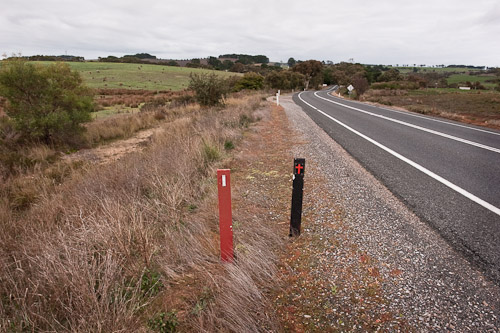
Gary Sauer-Thompson, crosses, Victor Harbor Rd, 2010
It is edgy work as the cars roar past at a 100km and there is not much room on the side of the road to set up tripods and cameras. So I am reluctant to use large format gear and a darkcloth.
There have been a lot of deaths on the highway from Adelaide to Victor Harbor or Goolwa for a variety of reasons: unsafe road, drink, speeding. The project is one way to explore a meaning ladened landscape that appears to be natural.
July 3, 2010
a creeping cultural conservatism
In his review of Jim McGuigan's Cool Capitalism in the New Statesman---- The Age of Consent”--- Mark Fisher from k-punk says:
The story of this decade has been about the defeat of bohemia by business. Now business wants not only to control culture, but to be culture, too. On the other hand, culture prostrates itself before business, like a cowed kid sucking up to a swaggering bully.
Our visual culture is mostly advertising, culture under neo-liberal mode of governance is all about ”market forces”, and museum policy, eco-tourism, and corporate branding have incorporated elements of counter-cultural critique.
Where once cultural value was deemed sufficient justification for art-oriented activities, now cultural value is subsumed into economic value. Everyone has to justify culture's marketability - culture becomes valuable only because it contributes to the economy. This suggests that capitalism now incorporates disaffection into capitalism itself, absorbing rebellion and thereby neutralising opposition to the present system of culture and society.
Fisher's concern is with the creeping triumph of a cultural conservatism that has insinuated itself so thoroughly into mass media that it now goes unperceived. You can sense it in the lack of both a political motivation and a critical edge in contemporary cultural studies; a consequence of its embrace of cultural populism. This involved hitching culture to the market and to government policy.
Fisher, however, is ever hopeful:
...the 2008 bank crisis robbed the business class of much of its credibility. So much of popular culture - all those property and home improvement shows, as well as the reality/entertainment matrix - now looks like the relics of a bygone era: glossy ruins that are still standing only because there is nothing yet to bulldoze them away. But if bohemia can rouse itself from defeat and depression, the cultural terrain seems open for contest in a way that it has not been for a long time.
Its true that the old neoliberal story is no longer viable. But where is bohemia these days? Does it still exist? Is it Richard Florida's creative economy and urban regeneration? Or the cultural bloggers in digital world? Is cyberculture the new bohemia? One that has little nostalgia for the exhausted paradigms of the old left.
Bohemia, if it is to have any meaning, must be concerned with the free development of culture, of creativity and resistance to the market and the state. It implies that there is still some space left for rebellion against the seductive power of the free market economy. This resistance needs to be connected to the digital public sphere.
In this interview Fisher refers to the work that had been developed on the blog networks, which was then picked up by Zer0, which, in turn, established a para-space, between theory and popular culture, between cyberspace and the university.
July 2, 2010
Evangeline: two versions
The first version is the well known folksy/country one by The Band and Emmylou Harris from the Last Waltz movie movie that was filmed by director Martin Scorsese in 1976. This version was done post the concert , and it was included in the film, rather than the live version of Evangeline.
Though there would be three more albums years later without Robertson, for the original quintet of The Band it ended with the release of the album and the film of the same name. So ended a chapter in the subtle fusion of modern music and old-time musical sensibilities.
Then I came across this version of Evangaelene on YouTube -- the concert version from The Last Waltz?-- it's a more electric and rockier interpretation, slower and ponderous :
The soundtrack recordings of The Last Waltz underwent post-concert production and they feature heavy use of overdubbing and re-sequencing owing to the many faults during the concert. I prefer the bouncier folky version.
In 1983, the Band reformed and recommenced touring, though without Robertson. Several different musicians were recruited to replace Robertson and to fill out the group. Richard Manual committed suicide in 1986 and Rick Danko died in 1999. Levon Helm is still making roots music and recording.
July 1, 2010
land use
The Jen Bekman Gallery's current Land Use Survey group exhibition features photographs, paintings and works on paper in a critical appraisal of land use across the United States. The press release says that the:
The show opens with a series of landscapes that remain untouched by man. Slowly, signs of human intrusion begin to appear: car tracks, empty bottles, a retaining wall and piles of dirt. As one progresses through the exhibition, both in the gallery space and within the areas described by the works, increasingly more land turns over to commercial and residential development, before finally giving way to the dizzying geometries of the modern metropolis.
This kind of thematic work is not generally shown in Australia, even though the issues raised by the work are similar.
 Beth Dow, Gravel, platinum palladium print, from Fieldwork series
This photographer of the land is concerned with ordinary spaces and "sculptured objects" in the Fieldwork series. We have a small heap of work site gravel or piles of wood or mulch that signify the human use, and transformation of, the land.