August 31, 2010
Edward Burtynsky: Oil Spill
Edward Burtynsky has taken aerial photographs of the oil spill in The Gulf Of Mexico. Burtynsky has explored the theme of oil for more than a decade, from the Alberta oil sands to Baku, Azerbaijan, one of the earliest sites of oil discovery.
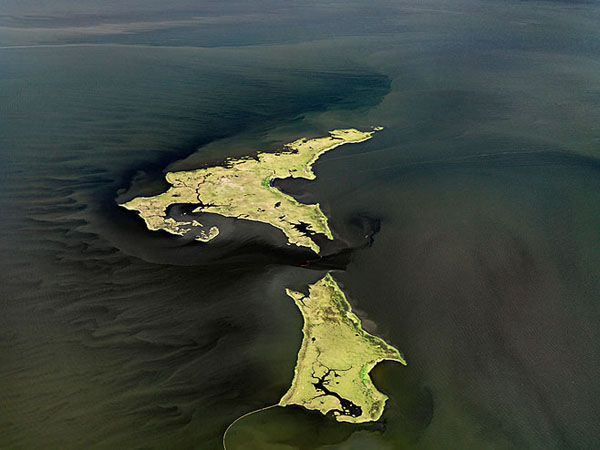 Edward Burtynsky, #14, Marsh Islands, May 12, 2010, chromogenic print
This Oil Spill work can be seen as adding to his body of work entitled Edward Burtynsky: Oil that documents the effects of oil on our lives. This work is also a traveling exhibition.
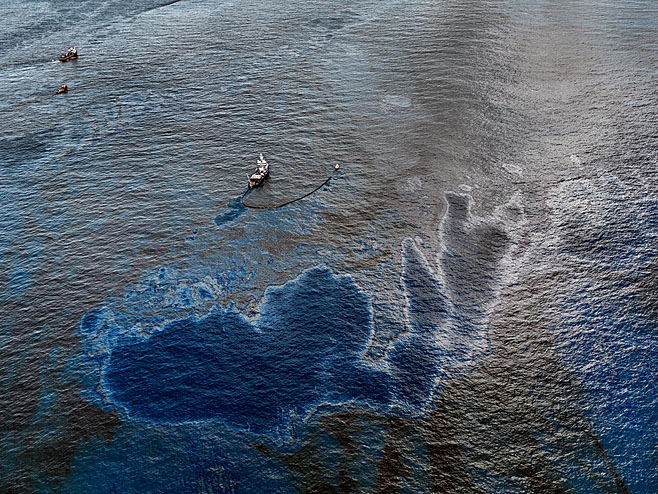 Edward Burtynsky, #4, Oil Skimming Boat near Ground Zero, May 12, 2010, chromogenic print
Burtynsky has traveled the world for more than a decade photographing polluted oil fields, crisscrossing highways, manufacturers’ lots overflowing with new cars, and wastelands of discarded tires and junked vehicles.
August 30, 2010
the (re)turn to large format photography
Apparently, there has been a turn back to large format photography, including 8x10. This is in spite of he besieged mentality has settled over anyone who still shoots film, the slow death of 8x10 monorail, the worries that the classical manufactures not turn out new product, and the fears about commitment by film companies to continue manufacturing film. Has the market seems to have stabilized?
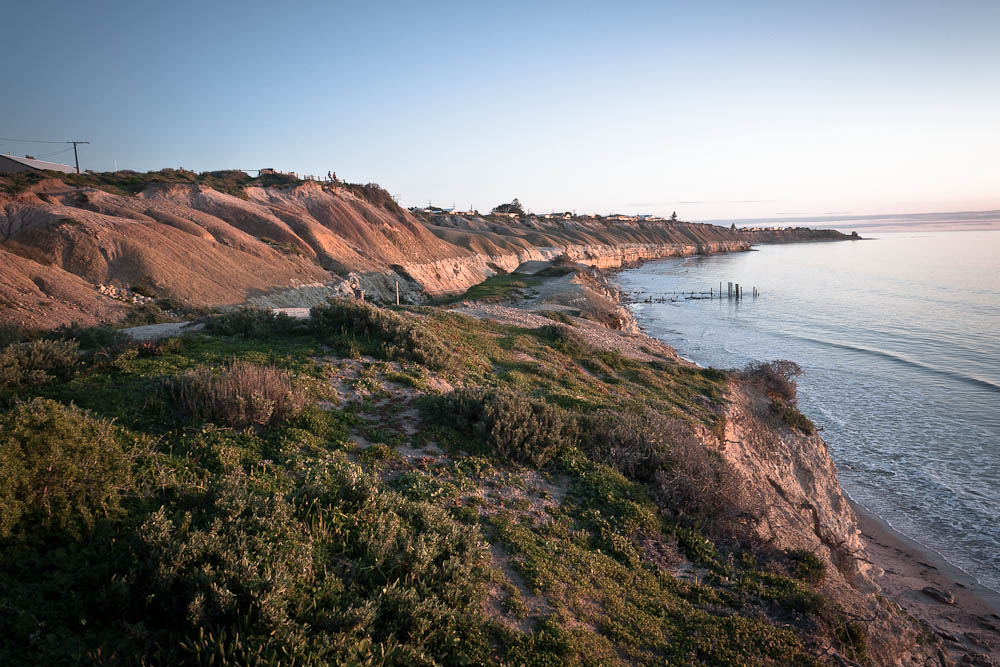 Gary Sauer-Thompson, Port Willunga, study for large format photo, 2010
The professional commercial photographers and news photojournalists have shifted to, and will remain with, digital, due to client demands. The commercial world is pretty happy with their 39 megapixel digital backs. It is the serious amateurs (either either retired or have full-time jobs) and fine art photographers have shifted to large format. When going to new locations I use my digital camera as a scouting shot--or “sketch pad” of sorts --- for future 5 x 7 and 8 x10 images.
Large format photography has moved into the same sort of area as wood carving, and print making etc.-- a craft with its own niche and ethos. As Fred R. Conrad at the New York Times reminds us with large format the process is slower as it takes time to set up the camera and to visualize what you want.
In this world you still come across the digital Luddites who have a vested interest in maintaining the exclusive use of "pure" photography for themselves and who suggest emphatically that somehow digital is not the real thing. It's largely a case of the old school hating the new school.
August 29, 2010
Australian photography: Ronda Wallis
In an earlier post I mentioned the Shimmer Photographic Festival that was organized by the City Of Onkaparinga. As part of this photo biennale there was a 'Meet the photographer' session at the Arts Centre Port Noarlunga.
I had intended to go to the session but wasn't able to. So I will explore the different photographers talking at the session on junk for code over the next week or so. One of those speaking was Ronda Wallis, a South Australian photographer whose work I did not know, and whose roots are in the low tech or toy camera end of photography.
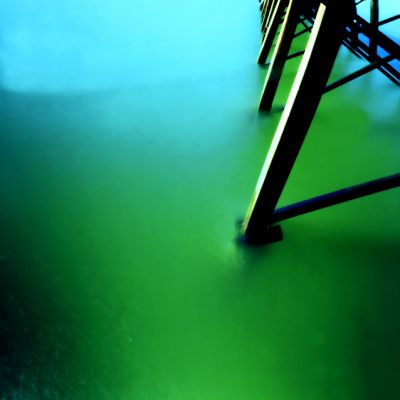 Ronda Wallis, How Deep/Green Sea, 2005, Pinhole Cibachrome from Beckon a Deep Ocean
Wallis' images from her Beckon a Deep Ocean are concerned with the coastal environment, are characterised by a low angle of view and a measure of distortion, and are taken using pinhole cameras the work shifts the viewer’s usual perspective.
There is a sense of colour-field painting in some of the images of the suburban beach that is coupled with a reference to the sublime. This is not a beach for summer frolicking and play in gentle surf. It is a sea that one is wary of. It expresses danger; a sense of being overwhelmed. An image that evokes our memories of the sea as a child? Is the pinhole camera perspective akin to one reminiscent of childhood – a time during which our sense of self develops often influenced by the surrounding landscape.
August 27, 2010
Beach Boys: Holland
I just stumbled across this song cycle from Holland--its a salute to their native state of California.
Holland followed Sunflower and Surf’s Up, which were technically complex and musically superior releases "Sail On Sailor" and “Trader” were the other two stand out tracks on Holland
August 26, 2010
urban waste
The city is primarily a space for commerce. A space where buying and selling is the order of the day, and indeed night. The retail section presents as a juxtaposed collection of disparate window displays, all vying for the unreasonable and excessive attention of the passing public, trying to seduce them into the game of consumer fetishism that embodies the vision of freedom through lifestyle consumption in a neoliberal world.
Today we see people; especially the middle classes, increasingly retreat into suburban havens that include shopping malls. They no longer partake in the culture of street life but rather disengage it, both geographically and politically. When they walk the city streets it is for work or shopping. They walk past the cultural detritus of the present and the past, avoiding the unclean consumer waste on the street or in the parklands, muttering that there is a need to ‘clean up’ the debris.
 Gary Sauer-Thompson, waste, Adelaide parklands, 2010
Of course, there are other forms of waste in the city--the idle of bodies of the homeless, mentally ill, aborigines, unruly public drinkers, drug users. The attitude is that there is a need to remove the waste, to ‘clean up’ the streets.
The moral economy of waste is at work in the moral economy of urban renewal of wasted spaces that are earmarked for regeneration and revitalisation projects.
August 24, 2010
Exposed: Voyeurism, Surveillance and the Camera
The Tate Modern has an exhibition entitled Exposed: Voyeurism, Surveillance and the Camera. It refers to the different ways that the camera has been used to make images surreptitiously and satisfy the desire to see what is hidden.
If the unwieldy nature of early photographic equipment made it very difficult to capture people unawares, then the classic Leica (film camera) made it easy:
 Harry Callahan, Atlanta 1984
The Callahan image is in the first section of the exhibition, which considers ways in which photography can reveal the world unawares and show people caught with their guard down.
Susan Sontag saidi n her 1977 book On Photography:
‘there is an aggression implicit in every use of the camera’, one which ‘may presume, intrude, trespass, distort, exploit, and at the farthest reach of metaphor, assassinate – all activities that … can be conducted from a distance, and with some detachment.’
Photography is a licence to spy and pry, to transgress, shock, provoke and, above all, to invade the privacy of others. It is an unspoken question that permeates the history of photography, but has received very little critical discussion.
Today, photography itself could be said to be under siege despite the emergence of our surveillance culture in which security cameras silently monitor from a distance individuals, groups, entire cities.
August 22, 2010
space + place
Space and place are complex.Though different concepts, they merge into one another. Nonhuman animals also have a sense of territory and of place. Spaces are marked off and defended against intruders. Places are centers of felt value where biological needs, such as those for food, water, rest, and procreation, are satisfied.
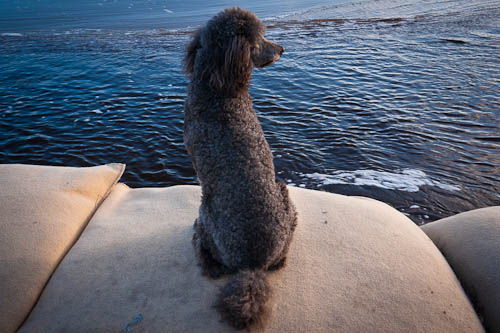 Gary Sauer-Thompson, Agtet, Hindmarsh River, Victor Harbor, 2010
Yi-Fu Tuan in his Space and Place: the perspective of experience says:
"Space"and "place" are familiar words denoting common "experiences. We live in space. There is no space for a another building on the lot. The Great Plains look spacious. Place is security, space is freedom: we are attached to the one and long for the other. There is no place like home. What is home? It is the old homestead, the old neighborhood, home- town, or motherland. Geographers study places. Planners would like to evoke "a sense of place." These are unexceptional ways of speaking. Space and place are basic components of the lived world; we take them for granted. When we think about them, however, they may assume unexpected meanings and raise questions we have not thought to ask.
The ideas "space" and "place" require each other for definition. From the security and stability of place we are aware of the openness, freedom, and threat of space, and vice versa. Furthermore, if we think of space as that which allows move-ment, then place is pause; each pause in movement makes it possible for location to be transformed into place.
August 20, 2010
Carolyn Drake: Hasankeyf
Carolyn Drake has chronicled areas threatened by Turkey’s Southeast Anatolia Project. Among them is the town of Hasankeyf which is situated along the Tigris River in Turkey sixty-five kilometres upstream from the Syria and Iraq borders. The town, along with more than fifty villages scattered along the banks of the Tigris, will eventually submerge under the floodwaters of the Ilisu Dam, when it is completed in 2013.
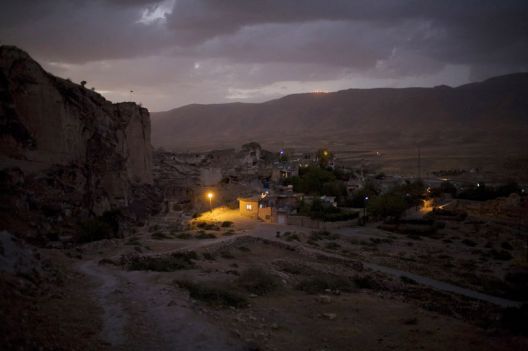 Carloyn Drake, Hasankeyf, Turkey
The Ilisu Dam, will displace thousands of people and cover most of the archaeology that’s built into the landscape. The twenty-two dams that constitute the project will help modernize Turkey’s poorest region.
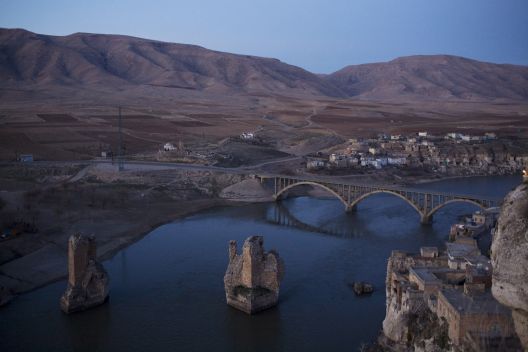 Carloyn Drake, Hasankeyf, Turkey
The aim of the Southeastern Anatolia Project (Turkish: Güneydoğu Anadolu Projesi, GAP) is regional development based on irrigated agriculture. Most of the thousands of villagers adversely affected by these projects do not appear to have been consulted at all about the dams and many of whom want to return to reservoir areas, having already been displaced by the recent conflict in the region. The overwhelming response in particular from women and their organisations is one of opposition to the negative impact on them and those in their care; yet women have been the least consulted sector.
August 19, 2010
unable to post
I could barely do my online work whilst I was down at Victor Harbor this week. Although this coastal town is on the urban rim of Adelaide, we are only able to access ADSL because of Telstra. The backhaul transmission link is owned by Telstra and it is the only link. Telstra is a monopolist and it has not time for the regions, other than to prevent a competitive market emerging.
After the recent storms the internet was clogged up or blocked. I could barely post. It would take ages to download and I could barely upload material to my weblogs. It had been like that on the weekend and it continued all week. It was hopeless to work with.
Was it the backhaul transmission link to Adelaide that was causing the bottleneck problem? Or the "last mile" Telstra line to the exchange? I had no idea, as the connection was so slow I couldn't get out to the Internode website to see what was happening. The telecommunications problems faced by regional consumers are particularly stubborn, and they have been used as a ransom note in conflicts between Telstra and Government for a decade or more.
Telstra management say that they are simply determined to try to maximize profits once they'd been privatised, and that the regions didn’t fit in that picture.They would rather not have to invest in these low-margin, high cost customers, even though it has banked banks billions in profits a year. As an effective monopolist Telstra saw the consumer pressure for better services in regions as leverage for either more money in subsidies, greater regulatory advantage, or both.
Telstra has turned on ADSL2 where customers could buy it from someone else. If you were lucky enough to have a competitor investing in your exchange, Telstra would rush to follow. But the cost to competitors to use Telstra backhaul line was kept high enough to prevent them from investing in an ADSL2+ network. So broadband competitors are locked out of regional markets because the price just to get to many towns is prohibitive. There’s one road in to town, and Telstra sets the toll.
Little events like this indicate why we need the backhaul monopoly broken.This is being done with a national broadband network with its fibre-to-the-home and altenative backhaul built to fix the blackspots. Victor Harbor is one of the blackspots, and we need a backhaul link is genuinely competitive. An alternative backhaul transmission link is being built. It cannot come soon enough.
What happens next after March 2011 when the alternative backhaul transmission link has been built? Does it make sense for an ISP business like Internode to continue to invest in DSLAMs that use the old copper network when a new fibre, wireless and satellite network is coming along? If iTelstra decides to play hard ball, it could take two years for a new DSLAM investment by Internode to get switched on.
Telstra’s strategy is to try to bind competitors to its ADSL2+ wholesale service, rather than them to invest in DSLAMs in its regional exchange. It reckons that it has market power in regional locations and it determined to hold on to it. Tha tis why we need a national broadband network with Telstra as just a retailer.
August 16, 2010
returning to Victor Harbor
I've returned to Victor Harbor via the Shimmer Photographic Festival organized by the City Of Onkaparinga. I wanted to have a look at the interesting 'Now and Then' exhibition by Tony Kearney and Sandra Elms at the Wirra Wirra Winery in McLaren Vale. McLaren Vale is one of the key wine regions of South Australia
 Gary Sauer-Thompson, rocks + sand, 2010
I'm just playing around with computer software---Silver Efex Pro---in order to get my eye back into black and white when I start sbooting with my old 8 x 10.
The new bellows for my old Cambo 8x10 view camera is on its way Adelaide from Custom Bellows in England, and I reckon that I will be using it in a couple of weeks. I have a couple of black and white shoots lined up along the rocky foreshore below the clifftops near Victor Harbor whilst I'm waiting for colour film to arrive from the US. shots that will require me to lug theheavy Linhof tripod and Cambo camera over my shoulder, or one in each hand with a pack on my back.
Therein lies the problem with using a Cambo 8x10 view camera in the field. It is difficult to transport once you have left the car as it cannot be folded up into a box like a field camera. It is bulky, awkward to carry and dam heavy--a big, heavy, metal monster. I bought it because it was usable in terms of movements and cheap but it requires a fitness program at the gym to be able to use it in the field--ie more than a few feet from the car.
August 15, 2010
photography in itself?
in the opening pages of his Camera Lucida Roland Barthes writes that he wished to identify photography‟s “essential features” through a phenomenology, and that “[he] wanted to learn at all costs what Photography was "in itself‟”. However, Camera Lucida has little to say about photography at all, as it is more a meditation on representation and mourning.
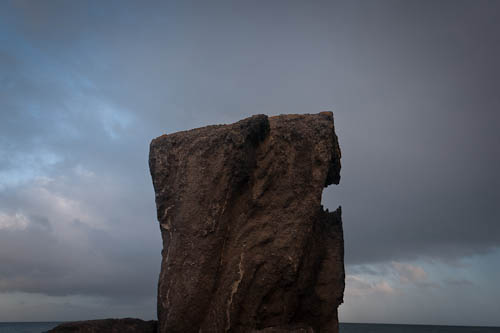 Gary Sauer-Thompson, rock + cloud, Victor Harbor, South Australia 2010
I am not really convinced that we should be talking about what what Photography is "in itself‟ meaning that it has universal, necessary or essential characteristics. I've tended to see it as a form of print making, but this is no longer possible given the digital turn in photography and our habits of looking at photographs as digital images on the web (eg., Flickr, or on photographer's websites).
Many have said that a necessary characteristic of photography---that which makes it what it it is--- is the mimetic or resemblance relationship but that is weakened by computer graphic software. Ron Burnett in Camera lucida: Roland Barthes, Jean-Paul Sartre and the photographic image says:
Crucially.... a photograph of Clint Eastwood, to take another example, has at best a very distant connection to the "real man". The various levels of signification which constitute his symbolic existence pivot not around his absence but around the impossibility of his presence. In that sense a photograph doesn't replace him, but is merely part of a vast system of signification into which he is constantly placed and which precludes the possibility of Eastwood ever coming to life as an exemplification of what he has come to signify. It is in this sense that he is a production. Inter-views with the "real man", newspaper articles about him, films in which he acts, all of these merely confirm a continuing spiral away from the simplicity of reference.
This image re-presents reality anew since the image in and of itself, does not name what it depicts. Photography was a continuation of older "naturalistic" pictorial codes in which photography masqueraded as a transparent and incorporeal intermediary between observer and world. The picture is taken by a machine, which as an optical device, is 'embedded in a much larger assemblage of events, codes and powers'.
Does it involve a transformation in the nature of visuality as equally profound as the break that separates medieval imagery from the Renaissance perspective; a post photography?
August 13, 2010
Alejandro Cartagena: Suburbia Mexicana
The project Suburbia Mexicana explores the major transformation in the landscape was taking place in Mexico city. Both private and public sectors are enforcing it and thousands of serial houses are being built. Cartagena says:
The economic strategies, implemented with a new publicly financed plan, had deliberately excluded urban growth from the metropolitan planning regulation. This allowed developers to design urbanization for profit rather than for the community’s well-being. Due to this plan the construction of roadways, parks and proper public transportation systems were far from becoming a reality for the future inhabitants.
The first part of the project is, Topographies of a fragmented city in which Cartagena sets out to document the new suburbs.
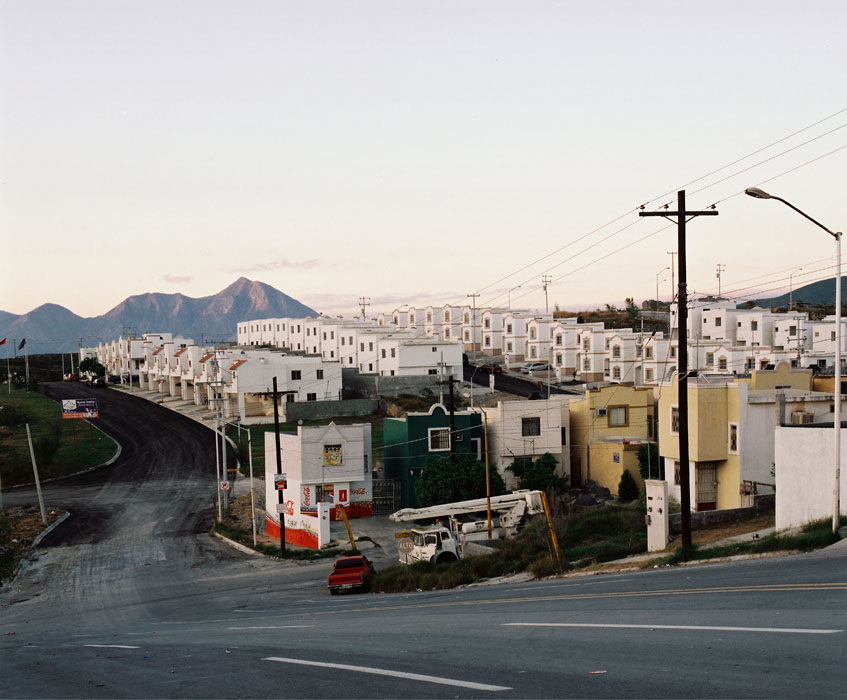 Alejandro Cartagena, Fragmented Cities
The series was shot over period of three years in his hometown of Monterrey, Mexico, and focuses on disruption to the landscape, both physical and social, that has occurred as a result of overbuilding. The landscape has been urbanized before plans for efficient roadways, recreational parks and public transportation can be realized.
August 11, 2010
image + text
One way to envisage the difference between “art” and “documentary” in photography turns on this relation to language and narrative. In the main, documentary is a closed form, designed to produce preferred interpretations. As such, images are usually combined with some form of anchoring text that steers the viewer/ reader in a particular direction. Photographic art, in contrast, typically abjures words, or employs elliptical text, in order to leave the image open to associations and interpretations. For art, vagueness or ambiguity is often the preferred mode.
In the 1980s, photo exhibitions were text-intensive as a reaction against the formalist aesthetics of the previous era where any contextualization or captioning was excoriated. But the pendulum swung again, and today text is usually shunned in the gallery space and banished to the artist’s statement available at the gallery desk or as a handout for visitors. Photographers can be creative at supplementing their images by using sound, narrative forms, or producing their own gallery guide, or brochure. But it’s not seen as acceptable at the present time to “force” visitors to read texts if they do not wish to.
August 10, 2010
at Victor Harbor
Victor Harbor was cold in the week that I was down there setting up the network and backing up the photos. That backup took 5 days with the old Windows based PC running nonstop. Thankfully the PC lasted and the photos were backed up.
It was a time of cold southerly winds, rain, overcast skies and chilly evenings. I had the flu which made me much more sensitive to the cold. It was only towards the end of the stay that the weather warmed up and I was in a state where I was able to play around taking some photos of rocks and moss.
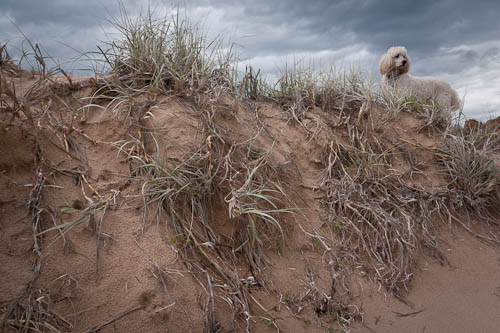 Gary Sauer-Thompson, Ari, Victor Harbor, 2010
That moment in the late afternoon was pleasant. The wind had dropped and there was sun. it was memorable because the seals were hunting close to the shore, schools of dolphins cruised by whilst the southern right whales frolicked offshore. Magic moments.
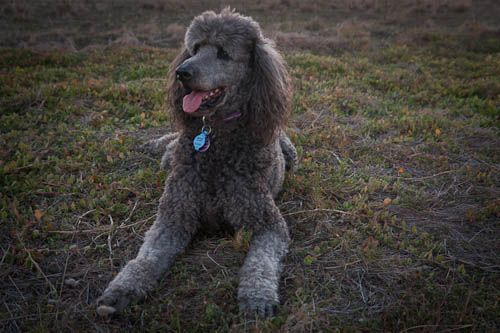 Gary Sauer-Thompson, Agtet, Victor Harbor, 2010
Even in winter Victor Harbor has become popular for tourists. The space along the clifftops that border the southern ocean was once wilderness on the edge of farmland. It is now constructed for tourism. It's where people stand to watch the whales, to relax, go walking with their dogs, or just go walking.
This is an aspect of the seachange phenomenon in the coastal areas outside the capital cities. It is characterised by a hotspots and the suburbanisation of the coast.
August 7, 2010
finally....
The election campaign that is currently taking place in Australia is widely regarded as boring, dull and uninteresting. It's all spin, personality and talking points with the politics being treated as entertainment by the media.
You can forget about policy issues: the politicians are in flight, the media caught up in election frenzy, has no interest in policy whilst the conservative (anti-Labor) media just bash the Greens as hard left (green on the outside and red on the inside).
 Bill Leak
This cartoon by Bill Leak in The Australian is one of the better visual comments on the emotions of the participants in the campaign; better because it goes behind the bland, glossy, showbiz appearances of politicians kissing babies, doing shopping mall walks and staged media interviews to state the talking point of the day in a measured tone.
August 6, 2010
Victor Burgin: photos as signs
In his 'Art, Common Sense and Photography' essay Victor Burgin says that because we have separate words for 'form' and 'content' we are mislead into believing that they stand for totally distinct areas of experience. He adds that there is no content without form and no form without content.
This argued against those modernist photographers who claimed that they could present a totally content-free world of pure forms and those left activists (social documentary photographers) who claim that the autonomous power of the truth can be stated regardless of formal considerations.

To ease his way out of this either or that framed our understanding of photography in the 1970s, Burgin turns to semiotics or semiology and argues that the photograph is a complex of signs used to communicate a message.
He says:
If you show me a photograph of a pile stones then, at an intermediate level, my eye receives visual noise just as my ear received verbal noise when you spoke to me in Greek, We can suppose that I have seen photographs since I was in a child and so have no problem interpreting these irregular patches of light and dark tones as representing stones. But beyond this? If I go on to remark that the photography depicts a temple, that the temple is ruined, and that it is Greek, then I relying on knowledge that that is no longer 'natural' , 'purely visual'; I am relying on knowledge that is cultural, verbally transmitted and, in the final analysis, ideological (I might think 'cradle of civilization', or damned Greek' according to when and where I happened to be born.
All photographers are aware of using some kind of effects in their work. They assume that the effect is to be achieved with the formal --the visual---since content is assumed to be just there in the world and therefore in the picture. But once we reject the idea of photography as a purely visual language understood by everybody, then we may consider the possibility that content too, may be produced as deliberately as one may plan the formal composition of the photograph.
August 5, 2010
Kate Ellis: delivering what for Adelaide?
Labor is the only political party committed to delivering a mandatory internet filter in Australia. Both the Liberals and The Greens oppose the mandatory aspect of the clean feed filter; a form of censorship defended by the Christian Right in its various forms.

Labor's political argument, as articulated by Senator Conroy, is that it is designed to prevent child pornography to protect kids. All those who are critical of the mandatory aspect are deemed to be defending the freedom of individuals to indulge in child pornography and supporting the abuse of children; even though the overwhelming preponderance of content which it is illegal to possess is still not published on the open web but rather inside of secret networks.
Labor, which has always had a troubled relation to free speech and individual freedom, is opposed to the more acceptable PC based filtering in the home. Labor sees the internet as a lawless jungle where libertarian nerds roam free amongst all the internet nasties. The internet stands for the dark side and must be censored, even though parents first want greater education options and at-home filtering and as a next-best option, an opt-in filter.
The opposition by the Greens and the Liberals means that Labor's legislation for a dodgy mandatory internet filter is effectively dead on arrival in the Senate. Thank goodness. The filter never was a cyber-safety tool designed to keep kids safe online. It's designed to "harmonise" censorship laws, not protect children from inappropriate content. It's censorship for its own sake.
Australia has one the most restrictive internet censorship regime in the Western world. Under amendments made to the Broadcasting Services Act in 1999, material rated as low as MA-15+ can be prohibited. It is the Refused classification category that is problematic. As Stephen Collins of Electronic Frontier Australia points out:
The fact is that of all material classified RC, it is only material depicting the sexual abuse of children that is that is illegal to own. For good reason. No reasonable person in today’s society believes that such material is suitable for adults to access, let alone children.Material that falls under the RC umbrella is unquestionably sometimes distasteful or controversial or contains or depicts concepts of an adult nature; drug abuse, explicit material about abortion, guides to assisted suicide, violence. Whether you personally approve of such things or not, none of this material is illegal to possess in this country; it’s perfectly legal for me or you to own a copy of Baise Moi or The Peaceful Pill, just not to make it available for sale.
Labor's mandatory filter to change this as the material the government proposes to filter is, in some cases, completely appropriate to access.
August 4, 2010
digital photography
The computer network for the small office at Encounter Studio in Victor Harbor is now up and running thanks to the help from the locally based tech support. The backups of the music files and photos from the old Windows-based PC to the network are now chugging along--- they will be continue to do so over the next few days given the slowness of the backup.
Hopefully the PC, which is on its last legs, will last long enough to complete the backups to the two Lacie external hard drives that form the storage part of the network. Finally, I have the professional, reliable, central storage for instantly storing, sharing, and backing up from any PC or Mac on my network.

The post-production photographic software has been loaded, and I've begun to experiment with it: reworking a digital colour photography into a black and white one using Silver Efex Pro. So my transition to the world of digital photography is complete. Goodbye to the dirty old world of smelly chemicals and darkrooms.
Some say that digital photographs function in an entirely different way from traditional photographs. The most common argument is that digital imaging destroys the innocence of straight photography by making all photographs inherently mutable. Does it? Lev Manovich in The Paradoxes of Digital Photography asks:
Shall we accept that digital imaging represents a radical rupture with photography? Is a picture, mediated by computer and electronic technology, radically describe film-based images using such categories as depth of field, zoom, a shot or montage, what categories should be used to describe digital images? Shall the phenomenon of digital imaging force us to rethink such fundamental concepts as realism or representation?
Manovich draws attention to one important distinction between analogue and digital photography which is the mutability of the image that has been highlighted by WJT Mitchell in his The Reconfigured Eye: Visual Truth in the Post-photographic Era. In this text Mitchell identifies straight, unmanipulated photography as the essential, "normal" photographic practice:
There is no doubt that extensive reworking of photographic images to produce seamless transformations and combinations is technically difficult, time-consuming, and outside the mainstream of photographic practice. When we look at photographs we presume, unless we have some clear indications to the contrary, that they have not been reworked.
This equation of "normal" photography with straight photography allows Mitchell to claim that a digital image is radically different because it is inherently mutable:
the essential characteristic of digital information is that it can be manipulated easily and very rapidly by computer. It is simply a matter of substituting new digits for old... Computational tools for transforming, combining, altering, and analyzing images are as essential to the digital artist as brushes and pigments to a painter.
Mitchell's argument is that because of the difficulty involved in manipulating them, photographs were comfortably regarded as causally generated truthful reports about things in the real world. Digital images, being inherently (and so easily) mutable, call into question our ontological distinctions between the imaginary and the real. Furthermore, in a digital image, the essential relationship between signifier band signified is one of uncertainty.
Manovich com technology and the tradition of montage and collage with the essence of digital imaging. what Mitchell takes to be the essence of photographic and digital imaging technology are two traditions of visual culture. Both existed before photography, and both span different visual technologies and mediums.
Victor Burgin: then + now re photography
Though I found Victor Burgin's 1980s text, Thinking Photography, a hard text to understand, the core argument about the process of signification, namely, that meaning is never simply 'there', but is always produced, was very influential for me. As Burgin puts it in this interview at Eurozone this text was a questioning of the:
unexamined assumptions that then dominated writing and talking about photography. The notion of the "purely visual" was prominent amongst these, as was the naïve realist idea that photography is a transparent "window on the world". The former belief dominated "fine art" photography at that time, while the latter provided the ideological underpinning of "social documentary".
That text was about opening up a critical discussion about the pre-established codes and norms that underpin representation, which practising photographers did not question. There was a marked division of labour" between "theorists" and "practitioners" in the 1970s, with a strong anti-intellectual current in the art world.
Burgin adds that since the 1970s and 1980s there has since been a massive return of "previous" frames of assumptions that had never in fact gone away. This return happens at a time when the art world and the art departments have provided media-ready art much as supermarkets provide oven-ready chickens.
He adds that he sees the critical task of art today as that of offering an alternative to the media. I am opposed to any form of conformity to the contents and codes of the doxa – what Rancière calls "consensual categories and descriptions" – even when these are deployed with a "Left" agenda, as I believe that in this particular case "one cannot dismantle the master's house with the master's tools".
My own sense of what is now fundamentally critical to the western societies in which I live and work is the progressive colonization of the terrain of languages, beliefs and values by mainstream media contents and forms – imposing an industrial uniformity upon what may be imagined and said, and engendering compliant synchronized subjects of a "democratic" political process in which the vote changes nothing. The art world is no exception to this process. Artists making "documentaries" usually encounter their subject matter not at first hand but from the media. The audience for the subsequent artworks will instantly recognize the issues addressed, and easily understand them in terms already established by the media. What is "documented" in such works therefore is not their ostensible contents but rather the mutating world view of the media, and they remain irrelevant as art if they succeed in doing no more than recycle facts, forms and opinions already familiar from these prior sources.
Documentary art is the "new doxa" and the important task is decoding the hidden meanings in ideologies that create representations in the cultural and commercial domains.
August 2, 2010
art + positivism
In Kant's Critique of Judgement art is commonly taken to be autonomous in an enlightened modernity. As autonomous art it is generally seen to be merely aesthetical, where aesthetics has come to mean beauty, so it lies outside truth, reason and morality. If taken to be outside truth and reason, then if art speaks in its own voice, it does not speak truthfully or rationally.
Aesthetic autonomy, or inscribing art within the autonomous realm of the aesthetic, means that art lives in an expelled space; a space in which art is an object of taste based on a certain kind of pleasurable experience is outside of truth and morality.
 Gary Sauer-Thompson, rose, Adelaide Parklands, 2010
This is the heritage of positivism in which science has a hegemony over questions of truth and which denies that art has any cognitive potential, is deprived of its power to speak the truth and, as a self-sufficient form of practice, loses its critical edge.
What we have inherited from Kant are the aesthetic concepts such as aesthetic reflective judgment, or the judgement of taste, which questions the paradigm of knowing as subsuming particulars under universals; the act of genius, which conceptualizes free action as creative and legislative rather than as rule following; sensus communis, which installs the notion of an epistemic community that breaks the claims of methodological solipism and permits a re-inscription of sensibility; and the sublime which provides for a concept of alterity or otherness that challenges the sovereignty of the self-determining autonomous moral agent.
There is a critical edge to Kant's Critique of Judgement as it was concerned to preserve something like teleological thought in a culture increasingly dominated by positivism and scientism---art's apparent unreason reveals the irrationality of a formal, enlightened, instrumental reason. This critical edge is buried in the refuge that aesthetics represents. This critical edge that is lost when some postmodern-era theorists reject traditional philosophies of art and the aesthetic as an autonomous sphere; but who then claim for their own practice a kind of reflective freedom – and hence autonomy that is beyond the discourse of science and philosophy.
There is a repression of what needs to be salvaged.
August 1, 2010
Kudditji Kngwarreye: My Country
Kudditji Kngwarreye (born c 1928) is a senior Anmatyerre artist who began painting in the early 1980s. He is the younger brother of renowned artist Emily Kame Kngwarreye, is associated with Utopia, located about 270 kms north east of Alice Springs.The lease of Utopia Station was ceded to Aboriginal people in the mid-1970s. There, the Aboriginal locals worked cattle, hunted kangaroo, gathered seeds and grasses, and collected yam seeds, the favourite food of emus.
Kudditji Kngwarreye’s colour-block paintings is constituted by squares, or lozenges, of colour and are a form of colour field painting:
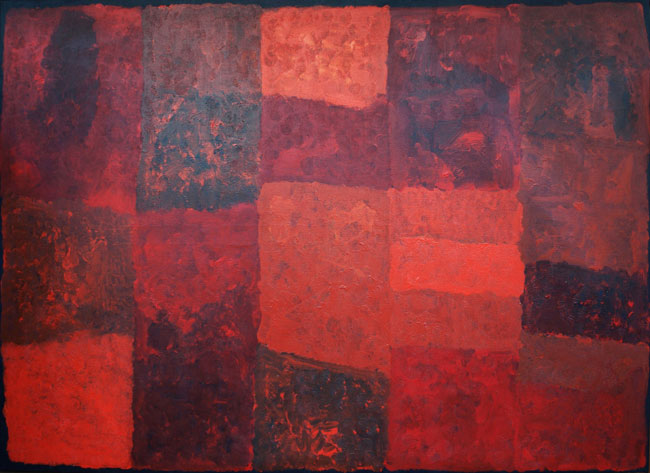 Kudditji Kngwarreye, My Country - Burning, acrylic on linen
Kudditji Kngwarreye’s paintings are an interpretation of his travels across Utopia; they are his versions of cultural emu creationist stories, some of which are violent or threatening, and they are an invocation of an individual perspective, on behalf of others.
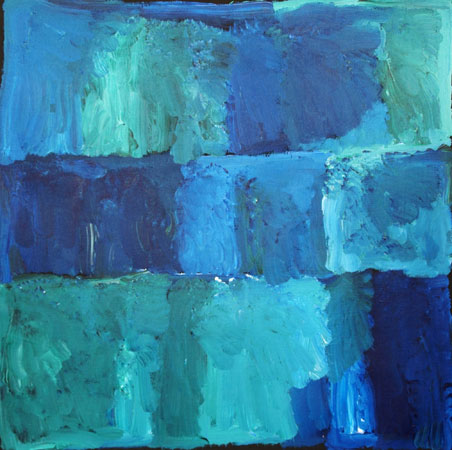 Kudditji Kngwarreye, My Country - Rain Coming, acrylic on linen
The large blocks of colour have subtle contrasts depending on the choice of shades.|