|
August 15, 2010
in the opening pages of his Camera Lucida Roland Barthes writes that he wished to identify photography‟s “essential features” through a phenomenology, and that “[he] wanted to learn at all costs what Photography was "in itself‟”. However, Camera Lucida has little to say about photography at all, as it is more a meditation on representation and mourning.
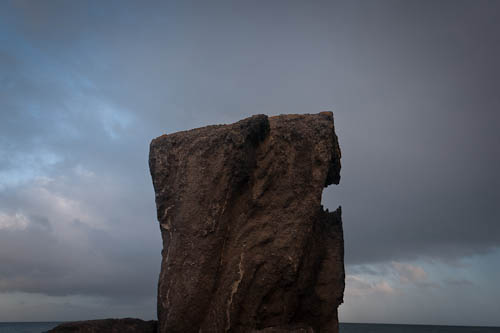 Gary Sauer-Thompson, rock + cloud, Victor Harbor, South Australia 2010
I am not really convinced that we should be talking about what what Photography is "in itself‟ meaning that it has universal, necessary or essential characteristics. I've tended to see it as a form of print making, but this is no longer possible given the digital turn in photography and our habits of looking at photographs as digital images on the web (eg., Flickr, or on photographer's websites).
Many have said that a necessary characteristic of photography---that which makes it what it it is--- is the mimetic or resemblance relationship but that is weakened by computer graphic software. Ron Burnett in Camera lucida: Roland Barthes, Jean-Paul Sartre and the photographic image says:
Crucially.... a photograph of Clint Eastwood, to take another example, has at best a very distant connection to the "real man". The various levels of signification which constitute his symbolic existence pivot not around his absence but around the impossibility of his presence. In that sense a photograph doesn't replace him, but is merely part of a vast system of signification into which he is constantly placed and which precludes the possibility of Eastwood ever coming to life as an exemplification of what he has come to signify. It is in this sense that he is a production. Inter-views with the "real man", newspaper articles about him, films in which he acts, all of these merely confirm a continuing spiral away from the simplicity of reference.
This image re-presents reality anew since the image in and of itself, does not name what it depicts. Photography was a continuation of older "naturalistic" pictorial codes in which photography masqueraded as a transparent and incorporeal intermediary between observer and world. The picture is taken by a machine, which as an optical device, is 'embedded in a much larger assemblage of events, codes and powers'.
Does it involve a transformation in the nature of visuality as equally profound as the break that separates medieval imagery from the Renaissance perspective; a post photography?
|


