January 31, 2008
Library of Congress on Flickr
My stumbling upon the Library of Congress Flickr page is courtesy of Sorrow at Sills Bend, one of the Australian academic bloggers mentioned by Melissa Greg in her draft paper Banal bohemia: Blogging from the ivory tower hot-desk, which I looked at in this post at conversations.
There are images here by some photographers whom I only know by name and from the few black and white images that have been shown or published from the Farm Security Administration archives.
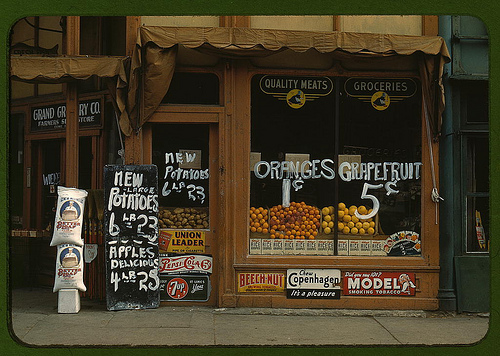 John Vachon, (1914-1975) , Grand Grocery Co., Lincoln, Neb.,1942, colour slide (Flickr
There are 3100 images posted in the Library of Congress' pilot project. The response by the Flickr user community has been overwhelming. This is Web 2 at its best--using historical pictures to broaden and strengthen the public commons of a nation's visual culture. It surely points the way for more historical photo collections to be put on Flickr.
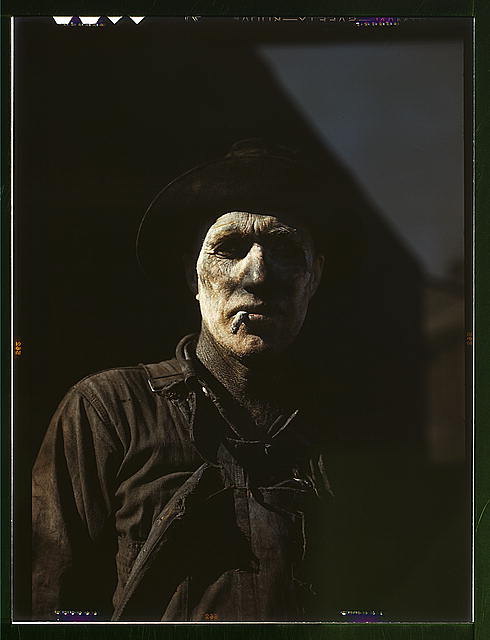 John Vachon, (1914-1975), Worker at carbon black plant, Sunray, Texas,1942, colour transparency (Library of Congress)
Vachon's style of documentary photography is the portrayal of people and places encountered on the street, and judging by the quality of the images, he used a view camera. This is slow, surefooted work based on a window on the world aesthetic that reaches all the way back to Leon Battista Alberti's De pictura (1435), which famously instructed painters to consider the frame of the painting as an open window.
January 30, 2008
bogan culture?
There is a bit of chat about Australian Bogan culture in the comments section of this post at Public Opinion.
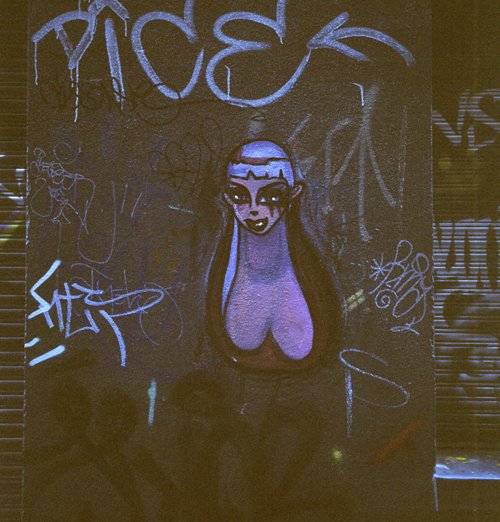 Gary Sauer-Thompson, boobs, Union Lane Melbourne, 2007
Do the boobs go with the flannel shirt or the Beanie in Bogan culture? How are they different from yobbos? It's an elusive term but have a go and do a good job.
Melissa Campbell says:
Popular culture provides a window into Australian-ness, presenting images of who we should be. More importantly, it also shows us who we must not be. The powerful people who control our film and television, literature and magazines, music and fashion, play a major part in determining social norms of "right" and "wrong". An underclass of those designated "abnormal" then emerges from the mire of our supposedly classless society. These social outcasts are called bogans.
January 29, 2008
beach architecture: a vanishing Australia
As you walk along Franklin Parade in Encounter Bay, Victor Harbor in South Australia, you see a history of beach architecture in Australia laid out along the Parade. We have the initial beach shack built out of whatever was to hand; then the casual and improvised beach house built from tin or fibro in the 1950s, to the McMansions that are now muscling their way in as the beach house owners die. Their seafront properties are sold for a lot of money but the neighbourly or community bonds go and are forgotten.
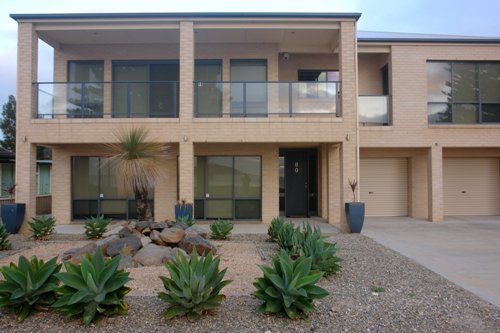 Gary Sauer-Thompson, seaside McMansion, Victor Harbor, 2008
This overblown architecture without architects is designed to show off wealth and indicate success at climbing the property ladder. They go with plasma screens, 4 wheel drives and boats, designer casual gear and being modern (cosmopolitan). The McMansions' repudiate the vernacular architecture of the beach house, are indifferent to the beach and are composed of materials (brick) that are alien to the Australian coast.
It's a repudiation of the past ---just as modernism broke and repudiated the older established forms in order to celebrate the industrial age. What the seaside McMansions signify is that the past is junk. It is to be done away with as just so much tacky shabby culture. The new muscular architecture signify an affront to conventional sensibilities and cultural traditions of the older coastal town.
If Pop Art put paid to modernism by dissolving the barriers between high and low, then these McMansions are the new junk architecture. They are big brutal and ugly, and if they bear little relationship to the modernist work of a Frank Lloyd Wright, then these symbols of success and wealth are a witness to a vanishing coastal culture. Self-interest and entitlement now rule, and the price paid is a wrecked nature and neighbourhood.
January 28, 2008
Port Elliot--beach culture
Yesterday afternoon we hung out at Horseshoe Bay near the Flying Fish Cafe (lots of photos by Mandi Whitten ) at Port Elliot. We were a little group amongst thousands of others having fun on the Australia Day weekend by being at the beach.
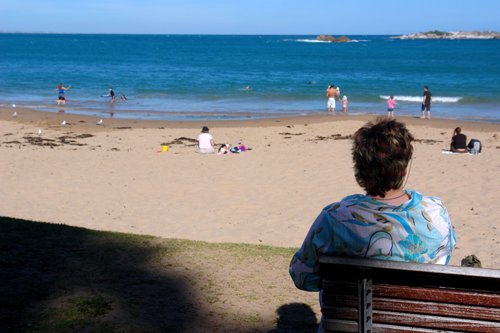 Gary Sauer-Thompson, Horseshoe Bay, Port Elliot, Fleurieu Peninsula, 2008
It was an outing as Monday was going to be spent working on the weekender.I tried to do some photography of beach culture---to question the prevailing notions of Australians as a people who look inward to the 'bush' or the continental centre as their primary reservoir of national identity-----but the harsh glaring light made things rather difficult.
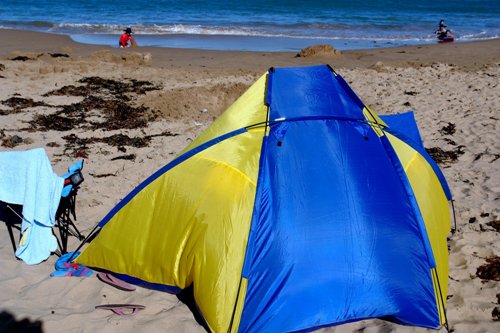 Gary Sauer-Thompson, beach tent, Horseshoe Bay, Port Elliot, Fleurieu Peninsula, 2008
Australia Day means having fun at the beach. If all the flag waving means love of country--rather than one white nation, then love of country includes love of the beach. It's the body, icecream, chips, beach cricket and volleyball, surfing, sunbaking, building sandcastles as well as gourmet food and wine. It is where surf clubs have changed from male bastions into family and community institutions.
 Gary Sauer-Thompson, beach tent Horseshoe Bay, Port Elliot, Fleurieu Peninsula, 2008
What I had in my mind was Phillip Drew's The Coast Dwellers: Australians Living on the Edge (1994), where he argued a thesis of Australians as 'verandah people' who derive their identity from their place at the physical margin of the island-continent. He argued for a view of Australians as continental fringe dwellers, who gaze out across their beachscapes in search of their place in the world.
Any thesis about the Australian identity being shaped by the beach would defeated by the complexity of meaning and experience arising from the diverse ways Australians use their beaches.
January 27, 2008
spec housing
It's not kitsch I admit. It's speculative housing built on a river flat that is now a wetland, which is filled with storm water from the housing estate and the high tides. It is 'the worst of' in one sense.
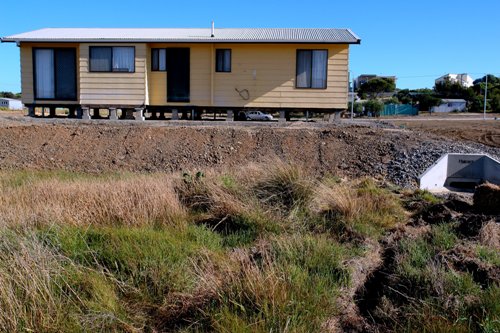 Gary Sauer-Thompson, seaside charm, Victor Harbor, 2008
The Victor Harbor Council turns a blind eye to houses being built with no foundations and built on a floodplain with a tidal wetland at the backdoor fed by with storm water. So what happens with rising sea levels from global warming? No worries. The house will have fallen apart by then anyway.
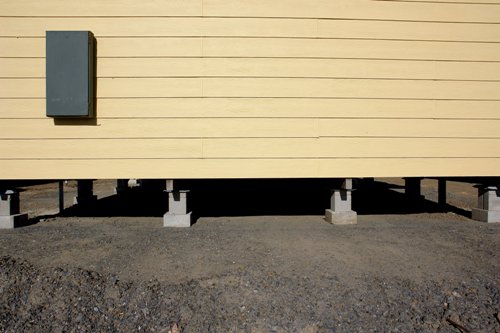 Gary Sauer-Thompson, junk housing, Victor Harbor, 2008
A large number of houses around Victor Harbor are built in this way. Too many. It's disposable housing as it is not designed to last for long. Throw up and throw away.
January 26, 2008
Australia Day: Mountain Devil Lizard Dreaming
It's Australia day. What better way to celebrate?

Kathleen Petyarre, Mountain Devil Lizard Dreaming (2007) Synthetic Polymer on Belgian Linen
According to Dean Chan's review of Christine Nicholls and Ian North, Genius of Place: the Life and Art of Kathleen Petyarre the consistent invocation of the journeying of Petyarre's Dreaming Ancestor, Arnkerrth, the Old Woman Mountain Devil or Thorny Devil Lizard in her paintings, can be understood as an intricate composite of personal memory, communal place, and pictorial symbology.
Chan adds:
Likewise, Nicholls points out that the seeming ‘aerial views’ presented in many of the paintings are best accounted for with reference to Anmatyerr systems of land-based epistemology. These systems of spatial knowledge or history of place are premised on the ability to reconstruct detailed and accurate mental maps of the land.
January 25, 2008
Heath Ledger, death, Hollywood tragedy
Celebrity often results in death, especially in Hollywood. Heath Ledger's body was discovered in the bedroom of his residence by his housekeeper and a masseuse who had an appointment with the actor at 3 p.m. An autopsy on the body of actor Heath Ledger proved inconclusive. Prescription sleeping pills and anti-anxiety pills were found in the home, and police said the death appeared to be accidental.
Is this another James Dean? A drug-related death? Ledger's Death bears all the hallmarks of a Hollywood tragedy-- living in the fishbowl of constant media attention.
 Heath Ledger as joker in Christopher Nolan’s successful Batman Begins sequel, The Dark Knight. The movie trailer is over the page:
This is part of a viral marketing campaign. For fans there is the teaser trailer--- the Dark Knight's bank heist trailer (low quality, as it is just a cam version). It's another viral promotion. Isn't there a difficulty in telling an American tragedy in the land of the American dream?
dancing with identity
Time again for the annual slugfest over who gets to own the definition of Australian. Although it won't be the same without the Howard industry leading the charge.
Over at Online Opinion Audrey Apple objects to the boofy bloke version of who we are and seems to conclude that the main thing we share is a tendency to get drunk on Australia Day.
Some of us will call it Invasion Day and be accused of trying to spoil it for everyone else.
The Chooky Dancers manage to accommodate pretty much everybody.
There's a more polished version through the 7.30 report site and a comment at YouTube says it's been on Greek TV.
This is so loaded with symbolism it's hard to know where to start. A lot like the whole concept of Australia Day.
Steve Reich, Music for 18 Musicians, trailer
A trailer of Steve Reich's mid 1970's work Music for 18 Musicians, as played by the Grand Valley State University New Musical Ensemble, who are based in the farmlands of Michigan. Some background here.
The trailer is like a sampler (better quality here; slow load) and indicates the potential of the internet for classical music to escape from its ghetto. The work is a transition from Reich's early, process-oriented Minimalist pieces to a more involved, expressive mode.
Another example of the way classical music is exploiting the virtual reality of internet is the web site of the Schenberg Centre in Vienna. This is an absolute goldmine of early artistic modernism.
January 24, 2008
modernism, Brasilia, urban planning
Brasília became the Brazilian nation’s capital on 21 April 1960, the city having been designed in the shape of a sprung bow and arrow, signifying future potential. Gathered around a lake, the futuristic city's plan takes the form of a giant bow and arrow (or aircraft, or bird in flight), in which Oscar Niemeyers' sculpted concrete monuments rise. In four years Niemeyer and Lucio Costa created a city of monumental architecture that was 1600 km from the main population centres, in an area with no communications, and only one natural resource... land.
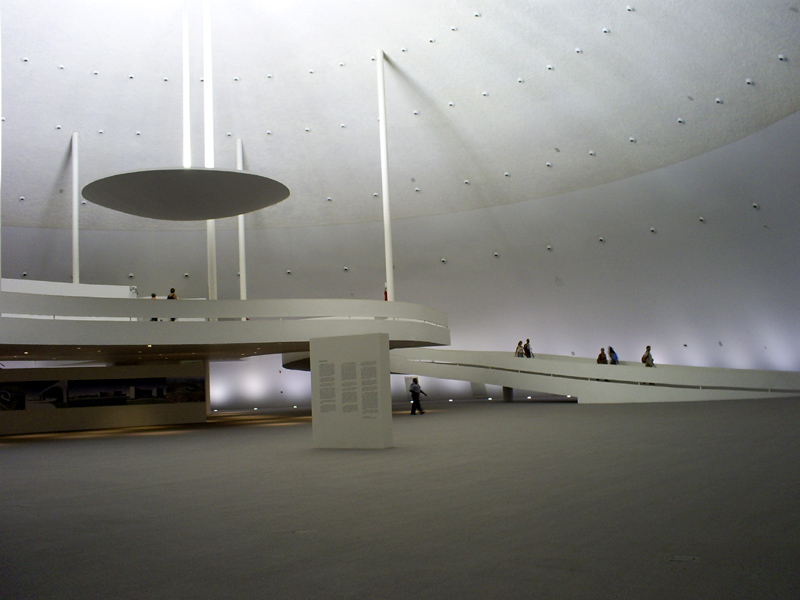
The city was built as a complete break with past in true spirit of heroic 20th-century modernism as a possibility to recreate the destiny of the country. Brasilia offered redemption from the awful history of a plantation economy based on slavery. The country's history had to be negated. Brasilia symbolized the inevitable movement from backwardness to modernity. Progress would enable Brazil to shake of the bonds of colonialism and leave its past behind, and embrace the future.
 Simon Norfolk, Oscar Niemeyer's Cathedral of Brasilia in front of the government ministries, 2005
It was Costa who envisioned the huge blocks of government offices, the sectors for banks and housing, everything positioned like chess pieces on a board, crisscrossed by boulevards. Niemeyer was then enlisted to design the major buildings -- fanciful, spectacular structures that breathed life into Costa's urban plan. Its a city of cars that move in endless streams along the broad avenues and around the cloverleafs (Costa designed the city without traffic lights, sidewalks or intersections). The cars are practically the only things in sight that move. In a place of nearly 2.5 million residents, there are few pedestrians. 'The street does not exist.
January 23, 2008
Kathleen Petyarre
Kathleen Petyarre is from the Utopia region of Central Australia and her dotted paintings are of the Arnkerrth (mountain devil lizard) Dreaming and other sacred women's sites. She is the custodian of the Arnkerrth Dreaming which tells the story of the female ancestors as they traveled across the country pinpointing sites essential for survival.
The painting depicts the Mountain Devil Lizard Ancestral tracks, as he travels the vast tracts of Atnangker country.
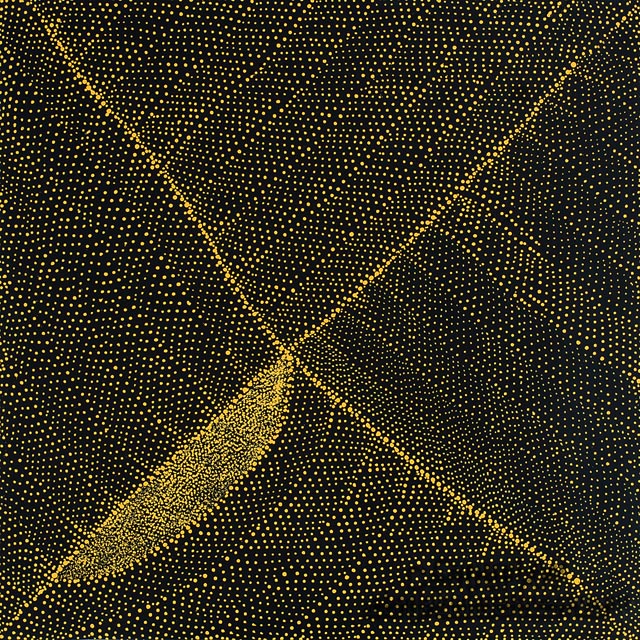 Kathleen Petyarre, Mountain Devil Lizard Dreaming, date ? Acrylic on Canvas
There is some discussion of Kathleen Petyarre's work by Deborah Barlow at Slowmuse in the Reading the land post. As a custodian of the Arnkerrth Dreaming, Petyarre has permission to represent her dreaming ancestor and through her art she creates a sense of a landscape densely patterned with collective and individual memory.
What we confront here is that to attend to the insistence of the aesthetic is not to offer it as a refuge from the conflicts of politics and history. The aesthetic does not appear as a form of space—a haven or enclave or utopia—but more as a taking a stand and refusing to give way.
As Forest Pyle observes in his Introduction: 'The Power is There': Romanticism as Aesthetic Insistence
No genuinely dialectical criticism—and Adorno remains its unsurpassed exemplar—understands the disinterestedness of aesthetic judgment or the autonomy of the aesthetic simply as the retreat of art to its own domain; but the characterization of the aesthetic as a space often underwrites the now familiar political criticism of aesthetic autonomy.... Terry Eagleton's neat summary of the left-wing position demonstrates the pervasiveness of this spatial logic: "art is ... conveniently sequestered from all other social practice, to become an isolated enclave within which the dominant social order can find an idealized refuge from its own actual values" (IA, 9).
photographs, romanticism, walking
This shelf cloud was photographed by Jeff Kerr during a trip crossing the prairies of Saskatchewan, Canada on the Trans-Canada Highway in 2001 August, and it is part of the Astronomy Picture of the Day series. I just love the colour and the sweep of the cloud in the early morning light that allude to the processes of nature:
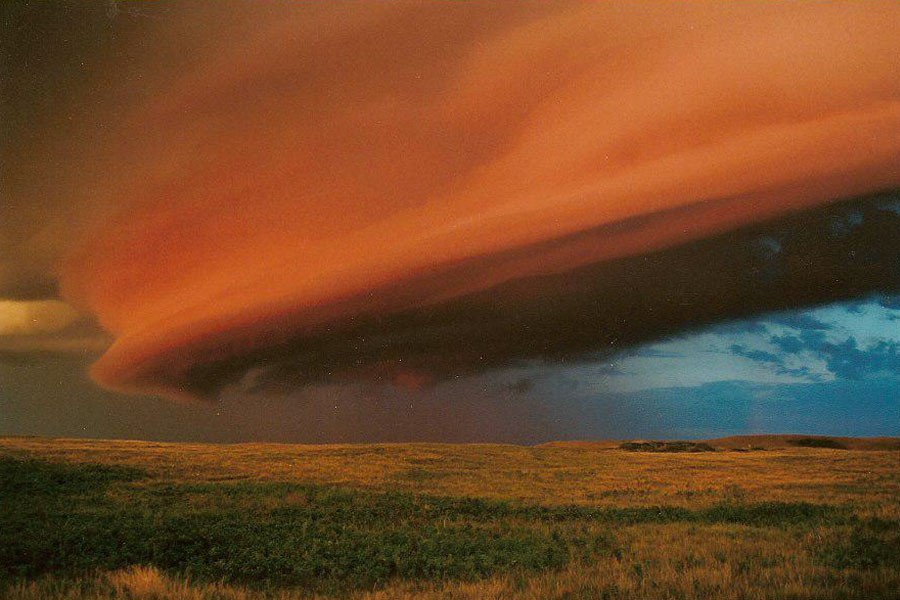 Jeff Kerr, Shelf Cloud Over Saskatchewan, Canada
If this image is where romanticism and science meet, then we need to rethink the way that Romanticism has been represented as a reaction to the rationalism of the Enlightenment (ie., defending the emotions; or a movement "against the tide of modernity," (a critique of industrial capitalism in the name of beauty) or a flight from history into the ideologically-determined consolations of the imagination (a retreat into subjectivity or the privileged interiority of the subject).
The photograph is also about the sublime, which following Burke, I interpret as being about awe and astonishment, as well as about terror and fear. This gives us a much wider range of human experience to the landscape than the narrowly defined purely aesthetic response (our sensations of the beautiful). this allows us to develop our sense that the Romantics understood sensations, emotions, and passions as embodied and contextual phenomena, rather than as "psychological events" that happen at some central point within an isolated subject.
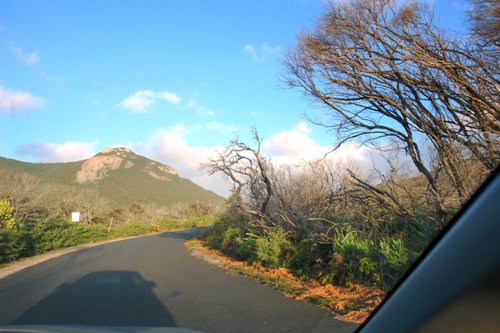 Gary Sauer-Thompson, Wilsons Promontory, 2007
The centre of Romanticism is the humanist subject, which is structured on the basic distinction between observer here and objects over there. Ron Broglio + Georgia Tech in Romanticism and the New Deleuze: Wandering in the Landscape with Wordsworth and Deleuze say:
Each object is considered abstractly by the individual observer, and the romantic artist takes the object in and discusses its aesthetic merit. While the land is experienced through a bodily walk, the representation of the space always removes the poet from the scene. Objects are clearly demarcated and any thing or person who threatens to impose upon the narrator gets appropriated as an object for the artist's self-contemplation.
These classical romantics--eg., Wordsworth on his walks in the Lakes District---eat nature, in the sense that they incorporate or internalize it. The walk in the landscape is designed to reflect the inner workings of the mind.
We can shift to the physicality of bodies and effects of environmental forces as significant agents. Nature has agency that impacts on our bodiliness as we meander through the landscape.
January 22, 2008
E-games + creative nation
I have often wondered what the creative industries refer to. I have presumed that they are less the new media (blogs, Facebook, Flickr) or digital photography (craft) and more in the way of design, fashion film, or computer games in the form of entertainment, such as Fury.

Though computer games are commonly seen as dragon slaying entertainment for teenage male geeks and nerds, they are more than mass entertainment of the culture industry. New media are still distrusted media, and if computer games are the contemporary currency, or the cutting edge, in new media, then I presume that the cultural critique of the computer/video games of the global media/entertainment companies is that are are seen to be too trivial to be discussed seriously.
If we pick up on an ongoing discussion on the Fibreculture List, starting from this Malcolm King article, we can see that have the global games industry ( World of Warcraft and Guild Wars) and the difficulties the games industry faces as it attempts to develop an Australian share of that global industry. In what way though? As outsourcing of the global entertainment firms? Or as an expression of Australian culture?
If it is the latter, then we have the link between creative innovation, the growth of knowledge new media literacy, a new and emerging market, and the “innovation frontier”. However, these creative industries have tended to be at the fringes of national discussions about science and innovation policy, and of related funding and industry programmes. Therein lies a problem.
The lack of an effective innovation system for the Australian creative industries producing digital content and applications is surprising, since the growth rates for the creative industries have consistently been more than twice that of the economy at large.
This translates directly into jobs and economic growth, fuels creative capital, results in enrolled students in game-related courses in academia, and nurtures creative workers who are increasingly being recognized as key drivers within national innovation systems. So why don't we see Australia as a creative nation?
Contrary to the view of the old economy--the old extraction-based, manufacturing economy--- Australia's creative industries should be seen as increasingly mainstream rather than marginal element of our economy . From an innovation/emerging markets perspective the creative industries are seen to comprise 13 sectors: advertising; architecture; the art and antiques market; crafts; design; designer fashion; film and video; interactive leisure software (such as computer games); music; the performing arts; publishing; software and computer services; and television and radio. That's a big swag of cultural activity.
The underlying assumption of the creative industries is that businesses in these sectors share a common foundation, despite their differences: they rely on individual creativity and imagination allied with skill produce wealth and jobs through the generation and exploitation of new intellectual property and content. However, to get anywhere in a global market dominated by big entertainment firms, these creative people are going to need to be both entrepreneurial and innovative.
January 21, 2008
Barrett-Jackson Car Auction
The Barrett-Jackson car auction has become the premier auction of automobiles in the United States through some clever marketing and exposure on Speed channel. The auctioneers and those on the stages work in unison to pump up the price and interest in a car. One Corvette went for 1.6 million USD, while another went for 1 million. They also use celebrities to spruik cars to the audience.

Not all of the cars auctioned are collectibles or hot rods, included on the auction block saturday was Robosaurus.

It went for a paltry half a million. Amazing the amount of disposable income that was on the bidding floor and stage.
Update
There was another auction held in Scottsdale at the same time. The cars went for higher average amounts including one Ferrari being sold for 3.3 million.
Adelaide modern
Having missed out so badly on making contact with 'the rush', which according to the publicity machine of the major events crowd, is surging through Adelaide to the rest of the world like a tidal wave, I decided to poke around the laneways of the CBD in the late afternoon.
I had a destination in mind-- the street art in Imperial Place done by Adelaide street artists Benzo, Store and Jules. I'd check it out, then I'd aimlessly wander home like a good situationist should. I'd given up on meeting up with 'the flowing rush'. Maybe it would find me, or I'd stumble upon it whilst doing something else ---acting like a tourist in my hometown:
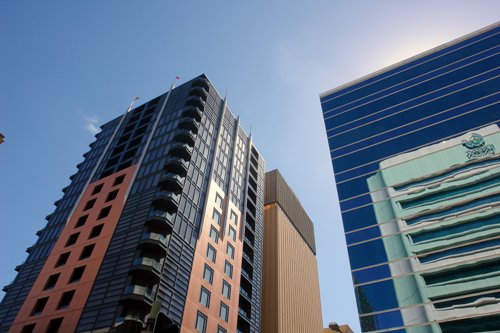 Gary Sauer-Thompson, Waymouth Street, Adelaide CBD, 2008
The day had cleared. It was bright and sunny. In the morning I had read about the seachangers going to the Gold Coast looking for the dream of a beachfront lifestyle in the sun at Noosa that was just a short trip to the cosmopolitan Brisbane were returning home bitterly disappointed. Their dream was to be ageing surfies drifting into retirement. They sold up, only to end up in the back blocks of a tacky suburbia, missing family and friends, unable to network, and struggling with the lack of infrastructure.
So why not view Adelaide through the eyes of the seachange bounce back people. They would see their old city anew after their experience, would they not?
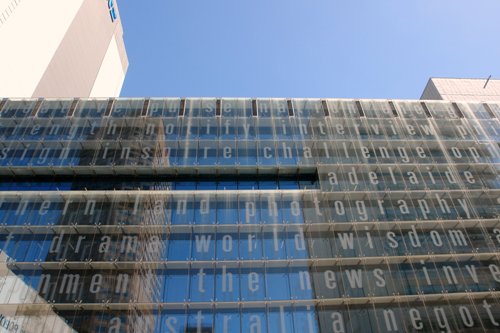 Gary Sauer-Thompson, Murdoch's Advertiser, Adelaide CBD, 2008
They would see how modern it was becoming whilst retaining its nineteenth century buildings and how this was so different to the development ethos of Gold and Sunshine Coasts. What is disclosed is the regional differences within the nation state; regional differences becoming ever more marked as the effect of globalization becomes deeper and more substantial.
January 20, 2008
feeling the rush
I arrived back in Adelaide last night to discover The Tour Down Under starting to wind up into action. The riders and crews were all staying in my urban neighbourhood with tour HQ in Victoria Square. The party had started according to the major events publicity machine that brands Adelaide as sensational:
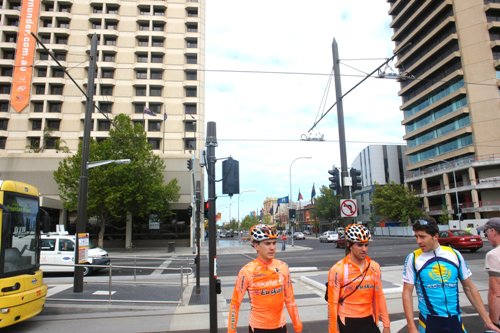
Gary Sauer-Thompson cyclists, Adelaide, 2008
As it was overcast this morning I slipped out from my household tasks to feel the buzz---the rush-- on Gouger Street. Alas:
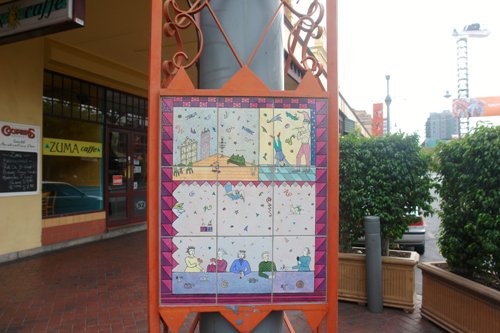 Gary Sauer-Thompson, lamp post, Gouger St, Adelaide CBD, 2008.
Where is 'the rush'? What is 'the rush'? I couldn't find it. It was empty streets with the odd person having coffee at Cibo's. A lazy Sunday morning.
So I came back to scrubbing graffiti (scrawls) off the townhouse wall, then painting the wall whilst listening to the Korean Christians singing something or other about saving Jesus to save their souls.
Update:12 Jan
Then it was scrubbing down the wooden deck in the front garden before giving it a much needed oiling. I looked up from the cleaning and saw this:
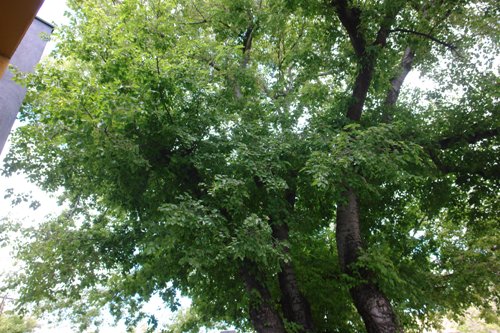 Gary Sauer-Thompson, street tree, Sturt Street, Adelaide, 2008
I found out latter that 'the rush' could be found at the Tour Down Under party at Glenelg, where the street races began. Silly me I was looking in the wrong place. It was sensational, say the publicity crowd in the culture industry who try so hard to manufacture the public mood for the Rann Government and the Big End of town.
January 19, 2008
post-photography?
The advent of the image-oriented computer in the mid-1980s is having a radical effect on the central place of photography in visual culture. This new technology of images changes the ways in which we encounter and use images in everyday life: in advertising, entertainment, news, evidence.
The changes are so great that many talk in terms of the ‘death of photography’ and the birth of a post-photographic culture. This is the story of how the image has now progressed from the age of its mechanical production to that of its digital origination and replication. For William Mitchell it is the story of how new technologies have provided ‘a welcome opportunity to expose the aporias in photography’s construction of the visual world, to deconstruct the very ideas of photographic objectivity and closure, and to resist what has become an increasingly sclerotic pictorial tradition.'
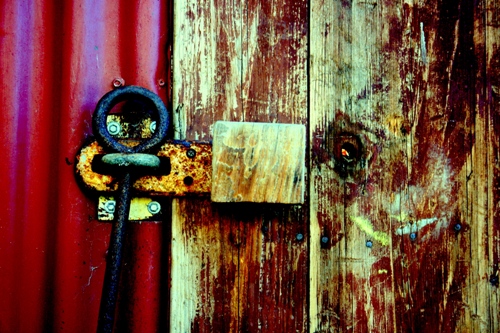 Gary Sauer-Thompson, door, Middleton, 2007
The notion of techno-cultural revolution has been widely accepted and celebrated by cultural critics and practitioners. It is widely accepted that the very idea of photographic veracity is being radically challenged by the emerging technology of digital image manipulation and synthesis. Photographs can now be altered at will in ways that are virtually undetectable and photorealistic synthesized images are becoming increasingly difficult to distinguish from actual photographs.
Photographs were once ‘comfortably regarded as causally generated truthful reports about things in the real world’, and it has convinced us of how unsophisticated we were in such a regard. It has convincingly argued that ‘the emergence of digital imaging has irrevocably subverted these certainties, forcing us to adopt a far more wary and more vigilant interpretive stance’
January 18, 2008
snapshot + art history
The Ur text of photographic modernism--- Beamont Newhall's The History of Photography from 1839 to the Present Day, (Museum of Modern Art, 1949) --- consolidates every type of photographic image into the rubric of art history, as he knew it.
The consequence of Newhall's refusal to separate a tradition of photographs conceived as pure aesthetic objects from those intended for documentary or other utilitarian purposes was the blanket importation of traditional art historical concepts (artist, style, oeuvre, masterpiece) to photographic materials of all kinds.
However, these categories are hardly appropriate to understand the humble snapshot:
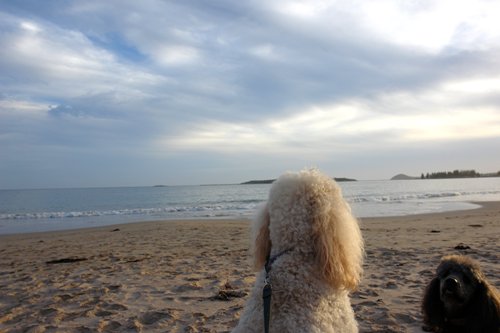 Gary Sauer-Thompson, dogs, Hayborough Beach, Victor Harbor, 2007
If cultural cultural history might ably handle aspects of the complex social, political, and economic circumstances surrounding the production and consumption of art photographs, traditional art history has proven insufficient to the task of handling nonart photographs.
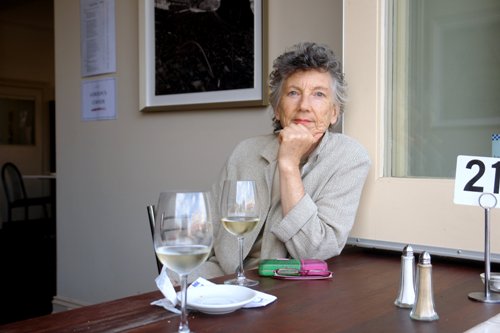 Gary Sauer-Thompson, Port Elliot Pub, 2008
The structural deficiencies of such aesthetic totalization lay behind much of the debate arising around photography in the period after 1975. This critique of aesthetic totalization cleared the way for what in principle could have become a cultural history of the photographic image--an analysis of the precise historical and material conditions out of which discursive meaning and authority is constituted.
So we are in a situation where recent accounts of photography's identity tend to divide between the postmodern view that all identity is determined by context and a formalist effort to define the fundamental characteristics of photography as a medium. How do we move forward? What signs point the way?
January 17, 2008
the local in the global
I'm sitting at the blue table on the balcony at Victor Harbor testing the wireless broadband with my PC laptop, looking at photographs to include in my coastal neighbourhood, exploring Myla Kent's delightful photoblog, reading Amanda's Gilligan's Mockingbird and listening to BBC Radio World service. It's called multi-tasking in the global village I suppose.
The internet means that the local is no longer the closed provincial looking inward. I find it comforting to be immersed in the 24 hours news cycle that endlessly repeats itself with enthusiasm. The momentary content is a story on the global credit crisis and the declining values of the London property market. Just a blip is the message from the suits. What global credit crisis? The Chinese, Russians and Indians are not experiencing a credit crunch in their countries.
The suits' account is that there are always ups and downs in price---that's how the market works. That is what happened in Canary Wharf in the 1990s. Some win some lose. But the property fundamentals today are sound. Look at the success of Canary Wharf. The developers usually get it---value---right in the long run.
It's all a long way from my little coastal neighbourhood with its rocks and beaches and the modest development of weekenders, resorts and marinas.
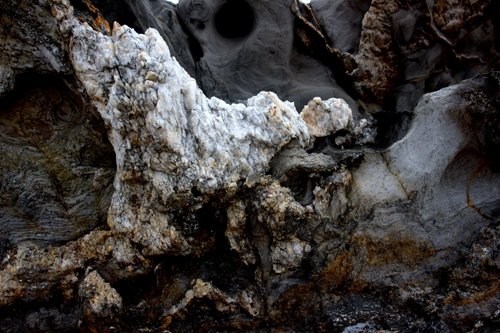 Gary Sauer-Thompson, rocks near Petrel Cove, Victor Harbor, 2008
Nobody mentions the Pelicans who made the area their home due to being feed fish by the returning recreational fishermen. What will the Pelicans do? Make do? Look for the human touch? Why cannot we have development and sanctuaries?
 Gary Sauer-Thompson, beach, Hayborough, Victor Harbor, 2007
If our roots are the local and the ariel is the global, then I feel like a broken butterfly in a storm. A storm is approaching for sure----its called global warming . Who will fix the broken butterflies' dreaming about the glory days? Or will they too dance in the dark?
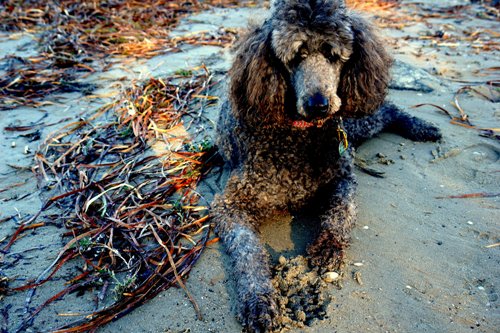 Gary Sauer-Thompson, Agtet, Encounter Bay, Victor Harbor, 2007
It is no long a case of regionalism in opposition to globalization is it? That much loved beach may no longer be there in ten years, if the Antarctic ice sheet continues to melt the way it currently is doing. All I see is the ice sheet melting faster than initially expected.
January 16, 2008
Best Street Party Ever - Parents Yet To Find Out
In the age of Paris Hilton we have Party boy Corey:
Corey Worthington could earn lots of quick money if he played his cards right and had the right publicity agent. So far the teenage party host - was unrepentant about the affair, adopted a cavalier attitude towards authorities and his parents, who at the time were on holiday interstate, as he cultivated his new-found fame.
He has maintained a public profile, appearing on television and radio as well as spending time at the beach with friends, and making international headlines.He would gain a lot of sympathy for his utter disdain for A Current Affair and his fightback against their boot in the mouth interview style.
after too much grog, or ...
Is this an expression of an apocalyptic culture?
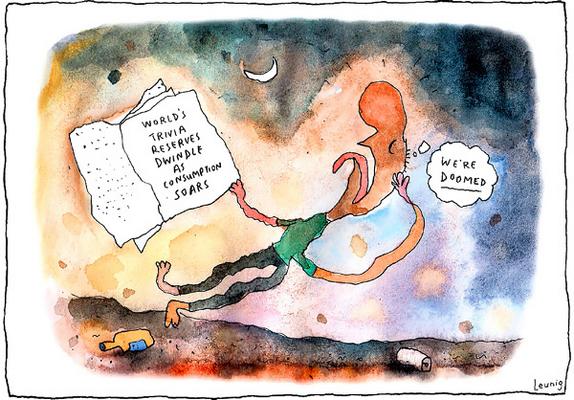 Leunig
Or more mundanely, it is the way I often feel in dealing with computer technology. The trivia would be Facebook---judging by this comment. The despair would be me currently trying to set up a functioning working office at the weekender in Victor Harbor.The old technology---computer, wireless modem and cordless phone-- have collapsed (computer) are not working properly (modem) or do not work in a wireless environment (phone). All have to be be replaced. So my consumption soars.
What is more frustrating is that the software on my Toshiba laptop is incompatible and so the Tecra laptop keeps closing itself down when the antivirus software cuts in to do its thing. The overall feeling is one of not coping, its all too much, everything is constantly changing.
January 15, 2008
the tourist gaze
The Big Lobster is similar to the Sunshine Coast's Big Pineapple and Coffs Harbour's Big Banana in that they function as tourist icons in a time of mass tourism as well as being bad art.
If these icons can be viewed as the part of the bad art or junk that make up popular culture, then they are also part of an economy of signs. We have well and truly shifted away from the high modernist view of high art is good, low art is bad, since as a cultural object created by the tourism industry, these big things along with tourist adverts have become ladened with cultural meaning about Australianness, national identity and subjectivity. On the Gold Coast the economy of signs include a palm tree, a girl in a bikini, a beach, a shining sun, a high-rise apartment building. These signify the Gold Coast lifestyle and holiday culture.
So what then of the tourist photographer in an economy of signs where reality becomes code-intensive?
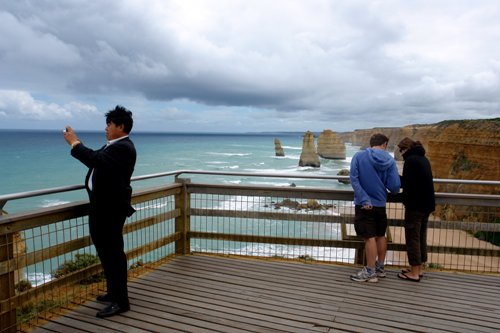 Gary Sauer-Thompson, Port Campbell, Victoria, 2008
The photographer is not just the observer who gazes on the world as through a window; the photographer inhabits this world of tourist images. My perception of the world's appeal and attraction ---ie., what captures my attention---is inseparable from my own interest in it. The photographer then produces more tourist signs that circulate through the economy of signs.
The big things like the Big Lobster are iconic nationalistic landscape objects and they suggest that the tourist/consumer gaze is complicit with the settler gaze, and that in some places, such as Kingston, the two function as one. The absurdly grand and the embarrassingly awful which come together in patriotic tourist iconography is built around the prosperity dream of the idealized and empty landscape.
These icons help to construct our subjectivities---part of the process by which subjectivities are formed--- of the people living in areas like Kingston; and so they interconnect with their desires and pleasures, hopes, fears, memories, and their likes and tastes. Often though the constellation of memory, tourism, consumerism and kitsch offers prepackaged emotion at the expense of critical thought and contains alternative politics.
Australians today, in responding to the trauma of globalization through consumerism, kitsch, and sentimental tourist icons, are revealing a tenacious investment in the idea of Australia's innocence: we have a nativism that needs to be defended from the negative effects of the global market.
January 14, 2008
a personal coastal moment
I haven't taken many photographs from the Victor Harbor weekender for some reason, despite the interesting views. We had gone down for the weekend to escape the heat. it is generally 10 degree cooler during summer and airconditioning is not required.
Sunday was soft, cool and overcast---such a contrast to the heat wave that Adelaide has been experiencing. In the evening I took some shots from the balcony:
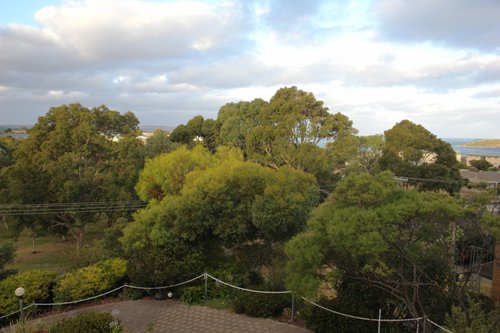 Gary Sauer-Thompson, view from Solway Cresent, Victor Harbor, 2008
This is the view we have in the early evening when we sit on the balcony having a drink, before we go and cook dinner. The sun is just beginning to set.
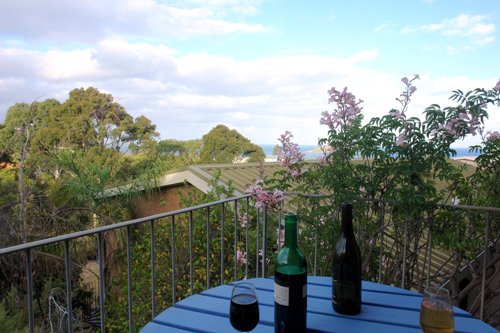 Gary Sauer-Thompson, balcony, Solway Cresent, Victor Harbor, 2008
It's just a little personal moment in the flow of nature. Nothing special. But it is something to share with others.
Hurricane Ivan from space
Hurricane Ivan, which was the strongest hurricane of the 2004 Atlantic hurricane season, as seen from International Space Station
 Astronomy Picture of the Day
What was photographed was the eye of Hurricane Ivan. It's a great shot.
January 13, 2008
bad public art in SA
Lazy Aussies' Worst of Perth occasionally makes exploratory forays outside Perth, but these forms of kitsch are only allowed if they can challenge one of Perth's own. An example offered is public sculpture and some have risen to the challenge as that post shows.
This giganticism, shot from a car window on the way to Wilsons Promontory would, I suggest, offer a good challenge to the Morley walrus. A tourist icon:
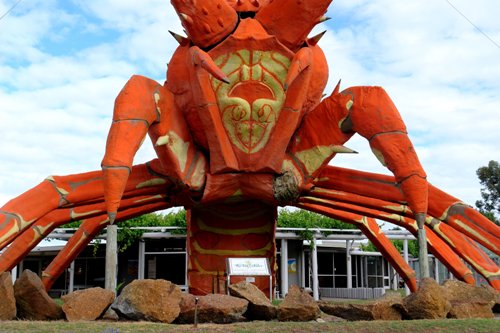 Gary Sauer-Thompson, Big Lobster, Kingston, SA, 2008
I do not know who designed or constructed the giant lobster on the Princess Highway. The same person who does the Big Pineapple? But I gather that the locals understand this form of public art(called Larry apparently) to be an expression and interpretation of their community, and one that contributes to a sense of pride and place to Kingston.
We were just passing through as 'cultural tourists' and we saw ourselves as visiting. We bought a drink, took some photos and travelled on to Port Fairy.
Update: 14 Jan
I guess that the Big Lobster sculpture was an early attempt to try and put a plain and unattractive Kingston on the national tourist map by signifying that Kingston was the home port of the lobster (crayfish) fishing industry. Kingston, as the 'Gateway to the South East', is overshadowed by the more attractive town of Robe, and so it needed a big tourist icon. The tourism industry was to be the extra engine that enabled development----boost growth in business and employment opportunities--rather than offer a kitsch tourist experience. I
January 12, 2008
Days of our lives
The Lives of Others is an excellent film about the East German state security service, which, by the mid-nineteen-eighties, employed more than ninety thousand personnel engaged in surveillance of its citizens in a Kafkaesque atmosphere. The plot is absurd but the narrative holds up: lives and talents wasted by a state with no good reason to exist apart from the maintenance of its own power.
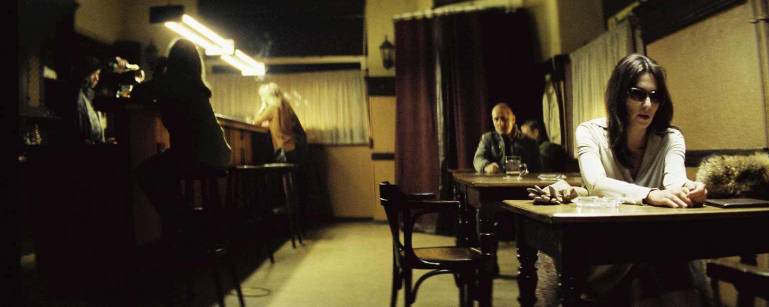
This is a world of a Stalinist state before the Berlin wall fell in 1989---the real daily horror of the communist secret-police state with the deceit and fear that fuelled the system. Fully 2% of the entire civilian population was on the payroll - so we have a network of fear and shame along the lines of George Orwell's Nineteen Eighty-Four.
I cannot write much more because the DVD from Qiuickflix was damaged and so we only saw half of the film.
beachside delight
The sign in the front of the property says Advanced Building Constructions:
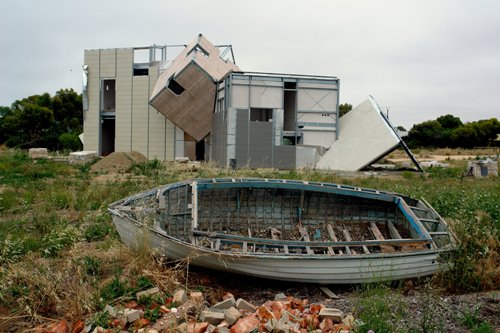 Gary Sauer-Thompson, holiday house, Goolwa, 2008
There is a lot of shoddy speculative building in Victor Harbor, mostly in the form of wooden shacks dumped onto four blocks. No need for foundations. The shacks are not expected to last ten years. Who cares? Not the local council.They turn a blind eye to what is going on. Development is what is required. More beachside houses; more boat ramps and marinas.
January 11, 2008
in my neighourhood
This is another attempt to do some street photography. This time in my urban neighbourhood. in late afternoon in high summer. So the possibilities for photography today were limited because of the glare and the extreme contrast.
 Gary Sauer-Thompson, Central Market Precinct, CBD Adelaide, 2008
Gouger Street is a public space near the Central Market, and this building---the Sir Samuel Way Building---is part of the law precinct clusted around the southern part of the much abused Victoria Square.
This neighbourhood area is populated with homeless people and druggies on methadone treatment Oh, there's the lawyers and political staffers who use the coffee shops and restaurants, along with the multitude of shoppers on their way to and from the Central Market. An occassional photographer wanders around, but there are no busking musicians.
January 10, 2008
public spaces in a post-industrial Adelaide
I caught the tram into the business part of the city this morning in order to pick up a new wireless modem for the home office from Internode---my ISP provider. This mode of transport makes it easier to move around the city. The tram was packed, as it has been every time I have used it in the last month or so.
However, I noticed that at the City South stop there was no shelter from the weather (it was going to be a 40+ degree day), no seats and no timetables. It is an indication that the shift to making the city a people friendly one has a long way to to go. Poor marks for quality of life in a public space I thought.
Was Adelaide on the way to becoming a place as opposed to a space of different flows? I wandered around the public spaces of the CBD taking some photos about Adelaide's identity or brand in a globalized world:
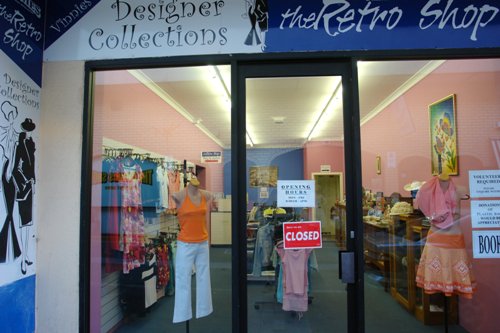 Gary Sauer-Thompson, retro fashion, Adelaide, 2008
What was surprising was the change in the city towards more the pleasant open air coffee shops that provided a space that linked the street to the shop. It gave people public space so they could have their privacy and yet interact publicly. The public space was more inclusive.
Was the uptight, aggressive, boorish Adelaide a part of the industrial city?
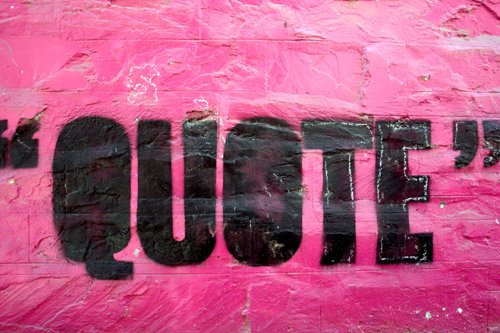 Gary Sauer-Thompson, quote, Adelaide CBD, 2008
The city was no longer a space with buildings, retail and cars, as there was a tacit recognition that the city is a place for people to be in, rather than just a space to work or shop; a space for economic flows. Is this an indication of a post-industrial Adelaide?
The prominence of Adam Internet and Internode in the CBD are an indication of this. I posted an image I'd taken on my laptop in a free wireless cafe, and whilst I was waiting at Internode for the shiny new modem, I made some comments to my weblogs on their public computer.
Is this another indication of the shift from industrial (manufacturing) cities towards cultural, creative and knowledge-based urban environments?
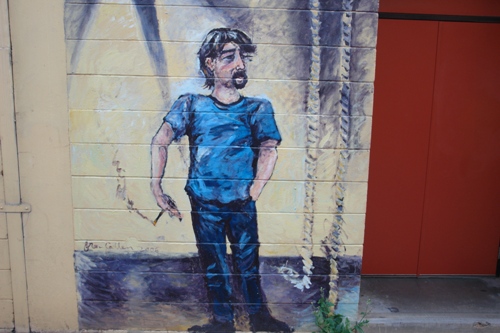 Gary Sauer-Thompson, mural, Adelaide CBD, 2007
The discernible shift I've noticed in the quality of life in the ‘new information economy’ that is transforming Adelaide discloses how the city has a special role to play, since face-to-face interaction, networking and trading, are vital for a quality of life.
If Adelaide has a long way to go in terms of the quality of the public space of urban life, then the ‘network society’ is here.
January 9, 2008
nationality + cricket
If in India the debate over Harbhajan's ban is not longer about a game of cricket, as the ICCC's treatment of the champion spinner has been interpreted by many as a slur on India's national reputation. If test cricket is an expression of Australianness or national identity, then the negative public reaction to the Australian cricket's test win indicates a split between the nationality of the culture industry (Channel Nine and The Australian), the players and the public.
The lack of public support for the team in this incident must come as a surprise to Ponting + Co and their backers who are scornful of concerns about players' conduct. The Australian p[layers are widely seen to have displayed poor sportsmanship---the constant sledging of opponents to ensure 'mental disintegration' is seen as contrary to the 'spirit of the game' the players say they uphold. They play hard but not fair, as they are seen to cheat. So the unified Aussie nationality is fracturing along ethical lines.
Penola: yesterday's charm
From Penola, or more accurately from Petticoat Lane, the oldest residential part of Penola, with its timber and stone cottages dating from 1850 to the First World War.This is heritage, National Trust style:
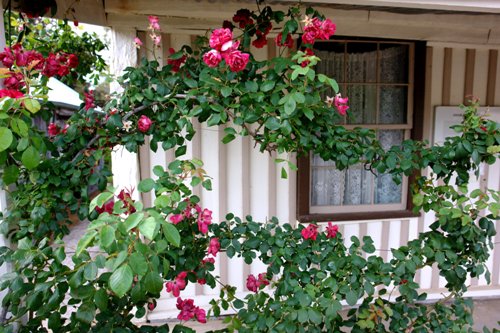 Gary Sauer-Thompson, Roses, Sharam's (Second) Cottage, Penola, 2007
I had a quick look on the morning before we drove back to Victor Harbor via Keith and Strathalbyn
January 8, 2008
cricket gets interesting
So the cricket between Australia and India is to be decided off the field, given the bad blood arising from very poor umpiring with India copping the brunt of it, sledging and taunts, lack of sportsmanship, a racist row, biased Channel 9 commentators and Australian arrogance (the champions claiming grounded catches and appealing for nicks when there were not any).
Why isn't simple technology like video slow motion replays being routinely employed to assist more fair judgements by umpires? What aren't bad umpires stood down? Why did not the ICC fine Harbhajan Singh instead of a giving him 3 match suspension? Or better still, why not say that, as there were no independent witnesses, no verdict could be reached and then given both teams final warnings regarding their behaviour around sledging and racist slurs.
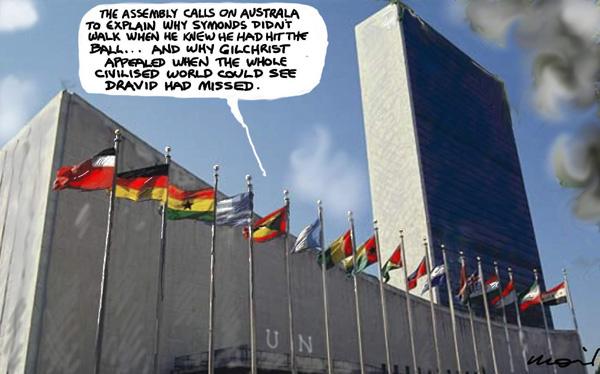 Alan Moir
An unhappy India is now exercising its muscle off the field. India has given the International Cricket Council (ICC) 24 hours to deal with its protests over the recently completed second Test in Sydney, or risk having the tour of Australia abandoned. The Board of Control for Cricket in India (BCCI) wants the racism charge against spinner Harbhajan Singh withdrawn and umpire Steve Bucknor sacked from the third Test in Perth.
The ICC in Dubai has already rejected the latter demand outright, putting the governing body on a collision course with the powerful Indian board. So the cultural divide between the Indian and Australian cricket teams deepens and Australian cricket continues to develop a tainted side---the national team wins games (a great team winning 16 tests on the bounce) but it develops a tattered reputation for the way it does so.
The cultural context is that the Indians were slow to investigate claims that sections of their crowds racially abused Symonds during the 2007 one-day series in India; and that someone has decided that enough is enough, and dished out some of their own sledging taunts to the Australian team.
January 7, 2008
memories and history
This sculpture or wall piece was on the wall of a cafe in Strathalbyn, near the Langhorne Creek wine region. We stopped there for lunch on our way back from Wilsons Promontory to mark the transition from holiday to work:
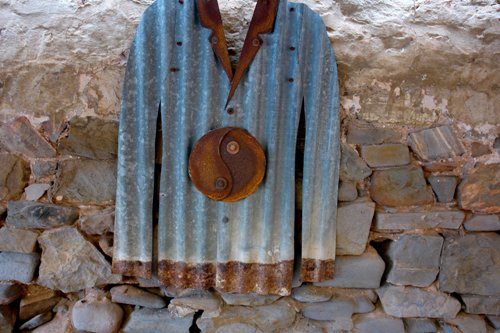 Gary Sauer-Thompson, metal coat, Strathalbyn, 2007
The SA country towns are often very attractive, and I'm suprised that Strathalbyn is not listed as a heritage town. It has heritage written all over it.
Looking back on the trip we agreed that our favourite was Penola in the big red country of the Coonawarra wine region in the south-east of South Australia. That town was very attractive and gracious, especially in the late afternoon light:
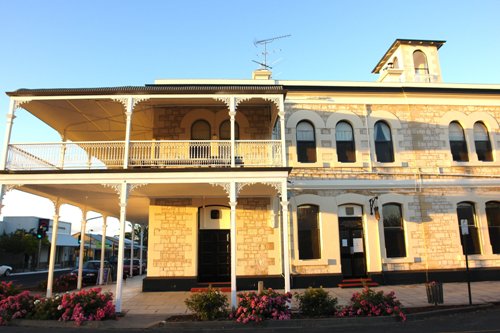 Gary Sauer-Thompson, Pub, Penola, 2007
The building is great, but the food was poor. Pity. Penola was mixing the new with the old, was proud of the old, and had a strong sense of settler history. Penola did not have that inward, bunkered down feel of some the country towns as it was linked into the global economy through the wine industry and international tourism.
January 6, 2008
Six Pistols: Filth + Fury
I watch DVD of the Six Pistols Filth and Fury by Julien Temple last night. It was their own story told in opposition to that of Malcolm McLaren in The Great Rock and Roll Swindle, which was also directed by Temple.
It is predominantly John Lydon's side of the story---I was ripped off by McLaren--- woven into a narrative about the bad boys who are too hot to handle.So there is lots of trouble. McLaren, who was not interviewed for the film, is represented by a disembodied bondage mask which speaks excerpts from previous interviews.

It was a very visual film. It situated the Sex Pistols in terms of images of the working class under a Labour Government (Wilson), the strikes under the Heath and Thatcher Government, a variety of English television comedy shows, and an odd 1950s film of Richard III.
The ugly Sex Pistols were a stand up comedy act, whilst punk was doing your own thing. The cultural context for punk (conflated throughout with the Sex Pistols) is British pop culture, and particularly British mainstream media culture.
The Sex Pistols's intrusion into an otherwise banal media culture is presented as a clash of styles, which sits at odds with the class politics outlined in the opening of the film. Rotten implies that the real story of punk is that of a genuine social movement struggling to create a truly participatory oppositional culture.
What suprised me was the failure to connect punk to the European avante garde of the 1930s---Dada , Lettrists, surrealists and situationists. There was a brief mention of New York Dolls; no mention of Iggy Pop and the Stooges or the Ramones. The Sex Pistols did it all of their own is the claim; a denial of the Greil Markus view of punk as making a new culture out of old chords. In this interview Temple says:
One of the things that The Filth and the Fury does is to challenge that theoretical take on the Sex Pistols as the whole story—that this was a manipulated series of events, and ideas from European art and political movements were somehow injected into these kids. These kids actually came pretty well formed, with their own versions of anarchy and anger and outrage. They didn’t need to have middle-class art school students telling them how to express those things. I think that’s an important consideration to put alongside all the Greil Marcus and Jon Savage theories, to see the actual people involved and what made them write the lyrics that they wrote and make the music that they made.
The freedoms that were opened up by the Sex Pistols, such as the freedom to make a movie when you’re young in England, the freedom to wear whatever you liked, have become industries like the London fashion business where they Hoover up any new idea as soon as it appears on the street and corporatize it and sell it back to you before it’s able to do anything on its own.
The Arizona Boneyards
Arizona is well known for its dry air. Consequently it has become an open-air aviation graveyard and museum. The famous boneyard, the David-Monthan air base in Tucson, has row after row of US military aircraft in open air storage. One of the Australian F111s was resurrected from there and got the nickname "Boneyard Wrangler".

As you drive through Arizona you keep hitting these museums of wonderfully preserved open-air displays of old aircraft.
In other news; I hit the limits of the free flickr account which is two hundred photos. I payed $25 for a year to have my complete library of photos displayed. If that had been even six years ago, there would have been no thought of payment, the internet was all based on a mix of free models. It is a sign of the economic maturity of the web and internet services that asking for $25 as a subscription is not an issue any longer.
Another interesting touch from yahoo, who owns flickr, is that credit card entry form does not ask what type of card it is. On most sites you have to choose whether it is VISA, American Express, etc. However the first four credit card numbers are unique to the type of credit card service. So by entering the credit card number the website should know what type of card it is. A big deal was made of this unnecessary user input by different usability blogs recently. This is the first time I have seen that put into practice. Well done yahoo and flickr.
January 5, 2008
From Kangaroo Island snap to photoblog
I've been considering setting up a photoblog on the Thought-factory.net website, and the other night I started thinking about which photos I would use. Further questions then arose: would the photoblog have a theme? Or would it be random shots? What would be its name? Would it be just images?
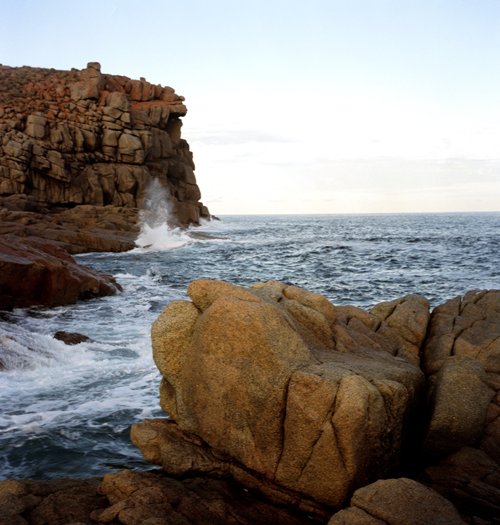 Gary Sauer-Thompson, Cape Willoughby, Kangaroo Island, SA, 2007
In exploring what I needed to do by way of photoblog software etc etc and looking around for ideas to these questions I stumbled upon the 2007 Photoblog Awards. There is some good/excellent work here. There is an Oceania section, which includes a number of Australian photoblogs including Mohamadreza Aghajani's The Frozen Memory, Amanda Gilligan's Montmartre,Tuan Nguyen's Ayusaki, Billy Law's Shisso Photoblog, the Native flavaz photoblog, and the photoblog of David Kleinert.
The winner of the Oceania section was Daniel Boud's Bouidist, which I have on my links under photography, and which I often dip into. It's a Sydney based music photoblog with brief comments run on Movable Type---just like Junk for Code. What I noticed was that the quality of the photos on Boudist are superior to those on junk for code. There is a richness to the Boudist images that is missing from those on junk for code, even though the richness is there on the computer.
As my photos on junk for code are too compressed by my hosting company for it to be a professional looking photoblog, I am going to have to set up a different kind of hosting facility.
January 4, 2008
Street snap, Melbourne
Melbourne has a lawyer's precinct the around Williams/Lonsdale streets area in the CBD, and I happened to be passing when the legal fraternity were gathered outside Melbourne's Supreme Court to celebrate a significant legal event.
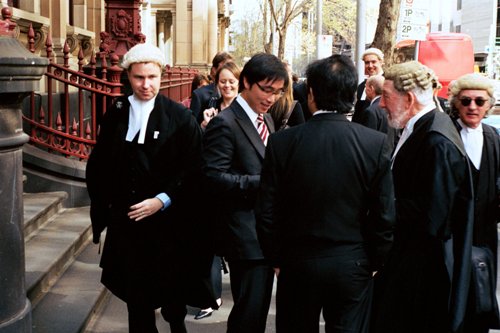 Gary Sauer-Thompson, lawyers, Melbourne CBD, 2007
I never found out what that legal event was. As I had run out of film and was running late for an appointment I had to move on.
That's street photography isn't. An isolated moment in a world of flux and flows. The moment is plucked out of the flow to stand on its own as an isolated image. The attempt to make sense of a moment - to “think the present historically” as Walter Benjamin put it --- is very difficult. Does an image enable us to do this?
January 3, 2008
A touch of surrealism
According to Katharine Wolfe in her From Aesthetics to Politics: Rancière, Kant and Deleuze in Contemporary Aesthetics Jacques Rancière insists that:
aesthetics must be understood in the terms of Kant's Critique of Pure Reason. Aesthetics is "the system of a priori forms determining what presents itself to sense experience"...Just as these a priori forms determine the organization of human experience and provide its conditions, aesthetics comes in various structural systems that serve both to condition the shared world of our daily experience and to partition that world and delimit the positions one might occupy within it.
This certainly opens up our understanding of aesthetics and takes it away from being confined in the art institution, equating aethetics with beauty, or aesthetics in the academy. It's a reclaiming of "aesthetics" from its current narrow confines to explore its significance for contemporary experience.
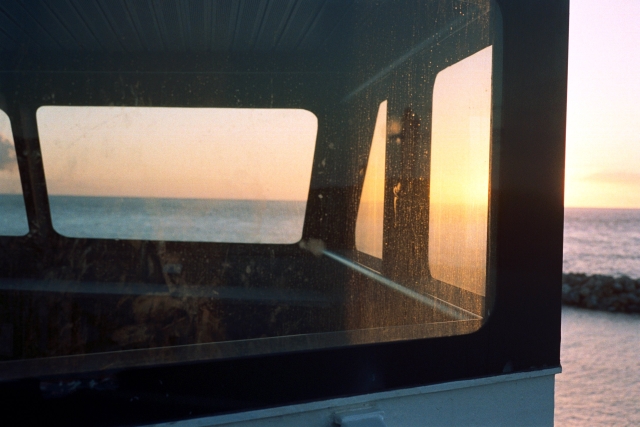 Gary Sauer-Thompson, evening, Cape Jervis Ferry, 2007
In The Politics of Aesthetics Rancière moves quickly on to undertake a Foucaultian historiography of distinct artistic practices and systems, illuminating the subject positions they make possible as well as the political systems with which they are synonymous.
January 2, 2008
Rancière + aesthetics
Jacques Rancière in his recent book, The Politics of Aesthetics, states that he is concerned here with “aesthetic acts as configurations of experience that create new modes of sense perception and induce novel forms of subjectivity”.
So what are new modes of sense perception? It is a seeing differently to our habitual ways of seeing---- to the previously established "distribution of the sensible", of what is visible, what can be said and done in our neoliberal world?
 Gary Sauer-Thompson, Schramm's Service Station, Coleraine, Victoria, 2007
So it would be a disengaging from, and a seeking to alter, the ways of seeing, feeling and experiencing in our neoliberal network society (society of the post-spectacle, of the simulacrum, of the proliferation of electronic media and their saturation of the real).
So what configurations of experience would create new modes of sense perception? It's not just looking at objects. It disputes or challenges the way that a given society distributes the “conditions of possibility” for what can (and what cannot) be sensed, felt, and spoken about, and what cannot; and it refers to bringing the people back into the discussion.
January 1, 2008
New Years Eve: beach culture
After a week of hot weather a mild cool change came through the Fleurieu Peninsula late in the afternoon of New Years eve. It was such a relief. So we went to the beach:
 Gary Sauer-Thompson, Victor Harbor, 2007
We just hung out on the beach watching the world go and thankful for the cloud cover:
 Gary Sauer-Thompson, Ari, Hayborough Beach, 2007
We talked about the different cultures of the different beaches in the sense of people relating to one another differently: some beaches are friendly and easy, others are tense and are marked by the kind of simmering cultural war, that continues to be defended by David Burchell here. The poodles signify inner city middle class café-society elitism for the outer suburban asspirationals.
Gold Coast: vulnerability
Lyn had an interesting post on community authoritarianism in the suburban heartland on the Gold Coast over at Public Opinion. References have been made about the effects of global warming on this city, which is the most popular location for tourism in Queensland.
The likely effects on this 'Development or Frontier City' are rising sea levels, more intense storms and cyclones and reduced water availability. I'm not sure about more heat waves. That means the Gold Coast needs to address the issue of sustainability. Will this new urban formations be able to do so?
 Gold Coast, source: Wikepedia

As a coastal region the Gold Coast is vulnerable to considerable damage to low-lying coastal settlements and infrastructure, as it is a space where populations, tourism and capital investment are large and growing.The beaches have a history of severe erosion and the tidal waterways, canal and estuarine systems are subject to intense flooding from king tides and extreme storm sequences.
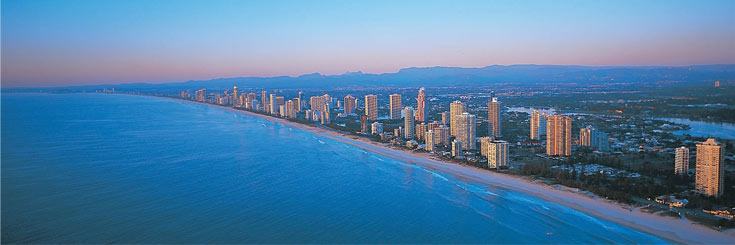 Gold Coast, looking south west, ( Courtesy Gold Coast City Council).
The suburban heartland of the Gold Coast is vulnerable to the effects of global warming because the heavily developed coastal strip sits on a narrow barrier sandbar between the waterways.and the sea. Much of the land between the coastal strip and the hinterland was once wetlands drained by the Nerang River, but the swamps have been converted into man-made waterways and artificial islands covered in upmarket homes in a resort-style residential real estate development. The area is 90 sq km in area and contains nearly 60, 000 dwellings, 40% of which are flood prone. Hence the need for flood mitigation projects.
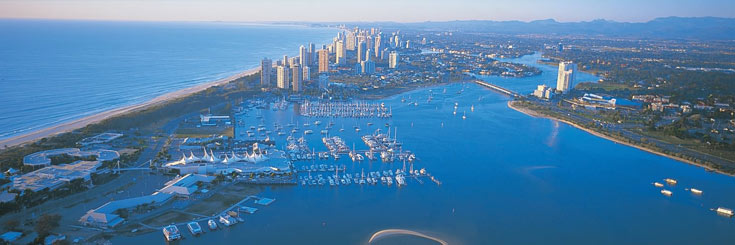 Gold Coast, looking south ( Courtesy Gold Coast City Council).
It is unlikely that the Gold Coast will become an ecological city-- a city in balance with nature. It will adapt to the effects of climate change.What does 'adapt. mean apart structural flood mitigation projects? it looks to mean a desalination plant powered by electricity from coal-fired power stations that produce greenhouse emissions to address water shortages?
So what will happen during the next big flood?