|
January 23, 2008
This shelf cloud was photographed by Jeff Kerr during a trip crossing the prairies of Saskatchewan, Canada on the Trans-Canada Highway in 2001 August, and it is part of the Astronomy Picture of the Day series. I just love the colour and the sweep of the cloud in the early morning light that allude to the processes of nature:
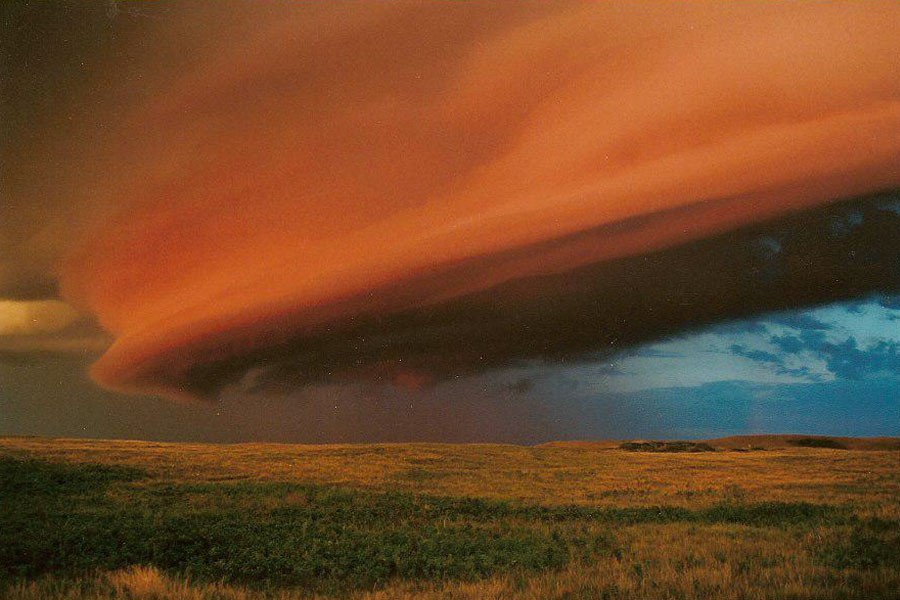 Jeff Kerr, Shelf Cloud Over Saskatchewan, Canada
If this image is where romanticism and science meet, then we need to rethink the way that Romanticism has been represented as a reaction to the rationalism of the Enlightenment (ie., defending the emotions; or a movement "against the tide of modernity," (a critique of industrial capitalism in the name of beauty) or a flight from history into the ideologically-determined consolations of the imagination (a retreat into subjectivity or the privileged interiority of the subject).
The photograph is also about the sublime, which following Burke, I interpret as being about awe and astonishment, as well as about terror and fear. This gives us a much wider range of human experience to the landscape than the narrowly defined purely aesthetic response (our sensations of the beautiful). this allows us to develop our sense that the Romantics understood sensations, emotions, and passions as embodied and contextual phenomena, rather than as "psychological events" that happen at some central point within an isolated subject.
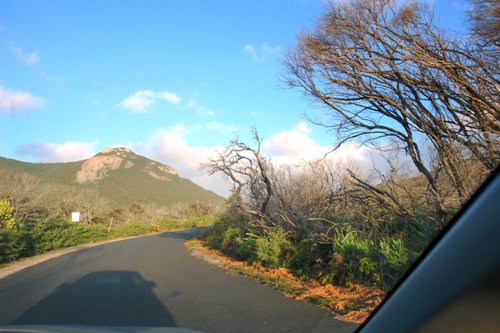 Gary Sauer-Thompson, Wilsons Promontory, 2007
The centre of Romanticism is the humanist subject, which is structured on the basic distinction between observer here and objects over there. Ron Broglio + Georgia Tech in Romanticism and the New Deleuze: Wandering in the Landscape with Wordsworth and Deleuze say:
Each object is considered abstractly by the individual observer, and the romantic artist takes the object in and discusses its aesthetic merit. While the land is experienced through a bodily walk, the representation of the space always removes the poet from the scene. Objects are clearly demarcated and any thing or person who threatens to impose upon the narrator gets appropriated as an object for the artist's self-contemplation.
These classical romantics--eg., Wordsworth on his walks in the Lakes District---eat nature, in the sense that they incorporate or internalize it. The walk in the landscape is designed to reflect the inner workings of the mind.
We can shift to the physicality of bodies and effects of environmental forces as significant agents. Nature has agency that impacts on our bodiliness as we meander through the landscape.
|


Gary,
there is the politics of Romanticism which you missed. It is important part of English literature.
The French Revolution embodied the hopes for the dawn of a new era for the British Romantics---William Wordsworth and Samuel Taylor Coleridge; and then the reaction that these writers felt with the course of the revolution's failures. That is the political narrative of British Romanticism's so-called first generation.
Though Romanticism's Romanticism's canonical second generation--Hazlitt, Lord Byron, and Percy Bysshe Shelley--- recovered the political idealism of its first generation, the radical hopes for a new political era in Europe promised by the French Revolution were irrecoverably lost to history.
Instead of radically new political order the political actuality was some renewed version of a familiar, repressive state structure.