March 31, 2010
You cannot live on exposure
So it now comes to learning how to survive in the rapidly changing photography market to ensure that my photography can begin to pay its way. You cannot live on exposure (Flickr and photoblogs) in a user generated world.
 Gary Sauer-Thompson, Adelaide parklands, 2010
So how can photography pay its way when it is not longer done as a hobby? I have no idea. Find other ways of making money that subsidize the work is all that I can come up with. And if I want to take early retirement from paid work?
March 30, 2010
Richard Mosse
Photographer Richard Mosse, originally from Ireland, is a graduate of the Yale MFA program in photography, as well as a recipient of a Leonore Annenberg Fellowship in the Performing and Visual Arts. This Fellowship has funded Mosse's ongoing series of travels around the world--- for two full years of traveling to make photographs of things falling apart or in decay.
The series that caught my eye was the one entitled Nomands, which refers to wrecked cars in the primeval desert landscapes of Iraq.
 Richard Mosse, wrecked car, Nomand series
These are forgotten relics or junk in the middle of nowhere, and they offer a way of reading the world and unpacking history. Mosse works slowly and methodically, lugging around an enormous studio camera and tripod, rather than shooting thousands of images on digital.
A latter series ---The Fall broadens this theme to crashed planes whilst earlier ones explored buildings damaged by war and earthquakes.
The cars----cast-offs, long forgotten in the former war-zones, and now unknown relics of the war machine---- indicate how photography is firmly rooted in the world of things. It carries a trace signifying an actual physical memory of a part of the world at a specific time and place.
March 29, 2010
Mars: Proctor Crater + other images
I've just found time to look at the catalog of photographs taken by the High Resolution Imaging Science Experiment (HiRISE) camera on the Mars Reconnaissance Orbiter satellite. They are pretty impressive:
 NASA, Sand Dunes and Ripples in Proctor Crater, Mars
NASA's Mars Reconnaissance Orbiter left Cape Canaveral in 2005, on a search for evidence that water persisted on the surface of Mars for a long period of time. While other Mars missions have shown that water flowed across the surface in Mars' history, it remains a mystery whether water was ever around long enough to provide a habitat for life.
This false-color image of the north polar layered deposits has been processed to emphasize color variations.
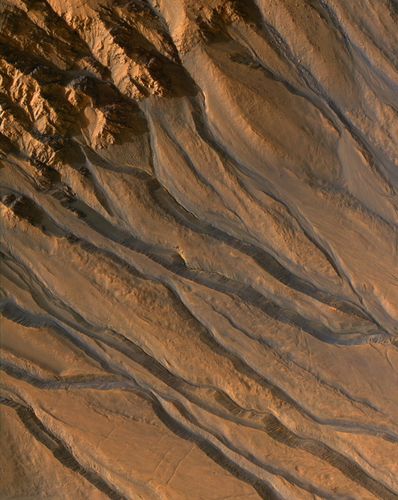 NASA, Lava-Draped Channel System on Mars
Mars is fundamentally a volcanic planet. Geologic mapping of Mars shows that about half the surface seems to be covered with volcanic materials that have been modified to some extent by other processes (such as meteorite impacts, blowing wind, and floods of water).
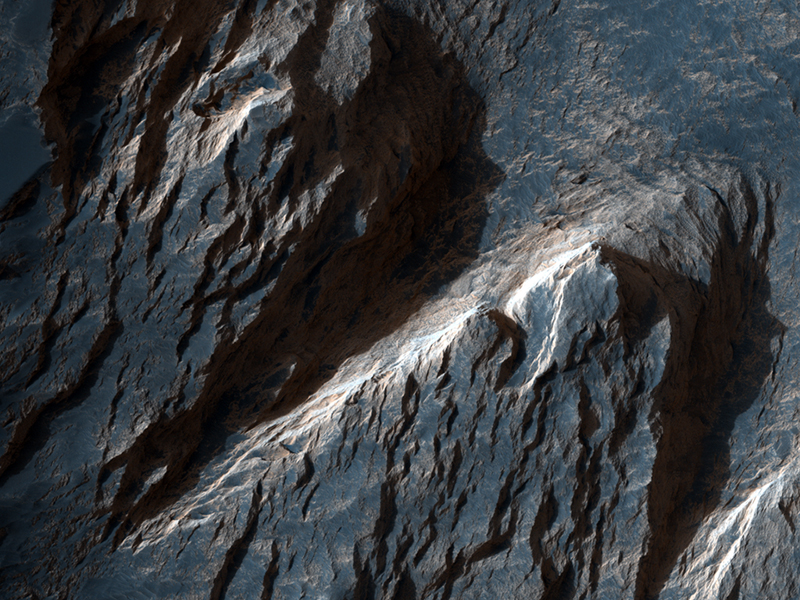 NASA, Layers and Dark Debris in Melas Chasma
The images collected under themes are even more graphic. Water on Mars has been confirmed.
Finding scientifically interesting spots that are safe to land future rovers is one of the primary goals for the MRO mission.The orbiter's primary mission ends about five-and-a-half years after launch, on Dec. 31, 2010.
March 28, 2010
possible digital futures
Painting the exterior of the inner city apartment in Adelaide was pretty much finished on the weekend, just before the rains came on Sunday. It has taken most of my time since I returned from the photo trip/holiday in Tasmania. I now have some free time to concentrate on my photography and I will ensure that I do whilst I begin to paint the inside of the weekender at Victor Harbor.
 Gary Sauer-Thompson, jetty, Strahan, Tasmania, 2010
It is not just a question of taking photographs every day, or post processing them ( ie., picture making) organizing and editing them into the various projects; or even critically reflecting on the work that has been done. It is also relating the projects to possible digital futures emerging from Apple's transformative iPad platform.
If publishers (and, more importantly, the public) really embrace the iPad, we're going to be seeing more than just black-text-on-white books--if you wanted that, you'd buy a Kindle--- not an iPad, which enables designers to embed audio and video into a photographic "book". The print magazine book culture already seems quaint, as does the Kindle, since Amazon is using new technology without really adapting the content.
The publishing industry is falling all over itself to promote tablet computing as a new savior for the dwindling prospects of printed books, newspapers, and magazines. They are rushing to get in bed with Apple, believing that the appeal of a new, shiny device may provide a window to charge for content that they gave away a long time ago. This is the next market that is poised to go digital.
What this means is that photographers need to multi-platform their projects in a magazine, a book or a website since each way of publishing can reach a different audience.
March 26, 2010
retro creatives
There is a strange debate in photography that has being going on for a couple of years as a result of the digital revolution that make the tools of the trade a PC, camera and software. This debate plays off film versus digital, and is premised on good versus bad and is often coded in terms of art versus amateur snaps. This debate ignores the 'as well'--people using both instruments to produce work--- preferring to remain with an 'either or' duality.
 Gary Sauer-Thompson, Franklin Street, Adelaide 2010
As an example, consider Darren Holliday's Going retro to get creative in the Guardian, which refers to the growing wave of creative artists who are eschewing digital cameras in favour of 30-year-old manual film cameras. This is true. Analogue photography appears to be "in vogue right now".
Holliday then says:
Let me explain what is so wrong with modern digital cameras, and by extension with software editors like the market leader Photoshop: I believe using such brutally efficient and capable technology in photography actually hampers a significant number of young artists. The psychology here is an obvious one, and can be observed in small children at play. Give a child a toy that does something amazing an unlimited number of times, in quick succession, then watch that child tire of it and look for something else. It's the same with digital cameras: "snap, snap, snap. Oh here's an interesting scene, let me take 20 pictures of it to make sure I get one good one, snap! I can always Photoshop that annoying lamppost out later, no need to look for a different angle, snap!" The artform of photography becomes diluted through the mass use of it.
Holliday adds that the small number of snappers unsatisfied with this approach--the retro creatives--- are not recognised as a significant cultural movement, but may be morphing into one thanks to the internet. And perhaps ironically, it is web-based sharing platforms that are feeding the retro movement. Flickr.com alone hosts a vast collection of manual photography work, and discussion.And so it does.
However, because analogue photography appears to be making a turn and becoming "in vogue right now" that doesn't mean that digital is no good, or that we should just shoot film and ignore digital as some say. Both film and digital have their uses depending on the type of work being done.
What we can say though is that as film photography developed in parallel to drawing/draughtsmanship and eventually took over from it in a hegemonic sense in the nineteenth century, so digital cameras +Photoshop developed in parallel to film and, in the last couple of years, has overthrown the dominant position held by the use of film.Is the new (digital) still wearing the ethos and aesthetic of the old( film)?
March 25, 2010
a photographic education
In his Introduction to Thinking Photography Victor Burgin critically comments on what a photographic education in the 1980s represented. He says that:
Contrary to their declared intent, the majority of those courses whose concern is with photography as art belong in the first [vocational] category rather than the second [ones that consider photography in its totality as a general cultural phenomenon, and to develop his or her own ideas as to what direction to pursue]. They offer a vocational training for that branch of the culture industry whose products are photographic exhibitions and books. The academic content of such courses tends overwhelmingly to take the form of an uncritical initiation into the dominant beliefs and values prevailing in the art institution as a whole. On such courses 'criticism' and 'history' stand in place of theory....The dominant mode of history and criticism of photography, in which the main concern is for reputations and objects, and in which the objects inherit the reputations to become commodities: a history and criticism to suit the saleroom.
That describes my experience in gaining a photographic education in the 1980s in Melbourne. Photography was the outsider to the art institution because it had been excluded through most of the 20th century. It just wanted to be accepted by the art institution, and was not critical of the ethos of the art institution.
What was not explored was 'Modernism', most specifically in the meaning that this word has been given in the writings of Clement Greenberg and his followers (the essential features of which are present in the earlier writings of Clive Bell and Roger Fry), the sign was to be totally erased from the surface. The art work was to become a totally autonomous material object which made no gesture to anything beyond its own boundaries; the surface itself - its colour, its consistency, its edge - was to become the only content of the work.
It was accepted by embracing the ethos of modernism. As Burgin points out after Cubism, Modernism was to free art from its old obligations to representation defined in those every terms which Cubism itself had called into question: illusion and communication:
Photography, however, was unable to follow painting into modernist abstraction without the appearance of straining after effect; the unprecedented capacity of photography for resemblance seemed most appropriately to determine its specific work and to distinguish it from painting...Certainly there has emerged over the modern period a form of 'photographic modernism' founded on concepts of 'photographic
seeing', but.... it has only the most tenuous and uneasy purchase on those considerations of 'content' which remain so obstinately central to our experience of photographs.
Photography's relationship to modernism and to theory was therefore an uneasy one. In my experience my photographic education made no reference to conceptual art which underlined the central importance of theory, to the photographic as sign, or to photographic meaning.
March 24, 2010
Salt: Murray Fredericks
I watched a documentary by Michael Angus and Murray Fredericks called SALT which was shown on the ABC Artscape programme. This was based on a visual diary about Frederick's Lake Eyre project in the remote north corner of South Australia. You can stream, vodcast or watch it on iview tomorrow from the Artscape page.
 Murray Fredericks, tent and bike, Lake Eyre series
Salt is a series of photographs of vast space and emptiness that conveyed a sense of space and the annulment of self. It began in 2003 and involved camping on Lake Eyre for a month or so each year with a with a 8x10 Toyo field camera being used to explore the nuances of light and space.
 Murray Fredericks, Salt 23, Lake Eyre series
The project reduces the landscape to its elemental aspects and only intermittently includes the visual anchor for most orthodox landscape photography - the line of the horizon. What is represented are landscapes suffused with light, space and colour at dusk, dawn and night that deliberately avoid any natural, animal or human features that would give a sense of scale to his work, thereby break with the traditional language of landscape photography.
Fredericks, who runs a successful commercial architectural photography practice using high end medium format digital equipment, uses a lot of equipment. He says that:
During the visits of 2007-8, the project developed again. An HD video camera, time lapse equipment and a high-resolution digital stills system was carried out onto the Lake along with the 'traditional' format. Footage of the trip was seen by director Michael Angus, who immediately 'recognized' a documentary in the making. Michael obtained significant funding from the ABC, the Adelaide Film Festival and the Film Finance Corporation to produce 'SALT'.
This is an example of a photographer immersing himself into the landscape rather than standing outside it, n but it requires far more resources to do than I have at my disposal. But the staying in one place and photographing the interactions between space and light with a large format camera is an interesting one; one that I can do from the cliff tops at Victor Harbor.
The Lake Eyre project has come to an end---Greenland is next place to mind's relationship to emptiness and visual representations of that.
March 23, 2010
photography+ creative industries
In Creative Industries After the First Decade of Debate Terry Flew and Stuart Cunningham from the Creative Industries Faculty, at the Queensland University of Technology, Brisbane, Australia wax lyrical about the creative industries, which include film, video, and photography.
 Gary Sauer-Thompson, burnt car, Adelaide CBD, 2010
They say that the creative industries approach is a move beyond the traditional discourses of the subsidized arts, and giving a central role to creativity in the generation of economic wealth.
They add that:
Rather than being a discourse that simply champions commercial popular culture as the obverse of traditional “market failure” rationales for arts and cultural funding, what has instead been emerging is a better understanding of the enabling role of public-sector institutions and government-funded cultural activities as drivers of innovation and socially networked markets
It shifts away from the traditional view that rejected markets as incompatible with culture, as it recognizes that most people’s cultural needs are being, for better or worse, supplied by the market as goods and services.
The problem that I have with the creative industries is that my photography does not make money and so it is not part of the image industry. Nor can I see myself becoming a photographer earning my livelihood from photography; or even earning enough from my photography to pay for its ongoing costs.
March 20, 2010
in Adelaide: state election
In The Australian David Penberthy makes an accurate observation about Adelaide:
At the turn of the century Adelaide looked like Detroit without the gangs. Its working-class southern and northern suburbs were filled with boarded-up reminders of a glorious manufacturing past; those factories that used to make car components, whitegoods and textiles were all closing as this small and geographically disadvantaged state stood powerless against globalisation.
The inner city or CBD area was depressingly empty of people and full of boarded up shop fronts and empty development sites. SA was seen as the basket case of the national economy, and younger people were forced to flee, as there were no jobs in the rust bucket state that was reeling from the State Bank collapse 15 years ago.
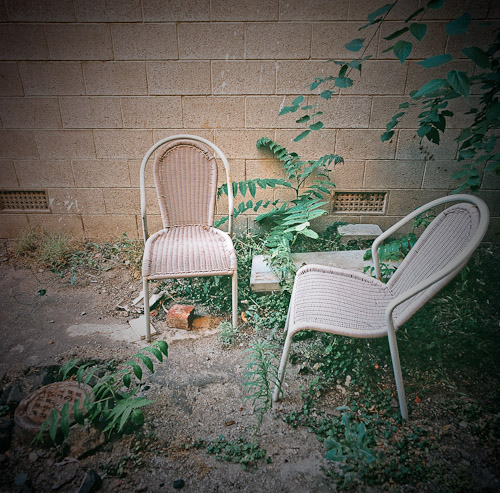 Gary Sauer-Thompson, two chairs, Adelaide, 2009
Things have economically improved under the Rann Labor Government since then, due to mineral exploration and a burgeoning defence industry.
Slowly the rust-bucket state is becoming part of the information society or knowledge economy with the flows of globalisation working to facilitate this. High speed broadband is slowly being seen as a foundation for economic growth, job creation, global competitiveness and a better way of life in that it enables entire new industries and unlocking vast new possibilities for existing ones.
Slowly because the idea of a “postindustrial” economy and the creative industries is still on the margins of policy discussions and SA, unlike Queensland, has still to use these ideas to move beyond the traditional discourses of the subsidized arts, to both give a central role to creativity in the generation of economic wealth, and to shift to the larger discourses such as those of trade policy, copyright and intellectual property, urban development, and educational futures.
The creative industries concept shares with information society theories an interest in the long-term shift in employment and national income from agriculture and manufacturing to services in advanced capitalist economies; the growing role of knowledge capital as a primary driver of growth in these economies; and creative industries as the loci of innovation and employment growth in increasingly knowledge-based economies.
March 18, 2010
photographic archives
Whilst down at Victor Harbor I've been going through my photographic archives on my computer, exploring the film images I had taken upon my return to photography, and selecting the odd one to be processed in Lightroom.
 Gary Sauer-Thompson, Suzanne, Aoraki/Mt Cook National Park, 2008
These were ones that I'd taken whilst I was in transition to a digital world but didn't really understand what I was entering into. Though the negatives were processed and scanned by the lab, and I uploaded them to the Windows PC computer, I was still thinking in analogue terms despite having just joined Flickr.
I had no work flow, no projects, and I was just content to publish them on Flickr and this weblog. I was an amateur taking images on holidays and when I had a bit of spare time. My identity was a policy wonk, not that of a photographer. I slowly learnt from my mistakes: the poor quality of the image on junk for code drove me to set up a photoblog, Rhizomes1; whilst the hard disc's crashing on my desktop and laptop Windows forced me to do proper backups; whilst the poor quality of Windows for image forced me to make the switch to Apple.
March 16, 2010
Jonathan Tagg on photographies
Jonathan Tagg in the Disciplinary Frame: Photographic Truths and the Capture of Meaning says that:
In the fleetingly modish area of photography, which offered a relatively unconsolidated space adjacent to but displaced from the more solidified institutions of art and art history, debate in the 1970s turned on the search for alternative avenues of radical practice beyond the well-trodden paths of leftist documentary and reportage and outside the tramlines of realism and artifice that had dictated the parallel tracks of discourse on photography since its invention.
He says that his aim was to relocate the debate on realism and challenging the notion of a progressive “documentary tradition” by connecting an array of nineteenth-century modes of photographic documentation to the emergence of disciplinary techniques and to a new form of the State.
The point was not to offer a monolithic account; rather, the intent was to pluralize photography, to insist on the specificity of frames of meaning.
In contrast with this drive to pluralize and specify photographies, one might say that
the persistent bent of photographic criticism from François Arago to Oliver Wendell Holmes and from Charles Baudelaire to Walter Benjamin had always been toward the totalization of photography, treating it as a homogeneous technology or singular medium whose meaning and historical consequences were somehow already immanent. Whether condemning photography’s alleged debasing effects or eulogizing its revolutionary productive potential, photographic criticism construed photography as a singular cultural force, for good or ill.
He adds that his argument was that photography could no longer be seen as a unified medium whose status and value were inherent within it--as the formalists claimed. Status, value, and meaning had to be produced — and they were produced locally and unevenly across a hierarchy of contingent and mutually defining cultural spaces in which what applied at one point might be totally at odds with what applied at another.
The discursive framing of a plurality of photographies effectively shreds the notion of “the medium,” whether conceived as an opaque material generating its own proper conventions or asa transparent vehicle mediating the efficient communication of meaning.
March 15, 2010
black humour
I've taken a couple of days off from painting the outside of the inner city apartment in Adelaide to come down to Victor Harbor. I plan to do some large format photography and site manage the repairs to the roof and the gutters of the weekender.
It is actually hotter down here on the coast than in Adelaide, which is not what I wanted at all. It is even too hot for the roofers. They've called it a day at lunch time saying they are getting too old for this kind of work; everything is too regulated, they are moving to Thailand and to hell with the superannuation.

This little break is a chance to reconnect with the style of photography that is developing whilst I'm down at Victor Harbor. I've been doing digital studies of rocks, seaweed and shells in the field and bringing the found objects back to the studio for tabletop shots.
The other work that is developing is some digital sketches or studies of minimalist landscapes for a reshoot with a view camera this week, weather permitting.
Update
I listened to the Grateful Dead Live at Barton Hall - Cornell University on 1977-05-08. I came across this MP3 of the Grateful Dead's famous concert-- Live at Barton Hall - Cornell University on 1977-05-08 this evening:
May 1977 was seen as one of the highpoints of their live music performance--- a pinnacle tour for the Grateful Dead--much like the Fillmore run of February 1969, or the string of shows from June 1974.
March 12, 2010
Dereliction and decline
It may be festival time in Adelaide but for the last week or so I've been painting the outside of the inner city apartment, and I have had little time to do much photography or to explore the various festivals. I just go the local gym, come home for breakfast, paint, walk the dogs in the Adelaide parklands at the end of the day, then pretty much collapse. I'm now sick of the painting. It is tedious.
On the other hand, painting gave me plenty of time to think. I found myself thinking about the ruins and decay in Tasmania--modern industrial ruins--including the useless or old or unusual—an aesthetics of decay. Associated with this is a cultural pessimism—a world conscious of its decline because of the abandoned houses and mines eroding or decaying under the elements as nature reclaimed them. Dereliction and decline in particular places such as Queenstown and Zeehan.
 Gary Sauer-Thompson, abandoned house, Queenstown, 2010
What we have is the cyclical nature of capitalism, whereby new industries suggest rational progress, but only at the expense of destroying old industries, entails a reworking of space in which disorder and mutability are suppressed. If there are any new industries in Queenstown and Zeehan then these are tourism.
Places come and go as people move on or abandoned them because capital has moved on and there are no jobs. The place no longer exists and it is mourned because of the loss.
March 9, 2010
returning to the old
I spent the long weekend down at Victor Harbor sorting through my old view/field camera equipment that had been stored away for a decade or more, and then waiting for the weather to settle down so that I could start using the gear. I had some shots already lined up.
Whilst in Tasmania I realized that though the Leica S2 may be the finest digital camera in regards to image quality I will never be able to buy one. Nor could I ever afford to buy the new Hasselblad H4D-40 megapixel camera, its medium format equivalent, or even the Nikon DX3.
As Elizabeth Carmel observes:
The Hasselblad system cost really does not make sense as an investment for people not making a living from their photography, unless you are independently wealthy and want the joy of working with the best money can buy.
So my only option is making use film and my old view/field cameras to get better quality than my digital point and shoot camera can deliver:
 Gary Sauer-Thompson, Quarry, Queenstown, Tasmania 2010
This is not just returning to the old and outmoded, given the possibilities offerred by Apple's iPad and its e-book format for photographers to break free of the constraints of the publishing houses and create & distribute their own content.
As Elizabeth Carmel observes tablets with hi-resolution color means that small indy publishers can release books in a digital format that can easily be downloaded and read (iphone is too small), and bypass the printing process.
March 8, 2010
cloud culture
Charles Leadbeater in Cloud Culture: the future of global cultural relations for the British Council says that:
The growth of the digital cloud will change both culture and creativity. Digital stores of data in the cloud, ubiquitous broadband, new search technologies, access through multiple devices – these should make more culture, more available than ever before to more people. We are also living through a massive proliferation of expressive capacity to add to and remix culture with cheaper, more powerful tools for making music and films, taking and showing images, drawing up designs and games.
The implication is that people will increasingly communicate to and through one another, rather than through formal media organisations like broadcasters and publishers. He says thatc loud culture is likely to take a huge diversity of forms:
Permanent clouds of global cultural resources for people to draw on will be created by public, private and voluntary contributions. An example of global public cloud culture is the World Digital Library. Wikipedia is the prime example of a global cultural resource created by volunteer contributions. Google is providing private funding to digitise a vast collection of out of copyright books. iStockphoto is a quasi-commercial collection of photographs mainly taken by amateurs. Flickr allows the creation of a vast collection of user-generated photographs
However, new kind of communication-based power, vested in forms of mass collaboration in civil society, is provoking a fierce struggle as governments and companies try to wrest back control. The web may prove to be such a pervasive and unsettling force, both for governments and corporations, that it will provoke a counter-revolution, which will bring with it more pervasive surveillance and tighter controls. Traditional media companies are trying to stall and resist the emergence of cloud culture.
Cloud culture will develop only if we trust remote, third-party providers of digital services to store our stuff for us and provide us with platforms – like YouTube, Facebook and Twitter – on which we interact. There are ample reasons why people should not automatically trust the clouds these corporations are creating.Yet Tthe web is changing culture more quickly and profoundly than it is changing politics and even business. It is changing how we express ourselves, how we communicate, how we share and find what is important to us. Culture and media in the decade just gone was dominated by the rise of Web 2.0 and social media. The decade to come will be made by the rise of cloud culture, a culture based on even more intensive collaboration and connection.What is emerging is a mass culture which is more participative and collaborative, which is about searching, doing, sharing, making, modifying.
March 7, 2010
Tasmanian landscape: David Keeling
The wild or untamed natural beauty of Tasmania has lured, inspired, enrapt, and obsessed artists since European occupation of the Island. However, the work of Tasmania’s contemporary landscape artists do not represent the sublime or beauty alone, as they have stumbled across the complexities underlying the island’s culture from invasion and ecological destruction and begun to introduce the politics, history and traditions of the island into their artwork.
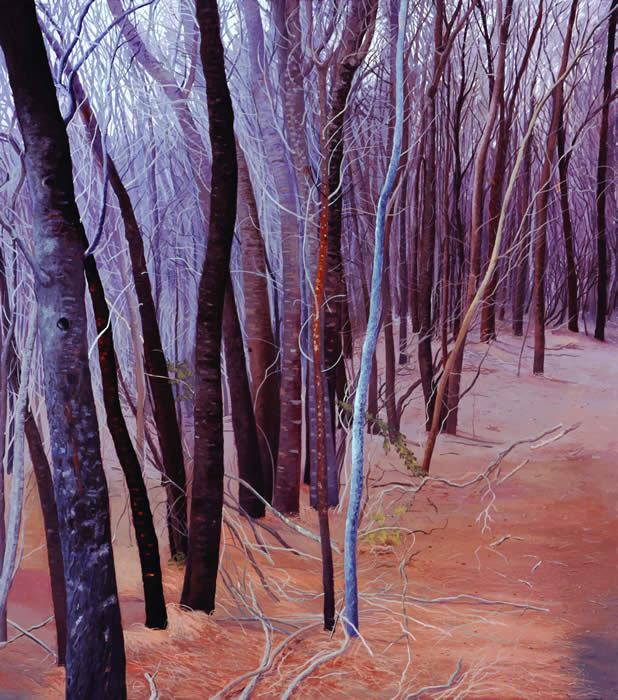 David Keeling, Hazards Forest 1, 2006, Oil on Linen
This treescape, with its straggly, rhythmic formations, breaks away from wilderness as beauty and the 19th-century landscape painters, whose scenes reinforced an idealised notion of place. It's effect is for us to ask a question rather than confirm a view (the Heidelberg School ) and so become aware of the baggage that comes with representing the landscape. We are obliged to deal with the tradition as well as the politics of the push to develop again in wilderness areas and the on urban encroachment onto the land.
March 6, 2010
Tasmania: The Glover Prize
When I was passing through the Georgian village of Evandale in Tasmania last week, there were street posters advertising the Glover Prize for 2010, named after John Glover the Tasmanian colonial painter.
This is a landscape prize, and it is awarded each year for the best new (previously unexhibited and less than a year old) painting depicting the Tasmanian landscape. The work of the previous winners of the prize is varied. However, the images of the 2010 finalists are not up.
John Glover is known for his contribution to the early development of the colonial picturesque in settler landscape art in Australia, due to his depiction of the Tasmanian light as bright and clear. Glover also did commissioned works for the proud landowners of the Colony and he contributed to the development of tourism promoting ‘places to see’ using the natural local scenery in perfect picturesque post cards’.
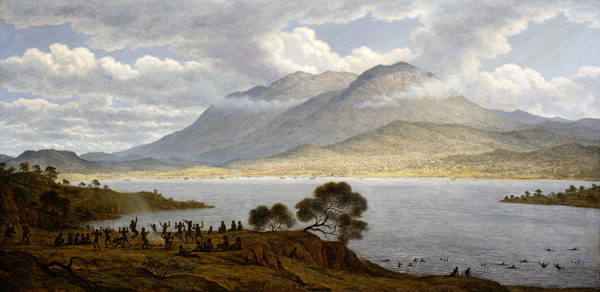 John Glover, Mount Wellington and Hobart Town from Kangaroo Point 1831-33, oil on canvas
Tourists in Europe in the early 19th century sought to locate places described in works by poets, romantic novelists and painters of the time which would accord with the ‘beautiful’, ‘sublime ’ ,‘ picturesque’ and ‘romantic ’. For Glover this was English Lake District .The touring artist often carried special items designed to assist in `aesthetic response’, such as a camera lucida.
Photography, print ma king and drawing has assumed a pivotal role in the presentation of contemporary Tasmanian
landscapes. It would appear that photographers--such as the Westbury based John Temple--- have inherited the mantle of the 18th century touring artists. It is they who represent scenes of wilderness and iconic sites and some of them sell their picture perfect images of Australian landscape as postcards that are then bought by tourists.
 Gary Sauer-Thompson cottage, Tunbridge, Tasmania
I couldn't resist this reference to Glover's A view of the artist's house and garden, in Mills Plains, Van Diemen's Land (1835) when I was in staying in Tunbridge.
Update
The 2010 finalists are now online and they are very diverse in their approach to the landscape. The 2010 winner is Ian Waldron's Walach Dhaarr (Cockle Creek)
March 2, 2010
Fringing
I arrived back in Adelaide to discover that the Fringe Festival is in full swing. It has its own Flickr group and blog to inform those like me who have little idea of the events and happenings around the city.
The events that interest me are Street Dreams that is part of the DIY artist run festival and Renewing Adelaide. My reason is that it is nigh on impossible to legally set up an artist or community led space in the city centre on an ongoing basis in Adelaide, which lacks a vital urban artistic culture. Yet there are a lot of empty space in the city and those spaces make the city feel dead, especially when they remain empty for a period of years.
 Gary Sauer-Thompson, street art, Flinders Street, Adelaide, 2010.
Adelaide like Newcastle is a ‘doughnut’ city –a city that lost their overnight populations and thus have a huge suburban belt but little city life with its sense of a lack of artistic community in the city centre, being isolated and bored with little option but to move to Melbourne.
The Renew Adelaide people---- Brigid Noone and Ianto Ware---are attempting to revitalise the city by filling the plethora of empty shop spaces with artist and community run initiatives. There are comparable projects being run overseas and there’s a strong history of artist run spaces taking over disused or underused urban areas. They say that a doughnut city is:
The doughnut phenomenon is partly about the volume of empty space in the city, partly about the overnight population but moreover it describes whether a city has held its place as a regional cultural centre. Cities are, by definition, cultural hubs. If they’re not, they’re just glorified suburbs. Unlike Newcastle, Adelaide has succeeded in maintaining its day time life but after 5 PM on weeknights they look exactly the same – empty.
A ‘cultural hub’ doesn’t shut down when the office workers leave. Adelaide lost a lot of its inner city life in the sixties and seventies due to suburbanization and the growth of suburban malls. The Renew Adelaide people add that:
A city that loses its sense of cultural and community life after 5 PM and replaces it with a weekend suburbanite drinking culture is less safe, less inclusive and less appealing to tourists, students and everyone who doesn’t like throwing up and getting in fights.The absence of support for artist run spaces and small arts production groups [means] that the volume of micro events in Adelaide is staggeringly low.
The end result is that, whilst the Fringe might make Adelaide amazing for a month, the rest of the year the city has a lot more in common with Newcastle than Melbourne, Sydney or even Brisbane and Perth.
These considerations are important because DIY festival refers to “Read/Write” culture in which ordinary citizens “read” their culture by listening to it or by reading representations of it, then add to the culture they read by creating and re-creating the culture around them. They do this re- creating using the same tools the professional uses. So we have a mixing, matching, and merging of visual and musical traditions taken from various sources.
March 1, 2010
SMiLE: Windchimes
The SMiLE album (1967) was to be the album the Beach Boys released after Pet Sounds, but it was never released. It remained unfinished until Brian Wilson returned to it in 2006.
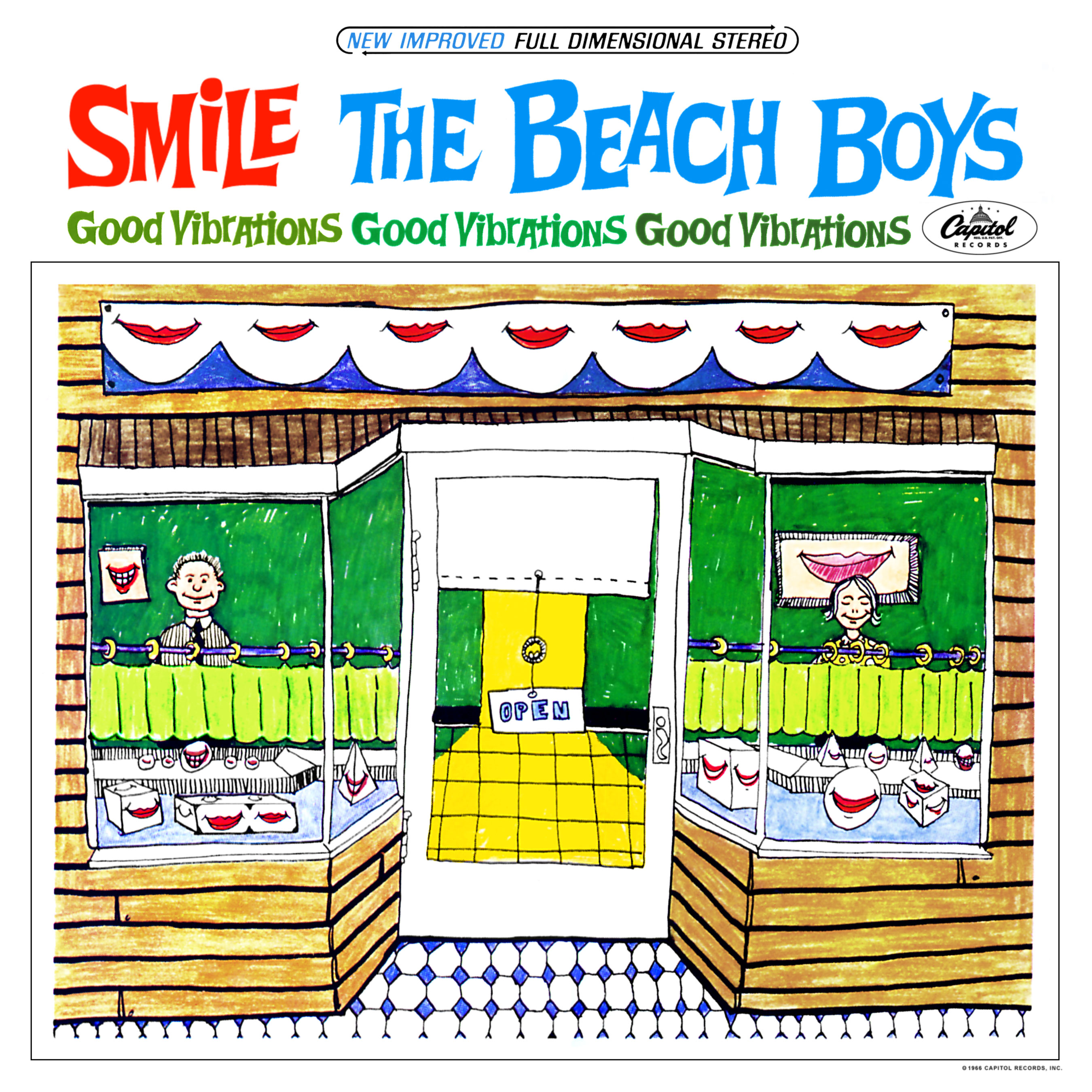
However, the actual Smile material is accessible on numerous bootlegs and on YouTube. It is interesting to compare it to Brian Wilson's 2007 interpretation.
Smile was devised as a an album-length suite of specially-written songs which were both thematically and musically linked, and constructed from barely-related musical sections that were recorded, painstakingly spliced together, and then reduced into a short pop song.
The video is Purple Chick's mix of Windchimes from the legendary Smile album, and though it is rough it sounds very fresh and contemporary:
Over time, the Beach Boys mutated into an oldies act, selling out large-scale tours on the strength of their nostalgic hits. What exists from the Smile period is the equivalent of many separate albums that might have been.