|
December 28, 2009
Murray Fredericks is known for his black and white images of the Tasmanian forests and mountains. Since 2002 he has been exploring Lake Eyre in South Australia in a minimalist and colourist way. He camps on the salt at Lake Eyre and he uses an 8 x 10 Toyo view and slow colour film to represent the intense light and the vast space of this remote region:
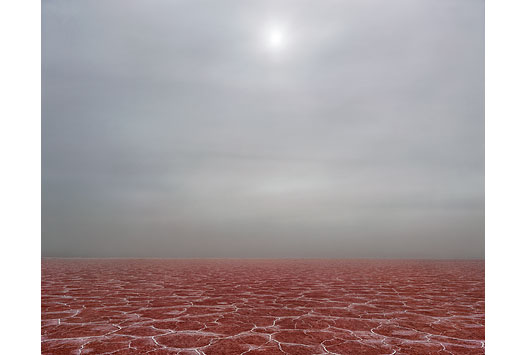 Murray Fredericks, Salt 108, 2007, pigment on cotton rag
These are not representations of a specific wilderness landscape, which has traditionally been represented as the dead heart in Australian culture. Some, no doubt, would interpret these images as representations of nothing--a black hole where nothing lives and even the desert vegetation is dead.
Fredericks says that in this work he is deconstructing the stereotypical images of postcards and calenders:
I was deliberately trying to break the calender aesthetic --which is very place based. I am not about describing Lake Eyre . I don't even want anyone to look and say that it is a nice place to visit. landscape is something that can be used to carry an emotion, all different emotions. It has a connection that goers beyond the conscious minds.
This is a reference back to Stieglitz's Equivalents series --an attempt to free the subject matter from literal interpretation, and, as such, create abstract photographic works of art.
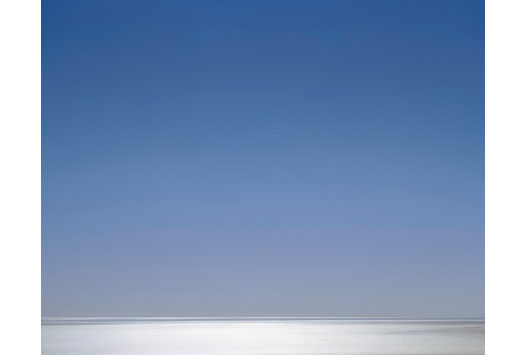 Murray Fredericks, Salt 30, 2007, pigment on cotton rag
Frederick's uses pictures as metaphors to represent feelings about things other than those shown by the pictures in this case his inner journey or subjectivity.
Trouble is, we have no idea of Frederick's emotions when he was camped at Lake Eyre. We just have the photographs. There is no way to know what Fredericks's photos are equivalent to (other than asking him). On the other hand, we can consider them equivalent to something from our own experience, if we so desire. Thus we can say that they are equivalent to pure emptiness or to the emotions of intense solitude.
 Murray Fredericks, Salt 133, 2007, pigment on cotton rag
Or we can interpret them as painterly abstractions within the modernist art tradition.
|


I understand that Murray Fredericks studied/worked with Gordon Undy in his studio. So there is a direct link between the old b+w landscape tradition and the new colourist one.