September 30, 2007
hanging out--free time?
It's the long weekend in South Australia and the start of the school holidays, so many of those who were not in Melbourne for the AFL final, are out and about in relaxing in Victor Harbor. They are walking the beaches, going to the cafes and restaurants, and hanging out on the balcony's of the beach houses with their friends.

Gary Sauer-Thompson, dogs Bluff, 2007
It's a moment of leisure time used to recover from the effects of work time --a profit oriented social life' a moment that avoids the market's version of leisure time (eg., that offered by the the entertainment industry). This time off work that helps us to fit into business life is what Adorno called free time.
Adorno argued in his 'Free Time', essay that the apparent separation of work and free time is only maintained because free time is needed for recreation, to recreate labour power: this explains its importance in bourgeois society, and the way in which it is seen to express a relation of opposition to work.

Gary Sauer-Thompson, Middleton, Fleurieu Peninsula, 2007
In the 'Culture Industry: Enlightenment as Mass Deception' chapter of Dialectic of Enlightenment Horkheimer and Adorno argue that:
Amusement under late capitalism is the prolongation of work. It is sought after as an escape from the mechanised work process, and to recruit strength in order to be able to cope with it again. But at the same time mechanisation has such power over a man’s leisure and happiness, and so profoundly determines the manufacture of amusement goods, that his experiences are inevitably after-images of the work process itself. The ostensible content is merely a faded foreground; what sinks in is the automatic succession of standardised operations. What happens at work, in the factory, or in the office can only be escaped from by approximation to it in one’s leisure time. All amusement suffers from this incurable malady.

Gary Sauer-Thompson, Middleton Beach, Fleurieu Peninsula, 2007
September 29, 2007
undermining minimalism?
This 300 kilogram spill of cellophane-wrapped, black liquorice rod candy is interpreted by the art institution---the Guggenheim --- as investigating the permeable and often fragile boundary between the public and private.

Felix Gonzalez-Tores, Untitled (Public Opinion), 1991
I cannot see this investigation myself. The art work is supposed to evoke bullets or missiles, and was created as a comment on the prevailing political mood of conservatism and censorship in the US. Again I cannot see it. Nor did I see it as a brooding sinister work. Is that due to the shape of the licorice candy--- a missile shape? How do we infer that public opinion is not as informed as it once was? Public opinion about what issue? The culture wars? Politics? Contemporary art?
What I do see is an attempt to undermine the non-representional aesthetic of minimalism of the 1960s, which had been a reaction against the painterly forms of Abstract Expressionism, as well as the discourse, institutions and ideologies that supported it from. According to the art institution we have an undermining of minimalism from within---undermining the neutrality of the minimalist work by introducing desire, loss, vulnerability and anger.
Well, I can see the how the black liquorice rod candy is the expression of individual desire, but loss, vulnerability or anger?
September 28, 2007
bendi lango
I've been at the Australian Psychological Society's annual conference in Brisbane this week and I noticed a stall for the bendi lango art exhibition. I did not have the time to go and have attend.
The images are online:
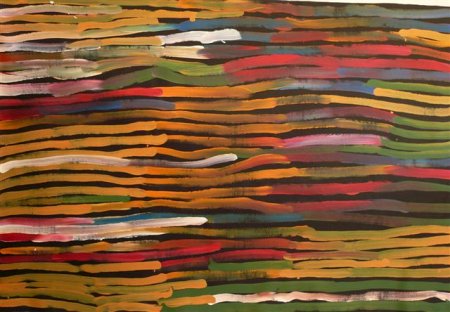
Minnie Pwerle, from the Awelye-Atnwengerrp series
Minnie Pwerle is from the Utopia region approximately 300km north east of Alice Springs. Utopia artists have been at the forefront of the contemporary Aboriginal art movement since the artist Emily Kngwarreye came to the attention of collectors and institutions in the 1990s.
Since then, distinguished artists such as Gloria Petyarre, Kathleen Petyarre, and Barbara Weir (Pwerle’s daughter) have risen to prominence and have captured the attention of the art world.
Minnie Pwerle was born around 1910 near Utopia in the Australian central desert. It was not until 1999 that she painted her first canvas and rapidly drew the attention of both local and international collectors. Minnie is now regarded as one of Australia's most important indigenous talents and is compared with her late friend and contemporary, Emily Kngwarreye.
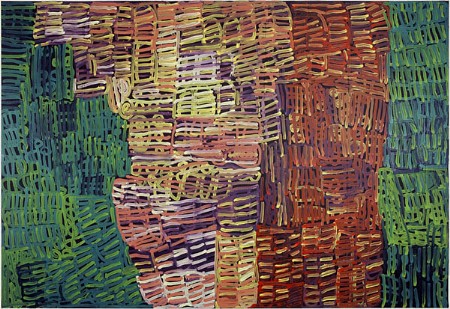
Minnie Pwerle, Awelyle, 2003
The Awelye-Atnwengerrp paintings were developed directly from Pwerle's experience as a ritual body-painter and they resemble the patterns and designs used in these ceremonies, in which a variety of powders ground from charcoal and yellow and red ochres are finger-painted on the breasts and upper bodies of the singers and dancers. Awelye signifies Women's Ceremony, and Atnwengerrp refers to Pwerle's country.
September 27, 2007
Melbourne snaps : heritage
I came across this truly magnificent building at 376-380 Collins Street when I was walking Melbourne. It is William Pitts Stock Exchange:
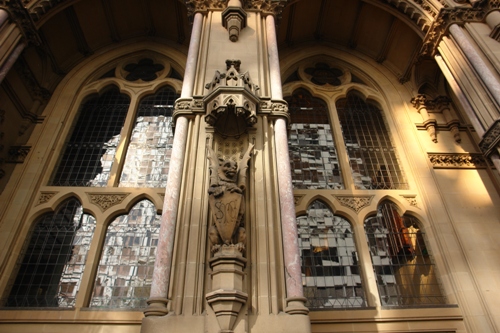
Gary Sauer-Thompson, ANZ Bank, Collins Street, Melbourne, 2007
Now an ANZ banking museum it is considered to be one of the best commercial Gothic Revival building in Australia. I did not have time to go inside the building.Nor did I have a chance to look inside to view the domed banking chamber of the former Commercial Bank of Australia.
September 25, 2007
Melbourne: Hosier Lane
Hosier Lane near Federation Square is the best lane in terms of the lanes as a gallery that exhibit Melbourne's street culture. It is there that you can see why Melbourne has a standing as an international hotspot for street art. In contrast, Centre Place is just a mess and there is no respect shown for any of the work.
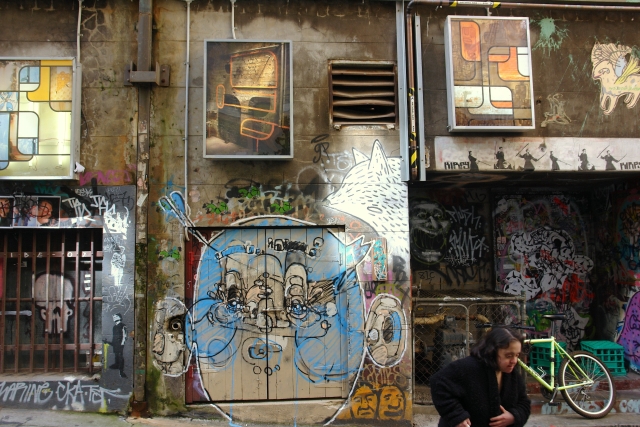
Gary Sauer-Thompson, Hosier Lane, Melbourne, 2007
It is here in a stinking, winding lane, full of overflowing garbage bins, that you can best see the creative graffiti and stencil work on display, its diversity and self referential gestures to the world of art exhibited in the National Gallery of Victoria just down the road. The curators there have recognized the value of the work and are collecting some of the artists.
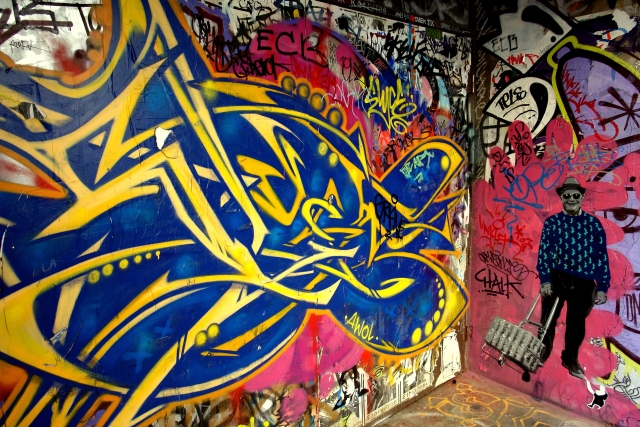
Gary Sauer-Thompson, Hosier Lane, Melbourne, 2007
Although Melbourne city council remains committed to the immediate removal of any form of graffiti in "highly visual" areas and members of the Brumby State Government see street art as graffiti as vandalism, the designs in Hosier Lane and many other laneways that criss-cross the city centre seem to go untouched. Late last year, the council, despite "protests, introduced a system allowing residents and businesses to apply for a permit to preserve street art they considered worthy of protection.
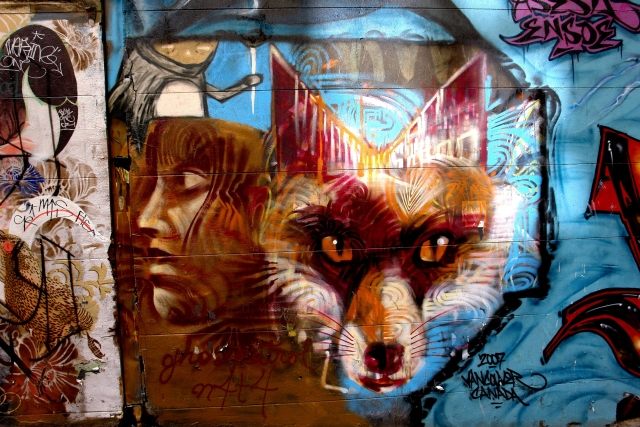
Gary Sauer-Thompson, Hosier Lane, Melbourne, 2007
Most of the works in the laneway are more ‘arty' than graffiti.
September 24, 2007
The View From Canberra
I recently moved to Canberra from Melbourne when offered a position in the Public Service. Last weekend my partner and I returned to Melbourne and stayed with friends in the same block of apartments in South Yarra that I used to call home, not far from where Chopper grew up.
The environment in Melbourne has a knack for creating and embracing characters. The inner-city suburbs buzz with human activity almost around the clock and it would be overwhelming if you've grown accustomed to the gentle peace of suburbia that prevails in the nations capital.
The trip only lasted a few days, but one of these days was put aside for engaging in my favourite Melbourne pastime, 'people watching'. It's a fairly common activity in Melbourne, as people seek to define their individuality with visual appeal and to share it with the broader public by wandering the streets aimlessly or lounging around all day and/or night in backstreet cafés.
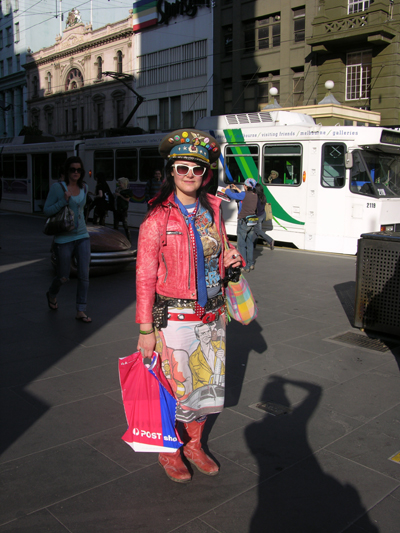
Melbourne, 2007
I recently moved to Canberra from Melbourne when offered a position in the Public Service. Last weekend my partner and I returned to Melbourne and stayed with friends in the same block of apartments in South Yarra that I used to call home, not far from where Chopper grew up.
The environment in Melbourne has a knack for creating and embracing characters. The inner-city suburbs buzz with human activity almost around the clock and it would be overwhelming if you've grown accustomed to the gentle peace of suburbia that prevails in the nations capital.
In Canberra, such activities are untenable. The broad malls in Canberra's centre create a sense of isolation, and it's no surprise that the cafes and restaurants generating the most activity are confined to a small walkway off the mall in the civic centre. There's little to encourage or incline the youth to confront or challenge their peers. Yet, while the streets feel empty and the parks and paths around Canberra's many lakes are scattered with pedestrians, the shopping centers seem to be teaming with consumers engaging in their favourite pastime.
It's a false perception, no doubt, but urban space isn't restricted to telling the truth.
from pop art to street culture
The Guggenheim Collection: 1940s to Now at the National Gallery of Victoria indicates that Pop Art consists of more then just Campbell Soup cans and comic strips. We have this kind of work that is very reminiscent of the walls of some of Melbourne's lanes.

Robert Rauschenberg, Combine 1954–1964
It is very recognizable popular imagery. A pictorial surface that is not a window on the world, but one lets the world in again.
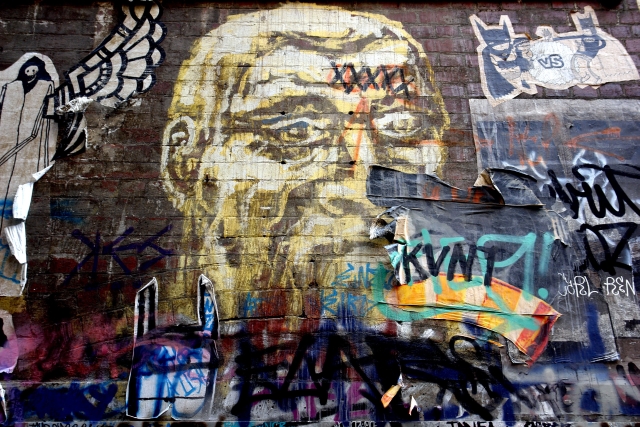
Gary Sauer-Thompson, Hosier Lane, Melbourne, 2007
I had a sense of deja vu when I saw the Guggenheim's Rauschenbergs in the National Gallery of Victoria ---I had spent several hours looking at imagery similar like this when walking in Melbourne's laneways.
September 23, 2007
Beat Strueli: photographs
Late Monday afternoon I took a break from exploring Melbourne's lanes to see the Guggenheim Collection: 1940s to Now at the National Gallery of Victoria. It is is exclusive to the National Gallery of Victoria and will not travel to any other Australian city. It features iconic artworks from the Guggenheim collections from 1940s to the present. Among the “name” international artists represented are the likes of Willem de Kooning, Mark Rothko, Jackson Pollock, Roy Lichtenstein, Gilbert & George, and Jeff Koons.
I was much taken by the photographs by Beat Streuli of people in urban spaces, and the way he explored the lone person in the big city crowd, which has been a central theme of modern art since Poe and Baudelaire.
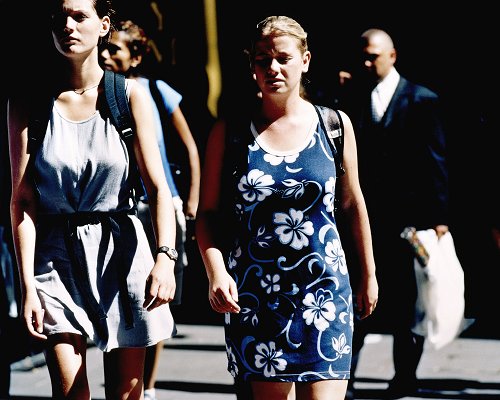
Beat Streuli, Sydney, 1999
Streuli, a Swiss photographer, captures people when they are at their most natural state, when they are not posing for the camera. He uses a telephoto lens at a distance to catch his unknowing subjects appearing naturally, without artifice.
He has developed a substantial and impressive body of work in photography and video that documents the mundane, transient pedestrian activity of urban life: of people moving through and among each other, each alone yet among the other, blur a line between portraying anonymity and individuality.

Beat Streuli, Bruxelles Midi, 2005/06
The interest of these telephoto "snapshots" is in the movements of people in the public spaces of large cities---in the way individuals exist in moments whilst composing a flow of humanity.
September 22, 2007
walking Melbourne with friends
On Tuesday, my last day in Melbourne, I meet Francis Xavier Holland who runs From A Lan Downunder and Nabakov, a well known and long time blogging commentator. They had generously offered to share their Melbourne with me.
Francis and I meet and chatted over coffee in the Rialto building in Collins Street:
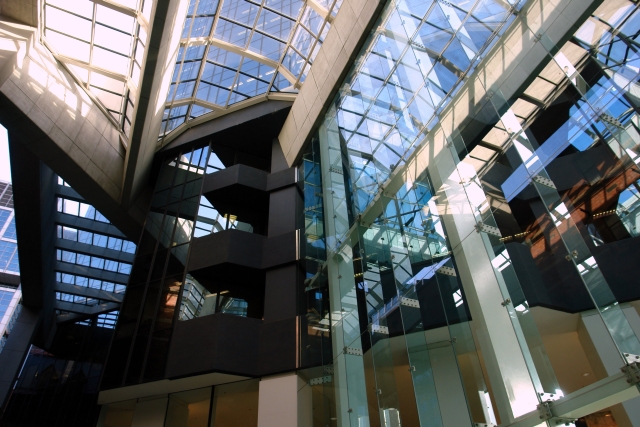
Gary Sauer-Thompson, interior Rialto Building. Melbourne, 2007
He pointed out out the history of this part of Melbourne from the 12th floor. Then we walked Francis' Melbourne to visit some of his favourite lanes.
This included walking north east in the CBD to Caledonian Lane:
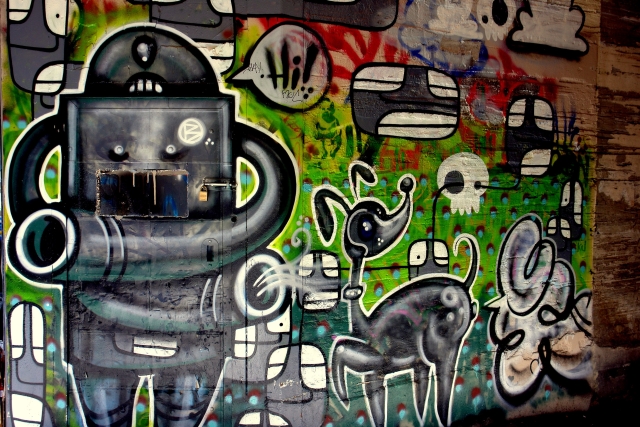
Gary Sauer-Thompson, machine figure, Caledonian Lane, Melbourne, 2007
We then walked directly south to Centre Place, off Flinders Lane:
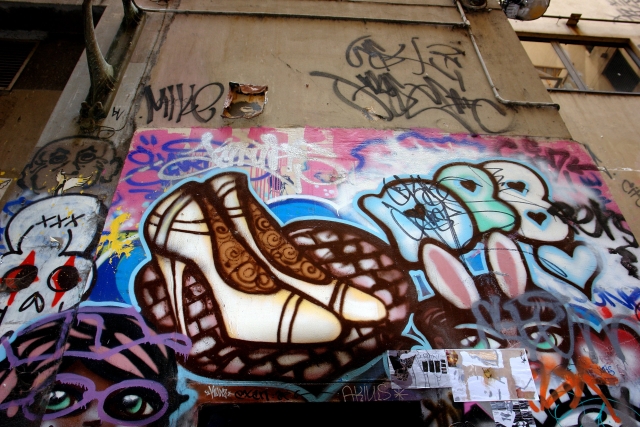
Gary Sauer-Thompson, shoes, Centre Place, Melbourne, 2007
We then meet up with Nabakov and the three of us walked east onto AC/DC Lane, which is between Exhibition and Russell. The lane is in the heart of the city's bar and rock 'n roll district. It was new terrain for me:
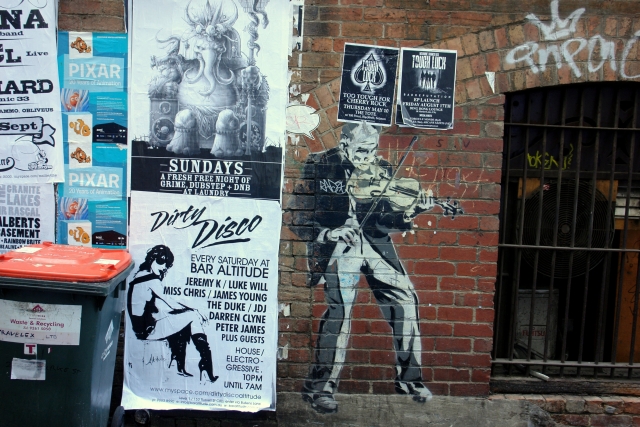
Gary Sauer-Thompson, musician, AC/DC Lane, Melbourne, 2007
The lane recognises the important contribution of musical and popular culture in Melbourne. Nabokov's Melbourne was the Melbourne of bars
Then it was off to an eagles view of Melbourne CBD from the top in the twin towers in Collins Street before having lunch at a Sushi bar in the top end of Bourke Street. Some of the discussion was about the way urban life a had been enhanced by the bar culture
Then I caught a cab to the airport to return to Canberra.
September 21, 2007
Melbourne: rolling back the cars
Late Sunday afternoon I meandered from the Exhibition Centre to the Grand Hotel of Marvellous Melbourne and explored around the Spencer St/ Flinders Street corner. This part of the Melbourne CBD was noisy, dirty and very unfriendly to pedestrians. I just wanted to flee from the dirt, noise and fumes.
I found a bit of wasteland between traffic lanes flowing to and from the corner:
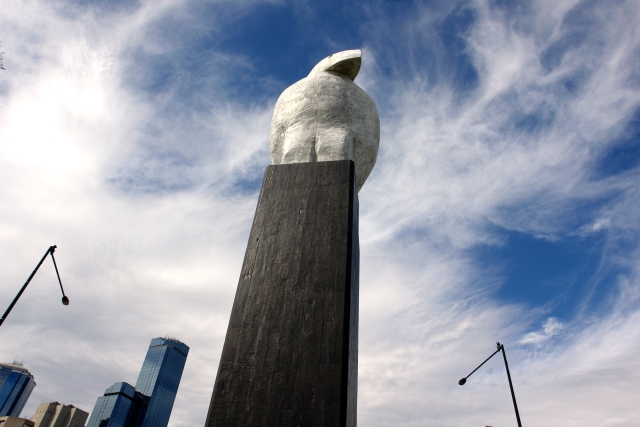
Gary Sauer-Thompson, statute, Melbourne, 2007
Since the Docklands looked to be an urban wasteland for a photographic flaneur I walked to the CBD. It was pleasant to wander down Swanston Street as the cars had gone. It was mostly trams and service vehicles. Suddenly it was enjoyable walking in the CBD looking at what was happening without having to fight against the noise and the smell of the cars. It's a definite improvement and Adelaide should do the same with King William Street in its CBD.
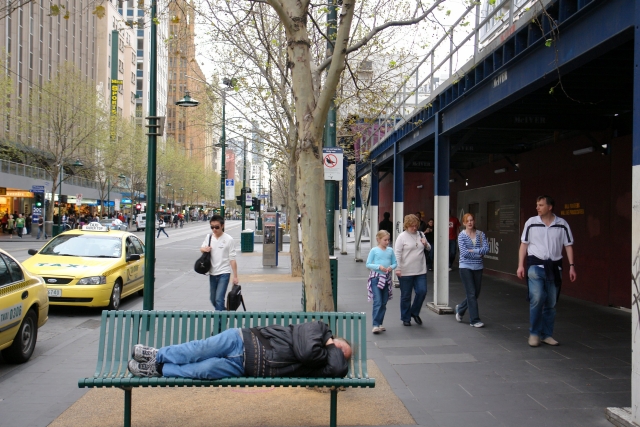
Gary Sauer-Thompson, Swanston Street, Melbourne, 2007
I remember Swanston Street as the grottiest retail strip in the city, the windblown City Square, the desolate, the demolished Queen Victoria hospital site, the rundown State Library forecourt, the l $2 shops and fast food and sex shops, lots of people shouting from doorways. In the 1980s, the city was little more than a daytime destination for commuting office workers who could not get home quickly enough. “Terminal decline” and “doughnut city” were how many commentators described the future of the CBD.
Now Swanton Street one of the more people friendly streets in the city, and it's pleasant to walk down it. Its part of the revitalization of the city as a centre of culture and entertainment.
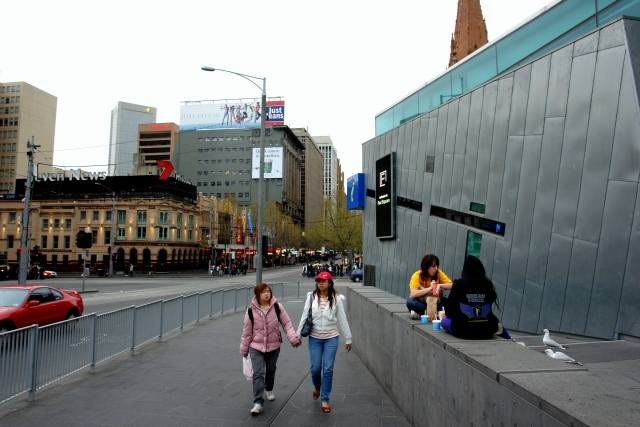
Gary Sauer-Thompson, Couple, Swanston Street, Melbourne, 2007
The Melbourne City Council deserves to be applauded for planning to revitalise Swanston Street through making it a semi-closed walk in the 1990s. I recall that everyone from the little tourist shops to big department stores like Myer opposed the development.
bloody Microsoft
I'm considering swapping from a Windows based PC to an Apple for my personal use and only using the former for my paid work. My reason? Windows inadequacies. I'm resentful that I pay for the operating software that doesn't work very well, even though it is Microsoft's flagship product.
John Gapper describes Windows inadequacies well:
I was among the early adopters of Windows 3.1 after Microsoft launched it in 1992. Since then I have taken my chances on Windows NT and Windows 2000 at work and Windows 95, 98, ME, XP and, most recently, Vista at home. Each time, I have hoped against hope that Microsoft had solved Windows' deep-seated problems. That adds up to a decade and a half of disappointment, which is more than anyone ought to endure. Windows can operate OK. When the computer is up and running, and not having to switch among a lot of applications, it trundles along just fine. But I have come to dread those application and system freezes and crashes that plague PCs and the endless wait for a Windows-run computer to regain consciousness from its slumber.
I too am tired of the system freezes and crashes and I'm resisting making the switch to Vista.
Gapper goes on to say that he has seen Bill Gates give presentations about how the next generation of software will change lives and let us perform many tasks seamlessly. Then I look at my laptop - the one I have to keep removing the battery from and unplugging to re-start - and I want to yell: "Forget all that, Bill. Just make this thing work properly!"
September 20, 2007
Federation Square--a postmodern public space?
Last Sunday afternoon, after I'd arrived in Melbourne I walked down to, and around, Federation Square. I wanted to explore the architecture and its functionality as a public space in relation to Harry Seidler's Riverside Centre in Brisbane. A modernist architecture was traditionally contrasted to Federation style, so why not contrast the Riverside Centre with a post modern architecture.
What Federation Square offers is another kind of contrast with Seidler's modernism --- the pluralism and difference in architecture --in constrast to sameness. Consequently, Federation Square signifies a paradigm shift in contemporary Australian architecture:

Gary Sauer-Thompson, Federation Square, Melbourne, 2007
What I noticed was architectural difference ---variety and complexity---within the site and how there was a coherence of difference in this Australian postmodernism. If modernism was in a state of denial about the past...then with post modernism, architects began to revisit our history.

Gary Sauer-Thompson, Federation Square, Melbourne, 2007
If architecture is akin to public sculpture, which we all have to live with for a long time, then the public spaces of Federation Square is also a civic space of the 21st century that embraced the new media and cyberspace.
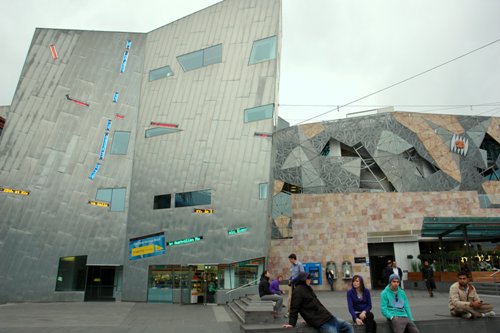
Gary Sauer-Thompson, Federation Square, Melbourne, 2007
It's a piazza at a time when people are supposedly at home watching TV. There is a lot of space outside the buildings, and people other than skateboarders were using it in the late afternoon. it was a genuinely public space for a multicultural society.
Does it create a new experience of the public realm? I wasn't sure. Networked cosmopolitanism came to mind. But what did that textbook concept mean? I tacitly knew that I was more at home here in a space of flows in a fluid city’ than in Seidler's Riverside Centre.
September 19, 2007
Melbourne: ariel views
On Monday morning when I was reading Russell Degnan's views on creative cities on his Civil Pandemonium weblog, and exploring the Melbourne conversations website, I looked out the window from my Melbourne hotel --Oaks on Collins Street:
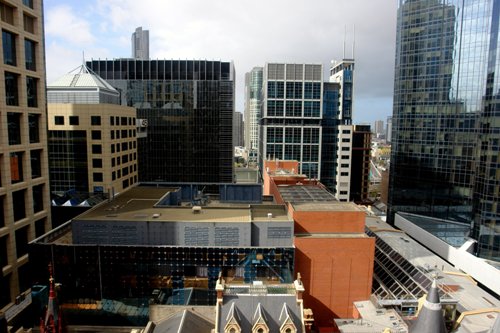
Gary Sauer-Thompson, rooftops, Rialto precinct, Melbourne, 2007
That view was not planned by city planners. It happened. The scene changes through the day as the light changes from morning to afternoon and then into the evening.
I quickly scanned the Melbourne Futures website to see what was happening before I stepped out to explore more of Melbourne's laneways.
Then I looked down at the street from my window:
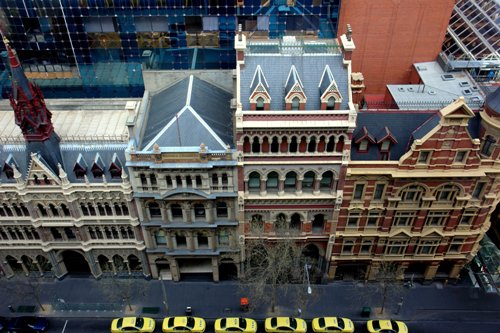
Gary Sauer-Thompson, Collins Street Rialto precinct, Melbourne, 2007
This is such a contrast to the perspective of corporate Melbourne that I was privileged to see on Tuesday lunchtime courtesy of Nabakov and FX Holden:
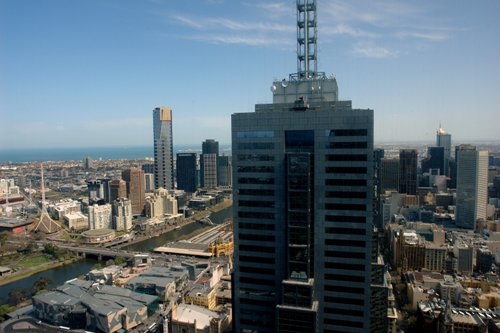
This is the view of Melbourne as seen by Invest Victoria rather than the tourist, or traveller or photographic flaneur.
September 18, 2007
Caledonian Lane Melbourne
I spent yesterday morning walking the back lanes of a self-confident Melbourne as a photographic flaneur exploring Caledonian Lane off Little Bourke Street, Centre Place off Flinders Lane and Hosier Lane near Federation Square.
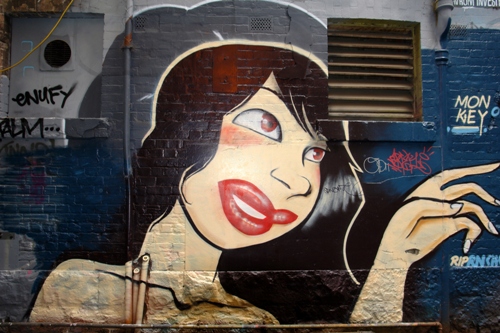
Gary Sauer-Thompson, Caledonian Lane, Melbourne, 2007
Melbourne buzzed with its coffee shops, bars, restaurants and it has become much more people friendly. Is this 'Melbourne cool'? Melbourne has an 'in-your-face' market ethos" of work hard, make a lot spend it on consumption because you deserve it. It doesn't matter that you go into debt--have fun.
The contrast to this market culture is provided by the Melbourne lanes, and by Julie Shiels at the excellent "City Traces.
I was mostly interested in the visual street culture in these funky lanes that signify the revitalization of the CBD:
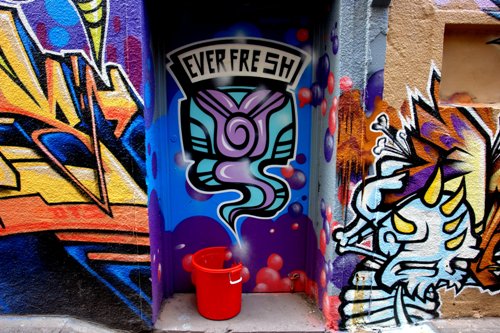
Gary Sauer-Thompson, Caledonian Lane, Melbourne, 2007
Residents are flocking back to the city streets, moving into apartments that were once warehouses, lofts that once housed offices. The vibrancy has returned and the city's lanes and alleys are leading the way as with Hardware Lane. Suzy Freeman-Greene in The Age says that:
Melbourne's lanes have an intimacy, a palpable history, you won't find amid northern skyscrapers and harbour panoramas. Lanes are textured, their past vivified in old bricks, torn posters, faint signs. Lanes give us strange new views: the arse-end of buildings; a kitchen hand slumped on a back step during smoko; bits of towers looming above brick walls.
There is an extremely rich visual street culture in the CBD of Melbourne and the walls should be made legal, celebrated and protected.
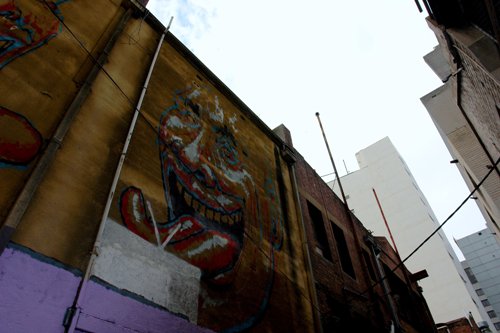
Gary Sauer-Thompson, Caledonian Lane, Melbourne, 2007
Melbourne has an intimate and enchanting web of lanes, alleys, little streets and arcades. boutiques, unique galleries, tiny cafés and hidden bars.the lanes and alleys branching off Flinders Lane between Swanston and Elizabeth Streets. The atmosphere of this precinct is modern, with its high fashion and crowded European-style cafés, while at the same time charming and old-fashioned.
I had lunch in Degraves Street and then explored a very grimy Centre Place.This is where Melbourne’s love affair with coffee explores its roots in the many Euro-type cafes that are crammed into the narrow streets.
The renaissance began with the run-down studio spaces around Flinders Lane, which were buzzing with young artists, clothes designers and jewellers. The cafes began by servicing a bunch of struggling young entrepreneurs, who are now celebrated for their role in rejuvenating the city.
September 16, 2007
Vegas Drama
The strip at Vegas is all about architectural drama. It rabidly borrows from the old, the dramatic, the distinctive; and then couples that with newness, freshness, cleanliness, air-conditioning and gambling.

The hotels are small dramatic conceptualisations of the old world; except the toilets work, the air is not musty, and every whim is catered for under the banner of 'sin city' and "what happens in Vegas, stays in Vegas."
That newness comes at a cost. Vegas is constantly being torn down and rebuilt. The cabbie told us that the hotel being built where the cranes are was costing 13 billion in investment. That kind of money can only come from Wall Street. The mob got run out of Vegas ages ago, partly because they were unable to raise the amount of capital that successful Vegas hotels required.

Vegas cannot afford to let anything get old. Instead it reinvents the old by making it new; and very dramatic.
Melbourne beckons
I'm off to Melbourne for two days holiday early this morning. I'm planning to take some photographs in the CBD that pick up from where I left a week or so ago:
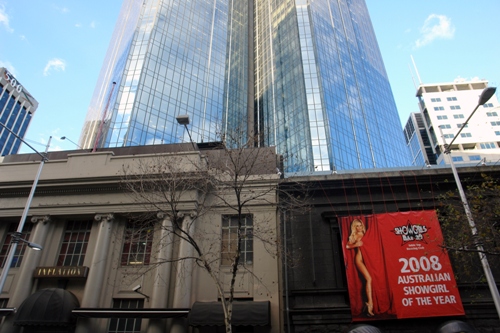
Gary Sauer-Thompson, Showgirl, CBD Melbourne, 2007
But I have some advice this time about what to look for in terms of street art in Melbourne. KeZ Majkut, a reader of junk for code, advises me that around Melbourne:
... the best places to photograph street art can be found around Hosier Lane (opposite fed square off Flinders St), Centre Place (off Flinders Lane, between Swanston and Elizabeth) and on Caledonian Lane (off Little Bourke, between Swanston and Elizabeth again). There's a little cafe down Caledonian Lane called St Jerome's where the hip young people hang out, so it's a good place to take photo's of people or just get a feel for the arts crowd. Much of the better street art around Melbourne is either by or inspired by the Everfresh studio.
I'm wanting to explore the work of the artists who endeavor to improve on the public perception of local space and help transform dingy back alleys into open art galleries. I'm also wondering if I can do some texture photographs---- little compositions in rust or pealing paint layers----as I wander along the back lanes viewing the world through a rectangle.
Update
The taxi was late and I missed the flight, so I am working in the Canberra Qantas Club until the latter flight at 10am:
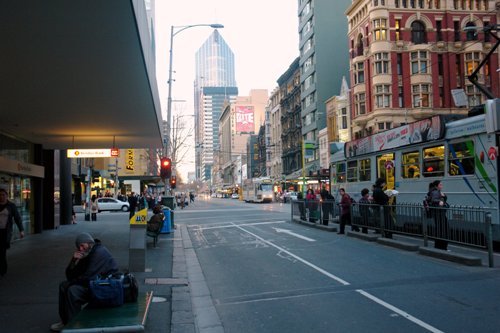
Gary Sauer-Thompson, Elizabeth Street, Melbourne, 2007
Melbourne Graffiti has some images of the street art in Hosier Lane. It is a long way from the stupid messages scratched into the window of the 8:32am to Flinders Street, or the nonsensical scribble across the doorway that you pass in that alleyway on your morning walk to work in the CBD. This creative work, which is carefully crafted over hours and hours of design, cutting, and planning, gives rise to a street urban culture.
This street culture finds its expression in Melbourne Pixel magazine ---where it mixes with photography, fashion, music, webdesign, comics. An example.
Update
I'm in Melbourne and I wandered over to the Convention Centre with Suzanne who is attending an Aged and Community Care Conference:
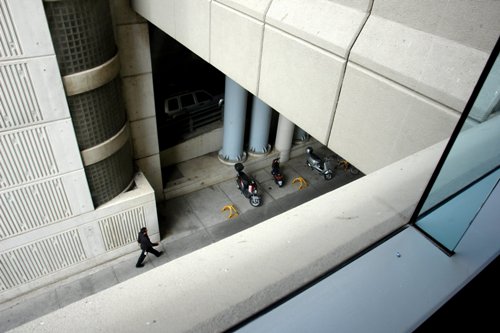
Gary Sauer-Thompson, Melbourne Convention Centre, 2007
I realized that I had ended up at the door of the Victorian Police HQ. It demanded identification before entry. I recalled all the media stories about police corruption, took a photo and moved on:
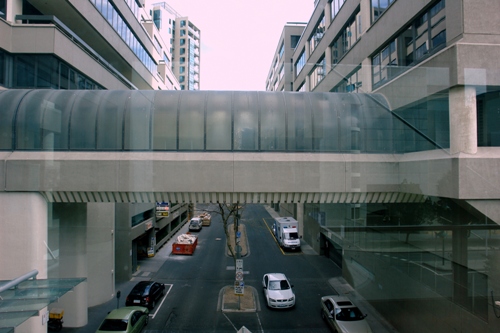
Gary Sauer-Thompson, Victorian police HQ, 2007
At what point does modernist, corporate Melbourne start to embrace postmodernism? Or is it just Federation Square?
Update: 18 September
KeZ, who was in Melbourne on the weekend, writes that he:
Saw three youngsters get nabbed when someone dobbed them in to the police for painting one of the walls down Hosier Lane. Did you notice the application for the wall to be made legal for street art?
I would have thought that the walls of the back lanes were legal. These are famous, known through out the world. Yet the Melbourne Council is hostile to wall painting.
September 15, 2007
Seidler, Riverside Centre, critical regionalism
As mentioned in this post on urban life I hung around Harry Seidler's Riverside Centre at lunchtime when I was Brisbane. It was constructed in the mid-1980s and I wanted to see how the Plaza, which opened to the river, functioned as a public space. Most modernists were concerned with the building as a machine, and their public spaces were little more than the empty, windswept ground upon which their towering concrete and glass tower stood.
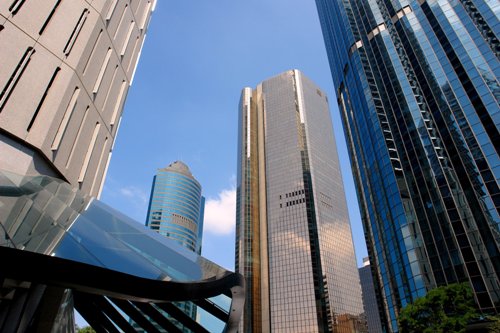
Gary Sauer-Thompson, Brisbane CBD from Riverside Centre 2007
I had always considered Seidler an orthodox modernist who saw Australia as a cultural ‘backwater’, and who deeply hostile to both heritage and a critical regionalism. But I admired the mid career Trade Group Offices (1970s) now known as the Edmund Barton Building. Moreover, the Riverside Centre had iconic status in Brisbane as it was seen to mark the the city' s maturation into a modern cosmopolitan city from a sleepy cultural backwater.
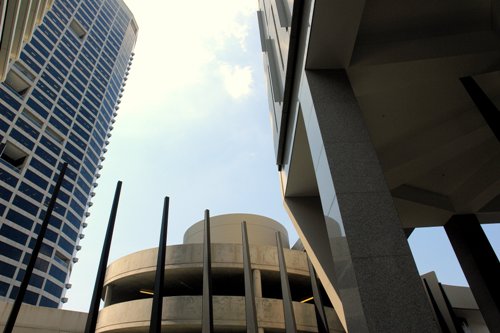
Gary Sauer-Thompson, Riverside Centre, Brisbane, 2007
Seidler understood himself to be "master architect"and so he accepted the Romantic assumptions underlying modernist aesthetic tenets such as the avant-garde "original", the artist as unique creative instance, the dialectic of subjective realisation through liberation from convention. These assumptions inform much cultural criticism of the contemporary "postmodern" moment, and Seidler was hostile to historicist notions of postmodernism in architecture.
Seidler moved away from the upturned functional cube, replacing the rectangular Bauhaus-style building with more shapely curved, sun-protected façades. The Riverside Centre creates a special local ambience through the plaza and its river views.
This article on Seidler by Chris Abel had caused me to revise my stereotyped interpretation of Seidler as a hard edged modernist indifferent to the nature and people in the city.Abel argues that Seidler was a critical regionalist
Seidler’s greatest contribution to a regionalized Modern architecture, however, is in the series of heavily shaded towers and other large residential and office buildings he designed and built in cities in different parts of Australia and around the Pacific Rim. These later works owe more to Seidler’s early association with the Brazilian designer Oscar Niemeyer, together with his admiration for baroque architecture in general, than to any orthodox Modernist influences. For all its mixed origins, however, the result is an architecture clearly belonging to and of the southern hemisphere, if not specifically Australia. For example, writing on Seidler’s Riverside Centre in Brisbane, 1986, Kenneth Frampton, who has elsewhere also interpreted Seidler in more orthodox terms, decisively claims the work as belonging to the school of critical regionalism, even though he does not actually use that precise description.
The Plaza represents a rupture with the orthodox user-unfriendly modernist development. As David Malouf public spaces such as these represent:
a notion of culture as open and continuous, but by example educates us into an acceptance of that, and of one another. It encourages flexibility and variety of response and a tolerance of where others find their interest; of the many ways in which we may fulfil ourselves in play.
September 14, 2007
Brisbane Snaps: urban life
When I was in Brisbane yesterday I came across an article at Barb and Mal's place in Wilston by David Malouf on modern Brisbane, which was published in the Weekend Australian. The post I wrote there on Malouf and urban life using the Apple Macbook Pro was lost for some reason.
Sadly, I am unable to find the Malouf article, with its emphasis on his roots in literary Brisbane, online. However, I did came across Malouf's talk about the complexity and diversity of modern cities at the Brisbane Institute.
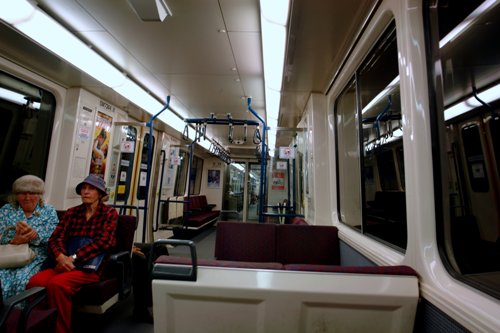
Gary Sauer-Thompson, on the Ferny Grove line, Brisbane, 2007
Malouf weaves complexity and diversity together in an interesting ways by linking them to public spaces and their shared social life.
He says:
Think of the map of your own day, your own week; the way we dip, according to our needs and interests, into the pool, the way by changing what we find useful in the cultural mix, we change our personal culture, or extend it by adding new interests to the old, opera or chamber music, for instance, to an older interest in pop or jazz. That interaction with the various elements of what the city offers is for any one of us, I’d suggest, every bit as complex as the transport system, as we would see if we had some means of laying side by side the two diagrams or maps.
He contrasts this with the conservative understanding of a society whose culture is uniform and single, where men and women share the same values, all of them undisputed, and the national culture was just itself and uncontaminated by outside influences or contradiction or conflict.
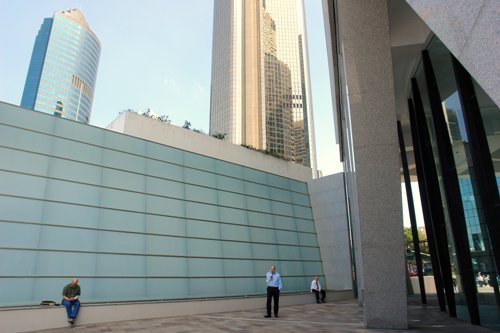
Gary Sauer-Thompson, lunchtime, Riverside Centre , Brisbane, 2007
Malouf defends the complex, diverse city that modern Brisbane has become:
that sort of complexity, that sort of cultural diversity, is worth defending, because it is often attacked: as being somehow impure; as being merely eclectic; as being a trivial form of culture for which the true model is the supermarket, with all its associations of instant appeal and glitter, and ultimate disposability.
Malouf says that one of the signs of the modern city is the creation of public spaces that are designed, in their very architectural form, to encourage a sense of shared social life, of active citizenship, that may be exhibited as clearly in play as in other more serious ways.
September 13, 2007
the heart of politics is...?
The earlier, companion cartoon is here at public opinion. It shows the plotters moving in for the kill. That's the real heart of politics some say.
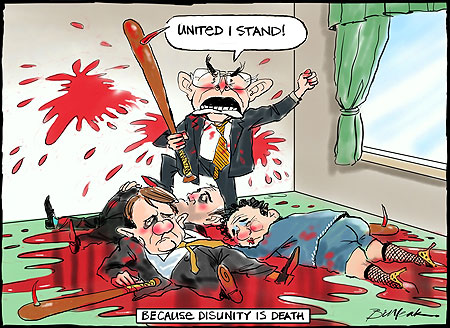
Bill Leak
It is hard to escape the hothouse politics in Canberra at the moment. It dominates the media and the chatter over pre-dinner drinks or coffee. Is Howard wounded? Who will win the election? Have the Libs self-destructed?
I will be glad to be in Brisbane for a day --in Beatties' cosmopolitan, modern Brisbane known as the smart state --not the old rural Queensland of Labor that refused steadfastly industrialization. I remember the sense of space of space and light --as well as the heat---that pointed to another heart of politics.
Update
I never knew the older literary Brisbane of the 1960s and 1970s that grew up in conservative authoritarian Queensland of the Bjelke Peterson regime. I presume the writers grew up in isolation as opposed to being part of a literary tradition. What I know and enjoy is the lively Brisbane of today, with its own confident style despite the standardized glass towers and Harry Seidler's Riverside in the CBD.
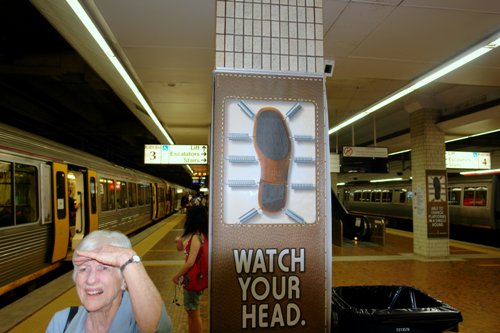
Gary Sauer-Thompson, Brisbane Railway Station, 2007
So another heart of politics is the development of an urban way of life built around a lively civil society. A decade of Beattie has bequeathed that to Brisbane. The spaces in Brisbane are democratic.
Update
Hell, I even had a soft spot for Seidler's austere, modernist Riverside Centre:
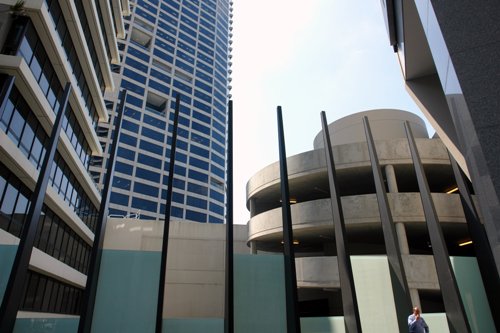
Gary Sauer-Thompson, at Seidler's Riverside Centre, Brisbane, 2007
The plaza or public space has opened up the river's edge and made it accessible to the people in the city. I guess that for all his modernist dismissal of Australia as a nineteenth century backwater that had to be junked Seidler had a point. I enjoyed my moment relaxing in the plaza.
September 12, 2007
demonic spirits
The demonic spirits are alive and well in Canberra. And they are causing a lot of damage in the House on the Hill.

Gary Sauer-Thompson, Canberra mural, 2007
The demonic spirits are the existential fear and trembling in the House. It is consuming Liberal people. The back bench is spooked. Increasingly it is in despair.
September 11, 2007
Canberra rocks on
I'm back in Canberra. It is interesting and explosive times for political junkies. This is a Canberra currently caught up in election fever and awash with political rumour and speculation that is pushed along and fueled by Sky News 24 hour news cycle. The talk is of betrayal and treachery in the ranks with talk of a tap on the shoulder of the great leader.
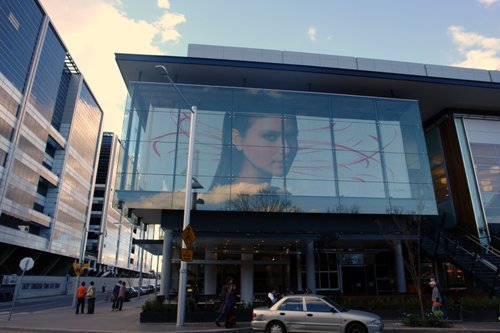
Gary Sauer-Thompson, Canberra Centre, 2007
There was also some pomp and ceremony as the Canadian Prime Minister was in town. So there was the big gun salute, drifting blue smoke and military parade outside the ministerial entrance to Parliament House that was not for the public. Oh, and the address to the joint sitting of Parliament by the Canadian Prime Minister.
Having missed the Canberra bloggers meeting I retreat to the other Canberra--the Canberra of the street:
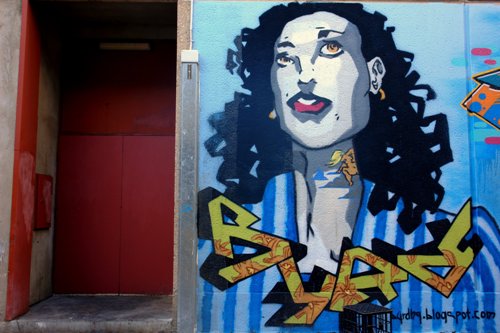
Apparently the Canberra blogmeet didn't happen. No one turned up! Canberra rocks.
September 10, 2007
Green Water
A bridge at Harpers Ferry, West Virginia with perfectly green water underneath.

The canals were part of an industrial network of paper mills and manufacturing in the town. The factories were washed away in the mid-19thC by floods. By that time coal was starting to take over from water as the main form of industrial energy. Harpers Ferry became a ghost town. Today it is a national park with Civil War and Abolitionist history.
September 9, 2007
snapshots +urbanity
When I lived in Melbourne I worked on the trams as a conductor and I became very familiar with the Collins and Spencer end of the CBD. I had started taking photographs whilst a conductor and I started attending a photography school top learn the basics in the film and darkroom days of yesteryear. Yesteryear because Melbourne was not then an informational city.
Because I spent so long on the trams each day moving people in and out of the CBD from the suburbs, my mode of visuality changed to that of the moment, the flux of urban life, and the snapshot.I saw the urban world from a moving tram. It was the casual images of crowded streets, everyday scenes and ordinary people, which stood as a direct contrast to the meaningfulness of 'serious' reportage

Gary Sauer-Thompson, cnr Collins + Elizabeth Street, Melbourne, 2007
Today, we have two forms of urbanity: streets and other physical public spaces on the one hand and the publicly accessible electronic networks on the other. Urbanity is about relations.
I also noticed the heritage buildings along Collins Street before they became heritage and often wondered whether good architecture was an indication, or an expression, of urbanity.

Gary Sauer-Thompson, Rialto, Melbourne, 2007
Then I realized that urbanity was about the relationships between people and the way they interacted with one another in public spaces.
September 8, 2007
satire
If APEC is a gabfest with dress-ups then the several hundred million dollars in security, which involves a further erosion of our civil liberties, stands for surveillance society.
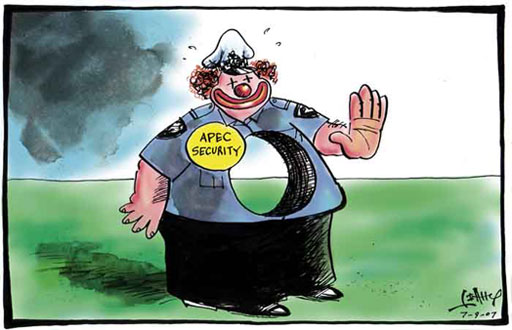
The clampdown on civil liberties is way over the top, the restrictions extend far from the key venues and the squashing of the legitimate expression of dissent is extensive. There was even a security ban on the cafe at the Museum of Sydney in Bridge Street placing cutlery on its outdoor tables and the police could inspect the contents of reporters' notebooks.
Adele Horin in the Sydney Morning Herald describes the surveillance thus:
Parts of the city look like a war zone, wreathed in five kilometres of fencing wire. Helicopters buzz, jumpy police bark at motorists. Riot cars tear through the city; the new water cannon lies in wait. Some city workers are forced to shuffle like prisoners through a series of chook runs. Laws are passed to give police extraordinary powers to search, detain, confiscate. There is a fenced-off "restricted" zone and a wider "security" zone.Worst of all, the right to march and protest is curtailed. APEC is disrupting the lives of 4 million people for a week in the interests, we are told, of a greater good. But a protest march that may disrupt the city for a few hours - for the legitimate purpose of expressing dissent - is deemed unacceptable.
Then there were the dog squads, the water cannon, the prison buses with their blacked out windows, the snipers on the roofs, the helicopter night patrols etc etc.
All this was for our protection from the subversives of The Chaser and their attempt to storm the Security Zone masquerading as a motorcade of Canadians.
September 7, 2007
on the road means
On the road means means rising early at 4am to catch an an early morning flight from Adelaide; having breakfast in the Qantas Club; reading the newspapers whilst flying to Melbourne, then walking through the long corridors of Melbourne's air conditioned airport around 8.00--8.30 am:

Gary Sauer-Thompson, Melbourne airport, Melbourne, 2007
Then its walk outside the airport to catch a cab to the CBD, make some phone calls in the cab before being dropped off in the CBD; then working all day in a meeting on an upper level floor in this kind of air conditioned corporate building that could be in any city anywhere:

Gary Sauer-Thompson, 500 Collins Street, Melbourne, 2007
Then it is collapse time after the days work in the Qantas Club whilst waiting for the flight home:

Gary Sauer-Thompson, Qantas Club, Melbourne, 2007
Then catching a cab home and arriving home around 8.00 pm feeling wearied and jaded.
That is what being on the road means these days. So many business people do it.The airports become nodal points.
September 6, 2007
Melbourne snaps: Collins Street
I was in Melbourne today for work. I managed to squeeze in some photography after work and before I caught the cab to the airport and then the plane back home to Adelaide:
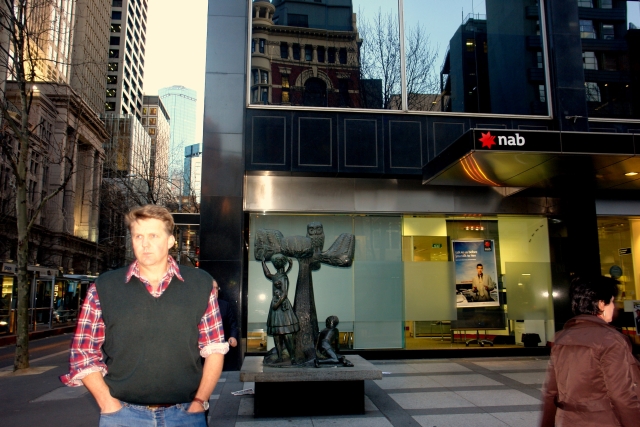
Gary Sauer-Thompson, Collins Street, Melbourne, 2007
I explored the lower end of Collins Street, near Spencer Street. I was familiar with this part of Melbourne from the time I lived there, and it was one of my favorite parts of the CBD. There is now a lot more urban life --cafes, bars, pubs where people gathered to socialize after work---than there used to be. Collins Street is no longer just a commuter street.
This part of the CBD has changed dramatically:
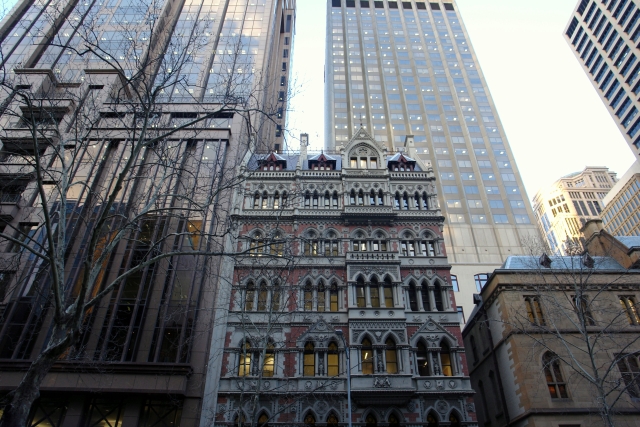
Gary Sauer-Thompson, Collins Street Heritage, Melbourne, 2007
I'm pleased they decided to keep the 19th century buildings with their graceful architecture, as opposed to tearing them down to make way for the skyscrapers:
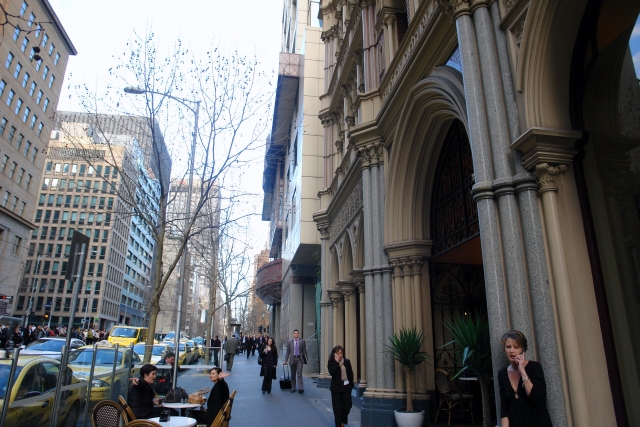
Garry Sauer-Thompson, Collins Street 1, Melbourne, 2007
I enjoyed walking around the streets I once knew. I was pleased with the way urbanity had developed. The promise was being realized. I decided that I would take a couple of days off when next in Canberra, fly to Melbourne and explore the CBD streets of the city with a camera.
September 5, 2007
lock down
I'm in the Qantas club waiting for a flight to Canberra to attend an all day forum. This cartoon appealed to me:
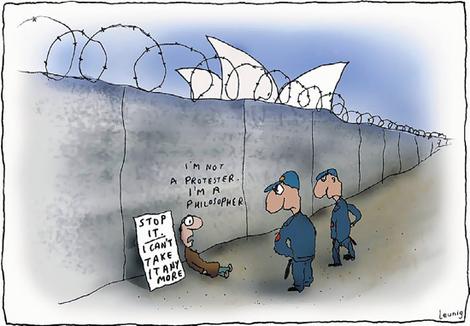
Leunig
Honestly, the whole national security thing for APEC has got out of hand. Locking down the CBD of the Emerald City, 2.8 meter wire security fences, motorcades and police and politicians on about the protestors, terrorists and rocket launchers expresses the paranoia of the national security state. Presumably, businesses in the CBD just shut their offices for the week and the staff work from home.
I would have though that the protestors were more about fair trade and the plight of the region's poorest workers not terrorism, but obviously the paranoid security state can make no distinction. There has to be a fortress to keep Australian citizens away from the transnational corporations and politicians cutting deals.
September 4, 2007
Port Elliot weekender
It is not often that holiday houses in the Fleurieu Peninsula feature in the Australian Financial Review's architectural section, either as illustrations of contemporary architectural design or for sale. We are talking about the top end of the national market and the Fleurieu Peninsula just doesn't cut it.

Gary Sauer-Thompson, weekender, Port Elliot, 2007
This house did. It is an example of the top end of the weekender market. It has sea views across the bay. It's modernist style and size represents the shift away from the modest beach shack of yesteryear.
The wooden beach shacks in prime locations are being bulldozed to make way for the air conditioned new:

Gary Sauer-Thompson, weekender, Port Elliot, 2007
visual politics
I'll post the editorial cartoons on Gunn's ardwood pulp mill proposal in the Tamar Valley, with its 80% reliance on native forest feedstock (at least in its first 5 years of operations) with plantations supposedly becoming more important in the future. as I come across them in order to illustrate one way a visual politics works.
It's different to the standard submission. Though it has taken the cartoonists a while to make the critical move on Gunn's, but they are up and running now:

Tandberg
I cannot understand why this development is seen as a bonanza since pulp will be no more valuable as an export commodity than woodchips, given the massive and cheaper capacity being developed in Brazil, Chile and South Africa.
As Henry Melville observes in the Tasmanian Times:
The international hardwood pulp market is a dumping ground. Cheap-pulp producers like Indonesia, Brazil and Chile are expanding their production capability massively. Supplying hardwood pulp into Australia’s domestic market will be difficult. Currently PaperlinX has that market effectively sewn up … unless of course Gunns and its backers are thinking of further expansion bids!
PaperlinX stands in Gunns Ltd’s way into the domestic market, effectively forcing each and every hardwood pulp mill onto the export market with all its rollercoaster volatility in pulp prices.
September 3, 2007
Victor Harbor snaps
In The sublime nature of politics in The Griffith Review Martin Leet and Roland Bleiker state that:
The analytical and political significance of the sublime derives from the way it opens a window on to the significance of emotions. Ancient philosophers understood well that the body politic is governed primarily by emotion and sentiment. People are driven to think and act by powerful undercurrents of feeling and passion...Experiences of the sublime hit us with the deficiencies of rationalist modes of perception and remind us of their normally hidden emotional building blocks.
Generally speaking, we move about in a familiar manner, adhering to routine habits of viewing the world. The sublime moves the earth from under our feet. We are plunged into the unknown, into a field of disorientation.

Gary Sauer-Thompson, Banksia, Victor Harbor, 2007
Leet and Roland Bleiker say that:
the sublime can overwhelm us with feelings we thought we had mastered but which had been bubbling under the surface all along, waiting for an opportunity to dislodge our comforting outlook. How should we react? What should we do? If you are shocked out of your mind, it is only natural to want to return home, to return to the bright lights of rational understanding.
The potent emotions unleashed are fair game for power politics. And we do have such a politics--one based on fear.
Garrett folds
Under the assessment of the mill being conducted by Malcolm Turnball, the federal Environment Minister, the impact of Gunn's proposed pulp mill on native forests is not being considered. Garrett's big point of difference with Turnbull is that he would endeavour to ensure that logging of native forests would not happen. How so?
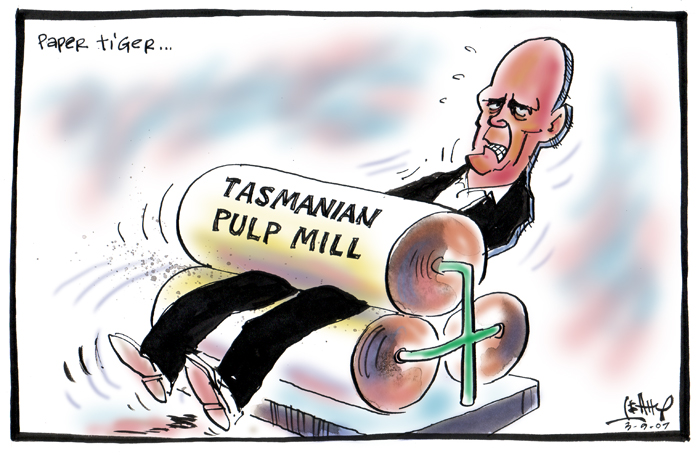
But the Regional Forestry Agreement (RSA) allows for the self regulation of forestry by the industry. So what prevents Gunn's from increasing the logging of native forests tenfold. It's promise not to do so? Garrett's media releases?
How come federal Labor still thinks of Tasmania as a forestry state instead of a tourism state? Isn't this an example of old style thinking?
Capturing Jefferson as a Tourist
Monticello is Thomas Jefferson's house just outside of Charlottesville. On Saturday it was teeming with visitors. Lines for the tour of the house were long despite the humid late summer heat and shuttle buses regularly dumped off twenty new visitors at a time for $15 a pop. This is not my first time at Monticello however like the other tourists I dutifully walked around the house, soaked in the environment and taking photos of Monticello's architecture and garden.

Yet of Jefferson's achievements; bricks and mortar, flora and fauna; were not what was drawing people to Monticello.
One of the things I really enjoy when visiting these historical sites is that their bookshops stock rare, odd and niche interest material. I came out of Monticello with David N. Mayer's The Constitutional Thought of Thomas Jefferson. When I bought the book the lady wrapping it said, "That looks like some tough reading!"
I replied, "I think the author had me in mind when he wrote it."
September 2, 2007
Victor Harbor + water restrictions
Although Victor Harbor draws its water from its own reservoir --the Myponga dam---and it is not reliant not on scarce River Murray water, it is still being treated to the same restrictions on water use as exist in Adelaide. Yet the Myponga dam currently has more water than past years.
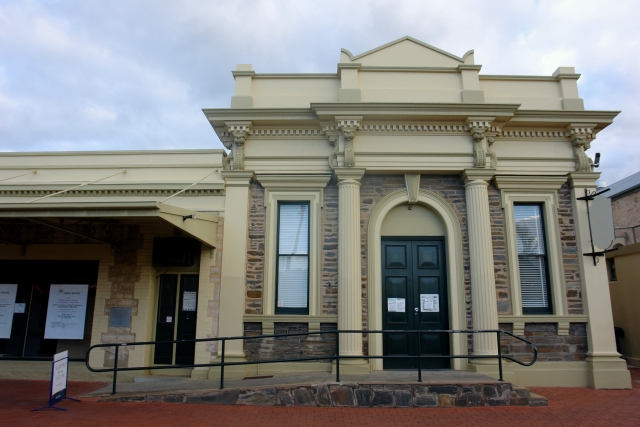
Gary Sauer-Thompson, Public Library, Victor Harbor, 2007
The water restrictions mean that there is no outside watering apart from the use of buckets, even though this method of watering a garden is more wasteful than the automatic dripper irrigation systems that use less water more efficiently. Though the restrictions make sense in Adelaide, because recent rains have generated only small inflows into the Murray Darling Basin's storage systems, they do not make sense in the Fleurieu Peninsula.
Heavy handed suppression of demand is the norm instead of subsidies to help households install rainwater tanks. New homes in the region are still not required to have rainwater tanks despite the Rann Government knowing about the effect of climate change in the region.
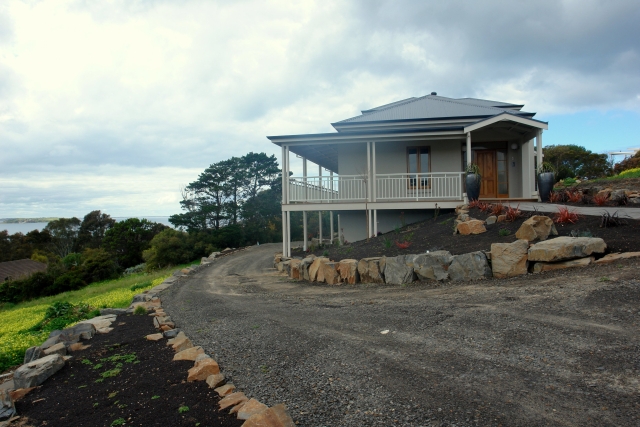
Gary Sauer-Thompson, House, Encounter Bay, 2007
Nor does the state government appear to provide incentives to encourage the storing of stormwater by local councils. The precious stormwater continues flows to the sea instead of being used to supplement the town's water supply.
So much for water security.
Gunns stand for environmental destruction
You'd think that the federal ALP could actually find some points of differences from the Coalition over the proposed Gunn's pulp mill in the Tamar Valley, given the recent corporatist history of showing democracy into the recycle bin.
As Sue Neales points out Tasmania's 45 parliamentarians have been exposed to extreme pressure of the past three months to facilitate a quick-fix Tasmanian parliamentary approval process without public hearings or public input, after Gunns withdrew from RPDC assessment on behalf of both the state and federal governments combined. Gunns withdrew because the commission indicated that the mill's environmental standards remained "critically non-compliant" in several key areas.
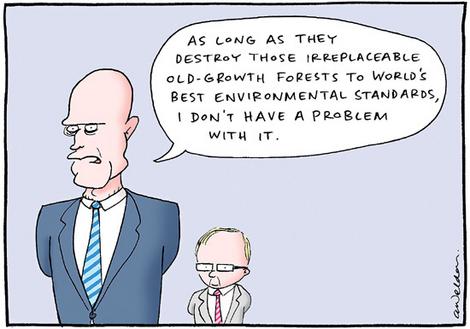
Weldon
Gunn's pulp mill is another infrastructure project that is being promoted locally in the name of progress and economic growth -- such as the Gordon-below-Franklin hydro-electricity dam --and so is increasingly becoming a national symbol of environmental destruction.
Still the federal ALP remains silent. Garrett has "lost his voice" on the pulp mill issue. Yet there is a section of the Tasmanian legislation that makes it impossible for any member of the public or organisation to mount a legal challenge or action against the pulp mill, once it is being built and/or operating.
September 1, 2007
fashion blogosphere
I'm down at Victor Harbor for the weekend. I'm looking through the various fashion blogs over breakfast courtesy of an article by Margaret Merten in the AFR Review Magazine entitled Click Cliques (not online). Victor Harbor is not definitely not the centre of fashion in Australia.
This months glossy Review Magazine is all about fashion for the smart and stylish professional. An example of a fashion blog. Another.
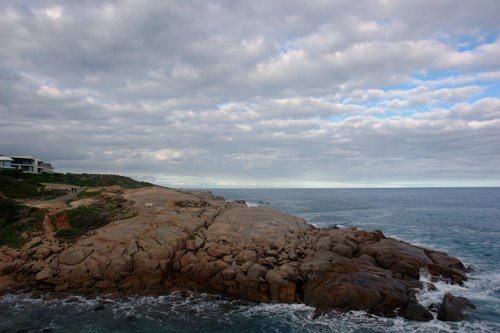
Gary Sauer-Thompson, weekenders, Port Elliot, 2007
So we have the formation of a
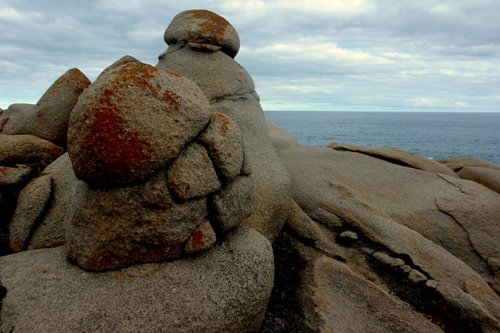
Gary Sauer-Thompson, rocks Port Elliot, 2007
Margaret Merten, who writes restaurant reviews for the SMH, says that:
....the fashion blogger is really just another opinionista. Some are wannabes journalists, some are self-appointed experts, others are simply bitches...The blogs that have something unique and funny will be the ones that last...While we don't think that t blogs are as influential as traditional media, like magazines, we believe that in the future the fashion blogger will integrate into a fashion community where everyone's voice on fashion will be heard and it will become a vital part of the fashion industry.
What the blogs offer is a layer of discussion, dissection and dissemination of fashion. Presumably, the more of this the better.