Thought-Factory.net Philosophical Conversations Public Opinion philosophy.com Junk for code

Mandy Martin, Puritjarra 2, 2005. For further information on MANDY MARTIN, refer here: http://www.mandy-martin.com/
If there are diverse kinds of knowledge and ways of knowing place, then we need to learn to value the different ways each of us sees a single place that is significant, but differently so, for each perspective.
RECENT ENTRIES
SEARCH
ARCHIVES
Library
Thinkers/Critics/etc
WEBLOGS
Australian Weblogs
Critical commentary
Visual blogs
CULTURE
ART
PHOTOGRAPHY
DESIGN/STREET ART
ARCHITECTURE/CITY
Film
MUSIC
Sexuality
FOOD & WiNE
Other
www.thought-factory.net
looking for something firm in a world of chaotic flux

Brisbane Snaps: urban life « Previous | |Next »
September 14, 2007

When I was in Brisbane yesterday I came across an article at Barb and Mal's place in Wilston by David Malouf on modern Brisbane, which was published in the Weekend Australian. The post I wrote there on Malouf and urban life using the Apple Macbook Pro was lost for some reason.

Sadly, I am unable to find the Malouf article, with its emphasis on his roots in literary Brisbane, online. However, I did came across Malouf's talk about the complexity and diversity of modern cities at the Brisbane Institute.
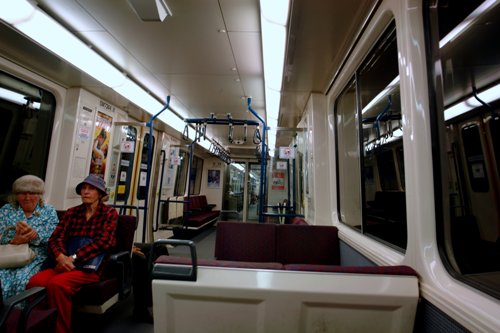
Brisbane train.jpg
Gary Sauer-Thompson, on the Ferny Grove line, Brisbane, 2007

Malouf weaves complexity and diversity together in an interesting ways by linking them to public spaces and their shared social life.

He says:

Think of the map of your own day, your own week; the way we dip, according to our needs and interests, into the pool, the way by changing what we find useful in the cultural mix, we change our personal culture, or extend it by adding new interests to the old, opera or chamber music, for instance, to an older interest in pop or jazz. That interaction with the various elements of what the city offers is for any one of us, I’d suggest, every bit as complex as the transport system, as we would see if we had some means of laying side by side the two diagrams or maps.

He contrasts this with the conservative understanding of a society whose culture is uniform and single, where men and women share the same values, all of them undisputed, and the national culture was just itself and uncontaminated by outside influences or contradiction or conflict.
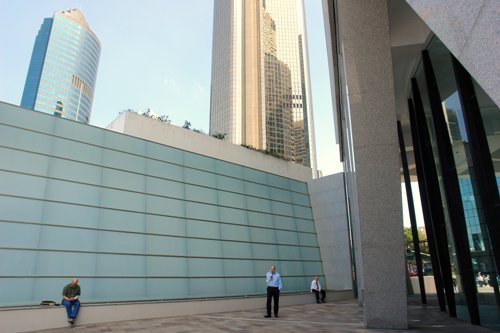
BrisbaneCBD lunchtime.jpg
Gary Sauer-Thompson, lunchtime, Riverside Centre , Brisbane, 2007

Malouf defends the complex, diverse city that modern Brisbane has become:

that sort of complexity, that sort of cultural diversity, is worth defending, because it is often attacked: as being somehow impure; as being merely eclectic; as being a trivial form of culture for which the true model is the supermarket, with all its associations of instant appeal and glitter, and ultimate disposability.

Malouf says that one of the signs of the modern city is the creation of public spaces that are designed, in their very architectural form, to encourage a sense of shared social life, of active citizenship, that may be exhibited as clearly in play as in other more serious ways.

| Posted by Gary Sauer-Thompson at 09:14 AM | | Comments (5)
Comments

Comments

Gary, its the Ferry Grove line . . .

Mal,
thanks for that. Dunno why I had Ferny Gully. Sounds exotic I guess. Ferns in subtropical Brisbane.

Well your both 1/2 right...I think its the Ferny Grove Line

Gary,
David Malouf in 'Johnno' contructs Brisbane as a place being in need of maturation. He constructs the place in terms of the social landscape he inhabited in the 1950s.

Malouf writes in the Preface that:

Despite Johnno's assertions that Brisbane was absolutely the ugliest place in the world, I had the feeling as I walked across deserted intersections, past empty parks with their tropical trees all spiked and sharp-edged in the early sunlight, that it might even be beautiful.’

Dane as a narrator in Johnno is constructed as an ‘outsider’ and an intellectual who reads classic literature, discuss philosophy and is imbued with ideas derived from myth and legend. He is an expat who spends time in Europe, and he talks about the destruction of the old Brisbane.

When he returns to Brisbane he’s distressed to find that much of it has been removed or cleaned up. The place he’d once thought he’d hated, is now lamented.

Pam,
I've always understood old Brisbane in terms of the inexplicable violence and the seedy nightlife of Brisbane as a dark social unconscious that is barely held in check by a thin veneer of civilisation.

I puzzle about this maturation thingy--it's a psychological concept and refers to people growing up. Does it refer to the maturity of a literary voic--ie., to the development of Queensland literature? For many expat writers --Maloufe, Thea Estley, Jessica Anderson and Joan Colebrook--Queensland is written about from exile and they are writting about the Queensland of their childhood. Hence we have the loss of innocence and simplicity.

So we have the sleepy innocent Queenland contrasted with the sophisticated experience southern states. Does maturation mean becoming like the southern states.

 
Post a comment

(If you haven't left a comment here before, you may need to be approved by the site owner before your comment will appear. Until then, it won't appear on the entry. Thanks for waiting.)

Name:
Email Address:
URL:
Remember personal info?
Comments: (you may use HTML tags for style)