|
September 15, 2007
As mentioned in this post on urban life I hung around Harry Seidler's Riverside Centre at lunchtime when I was Brisbane. It was constructed in the mid-1980s and I wanted to see how the Plaza, which opened to the river, functioned as a public space. Most modernists were concerned with the building as a machine, and their public spaces were little more than the empty, windswept ground upon which their towering concrete and glass tower stood.
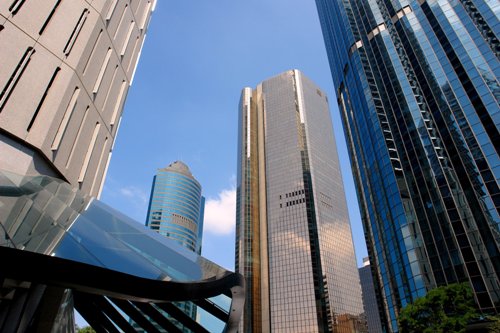
Gary Sauer-Thompson, Brisbane CBD from Riverside Centre 2007
I had always considered Seidler an orthodox modernist who saw Australia as a cultural ‘backwater’, and who deeply hostile to both heritage and a critical regionalism. But I admired the mid career Trade Group Offices (1970s) now known as the Edmund Barton Building. Moreover, the Riverside Centre had iconic status in Brisbane as it was seen to mark the the city' s maturation into a modern cosmopolitan city from a sleepy cultural backwater.
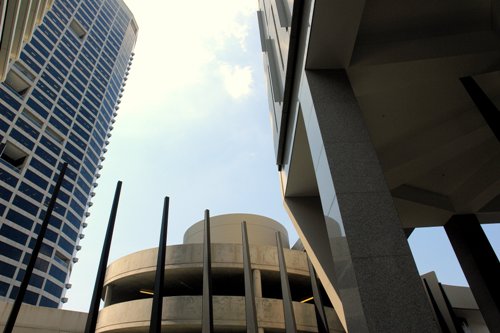
Gary Sauer-Thompson, Riverside Centre, Brisbane, 2007
Seidler understood himself to be "master architect"and so he accepted the Romantic assumptions underlying modernist aesthetic tenets such as the avant-garde "original", the artist as unique creative instance, the dialectic of subjective realisation through liberation from convention. These assumptions inform much cultural criticism of the contemporary "postmodern" moment, and Seidler was hostile to historicist notions of postmodernism in architecture.
Seidler moved away from the upturned functional cube, replacing the rectangular Bauhaus-style building with more shapely curved, sun-protected façades. The Riverside Centre creates a special local ambience through the plaza and its river views.
This article on Seidler by Chris Abel had caused me to revise my stereotyped interpretation of Seidler as a hard edged modernist indifferent to the nature and people in the city.Abel argues that Seidler was a critical regionalist
Seidler’s greatest contribution to a regionalized Modern architecture, however, is in the series of heavily shaded towers and other large residential and office buildings he designed and built in cities in different parts of Australia and around the Pacific Rim. These later works owe more to Seidler’s early association with the Brazilian designer Oscar Niemeyer, together with his admiration for baroque architecture in general, than to any orthodox Modernist influences. For all its mixed origins, however, the result is an architecture clearly belonging to and of the southern hemisphere, if not specifically Australia. For example, writing on Seidler’s Riverside Centre in Brisbane, 1986, Kenneth Frampton, who has elsewhere also interpreted Seidler in more orthodox terms, decisively claims the work as belonging to the school of critical regionalism, even though he does not actually use that precise description.
The Plaza represents a rupture with the orthodox user-unfriendly modernist development. As David Malouf public spaces such as these represent:
a notion of culture as open and continuous, but by example educates us into an acceptance of that, and of one another. It encourages flexibility and variety of response and a tolerance of where others find their interest; of the many ways in which we may fulfil ourselves in play.
|


