October 31, 2005
narrative photographic series
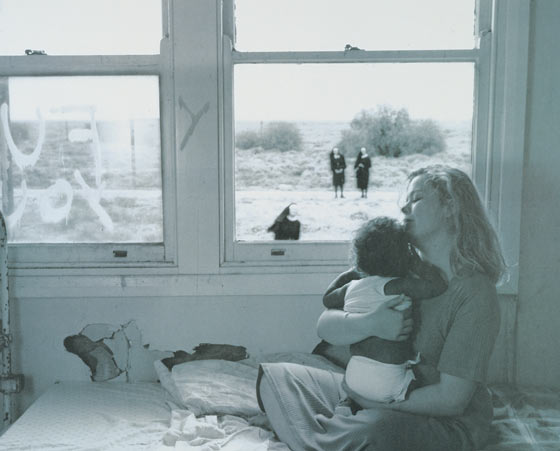
Tracey Moffat, Up in the sky 1, 1997, Photo-offset on paper
My favourite photographic narrative series. I found this one ticky tacky campy
October 30, 2005
at the Queensland Art Gallery
I spend the morning in Brisbane looking over the Queensland Art Gallery, as it was just across the river from the Chifley Hotel where I was staying. I spent several hours there before I caught a taxi to the airport to catch a plane back to Adelaide.
The Gallery was much smaller than I'd remembered, and it's collection of Australian art on show was modest.
They had a number of works of Ian Fairweather ---i was suprise by how heavy and ponderous they were, and subdued the colour was. Fairweather painted in Queensland near Brisbane, in a climate that is bright, sunny, green and full of colour--the purples and reds were everywhere today. Where was his eye? What was it looking at?
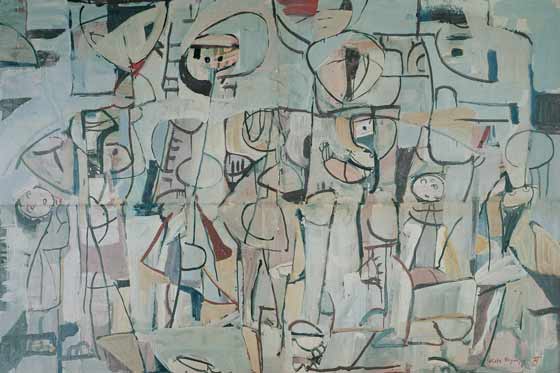
Ian Fairweather, Kite Flying, 1958
What was noticeable was less the fragmentary forms and figurative elements and more the layers and layers of paint. A number of works were dark and foreboding.
The Australian art section finished in 1975. That's thirty years ago. But I understand that a new Gallery of Modern Art is being built.
October 29, 2005
Charles Blackman
I'm in Brisbane and I notice that the Queensland Art Gallery has acquired a new paintingby Charles Blalckman entitled City Lights.
Here is a favourite Blackman painting:

Charles Blackman, Swimmer at St Kilda
cool eh.
October 28, 2005
Barbara Heath: 'off the body'
I flew into Brisbane this morning from Adelaide to give a paper on health care reform tomorrow. I return to Adelaide on Sunday, then fly to Canberra on Monday. Brisbane city looked very green as I viewed the cityscape from a taxi window. The rains have returned after a long drought in the last 2 weeks, but the rain is not falling in the catchment area, so the city remains on water restrictions, said the taxi driver.
We had a long conversation about the state of health care in Queensland. Premier Beattie, it seems, is on nose. He promises heaps but delivers little. The Queensland health bureaucracy sucks big time.
I'm currently working in a back corner in Barbara Heath's jewellery studio in Newmarket.
Many of the jewel and token works are designed for 'off the body' and they become tiny or minature sculptural pieces that are aesthetically pleasing and visually intriguing. An example is the work from the 'Love token' series, 1987-91.
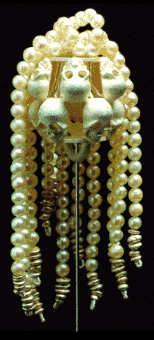
Barbara Heath, Skulls Love Token, circa 1988
Two love tokens:

Malcolm Enright
These "sculptures" are often assembled from the scrappy shapes and materials left over from the craft work process.
October 27, 2005
bird flu
The lethal H5N1 strain of the avian brid flu has spread from China and Thailand to Romania,Turkey and the southern Urals region of Russia.
We've gone from alerting people to a frightening possibility---a pandemic that could kill from 7million to 150million people to reassurance that a severe pandemic remains just a possibility, not a probability in the next few years. We also have reassurances that health authorities are doing everything they reasonably can to guard against the risks posed by infectious disease.

Each additional human case makes it easier to develop human-to-human transmission of the disease.
October 26, 2005
Rosa parkes: in memoriam
In 1956, Rosa Parks'was arrested for refusing to yield her seat to a white patron on a Montgomery, Alabama city bus. The bus driver had Mrs. Parks arrested, she was found guilty of disorderly conduct and that lead directly to the bus boycott, the civil rights movement, and civil disobediance.

The bus boycott was led by an unknown clergyman named Martin Luther King, Jr., and it resulted in the U.S. Supreme Court decision outlawing segregation on city buses.
October 25, 2005
fast foods
The mass-produced hamburger is the sign of fast food for me, rather than french fries. It stands for the dark side of food. For others--the free-market enthusiasts--- the inexpensive, franchised chain of restaurants is a highly efficient business model of McDonald's and other chains, such as Pizza Hut and Kentucky Fried Chicken.

Fast Food Nation is about food, its production and consumption. It is also about an America Triumphant over all competing political philosophies: rich, powerful and confident – yet often mean-spirited and scared. McDonald's represents Americana and the promise of modernization.
Eric Schlosser's historical and critical analysis of the fast-food industry is an indictment of the fast food industry. Schlosser argues that processed food "has helped to transform not only the American diet, but also our landscape, economy, workforce and popular culture." Schlosser argues that the fast-food joint near your neighborhood petrol station, is more than just a quick-meal fix; it's the end point where several long roads converge.
Schlosser explores the meatpacking plants, flavor-engineering factories, a day in the life of a teenage server, and fields of ranchers losing the battle against an enormous, industrialized agriculture industry. What is constructed is the degree to which the modern fast-food business is defined by the industrialization of most of its parts, and the nasty abuses in food production and handling.
Should there be increased regulation?
Reason magazinesays that:
Fast food is, certainly, a choice, and one's food choices ought to be personal matters. There seems to be no market as open and as accessible with as many options as the restaurant industry, with thousands of choices in any mid-sized city.The explosive growth of fast food restaurants over the course of the past several decades should tell us something: Fast food does not always satisfy one's highest aspirations -- much less the refined sensibilities of journalists. But it certainly fills one's tummy passably well.
And our health? What about obesity from fatty foods? Isn't public health a concern of governments as well as a concern of public opinion? It is not just consumer choice at play here.
Should we address the issue of what needs to replace fast-food meals -- the kinds of fresh foods that would be affordable, and accessible to replace the taste for fries, burgers and other processed, taste-engineered foods? Isn't a key question of one finding a healthier and more varied way of eating for the low-income people who are the market for fast food right now? Is it not about creating a food culture that insists that there are some things that really ought to be left in the food not watered down.
In the Afterword, Schlosser writes:
"Whatever replaces the fast food industry should be regional, diverse, authentic, unpredictable, sustainable, profitable--and humble. It should know its limits....This new century may bring an impatience with conformity, a refusal to be kept in the dark, less greed, more compassion, less speed, more common sense, a sense of humor about brand essences and loyalties, a view of food as more than just fuel. This don't have to be the way they are."
As Russell Arben Fox over at In Media Res observes this is a shift from liberal regulation to a criticism of our whole culture of consumption and growth and speed.
October 24, 2005
Barbara Heath
A survey exhibition at Queensland Art Gallery of the work of Barbara Heath. There is very little of the work in the exhibition online.That it is a pity because there are many fine forms.
Barbara Heath, Earrings, 18k gold, beryl
There are more online images at de novo

Barbara Heath, Earrings,18k gold, enamel, sapphires
These are examples of contemporary jewellery as wearables.

Barbara Heath: Brooch, enamel, 18k gold, silver, sapphire
But these images do not give any indication of the more scuptural or design pieces or the symbolic dimension of the work--mourning, memories, fertility charms, love tokens etc.
October 23, 2005
laughing with Destiny Deacon
I got back to Adelaide early this evening, had drinks on the balcony, dinner, then watched the Coen Brothers take on Hollywood, Barton Fink. The siren song of Hollywood leads to disappointment and creative hell on earth for a neurotic, leftwing NY intellectual playwright. There are lots of gestures to Hemingway, Faulkner, and Arthur Miller who lost their souls and their creative integrity in the dream factory on the West coast of the US.
I'm too tired to write about Barton Fink any more. So an interview with the Coen Brothers. They are into non-communicaton with journalists.
An eye catching image instead:

Destiny Deacon, The Last Laugh, 1994-2000
It is an example of 'urban Aboriginal art' . It is only acceptable to modernists like Deleuze and Adorno if it were a part of the art institution and so stands in opposition to the popular that is seen as the undesirable other, or worse, an enormous homogenising machine depriving art of its place and value in contemporary society.
October 22, 2005
Why not a congestion tax?
It is early morning, the sun is rising over Botany Bay, the planes are taking to the skies, the traffic is incessantly flowing to and from the airport, and the hotel's airconditioner is running. There are no windows in the building. This city is run on cheap energy fuelled by coal fired stations that produce a lot of Greenhouse gases.
Looking at the traffic flows I keep on thinking of all the problems Sydney has dealing with traffic--eg, the City Cross Tunnel--- and the way the politics of urban renewal is played out:

The City Cross Tunnel toll road seems to be more about improving tunnel revenue thrrough unpopular road closures than traffic flows. Does the contract allow the state government to improving public transport to take the cars off the road? Or is that considered to have a material adverse effect?
You can find more about about PP partnerships over at John Quiggin, the expensive financing of these projects, and the perverse impacts that tolls have on traffic flows.
Why cannot state governments borrow the money to fund infrastructure renewal? What is peverse about that? Why is that considered such a no no these days? Does anyone accept the mantra about governments 'crowding out' capital markets?
Why not bite the bullet and impose a congestion tax on cars entering the central city.The rolback of the car is going to have to start sometime.
October 21, 2005
Patricia Piccinini
I fly into Sydney from Adelaide late this afternoon. I'm here for some meetings about sports medicine.
We came in across Botany Bay. The Pacific Ocean crashing against the standstone cliffs was a brillant sight. Sydney sure is a magnificent city.
I'm now staying in a hotel near the airport watching all the traffic stream to and frrom the airport.
The traffic reminded me of this very frequent sight in Australian roads:

Patricia Piccinini, Roadkill, From Nature's Little Helper
This work is different from the earlier one about biotech explored here.
October 20, 2005
Joerg Immendorff: "Cafe Deutschland"
I remember the avant garde art world rejecting painting as an art form. That was in the 1980s, and performance was all the rage. Then along came neo-expressionism in Germany.
The "Cafe Deutschland" paintings were started in 1978 and work on the cycle stopped around 1982..

Joerg Immendorff, Cafe Deutschland - Cafeprobe, 1980, Synthetic resin on canvas
An imaginary nightclub sits on the east-west border, an independent territory where the burlesque theatre of cold-war politics, national identity, and battle of artistic legacy is played out night after night in all its subterfuge and drama.
In this interview with Pamela Kort in Artforum Immendorff states:
You might compare "Cafe Deutschland" to Edward Hopper's Nighthawks. That painting is permeated by a certain melancholy and isolation inherent in a big city like New York. My "Cafe Deutschland" works addressed the situation of a divided Germany, but they are similar to the Hopper in that they are also about alienation. They represent my attempt to break through a wall--and not merely the one that separated the former East and West Germanies. How odd it is that, despite the many ways we have of communicating with one another, we seem to be building up walls between ourselves rather than dismantling them. So the " Cafe Deutschland" paintings stand just as much for a then externally divided Germany as for the condition of an internally split man, who struggles to communicate not only with himself but also with his colleagues and lovers.
Here is Hopper's Nighthawk that Joerg Immendorff refers to:

Edward Hopper, Nighthawk, 1942
This is an image of both big-city loneliness and of existential loneliness. Ironically, Hopper was marooned artistically by the rise of Abstract Expressionism in the 1950s.
October 19, 2005
becoming
This was painted in the early nineteenth century. It is very abstract isn't it?

William Turner, The Breaking Wave, circa 1832, Gouache and watercolour on paper
What we have is the barest representation of sea and sky.

William Turner, Long Ship's Lighthouse, Land's End, 1834 - 1835, Watercolor and bodycolor
You look at that image and think movement, process or becoming and multiplicity
October 18, 2005
Miller's Crossing
I crawled out of a sickbed this evening and watched the Cohen Brother's superb and very stylized gangster homage to film noir: Miller's Crossing (1990).
 I was stunned by the brillance of the craft (script, photography, dialogue, acting, intertextuality) but it went over my head.
There was too much going on for me even though I got the narrative of a gang war between an Irish mobster and an Italian mobster.
I could barely follow the rich gangster jargon and the plot was like a big jigsaw puzzle.
Gangsters in forests? Dreams about hats in forests? The film ends with the central character Tom leaning against a tree in the forest and pulling his hat down over his face. I've no idea. I haven't read the work of Dashiell Hammett.
October 15, 2005
drunk with power
When I left a fog-bound Canberra early Friday morning I had another dose of the Canberra flu bug. Or was it the same one that I had during winter which was flaring up again?
I've been very feverish with a splitting headache and laid low. I spent most of the last 24 hours dozing in the sun.
I'm only just surfacing now. But I'm too tired to do anything apart from walking the dogs along the beach at Victor Harbor in the morrning and evening.
But I noticed this Moir cartoon:

Moir
Moir captures the political arrogance of the Howard Government that I've seen when I was in Canberra during sitting fortnights. Control of the Senate is going to their heads. They will do anything to retain power and rub it into their opponents faces.
An example.
October 13, 2005
the Amazon's new look
Looks like an example of the effect of global warming to me:

Tis the Amazon. More here. A warmer world could also mean the loss of the Amazon rainforest.
Of course, for neo-liberals, this ecological understanding amounts to eco-alarmism and environmentalist scare mongering that needs debunking by the sharp edge of econoimic reason.
The neo-liberal solution? Market forces need to be unleashed.
October 12, 2005
today's email
This used to be my maibox before I joined up with Internode:

Leunig
The Government's taxpayer-funded ads----four full page ads in all morning newspapers across Australia about its industrial relations reforms----can be seen as spam because they unlikely to convince electors.
I flicked them just like I do with spam. Why? Because this is a hard sell before the legislation has even been been tabled. Only big business has been briefed and they are going to run their own hard sell. It's spam.
October 10, 2005
Chris Orchard
An exhibition at BMG Art in Adelaide of some works by Chris Orchard.

Chris Orchard, Earth, Charcoal
This looks to be a "big drawing.
October 9, 2005
urban living
Fifty years ago, Australian cities were primarily a family dominated structure (two parent and two kids etc) living in suburban detached houses, with the (pure) garden suburbs connected to the (dirty) inner city by public transport.
It is a tired cliche because the demographics and urban mode of life in Australia have changed dramatically since then:

In an op ed in the Sydney Morning Herald Chris Johnson addresses the changes to the urban mode of life
In metropolitan planning, two simple extremes ripple around the opinion pages - suburban detached houses and urban high-rise towers. Australian society cannot be neatly sandwiched into these two models. The growth of Sydney's population in the coming 25 years or so must be accommodated somewhere and the two opposing concepts need to be reconciled.
The high rise apartment towers give us a particular kind of city:
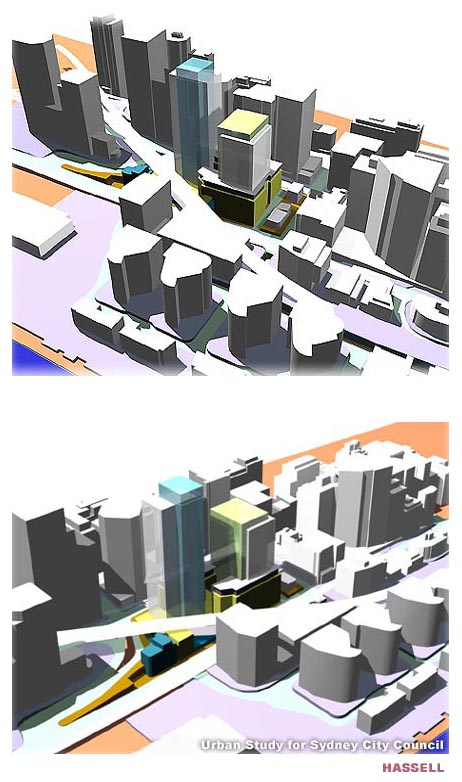
Hassell Architects, Housing project, Sydney
There is a need for a more diverse mix of housing stock because of the changing nature of households. As Johnson says:
In a recent survey for the Property Council of Australia, Bernard Salt predicted that by 2031 only one in four households will comprise a mother, father and children - down from the one household in two during the 1950s. Planning must respond to needs for housing to accommodate single people, single parents with children, childless couples, elderly couples and elderly singles.
Most of our politicians continue to talk about Australia in terms of the renovated 1950s suburban model. They are looking backwards into the future.
October 8, 2005
summertime in SA
When I saw this image it reminded me of summertime in South Australia:

Shelly Hicks, Boys Fishing Weekend, 2005
Tis a world of many years ago that still hangs on:

Shelly Hicks, Summer Sunlovers, 2004
These old beach shacks are now being replaced with two story airconditioned McMansions. What we have is something more than a landscape to be observed or captured by the artist's eye. This is a representation of our historical memory of a simple mode of life that is now slowly fading away. Yesrterday's beachside shacks on the edge of wilderness have given away to the beach suburbs of today.
Alas the HIcks' images say nothing about sun damaged skin and skin cancer arising from the sunloving.
October 7, 2005
the new political reality
The politics of fear in a tabloid world:
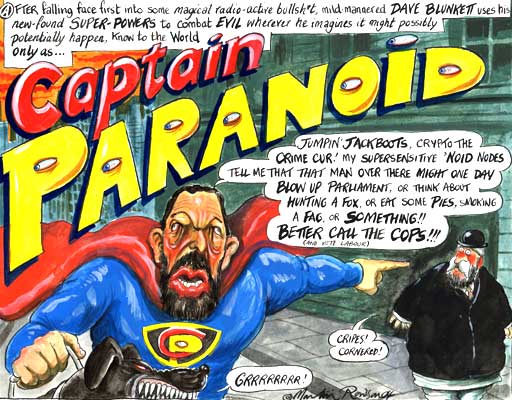
Some commentary here.
Isn't al-Qaeda pictured inthe tabloid media as a cartoonish bunch of demented Arab, Wahhabi freaks with no agenda except the evil destruction of the Australian way of life?
October 6, 2005
Scorsese on Dylan
I understand that SBS has won the rights to show Martin Scorsese's landmark Bob Dylan documentary No Direction Home in November. SBS will screen the almost four hour documentary, over two weeks on the 8th and 15th of November.
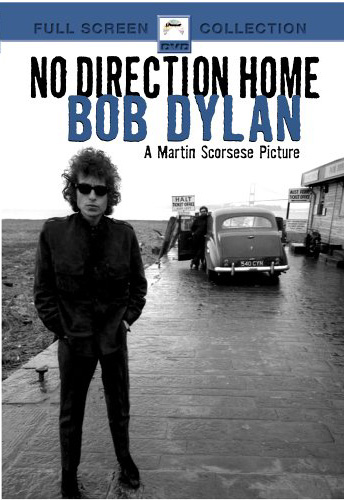 The two-part film, which focuses on the singer-songwriter's life and music from 1961-66, includes never-seen performance footage and interviews with artists and musicians whose lives intertwined with Dylan's during that time.
The years between 1961-1966 were inarguably the most artistically fertile for Bob Dylan. The soundtrack, which is part of the Bootleg Series, (Vol. 7) looks quite interesting.
They chart Dylan's evolution from an acoustic one-man band to leader of a great rock and roll outfit that produced Blonde on Blonde. It will be interesting to see the Newport Folk Festival in '65, the moment Dylan went electric, represented in the documentary.
I was impressed with Martin Scorsese The Last Waltz. I consider this to be the best rock concert film made, and it is visually impressive. 'No Direction Home' looks to be more a documentary than a film--more in the style of DA Pennebaker's 1960's Don't Look Back. Or is it? It appears to be a piecing of different archived material together.
The ABC's 7.30 Report has a piece on 'No Direction Home.' Some comments on the documentary can be found over at Floppy Eared Mule.
October 5, 2005
Bruce Davidson
This image of a unique urban place taken with a wide-angle lens has lovely, flowing curvey lines:

Bruce Davidson, Central Park, 1992-5
Davidson is a veteran of the civil rights movement and the ghetto ( East 100th Street ), has taken his camera into the New York subways, (Subway, 1980) and was commissioned to photogrpah Central Park.
He continues to work as an editorial and documentary photographer
October 3, 2005
consumption as a mode of being
When I was in walking around the global city of Sydney a month or so ago I realized just how much the market ruled everyday life in terms of work, leisure and happiness. Work and play is now enframed by the market.
I then realized just how postmodernity meant that consumption has become our primary language. Literacy now increasingly involves a visual literacy concerned with the interpretation of commercial signs, such as advertising. The act of consumption is now our primary mode of insertion into the public world and our experience of participation in something beyond ourselves and our private lives.
Consequently, we internalize the act of purchasing, and we then translate this experience into all other human activities and aspects of our social existence. It has beccome habitual.
The contrast could not be greater with Indonesia.
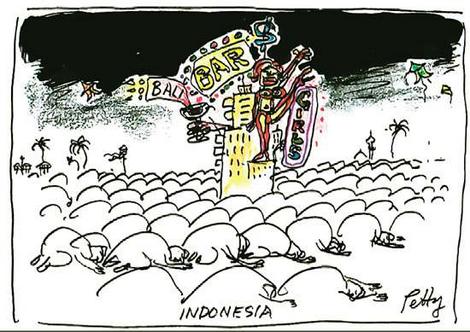
As the Petty cartoon shows the tourist bars and nightclubs are seen as immoral fleshpots that are deeply offensive to many Indonesian Islams.
Similar sentiments can be found amongst puritanical Christains in Australasia, but these are marginalized voices decry consumer society.
October 2, 2005
sky high petrol prices
Is this the case? Or is it more wishful thinking about the political fallout of the skyrocketing cost of filling the petrol tanks of our cars?
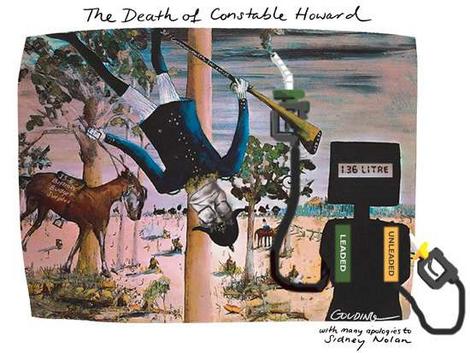
Matt Golding
Not really. It is a great image, but it is widely accepted that the Howard Government can do little in the face of global demand. And the ACCC has little concern about price gouging by the big oil companies.
The Government can do something about biofuels though. We consumers will buy smaller cars, change our domestic holiday destinations and increase our use of public transport.
information economy
In The Rise of the Network Society and related texts Manual Castells argued that a new global economy has formed. It has been kick-started by major breakthroughs in five areas of technological progress: micro-electronics, computing (both hardware and software), telecommunications, opti-electronics (advances in fibre optics) and biogenetic engineering. These technologies all involve the generation, storage and manipulation of information.
This means they can all be used together, or in combination. Each technological development supports the other, and combinations of these advances create new onward movement. Castells says that this raises knowledge and information to a new and central position in the historical development of capitalism. Hence the information economy or information society.
The global economy is now characterized by the almost instantaneous flow and exchange of information, capital and cultural communication. These flows order and condition both consumption and production. Thus a network logic now lies at the heart of capitalist production.
The networks themselves reflect and create distinctive cultures. Both they and the traffic they carry are largely outside national regulation. Our dependence on the new modes of informational flow gives enormous power to those in a position to control them to control us. The main political arena is now the media, and the media are not politically answerable.
The network society makes sense doesn't it.
October 1, 2005
music, file sharing, copyright, public interest
There were some articles in the Australian media about Kazaa, music piracy, file sharing and P2P last week , but I cannot find them whilst I'm on dialup at the holiday shack. Dialup is too slow to search the web. But Russ Degnan did provide this excellent article by Doc Searl and David Weinberger on the nature of the web that links to this earlier global village/Web2 post.
 If I remember one article was written by music industry executives--ARIA? --argued that music downloading was piracy and that filesharing had devastated the industry.
As usual, the ARIA failed to address the issue that the decline in revenue from CD sales was not solely caused by Internet music downloads.
I found that article. It was published in the Australian Financial Review and so it was not online. In the light of the Searl and Weinberger article we can say that the record industry is trying to hold back or damage the internet's capacity to move bits of information from one end to another. They equate the internet with their platform, when the internet as a highway that moves bits from one end to another is beneath and outside of their proprietary control.
I remember the other article saying that the music industry had won a battle when Justice Murray Wilcox in the Federal Court found Kazaa, the distributor of the popular MP3-swapping software, guilty of copyright infringement. The anti-piracy music industry had won an earlier battle with the Napster case. In both cases the courts ruled that whoever controlled the centralized file list containing works whose copyright was being infringed was responsible for any infringement. The primary weakness with the Napster model was the centralized servers. Napster continues to operate today by legally distributing music under a subscription-based model.
The article said that the war was not won by the music industry: it continues as the internet had moved on, new decentralised technology such as P2P had been devised, and musical filesharing was increasing.
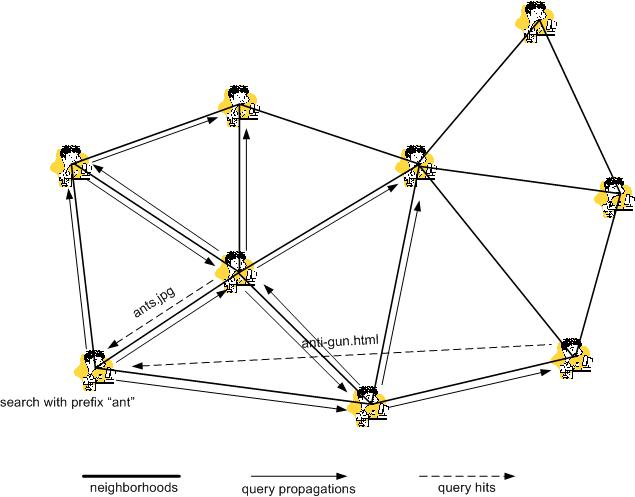
What I did find in my search was this article by Dan Stapleton in the Sydney Morning Herald. He makes the same point without going into the details of the new technology:
Even with the crackdown, file sharing among internet users continues to expand. Internationally, file downloads tripled in the first half of the year, to 180 million, thanks in part to rising broadband use.The anti-piracy lobby faces several challenges if it wishes to reverse this trend. Because file-sharing technology is developing rapidly, most consumers no longer use Kazaa, preferring newer, more advanced software.
I presume the shift to P2P is a shift away from Napster or Kazaa as the central index server with clients, topeer-to-peer architecture. It is a decentralised world of large and efficient networks without central servers.
Surely the private copying of music (my CD) for my personal use is legal? If not, it should be. Surely my sharing that music through p2p networks is, or should be, legal. After all I own the commodity--CD. This is fair use is it not?Should we not be concerned with copyright in the broader public interest? Should not we citizens have a say in copy right law? Do not users have rights that balance copyright protection to creators and so enable Australians to copy works under appropriate circumstances without further compensation?