|
October 1, 2005
There were some articles in the Australian media about Kazaa, music piracy, file sharing and P2P last week , but I cannot find them whilst I'm on dialup at the holiday shack. Dialup is too slow to search the web. But Russ Degnan did provide this excellent article by Doc Searl and David Weinberger on the nature of the web that links to this earlier global village/Web2 post.
 If I remember one article was written by music industry executives--ARIA? --argued that music downloading was piracy and that filesharing had devastated the industry. If I remember one article was written by music industry executives--ARIA? --argued that music downloading was piracy and that filesharing had devastated the industry.
As usual, the ARIA failed to address the issue that the decline in revenue from CD sales was not solely caused by Internet music downloads.
I found that article. It was published in the Australian Financial Review and so it was not online. In the light of the Searl and Weinberger article we can say that the record industry is trying to hold back or damage the internet's capacity to move bits of information from one end to another. They equate the internet with their platform, when the internet as a highway that moves bits from one end to another is beneath and outside of their proprietary control.
I remember the other article saying that the music industry had won a battle when Justice Murray Wilcox in the Federal Court found Kazaa, the distributor of the popular MP3-swapping software, guilty of copyright infringement. The anti-piracy music industry had won an earlier battle with the Napster case. In both cases the courts ruled that whoever controlled the centralized file list containing works whose copyright was being infringed was responsible for any infringement. The primary weakness with the Napster model was the centralized servers. Napster continues to operate today by legally distributing music under a subscription-based model.
The article said that the war was not won by the music industry: it continues as the internet had moved on, new decentralised technology such as P2P had been devised, and musical filesharing was increasing.
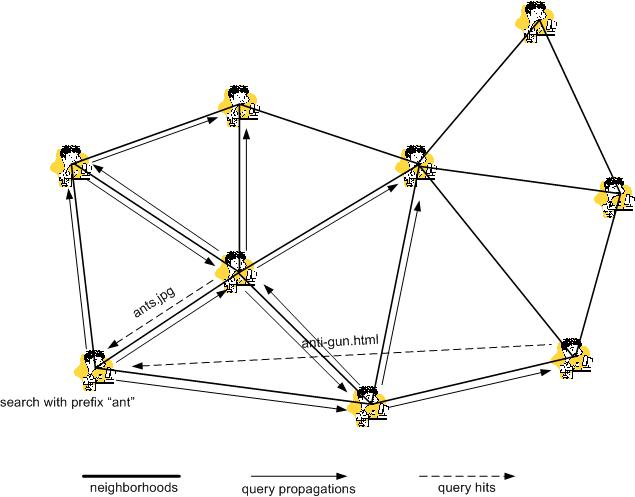
What I did find in my search was this article by Dan Stapleton in the Sydney Morning Herald. He makes the same point without going into the details of the new technology:
Even with the crackdown, file sharing among internet users continues to expand. Internationally, file downloads tripled in the first half of the year, to 180 million, thanks in part to rising broadband use.The anti-piracy lobby faces several challenges if it wishes to reverse this trend. Because file-sharing technology is developing rapidly, most consumers no longer use Kazaa, preferring newer, more advanced software.
I presume the shift to P2P is a shift away from Napster or Kazaa as the central index server with clients, topeer-to-peer architecture. It is a decentralised world of large and efficient networks without central servers.
Surely the private copying of music (my CD) for my personal use is legal? If not, it should be. Surely my sharing that music through p2p networks is, or should be, legal. After all I own the commodity--CD. This is fair use is it not?Should we not be concerned with copyright in the broader public interest? Should not we citizens have a say in copy right law? Do not users have rights that balance copyright protection to creators and so enable Australians to copy works under appropriate circumstances without further compensation?
|


Distribution of information has been commoditised and the capital intensive barriers reduced to the cost of a broadband connection. The middle man companies such as record companies and movie distributors have been made redundant. They only exist because the government has created an artificial form of scarcity and monopoly through copyright.
Darwin beckons.