September 30, 2009
free content
Clay Shirky in his Fame vs Fortune: Micropayments and Free Content (2003) hits the nail on the head. He argues that micropayments do not work and the failure of micropayments in turn helps explain the ubiquity of free content on the Web; that is the current grassroots media production of the ‘Web 2.0’ paradigm, which stresses openness, interactivity and reliance on free, user-generated content.
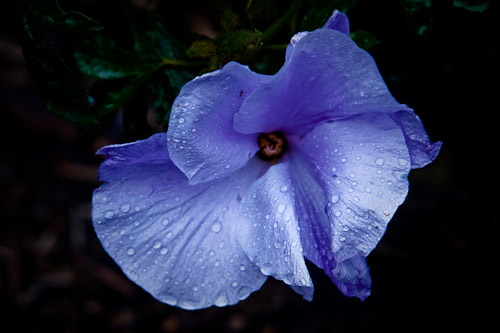 Gary Sauer-Thompson, native flower, 2009
Michel de Certeau’s work and his distinction between distinction between the concepts of strategy and tactics is particularly relevant here. To begin with, he argues for everyday consumption to be labelled as tactical, since it involves poaching (a form of ‘making do’ with whatever is at hand) and is largely decentralized, provisional and ultimately quasi-invisible.
Shirkey adds the fact that digital content can be distributed for no additional cost does not explain the huge number of creative people who make their work available for free. After all, they are still investing their time without being paid back. He asks
Why? The answer is simple: creators are not publishers, and putting the power to publish directly into their hands does not make them publishers. It makes them artists with printing presses. This matters because creative people crave attention in a way publishers do not. Prior to the internet, this didn't make much difference. The expense of publishing and distributing printed material is too great for it to be given away freely and in unlimited quantities -- even vanity press books come with a price tag. Now, however, a single individual can serve an audience in the hundreds of thousands, as a hobby, with nary a publisher in sight.
For a creator more interested in attention than income, free makes sense. In a regime where most of the participants are charging, freeing your content gives you a competitive advantage. The tactical nature of consumption is in other words increasingly replaced by more strategic instantiations of distribution and consumption, as the users themselves take more control and a new order gains permanence.
In a world of free content, even the moderate hassle of micropayments greatly damages user preference, and increases their willingness to accept free material as a substitute.The internet adds no new possibilities. It makes all user-supported schemes harder, and all subsidized schemes easier. he adds:
The interesting questions are how far the power of the creator to publish their own work is going to go, how much those changes will be mirrored in group work, and how much better collaborative filters will become in locating freely offered material. While we don't know what the end state of these changes will be, we do know that the shift in publishing power is epochal and accelerating.
September 29, 2009
Roman Polanski + sexual politics
The Polanski case is troubling.
In 1978 he had pleaded guilty to having unlawful sex with a 13-year-old girl, who drugged a 13-year-old girl with quaaludes and champagne; lured her to pose for naked photographs; ignoring her protests, had sex with her; and then anally raped her. The offence he pleaded guilty to is often described as "statutory rape", but more precisely as "unlawful sexual intercourse with a minor". The other charges were dropped.
That is the starting point. Some of the responses take the form of vindictive justice.

Polanski spent 42 days in prison in Chino, California, and was due to be sentenced to time served when it became clear that the deal his lawyers had negotiated with the prosecution was not to be honoured – and he would have had to spend much more time in jail than had been agreed. He fled the United States in 1978 and has never returned. His victim has moved on and wants this all dropped.
Poor Roman say his defenders when Polanksi was arrested by the Swiss police on an international arrest warrant. Remember, he survived the Holocaust, his wife Sharon Tate was murdered in 1969 by the Charles Manson gang, and Hollywood's celebrity culture was "Babylonic".
What is erased by the Polanski's life is a tragedy defence is the sexual politics of having non-consenting sex with an underage girl.
Marina Zenovich's Roman Polanski: Wanted and Desired argues that the American press--the media circus--- has traditionally viewed Polanski as "a man of darkness" and has always confused the man with his movies. He made The Tenant so must therefore be a transvestite. He made Chinatown and is therefore a paedophile. He made Rosemary's Baby and is thus in league with Satan. And so on. He's now seen as a predatory sex offender.
However, Zenovich's documentary suggests that Polanski, an irrepressible European, had been naughty during a colorful time, and that he has been toyed with by a monstrous legal system. Being naughty during a colourful time refers to Polanski drugging and raping a minor.
September 28, 2009
beach erosion, climate change, Krugman
I returned to Adelaide this morning from Victor Harbor without taking any of the planned medium format pictures of beach erosion at Encounter Bay over the weekend. The wind and the rain from the storms that swept across the Fleurieu Peninsula of South Australia were just too great for working on a tripod with long exposures.
 Gary Sauer-Thompson, erosion, Encounter Bay, 2009
All was calm and peaceful this morning when we left. The storm had gone. It was ideal conditions for landscape photography. All I had managed to take was a few snaps on the digital camera. Frustration.
On the drive back to Adelaide whilst listening to Radio National Breakfast about the economy and sharemarket I kept on thinking of climate change. I realized that I was linking the beach erosion to rising sea levels, and to the way that the scientific prognosis for this part of Australia just keeps on getting worse.
I realized that I was become ever more pessimistic. Paul Krugman in his latest op-ed in the New York Times asks: 'what is driving this pessimism?' He answers thus:
Partly it’s the fact that some predicted changes, like a decline in Arctic Sea ice, are happening much faster than expected. Partly it’s growing evidence that feedback loops amplifying the effects of man-made greenhouse gas emissions are stronger than previously realized. For example, it has long been understood that global warming will cause the tundra to thaw, releasing carbon dioxide, which will cause even more warming, but new research shows far more carbon dioxide locked in the permafrost than previously thought, which means a much bigger feedback effect.
It's happening now I thought. But it is not being taken seriously by Australian governments.
September 26, 2009
about water and dustbowls
The Spooner cartoon about use of groundwater highlights one future in southern Australia----desertification. However, it is ambiguous as to whether or not we are dealing with drought or a climate system shift. It doesn't take much to imagine a dust storm being stirred up by strong winds sweeping across this kind of dust bowl.
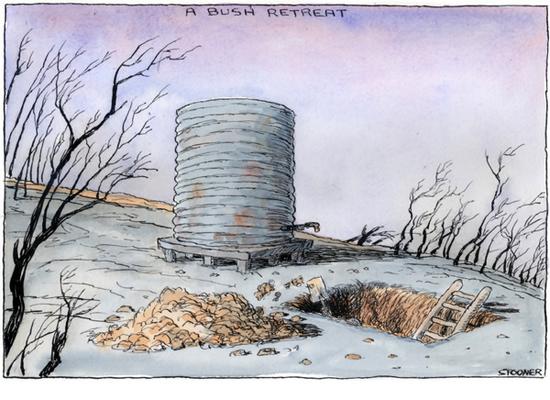
Australia epitomizes the "accelerated climate crisis" that global warming models have forecast. Australia is the harbinger of change, the canary of global heating.
In terms of the Fleurieu Peninsula it means little water for the Lake Alexandrina and Albert and the Coorong. Over the past decade, 94 per cent of the water extracted from the rivers of the Murray-Darling Basin has been used for irrigation. Inflows into the Murray-Darling river system are down to 5% of their long term average.
The life saving surgery needed to protect some of the wetlands involves closing off (regulators) the Currency and Finniss rivers with a regulator (dam) at Clayton to stop the water flowing into Lake Alexandrina. Water is currently being pumped from the ailing Lake Alexandrina over the dam at Clayton to prevent acid sulfate soils in the newly created Goolwa Lake from being uncovered in summer and to put water into the Goolwa Channel for the boaties and tourists.
This raises the question:Is Australia’s environment now past a point of no return in terms of climate change impacts? Are we already in an ecological crash? The debate here in Australia certainly doesn’t indicate an acceptance that we are in a state of ecological crash. Australia is what a heated up world will look like and it is probably too late to save much of Australia--the southern part may well become a permanent dust bowl with no more agriculture.
Despite this NSW recently auctioned water from the Great Artesian Basin and it plan to sell off more licences. SA allows BHP to expansde its water extraction from the Great Artesian Basin by BHP Billiton. Clearly the states can't be trusted with groundwater.
September 24, 2009
Mise-en-abyme
This is a photo taken late last summer towards the end of a long heat wave in Adelaide. A hot north wind was blowing, the temperature was in the mid-40s, and the pavement radiated heat.

It is a part of a set entitled Mise-en-abyme but I have completely lost the plot on what this project about. I looked at the images today and I can see that the concept has eluded me. The images make no sense at all as a project.
According to Wikipedia Mise en abyme occurs
within a text when there is a reduplication of images or concepts referring to the textual whole. Mise-en-abîme is a play of signifiers within a text, of sub-texts mirroring each other. This mirroring can get to the point where meaning can be rendered unstable and in this respect can be seen as part of the process of deconstruction. The film-within-a-film is an example of mise-en-abîme. The film being made within the film refers through its mise-en-scène to the ‘real’ film being made. The spectator sees film equipment, stars getting ready for the take, crew sorting out the various directorial needs. The narrative of the film within the film may directly reflect the one in the ‘real’ film.In Western art "mise en abyme" is a formal technique in which an image contains a smaller copy of itself, the sequence appearing to recur infinitely.
Well, nope that " stories within a story" is not what I had in mind at all. I had rejected narrative as story. What was I thinking? If I recall I was thinking in terms of a “hall or world of mirrors."
But what did that mean? The Wikipedia entry goes on to say that:
In literary criticism, "mise en abyme" is a type of frame story, in which the main narrative can be used to encapsulate some aspect of the framing story. The term is used in deconstruction and deconstructive literary criticism as a paradigm of the intertextual nature of language—that is, of the way language never quite reaches the foundation of reality because it refers in a frame-within-a-frame way to other language, which refers to other language, et cetera.
aah that is what I had in mind--- the intertextual nature of visual language. Yet the images in the set seem to refer to a narrative situation that leads into a vortex or abyss and to a hall of mirrors that is more like an endless reflexivity.
Thinking about it now I recall that the idea had little to do with an abyss, and everything to do with an internal mirroring that is endlessly repeating.
September 23, 2009
Dust storm in Broken Hill
A dust storm rolled into Sydney and then Brisbane this morning turning it orange--a red dawn This was interpreted as Life on Mars apocalypse along the eastern seaboard.
The dust storm had its origins in South Australia, where extremely dry conditions throughout the interior of the country along with strong winds provided the perfect recipe for the dust storm. It moved east to Broken Hill, where the dust and the 100 km winds caused a blackout:
Posted by rayneegir
These levels of natural dust cause eye irritations in many people, and particulate pollution in which the fine particles are hazardous to the health of fit and unfit persons alike.
Tom Coates has curated a Red Dust Gallery on Flickr of the dust storm in Sydney:
 MarchingAnts, dust storm, Sydney Harbor Bridge, 2009
So what does all that dust from the topsoil infer about the way that we care for the land? It indicates that there has been both an erosion of the country's farmable soil and a growing desertification of the landscape.
September 22, 2009
Ballarat Foto Biennale: Alex Syndikas
The Ballarat International Foto Biennale (BIFB) is built around 20 invited artists accompanied by an enormous fringe which is uncurated and open to anyone who cares to mount a show. The invited artists in the Core Exhibition Program include Australian and international artist photographers, many of whom have links to the fashion, media or documentary worlds.
Alex Syndikas, who works in the School of Creative Media at RMIT in Melbourne, is another Australian photographer shown in the festival's core program. He works in the alternative photographic processes tradition:
 Alex Syndikas, untitled, chemigram
Chemigrams can be made by painting, dripping or spraying developer onto various areas of a fully exposed piece of paper, or the paper can be activated with a range of chemicals during development. Another technique is covering hands or face with a thin layer of Vaseline and pressing it against a large sheet of photographic paper and then exposed it to light. During the development the developer is prevented from reaching the areas where the Vaseline is.
In Syndikas case he uses this means of artistic expression to produce a variety of surreal imagery by coating models with water-resistant gel then getting them to press themselves on sheets of photographic paper--the impressions then turn to positive images when the paper is developed.
It refers back to the modernist period of Christian Schad, Man Ray and Lazlo Moholy-Nagy in the Dada, Surrealist and Constructivist periods of art, respectively.
September 21, 2009
digital photographic books
I have been exploring Eric Harvey interesting The Social History of the MP inPitchfork on conversations and wondered how it could be applied to photographic books in a digital age.
 Gary Sauer-Thompson, Pilgrim Church, Flinders Street, Adelaide, 2009
Harvey concludes his article with the comment that the first step in this process of music-making.-- the establishment of new infrastructures and technologies-- has already happened.The second step is much tougher: using these new tools to push against the illogical constraints of those who think the old model is still viable, and set about redefining music's value.
If we rewrite his conclusion in terms of photographic books we have this:
We've been conditioned for the past century to think about music [photographic books] as a commodity. While in good faith ("support the artists"), this way of thinking only propagates the most fundamental ideal of capitalism: getting the most stuff for the least money. Otherwise known as "downloading." Artists need to make money for their music [photographic books] (if they want to), and they need a set of flexible legal and technological guarantees to ensure this. But these guarantees need to be flexible enough to allow the fans themselves to use their collective intelligence and passion to help the artists themselves, without being exploited, or written into a script fit for retired actors.If the networked public sphere shaped by mp3s [photographic books] could collaboratively re-imagine itself not as an audience or a market but as members of a civil society, who feel that they deserve a stake in its own culture, then the rules going forward, and our appreciation of music's [photography's] social and affective values, might emerge like mp3s [photographic books] themselves: from the bottom up. We've long since figured out how to grab and recirculate music [photography]. Now, let's make something with it.
So how do digital photography books differ from the old expensive print book if we think in terms of the social uses of the book.
September 20, 2009
Rencontres d'Arles: Avedon
According to Simon Bainbridge, editor of British Journal of Photography, the Rencontres d'Arles photo festival in recent years has found it difficult to balance populist shows that will benefit the town's tourist industry with the demands of the thousands of visitors who come during Professional Week to see something new.
It appears that the festival is increasingly split in two, with the blockbuster names shown alongside the big historical exhibitions in the old town where the tourists go, and the more contemporary work shown on the edge of Arles at the rejuvenated railway workshops, know as 'Les Ateliers'. And if plans to create a new culture park around the former SNCF sheds, based on designs drawn up by Frank Gehry and supported by the Arles-based LUMA Foundation, that distinction may prove sensible.
One of the exhibitions is Richard Avedon's In memory of the Late Mr. & Mrs. Comfort created for The New Yorker (November 6, 1995 Issue) in collaboration with Doon Arbus and featuring model Nadja Auermann:
 Richard Avedon, In memory of the Late Mr. & Mrs. Comfort, 01, 1995
This was Avedon's farewell to fashion photography which had helped to make Avedon a celebrity. Bye Bye.
 Richard Avedon, In memory of the Late Mr. & Mrs. Comfort, 12, 1995
It is a pretty significant fashion shoot---a spectral death-and-the-maiden one with both wearing different outfits by a variety of designers in an unromantic decrepit and shabby urban world. It that showcases everything that it supposedly satirises. It is fashion as it’s best: playful, shocking, fantatsical and fully self-aware.
September 19, 2009
The Adelaide Electric Supply Co Ltd
I'd been thinking of acquiring a second hand 5x4 Sinar view camera for architectural photography on e-Bay because I thought that the film for my old 5x7 camera was no longer available. But I then discovered that it still possible to buy this film. I ordered then bought some 5x7 colour film today for my old monorail Cambo 5x7 view camera with its simple ground glass.
I haven't used this camera in over a decade. I'd decided to return to it to do more in the way of urban architectural photography because I need to move beyond the limits of 35m wide angle digital approach:
 Gary Sauer-Thompson, The Adelaide Electric Supply Co Ltd, 2009
I appreciate that, as the use of view cameras declines in favor of digital photography, the swing and tilt movements of the view camera are being simulated using computer software. In the days of film it was a truism that the bigger the negative the higher the image quality. 4X5" trumped medium format, and medium format trumped 35mm. No one with any real-world experience debated this.
Film? What's film? Oh, don't you remember. We used to use that in the last century, didn't we?
However, since I cannot afford a digital back on a view camera I'm stuck with using sheet film holders and viewing the world upside down and laterally reversed under a dark cloth. Hence the decision to return to the Cambo 5x7; wgich was then reinforced when I found that I can continue to acquire the gear I need for the camera on e-Bay.
September 18, 2009
Benjamin Norman: Wall Street
I found this to be a striking image. It looks staged to me Though it is in the style of the Leica snapshot it looks staged to me--ie., Norman is using models:
 Benjamin Norman, from the Wall Street series
I could find little about Benjamin Norman or his work on the internet. Maybe he is just starting out in New York as an editorial and commercial photographer? He is connected, or rather a co-founder of, Hayden 5 Media.
 Benjamin Norman, from the Wall Street series
I did manage to come across a series of images about Cuba.
September 17, 2009
Ballarat International Foto Biennale: Gary Steer
Another Australian photographer shown in the Ballarat International Foto Biennale (BIFB) festival's Core Exhibition Program is Gary Steer, who has had a long career as a celebrated documentary film-maker, especially concerning animal behaviour, for Discovery channel, BBC and the National Geographic.
As mentioned in an earlier post there is next to no online presence of the work exhibited. From what I can gather Gary Steer is presenting a multi media presentation titled ‘Visions of Gold’ shown at the Gold Museum, Sovereign Hill.
I have I have turned elsewhere:
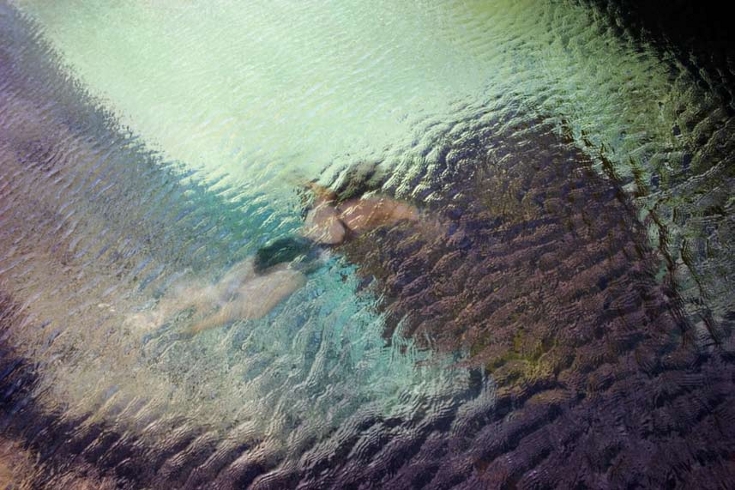 Gary Steer, The Visitor, 2009, from Frameworks Lightwave exhibition
Steer's recent work concentrates on impressionist interpretations of both nature and sport .Impressionistic here means illusionary and miragelike.
Some of the landscape work is more formal and abstract:
 Gary Steer, "Red Lake Crossing", 2008, Second Nature exhibition
The Second Nature exhibition was at the Brunswick Street Gallery in August, 2009
September 16, 2009
Ballarat Foto Biennale (BIFB): Wayne Quilliam + MAP
The Ballarat International Foto Biennale (BIFB) festival has an ambitious aim: to be a world class celebration of the photographic arts in the great tradition of the Recontres de la Photographie d'Arles in France. It is the biggest photographic event in the southern hemisphere.
The Core Exhibition Program will be devoted to the works of invited photographers, the BIFB Fringe Program is open to any photographer or group of photographers who can find a suitable venue in Ballarat or the immediate district and pay the modest registration fee.
Of the core program photographers I have previously mentioned Lauren Simonutti previously here on junk for code and here on conversations. One of the Australians is Wayne Quilliam, an Indigenous artist based in Melbourne, who is 2009 NAIDOC Aboriginal Artist of the Year.
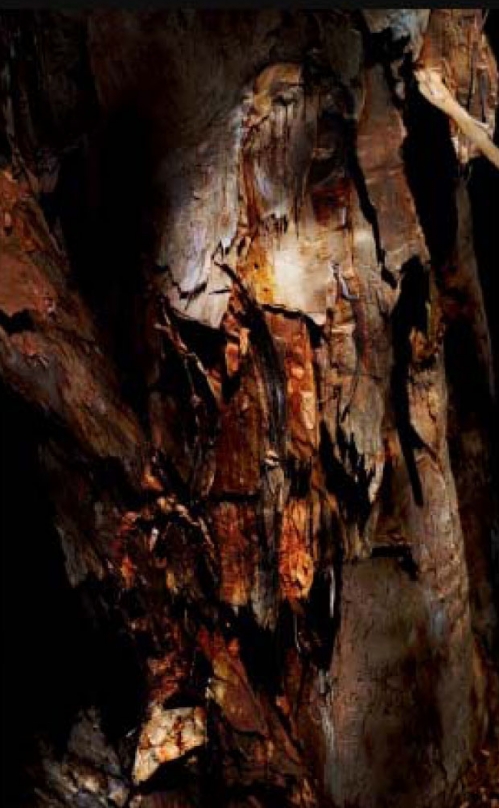 Wayne Quilliam, photomontage
Quilliam is primarily a social documentary photographer who works across a variety of areas including Indigenous affairs, sports, corporate events, photographic exhibitions, model and actor portfolios.
Quilliam's work appears to based on superimposing female bodies onto rocks, or more likely matted leaves of a forest floor, so that the body appears to be made of these natural materials. The image is striking but the inference is one of female body and nature with its patriarchal associations.
Another group of Australian photographers with a presence is the MAP group who did a project on the drought--Beyond Reasonable Drought. The Many Australian Photographers (MAP Group) is an independent association of documentary photographers, and their project for the Foto Biennale was MaPping Ballarat. This group of working professionals adopt a mostly social documentary in style and approach in capturing a day in the life of Ballarat.
Alas there are no images from this show under a creative commons licence I cannot any.
September 15, 2009
photography and place
The loss of a sense of place, and the increasing experience of a general sense of placelessness, is often taken to be one of the characteristic features of modernity. It is a feature usually taken closely tied to the enormous changes in communication and information technologies that have occurred over the last century. With the internet and the digital technologies associated with it place no longer seems to have any significance at all, and it has instead been replaced by a network of equally accessible locations within a single ‘space’.
Associated with this is the widespread view that place is inevitably connected with exclusion and violence, and with reactionary and conservative forms of politics. Place stands for a closed, exclusionary provincalism (belonging, rootedness, tradition homeland) in a cosmopolitan global world. In Australia it stands for an exclusionary politics in which “others” (non-whites) have been excluded on the grounds of race.
 Gary Sauer-Thompson, Encounter Bay, Victor Harbor, 2009
The history of place within the Western philosophical tradition has generally been one in which place has increasingly been seen as secondary to space—typically to a particular (physicalist) notion of space as homogeneous, measurable extension—and so reduced to a notion of position, simple location, or else mere “site.” Place is reduced to an arbitrary region of physical space.
Yet human life remains tied to specific times and places – we find ourselves already “there,” in the world, in “place”, as Heidegger pointed out. The words place, home, situatedness, and involvement form a grouping that is often structured around place, belonging, and identity that refer to our “being-in-the-world.”
Thus Aboriginal-Australians have a conception of human life, and of all life, as inextricably bound up with the land and place. Consequently, for an Aboriginal person to be removed from that country to which he or she belongs is for them to be deprived of their very identity ans being, and often in past times such removal – particularly when it involved imprisonment – frequently led to sickness and death.
Photography itself arise out a certain sort of situatedness--- being in a place refers to gathered “region” or “locale” in which we find ourselves along with other persons and things. It refers to a special relation to landscape. We can view the landscape itself as one of the ways in which place is formed, and also, one of the modes of our own self-formation. It has, as in the above photo, what Jeff Malpas calls a ‘bounded openness’, as well as having a dynamic element– place is that wherein things happen, in which things ‘take place’.
What is referred to in the photo is a sense of place, which Malpas says refers:
both to a sense of the character or identity that belongs to certain places or locales, and to a sense of our own identity as shaped in relation to those places, such that we might even be said to belong to those places.
Often place is understood as 'significant locale'--as ‘simple location’ plus , cultural meaning , or ‘humanised’ space or cultural heritage. What matters here is not the actual location, but rather the meaning that attaches to the specificity of location; a meaning that can, as it were, be ‘read from’ the location, and then recreated digitally, thereby recreating the place, and the sense of place with it.
Malpas rejects this interpretation in favour of one that refers us to the Aboriginal-Australian existential ground understanding. This refers to the:
way in which to be is always to be in some place – place is the ground on which ourexistence is based, and in and through which it is articulated. We are who and what we are through our relatedness to what exists around us, but such relatedness is itself inseparable from the specificity of our own locatedness, from the place, and places, in which we live. Our existence is, then, fundamentally a matter of our being ‘in’ place, our being ‘there’.
This is the very frameworkof relatedness that establishes certain entities, whether persons or things, not merelyas having a certain character, but also as being ‘in’ a place – as being there such that one can indeed say ‘there is..’.
September 13, 2009
Encounter Studio
The studio photography at Encounter Studio continues slowly, very slowly. It is being done with film on a Rollei 6006 and it is shot by shot. A roll of 120 film takes a long time to get through, then it has to be processed and scanned.
I get impatient with this type of work flow so I shoot with a digital camera:
 Gary Sauer-Thompson, Protea cynaroides, digital, 2009
The problem is the subject matter. Flowers are plain boring after a while. Flowers are good for learning the technique of studio photography, but ultimately they are of little interest content wise. So the problem is one of content. What do I do?
The other problem I'm having in the studio is technological. Firstly, I've had lots of trouble establishing the backup for the digital photos on the PC hard drive---getting the Lacie Big Disc operating both as a backup and as a network. In the end I gave up on the so called "plug in and play" and I took it to a computer shop to have installed.
Secondly, this lack of technological know how is a problem given my desire to develop my photography into a gallery and an e-book
September 12, 2009
graffiti in a digital world
Graffiti is now a way of visual thinking and acting that is shifting from the margins to the centre of our visual world.
 Gary Sauer-Thompson, Hosier Lane, Melbourne, 2008
The culturally conservative attitudes in society are best indicated by Peter Bond, The City of Victor Harbor’s Director of Environment and Infrastructure, who says:
Graffiti imposes huge costs to society, not only in dollars but also through increased fear of crime and a lowering of the quality of life in our communities... of course there is also the massive indirect and hidden costs that are not accounted for that potentially double the financial burden caused by graffiti
Graffiti in Victor Harbor is seen as offensive. The local Neighbourhood Watch (NHW) has a volunteer graffiti officer.
In Texting and Graffiti: Understanding the Reader in Contemporary Art in Journal of Aesthetics and Protest (Issue 5) Karla Diaz says that today:
Graffiti artists now take pictures on their cell phones and send them to friends. Text culture and the accessibility of phones changed the way Graffiti is now accessed, documented and read. Graffiti that was done on walls and the streets was never documented in this way before. The way most Graffiti artists documented it was through cameras that used film and then they developed the images for documentation. They often had to develop several shots and form a series of collages to get a full view of a piece they did on a long wall. Often, Graff artists compiled photo albums of their pieces and carried it with them to show others their work—a sort of artistic portfolio.
Diaz adds graffiti should still be looked at in terms of its context and the politics of being rooted on the streets. This is important because meaning, originality and style will always be invented here. However, there is a disparity in the way graffiti is socially perceived and privately practiced.
The conservative attitudes in the centre are best indicated by Peter Bond, The City of Victor Harbor’s Director of Environment and Infrastructure, who says:
Graffiti imposes huge costs to society, not only in dollars but also through increased fear of crime and a lowering of the quality of life in our communities... of course there is also the massive indirect and hidden costs that are not accounted for that potentially double the financial burden caused by graffiti
Graffiti in Victor Harbor is seen as offensive.
September 11, 2009
Victor Harbor: foreshore erosion
Whilst walking the dogs on the beach at Encounter Bay at Victor Harbor in the mornings and evenings this week, I've been noticing the effect of the tide on the foreshore compared to the past. The erosion of the sand dunes has been quite marked from the storm surges this winter:
 Gary Sauer-Thompson, erosion, Encounter Bay, Victor Harbor, 2009
I imagine that this is how the rising sea levels caused by global heating manifests itself--as a steady erosion of the sand dunes from the higher tides and the wilder weather. This erosion will continue due to warming of the oceans and the consequent thermal expansion and melting of non-polar glaciers and icecaps and the ice sheets of Antarctica and Greenland. Seawater will forced its way through sand dunes and spilled across the low-lying land
The Victor Harbor City Council will be required to protect the coastal area rather than retreat since abandonment is not usually an option. Part of adapting to rising sea levels will, presumably, involve building protective sea walls for the resort-area beaches:
 Gary Sauer-Thompson, erosion + Maleleuca, Encounter Bay, Victor Harbor, 2009
Many would argue that this erosion is not unusual in that beach and sand dunes built-up during months of relative calm will be eroded during stormy seasons, only to be built-up again after the storms have passed. As well, wave action and currents are continually moving sand along the shore, often resulting in a net drift of material in one direction.
However, the storm surges and beach erosion must be more severe than usual because the City Council has placed several lines (groynes?) of sand bags from the dunes to the sea in order to protect the dunes from tidal movement. Secondly, that ignores that sea levels along the South Australian coast are expected to rise by up to 40 cm above 1990 levels by 2050 and by 90 cm by 2100, with each one centimeter of rise resulting in one meter of erosion on low-lying beaches.
That means the coastline will move inward. What is now currently a vegetated dune will become the beach. There is not that much distance (or height) from the outer edge of the sand dunes to the foreshore holiday houses along the coastline near the city. So far the Council's response to beaches shrinking as the sand is washed away is sand deposits in order to protect the beaches.
Space: butterfly-shaped nebula
There have been new pictures from the new Wide Field Camera 3 aboard the upgraded NASA Hubble Space Telescope.The image below shows NGC 6302, a butterfly-shaped nebula surrounding a dying star. The WFC3 was installed by NASA astronauts in May 2009, during the servicing mission to upgrade and repair the 19-year-old Hubble telescope.
 NASA, Hubble, Butterfly Emerges from Stellar Demise in Planetary Nebula NGC 6302
What resemble dainty butterfly wings are actually roiling cauldrons of gas heated to more than 36,000 degrees Fahrenheit. The gas is tearing across space at more than 600,000 miles an hour—fast enough to travel from Earth to the Moon in 24 minutes
A dying star that was once about five times the mass of the Sun is at the center of this fury. It has ejected its envelope of gases and is now unleashing a stream of ultraviolet radiation that is making the cast-off material glow.
September 8, 2009
Leica M9 + others
Leica Camera AG will announce the M9 -- the world’s first digital rangefinder camera with a full-frame 24 x 36mm sensor and 18 megapixels -- tomorrow.
This continues the long heritage of the Leica rangefinder system. Leica introduced the first M series camera, the M3 in 1954, and the M9 continues the 50-year-old product designs. The M3 was the first Leica rangefinder body with a bayonet interchangeable lens mount.
If the M8 represented a pivotal move to digital, then the M9 shows the potential of what is possible in a digital M body. It will be expensive though: $A11,500.00 for the body + $A3-4000 or more for a lens such as the Summicron 35mm f/2.5 ASPH.

The M9 could very well be the most anticipated Leica M ever. Film users are holding out for a full-frame digital M before making the switch and the tens of thousands of existing M8 users are waiting to upgrade to a high quality image-making tool.
Associated with the launch of the M9 will be the X1--a small digital fixed lens pocket camera with a large sensor.

The lens is a 24mm f/2.8 Elmarit ASPH, the camera shoots raw (DNG) as well as JPG, and it comes with Adobe Lightroom 2.4.
The third camera announced was the extremely expensive S2, a digital medium format camera in a SLR style body. This is their first digital DSLR and it places Digital Medium Format Sensors and 'new' MF Lenses at the top end of DSLR development directly competing with established medium format DSLR systems such as those made by Hasselblad:

This weatherproof camera will cost more than a new car---the body-only price is around $A38,000 whilst the lenses range from £3,096 to £5,160. We won't see many of these studio/field cameras in Australia.
Update
I watched Leica's 3 big product launch in New York live on a video stream. Like Apple Leica wants to assert itself as a creative, high-end, relevant and innovative product maker, not an also-ran. In contrast we have Apple's very limited product release at its annual gig. A new version of Apple's best selling iPod, the Nano, which now includes a video camera, an FM radio, a pedometer and a microphone and speaker. No still pictures. Not much by way of innovation is it? Has Apple stalled?
But then Apple have made the transition from a computer to a services company. Leica are only starting their transition from film to digital. Will they succeed? They've "mortgaged" themselves to the hilt to produce the S2, and it may not even be an economic proposition. Rolleiflex, for instance, went into bankruptcy as a result of trying to make the transition from film to digital in medium format cameras.
Will these innovative products get the company back to what it once was - a producer of extremely high quality, practically designed imaging tools?
Update 2: 17th September
Tonight I went to the launch of the camera gear in Adelaide held at Photoco in the Central Market along with 40-50 other Leica fans. I could play with the cameras--the M9 and S2, as the X1 was a pre-production model, or a mockup. The M9 was a delight to handle--a unique photographic camera that provides a way of doing photography that reaches back to the beginnings of photojournalism in the early years of the 20th century. The M9 will be a home run for Leica.
The S2 evoked camera envy--it was simply a gorgeous piece of machinery. It is a high quality camera with equally high quality lens a studio camera with the ease of use of an slr, but with the resolution of medium format digital. It sits very comfortably in the hand whilst the viewfinder is among the best I've ever seen, huge and bright for precise framing and focusing. Easy to hold, transport, great sensor, great optics. They are breaking new ground in the top end of the market, as this camera is designed to be portable, to go outdoors.
The market is crying out for something that is better than the best 35mm platform. Will the S2 succeed in establishing a presence in the medium format digital market? We will have to wait at least a year or more to see. We will know soon enough if the S2 signals a new era for Lecia or the beginning of the end.
September 7, 2009
At Victor Harbor
I'm in Victor Harbor doing some studio photography whilst Suzanne is in the Bungles Bungles or the Purnululu National Park. This is famous for the unusual and visually striking sandstone domes, with their striping in alternating orange and grey bands.
 Suzanne Health, Argyle Mine, WA, 2009
The Kimberley region of WA is big country that I will never really explore. Most of it is accessible on a fly in have a quick look and fly out basis.
September 6, 2009
beyond positive thinking: carnival
Positive thinking: the cult of uplift. The tight smile covering over the despair of helplessness. A matter of self-confidence ---maintaining a positive outlook--in times of institutional failure. Out of the Depression, the modern Positive Thinking movement---the advocates of the peppy, look-on-the-bright-side attitude-- was born.
You can have whatever you want say the books in the business section of airport bookshops.They scream out against 'negativity' and advise the reader to be at all times upbeat, optimistic and brimming with confidence. Thus we have the affirmation business.

Positive thinking--feeling happy in adverse circumstances--places to one side our fears and negative thoughts, thereby ignoring that we need to be alert to the world outside ourselves, even when that includes absorbing bad news and entertaining the views of ‘negative’ people. Carnival is a better response when we re faced with the symbolic penetration of corporate advertising culture to the city level--it is a resistance to full capitalization of everything.
Historically, carnival or festival was a celebration of social inversion when hierarchies and polarities of wealth, power, gender, and race were reversed and parodied. It is a view of the world as seen from below. This served as a kind of steam valve in a feudal world, allowing the plebeian masses to transgress the rigid social order for one week out of the year. The names in modernity are Baktkin, Bataille and the Situationists.
Carnival was never an aggressive or militarized act of revolution, but rather the kind of "Revolution of Everyday Life" that would later fascinate the French situationists. Carnival's strategy was to turn the world on its head. Its weapon against advertising photography's seducing us within a endless labyrinth of commodified market desires through image production is laughter.
Punk, a howl of rage, was a 'carnival of the oppressed' by 'teenagers who changed their lives and overturned established differences.and everyday life is reconfigured. It was an inversion of low (debased, tabooed) culture over elite high culture that produces new combinations in a given semiotic system.
September 5, 2009
Led Zeppelin: The Song Remains the Same
I watched a remixed DVD of "The Song Remains The Same" ---a film of a Led Zeppelin concert during their American tour of 1973. From 1971-1975 period, Led Zeppelin were the biggest band in the world, and their film is taken from three nights of concerts at New York's Madison Square Garden.
The band were golden rocks gods, selling out stadiums across America, and they stood for excess: private plane, motorcades, fantasy sequences, blown out music (eg., a 23-minute-long version of the song "Dazed and Confused"), and bloated grandeur. Freedom from taboos was being celebrated by the rock gods in opposition to the misery and limitations of everyday life.

Though the sound quality was excellent, musically the improvisations were uninteresting. The film was mostly all about Jimmy Page, as rock god soloing away on his guitar. A pity because, the concert comes in between two good albums:-Houses of Holy and Physical Graffiti.
Visually, the film is about celebrity culture before punk. You can see what punk was reacting against. It was a rebellion against the excess of the spectacle as entertainment for the masses that expresses the repressed realm of the sensational. The live performance now operates between the misery of an everyday life without adventure and the hell of a glamorous world devoid of experience.
The French writer Guy Debord described the spectacle as a complex system of delusion and deception which adapts people to the demands of the media and of work in modern society and robs them of their life.
September 4, 2009
Adelaide photographers: Rossanne Pellegrino
Gallery 139 is an Adelaide based gallery that sometimes shows the work of Adelaide based photographic artists. An example is the Of no particular order exhibition by local photographer Rossanne Pellegrino in March 2008. This mixed media work incorporated photo transfer techniques, hand painted imagery and Polaroid manipulation to create painterly imagery that blurs the traditional borders between painting and photography. She says:
I take photos and then manipulate them by painting them, then taking more photos of that image, melding images together and then applying chemicals to them and then press printing that image onto paper
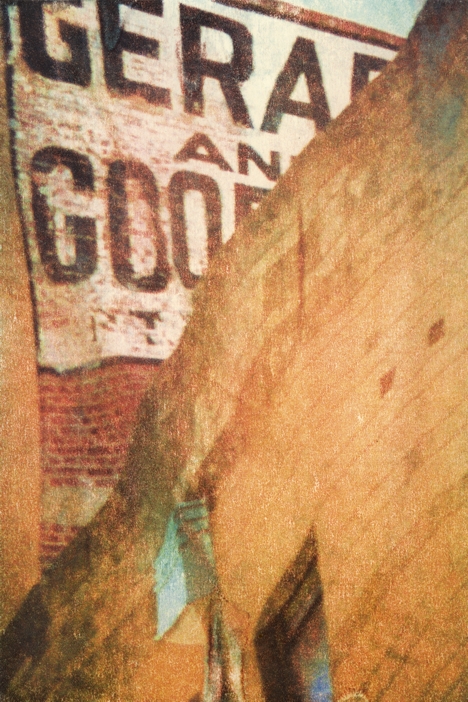 Rossanne Pellegrino, Est. 1907, c-type print, slide film, photo transfer, giclee print,
These urban scenescapes evoke moments from the artists' history from the perspective of memory. We enter into a dream world where images of reality are melded together and obscured by heightened personal memory.
Pellegrino left Adelaide because she felt Ishe was doing the same type of work same people coming to my shows. Whilst in London she established the London based We are all artists as one way in which emerging artists could showcase their artwork within their own communities as well as in international circles.
September 3, 2009
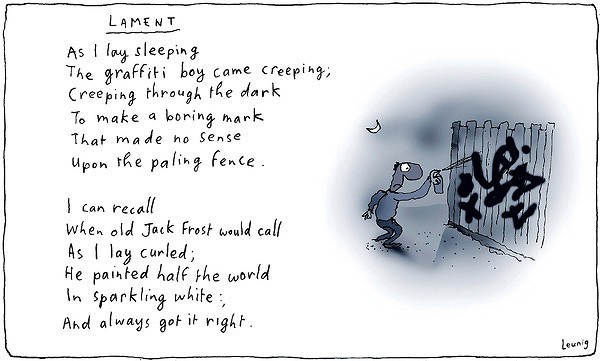
Leunig: graffiti + nostalgia
aah nostalgia. And a sense of being out of joint with the times. That is Leunig isn't it. Trouble is the frosty times in south eastern Australia are long gone with the global heating now associated with climate change:
More nostalgia for an object of desire in the film world of yesteryear. A design classic as it were, though not an everyday one.
The future. Mobile phones are seen as a threat to many standalone devices: PDAs, MP3 players, GPS and satnav devices, handheld games consoles and electronic book readers. They are the platform of today after the visual or pictorial turn.
There s also nostalgia for the view--that goes sback to Plato's Cratylus that images are understood to be tied by natural forces/objects to what they resembled, iconic analogues of their objects.In this view the naturalness of the image makes it a universal means of communication that provides a direct, unmediated, and accurate representation of things, rather than an indirect, unreliable report about things.
Thus the legal distinction between eyewitness evidence and hearsay, or between a photograph of a crime and a verbal account of a crime, rests on this assumption that the natural and visible sign is inherently more credible than the verbal report. however, After the recent visual turn the claim that images can be understood as natural or analogical signs with universal capacities to communicate has almost entirely come undone given the discursive, textual or institutional constitution of images.
The image as a natural sign, a straightforward analogue of its object, is an assumption whose time has clearly gone. The eye is not innocent. We now talk about he hermeneutics of seeing’, ‘the rhetoric of images’ and ‘visual narratives’.
September 2, 2009
Dean Sewell + Tamara Dean on photography
Dean Sewell and Tamara Dean are members of Oculi, a photographic collective. They both work for Fairfax Media and are based in Sydney. This is a video of them talking about their work --courtesy of ABC Flora.
Sewell is known for his work on the Tsunmai aftermath in Indonesia and in 2009 and on the plight of the Murray-Darling river system.The latter is part of the Engaging Visions project organized by Dr John Reid.
Engaging Visions is a joint initiative between the Murray-Darling Basin Authority, the Australian National University and the Australian Research Council that examines how art can enhance the discussion of sustainable practices in the Murray-Darling Basin.
 Dean Sewell, A Dry Argument,
Sewell won the Doug Moran Photographic Prize for 2009 for this photo and he is is the Engaging Visions documentary photographer. There are four Engaging Visions Field Studies and an exhibition of the Riverland one was held in March 2009.
previous post on Tamara Dean.
September 1, 2009
NZ photography: Maurice Lye
Maurice Lye is a Christchurch based New Zealand photographer who has being exhibiting since the late 1970s. His work included in a number of survey exhibitions, including 'The Active Eye': a survey of New Zealand Photography in 2000.
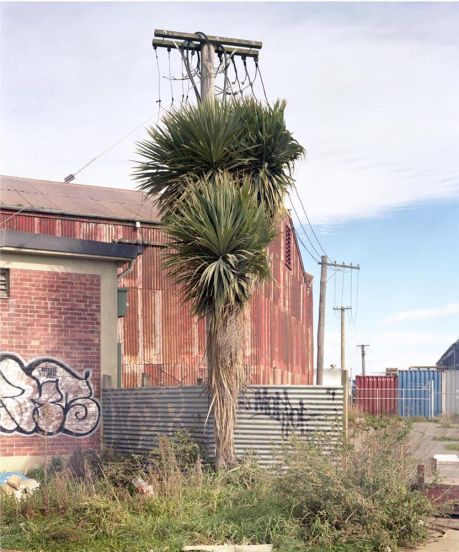
Maurice Lye Cabbage Tree, Christchurch 2007
Lye describes himself as a scavenger:
forever on the lookout for situations that appeal to my vision, sense of humour and irony. How people affect their environment, the traces they leave and their responses to the creatures and plants we co-habit with, intrigues me and provides fertile ground for exploration
The Tree portraits are of trees that are almost invisible, because they are so common place. His latest work on sea tulips entitled Board Members is exhibited at Gilt, an online art gallery located in Christchurch.
 Maurice Lye, sea tulip, from Board Member series
Lye says that the stalked sea tulips (Pyura pachydermatina):
start out as tadpole like larvae, swimming about trying to find a suitable location to take up residence for the rest of their lives. A prime spot could be a rock, wharf pile or any piece of solid sea bed. Once found, this location will have to provide “the right” conditions that will allow the filter feeding siphons of the animals access to an abundance of planktonic food in the surrounding water. To secure the position the larva adheres itself to the spot and starts to transform into an adult. During their one - two year life span they can grow up to 50cm, most of this is stalk. The ‘flower’ heads are about 20 - 80mm.
The specimens displayed in this exhibition were gathered at Riverton, in Southland. Sometimes many thousands of these creatures are washed up on the eastern beaches of the South Island.’