|
September 3, 2009
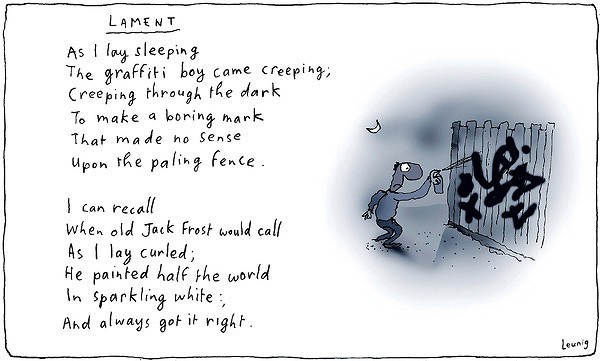
aah nostalgia. And a sense of being out of joint with the times. That is Leunig isn't it. Trouble is the frosty times in south eastern Australia are long gone with the global heating now associated with climate change:
More nostalgia for an object of desire in the film world of yesteryear. A design classic as it were, though not an everyday one.
The future. Mobile phones are seen as a threat to many standalone devices: PDAs, MP3 players, GPS and satnav devices, handheld games consoles and electronic book readers. They are the platform of today after the visual or pictorial turn.
There s also nostalgia for the view--that goes sback to Plato's Cratylus that images are understood to be tied by natural forces/objects to what they resembled, iconic analogues of their objects.In this view the naturalness of the image makes it a universal means of communication that provides a direct, unmediated, and accurate representation of things, rather than an indirect, unreliable report about things.
Thus the legal distinction between eyewitness evidence and hearsay, or between a photograph of a crime and a verbal account of a crime, rests on this assumption that the natural and visible sign is inherently more credible than the verbal report. however, After the recent visual turn the claim that images can be understood as natural or analogical signs with universal capacities to communicate has almost entirely come undone given the discursive, textual or institutional constitution of images.
The image as a natural sign, a straightforward analogue of its object, is an assumption whose time has clearly gone. The eye is not innocent. We now talk about he hermeneutics of seeing’, ‘the rhetoric of images’ and ‘visual narratives’.
|


The damnedest thing you ever saw! ,