April 30, 2008
Colin McCahon
When I was traveling through the high country in Canterbury and Otago I kept on recalling some of the early paintings by Colin McCahon. He had started out as part of the cultural nationalism of the Canterbury regionalist school, which represented rurality within a pastoral tradition in the 1930-40s, and increasingly shifted to a more abstract style.
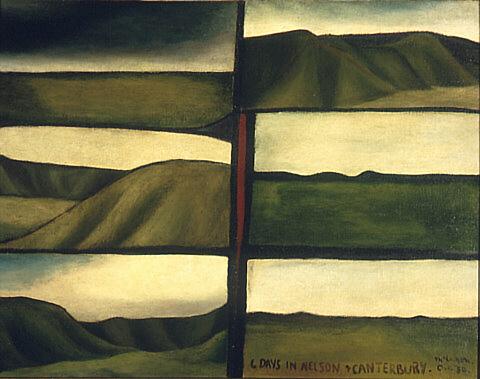 Colin McCahon Six days in Nelson and Canterbury, 1950, Oil on Canvas
The turn to abstraction came from stumbling into modernism---Cezanne and Cubism--through the filter of well-thumbed copies of The Illustrated London News and other NZ painters. Derided and misunderstood for most of his career, by both the art establishment and the general public in a provincial culture, he is now generally seen New Zealand's first and greatest modernist.
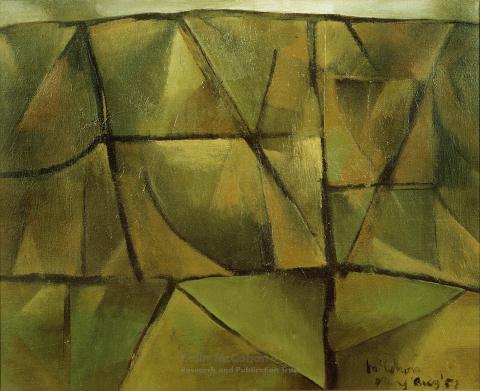 Colin McCahon, Canterbury landscape, 1952, oil on canvas
McCahon's latter work explored religious themes written in a graffiti style based on the biblical graffiti that was often scrawled across the walls and outhouses of the New Zealand landscape. Sometimes long tracts were painted onto huge outcrops of rock.
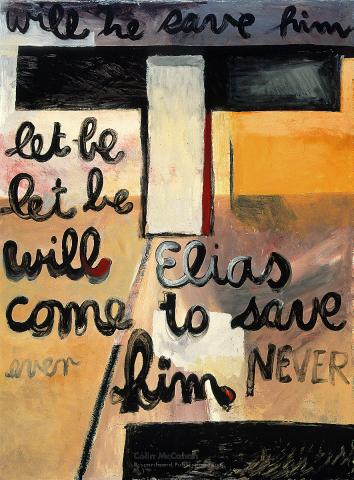 Colin McCahon, Will he save him, 1959, Oil on canvas
Today McCahon has the beginnings of an international reputation
Franz Josef Glacier
Like Mt Cook or Milford Sound the Franz Josef Glacier is another iconic site for international tourists. The glacier is easily accessible by foot through walking up the Waiho River bed. Many view the glacier and the Fox Glacier by helicopter, whilst others walk up the glacier in a group with with a guide. The high tourist numbers indicate how much naturalness as wilderness has become commodified, as well as a powerful ideological force.
The glacier's rockface gave me the chance to shift to a more abstract style:
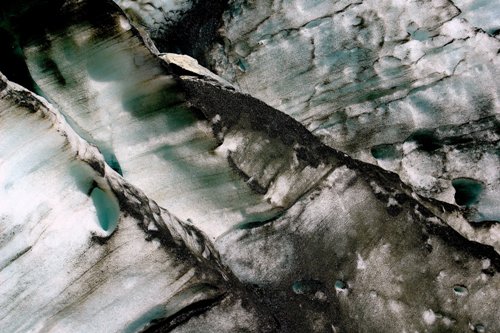 Gary Sauer-Thompson, Franz Josef Glacier, 2008
I kept on recalling the images of waterfalls produced by Colin McCahon as I slowly slowly walked back down the river that runs off the Franz Josef Glacier in the Southern Alps.
April 29, 2008
Rita Angas + NZ regionalism
Rita Angas's Cass is one of New Zealand's most popular paintings. The regional realist school was concerned with the physical appearance of the Canterbury landscape and seeking identification with it. Weathered wood and decayed churches, pine trees and dry-as-dust grass, have appeared time and time again in the work of these painters.
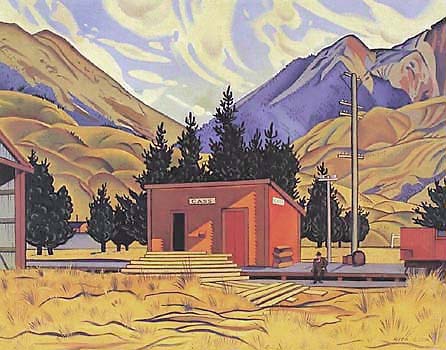 Rita Angas, Cass, 1936, Oil on Canvas
The work represents the railway station of a tiny rural community in Canterbury nestled in front of bare hills and mountains. The small figure of the waiting man emphases the isolation and remoteness of the area.
We are a long way from the ruined urban world of European modernity ---the industrial ruin, the defunct image of future leisure (the vacant mall or abandoned cinema), or the specter of war —that signify a ruin of the future. There the frisson of decay, distance, destruction represents a melancholy world.
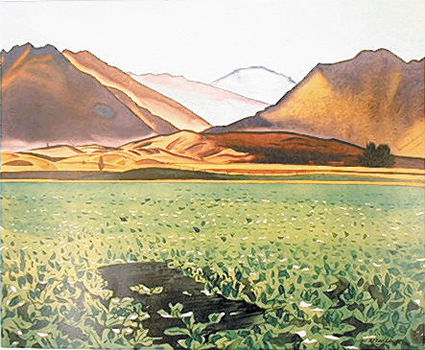 Rita Angas, Wanaka Landscape, 1939, watercolour
A dichotomy still exists the regional landscape tradition constitutes accessible "low" art while non-objective or abstract modernist painting is seen as difficult "high" art.
Eugene Von Guerard: Lake Wakitipu
As we have seen the NZ work by Von Guerard informs, and is a part of, the NZ landscape tradition. It can be referenced back to the Hudson River School in the US.
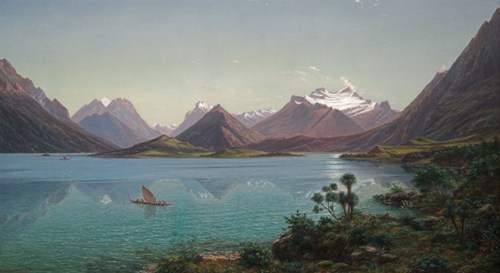 Eugene Von Guerard, Lake Wakitipu with Mount Earnslaw, Middle Island, New Zealand 1877-1879, Oil on Canvas
This romanticism was pushed into the background by the landscape painting of the 1930s and 1940s which centres on a group of realist painters based in the South Island city of Christchurch. One of these is Rita Angus, who was concerned to to create a distinctly New Zealand art and whose work was informed by the American regionalist movement.
The debate over Modernism/regionalism was really a conflict over who would define New Zealand art. The conservative critics who promoted Regionalism often did so as they saw it both as a bulwark and a way to defeat the influence of abstraction arriving from Europe.
I've introduced von Guerard's New Zealand work because the romantic sublime has been lost to contemporary wilderness photographers, who are struggling to free themselves from the the conservationist idea of the photo as illustration within scientific knowledge of the earth and botanical sciences. In reaction they make the turn to what they call art photography (good form) to aesthetics, and to poetry, imagination, the transcendental, heightened spiritual feelings and the mood of a place. In doing so they (eg.,Craig Potton and Andy Dennis' 'Images from a Limestone Landscape') more often than not, tacitly embrace the picturesque, or modernist abstraction. For them 'aesthetics 'stands for beauty (of the wilderness), rather than the philosophical concepts we use to talk about art works whilst the imagination colors nature.
What is being invoked in the reference to darkness, storms, craggy rocks, ragged precipices is the Romantic tradition, with its ethos of freedom, rebelliousness, individualism, irrationality, spontaneity, primitivism, nature-worship, and its conception of the artist as an outsider, a lonely genius, a man of destiny, who listens only to his own inner voice and is constantly in opposition to a society which resents him.
April 28, 2008
Taliesin West
With the commision money he earned from the Falling Water home in Pennsylvania Frank Lloyd Wright bought 500+ acres in Scottsdale, AZ. At the time Scottsdale was a little desert outpost with about two hundred residents, not the trendy fashion-laden suburb it is now. Wright used his land, Taliesin West, to develop ideas on Organic Architecture as well as establish an architectural school for many students. Plus it allowed him to avoid the bitter Wisconsin winters.

Many innovations came out of Taliesin West; the great room as seen in the photo above, track lighting, floor lighting that could be walked on, use of steel reinforcement in concrete, rooms that integrated with the landscape and canvas roofing that allowed for uniform natural light to flow into the room. We can celebrate Wright as innovator, but we can't really celebrate him at Taliesin West as a designer. The place looks cheap, nasty, haphazard, unfinished, incoherent and inconsistent. It is not 'designed' but rather reflects the changing and eccentric interests of Wright himself.
A good example of the inconsistency is the Asian sculptures. They are ceramic and he picked them up cheaply in a crate because they were broken. They do not fit with the buildings or site at all, rather they just represent his cheap nature and interests. But then Wright was cheap except when he was expensive. His bathroom in his bedroom has polished aluminium walls and fixtures; which cost a fortune back then. That style is common and fashionable (as well as expensive) today, so he was innovative, but again it just represents his whimsical interests rather than being an integrated and flowing design.
Still; the place definitely has its moments, like the sloped and triangular buttresses of the design offices[below].

Taliesin West is worth a look but it is not a showroom. It is basically the physical constructs stemming from the changing and incoherent interests of an innovative and difficult man. It is no architectural nirvana.
April 27, 2008
Eugene Von Guerard: Milford Sound
The German romantics had a profound influence on the way the Australian landscape was first imagined. as exemplified in the work of Eugene Von Guerard. Von Guerard's painting below of a NZ alpine landscape invokes the sublime through the vastness and otherness of the wilderness.
It can be contrasted with with naturalistic French landscape settings, or neo classical paintings that reflect nostalgia for humanity as an enduring presence manifested in traces of antiquity, or the intensely occupied pastoral landscapes of Constable and Courbet.
 Eugene Von Guerard, Milford Sound, New Zealand 1877-79, Oil on canvas
Milford Sound is one of New Zealand's most recognizable images and it continues to attract painters. This work by Von Guerard informs, and is a part of, the NZ landscape tradition. It evokes the Yosemite Valley paintings of Alfred Bierstadt:
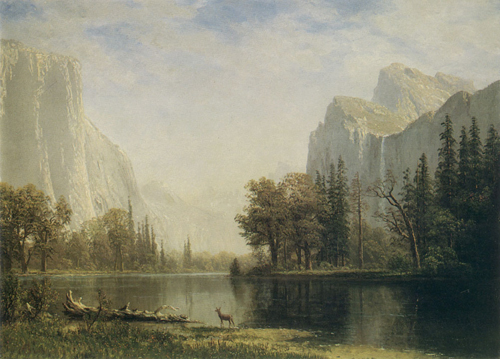 Alfred Bierstadt, Yosemite Valley, 1865, Oil on Canvas
Bierstadt and the earlier Hudson River painters set about to heed Emerson's call "to ignore the courtly Muses of Europe" and define a distinct vision for American art. Their roots were in European Romanticism and their work can be referenced back to that of Caspar David Friedrich in Germany.
I do not know the history of romanticism in New Zealand visual art or the tradition's different interpretations of nature. The tradition in general conceptualized nature as a mysterious and enigmatic force before which the artist must humble himself if he were to learn nature's secrets.The best place to become part of the underlying rhythms of the landscape was in the wild landscapes that stretched the 18th-century idea of the "picturesque" beyond breaking point.
JMW Turner was the English lodestone: wild nature, the interests in the classics and in literature, the interests in storms, in medieval architecture, in mountains, in atmospheric effects, in the dramatic portrayal of light, and in the truthful and yet poetic rendering of a locality. Turner was undoubtedly the most representative of all the English romantic landscape artists. If the European natural world was increasingly subject to an alarming erosion: its outlines have begun to blur, its forms to dissolve, and it becomes ruined, then NZ's South Island stands for wilderness untamed.
April 26, 2008
Haast River
This was taken along the Haast Pass at a location called the Gates of Haast:
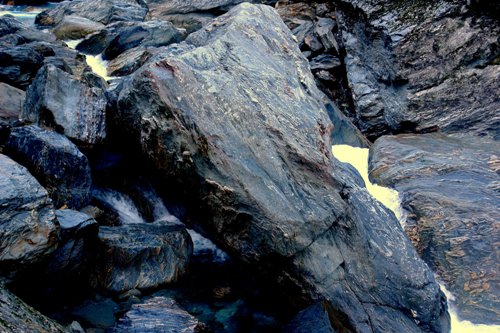
The photo of this impressively wild river was taken near an old bridge. It was the only location that was easily accessible of this wild river. It is a matter of getting out and walking up the river on its edge. It would be hard going:
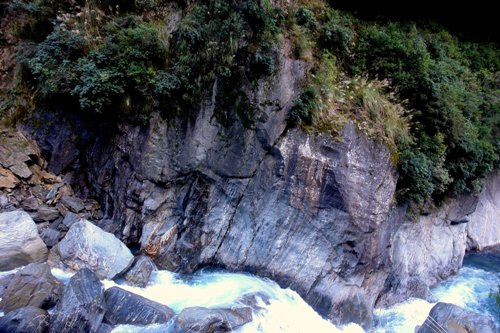 Gary Sauer-Thompson, Gates of Haast, South Island, New Zealand
April 25, 2008
Church architecture: Franz Josef Glacier
The west coast of the South Island of New Zealand has not changed much apart from the penetration of the global economy in the form of international tourism concentrated around the Fox and Franz Joseph Glaciers in the Westland National Park.
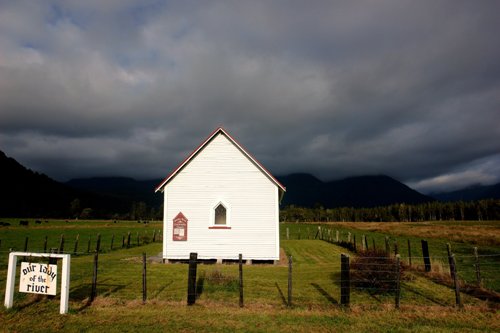 Gary Sauer-Thompson, church, Westland, South Island, New Zealand
Westland is a distinctive and unexplored bioregion with human civilization located in isolated spots along the coastal edge. The region is sparsely populated, especially in the south.
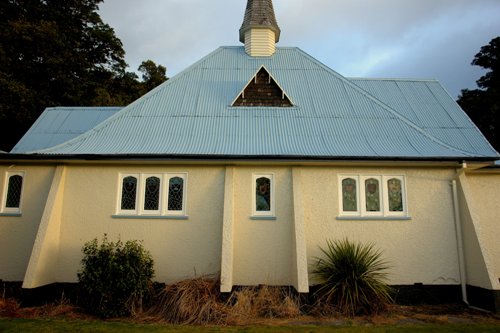 Gary Sauer-Thompson, Catholic Church, Franz Josef Glacier, 2008
The glaciers dominate the region.
April 24, 2008
Milford Sound
Milford Sound is an iconic tourist site in the Fiordland National Park. So it is a much photographed location.
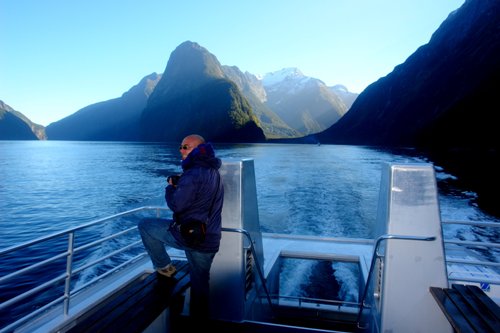 Gary Sauer-Thompson, Milford Sound, New Zealand, 2008
The options for exploring are limited: helicopter or plane; bushwalking or boat. We took the early morning boat trip of the glacier shaped fiord to the sea. Milford is very much a getting out and walking the various tracks--eg., the Milford Track---if you want to get to know it. That means oodles of time.
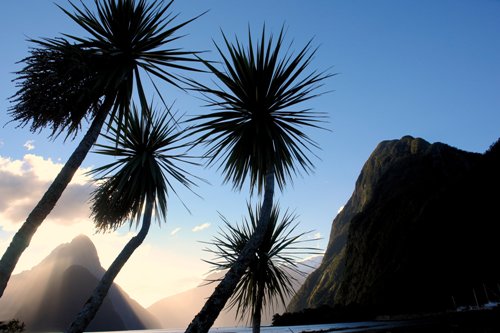 Gary Sauer-Thompson, Cabbage Tree, Milford Sound, 2008
Apart from that it is a quick cruise around the foreshore walks.
April 23, 2008
Te Anau: tourism
The road to Milford Sound is the tourist road in the South Island Dozens of coaches full of day trippers from Queenstown dominate the road there and back. An early stopping point for them is Lake Te Anau, and the township is heavily reliant on international tourists:
 Gary Sauer-Thompson, Te Anau, New Zealand, 2008
The backpackers presence is strong on this tourist road. Many of thel ocals see them as grungy travellers lugging packs around, pinching food from supermarkets and inhabitating mozzie-infested hostels even though they bring cash to the local economy.
The backpackers are outnumbered by the international tourists--mostly Japanese--- on daytrips to Milford Sound from their base in Queenstown.
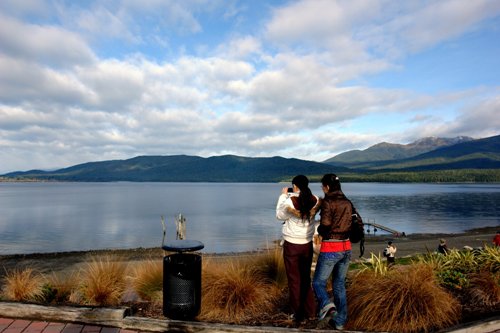 Gary Sauer-Thompson, Japanese tourist, Te Anau, 2008
There are different tourist markets based on the wealth of the tourist. All travel the same road to the same iconic places. Milford Sound and the National park is a world heritage one.
April 22, 2008
towards wilderness
Queensland is definitely the playground for the international tourists. It is full of excitement and buzz. And commercialism, MacDonalds and Starbucks. Everybody is waiting for the snow and the partying to begin in a month or so.
It was a pleasure to get away from rip off town to something more low key:
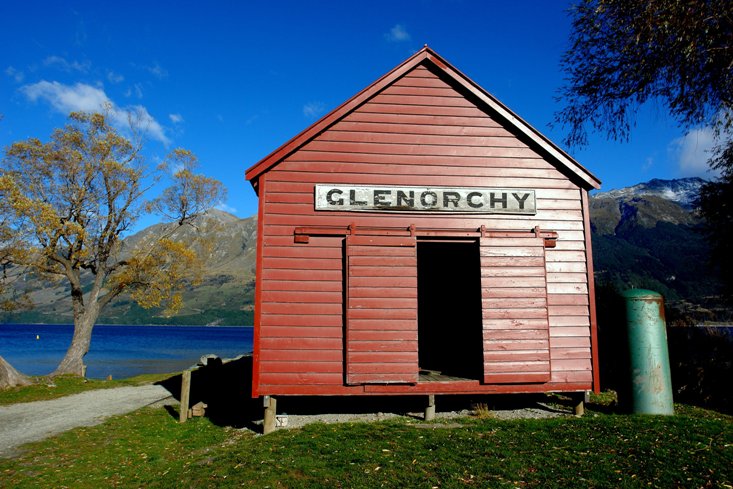 Gary Sauer-Thompson, Lake Wakatipu, Glenorchy, New Zealand, 2008
The eastern end of Routeburn Track was the destination. We wanted to explore it at both the eastern and western ends to see what it was like:
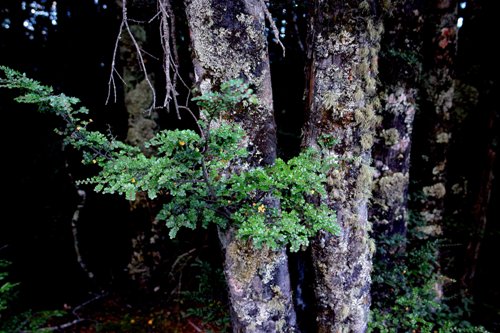 Gary Sauer-Thompson, Routeburn Track, Glenorchy, 2008
The track, which straddles both the Mount Aspiring and Fiordland National Parks, is very popular with bush walkers.
April 21, 2008
Lake Wanaka
It looks pretty but the water level of Lake Wanaka is low. The rains haven't come the locals say. They do not seem to be too worried.
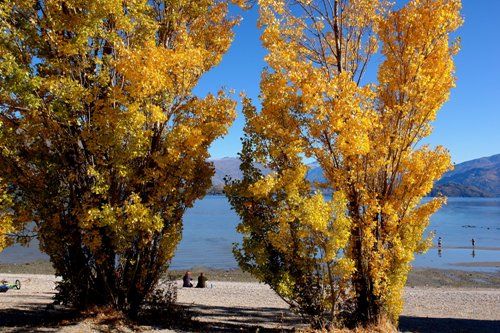 Gary Sauer-Thompson, Lake Wanaka, New Zealand
Fun can still be had on Lake Wanaka and in the surrounding mountains.The lifestyle is very pleasant. Does it matter if the lake retreats a little? The international tourists are still coming for the snow, the extreme sports or to experience the wilderness areas, such as the Mt Aspiring National Park. All's well. The snow and rain will come. It's just part of the natural cycle.
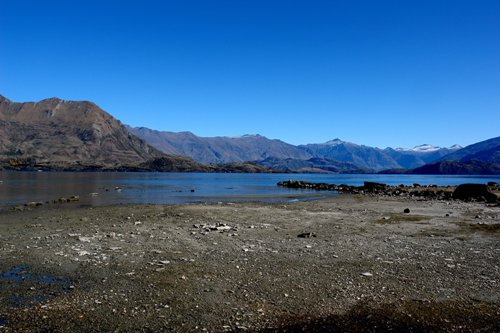 Gary Sauer-Thompson, Lake Wanaka, New Zealand
Aspiring National Park straddles the 'great divide' of the Southern Alps and at its heart is a massive area of wilderness - glaciers, snowfields, mountains, valleys and wildlife habitats that require days of hiking to reach.
Update:23/4
We have returned to Lake Wanaka after being in Milford Sound. The place is full of snow bums---scruffily dressed, beer drinking, cigarette smoking males who have left Queenstown because it is too expensive. They hang around rhe cafes and pubs ----what for? The snow?
Road Trip to Tombstone, AZ
I recently read Tough Towns by Robert Barr Smith which documented how upstanding and well armed citizens contributed to establishing law and order, especially from bandits who preyed on banks, stores and trains. One of the bandits mentioned was Dirty Dave Rudabaugh who spent time in the Tombstone area of Arizona including one suspected shoot out with Wyatt Earp. Tombstone is about three and a half hours from Phoenix; hence on the cards came a fun and beautiful road trip through plains and desert south of Tucson.

Tombstone itself is a mix between old Sydney Town and Ballarat. The main part of the historic street is chained off from cars and tourists lazily walked down the street under beautiful weather looking at the museums, stores and carriages being pulled by horses down the street.
The history at the OK Corral is appealing however the real star of the road trip was the landscape. The area around Tombstone is the South West USA at its most rugged and gorgeous.

Rather than join the tourists in the OK Corral, or in the stores, I ended up sitting down several times on Allen St in the bench chairs and simple enjoying the weather and the view. I wasn't alone several others were too; including many in period dress who were spruiking services, shows, and history re-enactments in the town.
April 20, 2008
Lindis Pass
The road that leads from Mt Cook to Lake Wanaka and then to Queenstown leds through the austere Lindis Pass:
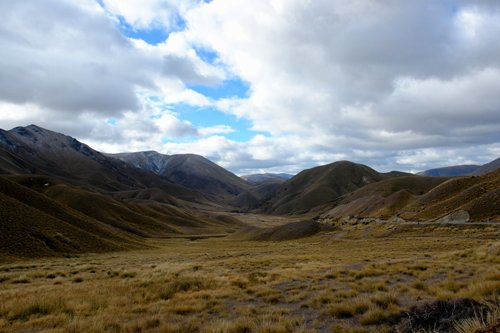 Gary Sauer-Thompson, Lindis Pass South Island, New Zealand, 2008
This is tussock grassland country and it links the Mackenzie Basin with Central Otago. The old Maori track through the hills was rediscovered by John T Thomson while surveying this region in 1857 and was soon traveled by large numbers of gold prospectors. In the valley of the Lindis River a number of old farmsteads dating from the time of the early settlers still survive; particularly notable is Morven Hills farm.
At the southern end of the Lindis Pass is the small village of Tarras:
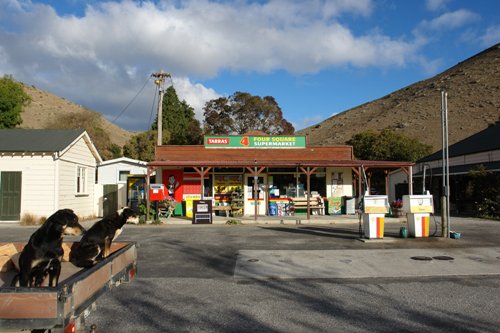 Gary Sauer-Thompson, Tarras, South Island, New Zealand
Sites used to film the Great East Road and the Flight to the Ford in Peter Jackson's Lord of the Rings are on private land about ten-minutes drive from the tiny township of Tarras, but you can still see much of the general area from a nearby side road.
April 19, 2008
Mt Cook
There was no wireless internet at Mt Cook National Park The caravan park facilities were very poor. The accommodation was definitely top of the range at The Hermitage ($360 per night AUTUMN SPECIAL) with a lousy dialup facility.
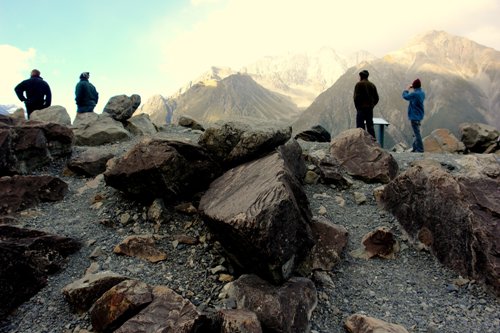 Gary Sauer-Thompson, near Tasmanian Glacier 2008
There was snow during the night. Mt Cook itself was full of international tourists, most of whom were interested in doing walks with many doing serious mountaineering. We did a little:
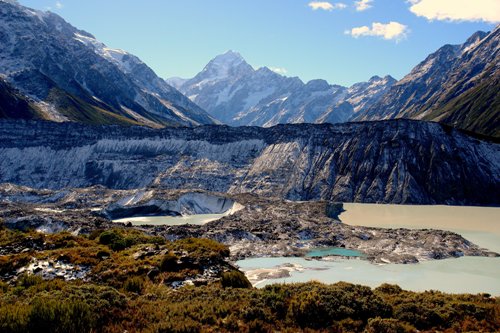 Gary Sauer-Thompson, Mt Cook, New Zealand, 2008
The light was all wrong for photography--it was a case of shooting into the sun and hoping for the best, given the extreme contrast in the alpine country.
The best place to hang out for coffee and internet access was the Old Mountaineers Cafe. An example of good wilderness photography is the work of Craig Potton.
April 18, 2008
NZ humour
I'm not sure what tagging refers to in NZ. I presume it has little to do with tagging images on Flickr or on weblogs.
 Slane NZ Herald
Something to do with street art? Or something to do with sheep perhaps? If it is the former, then I have seen very little street art in the South Island. There was some in Christchurch, but little elsewhere.
April 17, 2008
NZ: high country
I'm in another wirelessed holiday park at Fairlie, a little town near Lake Tekapo. We spent the day exploring the high country around the Rangitata River. This is the country that Peter Jackson shot Lord of the Rings and where I once worked putting up fences whilst a student at Canterbury University.
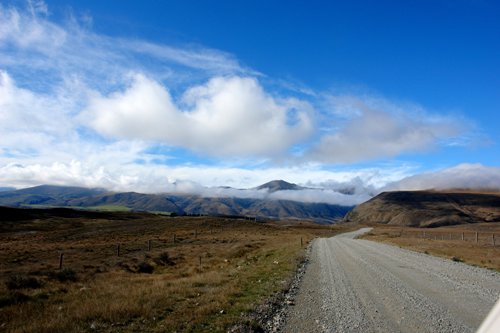 Gary Sauer-Thompson, returning to Mt Somers, NZ, 2008
It was grey, overcast with drizzle in the Rangitata country near Mt Potter and Erewhon stations and it only cleared as we came out of the Valley to return to our base at Mt Somer to make our way to Mt Cooke. That moment was brief as it clouded over again as the cloud descended. Most of my photographs did not work because of the heavy mist.
It would be very difficult to do serious wilderness photography here. You would have to stay at a place for a while and get to know the area and the light and use a large format camera (5X 4) if you wanted to avoid the pretty tourist images.
Border Crossings
The chaos of returning to the United States from Mexico through Sonoyta/Lukesville. It was more car parking lot than orderly lines. We were run through a radio-isotope detector and asked to hand over our oranges, but not our limes.

Borders like that always make me nervous since I am no longer rooted in the entitlement of nationalism. I have an Australian passport and a Greencard which means I fear that crossing a border might be arbitrary and drop me into an obscure form of statelessness.
The best border I have seen in my travels was the one between Germany and Belgium. It was an abandoned building that looked like an old 1970s petrol station. It was an old border crossing that was no longer manned.
April 15, 2008
Akaroa, South Island
Akaroa is the playground of the Christchurch crowd. The French influence is barely noticeable apart from naming streets and restaurants cashing in on for tourism purposes to give themselves a touch of class and elegance.
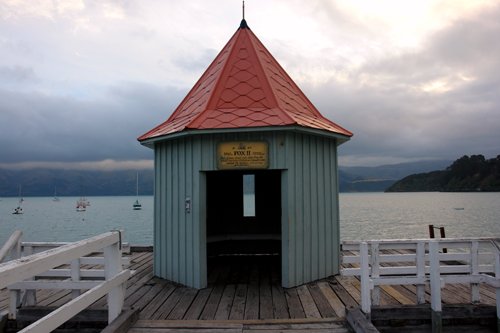 Gary Sauer-Thompson, Akaroa, South Island, New Zealand, 2008
I am able to sit in the touristy Akaroa holiday park in the Britz van in the caravan park and produce this blog using a wireless internet connection. I presume that the wi-fi is 802.11---ie., a local area network that offers coverage over a radius of 10 to 40 metres---that is similar to that used by coffee shops, hotels, airport lounges and homes, which generally use 802.11g, which is capable of shifting up to 54 megabits of data per second (though in practice, speeds are usually a good deal slower).
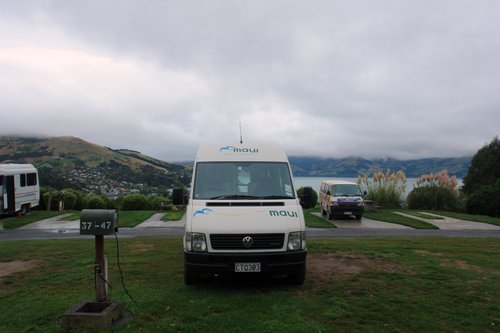 Gary Sauer-Thompson, Akaroa Holiday Park, New Zealand, 2008
It is raining, the mist hangs around the hills and it is very still. I am surrounded by my memories of childhood holidays in Akaroa.
in Christchurch
My old hometown is now the gateway to the wilderness of the South Island for international tourism. We international tourists are everywhere, and it is they who give the city (the CBD) its buzz. The backpackers were everywhere. The locals live in the suburbs and the city fathers have constructed the inner city as a garden city and the tourists are tempted to spend a day in the city, do some of the touristy things, and spend some money.
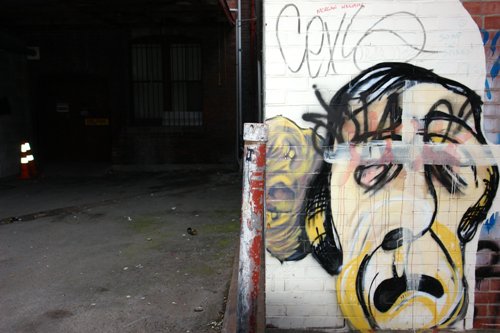 Gary Sauer-Thompson, street art, Lichfield St, Christchurch, New Zealand, 2008
We played the part. After checking into Warners Hotel we wandered the city, had a drink at What Bar in the So Hotel, explored the entertainment district around His Lordships Lane in Sol Square and dined at Annies in the old University of Canterbury in the city.
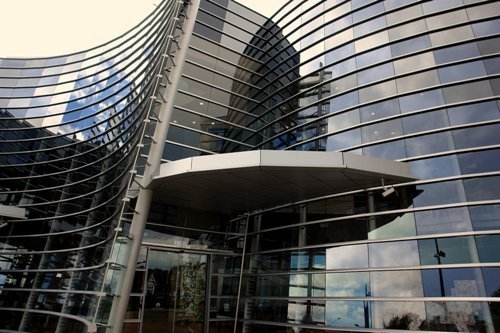 Gary Sauer-Thompson, Christchurch Art Gallery, Christchurch, 2008
Christchurch gives the appearance of being a cultural centre as well as being the gateway to the wilderness, but there was little evidence of a strong artistic culture in the galleries that I popped into. The real funkiness can be found at the port of Lyttleton:
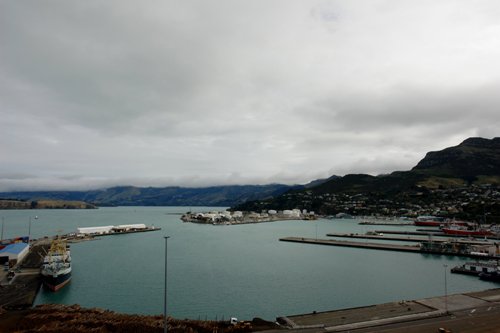
Gary Sauer-Thompson, Lyttelton, Christchurch, NZ, 2008
April 14, 2008
Hubble images
A lovely image from NASA's image of the day gallery; one that is taken by the Hubble telescope.
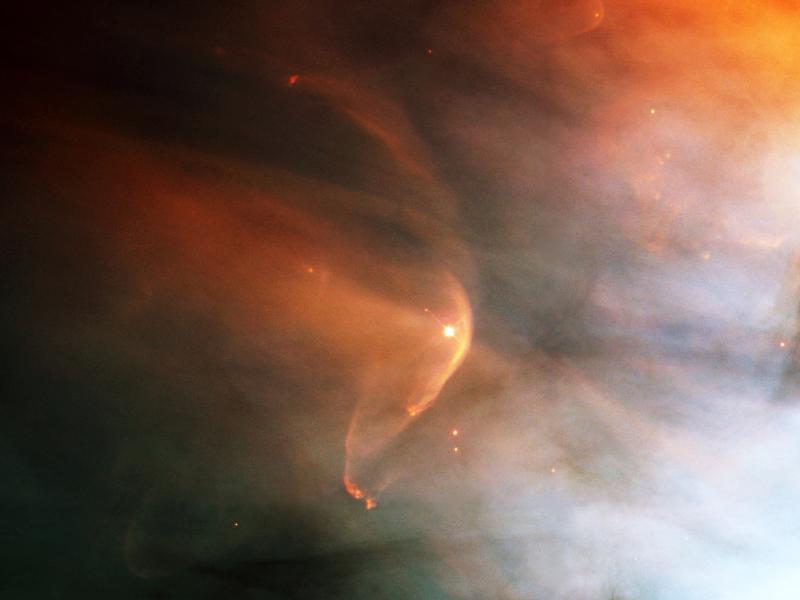 NASA, Bow Shock Near a Young Star, Great Nebula in Orion,
This is much better than the view from my hotel (Holiday Inn) room in Melbourne, which looks out onto the airport's long term carpark, or the view in Starbucks at Melbourne International airport.
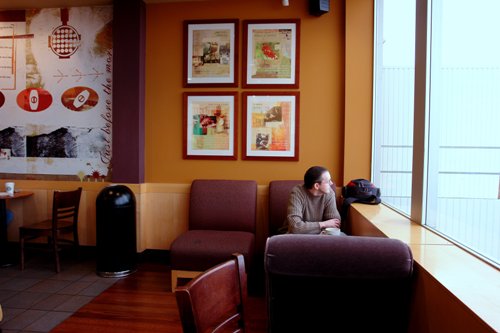 Gary Sauer-Thompson, Starbucks, Melbourne International Airport, 2008
Starbucks has such awful coffee.
April 13, 2008
roots + identity
I've been posting some old images of the River Murray on Flickr as I prepare to fly to New Zealand today via Melbourne. I'm not sure why I'm posting these images from the film archive ----maybe I'm expressing my Australian roots as a counterbalance to returning to my primeval Zealand roots in the South Island? Or is it to protect me from any desire to return home to New Zealand?
Identity is different from roots and in a market society the former is signified by style, fashion, taste and wealth, even when a tourist:
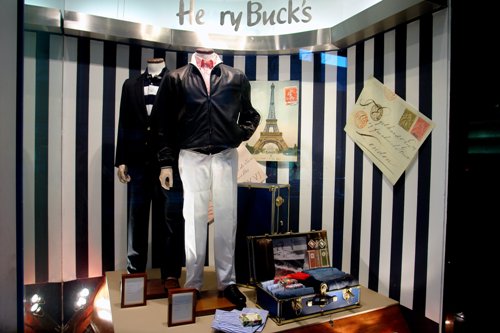 Gary Sauer-Thompson, mens fashion, Melbourne, 2007
Appearance--looking fashionable and stylish--is the identity of the fashion industry and its ethos of beauty is celebrated by the market. It is not the identity of a creator of images or a collector with an keen eye for urban archaeology and modernist art. From this perspective identity is less about about how we look, and more about the production of images, how good these are, and what they signify in our culture.
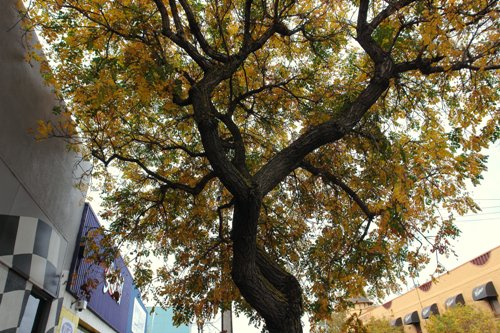
Identities come and go. We live with multiple identities as we now constantly reinvent ourselves in both work and leisure.
 Gary Sauer-thompson, Gilles Street, Adelaide CBD, 2008
One identity, for example, is that we could, as creators, are involved in a visual opening up to what lies around the everyday habitual world that we pass through and treat as a backdrop for the self's movements and experiences. Then we find that tourism has packaged what lies beyond the drab everyday with great and wonderful experiences that it sells to us at great expense.
April 12, 2008
John Ford: The Searchers
We watched John Ford's classic Stagecoach, the movie that put the western on the cinematic map.
I expected the gender stereotypes---men are men and women are (sexless) women--- and the representation of Native Americans as a kind of subhuman species, and the brightly colored black-and-white world, since this was a fil about 'the winning of the West'. I was a rather taken back by the comic set pieces, the trashy phoney dialogue, the rigid, one dimensional acting styles as well as the racism, Indian hating, violence and mawkish celebration of white settler society. This was undercut by the darkness and pathology of the character of the embittered Ethan Edwards, an ex-Confederate soldier who did not really belong anywhere in the post-Civil War era; and who, as a hero trapped in a monomaniacal quest for vengeance, is at odds with the society he is expected to protect:
I read this film about the society being forged, in violence, by the settlers as a pastiche---as fidgeted-together that is open to interpretation.
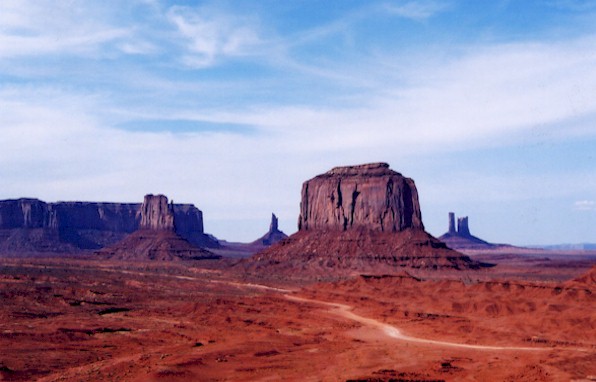
Aesthetically, The Searchers presents a vast, sophisticated panaroma of the American West - the imagery of buttes and spires of Monument Valley, Utah, with its rockscapes and sweeping vistas, that is often called mythic. This transcended the awkwardness and corniness of life in settler society
 Monument Valley, Utah
We have the hint of closing of the frontier, the establishment of order in wild places beyond the border of civilization, the heart of darkness on the other side of the border, American machismo and justice transforming into where vengeance.
 Monument Valley, Utah
The representation of the landscape and the people by Winton C. Hoch is where this film is visually masterful, especially the frame within the frame shots from a domestic space into the wilderness and barbarism. What is also masterful is the way that the triumph of settler civilization over barbarism is founded on a necessary lie, and that underneath its polished procedures, myths and high-minded institutions is the buried legacy and truth of violence and bloodshed.
Therein lies the core of the western---a man standing framed in a doorway, alone looking out at desolate expanse. The doorway is the line or border that separates the wilderness and the garden. Theboder signifies the cost of violence, which is the moment at which settler's society's foundations are laid over blood and sand.
April 11, 2008
Phobos: Stickney Crater
I'm off to NZ for two weeks holiday next week, exploring the South Island, starting on Monday from Christchurch my old home town. I've had a brief look at the internet access in this neck of the woods, and it looks as if I will have to rely on internet cafes.
So posting may be hit and miss. I may be constrained to down load more found images:
 Stickney crater, Phobos, Astronomy Picture of the Day
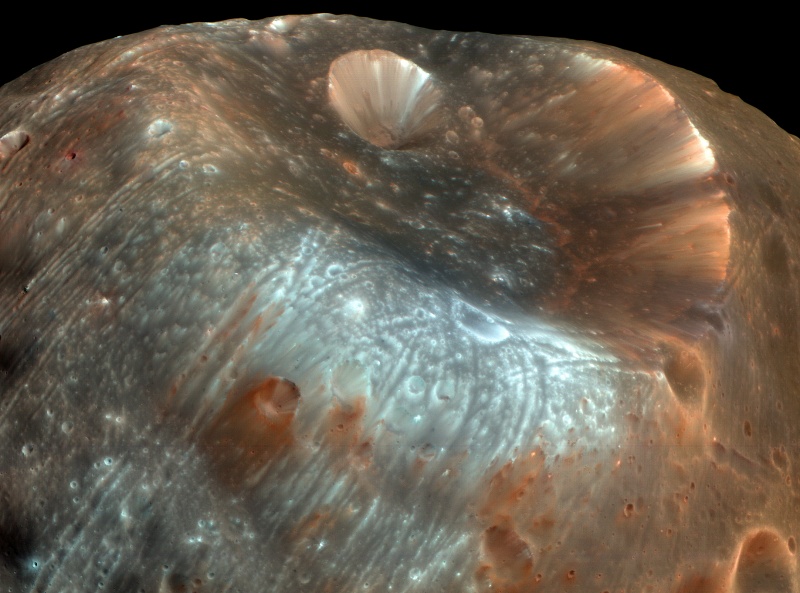
Phobos is one of the Martian moons and it appears from the photos taken by HiRISE camera aboard NASA's Mars Reconnaissance Orbiter, that the crater was created by an enormous impact. Phobos may well be an asteroid captured by the gravitational pull of Mars.
It's fly (from Melbourne) and drive in a high top with lots of wandering, starting from Banks Peninsula east of Christchurch then onto Canterbury region and the river country.
April 10, 2008
a dying Murray River
The Murray-Darling River system is dying from the mouth up. The southern lakes (Alexandrina and Albert) are drying up from lack of flow, and it is probably already too late to revive Lake Alexandrina at the mouth of the river.
There is now acidification on top of salinity, due to lack of flows. The oil in the lake is laced with sulphides that turn into sulphuric acid with prolonged contact with the air.The pH level of the lake, which measures the acid/alkaline balance, is already bad enough to make it toxic to animals.
 Gary Sauer-Thompson, Murray Mouth, 2006
Today, the danger is that without flushing as a result of heavy rains upstream, the combination of salt and acid will move upstream and progressively contaminate the lower Murray.
Kenneth Davidson in The Age says:
Murray Bridge, 38 kilometres from the mouth of the Murray, is only two metres above sea level at the mouth of the river — a drop of less than half a centimetre a kilometre — which means that the salt and acid can move relatively easily upstream. The lower Murray is more akin to a series of interconnected ponds rather than a free-flowing river.
It hasn't been a free flowing river for ages. Basin wide irrigation made sure of that. In all probability there will be a weir built at the top of Lake Alexandrina near Wellington and the lower lakes become seawater lakes.
April 8, 2008
Evening Rhythms
I had to put my car in for basic maintenance work last week. Since it has been rare that I have been able to get away from work while there has been daylight I quickly cut across town to try and get a strenuous hike in. Camelback has a very small carpark and I had to wait approximately ten minutes before I could park nearby. It was very orderly, cars waited in line until hikers came down and drove away.

The benefit of hiking the mountain in the evening was in catching the softer and deeper hues of the sunlight as it slowly crept down over the western ranges.
The result was a sandier orange rather than the strong red morning hues of the sun jumping over the eatern desert.

Quite pretty.
Astronomy picture of the day
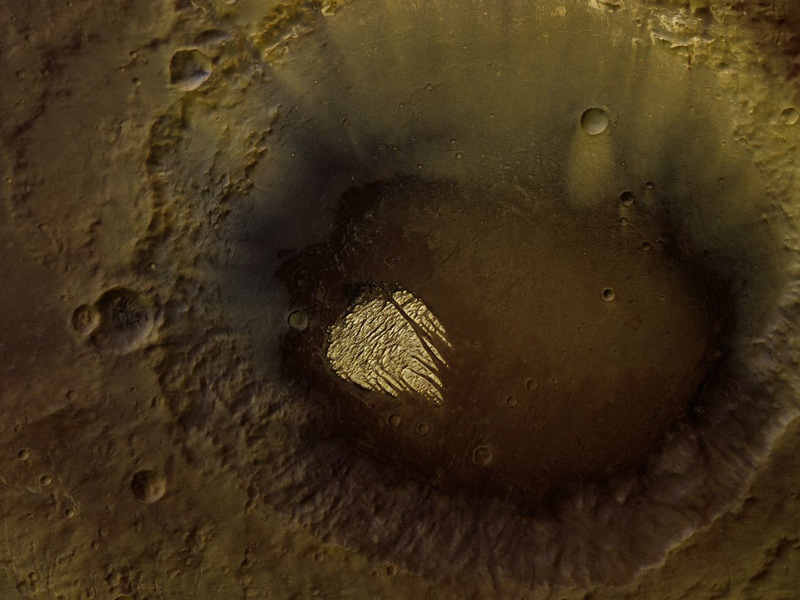
This picture was taken from the Mars Express spacecraft currently orbiting Mars.
 White rock, Mars, Astronomy Picture of the Day
It appears to be an erosion of the surface rock.
Modern Phoenix Home Walk
On the weekend I went to the Modern Phoenix Home Tour and Expo. This opened several houses through an older neighbourhood that had been built by the Schreiber brothers, Charles and Arthur as part of Phoenix's growth in the 50s and 60s. It celebrated the style and the doing over of these houses in a modern contemporary look.

Phoenix has a strong contemporary streak. I suspect it is because it is a cheap place to live relatively, many of the houses are old, and the neighbourhoods like Scottsdale are heavily gentrified. Consequently houses get made over and modernised in a very stylish manner. It makes Phoenix and Scottsdale appear very hip in a mini Los Angeles kind of way. It is very much a part of Phoenix's culture.
April 7, 2008
Samantha Hobson: indigenous art + abstract expressionism
Though indigenous people make up less than three percent of the population, their art in recent years reportedly accounts for about half of the total dollar value of all art sold in Australia. It has a high international profile, even if sales are slow for some regional art centres trying to crack the international art maket Indigenous artists are able to work as professional painters instead of sitting their local communities amongst the violence getting busted up.
An example is the work of Samantha Hobson. The image below is entitled 'Today Life' (2008, synthetic polymer paint , pigment and glaze on canvas) and it is from her 'Growing Up With Country exhibition at the Vivien Anderson Gallery in Melbourne:
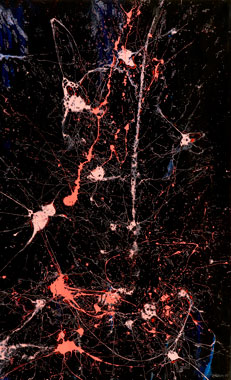 For a western audience this work's style resonates with the drip painting of Jackson Pollock. That is our immediate reference point. We automatically file it under abstract expressionism category, and accept the art history frame which states that Abstract art is an expansive term that is generally associated with all non-representational art.
In doing so, we tacilty locate it within the modernist movement of abstraction, whose origin lies with the diversw works of Wassily Kandinsky as an Expressionist artist, Pablo Picasso the cubist, and Kasmir Malevich a Russian Constructivist.
We understand that the style of this urban work is influenced, and being shaped by, by the international art market, even though we appreciate that it often expresses the beauty of life on the coast of the Great Barrier Reef and the blood, bruising and emotional distress realities of remote community life for Aboriginal people.
Painting, for professional artists such as Samantha Hobson, is their way of dealing with what goes wrong in a an indigenous community where unemployment and alcoholism have a death-grip on people’s hope for the future.
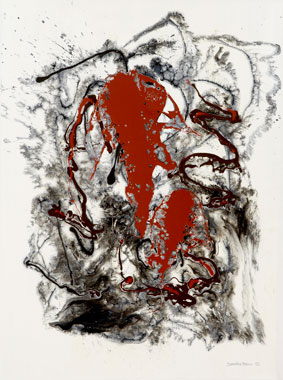 Samantha Hobson's Ol’man Hide 2008, (synthetic polymer paint, pigment and glaze on canvas) is another example of adopting formal considerations from a western perspective, coupled with a strong cultural and aesthetic connection with the land to evelove into a rich source of abstraction.
This indicates the possibility of a number of stylistic developments within the conventions of abstraction and it suggests that we should become critical of the way Aboriginal Art is marketed from the Western Art aesthetic to which is attached an Aboriginal 'Spirituality'. This selling of spirituality consigns the art to ethnography.
The ethnography refers to the stories previously only painted during rituals as sand mosaics or body art. Stories of a creation epoch they call the ‘Dreamtime’; stories that carried traditional laws, philosophies and desert survival skills—the cultural bloodline of the oldest society on earth.
It is more honest to interpret the work of professional indigenous painters, such as Samantha Hobson, as contemporary examples of abstract expressionism.
April 5, 2008
balcony views
These banksias grow on the balcony of the apartment in Adelaide. We are rather proud that these have grown so well in pots especially after the long hot summer that saw eucalypts in the parklands die.
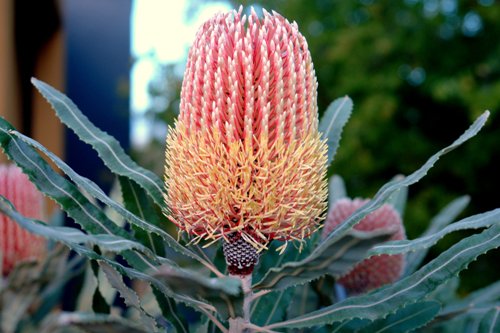 Gary Sauer-Thompson, banksia, Sturt Street apartment, Adelaide, CBD
I'd been down at Victor Harbor setting up the new modem, a repaired computer and the Lacie Big Disc as a backup for my photographs to turn it into a working digital studio. I had returned to Adelaide just as the sun's late afternoon/early evening light was lighting up the tops of the street trees around the apartment.
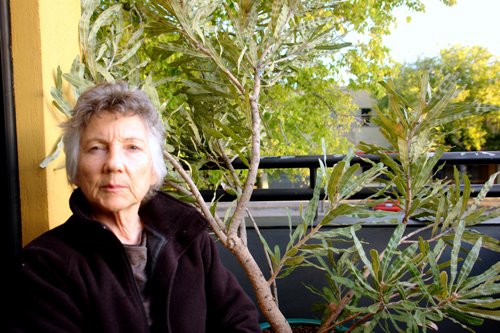 Gary Sauer-Thompson, Suzanne, Sturt Street, 2008
The leaves of the English street trees are beginning to turn. Even if there is no rain it is definitely autumn in Adelaide. The days are cooler and shorter. Darkness falls quickly.
April 4, 2008
poodlying
I decided to take a camera with me today when I walked the dogs in the southern parklands.They like hanging around the trees checking out the possums. Instead of trying to get them to move on with little effect I decided to hang around as well checking out the photographic possibilities. They ended up waiting for me.
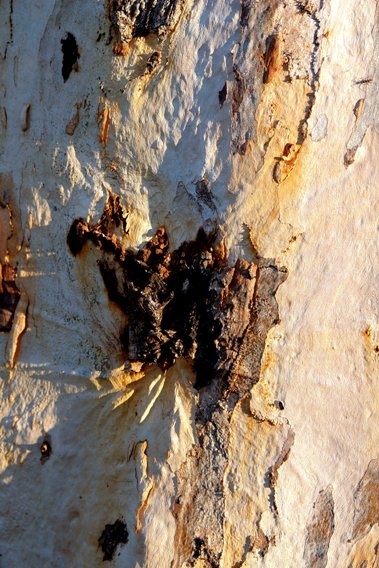 Gary Sauer-Thompson, tree trunk, Salmon gum Adelaide parklands, 2008
The bark was falling off the trees and so I had a lovely time looking at the abstractions. Some of them were quite minimalist since most of the bark was already on the ground.
April 3, 2008
Andreas Gursky: photographing the sublime
It's the inhumanity isn't it that suggests the sublime. We interpret the people as tiny and akin to making their presence felt in the world, like a minute, leisurely colony of ants. Is this not a landmark of a global economy and does not this work constitute a map of the postmodern civilized world?
 Andreas Gursky, Copan, 2002, Chromogenic print
We sense that we can be swept away by the powerful and destructive flows of global finance and we feel helpless and full of despair. What will happen to us, we ask? Will we lose our homes? Our jobs? How will this destructive force impact on our lives? We sense the awesomeness of the global economy, dread the worst and struggle with the overwhelming feelings of being terrified.
 Andreas Gursky, "Atlanta", 1996,
These images cause us to have an uneasy, anxious feeling and we shift to a sense of dread that makes us very uncomfortable. We feel that human beings are inconsequential before the dynamic flows of the global economy.
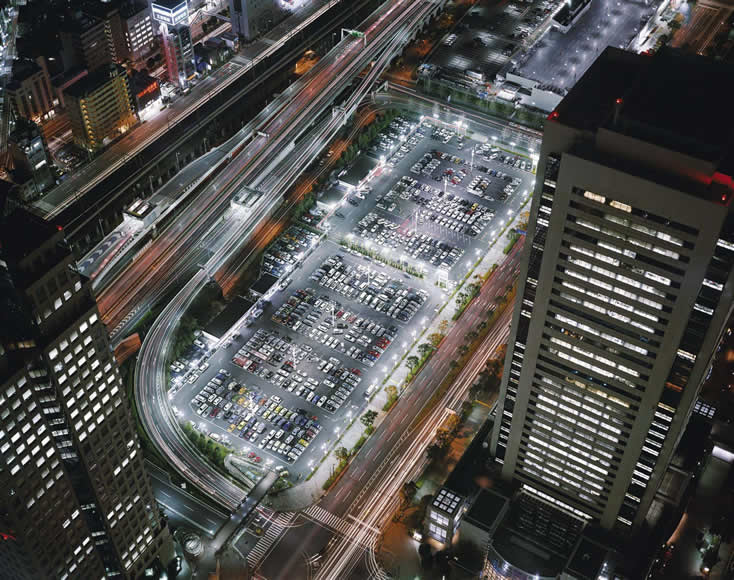 Andreas Gursky, Spectacular City, Düsseldorf, 2007
This work evokes the sublime in urban phenomena---in the connections that constitute globalization in the form of computer networks, international exchanges, trade relations, architecture.
April 2, 2008
Fiona Omeenyo + Silas Hobson
In an earlier post I argued that the Lockhart River Gang is developing its own mode of expression that is different from the art of central Australia and other parts of Australia. In another post I explored the way that some of Fiona Omeenyo's work can be interpreted in terms of hauntology and that it has a critical edge.
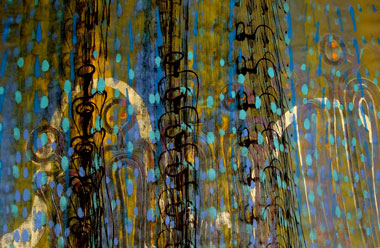 Fiona Omeenyo, Sunlight Coming Through 2008, synthetic polymer paint on canvas
Five of the Art Gang members----Rosella Namok, Samantha Hobson, Fiona Omeenyo, Adrian King and Silas Hobson--- have gone on to develop solo careers whilst developing their regional patterning and colour in terms of their own concerns and issues. Omeenyo's images are interpretations of generational links and traditional stories and her work indicates how this art is both contemporary and Aboriginal.
It was a model of education that was designed to provide training for employment to the youth and a basis for economic development in Lockhart River. The story here is a model of education that appears to have succeeded in melding generations, locating strength in tradition, and moving towards an integration with the larger Australian economy.
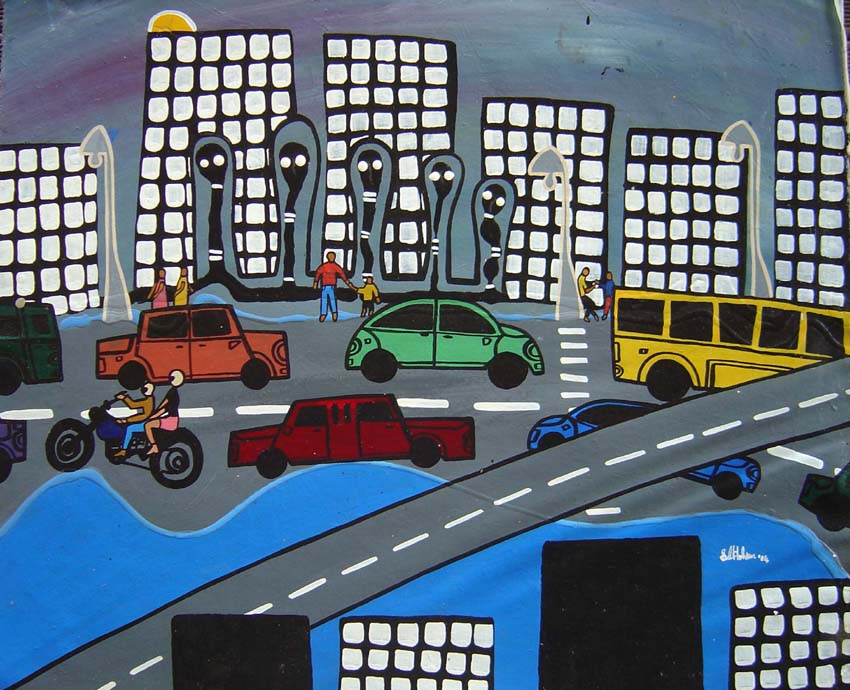 Silas Hobson, Awu's in the city
We are presented with stories about place ---an exploring of aspects ofeveryday life, including family relationships and country, and details the current situation of the local community.
April 1, 2008
killer storm = romantic sublime
It looks as if the rains will finally arrive in South Australia. They will accompany a southerly change from the west and, finally, we will have cool autumn temperatures. Not that the rains will be much. Strong winds and showers are what is expected to arrive during the night. The showers will only wet the dry, cracked ground. We need it to rain steadily for several day at the very least. That is not forecasted.
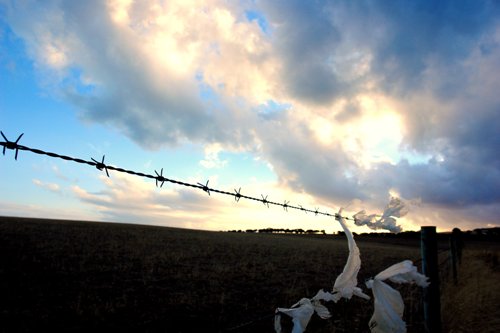 Gary Sauer-Thompson, barbed wire + storm clouds, Fleurieu Peninsula, 2008
The cold front did arrive in South Australia from the south west. About 10,000 homes In SA were left without power as winds reached 90kmh in areas stretching from Goolwa, south of Adelaide, to Kapunda, north of Adelaide. There were wind gusts of up to 137km/h at Cape Willoughby on Kangaroo Island whilst dust storms swept through the Mallee and Riverland. There was little rain though as the winds were dry. It is rain we need.
The wild weather--the killer storm of the media --can be understood as a quite dark, powerful,violent, and ugly force of nature. Is this not the tabloid's 'killer storm' another name for the romantic sublime? Does this not indicate that the sublime is related to the sense of tragedy?
We think of painting and the sublime --an example--but not photography and the sublime. Yet photography is a pictorial or visual language.