|
April 29, 2008
Rita Angas's Cass is one of New Zealand's most popular paintings. The regional realist school was concerned with the physical appearance of the Canterbury landscape and seeking identification with it. Weathered wood and decayed churches, pine trees and dry-as-dust grass, have appeared time and time again in the work of these painters.
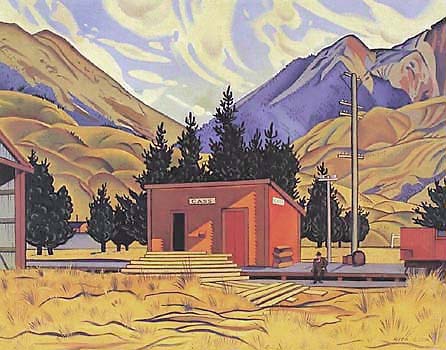 Rita Angas, Cass, 1936, Oil on Canvas
The work represents the railway station of a tiny rural community in Canterbury nestled in front of bare hills and mountains. The small figure of the waiting man emphases the isolation and remoteness of the area.
We are a long way from the ruined urban world of European modernity ---the industrial ruin, the defunct image of future leisure (the vacant mall or abandoned cinema), or the specter of war —that signify a ruin of the future. There the frisson of decay, distance, destruction represents a melancholy world.
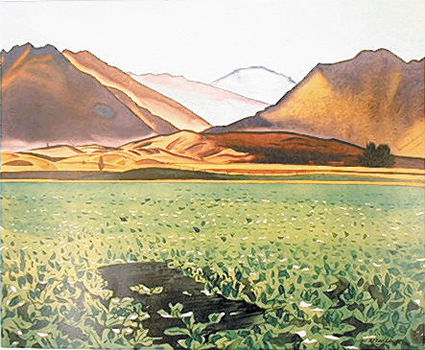 Rita Angas, Wanaka Landscape, 1939, watercolour
A dichotomy still exists the regional landscape tradition constitutes accessible "low" art while non-objective or abstract modernist painting is seen as difficult "high" art.
|


Interesting style this Rita Angas- a bit reminiscent of Howard Arkley. I've been trying to process some photos after the style of Arkley's suburban paintings recently. Hadn't seen Angas before, even though I was born a Kiwi- haven't really explored their art.