|
April 29, 2008
As we have seen the NZ work by Von Guerard informs, and is a part of, the NZ landscape tradition. It can be referenced back to the Hudson River School in the US.
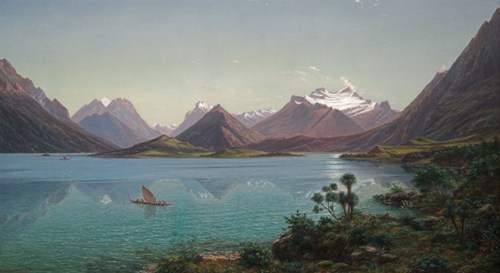 Eugene Von Guerard, Lake Wakitipu with Mount Earnslaw, Middle Island, New Zealand 1877-1879, Oil on Canvas
This romanticism was pushed into the background by the landscape painting of the 1930s and 1940s which centres on a group of realist painters based in the South Island city of Christchurch. One of these is Rita Angus, who was concerned to to create a distinctly New Zealand art and whose work was informed by the American regionalist movement.
The debate over Modernism/regionalism was really a conflict over who would define New Zealand art. The conservative critics who promoted Regionalism often did so as they saw it both as a bulwark and a way to defeat the influence of abstraction arriving from Europe.
I've introduced von Guerard's New Zealand work because the romantic sublime has been lost to contemporary wilderness photographers, who are struggling to free themselves from the the conservationist idea of the photo as illustration within scientific knowledge of the earth and botanical sciences. In reaction they make the turn to what they call art photography (good form) to aesthetics, and to poetry, imagination, the transcendental, heightened spiritual feelings and the mood of a place. In doing so they (eg.,Craig Potton and Andy Dennis' 'Images from a Limestone Landscape') more often than not, tacitly embrace the picturesque, or modernist abstraction. For them 'aesthetics 'stands for beauty (of the wilderness), rather than the philosophical concepts we use to talk about art works whilst the imagination colors nature.
What is being invoked in the reference to darkness, storms, craggy rocks, ragged precipices is the Romantic tradition, with its ethos of freedom, rebelliousness, individualism, irrationality, spontaneity, primitivism, nature-worship, and its conception of the artist as an outsider, a lonely genius, a man of destiny, who listens only to his own inner voice and is constantly in opposition to a society which resents him.
|


